Do you find yourself typing “also” repeatedly in emails, essays, or social media posts? You are not alone. Many writers, students, and professionals struggle with overusing this common word. Repeating the same transition word can make your writing feel flat and uninspired.
The good news is that English offers many rich alternatives. Learning the right synonyms of also will transform your writing from repetitive to remarkable. This guide will help you choose the perfect word for every situation.
What Does “Also” Mean?
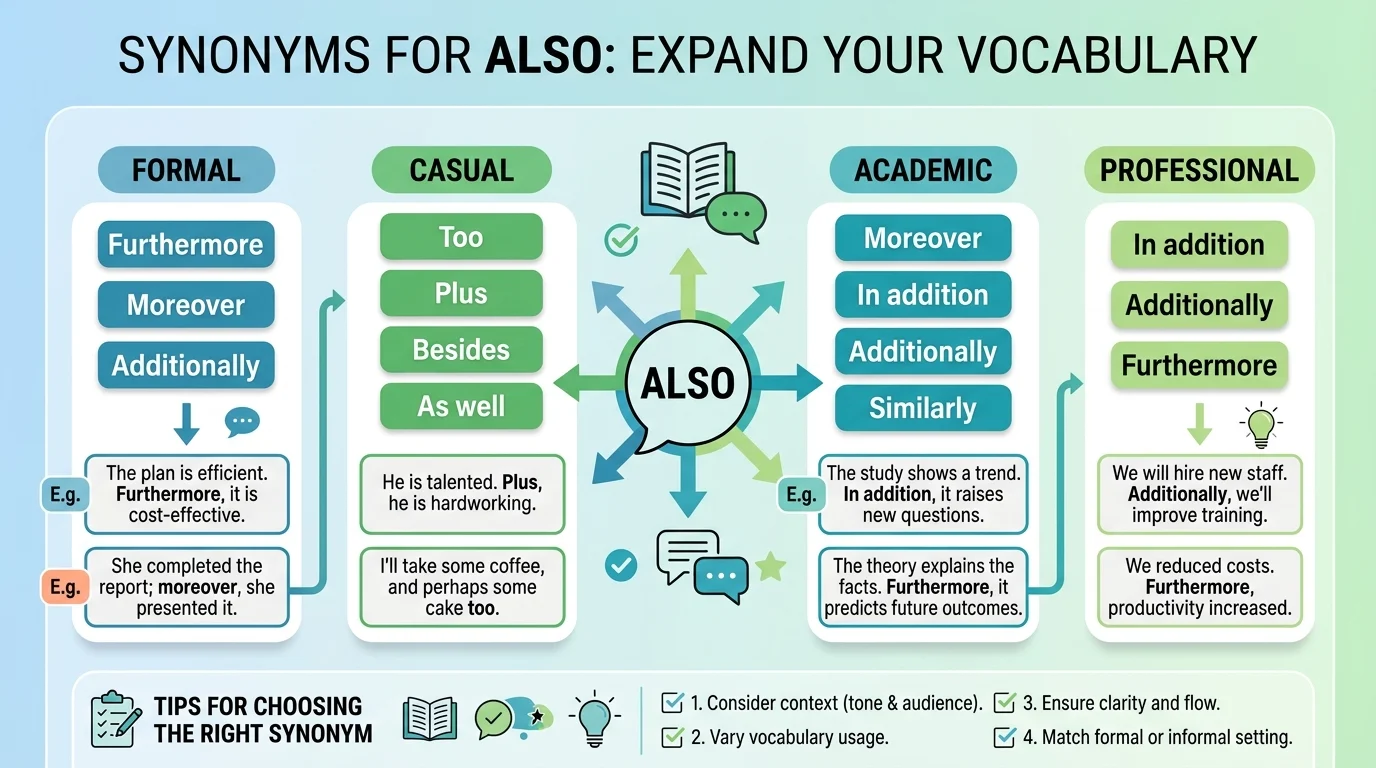
Also is an adverb that means in addition or too. It connects related ideas and shows that something extra is being included. The best synonyms of also depend on your context. formal writing, use additionally or furthermore. For casual conversation, try too or as well. For professional communication, consider moreover or in addition. emotional emphasis, use even or besides.
Meaning, Tone and Context
Simple Definition
Also means in addition to what has already been mentioned. It signals that you are adding another point, item, or idea to the conversation.
Part of Speech
Also is an adverb. It modifies verbs, adjectives, or other adverbs to show inclusion.
Tone
Also has a neutral tone. It does not carry strong positive or negative feelings. This makes it safe for almost any situation. However, its neutrality also makes it forgettable when overused.
Formality Level
Also works at every formality level. You can use it in casual texts and formal reports. This flexibility explains why so many people rely on it so heavily.
Common Use Cases
People use also to connect thoughts, add examples, and build arguments. It appears frequently in academic papers, business emails, news articles, and everyday conversations.
Important Word Forms
The word also does not have common variations. Related forms include the conjunctive “and” and the prefix “extra.” The opposite of also is “only” or “solely.”
When and How to Use “Also”
Understanding when to use also helps you decide when to replace it. Use also when you want to add information that supports or extends your main point. Avoid using also more than once in the same sentence or paragraph. Here are examples showing proper usage across different contexts.
Professional Context
We reviewed the quarterly budget. Also, we need to finalize the marketing plan before the board meeting.
Academic Context
The study found significant results. Also, the researchers noted several limitations in their methodology.
Personal Context
I love hiking in the mountains. Also, I enjoy swimming in the lake during summer weekends.
Emotional Context
She was heartbroken by the news. Also, she felt angry about being misled for so many years.
Creative Context
The forest whispered ancient secrets. Also, the river carried stories from distant lands.
Social Media Context
Just finished my morning run. Also, I made a healthy smoothie to start the day right.
Email Context
Thank you for your prompt response. Also, I have attached the updated contract for your review.
Resume Context
Managed a team of fifteen employees. Also, I implemented new training procedures that increased productivity.
Another Word for “Also”
Choosing the right synonym depends on your purpose and audience. Each alternative carries a slightly different shade of meaning. Here are specific recommendations for different writing situations.
Professional Writing
Use “additionally” or “moreover.” These words sound sophisticated and precise. They work well in reports, proposals, and formal correspondence.
Academic Writing
Use “furthermore” or “in addition.” These terms demonstrate logical progression. They help structure arguments clearly in research papers and essays.
Casual Conversation
Use “too” or “as well.” These options feel natural and friendly. They fit perfectly in everyday speech and informal messages.
Emotional Writing
Use “even” or “besides.” These words add intensity and feeling. They work well in personal narratives and persuasive pieces.
Creative Writing
Use “likewise” or “similarly.” These synonyms create rhythm and flow. They add variety to descriptive and narrative prose.
Resume Writing
Use “in addition” or “along with.” These phrases highlight multiple accomplishments. They make your qualifications stand out to employers.
Social Media Captions
Use “plus” or “also.” Short and direct options work best. They keep captions engaging and easy to read.
Stronger Meaning
Use “what is more” or “indeed.” These phrases emphasize importance. They draw attention to particularly significant points.
Softer Meaning
Use “as well” or “too.” These options feel gentle and subtle. They add information without demanding attention.
When Not to Use “Also”
Using also too frequently makes your writing sound monotonous. It can also make your sentences feel choppy and disconnected. Sometimes, also is simply the wrong choice because it weakens your message.
When also sounds too vague
Consider this sentence: The product is affordable. Also, it is durable.
The word also fails to show how affordability and durability connect. A better option: The product is not only affordable but also remarkably durable.
When also sounds too casual
Formal reports require precise language. Using also repeatedly reduces your credibility. Replace it with additional to sound more authoritative.
When also sounds too weak
Compare these two sentences:
Original: The research was groundbreaking. Also, it challenged established theories.
Improved: The research was groundbreaking. Moreover, it fundamentally challenged established theories.
When a different word adds more clarity
Sometimes, transitional words like “consequently” or “therefore” work better. They show cause and effect rather than simple addition. Consider your logical relationship before defaulting to also.
Words Commonly Confused With “Also”
Many words appear similar to also but serve different purposes. Understanding these distinctions will improve your word choice dramatically.
Also versus Too
The main difference lies in sentence position. Also typically appears before the verb or at the beginning of a clause. Too usually appears at the end of a clause. Example: I also want to attend. I want to attend too.
Also versus As Well
As well functions similarly to too but sounds slightly more formal. It always appears at the end of a sentence. Example: She brought dessert as well. Also works in more positions within a sentence.
Also versus Additionally
Additionally sounds more formal and academic than also. It often introduces a new paragraph or major point. Also works better for adding minor details within sentences.
Also versus Furthermore
Furthermore signals a stronger logical connection. It suggests that the new point builds on previous information. Also simply indicates addition without implying progression.
Also versus Likewise
Likewise means similarly or in the same way. It compares two things that share characteristics. Also just shows inclusion without comparison.
Also versus Besides
Besides often introduces an exception or additional consideration. It can mean in addition to or apart from. Also does not carry this exception meaning.
Best Synonym by Context for “Also”
| Context | Best Synonym | Why It Works | Example |
|---|---|---|---|
| Formal Writing | Additionally | Adds professionalism and clarity | The committee approved the budget. Additionally, they endorsed the new strategic plan. |
| Academic Writing | Furthermore | Shows logical progression of ideas | The data supports the hypothesis. Furthermore, the results align with previous research. |
| Professional Business | Moreover | Conveys authority and confidence | Our revenue increased substantially. Moreover, our market share expanded significantly. |
| Resume Writing | In Addition | Highlights multiple achievements clearly | Led product development. In addition, I managed cross functional teams effectively. |
| Casual Conversation | Too | Sounds natural and friendly | I am coming to the party too. |
| Creative Writing | Likewise | Creates rhythm and literary flow | The wind whispered through the pines. Likewise, the river murmured softly. |
| Emotional Tone | Even | Adds intensity and surprise | He apologized sincerely. Even more, he made meaningful changes. |
| Strong Intensity | What is More | Emphasizes crucial additional points | She excelled in academics. What is more, she contributed to community service. |
| Soft Moderation | As Well | Feels subtle and understated | We visited the museum as well. |
| Social Media Captions | Plus | Short and engaging for digital content | Great coffee. Plus, amazing views. |
| US Usage | Also | Standard across all American English contexts | We went to the movies also. |
| UK Usage | As Well | More common in British English patterns | We went to the cinema as well. |
Which Synonym Should You Choose?
Choosing the right synonym requires thinking about your audience, purpose, and message. Start by identifying your context. Are you writing a formal business report or a casual text message? Your formality level determines your options.
Consider the emotional impact you want to create. Do you want to emphasize importance or simply add information? Stronger words like “moreover” and “furthermore” command attention. Softer words like “too” and “as well” blend in smoothly.
Think about sentence flow and rhythm. Some words sound better in certain positions. “Additionally” works well at the start of sentences. “As well” and “too” typically appear at the end. Experiment with different positions to find the most natural option.
Evaluate the logical relationship between your ideas. Are you simply adding information, or are you building an argument? “Furthermore” suggests progression. “Moreover” implies importance. “Likewise” indicates similarity. Choose the word that best reflects your intended meaning.
Finally, read your sentence aloud. The right synonym should sound natural and enhance your message. If it feels awkward or forced, try a different option. Trust your ear and your understanding of your audience.
Real Life Examples of “Also” in Sentences
These examples show how also and its synonyms appear in everyday situations. Each example demonstrates appropriate usage for different contexts.
School Context
The teacher assigned reading homework. Additionally, she requested that students prepare discussion questions for the next class.
Workplace Context
Our department exceeded its sales targets. Moreover, we received excellent feedback from our clients about the new service offerings.
Writing Context
The novel explores themes of identity and belonging. Furthermore, it examines the role of memory in shaping personal narratives.
Conversation Context
I am planning to attend the conference. Several of my colleagues are going as well.
Social Media Context
Beautiful sunset tonight. Plus, perfect weather for evening photos.
Resume Context
Increased sales by thirty percent. In addition, I developed training materials that improved team performance.
Email Context
Please review the attached proposal. Also, I have included a timeline for the implementation phase.
Storytelling Context
The detective studied the crime scene carefully. Likewise, she interviewed every witness to gather additional information.
15 Synonyms for “Also”
| Synonym | Simple Meaning | Best Used For | Example Sentence |
|---|---|---|---|
| Additionally | In addition to what was mentioned | Formal and professional writing | The candidate has excellent qualifications. Additionally, she has ten years of relevant experience. |
| Furthermore | In addition to and building upon | Academic and persuasive writing | The argument is logically sound. Furthermore, it is supported by extensive evidence. |
| Moreover | In addition to what is important | Professional and business communication | Our team delivered outstanding results. Moreover, we completed the project ahead of schedule. |
| In Addition | As an extra item or point | Resumes, reports, and clear announcements | The package includes free shipping. In addition, you receive a thirty day money back guarantee. |
| Too | In addition or also | Casual conversation and informal writing | I would like to visit that museum too. |
| As Well | In addition to | Everyday speech and simple writing | She ordered pasta as well. |
| Plus | With the addition of | Social media and casual communication | The room is spacious. Plus, it has a great view. |
| Likewise | Similarly or in the same way | Creative and comparative writing | The first chapter introduces the setting. Likewise, the second chapter develops the characters. |
| Further | To a greater extent or additionally | Academic and technical writing | The study examined the primary data. Further analysis revealed unexpected patterns. |
| Along With | Together with or in addition to | Lists and descriptive writing | We received support from our partners along with contributions from local businesses. |
| Besides | In addition to or apart from | Conversational and persuasive contexts | Besides the financial benefits, the project offers valuable learning opportunities. |
| What Is More | More importantly or additionally | Emphatic and persuasive communication | The product is affordable. What is more, it is environmentally sustainable. |
| And | Used to connect ideas | All contexts when linking two items | The presentation was informative and engaging. |
| Also | In addition | General use across all contexts | We need to order supplies also. |
| Not To Mention | Used to add emphasis | Conversational and informal writing | The restaurant has excellent food, not to mention the beautiful decor. |
Synonym Groups and Usage Differences
Professional vs. Personal Synonyms
Professional contexts demand precision and authority. Words like “additionally” and “moreover” project competence and credibility. They work well in business reports, client communications, and formal proposals. Personal contexts allow for warmth and familiarity. Words like “too” and “as well” feel approachable and genuine. They are perfect for emails to friends, family conversations, and personal notes.
Formal vs. Conversational Synonyms
Formal writing requires elevated vocabulary. Use “furthermore,” “in addition,” and “additionally” in reports, essays, and official documents. These words demonstrate careful thought and serious purpose. Conversational writing benefits from simpler options. “Too,” “plus,” and “as well” sound natural in texts, social media, and casual emails. They help you connect with readers without sounding stiff or pretentious.
Academic Synonyms
Academic writing values precision and logical progression. “Furthermore” shows that new information builds on previous points. “Additionally” introduces supporting evidence clearly. “Moreover” emphasizes the importance of added information. These words help structure arguments and guide readers through complex reasoning. They signal that you are developing ideas carefully and systematically.
Professional and Business Synonyms
Business communication requires clarity and confidence. “Additionally” works for routine additions. “Moreover” adds weight to important points. “In addition” introduces extra items in lists and reports. These words help you sound authoritative while remaining accessible. They show that you are organized and thoughtful in your communication.
Creative or Literary Synonyms
Creative writing benefits from variety and rhythm. “Likewise” creates parallel structures that please the ear. “Similarly” draws meaningful comparisons between ideas. “Further” can add a poetic sense of exploration. These synonyms help you avoid repetition while maintaining your artistic voice. They contribute to the overall beauty and flow of your writing.
Slang or Modern Synonyms
Modern communication evolves constantly. “Plus” has become widely accepted in social media and casual writing. It feels current and engaging. “Also” itself works well in digital contexts. Avoid using highly informal alternatives like “and also” in professional settings. Know your audience and platform before choosing modern or slang options.
Strongest vs. Weaker Synonyms
The intensity scale ranges from mild to emphatic. Weakest options include “too” and “as well.” They add information subtly. Moderate options include “additionally” and “in addition.” They add information clearly. Strongest options include “moreover” and “what is more.” They demand attention and emphasize importance. Choose your intensity based on how much emphasis you want to create.
Emotional vs. Neutral Synonyms
Emotional synonyms add feeling and impact. “Even” suggests surprise or intensity. “What is more” creates excitement and emphasis. These words engage readers emotionally and strengthen persuasive writing. Neutral synonyms simply add information without emotional weight. “Additionally” and “furthermore” stay objective and factual. Use emotional options when you want to connect with readers on a deeper level.
Antonyms of “Also”
| Antonym | Meaning | Example Sentence |
|---|---|---|
| Only | Exclusively or solely | She invited only her closest friends to the dinner. |
| Solely | Exclusively or entirely | The decision rests solely with the committee. |
| Exclusively | Limited to one thing | The offer is available exclusively for members. |
| Merely | Just or only | He was merely a spectator in the discussion. |
| Just | Only or simply | I wanted just a small piece of cake. |
| Simply | Merely or only | She simply wanted to help the community. |
| But | Except or apart from | Everyone attended but Sarah. |
| Except | Excluding or apart from | All stores will close except the pharmacy. |
| Aside From | Excluding or apart from | Aside from the cost, the project is perfect. |
| Apart From | Other than or excluding | Apart from the weather, everything went well. |
| Barring | Except if or unless | Barring any emergencies, we will finish on time. |
| Excluding | Not including | The total cost excluding taxes is five hundred dollars. |
| Without | Lacking or not having | We completed the project without any problems. |
| Not Including | Leaving out | The price includes dinner not including drinks. |
| Other Than | Apart from or except | Other than that, I have no complaints. |
Comparison: Also vs. Similar Words
Also vs. Too
The main difference is sentence position. Also appears before the main verb or at the start of a clause. Example: I also enjoy reading. Too appears at the end of a clause. Example: I enjoy reading too. Also sounds slightly more formal than too. Too feels more conversational. Both words mean in addition.
Example with also: She also decided to join the team.
Example with too: She decided to join the team too.
Also vs. As Well
As well always appears at the end of a sentence or clause. Also can appear in multiple positions. As well sounds slightly more formal than too but less formal than also. It is common in British English. Also remains standard across all varieties of English.
Example with also: I also plan to attend the meeting.
Example with as well: I plan to attend the meeting as well.
Also vs. Additionally
Additionally is more formal than also. It often starts a new sentence or independent clause. Also works within sentences more flexibly. Additionally signals that you are introducing a separate point. Also can add minor details without emphasis. Choose additionally for formal writing and clear transitions.
Example with also: We need to hire staff. We also need training.
Example with additionally: We need to hire staff. Additionally, we need to provide comprehensive training.
Also vs. Furthermore
Furthermore suggests that new information builds on previous points. Also simply indicates addition. Furthermore implies progression and development. Also does not imply a logical relationship. Use furthermore when you are developing an argument or advancing a thesis.
Example with also: The research is valid. Also, it is relevant.
Example with furthermore: The research is valid. Furthermore, it directly addresses current challenges.
Also vs. Moreover
Moreover adds weight and emphasis to new information. It suggests that the additional point is particularly important. Also adds information neutrally. Moreover calls attention to significance. Use moreover when you want to highlight crucial supporting evidence.
Example with also: The candidate has experience. Also, she has strong references.
Example with moreover: The candidate has experience. Moreover, she has an exceptional track record of success.
Also vs. Likewise
Likewise means similarly or in the same way. It draws comparisons between parallel situations. Also just shows inclusion. Likewise suggests equivalence or similarity. Also does not make comparisons. Use likewise when you want to show that two things are alike.
Example with also: She enjoys cooking. Also, she likes baking.
Example with likewise: She enjoys cooking. Likewise, she finds baking equally rewarding.
Common Phrases and Expressions with “Also”
1. “Not Only … But Also”
Meaning: This construction emphasizes two connected ideas, with the second being more significant.
Example sentence: The new policy not only improves efficiency but also boosts employee morale significantly.
2. “Also Known As”
Meaning: This phrase introduces an alternative name or alias for something.
Example sentence: The rare gemstone, also known as the Star of India, is housed in a museum.
3. “And Also”
Meaning: This adds an additional item or point, though sometimes it is redundant.
Example sentence: We need to schedule the meeting and also prepare the agenda.
4. “Also Ran”
Meaning: This refers to someone who competed but did not win.
Example sentence: The candidate was an also ran in the election, failing to secure enough votes.
5. “Also In Attendance”
Meaning: This indicates that someone else was present at an event.
Example sentence: The CEO was present at the conference, also in attendance were several board members.
6. “Also Included”
Meaning: This adds items that are part of a package or group.
Example sentence: The vacation package includes airfare and hotels. Also included are daily meals and tours.
7. “Also Available”
Meaning: This indicates that something additional can be obtained.
Example sentence: The book is available in hardcover. Also available is an electronic version.
8. “Also Worth Mentioning”
Meaning: This introduces another important point worthy of attention.
Example sentence: The project was completed on time. Also worth mentioning is the exceptional quality of the work.
Common Mistakes to Avoid
Mistake 1: Overusing also in a single paragraph
Repeating also makes your writing dull and repetitive. Replace some instances with synonyms. Use “additionally,” “furthermore,” or “moreover” to add variety and maintain reader interest.
Mistake 2: Using also when a stronger word is needed
Also can sound weak when you want to emphasize importance. Use “moreover” or “what is more” to highlight significant points. These words command attention and convey authority.
Mistake 3: Confusing also with similarly
Also adds information. Similarly draws comparisons. Use also for simple addition. Use similarly for parallel situations. Misusing these words confuses your readers.
Mistake 4: Using casual synonyms in formal writing
“Plus” and “as well” may not suit formal contexts. Choose “additionally” and “furthermore” for professional documents. Match your vocabulary to your audience and purpose.
Mistake 5: Using overly dramatic synonyms for simple situations
“What is more” and “moreover” create emphasis. Reserve them for truly important points. Using them too often dilutes their impact and sounds exaggerated.
Mistake 6: Repeating the same synonym without variety
Variation keeps writing fresh and engaging. Use different synonyms throughout your text. This shows vocabulary range and holds reader attention.
Mistake 7: Choosing synonyms with wrong emotional tone
Some synonyms add intensity. Others stay neutral. Match your word choice to your intended emotional impact. Wrong emotional tone can undermine your message.
FAQs
What is the best synonym for “also”?
The best synonym for also depends on your context. formal writing, use additionally. For casual conversation, use too. For academic writing, use furthermore. business communication, use moreover.
What is a formal synonym for “also”?
Formal synonyms for also include additionally, furthermore, moreover, and in addition. These words work well in reports, academic papers, and professional correspondence where precision and authority matter.
What is an informal synonym for “also”?
Informal synonyms for also include too, as well, and plus. These words fit naturally in casual conversations, text messages, social media posts, and friendly emails where a relaxed tone is appropriate.
What is another word for “also” in professional writing?
In professional writing, use “additionally” or “moreover” as alternatives to also. These words project confidence and competence. They help you sound authoritative and well organized in business documents.
What is the difference between “also” and “too”?
The main difference is position in the sentence. Also appears before the verb or at the start of a clause. Example: I also want to go. Too appears at the end of a clause. Example: I want to go too.
What is the opposite of “also”?
The opposite of also includes words like “only,” “solely,” and “exclusively.” These words indicate limitation or exclusion rather than addition. They signal that something is singular or restricted.
Conclusion
Also remains one of the most useful words in English. It helps you add information and connect ideas across all contexts. However, relying on this single word limits your writing potential. Expanding your vocabulary with synonyms will make your communication more engaging and effective. Remember that context matters when choosing alternatives. Formal writing requires precise words like “additionally” and “furthermore.” Casual settings welcome simpler options like “too” and “as well.” The key is matching your word choice to your audience and purpose. Start practicing these synonyms today. Your readers will notice the difference, and your writing will become more dynamic and persuasive.