Do you find yourself reaching for the word “dumb” when you want to criticize an idea, a decision, or even yourself? You are not alone. Many writers and speakers rely on this single term, but it rarely captures the real nuance of what you mean.
Worse, using “dumb” can offend people, minimize complex issues, or make you sound unprofessional. Whether you are writing an email, a report, a social media caption, or a personal note, choosing a more precise and respectful synonym will improve your communication and your credibility.
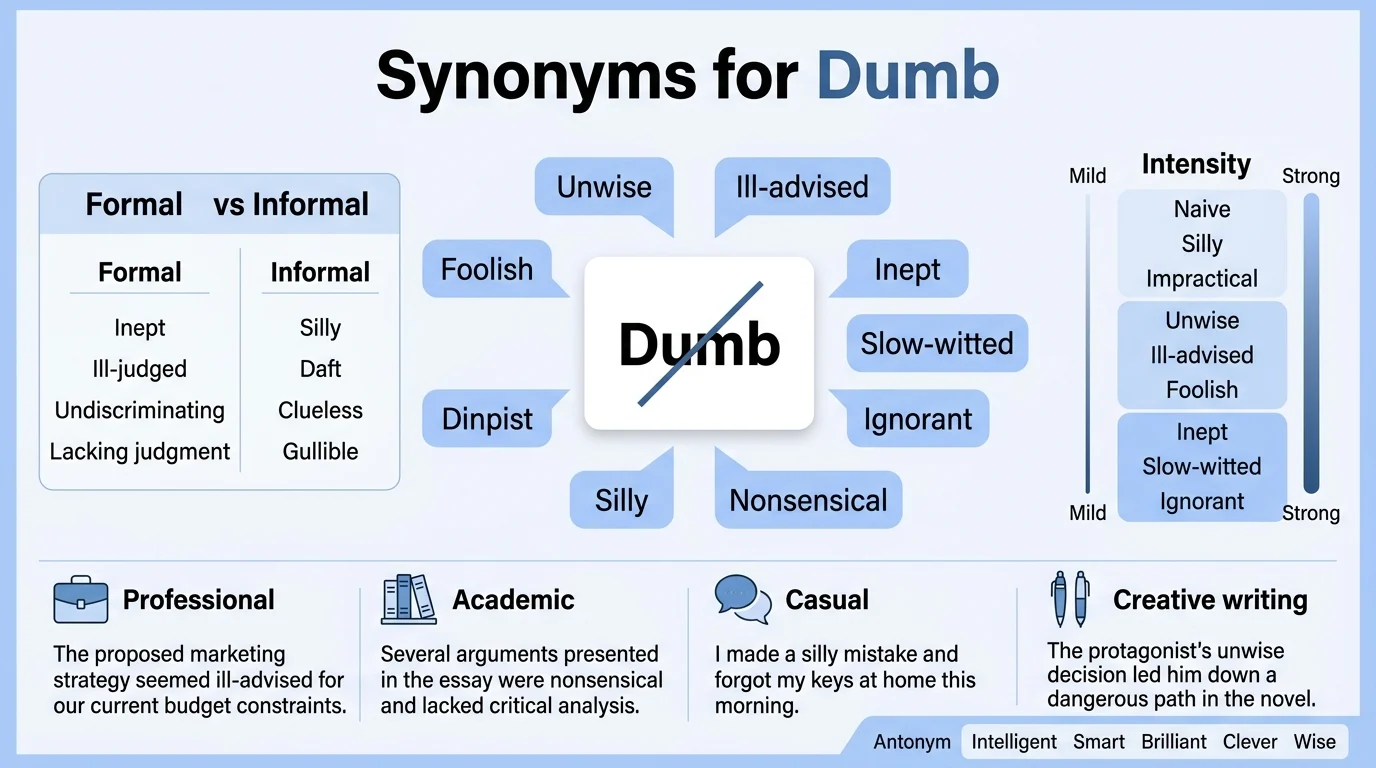
This guide offers over 50 thoughtful alternatives to “dumb,” grouped by context, tone, and intensity. You will learn exactly which word fits each situation, from formal business reports to casual conversations, without ever resorting to hurtful language.
What Does “Dumb” Traditionally Mean?
The word “dumb” originally meant unable to speak, but modern usage has shifted to mean foolish, silly, or lacking intelligence. Because the term can be hurtful and imprecise, better synonyms depend on context. For formal writing, use “illogical” or “unsubstantiated.” professional criticism, choose “shortsighted” or “ineffective.” For casual situations, “silly” or “ridiculous” work well. self‑reflection, “foolish” or “unwise” are kinder.
Meaning, Tone and Context (of “Dumb”)
Simple definition: “Dumb” traditionally described someone who could not speak. Today it is often used informally to describe a person, action, or idea that lacks sense or intelligence.
Part of speech: Adjective. Noun: “dumbness.” Adverb: “dumbly.”
Tone: Generally negative and can be disrespectful, especially when applied to people.
Formality level: Informal. Avoid in academic, professional, or formal contexts.
Common use cases: Casual conversation, social media, and informal writing. However, even in these settings, more respectful alternatives exist.
Important word forms: “Dumbfounded” (speechless with shock) and “dumbstruck” (overwhelmed) are neutral and acceptable. These are not harmful because they do not judge intelligence.
When and How to Use Alternatives to “Dumb”
Instead of using “dumb,” choose a synonym that accurately reflects your intended meaning without labeling anyone negatively. Here are examples with respectful alternatives:
Professional context (critiquing a decision): “That decision seems short‑sighted given our budget constraints.” Avoid calling the decision “dumb.”
Personal context (self‑criticism): “I made a careless mistake and forgot my keys.” Use “careless” or “absent‑minded” instead of calling yourself “dumb.”
Academic context (critiquing an argument): “The argument is unsupported by the evidence.” Use “unsupported” or “unfounded.”
Emotional context (regret): “I felt foolish for not seeing the obvious answer.” “Foolish” expresses regret without harsh judgment.
Creative context (describing a plot): “The movie had a predictable and unconvincing plot.” Use specific critique like “predictable” or “contrived.”
Social media context: “That decision makes no sense to me.” Keep it neutral and opinion‑based.
Email context: “I realize I overlooked the details. Could you clarify the deadline?” Take responsibility without self‑insult.
Another Word for “Dumb” (Respectful Options)
The best replacement depends on your context and what you actually mean. Here are specific suggestions:
Professional writing: Use “illogical” for flawed reasoning, “unreasonable” for unfair demands, or “ineffective” for poor results.
Academic writing: Choose “unsubstantiated” for claims without evidence, “unfounded” for accusations, or “irrational” for illogical positions.
Casual conversation: Say “silly” for harmless errors, “ridiculous” for absurd situations, or “unexpected” for surprising outcomes.
Emotional writing: Use “foolish” to express regret, “naive” for overly optimistic assumptions, or “reckless” for dangerous actions.
Creative writing: Pick “mindless” for thoughtless actions, “senseless” for meaningless events, or “absurd” for extreme situations.
Resume or workplace use: Never use derogatory terms. Describe challenges as “challenging,” “unfamiliar,” or “complex.”
Social media captions: Use “wild,” (in a light way), “hilarious,” or “baffling” depending on tone.
Stronger meaning (when you need force): “Asinine” is strong but still not as derogatory if used for actions. “Preposterous” works for extreme nonsense.
Softer meaning: “Unwise,” “simple” (as in straightforward), “naive,” or “uninformed” are gentle and constructive.
When Not to Use “Dumb” (or Its Harsh Equivalents)
Avoid any word that labels a person’s inherent intelligence. Instead, focus on actions, decisions, or ideas.
Vague and harsh example: “The proposal was dumb.”
Better: “The proposal lacked a clear evidence base.”
Casual but still respectful: “That policy seems counterproductive.”
Better than calling it “dumb”: “That policy creates unnecessary obstacles.”
Self‑criticism example: “She felt dumb about the mistake.”
Better: “She felt embarrassed about the oversight.”
Choosing constructive language shows respect, builds trust, and elevates your writing.
Words Commonly Confused With “Dumb” (and Respectful Distinctions)
Many similar words have distinct meanings. Using the right one avoids offense.
Ignorant vs. Foolish
“Ignorant” means lacking knowledge or awareness. It is neutral if you refer to a specific topic. “Foolish” describes poor judgment. Ignorance can be cured with learning; foolishness is about choices.
Uninformed vs. Reckless
“Uninformed” means lacking necessary information. Reckless” means acting without care for consequences. One is about knowledge, the other about risk.
Foolish vs. Inconsiderate
“Foolish” relates to poor judgment. “Inconsiderate” relates to thoughtlessness toward others. Choose “inconsiderate” if the issue is about empathy.
Irrational vs. Unreasonable
“Irrational” describes actions not guided by reason. “Unreasonable” describes expectations that are excessive. Both are more precise than “dumb.”
Absurd vs. Mindless
“Absurd” means wildly illogical. “Mindless” means done without thought. Use “absurd” for extreme situations and “mindless” for automatic actions.
Naive vs. Simple
“Naive” suggests a lack of experience or worldly wisdom. “Simple” can mean uncomplicated or straightforward. Neither implies lack of intelligence.
Best Synonym by Context for “Dumb” (Respectful Guide)
| Context | Best Synonym | Why It Works | Example |
|---|---|---|---|
| Formal writing | Illogical | Objective and analytical | “The committee found the proposal illogical.” |
| Academic writing | Unsubstantiated | Focuses on lack of evidence | “The hypothesis remains unsubstantiated.” |
| Professional business | Shortsighted | Critiques decisions professionally | “This shortsighted approach will hurt growth.” |
| Resume writing | Challenging | Describes difficulties constructively | “Managing the project presented unique challenges.” |
| Casual conversation | Silly | Light and non offensive | “That is such a silly thing to worry about.” |
| Creative writing | Senseless | Adds emotional depth | “The destruction felt completely senseless.” |
| Emotional tone | Foolish | Expresses regret kindly | “I made a foolish decision.” |
| Strong intensity | Asinine | Very strong but focused on actions | “That is an asinine suggestion.” |
| Soft or moderate | Unwise | Gentle criticism | “It seems unwise to proceed.” |
| Social media | Ridiculous | Engaging and expressive | “This situation is ridiculous.” |
| US usage | “Dumb” appears in casual speech | But we recommend alternatives | Instead, use “silly” or “unreasonable.” |
Which Synonym Should You Choose?
Consider your audience first. Professionals and academics expect precise, non‑judgmental language. Friends and family accept casual terms like “silly.”
Next, think about formality. Formal writing calls for “illogical,” “unsubstantiated,” or “unreasonable.” Casual settings allow “ridiculous” or “silly.”
Consider emotional intensity. Strong frustration might lead you to “absurd” or “reckless,” but always aim for constructive rather than insulting.
Focus on the subject: are you critiquing a decision, an action, a person’s knowledge, or an outcome? Choose a word that targets that aspect.
Finally, match the tone of your entire piece. A humorous blog can use “wild”. A serious report needs “ineffective” or “counterproductive.”
Real Life Examples of Respectful Alternatives in Sentences
School example: “The teacher said my question was perfectly valid because all questions help learning.” Avoid labeling any question as “dumb.”
Workplace example: “Making that decision without data was shortsighted and risky.” A professional alternative.
Writing example: “The author’s argument seems unsupported by the evidence presented.” Academic and precise.
Conversation example: “I felt so silly after realizing my phone was in my pocket the whole time.” Lighthearted self‑deprecation.
Social media example: “This app update makes no sense. The changes are baffling.” A respectful complaint.
Resume example: “I learned from challenging situations and adapted quickly.” Professional language.
Email example: “I apologize for the oversight. I should have double‑checked the details.” Taking responsibility without self‑insult.
Storytelling example: “The character made a reckless choice that changed everything.” Adding emotional weight with a precise word.
15 Respectful Synonyms for “Dumb”
| Synonym | Simple Meaning | Best Used For | Example Sentence |
|---|---|---|---|
| Foolish | Lacking good judgment | Personal reflection or regret | “I made a foolish decision to trust him.” |
| Silly | Harmlessly foolish | Lighthearted situations | “Wearing mismatched socks is silly.” |
| Unwise | Not showing good judgment | Gentle criticism | “It would be unwise to ignore the warning.” |
| Absurd | Wildly unreasonable | Extreme situations | “The price increase is absurd.” |
| Ridiculous | Deserving mockery | Expressing disbelief | “Her excuse was ridiculous.” |
| Illogical | Not following reason | Formal or analytical contexts | “The argument is illogical.” |
| Irrational | Not based on reason | Academic or psychological contexts | “His fear of flying is irrational.” |
| Mindless | Done without thought | Creative or descriptive writing | “The violence felt mindless.” |
| Senseless | Lacking meaning | Emotional or serious situations | “The loss seemed senseless.” |
| Asinine | Extremely foolish | Very strong criticism of actions | “That is an asinine proposal.” |
| Nonsensical | Making no sense | Describing ideas or statements | “His explanation was nonsensical.” |
| Unreasonable | Not based on good sense | Formal criticism | “The demands are unreasonable.” |
| Uninformed | Lacking knowledge | Neutral critique | “She was uninformed about the policy.” |
| Reckless | Acting without caution | Risky or harmful actions | “His reckless driving caused the accident.” |
| Inconsiderate | Thoughtless of others | Social or interpersonal contexts | “That was an inconsiderate thing to say.” |
Synonym Groups and Usage Differences
Professional vs. Personal Synonyms
Professional contexts require words that sound objective and measured. Use “illogical,” “unreasonable,” or “shortsighted” for workplace communication. These words focus on the idea or action rather than judging the person.
Personal situations allow more emotional language. “Silly” works for harmless mistakes. “Ridiculous” fits frustrating situations. “Foolish” expresses personal regret.
Formal vs. Conversational Synonyms
Formal writing demands precise vocabulary. “Unsubstantiated” works for academic arguments. “Irrational” fits psychological discussions. “Unreasonable” applies to policy debates.
Conversational language is more flexible. “Silly” and “ridiculous” are common in everyday speech. Save formal synonyms for writing and professional presentations.
Academic Synonyms
Academic writing needs words that sound precise and objective. “Unsupported” describes claims without evidence. “Unfounded” works for accusations without proof. “Illogical” describes flawed reasoning.
Avoid emotional language in academic work. Stick to terms that focus on logic and evidence.
Professional and Business Synonyms
Business communication benefits from constructive language. “Shortsighted” criticizes decisions professionally. “Ineffective” focuses on results rather than intelligence. “Counterproductive” describes actions that hurt goals.
These words maintain professionalism while still conveying criticism. They avoid personal attacks and focus on outcomes.
Creative or Literary Synonyms
Creative writing offers more freedom. “Mindless” adds imagery to actions. “Senseless” creates emotional weight. “Absurd” paints vivid pictures.
These words enrich descriptions and deepen meaning. They work well in fiction, poetry, and personal essays.
Slang or Modern Synonyms (Use Cautiously)
Modern slang includes (UK), “clueless,” and “out to lunch.” These are informal and often playful. Use them only with friends or in very casual contexts. Avoid them in professional or academic writing.
Strongest vs. Weaker Synonyms
Intensity scale from mild to strongest:
Mild: Simple, Unwise, Naive, Uninformed
Moderate: Foolish, Silly, Unreasonable
Strong: Reckless, Irrational, Asinine, Absurd
Very Strong: Preposterous, Outrageous
Choose the intensity level that matches your situation. Overly strong words seem aggressive. Weak words fail to convey your meaning.
Emotional vs. Neutral Synonyms
Emotional synonyms add feeling: “Foolish” conveys regret. “Absurd” shows frustration. “Senseless” expresses sadness or anger.
Neutral synonyms stay factual: “Illogical” describes reasoning. “Unsupported” discusses evidence. “Unreasonable” evaluates situations.
Choose emotional words for personal writing and neutral words for professional contexts.
Antonyms (What “Dumb” Is Not)
| Antonym | Meaning | Example Sentence |
|---|---|---|
| Intelligent | Having good understanding | “She is an intelligent student.” |
| Smart | Quick thinking and clever | “He made a smart decision.” |
| Wise | Using good judgment | “The wise choice was to wait.” |
| Brilliant | Exceptionally intelligent | “Her solution was brilliant.” |
| Logical | Following reason | “His argument is logical.” |
| Reasonable | Based on good sense | “The price seems reasonable.” |
| Sensible | Practical and wise | “That is a sensible plan.” |
| Clever | Skillful and intelligent | “She found a clever solution.” |
| Sharp | Quick to understand | “He has a sharp mind.” |
| Astute | Showing good judgment | “The astute investor made a profit.” |
| Perceptive | Understanding well | “She is very perceptive.” |
| Savvy | Practical intelligence | “He is savvy about business.” |
| Informed | Having knowledge | “Stay informed about current events.” |
| Educated | Having learned much | “An educated person can understand this.” |
| Thoughtful | Considerate and reflective | “That was a thoughtful response.” |
Comparison: Respectful Alternatives for Different Meanings
“Dumb” (as in speechless) vs. “Foolish”
Main difference: “Speechless” describes inability to talk; “foolish” describes poor judgment.
Which one is stronger: “Foolish” carries judgment; “speechless” is neutral.
Which one is more formal: “Speechless” is neutral. Use “dumbfounded” or “silent” instead.
Example for speechless: “The news left her speechless for a moment.”
Example for foolish: “It was foolish to invest without research.”
Uninformed vs. Ignorant
Main difference: “Uninformed” means lacking specific knowledge. “Ignorant” can imply a broader lack of awareness and may sound insulting.
Which one is stronger: “Ignorant” is stronger and often negative.
Which one is more formal: Both are acceptable; “uninformed” is gentler.
Example for uninformed: “He is uninformed about the new regulations.”
Example for ignorant: “She was ignorant of the cultural norms.” (Use cautiously.)
Foolish vs. Reckless
Main difference: “Foolish” is about poor judgment; “reckless” implies disregard for danger.
Which one is stronger: “Reckless” is stronger because it involves risk.
Which one is more formal: Both can be formal.
Example for foolish: “It was foolish to drive without a spare tire.”
Example for reckless: “His reckless driving caused an accident.”
Inconsiderate vs. Unreasonable
Main difference: “Inconsiderate” focuses on lack of empathy. “Unreasonable” focuses on excessive demands.
Which one is stronger: Similar in strength.
Which one is more formal: “Unreasonable” is more formal.
Example for inconsiderate: “She made an inconsiderate comment about his work.”
Example for unreasonable: “The deadline is unreasonable.”
Irrational vs. Illogical
Main difference: “Irrational” often refers to emotions or beliefs. “Illogical” refers to reasoning.
Which one is stronger: Similar.
Which one is more formal: Both are formal.
Example for irrational: “His fear of spiders is irrational.”
Example for illogical: “The conclusion is illogical given the facts.”
Silly vs. Absurd
Main difference: “Silly” is light and harmless. “Absurd” is extreme and ridiculous.
Which one is stronger: “Absurd” is much stronger.
Which one is more formal: “Absurd” can be formal; “silly” is informal.
Example for silly: “Wearing a party hat to a funeral would be silly.”
Example for absurd: “The idea of taxing air is absurd.”
Common Phrases and Expressions (Without Harmful Terms)
1. Oversimplify
Meaning: To make something overly simple, often losing nuance.
Example sentence: “The textbook oversimplified the complex theory.”
2. Speechless with Shock (instead of “struck dumb”)
Meaning: Unable to speak due to surprise.
Example sentence: “The announcement left the audience speechless.”
3. Foolish Move (instead of “dumb move”)
Meaning: An unwise action.
Example sentence: “Quitting without another job was a foolish move.”
4. No Such Thing as a Bad Question
Meaning: Encourages curiosity without judgment.
Example sentence: “The teacher always says there are no bad questions.”
5. Baffled
Meaning: Confused or perplexed.
Example sentence: “I am baffled by his decision.”
6. Perplexing
Meaning: Confusing or puzzling.
Example sentence: “The instructions are perplexing.”
Common Mistakes to Avoid
Mistake 1: Using “dumb” when a more respectful synonym exists.
Instead of “That was dumb,” say “That was shortsighted” or “That was ineffective.”
Mistake 2: Applying intelligence labels to people instead of actions.
Critique the behavior or decision, not the person. Use “uninformed” if they lacked knowledge,
Mistake 3: Using overly casual terms in formal writing.
“Silly” and “ridiculous” do not belong in academic papers or business reports.
Mistake 4: Using overly dramatic synonyms for simple situations.
Calling a small oversight “asinine” makes you sound excessive.
Mistake 5: Repeating the same vague term.
Variety strengthens your writing. Use a range of precise synonyms.
Mistake 6: Choosing a synonym with the wrong emotional tone.
Using “absurd” for a minor issue sounds angry. Using “silly” for a serious problem sounds dismissive.
Mistake 7: Using slang in academic or professional writing.
Words like “clueless” are too informal. Stick to neutral terms.
FAQs
What is the best respectful synonym for “dumb”?
The best depends on context. Use “foolish” for regret, “illogical” for reasoning, “uninformed” for knowledge gaps, and “reckless” for risky actions.
What is a formal synonym for “dumb”?
Formal synonyms include “illogical,” “unsubstantiated,” “unreasonable,” and “irrational.”
What is an informal but respectful synonym?
“Ridiculous,” “silly,” and “unwise” are informal yet non‑offensive.
What is another word for “dumb” in professional writing?
Professional writing benefits from “shortsighted,” “counterproductive,” “ineffective,” or “unreasonable.”
What is the difference between uninformed and ignorant?
“Uninformed” suggests a temporary lack of knowledge. “Ignorant” implies a more permanent or broader lack and can be insulting.
What is the opposite of “dumb”?
Opposites include “intelligent,” “smart,” “wise,” “logical,” and “informed.”
Conclusion
The word “dumb” is imprecise and can be hurtful. By choosing respectful synonyms like “foolish,” “illogical,” “uninformed,” “reckless,” or “inconsiderate,” you communicate more clearly and maintain professionalism and empathy. Always focus on actions, decisions, or knowledge gaps rather than labeling people. A single word change can transform your message from dismissive to constructive.
Please verify all definitions using trusted dictionaries such as Cambridge, Oxford, Merriam Webster, Collins, or Britannica before publishing.