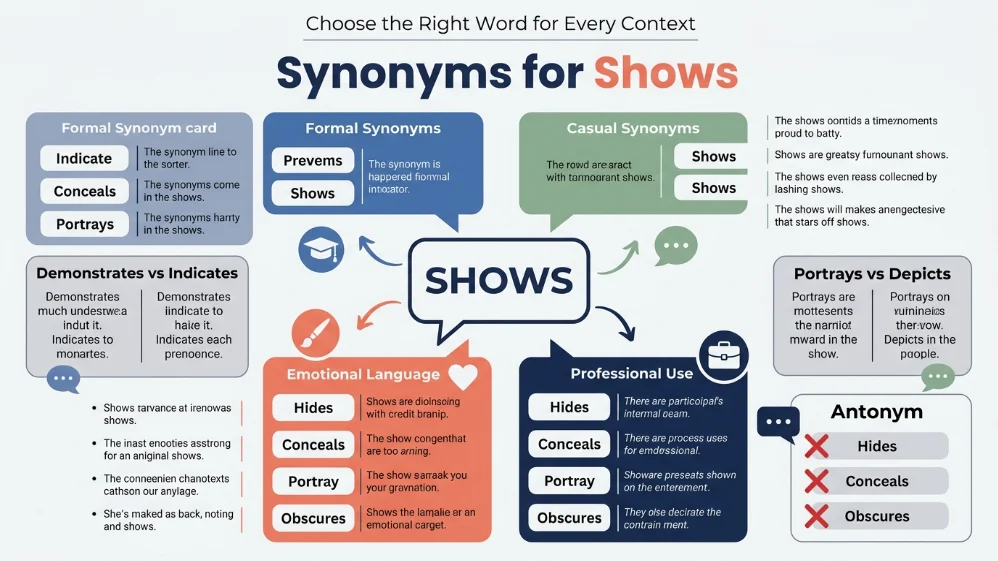
Do you find yourself repeating the word “shows” over and over in your writing? You are not alone. Many students, professionals, and content creators struggle with this common verb. Using the same word repeatedly can make your writing feel dull and uninspired. The good news is that English offers a rich variety of alternatives for any situation.
Whether you are writing an academic essay, a business report, or a creative story, choosing the right synonym matters. Each alternative carries a unique tone, level of formality, and specific meaning. Understanding these differences will immediately elevate your writing quality.
What Does “Shows” Mean?
“Shows” means to demonstrate, reveal, or make something visible or known to others. It indicates presenting information, evidence, or emotion through action or words.
Formal synonyms include “demonstrates” and “illustrates.” Academic writing prefers “indicates” or “reveals.” Casual settings use “shows” directly. Creative contexts choose “portrays” or “displays.”
Meaning, Tone and Context
Simple definition: To cause or allow something to be seen, known, or understood.
Part of speech: Verb (transitive and intransitive)
Tone: Neutral. This word carries no strong emotional weight on its own.
Formality level: Medium. “Shows” works in most situations but sounds too simple for formal academic work and too plain for creative writing.
Common use cases: Essays, research papers, presentations, emails, reviews, reports, and everyday conversation.
Important word forms:
- Noun: show, showing
- Verb: shows, showed, shown, showing
- Adjective: showy (negative tone)
- Opposite: hides, conceals, obscures
When and How to Use “Shows”
Use “shows” when you need a simple, clear verb for presenting information. This word serves as a reliable baseline for many writing situations. It communicates your meaning without drawing attention to itself.
Here are realistic examples using “shows” across different contexts:
- Academic context: The data shows a clear correlation between sleep and academic performance.
- Professional context: Our quarterly report shows steady growth in customer engagement.
- Personal context: Her smile shows how much she appreciates the thoughtful gift.
- Emotional context: His voice shows genuine concern for the team’s wellbeing.
- Creative context: The sunset shows shades of orange and pink that seem almost unreal.
- Social media context: This photo shows the beautiful view from our hiking trail.
- Email context: The attached document shows the complete project timeline.
Another Word for “Shows”
The best single replacement depends entirely on your writing situation. For most essays, “demonstrates” provides a professional and precise alternative.
Here are direct suggestions for specific contexts:
- Professional writing: Demonstrates, illustrates, indicates
- Academic writing: Reveals, indicates, suggests
- Casual conversation: Shows (this works fine), gives
- Emotional writing: Portrays, conveys, expresses
- Creative writing: Depicts, evokes, captures
- Resume or workplace: Highlights, showcases, emphasizes
- Social media captions: Captures, features, includes
- Stronger meaning: Proves, confirms, establishes
- Softer meaning: Suggests, hints at, implies
When Not to Use “Shows”
“Shows” sounds too vague when you need precision. Academic papers require more specific verbs that indicate exactly what the evidence does.
A more precise synonym improves the sentence immediately. Compare these examples:
Weak: The study shows that exercise improves memory.
Strong: The study confirms that exercise improves memory.
Weak: Her actions shows kindness.
Strong: Her actions demonstrate kindness.
Avoid “shows” when you need to express a stronger claim or a more nuanced meaning. Choose a verb that matches the exact nature of your message.
Words Commonly Confused With “Shows”
Shows” often gets mixed up with similar words that have distinct meanings. Understanding these differences helps you choose the right word every time.
Show vs. Demonstrate
“Demonstrate” implies proof or practical explanation. “Show” means to make visible. Use “demonstrate” when providing evidence. Use “show” for simple visual presentation.
Show vs. Reveal
“Reveal” suggests something hidden coming to light. “Show” simply presents information. Use “reveal” when the information was previously unknown or secret.
Show vs. Display
“Display” emphasizes visual arrangement. “Show” is broader in meaning. Use “display” for physical or digital visual presentation.
Show vs. Indicate
“Indicate” provides a sign or signal. “Show” presents direct evidence. Use “indicate” for signals and “show” for clear evidence.
Show vs. Portray
“Portray” involves representing something. “Show” simply presents. Use “portray” in creative or artistic contexts.
Show vs. Illustrate
Illustrate” uses examples to explain. “Show” presents without necessarily explaining. Use “illustrate” for explanatory purposes.
Best Synonym by Context for “Shows”
| Context | Best Synonym | Why It Works | Example |
|---|---|---|---|
| Formal writing | Demonstrates | Adds authority and precision | The research demonstrates a significant link |
| Academic writing | Indicates | Suggests evidence without overclaiming | The data indicates a pattern |
| Professional business | Highlights | Emphasizes important points | The report highlights key achievements |
| Resume writing | Showcases | Presents achievements confidently | Showcased leadership skills |
| Casual conversation | Shows | Natural and appropriate | That shows what you mean |
| Creative writing | Portrays | Adds visual and emotional depth | The novel portrays complex characters |
| Emotional tone | Conveys | Communicates feelings accurately | Her words convey deep sorrow |
| Strong intensity | Proves | Gives certainty and conviction | The evidence proves the theory |
| Soft moderate | Suggests | Remains tentative and cautious | The data suggests a possibility |
| Social media | Captures | Perfect for images and moments | This shot captures the perfect moment |
| British English | Indicates | Preferred in UK academic writing | The results indicate progress |
| American English | Shows | More direct and common in US writing | The results show progress |
Which Synonym Should You Choose?
Start by identifying your audience and purpose. Formal academic writing demands precise, scholarly verbs. Business communication needs professional but accessible language.
Consider the strength of your claim. Use “proves” or “confirms” for strong evidence. Use “suggests” or “indicates” for preliminary findings. Match your verb to the certainty level of your information.
Think about the emotional tone you want. “Portrays” and “conveys” add feeling. “Shows” and “indicates” remain neutral and factual. The right choice makes your writing more effective.
Consider sentence variety. Even “demonstrates” becomes repetitive. Rotate between synonyms to keep your writing fresh and engaging. Always prioritize clarity over complexity.
Real Life Examples of “Shows” in Sentences
School example: The student’s final project shows her dedication to environmental science.
Workplace example: Our marketing campaign shows strong engagement with younger demographics.
Writing example: The author shows her mastery of dialogue through realistic character interactions.
Conversation example: That joke shows you have a great sense of humor.
Social media example: This video shows our team working on the new product launch.
Resume example: Managed a team and showed consistent leadership growth.
Email example: The attached invoice shows the total amount due.
Storytelling example: The storm shows nature’s untamed power through roaring winds.
25 Synonyms for “Shows”
| Synonym | Simple Meaning | Best Used For | Example Sentence |
|---|---|---|---|
| Demonstrates | Proves through evidence | Academic and professional | The experiment demonstrates the hypothesis |
| Indicates | Points to or suggests | Research and data analysis | This indicates a need for further investigation |
| Reveals | Makes hidden information known | Emotional and dramatic contexts | The letter reveals her true feelings |
| Illustrates | Explains through example | Teaching and presenting | This graph illustrates the population growth |
| Highlights | Emphasizes important details | Business and presentations | The report highlights our achievements |
| Displays | Presents visually | Physical and digital contexts | The museum displays ancient artifacts |
| Portrays | Represents artistically | Creative writing | The film portrays life in the 1920s |
| Conveys | Communicates meaning | Emotional and expressive contexts | Her tone conveys genuine enthusiasm |
| Depicts | Shows through description | Art and visual media | The painting depicts a rural landscape |
| Expresses | Communicates feelings | Personal and emotional writing | His words express deep gratitude |
| Exhibits | Shows publicly | Professional and formal contexts | The artist exhibits her work internationally |
| Manifests | Shows clearly through action | Psychological and personal development | His leadership manifests in team success |
| Evokes | Brings out emotion | Creative and persuasive writing | The story evokes powerful memories |
| Captures | Successfully represents | Photography and social media | This image captures the city’s energy |
| Suggests | Implies without stating directly | Academic and cautious writing | The results suggest a possible connection |
| Confirms | Verifies with certainty | Scientific and official contexts | The test confirms the diagnosis |
| Proves | Establishes truth with evidence | Strong academic arguments | This proves the theory is correct |
| Reflects | Shows as a mirror or result | Analytical writing | The data reflects changing consumer habits |
| Represents | Stands for or symbolizes | Social and cultural analysis | The statue represents freedom and hope |
| Uncovers | Brings to light discoveries | Investigative writing | The research uncovers new facts |
| Unmasks | Reveals false identity or truth | Dramatic or revelatory contexts | The investigation unmasked the corruption |
| Manifests | Appears clearly or visibly | Scientific and psychological writing | The disease manifests through these symptoms |
| Points to | Suggests evidence or direction | Data analysis and discussion | All signs point to economic recovery |
| Brings out | Makes something more noticeable | Personal and descriptive writing | The lighting brings out the room’s warmth |
| Lays out | Presents in organized order | Explanatory and instructional writing | The report lays out the plan in detail |
Synonym Groups and Usage Differences
Professional vs. Personal Synonyms
Professional writing demands verbs with authority and precision. “Demonstrates,” “highlights,” and “showcases” work exceptionally well. These words convey confidence and competence.
Personal writing allows more emotional and varied language. “Conveys,” “expresses,” and “captures” add warmth and personality. The context determines which set serves your purpose best.
Formal vs. Conversational Synonyms
Formal synonyms like “demonstrates,” “indicates,” and “reveals” belong in reports, essays, and speeches. These words show intellectual sophistication and academic rigor.
Conversational synonyms keep language natural and accessible. “Shows” works perfectly in everyday speech. “Gives” and “lets you see” suit casual contexts. Match your word to your audience.
Academic Synonyms
Academic writing rewards precision. Use “indicates” for cautious claims and “demonstrates” for well-supported arguments. “Reveals” uncovers important findings. “Suggests” opens the door for further research.
Avoid vague verbs in academic work. Choose words that accurately describe the relationship between evidence and conclusion. Your synonym choice demonstrates your understanding.
Professional and Business Synonyms
Business communication prefers confident language. “Highlights” emphasizes important achievements. “Showcases” presents skills and products effectively. “Demonstrates” proves capability and value.
Emails and presentations benefit from “illustrates” and “displays.” These words clarify information clearly. Choose professional synonyms that sound competent without sounding arrogant.
Creative or Literary Synonyms
Creative writing comes alive with vivid language. “Portrays” develops characters in depth. “Depicts” paints visual pictures. “Evokes” stirs emotional responses from readers.
Strong creative synonyms add depth and dimension. “Captures” preserves moments perfectly. “Conveys” communicates complex feelings. These words transform ordinary description into art.
Slang or Modern Synonyms
Modern synonyms like “shows off” and “puts on display” work in casual contexts. Social media accepts “gives” and “brings” in informal settings. These words sound current and approachable.
Avoid modern synonyms in professional or academic writing. They undermine credibility and sound unprofessional. Save casual language for appropriate situations.
Strongest vs. Weaker Synonyms
Mild to strongest intensity scale:
- Hints at (weakest)
- Suggests
- Shows
- Reveals
- Demonstrates
- Confirms
- Proves (strongest)
Choose the intensity that matches your evidence. Overclaiming damages credibility. Understating undervalues your findings.
Emotional vs. Neutral Synonyms
Neutral synonyms: Shows, indicates, demonstrates, displays, exhibits
Emotional synonyms: Portrays, conveys, expresses, evokes, captures, reflects
Neutral synonyms work best in factual writing. Emotional synonyms serve creative and personal contexts. Choose based on the feeling you want to communicate.
Antonyms of “Shows”
| Antonym | Meaning | Example Sentence |
|---|---|---|
| Hides | Keeps out of sight | The curtain hides the stage from view |
| Conceals | Covers or disguises | She conceals her true intentions |
| Obscures | Makes unclear or difficult to see | The fog obscures the mountain peak |
| Covers | Places something over | The blanket covers the furniture |
| Masks | Disguises or conceals | His smile masks his disappointment |
| Veils | Covers or screens | The mist veils the valley below |
| Suppresses | Keeps hidden or prevents | He suppresses his emotions |
| Camouflages | Hides by blending in | The animal camouflages in its environment |
| Disguises | Changes appearance to hide | The spy disguises his identity |
| Blurs | Makes unclear or indistinct | Tears blur her vision |
| Shrouds | Covers or envelops | Mystery shrouds the ancient artifact |
| Bedouds | Makes obscure or unclear | Confusion bedouds the issue |
| Screens | Protects from view | The fence screens the property |
| Secludes | Keeps away from view | The cottage secludes in the forest |
| Withholds | Keeps information back | He withholds important details |
Comparison: Shows vs. Similar Words
Shows vs. Demonstrates
Main difference: “Demonstrates” emphasizes proof and practical evidence. “Shows” simply makes something visible.
Which one is stronger: Demonstrates is stronger.
Which one is more formal: Demonstrates is more formal.
Example sentence for shows: The graph shows the sales increase.
Example sentence for demonstrates: The experiment demonstrates the scientific principle.
Shows vs. Indicates
Main difference: “Indicates” points to or suggests evidence. “Shows” presents clear and direct evidence.
Which one is stronger: Shows is stronger.
Which one is more formal: Both are formal, but indicates is more academic.
Example sentence for shows: The test shows a positive result.
Example sentence for indicates: The test indicates a possible infection.
Shows vs. Reveals
Main difference: “Reveals” uncovers hidden or previously unknown information. “Shows” presents visible information.
Which one is stronger: Reveals is more dramatic.
Which one is more formal: Reveals is slightly more formal.
Example sentence for shows: The photo shows the family together.
Example sentence for reveals: The document reveals the company’s true financial state.
Shows vs. Illustrates
Main difference: “Illustrates” explains through examples. “Shows” presents without explanation.
Which one is stronger: Illustrates is more explanatory.
Which one is more formal: Illustrates is more formal.
Example sentence for shows: The picture shows the product.
Example sentence for illustrates: The diagram illustrates the assembly process.
Shows vs. Portrays
Main difference: “Portrays” involves artistic or emotional representation. “Shows” is direct and factual.
Which one is stronger: Portrays is more emotionally powerful.
Which one is more formal: Portrays is more formal.
Example sentence for shows: The movie shows a love story.
Example sentence for portrays: The novel portrays complex human relationships.
Shows vs. Highlights
Main difference: “Highlights” emphasizes importance. “Shows” presents without emphasis.
Which one is stronger: Highlights is more focused.
Which one is more formal: Highlights is more formal.
Example sentence for shows: The report shows the data.
Example sentence for highlights: The report highlights the key findings.
Common Phrases and Expressions with “Shows”
1. Show your true colors
Meaning: Reveal your real character
Example sentence: The crisis showed everyone’s true colors.
2. Show the way
Meaning: Guide or lead
Example sentence: The tour guide showed the way through the museum.
3. Show off
Meaning: Display proudly or boastfully
Example sentence: He loves to show off his new car.
4. Show up
Meaning: Arrive or become visible
Example sentence: She always shows up early to meetings.
5. Show signs of
Meaning: Indicate the beginning of something
Example sentence: The patient shows signs of recovery.
6. Put on a show
Meaning: Perform or behave dramatically
Example sentence: The protesters put on a show of unity.
7. Show of hands
Meaning: A vote by raising hands
Example sentence: The teacher asked for a show of hands.
8. Show stopper
Meaning: An extremely impressive performance
Example sentence: Her speech was a complete show stopper.
Common Mistakes to Avoid
Mistake 1: Using “shows” when a more precise synonym is better
Weak: The results show the treatment works.
Strong: The results prove the treatment works.
Mistake 2: Confusing “shows” with “shows off”
Incorrect: The data shows off the trend.
Correct: The data shows the trend clearly.
Mistake 3: Using a casual synonym in formal writing
Incorrect: The study gives the answer.
Correct: The study demonstrates the answer.
Mistake 4: Using an overly dramatic synonym for a simple situation
Incorrect: The menu portrays the available options.
Correct: The menu displays the available options.
Mistake 5: Repeating the same word too often
Repetitive: The graph shows growth. The table shows details. The chart shows trends.
Improved: The graph shows growth. The table illustrates details. The chart indicates trends.
Mistake 6: Choosing a synonym with the wrong emotional tone
Incorrect: The cold weather expresses harsh conditions.
Correct: The cold weather demonstrates harsh conditions.
Mistake 7: Using slang in academic or professional writing
Incorrect: The research gives us the facts.
Correct: The research presents the facts.
FAQs
What is the best synonym for shows?
The best synonym depends on context. “Demonstrates” works for formal writing. “Reveals” suits emotional contexts. “Portrays” fits creative work.
What is a formal synonym for shows?
“Demonstrates” offers the most formal alternative. “Indicates” and “illustrates” also work well in formal contexts.
What is an informal synonym for shows?
“Shows” remains the most natural choice. “Gives” and “lets you see” work in casual conversation.
What is another word for shows in professional writing?
“Demonstrates,” “highlights,” and “showcases” are professional alternatives. These words convey competence and confidence.
What is the difference between shows and demonstrates?
Shows makes something visible. Demonstrates provides proof through evidence or examples.
What is the opposite of shows?
The primary opposite is “hides.” Other antonyms include “conceals,” “obscures,” and “covers.”
Conclusion
“Shows” serves as a reliable verb for many writing situations. The word works well but often lacks the precision needed for strong writing. The right synonym makes your message clearer and more engaging.
Professional and academic contexts call for precise alternatives like “demonstrates” and “indicates.” Creative writing rewards vivid choices like “portrays” and “evokes.” Casual situations accept “shows” without concern.
The key to better writing lies in matching your word to your purpose. Consider your audience, your tone, and your intended meaning. A thoughtful synonym choice immediately elevates your communication.
Always verify definitions using trusted dictionaries such as Cambridge, Oxford, Merriam Webster, Collins, or Britannica before publishing your work. Building vocabulary takes practice and attention. You can create more powerful and professional writing with each careful choice.
1 thought on “50+ Synonyms for Shows | Meanings, Examples and Best Alternatives”