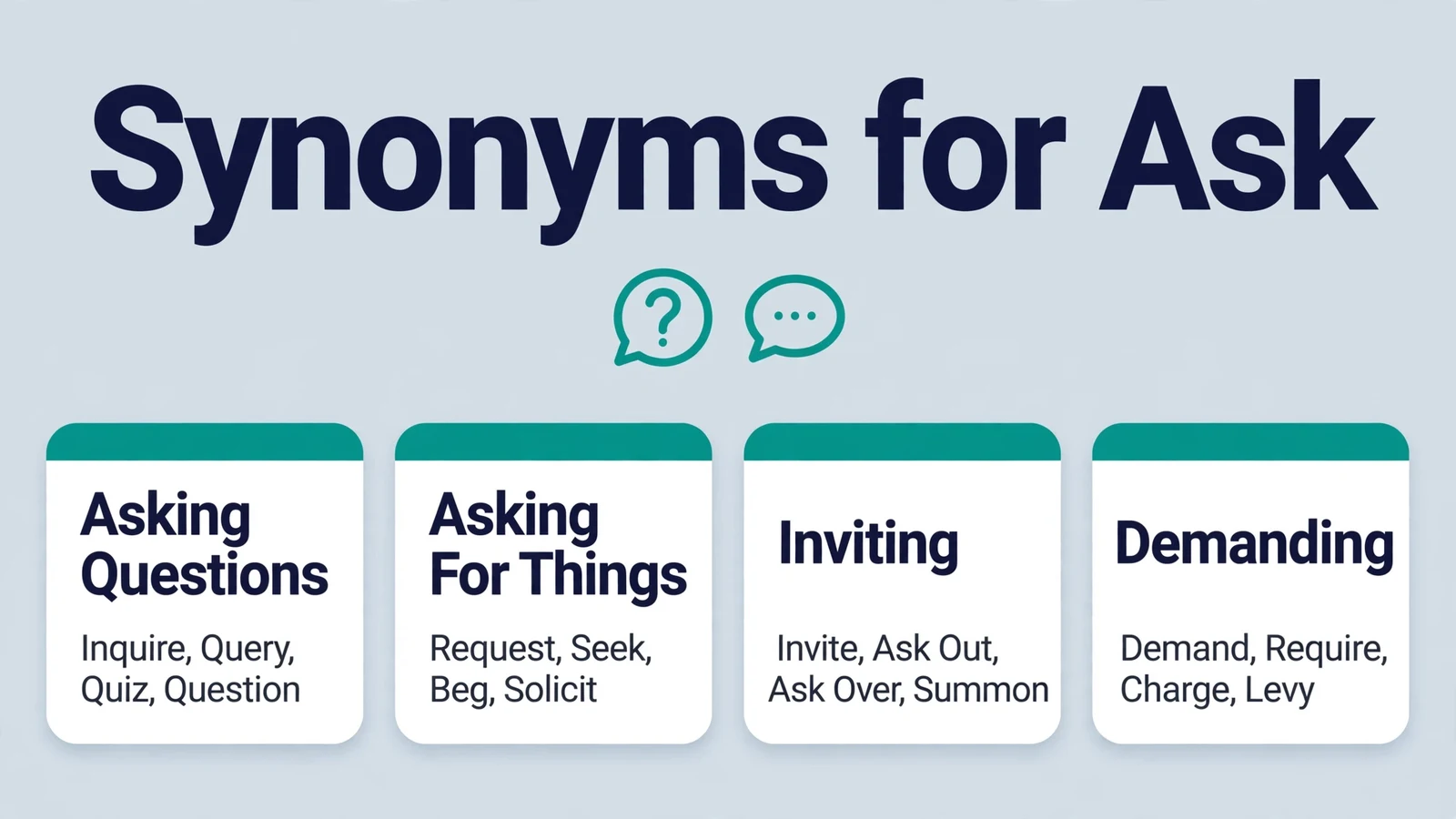
Ask may be a tiny verb, but it does five different jobs in English. You ask a question, ask for help, ask someone to stay, ask a friend over, and complain that a task asks too much. The strongest synonyms for ask are inquire, question, query, request, seek, beg, plead, invite, and demand. Each one fits a different job, though, so a single replacement rarely works everywhere.
This guide groups more than 40 synonyms for ask by sense, so you always grab the right one. Dictionary editors at Merriam-Webster draw the same lines, which keeps the groups honest. Every word below was checked against major thesauruses before it earned a place, so the register labels reflect real usage rather than guesswork. You also get example sentences, register tips, and a mistakes section that flags the swaps that quietly change your meaning.
Top Synonyms for Ask: Quick Reference
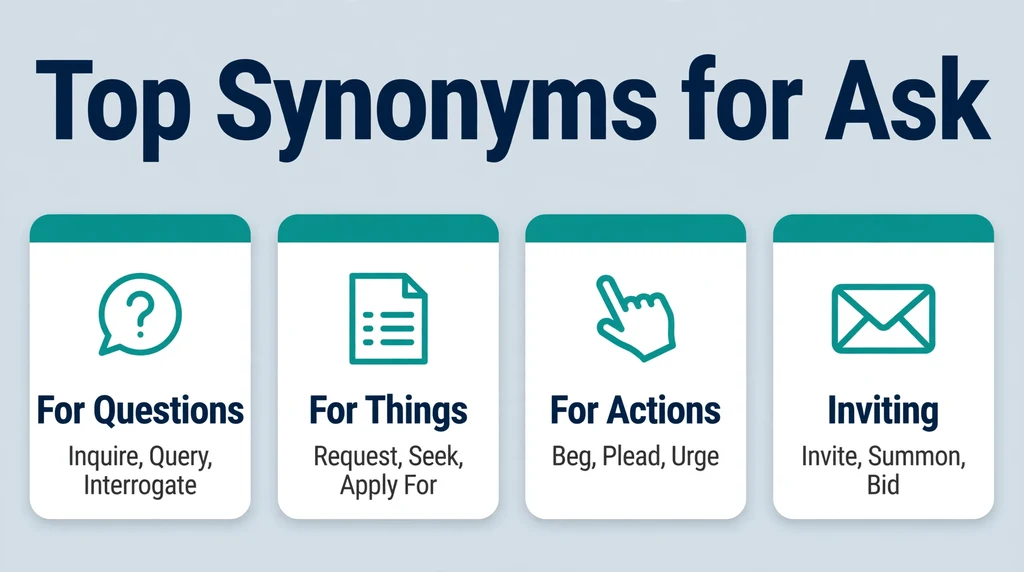
The table below covers the 26 synonyms readers reach for most often. Start here when you need one quick replacement. Later sections sort the full list into finer groups by sense and tone.
| Word | Meaning in one line | Best for |
|---|---|---|
| Inquire | Ask in a formal, fact-seeking way | Letters, offices, polite questions |
| Question | Ask a series of questions | Police, interviews, formal checks |
| Query | Ask for confirmation or raise a doubt | Work, editors, official answers |
| Quiz | Test someone with short questions | Classrooms, games, light tests |
| Interrogate | Question formally and systematically | Police, officials, serious scenes |
| Request | Ask politely and a little formally | Emails, forms, offices |
| Seek | Ask for and try to obtain | Help, advice, permission |
| Beg | Ask earnestly or humbly | Urgent favours, strong emotion |
| Plead | Ask with urgent emotion | Desperate or heartfelt requests |
| Appeal | Ask earnestly, often in public | Charity, public, heartfelt cases |
| Petition | Make a formal, often written request | Governments, groups, officials |
| Solicit | Ask by approaching people | Donations, opinions, business |
| Apply for | Request through a formal process | Jobs, grants, permits |
| Invite | Ask someone to come or join | Parties, visits, events |
| Summon | Order someone to come officially | Courts, offices, formal calls |
| Demand | Ask firmly, expecting compliance | Rights, answers, strong claims |
| Grill | Question intensely, informal | Interviews, family teasing |
| Pump | Keep asking to extract information | Informal, determined digging |
| Sound out | Ask an opinion carefully first | Plans, decisions, diplomacy |
| Requisition | Request supplies officially | Military, hospitals, stores |
| Order | Ask for goods to be supplied | Restaurants, shops, services |
| Crave | Want and ask for intensely | Strong desires, formal pleas |
| Urge | Press someone to do something | Advice, campaigns, persuasion |
| Call for | Publicly request or demand | Inquiries, reforms, the bill |
| Consult | Ask an expert for advice | Doctors, lawyers, specialists |
| Ask around | Ask several people in turn | Finding services, local tips |
What Does Ask Mean?
At its core, ask means to put a question to someone because you want an answer. Collins defines it as saying or writing something in a form that requires an answer. Merriam-Webster lists four verb senses in total, and the sections below follow them closely.
The question sense
First, ask covers plain questions. You ask a name, ask the time, or ask where the station is. The verb says nothing about pressure or ceremony. It simply means a question left your mouth and an answer is expected back.
The request senses
Second, ask covers requests, and it splits into two patterns. You can ask FOR a thing, such as help, money, or permission. You can also ask a PERSON to do something, as in asking a neighbour to water the plants. Both patterns are polite by default, which is why ask sounds softer than demand.
The invite and price senses
Third, ask can mean invite, as in asking friends over for dinner. Fourth, it can set a price, so a seller asks 300 dollars for an old clock. In reported speech, ask also partners with the verbs covered in our guide to synonyms for say, since we report questions with asked and statements with said.
Small words that steer ask
The little word after ask steers the whole meaning. Ask ABOUT a topic when you want information, and ask FOR a thing when you want to receive it. Ask AFTER someone, in British English, means asking for news about their health or progress. Ask someone OUT, IN, OVER, or BACK, and the verb becomes an invitation instead. Learners who master these five patterns rarely need a rarer synonym, because the patterns already cover most daily situations with perfect clarity.
Synonyms for Ask a Question
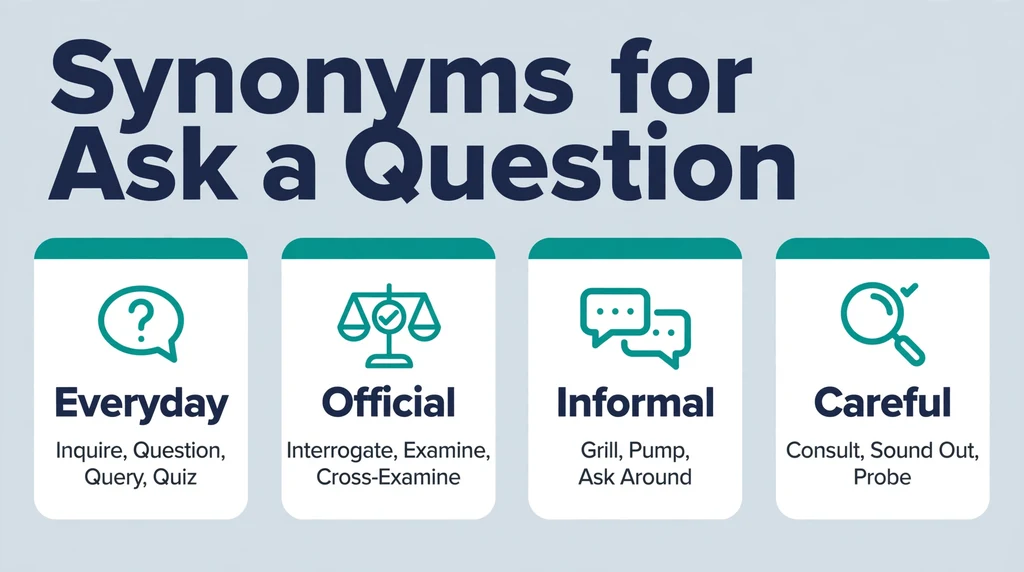
When you ask a question, your goal is information. Still, the setting changes everything. A child asking about dinosaurs, a lawyer testing a witness, and a detective interviewing a suspect all ask, yet each scene needs its own verb.
Everyday words for asking questions
Inquire is the formal everyday choice. It means asking while searching for facts or truth, and it suits letters, offices, and polite phone calls. For example, she called the garage to inquire when her car would be ready. British writers often spell it enquire, with no difference in meaning.
Question usually means a series of questions rather than one. Police question a suspect, and journalists question a minister. A single quick question sounds odd with this verb, so save it for longer exchanges.
Query asks for authoritative information or confirmation. It can also carry a hint of doubt about whether something is correct. An editor queries a spelling, and a customer queries a bill that looks too high.
Quiz means testing someone with short questions. Teachers quiz a class, and friends quiz each other for fun. The word always implies checking what someone knows, not learning something new yourself.
Ask around is a friendly phrase for questioning several people in turn. You ask around when you need a good plumber or a spare ticket. It spreads one question across many people instead of pressing a single person.
Consult means asking an expert for advice or information. Patients consult a doctor, and clients consult a lawyer. The expert’s knowledge is the whole point of the word, so it never fits casual chats.
Deeper and more official questioning
Interrogate is the heavyweight of this group. It suggests formal, official, and systematic questioning, often by police or prosecutors. Because it sounds intense, writers also use it playfully for tough family questioning at dinner.
Examine means questioning someone closely and in order. Lawyers examine witnesses in court, and committees examine officials at hearings. The word focuses on testing answers, not just collecting them.
Cross-examine goes one step further. It means questioning a witness or opponent to test what they said earlier. Outside court, it describes any sharp round of follow-up questions that hunts for weak spots.
Catechize is a rare, formal word. It means questioning with fixed answers already expected, and it began in religious teaching. Today it mostly appears when someone is drilled through set questions and set replies.
Probe means asking or searching deeply into a matter. Investigators probe a claim, and reporters probe a company’s record. The questions dig below the surface, so the word suits slow, careful digging.
Interview means asking structured questions in a planned session. Journalists interview athletes after a race, and employers interview candidates. Unlike a casual chat, an interview has a purpose and usually a record.
Informal words for pressing questions
Grill is the informal word for intense questioning. It suggests heat, pressure, and no easy escape. Parents grill teenagers about a late return, and reporters grill officials after a scandal.
Pump means keeping the questions coming until the information flows out. You pump a friend for details about a new job. The word suggests persistence, so use it only when that pressure is real.
Sound out is the gentle opposite. It means asking someone’s opinion carefully before you act. Managers sound out a team before announcing a change, because the goal is honest reaction, not hard facts.
Synonyms for Ask For Something
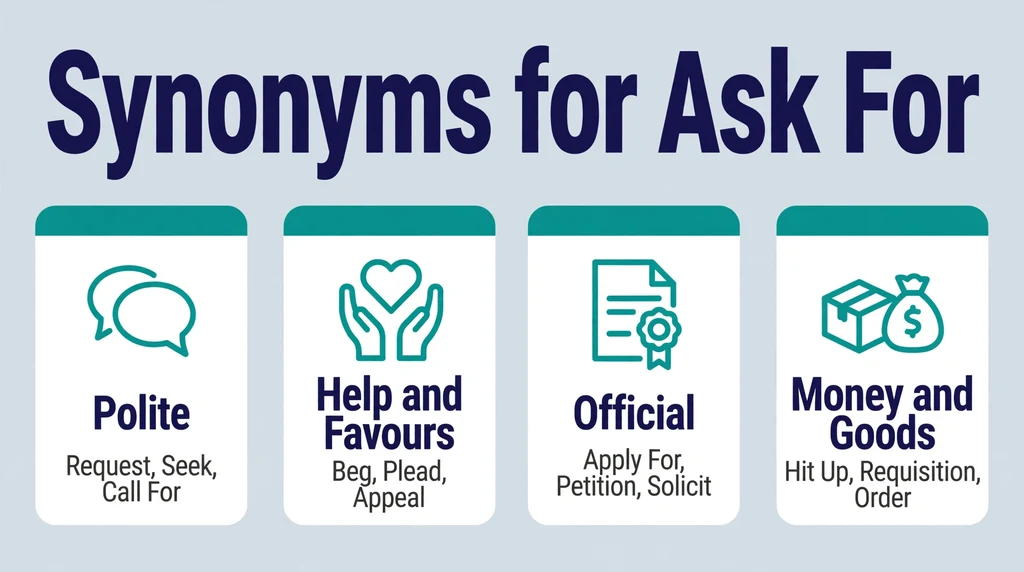
Asking FOR something is the request sense readers use most. You might want help, money, permission, or a simple glass of water. The words below move from everyday politeness to formal procedure, so tone rises step by step.
Everyday and polite requests
Request is the polite standard. It asks in a courteous, slightly formal way, and it fills emails, forms, and office speech. If ask feels too plain for a business letter, request is usually the upgrade you want.
Seek means asking for something while actively trying to obtain it. People seek help, seek advice, and seek permission. It sounds formal and determined, so it suits writing more than casual speech.
Call for makes a request public. Crowds call for an inquiry, and diners call for the bill. The word often carries demand inside it, which makes it stronger than a private ask.
Hit up is slang for asking someone for money or a favour. A friend might hit you up for a small loan. It is friendly and casual, and it never belongs in formal writing.
Angle for means asking indirectly, by hinting rather than stating. Someone angles for an invitation or for compliments. The word always suggests a hidden route to the goal, so it can sound slightly sly.
Asking for help and favours
Sometimes the stakes are higher, and plain ask feels too weak. English then reaches for warmer or more urgent words. If the thing you need most is support itself, our guide to synonyms for help pairs well with this section.
Beg means asking earnestly or humbly. A child begs for a later bedtime, and a traveller begs a stranger for directions. The word admits that the other person holds all the power.
Plead adds open emotion to begging. Someone pleads for mercy, pleads for time, or pleads with a friend to stay. It suits desperate or heartfelt moments rather than routine requests.
Appeal means asking earnestly, often to a wide audience. Charities appeal for donations, and police appeal for information. The word also names the formal legal step of asking a higher court to review a decision.
Pray survives in formal and older English as an earnest ask. You still meet it in phrases like pray tell, and in religious contexts it means asking God. In modern everyday requests it sounds stiff or old-fashioned.
Crave means wanting something so strongly that you ask for it with real intensity. Collins labels this use informal in the asking sense, and it often appears in very polite old formulas, such as craving someone’s indulgence. Today it mostly signals hunger or deep desire.
Formal, written, and official requests
Apply for means requesting through a set process. You apply for a job, a grant, a visa, or a permit. Forms, evidence, and waiting are built into the phrase, so it never means a quick spoken favour.
Petition means making a formal request, often in writing and often as a group. Citizens petition the council, and workers petition management. A petition usually carries names, signatures, or legal weight behind it.
Solicit means seeking something by approaching people directly. Charities solicit donations, and firms solicit new business. Merriam-Webster notes that solicit calls attention to your wants, often through public announcement, which is why it suits campaigns.
Requisition is the official word for requesting supplies or services inside an organisation. Hospitals requisition medicine, and army units requisition fuel. It belongs to systems and stores, not to personal favours.
Order asks for goods or services to be supplied. Diners order food, and offices order paper. It sounds firmer than request because payment and delivery sit behind it, so never use it for a personal favour.
Desire is a formal, dated way to ask for something. Old letters desire a reply, and formal notices still use it occasionally. Modern writers mostly choose request instead, since desire now mainly means wanting.
Sue for is a legal and formal phrase. Nations sue for peace, and parties sue for damages in court. Outside those settings it sounds heavy, so keep it for law, history, and diplomacy.
Asking for permission
Permission has its own small ladder. Between friends, plain ask rules: you ask to borrow the car or ask to leave early. At work, request adds polish, so staff request leave in writing. Seek sounds higher still, and officials seek approval before a project starts. Apply for belongs to permits and licences, where a form decides the answer. Choosing one rung too high makes a small favour sound like a court case, while one rung too low can sound careless in a formal office.
Synonyms for Asking Someone to Do Something
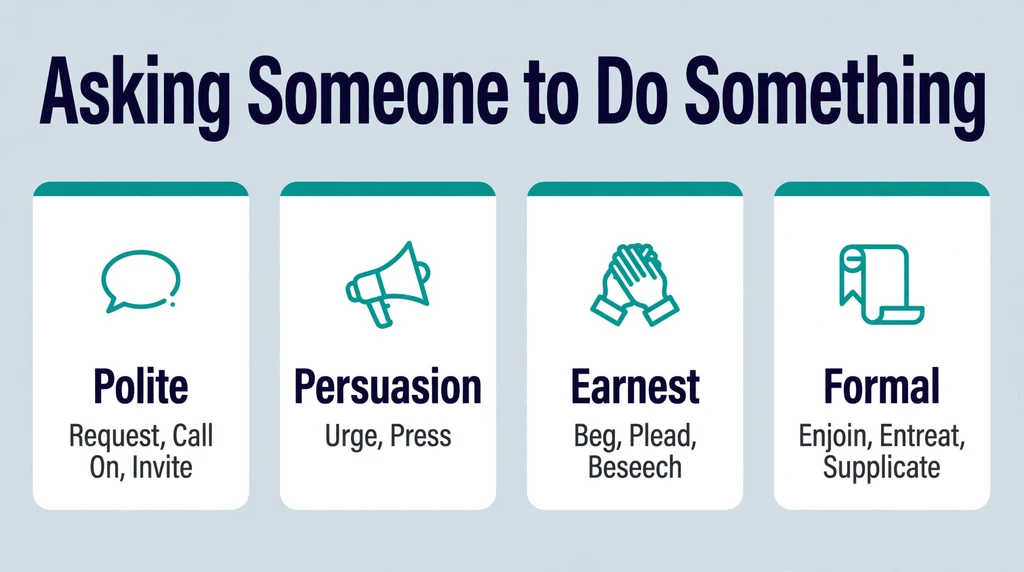
Asking a person to act is different from asking for a thing. The listener must now spend time or effort, so politeness matters even more. English grades these words on a clear ladder, from a gentle request to something close to an order.
The polite middle of the ladder
Request works here too, and it stays courteous. A letter can request the chorus to perform, and a manager can request a report by Friday. The formality protects the listener, which is why officials prefer it.
Call on means asking someone formally to do something or to speak. A chair calls on a member to present, and leaders call on volunteers to help. It carries ceremony, so it fits meetings and public events.
Urge means pressing someone strongly to act. Doctors urge patients to rest, and campaigns urge voters to register. Urging is persuasion with pressure, yet the final choice still stays with the listener.
Invite can also ask someone to do something, in a welcoming way. Organisers invite entries, invite comments, and invite guests to take a seat. The ask hides inside an offer, which makes it gentle and positive.
Earnest and urgent asking
Beg and plead return here with people as their target. You beg a friend to come back, or plead with a team to wait. Both words show need, and both lower the asker on purpose.
Beseech, implore, entreat, and supplicate form the formal, literary shelf. All four mean asking earnestly and humbly. Beseech and implore carry strong feeling, entreat sounds gentler, and supplicate adds humility, even prayer. Modern speech rarely uses them outside stories, speeches, and ceremonies.
Importune is a rare formal word for asking repeatedly and urgently. Merriam-Webster lists it in this family, but few modern readers meet it. If your audience may pause on a word, choose plead or press instead.
Enjoin is a legal-flavoured word. It means urging or ordering someone formally, and courts enjoin parties to act or to stop acting. Its authority makes it far stronger than a friendly ask.
Press means asking persistently, as in pressing someone for an answer or pressing a claim. The picture is steady pressure rather than one loud demand. Because it can tire the listener, writers use it when persistence is exactly the point.
Synonyms for Ask That Mean Invite
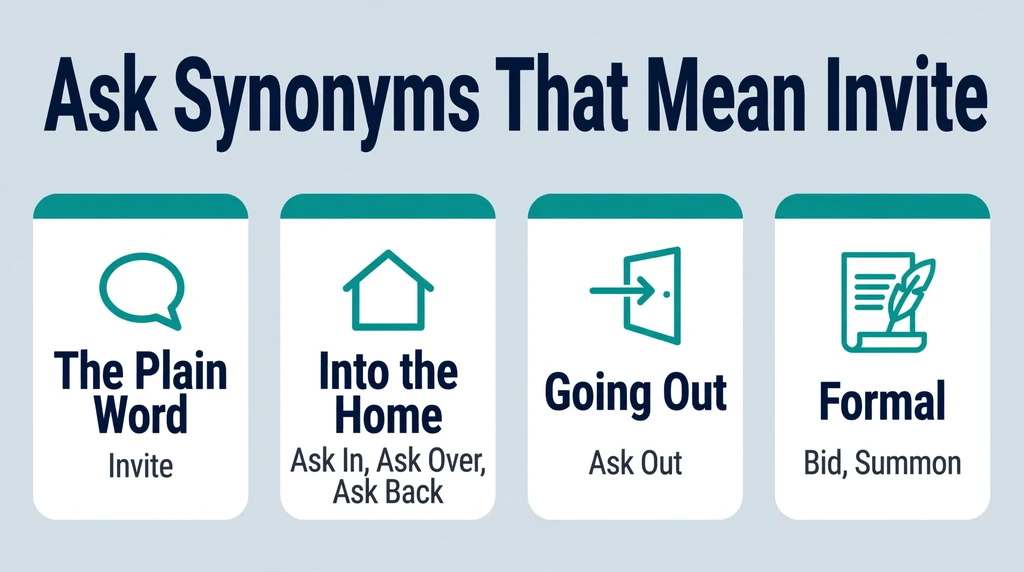
The friendliest sense of ask is the invitation. You ask people in, ask them out, ask them over, and ask them back. Each little word after ask changes the direction of the invitation, so learners should learn the set as a group.
Invite is the plain synonym and the safe default. You invite colleagues to lunch and invite neighbours to a wedding. It covers every pattern above, which is why dictionaries use it to define this sense of ask.
Ask out usually means inviting someone on a date. It can also mean inviting friends out socially, yet the romantic reading is the famous one. Context decides, so writers add a detail when the meaning matters.
Ask in and ask over (or ask round) bring people into your home. Asking neighbours over means inviting them to visit, usually for food or drinks. These phrases sound warm and informal, and they suit homes far better than offices.
Bid is the formal, older word in this group. Hosts once bade guests welcome, and people still do as they are bidden. Today bid in this sense feels ceremonial or literary, so save it for formal invitations and stories.
Summon looks like an invitation but behaves like an order. A court summons a witness, and a boss summons an employee to a meeting. Nobody refuses a summons happily, so never use it for a friendly invitation.
When Ask Means Demand, Expect or a Price
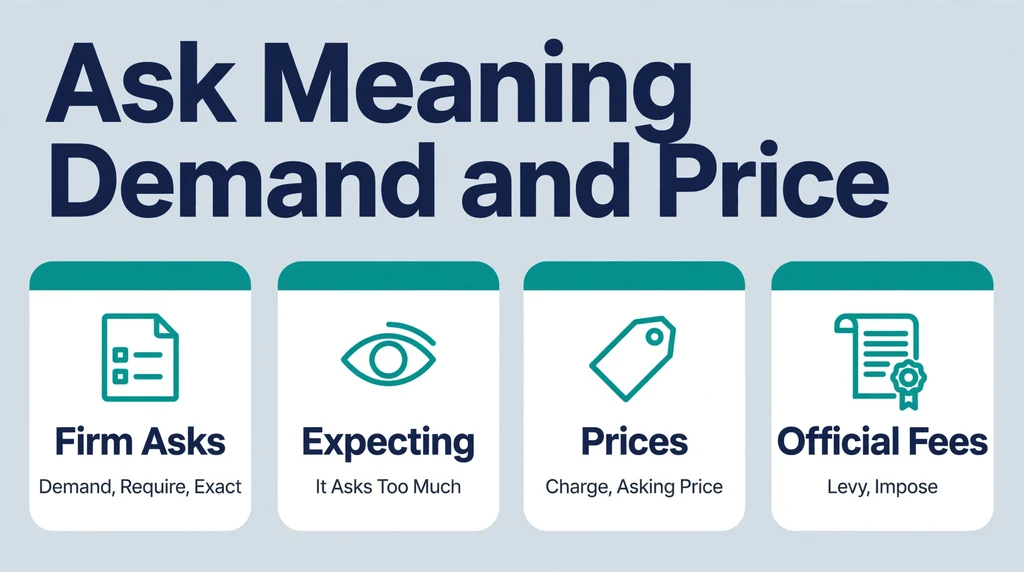
Ask has a firm side too. Sometimes it expects, requires, or charges, and no polite question is involved at all. This section keeps those uses apart, because swapping them into gentle requests creates instant confusion.
Demanding and expecting
Demand is the strongest common word here. It means asking firmly while expecting to be obeyed or answered. Workers demand fair pay, and readers demand an explanation. Unlike ask, demand leaves little room for a polite no.
Require means something is needed or expected as a condition. A course requires effort, and a role requires patience. When people say a job asks a lot of you, require is the closest formal replacement.
Exact means demanding and obtaining something by authority. Rulers exacted taxes, and blackmailers exact a price. Merriam-Webster places it in the request family, yet its force makes it a demand word, not an asking word.
The phrase it asks too much means a task expects more than is fair. It asks too much of new staff, or the price asks more than the car is worth. In this pattern, ask behaves like require, not like a question.
The price sense
Charge is the price word. Merriam-Webster pairs it with ask in the sense of setting or receiving a price. A dealer asking 25 dollars for a watch is charging 25 dollars, and the noun asking price keeps the same idea.
Levy means officially demanding a payment or tax. Governments levy a charge on imports, and banks levy small fees. It belongs to rules and systems, never to personal requests.
Impose enters this family through the phrase impose on. Asking too many favours imposes on a friend’s kindness. Thesaurus lists place impose near ask for this reason, yet the meaning is really taking advantage, so use it with care.
Ask vs Inquire vs Question: Register and Formality
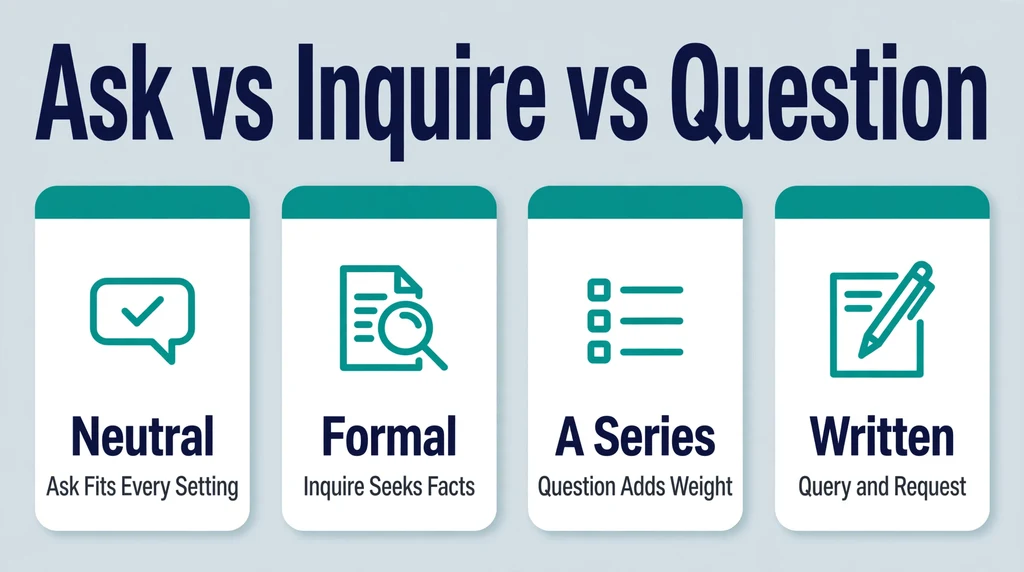
Register is where most ask synonyms succeed or fail. The words share a core meaning, yet they wear different clothes. Choosing by setting, rather than by meaning alone, keeps your English natural in both speech and writing.
Ask: the neutral default
Ask is the plain, everyday verb, and Merriam-Webster says it implies no more than the putting of a question. It fits every setting, from text messages to boardrooms. When in doubt, ask is never wrong, only sometimes less precise than an alternative.
Inquire: formal and fact-seeking
Inquire implies a search for facts or truth, often carried out through questions. That makes it the verb of letters, receptions, and customer service desks. She inquired about train times sounds polished, while she asked about train times sounds plain. Both are correct, yet the first suits a written or formal scene.
Question: a series, with weight
Question usually suggests a series of questions, and it often carries doubt or authority. Police question suspects, and committees question ministers. Used on a friend, it can sound heavy, so a single friendly query deserves ask or inquire instead.
Query, request, and the written word
Query sits between inquire and question. It asks for confirmation from someone who should know, and it can flag a possible error. Request, meanwhile, is the formal twin of ask for things and actions. In short, speech runs on ask, while careful writing rotates inquire, query, and request by need.
British and American notes
Spelling splits this family slightly. Inquire is the standard form in American English, while British English uses both inquire and enquire for everyday questions. British style often reserves inquire for formal investigations, yet ordinary writers swap them freely. The meaning never changes, so pick one spelling and stay consistent. Pronunciation stays the same on both sides of the Atlantic, which makes this a writing choice only, never a speaking one.
How to Choose the Right Synonym for Ask
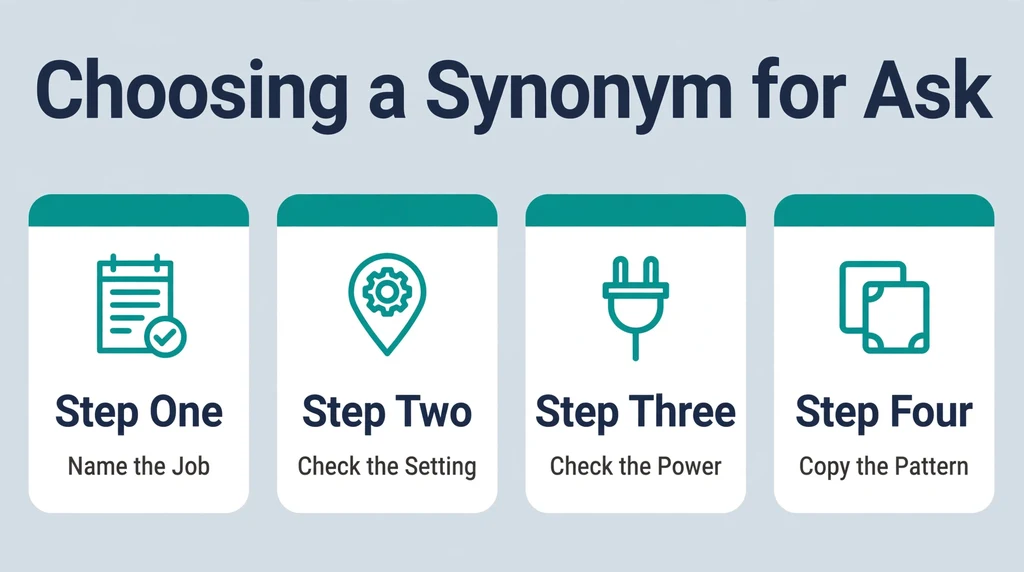
Start with the job, not with the word. First decide whether you need information, a thing, an action, an invitation, or a demand. That single choice removes most of the list at once, and the tone checks below finish the job.
Match the word to the setting
Compare these pairs. A parent asks a child to tidy a room, while a court summons a witness to appear. A student inquires about an exam date, while detectives interrogate a suspect for hours. In each pair, the second verb adds formality, pressure, or both.
Match the word to the power balance
Begging lowers you, demanding raises you, and requesting keeps you level. So a favour from a friend takes ask or beg, never requisition. A claim you are entitled to can take demand. Most daily situations sit in the middle, which is why request and ask dominate real English.
Watch the grammar pattern
Some synonyms change the sentence shape. You ask someone TO leave, request someone TO leave, and beg someone TO leave. But you inquire ABOUT a topic, apply FOR a post, and plead WITH a person. Copying the pattern matters as much as copying the word, because a right word in a wrong frame still sounds broken.
The same scene, five ways
Watch one scene change as the verb changes. A reporter asks the mayor about the new bridge, and the sentence stays neutral. The reporter inquires about the bridge, and the scene turns formal, almost written. The reporter queries the cost, and now a figure may be wrong. The reporter grills the mayor for an hour, and readers feel heat and pressure. Finally, residents petition the council about the bridge, and the ask becomes collective, written, and official. Same bridge, five stories, and only the verb moved.
Antonyms for Ask
Opposites of ask depend on the sense, yet a few clear pairs cover most writing. For questions, the opposites are answer, reply, inform, and tell, since the information flows the other way. Collins and Webster’s both give answer and tell as direct opposites.
For requests, the opposites are give, grant, deny, and refuse. Giving answers a request with action, while denying or refusing closes it. For invitations, disinvite is the rare but exact opposite, and ignore opposes every sense at once, since the ask receives nothing back.
Writers rarely need the whole set at once. In practice, answer closes a question, refuse closes a request, and grant quietly does the opposite of both asking and begging. Pick the opposite that matches your sense of ask, and the contrast will read cleanly.
If you need the richer family around the main opposite, our guide to synonyms for tell covers the answering side in full.
Words That Are Not True Synonyms for Ask
Some words sit near ask in thesaurus lists but fail in real sentences. Knowing them protects your writing from the classic swap errors that make readers pause.
Tell is not a synonym at all. It is the opposite move, since telling supplies the information that asking requests. You can ask and tell in one conversation, yet never in the same slot.
Command and order overshoot the request sense. A command expects obedience and removes the listener’s choice. Order only works as an ask synonym when goods are being supplied, as in ordering food or stock.
Suggest and propose offer ideas rather than request answers or actions. You suggest a plan for consideration, but you ask a question for an answer. The listener’s job differs, so the verbs should too.
Investigate goes beyond asking. Investigators use documents, scenes, and tests as well as questions. A reporter can investigate a story without asking anyone anything, which proves the words are neighbours, not twins.
Pop the question appears in older synonym lists, yet it means proposing marriage. Nobody pops the question about a train time. Treat it as an idiom with one fixed job, never as a general replacement.
Challenge questions a claim, not a person. You challenge a decision, a figure, or an idea when you doubt its truth. Merriam-Webster treats that doubting sense separately from asking for information. So challenge belongs in debates about correctness, not in requests for directions or help.
Frequently Asked Questions
What is the most common synonym for ask?
Request is the most common all-purpose synonym, and inquire is the most common one for questions. Request covers things and actions, as in requesting help or requesting leave. Inquire covers information, as in inquiring about a price. Ask itself stays far more frequent than both in everyday speech.
What is a formal synonym for ask?
Inquire is the formal synonym for asking a question, and request is the formal synonym for asking for something. Petition and solicit suit official or public requests. Beseech, entreat, and supplicate are formal too, but they sound literary or old-fashioned in modern writing.
What is the difference between ask and inquire?
Ask is the plain verb for putting a question, with no extra suggestion. Inquire adds a search for facts or truth, often through several questions. Inquire also sounds more formal, so it suits letters and offices. You ask a friend casually, but you inquire at a desk or in writing.
What is the difference between ask and request?
Request is more polite and more formal than ask. People ask friends for small favours and request official things like documents, leave, or refunds. Request also sounds safer when the other side may refuse. In grammar, both take the same patterns, including ask or request someone to do something.
Is beg a synonym for ask?
Yes, but beg is much stronger and more emotional. Begging admits the asker has no power and the listener may refuse. People beg for mercy, beg for forgiveness, or beg a friend to stay. For ordinary favours, beg sounds dramatic, so writers save it for urgent or heartfelt scenes.
What are synonyms for ask for help?
The closest synonyms are seek help, request help, appeal for help, and call for help. Seek sounds formal and determined, while appeal suggests a public or urgent need. Ask for help itself remains the clearest everyday phrase, and none of the synonyms improves a genuine emergency message.
How do you ask someone out using synonyms?
Invite is the safe synonym, as in inviting someone to dinner or to the cinema. Ask out is the classic phrase for a date, and it usually carries a romantic meaning. Bid and summon do not work here at all, since one is ceremonial and the other is an order.
What does asking price mean?
An asking price is the amount a seller wants for something. A dealer might set an asking price of 25 dollars for an old watch. Buyers can offer less, so the asking price is a starting point for negotiation. The verb behind it is the price sense of ask, close to charge.
Final Thoughts
Ask looks simple, yet it quietly covers questions, requests, invitations, and demands. The trick is choosing by sense first and by tone second. Inquire for formal questions, request for polite asks, invite for people, and demand only when you truly expect compliance.
For an even deeper list with related words and near-synonyms, the Merriam-Webster Thesaurus entry for ask is a reliable next step. Keep this guide bookmarked too, and your questions and requests will land with exactly the force you intend.