Have you ever caught yourself using the word “fear” over and over in an essay, email, or conversation? You are not alone. Many writers, students, and professionals struggle to find the right alternative for this common emotion.
Choosing the perfect synonym for fear can transform your writing from repetitive to powerful. The right word captures the exact shade of anxiety, dread, or concern you want to express. This guide will help you master the art of replacing “fear” with precision and confidence.
What Does “Fear” Mean?
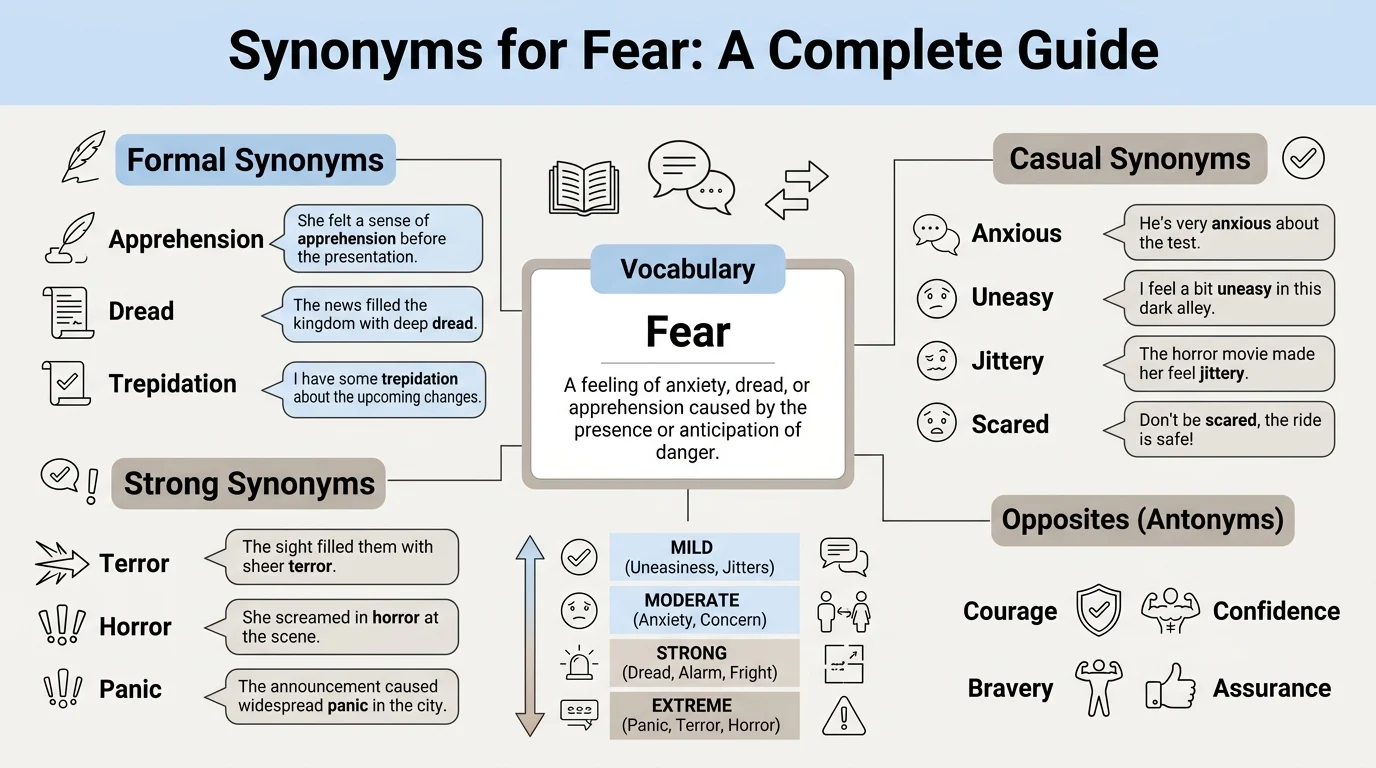
Fear is an unpleasant emotion caused by the threat of danger, pain, or harm. The best synonyms depend on your context. For formal writing, use “apprehension” or “trepidation.” For casual conversation, try “worry” or “concern.” Each synonym carries a unique tone and level of intensity.
Meaning, Tone and Context
Simple Definition
Fear is the emotional response to perceived threat or danger. It can be a mild unease or an overwhelming panic.
Part of Speech
Fear functions as a noun and a verb. The adjective forms include “fearful” and “fearsome.” The adverb is “fearfully.”
Tone
Fear is a negative emotion word. It carries a serious, sometimes heavy tone depending on context.
Formality Level
Fear is neutral and works in almost any setting. Some synonyms are more formal or casual.
Common Use Cases
You will use fear in psychological discussions, creative writing, professional risk assessments, personal stories, and everyday conversation.
Important Word Forms
The verb “to fear” means to be afraid of something. “Fearless” is the opposite. “Fearsome” describes something that causes fear.
When and How to Use “Fear”
Use “fear” when you want a straightforward, universally understood word for being afraid. It works in almost every situation without sounding too dramatic or too mild.
The word is particularly effective when you want to communicate a genuine emotional response. It is the safest choice when you are unsure which synonym fits best.
Professional Context
The project manager expressed fear that the timeline would not be met without additional resources.
Personal Context
I have a fear of public speaking that makes presentations challenging.
Academic Context
The study examined how childhood trauma contributes to fear responses in adults.
Emotional Context
She could not hide the fear in her voice when she described the accident.
Creative Writing
Fear crept through the dark hallway like a living shadow.
Social Media
Overcoming my fear of failure has been the most important lesson this year.
Email Context
I write with some fear that this proposal may not fully address your concerns.
Another Word for “Fear”
Finding the perfect replacement for fear depends entirely on your situation. The right synonym can elevate your writing and communicate your exact meaning.
Professional Writing
Use “concern” when you want to sound measured and businesslike. It shows awareness without emotional excess.
Academic Writing
Choose “anxiety” for psychological contexts. Use “apprehension” for more formal scholarly work.
Casual Conversation
Go with “worry” for everyday discussions. It feels natural and relatable.
Emotional Writing
Select “dread” to convey a deep, sinking feeling. “Terror” works for extreme situations.
Creative Writing
Use “trepidation” for literary effect. “Foreboding” adds atmosphere and suspense.
Resume or Workplace
Replace fear with “concern” in professional documents. It sounds more composed and less emotional.
Social Media Captions
Try “anxiety” or “nerves” for relatable content. These words resonate with online audiences.
Stronger Meaning
Use “terror” or “horror” for the most intense fear. These words describe paralyzing experiences.
Softer Meaning
Choose “unease” or “discomfort” for mild situations. These words suggest slight nervousness.
When Not to Use “Fear”
Fear becomes too vague when you need to describe a specific type of anxiety. Repeated use makes your writing feel lazy and imprecise.
Too Vague
“Fear” does not distinguish between mild worry and absolute terror. Your reader will not know the intensity you mean.
Weak Sentence: I felt fear before the interview.
Improved: I felt nervous anticipation before the interview.
Too Casual for Formal Writing
In academic papers, “fear” lacks the precision required for scholarly discussion.
Weak Sentence: The subjects showed fear during the experiment.
Improved: The subjects exhibited measurable anxiety responses during the experiment.
Too General for Professional Communication
Business contexts demand more measured language. “Fear” can sound unprofessional.
Weak Sentence: I fear we will miss the deadline.
Improved: I am concerned about our ability to meet the deadline.
Words Commonly Confused With “Fear”
Many words relate to fear but carry distinct meanings. Understanding these differences will help you choose the right word every time.
Fear vs. Anxiety
Fear is a response to a specific, present threat. Anxiety is a general feeling of worry about future events.
Use fear for immediate danger. Use anxiety for ongoing worry.
Fear vs. Dread
Fear is broad and can be mild. Dread is a deep, sinking anticipation of something terrible.
Dread is more intense and specific than general fear.
Fear vs. Terror
Terror is fear at its most extreme. It suggests complete loss of control.
Use terror only for overwhelming, paralyzing situations.
Fear vs. Apprehension
Apprehension is fear about something that might happen. It is more intellectual than emotional.
Apprehension works well in formal contexts.
Fear vs. Phobia
A phobia is an irrational, persistent fear of a specific thing. Fear is a normal emotional response.
Use phobia for clinical or psychological discussion.
Fear vs. Panic
Panic is a sudden, uncontrollable fear that leads to irrational behavior. It is more urgent than fear.
Use panic for immediate, disruptive reactions.
Best Synonym by Context for “Fear”
| Context | Best Synonym | Why It Works | Example |
|---|---|---|---|
| Formal Writing | Apprehension | Sounds measured and academic | The committee viewed the proposal with apprehension. |
| Academic Writing | Anxiety | Precise psychological terminology | The study measured anxiety levels in participants. |
| Professional Business | Concern | Professional and composed | We have concerns about the quarterly projections. |
| Resume Writing | Concern | Shows awareness without weakness | I addressed safety concerns in the previous role. |
| Casual Conversation | Worry | Natural and relatable | I worry about my kids sometimes. |
| Creative Writing | Trepidation | Literary and atmospheric | She entered the room with visible trepidation. |
| Emotional Tone | Dread | Conveys deep, sinking feeling | A sense of dread settled over him. |
| Strong Intensity | Terror | Describes paralyzing fear | The passengers experienced sheer terror. |
| Soft Tone | Unease | Suggests mild discomfort | He felt a vague unease about the decision. |
| Social Media | Nerves | Modern and conversational | My nerves are shot before this exam. |
| US Usage | Fear | Universal American English | She has a fear of heights. |
| UK Usage | Fright | Common British English | He got a fright from the loud noise. |
Which Synonym Should You Choose?
Selecting the right synonym depends on several factors. Consider the intensity of the emotion you want to express.
Think about your audience and the formality level required. Academic audiences expect precision. Professional audiences expect composure. Casual audiences expect relatability.
Consider the emotional weight you want to carry. Stronger synonyms like “terror” or “horror” are best for dramatic situations. Milder options like “unease” work for everyday discomfort.
Look at the structure of your sentence. Some synonyms pair better with certain prepositions. For example, you feel “fear of” something but “anxiety about” something.
Real Life Examples of “Fear” in Sentences
School Setting
The student felt a genuine fear of failing the final exam, but she channeled that emotion into focused study sessions.
Workplace Context
Our team leader addressed our collective fear of layoffs with transparent communication and regular updates.
Creative Writing
Fear wrapped around his chest like a tightening band, making each breath a conscious effort.
Everyday Conversation
I have a real fear of driving on icy roads after last winter’s accident.
Social Media Post
Learning to sit with my fear instead of running from it has changed my entire perspective.
Professional Email
I have some fear that our main competitor will release a similar product before our launch date.
Storytelling
The child’s fear of the dark vanished when she discovered the magic of starry night skies.
25 Synonyms for “Fear”
| Synonym | Simple Meaning | Best Used For | Example Sentence |
|---|---|---|---|
| Apprehension | Fear about a future event | Formal and academic writing | Her apprehension about the surgery was understandable. |
| Anxiety | Persistent worry or unease | Psychological or casual contexts | His anxiety about finances kept him awake at night. |
| Dread | Deep, sinking anticipation of doom | Emotional and creative writing | A sense of dread filled the abandoned house. |
| Terror | Extreme, overwhelming fear | Dramatic or intense situations | The passengers faced sheer terror during the turbulence. |
| Alarm | Sudden fear from immediate danger | Urgent or warning situations | The alarm in her voice was unmistakable. |
| Panic | Sudden, uncontrollable fear | Emergency or chaotic events | Panic spread through the crowd at the loud noise. |
| Trepidation | Nervous fear about something | Literary or sophisticated contexts | He approached the stage with trepidation. |
| Worry | Mild fear about potential problems | Casual conversation and daily use | She expressed worry about her test scores. |
| Concern | Careful attention to potential risk | Professional and business contexts | We have concern about the environmental impact. |
| Unease | Slight discomfort or nervousness | Softening fear in conversation | He felt a vague unease about the new plan. |
| Foreboding | Sense that something bad will happen | Creative and atmospheric writing | A sense of foreboding hung over the castle. |
| Fright | Sudden, brief fear | Informal and British English | The sudden noise gave her quite a fright. |
| Horror | Fear mixed with shock or disgust | Strong emotional situations | The horror of the accident was indescribable. |
| Phobia | Irrational, persistent fear | Clinical or psychological contexts | Her phobia of spiders made summer difficult. |
| Misgiving | Feeling of doubt about something | Formal or cautious situations | He had misgivings about the investment. |
Synonym Groups and Usage Differences
Professional vs. Personal Synonyms
Professional settings favor measured language. “Concern” and “apprehension” sound composed and thoughtful. Personal contexts allow for more emotional words like “worry” or “dread.”
Formal vs. Conversational Synonyms
Formal writing benefits from “trepidation” and “misgiving.” These words add sophistication to academic or professional documents. Casual writing welcomes “scare” and “worry” for natural conversation.
Academic Synonyms
“Anxiety,” “apprehension,” and “phobia” are precise terms used in psychology and research papers. These words carry scientific weight and specific meanings.
Professional and Business Synonyms
“Concern” and “apprehension” are ideal for workplace communication. They show awareness without emotional excess. “Risk” is also useful in business contexts.
Creative or Literary Synonyms
“Foreboding,” “trepidation,” and “dread” add depth to fiction and poetry. These words create atmosphere and emotional resonance.
Strongest vs. Weaker Synonyms
Mild: Concern, unease, worry
Moderate: Apprehension, anxiety, fear
Strong: Dread, terror, horror
Extreme: Panic, fright, alarm
Emotional vs. Neutral Synonyms
Emotional words like “dread” and “terror” carry strong feelings. Neutral options like “concern” and “apprehension” are more measured and intellectual.
Antonyms of “Fear”
| Antonym | Meaning | Example Sentence |
|---|---|---|
| Courage | Ability to face danger bravely | Her courage inspired everyone during the crisis. |
| Confidence | Belief in your own abilities | His confidence grew with each successful presentation. |
| Bravery | Willingness to face fear | The soldier’s bravery saved many lives. |
| Fearlessness | Complete absence of fear | Her fearlessness in business is admirable. |
| Calm | Peaceful state of mind | He remained calm despite the chaos. |
| Serenity | Complete peace and tranquility | The garden provided a sense of serenity. |
| Boldness | Willingness to take risks | Her boldness in negotiations impressed the board. |
| Courageousness | Quality of being brave | His courageousness made him a natural leader. |
| Intrepidity | Fearless courage | The explorer’s intrepidity was legendary. |
| Valiance | Great courage under pressure | The firefighter received recognition for his valiance. |
| Assurance | Certainty and confidence | She spoke with complete assurance about the project. |
| Fortitude | Mental strength in difficulty | He showed remarkable fortitude during his illness. |
| Heroism | Great bravery in difficult situations | The rescuer’s heroism saved the trapped child. |
| Daring | Adventurous courage | His daring approach led to breakthrough discoveries. |
| Pluck | Determined courage | The young athlete showed real pluck in the competition. |
Comparison: Fear vs. Similar Words
Fear vs. Anxiety
Main Difference: Fear is a response to a specific immediate threat. Anxiety is ongoing worry about potential future problems.
Which is Stronger: Both can be strong, but fear is more intense in the moment. Anxiety can be chronic and debilitating.
Which is More Formal: Anxiety is more clinical and formal. Fear is more neutral.
Example with fear: She felt fear when the dog barked loudly.
Example with Anxiety: She experiences anxiety about social situations.
Fear vs. Dread
Main Difference: Dread is the anticipation of something terrible. Fear can be about present or future situations.
Which is Stronger: Dread often carries a deeper, more oppressive feeling than general fear.
Which is More Formal: Both work in formal contexts, but dread is more literary.
Example with Fear: He has a fear of flying.
Example with Dread: She felt dread as the exam date approached.
Fear vs. Terror
Main Difference: Terror is the highest intensity of fear. It suggests complete loss of control.
Which is Stronger: Terror is significantly stronger than fear.
Which is More Formal: Terror is used in serious contexts like terrorist attacks or horror fiction.
Example with Fear: The child had a fear of the dark.
Example with Terror: He watched in terror as the car came toward him.
Fear vs. Apprehension
Main Difference: Apprehension is intellectual fear about future possibilities. Fear is more emotional and immediate.
Which is Stronger: Fear is often stronger and more visceral.
Which is More Formal: Apprehension is more formal and academic.
Example with Fear: She felt fear when she saw the snake.
Example with Apprehension: He approached the meeting with apprehension.
Fear vs. Panic
Main Difference: Panic is sudden, overwhelming fear that disrupts rational thinking. Fear can be controlled.
Which is Stronger: Panic is more intense and immediate.
Which is More Formal: Panic is used in psychological and emergency contexts.
Example with Fear: She has a fear of crowds.
Example with Panic: He panicked when he lost his wallet.
Common Phrases and Expressions with “Fear”
1. Fear of the Unknown
Meaning: Anxiety about uncertain future events or unfamiliar situations.
Example: Many people stay in unsatisfying jobs because of their fear of the unknown.
2. Strike Fear Into
Meaning: Cause someone to feel intense fear.
Example: The villain’s reputation struck fear into the hearts of the townspeople.
3. For Fear of
Meaning: To avoid something because of fear.
Example: She stayed quiet for fear of sounding in the meeting.
4. Fear and Loathing
Meaning: Intense fear combined with strong dislike.
Example: His fear and loathing of public speaking prevented him from advancing in his career.
5. In Fear of One’s Life
Meaning: Being afraid of being killed.
Example: The witness went into hiding in fear of his life.
6. No Fear
Meaning: A phrase meaning “certainly not” or “definitely.”
Example: Would I jump off that cliff? No fear.
7. Fear Factor
Meaning: An element that causes fear or anxiety.
Example: The fear factor in that roller coaster is what makes it so popular.
Common Mistakes to Avoid
1. Using Fear When a More Precise Synonym Works Better
Fear is too general for many situations. Choose a specific synonym for clarity.
2. Confusing Fear with Similar Words
Do not use “anxiety” when you mean “terror.” Intensity matters.
3. Using Casual Synonyms in Formal Writing
“Scare” has no place in academic papers. Use “apprehension” or “concern.”
4. Using Overly Dramatic Synonyms for Simple Situations
Saying you feel “terror” about a test is exaggerated. Use “worry” or “nerves.”
5. Repeating the Same Word Too Often
Variety keeps your writing engaging. Use different synonyms throughout.
6. Choosing a Synonym with the Wrong Emotional Tone
“Terror” suggests extreme fear, not mild discomfort. Match intensity to the situation.
7. Using Slang in Academic or Professional Writing
Save “freaked out” for casual conversation. Use proper synonyms in formal contexts.
FAQs
What is the best synonym for fear?
The best synonym depends on context. “Apprehension” works for formal writing, “worry” for casual use, and “terror” for intense situations.
What is a formal synonym for fear?
“Apprehension” and “trepidation” are excellent formal synonyms for fear in academic or professional writing.
What is an informal synonym for fear?
Worry,” “scare,” and “nerves” are common informal synonyms for everyday conversation.
What is another word for fear in professional writing?
“Concern” is the most appropriate professional synonym for fear in business communication.
What is the difference between fear and anxiety?
Fear is a response to a specific threat. Anxiety is general worry about future possibilities.
What is the opposite of fear?
Courage is the primary opposite of fear. Other antonyms include confidence, bravery, and fearlessness.
Conclusion
Fear is a powerful and versatile word, but it should not be your only option. Understanding the nuances between synonyms allows you to express exactly the right shade of emotion.
The best synonym depends on your context, audience, and the intensity you want to convey. Formal situations call for “apprehension” or “concern.” Casual conversations welcome “worry” or “nerves.” Creative writing thrives on “dread” and “foreboding.”
Remember to verify your synonym choices with trusted dictionaries. Your vocabulary will grow richer with practice and attention to context.