Have you ever found yourself writing an essay, a business report, or a social media post and realized you have used the word “holistic” three times in two paragraphs? It happens to everyone. The word is useful, but overusing it makes your writing feel repetitive and lazy. When you search for synonyms of holistic, you are not just looking for a list of words. You want to understand which alternative fits your specific situation. Choosing the right synonym improves your clarity and makes your communication sound more polished. This guide will help you master the word and all its best alternatives.
What Are the Best Synonyms of “Holistic”?
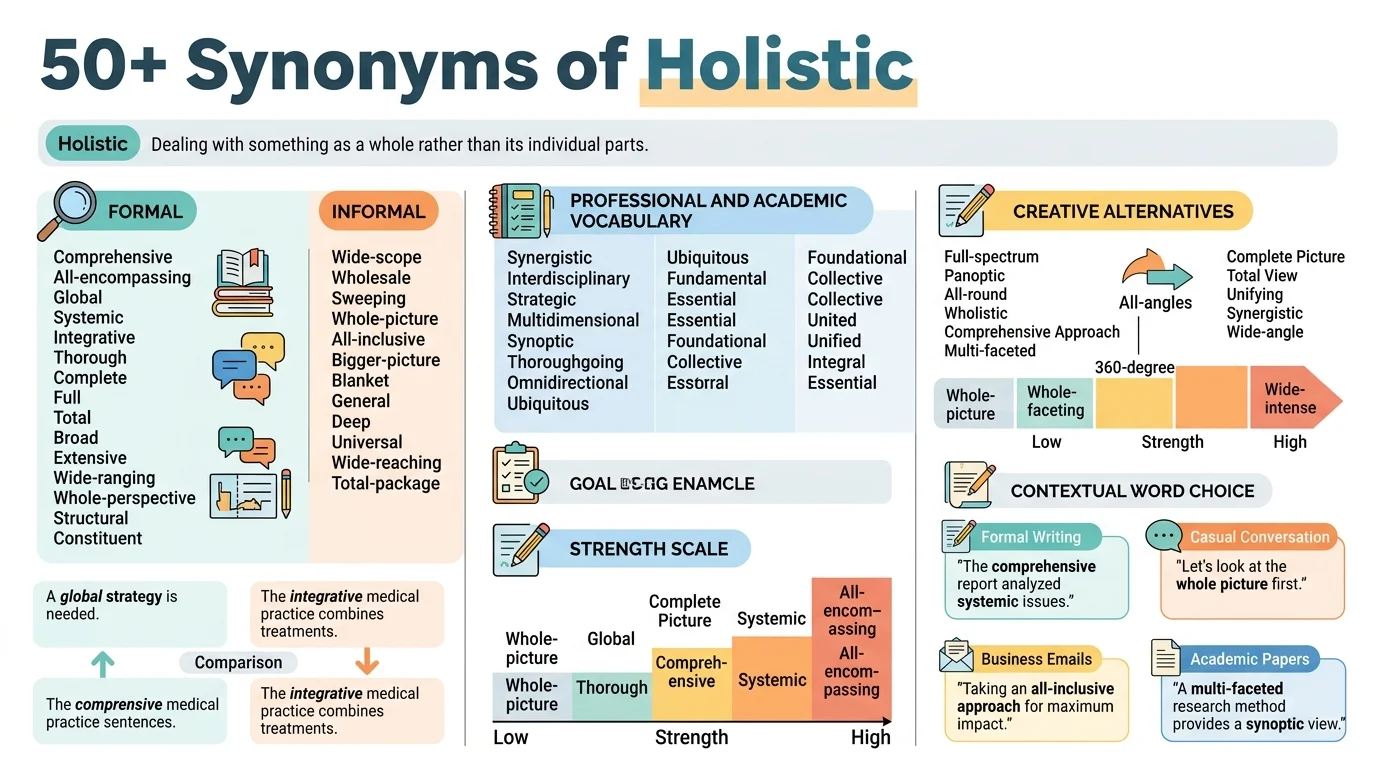
Holistic means considering the whole system or complete picture rather than focusing on individual parts. The best synonyms depend on your context. For formal writing, choose “comprehensive” or “integrated.” For casual conversation, try “big picture” or “all around.” In academic writing, use “systemic” or “exhaustive.” Professional communication benefits from “all inclusive” or “complete.”
Meaning, Tone, and Context
Simple Definition
Holistic describes an approach that considers every part of a system as interconnected. It emphasizes the whole rather than isolated pieces. When you think holistically, you recognize that everything affects everything else.
Part of Speech
Holistic is an adjective. It modifies nouns to describe a comprehensive viewpoint.
Overall Tone
The word is generally positive and insightful. It suggests wisdom, thoroughness, and a mature understanding of complexity. People view holistic approaches as more intelligent and thoughtful.
Formality Level
Holistic is semi formal to formal. You will hear it in professional settings, academic papers, and healthcare discussions. It feels too serious for casual texting but works well in most written communication.
Common Uses
Native English speakers use holistic in several fields. Healthcare professionals talk about holistic medicine. Business leaders describe holistic strategies. Educators use holistic assessment methods. Environmentalists discuss holistic ecological approaches. The word appears in any context where understanding the complete picture matters.
Word Forms
- Noun: Holism (the philosophy or practice of considering wholes)
- Adjective: Holistic (the most common form)
- Adverb: Holistically (describing the manner of thinking or acting)
When and How to Use “Holistic”
Choose holistic when you want to emphasize that you are considering every angle. Use it when you want to sound thoughtful, thorough, and wise in your decision making. It works best in discussions of systems, organizations, health, education, and complex problems.
Professional Context
Our team adopted a holistic approach to project management, which improved coordination across all departments.
Academic Context
The research paper presented a holistic framework for understanding climate change impacts on coastal communities.
Workplace Context
She suggested a holistic review of company policies rather than fixing one issue at a time.
Personal Context
I started taking a holistic view of my health by paying attention to sleep, nutrition, and stress levels together.
Email Context
Please take a holistic look at the quarterly numbers before we meet to discuss next steps.
Resume Context
Developed holistic training programs that addressed both technical skills and professional development.
Social Media Context
Taking a holistic approach to wellness changed my entire perspective on daily habits.
Best Synonyms of “Holistic”
No synonym captures every nuance of holistic in every situation. Each alternative carries its own shade of meaning, formality level, and emotional weight. Here are the best recommendations for specific contexts.
Professional Writing
Comprehensive is the strongest professional alternative. It communicates thoroughness without sounding academic. Your boss will understand exactly what you mean.
Academic Writing
Systemic works best in scholarly contexts. It emphasizes the interconnected nature of systems and appeals to academic readers.
Business Communication
Integrated fits business settings perfectly. It suggests that different elements have been combined into a functioning whole.
Casual Conversation
Big picture is the most natural conversational choice. Native speakers use this phrase frequently in everyday talk.
Emotional Writing
Wholistic (with a “w”) adds a gentle, soulful quality. Some people use this spelling to emphasize emotional and spiritual dimensions.
Creative Writing
All embracing creates a warm, inclusive image. It works well in descriptive and narrative writing.
Resume Writing
Cross functional demonstrates that you understand how different areas connect. Employers value this language.
Workplace Communication
End to end shows you understand complete processes. It is practical and action oriented.
Stronger Meaning
Exhaustive conveys the strongest sense of completeness. Use this when you want to emphasize thorough investigation.
Softer Meaning
Broad offers a gentler alternative. It suggests a wide view without the full weight of holistic.
When Not to Use “Holistic”
Holistic sounds out of place in certain situations. Understanding when to avoid it makes your writing stronger.
When It Sounds Too General
Using holistic without specifics weakens your message. It becomes a vague buzzword that adds little meaning.
Incorrect: We need a holistic solution.
Better: We need a solution that addresses budgeting, staffing, and timelines together.
When It Sounds Too Formal
Holistic feels heavy in casual conversations with friends or family.
Incorrect: I am taking a holistic approach to planning my birthday party.
Better: I am thinking about everything for my birthday party.
When It Sounds Too Academic
Sometimes the word makes you sound pretentious, especially in simple everyday situations.
Incorrect: My holistic grocery shopping list includes every food group.
Better: My grocery list covers all the food groups.
When It Is Too Weak
Sometimes you need a word with more power. Holistic describes approach, but it does not describe intensity.
Incorrect: We conducted a holistic investigation.
Better: We conducted an exhaustive investigation.
Words Commonly Confused With “Holistic”
Several words overlap with holistic in meaning but serve different purposes. Understanding these distinctions helps you choose the right word.
Comprehensive
Difference: Comprehensive means including all elements. Holistic emphasizes the relationship between elements.
When to Use It: Use comprehensive when listing complete coverage.
Example: The comprehensive guide covers every chapter in the textbook.
Systemic
Difference: Systemic focuses on systems as a whole. Holistic emphasizes the interconnectedness of parts.
When to Use It: Use systemic when discussing problems that exist within a system.
Example: The company faced systemic issues in its supply chain.
Integrated
Difference: Integrated describes elements that have been combined. Holistic describes the viewpoint that sees them as combined.
When to Use It: Use integrated when discussing combined processes or teams.
Example: The integrated software platform connects all our tools.
Exhaustive
Difference: Exhaustive emphasizes completeness and thoroughness. Holistic emphasizes the whole picture.
When to Use It: Use exhaustive when you have examined every possible detail.
Example: The exhaustive report analyzed every piece of data.
Broad
Difference: Broad suggests width but not necessarily depth. Holistic suggests depth and interconnectedness.
When to Use It: Use broad for general descriptions without deep analysis.
Example: The broad overview covered the main topics quickly.
Wholistic
Difference: Wholistic is a variant spelling sometimes used to emphasize spiritual or emotional elements.
When to Use It: Use wholistic in wellness or alternative medicine contexts.
Example: She practices wholistic healing that cares for mind and body.
Best Synonyms of “Holistic” by Context
| Context | Best Synonym | Why It Works | Example |
|---|---|---|---|
| Formal writing | Comprehensive | Shows thoroughness without being casual | The comprehensive review addressed all concerns. |
| Academic writing | Systemic | Emphasizes system wide understanding | The systemic analysis revealed unexpected connections. |
| Professional communication | Integrated | Suggests coordination and efficiency | Our integrated strategy combines marketing and sales. |
| Business emails | All inclusive | Clear and professional | Please provide an all inclusive list of expenses. |
| Resume writing | Cross functional | Demonstrates workplace versatility | Managed cross functional teams across departments. |
| Workplace communication | End to end | Shows process understanding | We handle end to end project delivery. |
| Casual conversation | Big picture | Natural and easy to understand | Let’s look at the big picture before deciding. |
| Everyday speaking | Overall | Simple and widely understood | The overall plan makes sense. |
| Creative writing | All embracing | Warm and descriptive | The all embracing garden included flowers, herbs, and vegetables. |
| Storytelling | Sweeping | Adds dramatic quality | A sweeping view of the landscape revealed everything. |
| Emotional writing | Wholistic | Feels gentle and caring | Her wholistic approach to life brought her peace. |
| Strong emphasis | Exhaustive | Conveys absolute thoroughness | The exhaustive investigation left no question unanswered. |
| Mild tone | Broad | Soft without being weak | The broad plan covered the main goals. |
| Social media captions | Full picture | Friendly and visual | Getting the full picture of wellness matters. |
How to Choose the Best Synonym of “Holistic”
Choosing the right synonym requires thinking about your audience and purpose.
Start With Meaning
What are you trying to say? If you want to emphasize completeness, choose “comprehensive.” If you want to emphasize connections, choose “integrated” or “systemic.”
Consider Your Tone
Formal writing needs precise academic words like “systemic.” Casual conversations need simple words like “big picture.” Match your word to your audience.
Think About Your Audience
A business executive understands “integrated.” A friend understands “overall.” Choose words your reader will recognize and appreciate.
Evaluate Emotional Strength
Some words carry more weight than others. “Exhaustive” is strong and serious. “Broad” is mild and approachable. Pick the intensity that fits your message.
Check Your Writing Purpose
Are you writing a research paper? Use “systemic.” Are you writing a social media post? Use “full picture.” The purpose of your writing should guide your word choice.
Prioritize Natural Sounding Usage
Read your sentence aloud. If the synonym sounds forced or awkward, try another word. Natural language always communicates better.
Real Life Examples of “Holistic”
School
The science project required a holistic understanding of how different ecosystems interact with each other.
College
Her holistic approach to studying combined flashcards, group discussions, and practice tests.
Workplace
The manager took a holistic view of the team’s performance rather than focusing on one bad quarter.
Business
Our company uses a holistic business model that considers employees, customers, and community together.
Before making a decision, please take a holistic look at all the options we have discussed.
Resume
Designed holistic employee development programs that improved retention and satisfaction.
Conversation
I am trying to take a more holistic view of my career instead of just chasing promotions.
Storytelling
From her window, she saw the holistic beauty of the city, every neighborhood connected like pieces of a quilt.
Blogging
Living a holistic lifestyle means paying attention to your physical, mental, and emotional health.
Social Media
Taking a holistic approach to wellness transformed my mornings. 🌿 #wellnessjourney
18 Best Synonyms of “Holistic”
| Synonym | Simple Meaning | Best Used For | Example Sentence |
|---|---|---|---|
| Comprehensive | Including everything necessary | Professional and academic writing | The comprehensive report covered every aspect of the project. |
| Systemic | Relating to an entire system | Academic discussions | The systemic problem required changes at every level. |
| Integrated | Combined into a unified whole | Business communication | The integrated marketing strategy boosted sales across channels. |
| All inclusive | Including every element | Formal descriptions | The all inclusive package covered travel, meals, and activities. |
| Exhaustive | Complete and thorough | Strong emphasis | The exhaustive search found the missing documents. |
| Big picture | The overall view | Casual conversation | Let’s look at the big picture before making decisions. |
| Overall | General and total | Everyday writing | The overall plan seems solid and achievable. |
| Broad | Wide in scope | Mild and general use | The broad approach left room for flexibility. |
| Wholistic | Alternative spelling emphasizing spirituality | Wellness and alternative medicine | Her wholistic practice treats the entire person. |
| Cross functional | Involving different areas | Resume and workplace writing | The cross functional team improved company communication. |
| End to end | Complete process coverage | Business and technical writing | We manage end to end delivery for our clients. |
| Sweeping | Wide and dramatic | Creative and descriptive writing | A sweeping solution addressed every department’s needs. |
| All embracing | Including everything warmly | Emotional and narrative writing | The all embracing policy protected every worker. |
| Universal | Applying to all cases | Formal and philosophical writing | Universal health coverage requires a holistic approach. |
| Global | Worldwide or all encompassing | International business | The global strategy accounted for every region’s needs. |
| Inclusive | Covering all groups | Social and organizational writing | The inclusive policy considered every employee’s situation. |
| Thorough | Careful and complete | Professional writing | The thorough analysis left no detail untouched. |
| Unifying | Bringing together | Team and relationship writing | The unifying vision brought different departments together. |
Synonyms of “Holistic” by Usage
Professional vs Personal Synonyms
Professional synonyms work best in workplace settings. “Comprehensive” in reports and presentations. Use “integrated” when describing team collaboration. “Cross functional” on resumes. Use “end to end” for process descriptions. Use “systemic” for organizational analysis.
Personal synonyms sound better in everyday conversations. “Big picture” when talking to friends. Use “overall” for casual descriptions. Use “broad” in relaxed discussions. “All around” in simple conversations.
Formal vs Conversational Synonyms
Formal synonyms belong in reports, essays, and business writing. “Comprehensive” works for academic papers. “Systemic” fits research discussions. “Exhaustive” suits detailed analysis. “Universal” matches philosophical arguments. “Global” fits international presentations.
Conversational synonyms sound natural in everyday talk. “Big picture” is friendly and clear. “Overall” feels simple and direct. “Broad” is easy to understand. “Full picture” works well in texting.
Academic Synonyms
Academic writing demands precision and authority. “Systemic” emphasizes interconnections within systems. “Comprehensive” shows thorough coverage of topics. “Exhaustive” demonstrates complete investigation. “Universal” suggests broad applicability. “Global” indicates worldwide relevance. These words carry weight in scholarly contexts.
Professional and Business Synonyms
Business environments value practical, clear language. “Integrated” shows coordination between departments. “Cross functional” demonstrates team collaboration. “End to end” indicates process management. “All inclusive” covers complete packages. “Thorough” suggests careful attention to detail. These words impress employers and clients.
Creative and Literary Synonyms
Creative writing benefits from expressive alternatives. “All embracing” adds warmth and inclusivity. “Sweeping” creates dramatic imagery. “Unifying” suggests connection and harmony. “Wholistic” brings spiritual undertones. These words add emotion and depth to narratives.
Slang or Modern Synonyms
No genuine slang synonym exists for holistic. The word remains formal in all contexts. Some people use “big picture” as a casual substitute. “Full picture” works as a modern alternative. These phrases function as informal replacements.
Strongest to Mildest Synonyms
Mild: Broad, overall, big picture
Moderate: Comprehensive, integrated, inclusive
Strong: Systemic, exhaustive, universal
Very Strong: All embracing, sweeping, global
Emotional vs Neutral Synonyms
Emotional synonyms express stronger feelings. “Wholistic” feels spiritual and caring. “All embracing” suggests warmth. “Unifying” evokes connection. “Sweeping” creates dramatic emotion.
Neutral synonyms simply communicate information. “Comprehensive” provides factual coverage. “Systemic” describes structure. “Overall” states the general picture. “Thorough” indicates careful work.
Antonyms of “Holistic”
| Antonym | Meaning | Example Sentence |
|---|---|---|
| Narrow | Limited in scope | His narrow view ignored important factors. |
| Partial | Incomplete | The partial solution failed to address the real problem. |
| Segmented | Divided into separate parts | The segmented approach caused confusion between teams. |
| Fragmented | Broken into disconnected pieces | Their fragmented efforts produced no unified results. |
| Isolated | Separate and alone | The isolated decision affected only one department. |
| Limited | Restricted in range | A limited perspective prevented them from seeing solutions. |
| Specific | Focused on one detail | The specific analysis missed the broader context. |
| Selective | Choosing certain elements | Selective attention meant they overlooked key issues. |
| Incomplete | Not finished or whole | The incomplete assessment left many questions unanswered. |
| Narrow minded | Unwilling to see the whole | Her narrow minded attitude hurt team morale. |
| Component | Relating to individual parts | The component review ignored system interactions. |
| Localized | Confined to one area | The localized fix did not solve regional problems. |
| Insular | Isolated from others | The insular team refused to collaborate. |
| Disconnected | Lacking connection | Disconnected departments caused communication failures. |
| Reductionist | Explaining wholes through parts | The reductionist approach oversimplified complex issues. |
Comparison: “Holistic” vs Similar Words
Holistic vs Comprehensive
Main Difference: Holistic emphasizes interconnections and relationships. Comprehensive emphasizes including every item or element.
Which Is Stronger? Comprehensive is stronger for coverage. Holistic is stronger for understanding.
Which Is More Formal? Both are formal, but comprehensive appears more frequently in business contexts.
When to Use Each: Use holistic when discussing how parts relate. Use comprehensive when listing everything included.
Examples:
Holistic: Her holistic health plan considered diet, exercise, and stress.
Comprehensive: The comprehensive manual covered every repair procedure.
Holistic vs Systemic
Main Difference: Holistic describes a viewpoint that sees wholes. Systemic describes problems or features that exist within systems.
Which Is Stronger? Systemic is stronger for diagnosing system wide issues.
Which Is More Formal? Systemic is more academic and technical.
When to Use Each: Use holistic for general thinking approaches. Use systemic for specific system problems.
Examples:
Holistic: A holistic approach to education values arts and sciences equally.
Systemic: The company faced systemic racism in its hiring practices.
Holistic vs Integrated
Main Difference: Holistic describes how you see things. Integrated describes how things have been combined.
Which Is Stronger? Integrated is stronger for describing action. Holistic is stronger for describing thought.
Which Is More Formal? Both are professional, but integrated is more business oriented.
When to Use Each: Use holistic for perspectives. Use integrated for processes and systems.
Examples:
Holistic: Her holistic view of the market considered every competitor.
Integrated: The integrated system connected sales, marketing, and support.
Holistic vs Exhaustive
Main Difference: Holistic emphasizes seeing everything together. Exhaustive emphasizes leaving nothing out.
Which Is Stronger? Exhaustive is stronger for intensity and completion.
Which Is More Formal? Exhaustive is more formal and academic.
When to Use Each: Use holistic for approaches and frameworks. Use exhaustive for investigations and research.
Examples:
Holistic: The holistic evaluation considered all team members.
Exhaustive: The exhaustive evaluation examined every data point.
Holistic vs Broad
Main Difference: Holistic suggests depth and connection. Broad suggests width without depth.
Which Is Stronger? Holistic is stronger because it implies deeper understanding.
Which Is More Formal? Holistic is more formal. Broad is widely used in all contexts.
When to Use Each: Use holistic when you mean thorough understanding. Use broad when you mean general coverage.
Examples:
Holistic: We need a holistic solution to this complex problem.
Broad: We need a broad outline of the proposal.
Holistic vs Overall
Main Difference: Holistic suggests thoughtful integration. Overall suggests summary or general assessment.
Which Is Stronger? Holistic is stronger and more specific.
Which Is More Formal? Holistic is more formal. Overall is neutral.
When to Use Each: Use holistic for approaches and strategies. Use overall for simple summaries.
Examples:
Holistic: The holistic wellness center treats mind, body, and spirit.
Overall: The overall sales number increased this quarter.
Common Phrases and Expressions with “Holistic”
Holistic Approach
Meaning: A method that considers every part as connected and important.
Example Sentence: The teacher used a holistic approach to help students develop academically and socially.
Holistic Health
Meaning: Health care that treats the entire person, not just symptoms.
Example Sentence: She switched to holistic health practices that included meditation and nutritional counseling.
Holistic View
Meaning: A perspective that sees the complete picture.
Example Sentence: You need a holistic view of the economy to understand inflation.
Holistic Thinking
Meaning: The process of considering all factors together.
Example Sentence: Holistic thinking helps leaders make better strategic decisions.
Holistic Medicine
Meaning: Medical practices that treat physical, mental, and spiritual health.
Example Sentence: Holistic medicine has gained acceptance in mainstream healthcare.
Holistic Education
Meaning: Teaching that develops intellectual, emotional, and social skills.
Example Sentence: The school adopted holistic education to prepare students for life.
Holistic Development
Meaning: Growth that happens in all areas simultaneously.
Example Sentence: The program supports holistic development in young children.
Holistic Solution
Meaning: A solution that addresses every aspect of a problem.
Example Sentence: The consulting firm proposed a holistic solution for the company’s challenges.
Common Mistakes to Avoid
1: Using “Holistic” Too Vaguely
Saying “holistic approach” without details sounds like business jargon.
Incorrect: We need a holistic approach.
Better: We need a holistic approach that connects marketing, sales, and customer service.
Why: Specific details make your writing stronger and more meaningful.
2: Confusing “Holistic” with “Wholesome”
These words are not interchangeable.
Incorrect: She has a holistic smile.
Better: She takes a holistic approach to her health.
Why: Holistic describes views and systems, not personal qualities.
3: Using “Holistic” Too Often
Repeating the same word makes your writing boring.
Incorrect: The holistic plan requires holistic thinking and a holistic team.
Better: The comprehensive plan requires integrated thinking and a cross functional team.
Why: Varied vocabulary keeps readers engaged.
4: Using “Holistic” in Casual Situations
The word sounds formal and academic.
Incorrect: I want a holistic snack that covers all food groups.
Better: I want a snack that has protein, carbs, and fruit.
Why: Simple language suits casual conversations.
5: Choosing the Wrong Emotional Tone
Some synonyms sound too strong or too weak.
Incorrect: We conducted a broad investigation of the fraud.
Better: We conducted an exhaustive investigation of the fraud.
Why: “Broad” sounds too casual for serious situations.
6: Using “Systemic” When You Mean “Holistic”
These words are related but not identical.
Incorrect: The school needs a systemic approach to student success.
Better: The school needs a holistic approach to student success.
Why: Holistic emphasizes the whole student. Systemic emphasizes the system.
7: Using Slang in Professional Writing
No slang exists for holistic, so don’t force it.
Incorrect: We need a big picture solution for our clients.
Better: We need an integrated solution for our clients.
Why: “Big picture” sounds too casual in professional emails.
Frequently Asked Questions
1. What are the best synonyms of holistic?
The best synonyms of holistic depend on context. Use “comprehensive” for formal writing, “big picture” for conversation, and “systemic” for academic work. “Integrated” and “all inclusive” work well in professional settings.
2. What are the best formal synonyms of holistic?
The best formal synonyms of holistic are “comprehensive,” “systemic,” “exhaustive,” and “universal.” These words appear in academic papers, business reports, and professional correspondence where formal language is expected.
3. What are common informal synonyms of holistic?
Common informal synonyms of holistic include “big picture,” “overall,” “broad,” and “full picture.” Native speakers use these phrases in everyday conversation, texting, and casual social media posts.
4. What is another word for holistic in professional writing?
Another word for holistic in professional writing is “integrated.” You can also use “cross functional” for teamwork contexts or “end to end” for process descriptions. “Comprehensive” works well in most business documents.
5. What is the difference between holistic and comprehensive?
Holistic emphasizes seeing relationships between parts while comprehensive emphasizes including everything. You use holistic for understanding connections and comprehensive for covering all elements. They serve different purposes in writing.
6. What is the opposite of holistic?
The opposite of holistic includes “narrow,” “fragmented,” “segmented,” and “partial.” These words describe approaches that focus on individual parts instead of the complete system. “Reductionist” is another common antonym.
Conclusion
Holistic describes the valuable ability to see the complete picture. The word carries weight in professional, academic, and personal contexts. No single synonym works perfectly in every situation. “Comprehensive” excels in formal writing. “Big picture” fits casual conversation. “Integrated” works well in business settings. “Systemic” serves academic purposes. The best writers choose synonyms based on their audience, tone, and purpose. Start paying attention to which word feels most natural in your writing. Experiment with different alternatives. Your communication will become clearer and more effective. For more vocabulary guidance, explore synonyms of related words like comprehensive, integrated, and systemic. The right word makes all the difference.