Have you ever caught yourself using the word “life” over and over in a single paragraph? You are writing an email, crafting a social media caption, or working on an important essay. You know you need variety, but your mind goes blank.
The word “life” appears everywhere. We talk about work life, personal life, daily life, and professional life. We discuss life experiences, life goals, and life lessons. Repetition makes your writing feel dull and unpolished.
This guide will give you powerful alternatives. You will learn exactly which synonym fits each situation. Whether you are a student, writer, professional, or job seeker, you will find the perfect word choice here.
What Does “Life” Mean?
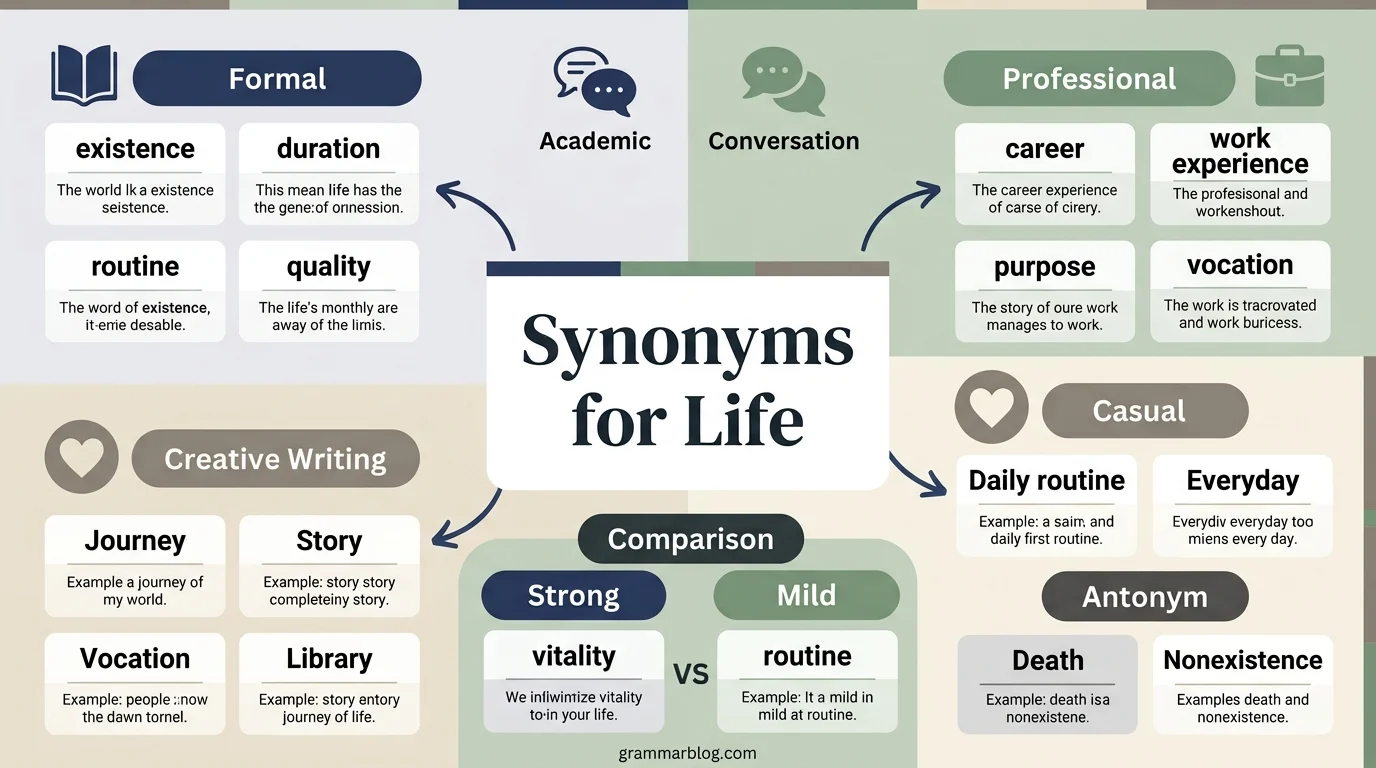
Life means the existence of an individual human being or living organism. The best synonyms depend on your context. For formal writing, use existence or being. casual conversation, try daily routine or way of living. For emotional writing, consider journey or experience. professional use, choose career or lifestyle.
Meaning, Tone and Context
- Simple definition
Life refers to the state of being alive, the period between birth and death, or the way someone lives. - Part of speech
Life is a noun. - Positive, negative, or neutral tone
Life is neutral. It becomes positive or negative based on the words you pair with it. Good life sounds positive. Hard life sounds negative. - Formality level
Life is neutral and works in every level of formality. It appears in academic writing, casual speech, professional emails, and creative work. - Common use cases
You use life when describing personal experiences, professional paths, daily existence, emotional states, and creative stories. It appears in resumes, essays, captions, emails, and conversations. - Important word forms
The adjective form is live as in live events. The verb form is live. The related noun lifestyle describes how someone lives. The opposite form is death.
When and How to Use “Life”
Use life when you need a general word for existence or human experience. It works best for broad statements. For specific situations, choose a more precise synonym.
Here are realistic examples with labeled contexts:
- Professional context
My professional life requires constant learning and adaptation to new technologies. - Personal context
My personal life brings me the most joy through family and close friendships. - Academic context
The study examines quality of life among urban populations over the past decade. - Emotional context
She embraced life with enthusiasm after surviving a serious illness. - Creative context
The artist painted life in all its beautiful, chaotic, and unpredictable forms. - Social media context
Life feels better when you stop and notice the small moments around you. - Resume context
I balance my work life with community service and volunteer leadership roles.
Another Word for “Life”
The best single replacement depends entirely on your context and audience. Consider these direct suggestions:
- Professional writing
Use career or profession when referring to work life. Use operations when describing organizational life. Use tenure when discussing time in a position. - Academic writing
Use existence to discuss philosophical concepts. Use duration for time based studies. Use organism for biological contexts. - Casual conversation
Use everyday life or daily routine when discussing regular activities. Use way of living when describing habits. - Emotional writing
Use journey when describing personal growth. Use experience when focusing on events. Use story when telling a personal narrative. - Creative writing
Use existence for philosophical depth. Use being for abstract concepts. Use vitality for energy and spirit. - Resume or workplace use
Use career path for professional growth. Use work experience for job history. Use professional journey for career development. - Social media captions
Use everyday for relatable content. Use lifestyle for aspirational posts. Use moments for quick, meaningful updates. - Stronger meaning
Use vitality to emphasize energy and vigor. Use existence to emphasize the fact of being alive. - Softer meaning
Use daily routine to downplay importance. Use way of living to sound approachable.
When Not to Use “Life”
Do not use life when you need precision. Life is too general for many situations.
Example of vague usage
“His life changed.” This sentence is too vague. What exactly changed?
Improved with precision
“His career path changed after the promotion.”
Another example
“She loves life.” This sounds generic and lacks depth.
Better alternative
“She loves her daily routine and simple pleasures.”
When writing about specific professional matters, avoid using life. Instead, use career, profession, or work. When describing a single event, avoid life and use experience or moment.
Words Commonly Confused With “Life”
These words often replace life incorrectly. Here is the difference explained simply.
- Life vs. Lifestyle
Life is the general state of being alive. Lifestyle refers to how someone lives, including habits and choices. Lifestyle focuses on specific behaviors. - Life vs. Existence
Existence is more philosophical and abstract. Life is practical and everyday. Existence fits academic and deep discussions better. - Life vs. Spirit
Spirit refers to energy or attitude. Life is the physical state. Spirit describes personality, not biological existence. - Life vs. Soul
Soul has religious or spiritual meaning. Life is neutral and scientific. Soul works for emotional writing about a person’s essence. - Life vs. Career
Career is specifically work related. Life includes everything, work, family, hobbies, and health. - Life vs. Routine
Routine describes repetitive daily activities. Life is much broader and includes everything a person experiences.
Best Synonym by Context for “Life”
| Context | Best Synonym | Why It Works | Example |
|---|---|---|---|
| Formal writing | Existence | This word sounds precise and intellectual. It fits philosophy and academic work. | The study examines human existence in modern society. |
| Academic writing | Duration | This word works for research about time and human experience. | The research measures lifespan duration in various populations. |
| Professional business | Career | This word focuses directly on work related matters. | She built a successful career in financial services. |
| Resume writing | Work experience | This phrase clearly describes job history and qualifications. | My work experience includes management and leadership roles. |
| Casual conversation | Daily routine | This phrase sounds approachable and relatable. | My daily routine includes walking my dog every morning. |
| Creative writing | Journey | This word adds storytelling depth and emotional resonance. | Her journey through the mountains changed her forever. |
| Emotional tone | Experience | This word captures the feeling of events and personal growth. | That experience taught her more than any book could. |
| Strong intensity | Vitality | This word radiates energy, health, and enthusiastic living. | The vitality of the city inspired everyone who visited. |
| Soft moderate tone | Way of living | This phrase sounds gentle and non dramatic. | His way of living focuses on simple pleasures and relationships. |
| Social media captions | Everyday | This word feels relatable and immediate for modern audiences. | Everyday moments are the ones we treasure most. |
| US usage | Life | This word is standard and familiar across all American contexts. | American life values independence and personal freedom. |
Which Synonym Should You Choose?
Choosing the right synonym requires considering several factors.
First, examine your audience. For academic readers, choose existence or duration. For casual readers, pick daily routine or everyday. professional readers, select career or work experience.
Second, consider your purpose. Are you describing a person’s entire existence or just their work? Are you writing emotionally or practically?
Third, think about emotional intensity. Do you want a strong word like vitality or a softer word like way of living? Match the intensity to your message.
Fourth, evaluate your sentence structure. Some synonyms flow better in certain sentences. Try reading your sentence aloud with each option.
Fifth, check for clarity. Does the synonym actually mean what you want to say? Never choose a fancy word that confuses your reader.
Real Life Examples of “Life” in Sentences
These examples show the word life and stronger synonyms across different situations.
School context
“Her academic journey began with a love for reading in elementary school.” This sounds more descriptive than “Her life began with reading.”
Workplace context
“The company values professional development and work experience.” This is more specific than “The company values life.”
Writing context
“The author wrote about human existence in the modern age.” This is more precise than “The author wrote about life.”
Conversation context
“My daily routine includes exercise and healthy meals.” This is clearer than “My life includes exercise.”
Social media context
“Capturing everyday moments that matter.” This sounds more intentional than “Capturing life.”
Resume context
“Five years of work experience in project management.” This is more professional than “Five years of life in project management.”
Email context
“I am grateful for my personal journey and the lessons learned.” This sounds more reflective than “I am grateful for my life.”
Storytelling context
“The traveler’s journey across the ocean changed everything.” This is more vivid than “The traveler’s life changed.”
25 Synonyms for “Life”
| Synonym | Simple Meaning | Best Used For | Example Sentence |
|---|---|---|---|
| Existence | The state of being alive | Academic and philosophical writing | Philosophers debate the meaning of human existence. |
| Being | The state of existing | Creative and abstract contexts | Her being radiated peace and contentment. |
| Duration | The length of time something exists | Formal and scientific writing | The study measured the duration of plant life. |
| Lifetime | The entire period a person lives | General use about time spans | She accomplished her goals within a single lifetime. |
| Vitality | Energy and power to live | Emotional and motivational writing | His vitality inspired everyone at the event. |
| Career | Professional work life | Business and resume contexts | She chose a career that helped others. |
| Journey | Personal path with growth | Creative and emotional storytelling | Her journey taught her patience and strength. |
| Experience | Events and activities lived through | General and reflective writing | That experience shaped her entire perspective. |
| Lifestyle | How someone chooses to live | Casual and health related contexts | He adopted a healthy lifestyle after his diagnosis. |
| Profession | A specific career or job | Workplace and formal writing | Her profession requires continuous education. |
| Routine | Daily habits and activities | Casual and conversational use | My morning routine sets the tone for the day. |
| Story | A personal narrative | Creative and social contexts | His story touched everyone who heard it. |
| Tenure | Time spent in a position | Formal and professional writing | Her tenure at the university lasted thirty years. |
| Course | The direction of a person’s life | Narrative and reflective contexts | The course of his life changed after the accident. |
| Path | The direction someone follows | Creative and motivational writing | She found her true path later in adulthood. |
| Way | A manner or method of living | General conversational use | He made his own way in the world. |
| Biography | Written account of a life | Formal and literary contexts | The biography detailed her rise to fame. |
| History | Past events of a person’s life | Academic and reflective writing | His history included both triumph and struggle. |
| Reality | Actual existence as opposed to fantasy | Contrast and philosophical contexts | She faced reality with courage and strength. |
| Essence | The core nature of a person | Creative and emotional writing | Her essence remained kind despite hardship. |
| Spirit | Energy and attitude toward living | Emotional and motivational contexts | Her spirit refused to give up. |
| Adventure | Exciting or unusual experiences | Creative and casual contexts | Moving abroad became her greatest adventure. |
| Mission | A purpose or calling in life | Motivational and professional contexts | His mission was to educate underprivileged children. |
| Vocation | A strong feeling of career calling | Formal and professional contexts | She found her vocation in teaching. |
| Quality of life | Overall wellbeing and satisfaction | Academic and health contexts | The program improved quality of life for patients. |
Synonym Groups and Usage Differences
Professional vs. Personal Synonyms
Professional synonyms focus on work and career. Career, profession, tenure, and work experience all describe the work aspect of life. These words sound appropriate in resumes, emails, and business meetings.
Personal synonyms describe the private sphere. Routine, daily life, and way of living fit personal conversations. These words sound warm and approachable.
Formal vs. Conversational Synonyms
Formal synonyms fit reports, essays, and speeches. Existence, duration, biography, and quality of life sound scholarly and precise.
Conversational synonyms fit texts, captions, and casual talk. Everyday, routine, lifestyle, and adventure feel natural in everyday speech.
Academic Synonyms
Academic contexts demand precision. Existence works for philosophy. Duration works for time studies. Quality of life works for health research. History works for social sciences.
Professional and Business Synonyms
Business settings require clear, concise language. Career, profession, vocation, and tenure communicate professionalism. These words show you understand workplace norms.
Creative or Literary Synonyms
Creative writing benefits from imagery and emotion. Journey, story, adventure, essence, and spirit add depth and feeling. These words paint pictures in the reader’s mind.
Strongest vs. Weaker Synonyms
Intensity scale from mild to strongest:
Mild: routine, daily life, way of living
Moderate: experience, lifestyle, path
Strong: existence, being, history
Strongest: vitality, essence, spirit
Emotional vs. Neutral Synonyms
Emotional synonyms add feeling and depth. Journey, story, spirit, essence, and adventure carry emotional weight.
Neutral synonyms stay factual and objective. Existence, duration, tenure, and profession avoid emotional coloring.
Antonyms of “Life”
| Antonym | Meaning | Example Sentence |
|---|---|---|
| Death | The end of biological existence | Death is a natural part of every living organism. |
| Nonexistence | The state of not existing | Philosophers debate the meaning of nonexistence. |
| Inanimation | The lack of life or spirit | The inanimation of the machine surprised no one. |
| Oblivion | The state of being forgotten | His contributions faded into oblivion over time. |
| Ending | The termination of something | The ending of her career came sooner than expected. |
| Cessation | The act of stopping | The cessation of breathing marked the final moment. |
| Demise | Formal word for death | The demise of the industry created unemployment. |
| Inactivity | Lack of movement or energy | The inactivity of the patient concerned the doctor. |
| Stagnation | Lack of progress or movement | The stagnation of his career frustrated him. |
| Unconsciousness | State of lacking awareness | The unconsciousness prevented her from responding. |
| Termination | The act of ending something | The termination of the project disappointed everyone. |
| Extinction | The process of dying out | The extinction of species is a global concern. |
| Stillness | Absence of movement or action | The stillness of the morning calmed her nerves. |
| Nothingness | Complete absence of existence | The philosopher wrote extensively about nothingness. |
| Lifelessness | Lacking the qualities of life | The lifelessness of the room felt unsettling. |
Comparison: Life vs. Similar Words
Life vs. Existence
- Main difference
Life refers to the practical, everyday state of being alive. Existence is more abstract and philosophical. - Which one is stronger
Existence feels more powerful in intellectual contexts. It carries weight in academic writing. - Which one is more formal
Existence is significantly more formal than life. - Example sentence for each
Life example: “She enjoyed her life in the countryside.”
Existence example: “Philosophers question the meaning of human existence.”
Life vs. Lifestyle
- Main difference
Life includes everything about a person. Lifestyle focuses specifically on choices, habits, and behaviors. - Which one is stronger
Life is broader and more comprehensive. Lifestyle is more specific. - Which one is more formal
Lifestyle is neutral. Life is slightly more versatile. - Example sentence for each
Life example: “His life changed after the marriage.”
Lifestyle example: “She adopted a healthier lifestyle through diet and exercise.”
Life vs. Career
- Main difference
Career exclusively describes professional work. Life includes work, family, health, and hobbies. - Which one is stronger
Career sounds more professional. Life sounds more personal. - Which one is more formal
Career is more formal in workplace contexts. - Example sentence for each
Life example: “He balanced his life between work and play.”
Career example: “He built a successful career in marketing.”
Life vs. Journey
- Main difference
Journey implies movement, growth, and change. Life can be static or dynamic. - Which one is stronger
Journey is more emotional and descriptive. Life is neutral. - Which one is more formal
Life is more formal. Journey works better in creative writing. - Example sentence for each
Life example: “Life has its ups and downs.”
Journey example: “Her journey across the country taught her resilience.”
Life vs. Experience
- Main difference
Experience focuses on specific events and lessons. Life encompasses everything. - Which one is stronger
Experience is more concrete. Life is more abstract. - Which one is more formal
Both are neutral. Experience is more precise. - Example sentence for each
Life example: “Life is full of surprises.”
Experience example: “That experience changed how she sees the world.”
Life vs. Spirit
- Main difference
Spirit refers to energy, attitude, and personality. Life refers to biological existence. - Which one is stronger
Spirit feels more emotionally powerful. Life feels more factual. - Which one is more formal
Life is more formal and scientific. Spirit is more poetic. - Example sentence for each
Life example: “Life exists in extreme environments.”
Spirit example: “Her spirit lifted the entire room.”
Common Phrases and Expressions with “Life”
1. Quality of life
Meaning: The general wellbeing and satisfaction of a person or community.
Example sentence: “The new healthcare policy improved quality of life for millions of citizens.”
2. Way of life
Meaning: The habits, customs, and values that define how someone lives.
Example sentence: “Farming has been their way of life for generations.”
3. Life span
Meaning: The maximum length of time an organism can live.
Example sentence: “The average human life span has increased dramatically over the past century.”
4. Life experience
Meaning: The knowledge and wisdom gained from living through events.
Example sentence: “Her life experience made her an excellent mentor for younger employees.”
5. Work life balance
Meaning: The equilibrium between professional responsibilities and personal time.
Example sentence: “Companies increasingly prioritize work life balance to retain talented employees.”
6. Daily life
Meaning: The routine activities and experiences that occur every day.
Example sentence: “Technology has transformed daily life in ways we could not imagine.”
7. Real life
Meaning: Actual existence as opposed to fiction or imagination.
Example sentence: “The movie felt like real life because of its authentic characters.”
8. Life lesson
Meaning: Knowledge gained through personal experience or difficult situations.
Example sentence: “That difficult year taught her a valuable life lesson about patience.”
Common Mistakes to Avoid
- Using life when a more precise synonym is better
Instead of “His life changed,” say “His career path changed” or “His daily routine changed.” Specificity improves clarity. - Confusing life with lifestyle
Life describes existence. Lifestyle describes habits. Do not use lifestyle when you mean general existence. - Using a casual synonym in formal writing
Words like routine and everyday feel too casual for academic papers. Choose existence or duration instead. - Using an overly dramatic synonym for a simple situation
Do not use journey when you mean routine. Avoid spirit when you mean habits. Match intensity to the situation. - Repeating the same word too often
Variety improves readability. Use synonyms to avoid monotony in paragraphs and essays. - Choosing a synonym with the wrong emotional tone
Do not use vitality for sad or neutral topics. Do not use journey for mundane descriptions. Match emotional tone to context. - Using slang in academic or professional writing
Avoid trendy words like vibe or flow in formal settings. Stick to professional synonyms like career or experience.
FAQs
- What is the best synonym for life?
The best synonym depends on context. Existence works for formal writing. Journey works for creative writing. Career works for professional use. - What is a formal synonym for life?
Existence is the most formal synonym. Duration and quality of life also work well in academic and professional contexts. - What is an informal synonym for life?
Routine, everyday, and way of living are informal synonyms. These sound natural in conversation and social media posts. - What is another word for life in professional writing?
Career, profession, tenure, and work experience are excellent professional synonyms. They show workplace awareness and precision. - What is the difference between life and existence?
Life is practical and everyday. Existence is philosophical and abstract. Use life for real situations. Use existence for deep discussions. - What is the opposite of life?
Death is the most direct opposite. Nonexistence and oblivion are also accurate antonyms for different contexts.
Conclusion
Life is a versatile word, but overusing it weakens your writing. The right synonym adds precision, emotion, and professionalism to your communication.
Remember to match your word choice to your audience and purpose. Formal situations need existence or duration. Professional settings benefit from career or work experience. Creative writing thrives with journey, story, or spirit. Casual conversations work best with routine, everyday, or way of living.
Stronger synonyms like vitality and essence add power and energy. Softer synonyms like daily life and routine sound approachable and relatable.
Start small. Replace one repetition today with a more precise synonym. Your writing will sound clearer, more confident, and more professional.