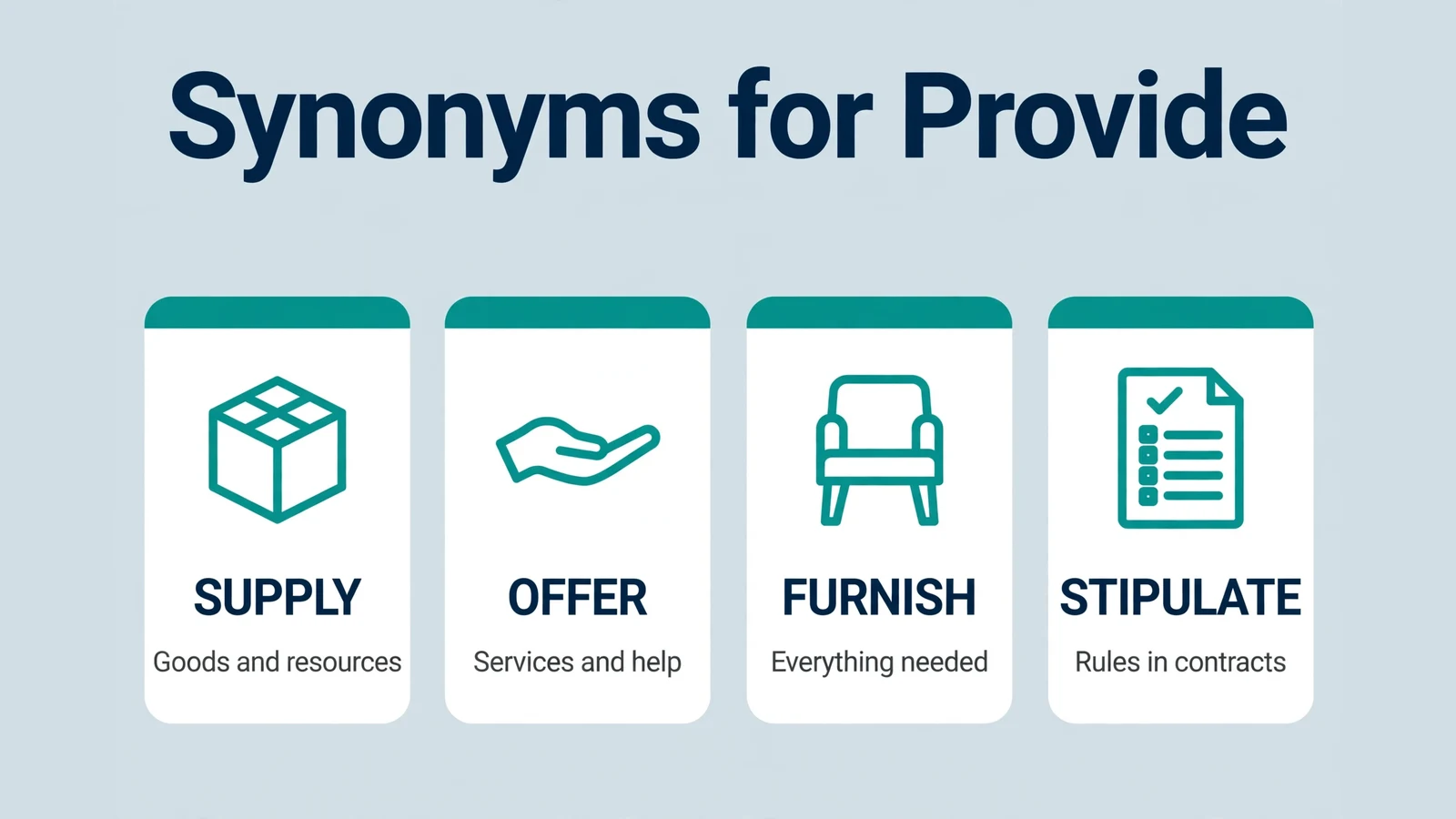
Provide is one of the hardest-working verbs in English. Schools provide meals, websites provide information, and contracts provide deadlines. Yet repeating the same word soon makes writing sound flat and lazy. The good news is that English offers plenty of sharper choices. The most useful synonyms for provide are give, supply, furnish, deliver, offer, present, contribute, equip, afford and grant. Each one fits a slightly different job, though. Supply suits goods and resources, for example. Offer suits services and help instead. This guide groups more than 40 verified alternatives by meaning, so you can pick the word that matches your sentence. It also covers the formal legal sense, where provide means something quite different.
Synonyms for Provide: Quick Reference Table
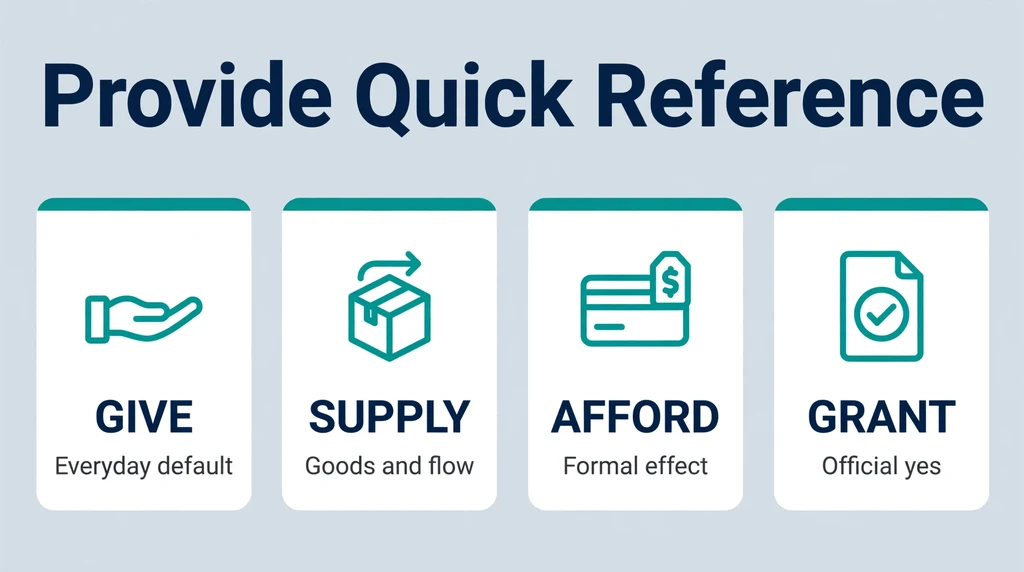
This table gathers the words you will reach for most often. Each row gives a one-line meaning and the setting where the word works best. Later sections then explain the smaller differences in detail.
Everyday and Supply Words
| Word | Meaning in one line | Best for / tone |
|---|---|---|
| give | Hand something over to someone | Everyday, all settings |
| supply | Provide goods or resources, often regularly | Business, neutral |
| furnish | Supply everything needed for a task or place | Slightly formal |
| deliver | Bring something to the person expecting it | Services, logistics |
| hand | Pass something directly to someone | Everyday, physical |
| equip | Give someone the tools or skills they need | Training, work |
| outfit | Kit someone out with gear or clothing | Outdoor, sport, work |
| contribute | Give money, time or help toward a shared goal | Charity, teamwork |
| offer | Make something available for someone to accept | Polite, services |
| present | Give formally, often in a ceremony | Formal |
Formal, Official and Legal Words
| Word | Meaning in one line | Best for / tone |
|---|---|---|
| afford | Give or make available as a natural result | Formal, written |
| grant | Officially allow or give something requested | Official, legal |
| render | Give help or a service, in formal phrasing | Formal |
| impart | Give knowledge or a quality to something | Formal |
| stipulate | State a condition in a rule or contract | Legal |
| specify | State something clearly and in detail | Legal, technical |
| confer | Give a degree, title or honour formally | Very formal |
| bestow | Give something as an honour or gift | Formal, literary |
| allocate | Set aside a share for a person or purpose | Official, budgets |
| dispense | Give out items or services one by one | Official, medical |
What Does Provide Mean?
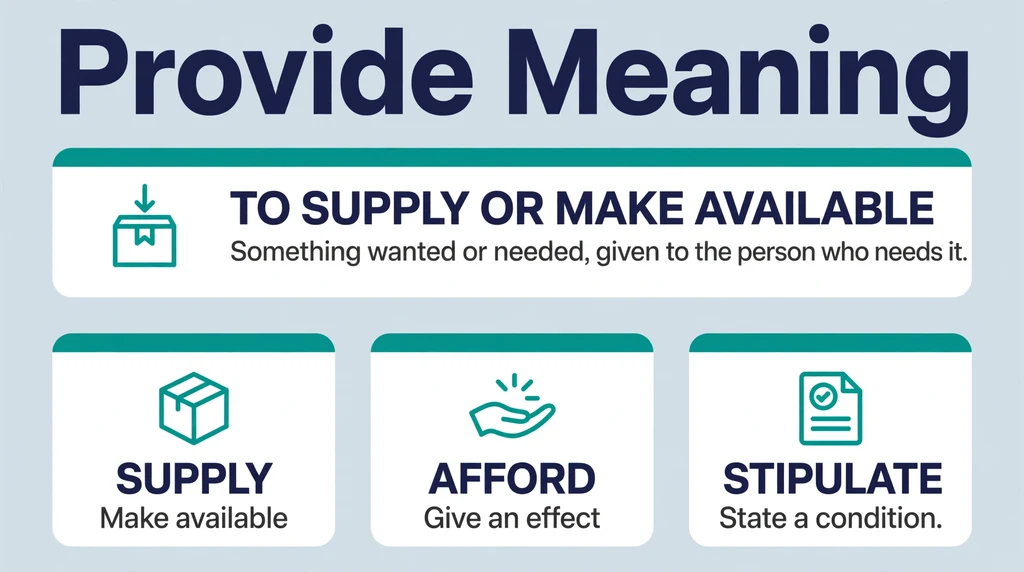
Merriam-Webster defines provide, at its core, as “to supply or make available (something wanted or needed).” That single line explains most everyday uses. A library provides books because readers need them. A jacket provides warmth because your body needs it. In other words, provide always points at a need on the other side.
The dictionary also lists a second pattern: “to make something available to” someone. This is why English uses two frames. You can provide something, or you can provide someone with something. Both frames mean the same thing, so writers can choose the smoother one.
Where the Word Comes From
Provide has a surprisingly thoughtful history. It comes from the Latin *providēre*, which literally means “to see ahead.” The word joins *pro-*, meaning forward, with *vidēre*, meaning to see. So a provider was originally someone who looked ahead and prepared. That old idea still sits inside the modern word. Good providers, after all, think ahead about what people will need.
Interestingly, Merriam-Webster dates the first known use to the 15th century. The earliest recorded sense was not the giving sense at all. It was the legal sense, to stipulate, which the next sections explain. English speakers have therefore used this word in contracts for roughly six centuries.
The Two Sentence Frames
Learners often ask whether “provide someone something” is correct. In American English, the safe pattern is “provide someone with something.” You can also flip it and “provide something for someone.” British English accepts “provide someone something” more readily, though the *with* frame is always safe. Choosing the right frame matters as much as choosing the right synonym.
Frames decide politeness too. “Provide us with your passport” sounds firmer than “provide your passport,” which is why official letters keep the longer frame.
Phrases That Partner With Provide
Certain nouns follow provide so often that they feel like fixed pairs. Writers provide information, provide support, provide access and provide evidence every day. They also provide insight, provide coverage and provide relief. Learning these partnerships helps the synonyms click into place. You can deliver evidence, offer support, grant access and impart insight, for example. Each swap keeps the partnership natural while varying the verb.
Why Provide Sounds Formal
Many learners sense that provide sounds more formal than give, and they are right. The dictionary examples in this guide point the same way. Merriam-Webster illustrates the verb with hotels, contracts and constitutions. Collins reaches for laws, summits and reports. Everyday give, by contrast, fills kitchen-table sentences in the Cambridge entry, like handing over a dirty plate. Neither word is better in itself. The trick is matching the register to the reader in front of you.
Synonyms for Provide for Supplying Things People Need
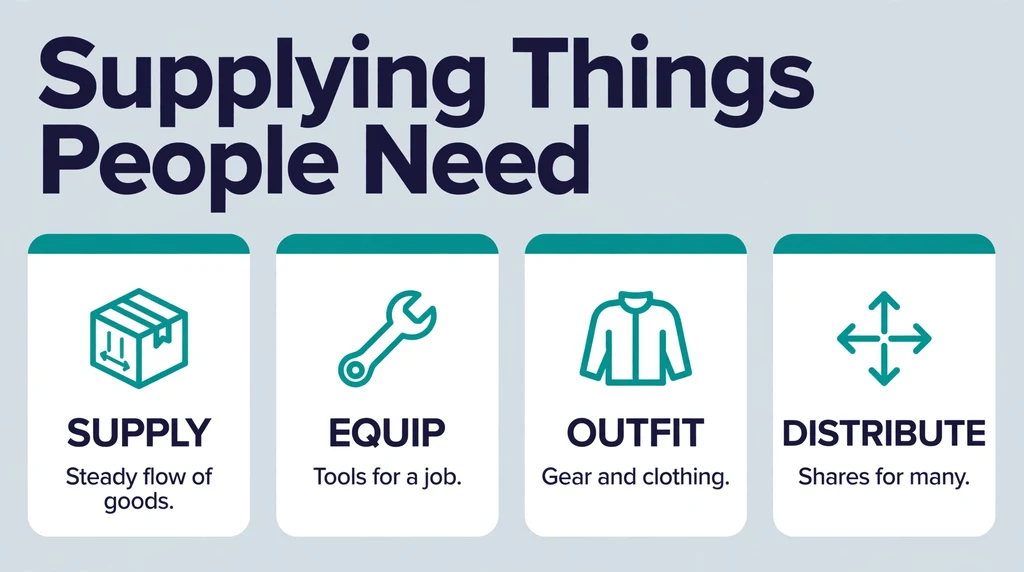
Most searches for this word start with things: food, water, tools, money, equipment. The words below all cover that ground. Still, each one carries its own picture, so read the glosses before you swap them in.
Everyday Handing Over: Give, Hand and Pass
Give is the broadest word in this whole guide. It covers gifts, information, money and help, in almost any tone. Because it is so general, it rarely sounds wrong. It can, however, sound plain beside a more precise choice.
Hand is physical and immediate. You hand someone a pen, a form or a cup of tea. Pass works the same way across a table or along a line. Pass on adds movement through a chain, so it suits messages, documents and second-hand goods. Hand over suggests a formal transfer, often to an authority, as when a guard hands over the keys.
Supplying Goods and Equipment: Supply, Furnish, Equip and Outfit
Supply is the businesslike choice. Companies supply parts, towns supply water, and farms supply supermarkets. It often hints at a steady flow rather than a single gift. That steady feel is why supply dominates contracts and news reports.
Furnish means supplying everything a place or task needs. Hotels furnish rooms, and teachers furnish classrooms with posters. Merriam-Webster’s synonym discussion makes the point neatly. Furnish, equip and outfit all mean “to supply one with what is needed.” Furnish itself, though, “implies the provision of any or all essentials for performing a function.”
Equip focuses on tools and skills for a job. A course equips students for the workplace, for instance. Outfit is its close cousin for gear and clothing. Rescue teams get outfitted with boots, ropes and radios. Feed, in this family, simply means providing food, as in feeding a crowd. Purvey is a formal business word for supplying goods or services for sale. Restaurants purvey meals, for example, though the word now sounds rather grand.
Finally, cater to means shaping what you provide around a group‘s wishes. A café caters to vegans when its menu answers their needs. The word always involves listening first, then supplying.
Sharing Out: Distribute, Dispense, Allocate, Allot and Assign
Some providing happens in shares. Distribute means giving portions to many people, like distributing leaflets or aid parcels. Dispense is more official and measured. Pharmacists dispense medicine, and machines dispense tickets, one careful portion at a time.
Allocate means setting aside a share for a stated purpose. Councils allocate funds to road repairs, for example. Allot is similar but simpler, and it often appears with time or tasks. A teacher allots ten minutes per question. Assign points the share at a named person or duty. Managers assign tasks, and systems assign seats. Administer, lastly, is the formal word for giving out aid, tests or treatment in an organised way.
A close relative, portion out, appears in the same Merriam-Webster lists for measured shares. Cooks portion out soup into bowls, and officers portion out duties among a crew. The phrase always suggests fairness and measure. If the shares are equal and counted, portion out may beat distribute for precision.
Synonyms for Provide for Offering Services, Help and Access
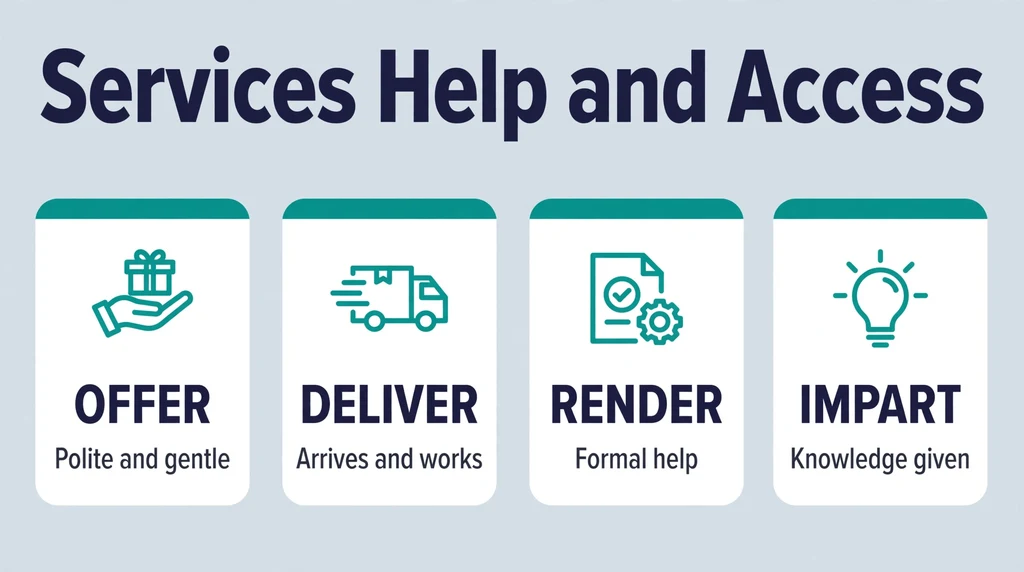
Not everything provided is a thing. Hotels provide services, teachers provide feedback, and websites provide access. The verbs in this group handle that intangible side of the word.
Offer is the politest member of the group. To offer is to make something available and let the other person decide. Doctors offer advice, and hosts offer drinks. Because the receiver can refuse, offer feels gentle and respectful.
Deliver has grown far beyond parcels. Companies deliver services, speakers deliver talks, and software delivers results. It promises that the thing actually arrives and works. Present, meanwhile, adds ceremony or display. A host presents a prize, and a report presents findings to a board.
Serve works when providing is part of a role. A helpline serves the public, and a kitchen serves meals all day. Render is the formal twin, common in set phrases. People render assistance, render a service, or render first aid. It sounds official, so save it for formal writing.
Impart means giving knowledge or a quality. Teachers impart knowledge, and a coat of paint imparts a warm tone. Submit and hand in cover documents. Students hand in essays, and applicants submit forms, so both verbs mean providing paperwork to an authority.
Synonyms for Provide in Common Situations
Context decides the winner more than formality does. The same verb can sound perfect in a kitchen and clumsy in a courtroom. These everyday situations show the verified words doing real work.
Providing Food and Drink
Kitchens run on supply, serve and feed. A bakery supplies cafés with bread every morning. A canteen serves lunch to hundreds of students. Volunteers feed rescue workers through the night. When guests help with the cost, they chip in for the ingredients. When the host pays for everything, guests might joke that he forked out for the whole feast. Notice how each verb changes the picture slightly, even though the food stays the same.
Providing Money and Funding
Money has its own vocabulary. Governments grant funding after applications, and councils allocate budgets across departments. Charities rely on people who donate or contribute regularly. A sponsor might gift a sum to a museum in one payment. Each of these verbs clearly puts money in someone’s hands, which is why careful writers reach for them first.
Providing Information and Evidence
Facts travel with provide, present, submit and impart. Witnesses provide statements, and lawyers present evidence in court. Applicants submit documents before a deadline. A good briefing imparts insight rather than raw data alone. When information moves through people, we say someone passed on the details or handed over the file. These small verbs keep reports readable when “provided” would otherwise appear in every line.
Providing Shelter, Space and Access
Buildings and systems provide in quieter ways. A hall provides seating for two hundred people, though afford sounds more elegant for the same fact. Hosts offer a spare room to travellers. Platforms grant access after a password check. A ramp provides entry for wheelchair users, and here provide access remains the clearest phrasing of all. In this area, plain wording usually beats every fancy alternative.
Providing Help and Care
Care has the gentlest vocabulary in this guide. Charities offer support to families in crisis. Medics render first aid at the scene of an accident. A friend lends a hand with moving boxes, using lend in its kindest idiom. Long-term care, though, returns to provide itself: homes provide care, and carers provide companionship. When money joins the care, families contribute toward costs together. The tone stays human because each verb respects the receiver’s dignity.
Synonyms for Provide in Technology and Online Life
Screens changed what gets provided, but not the verbs we use. The same old words now describe accounts, data and access.
Access, Accounts and Permissions
Apps provide access through a login, and administrators grant permissions to new staff. A reset email offers a way back into a locked account. Platforms present terms on a sign-up screen, and users submit their details to continue. When a service shuts an account down, it withdraws access, reversing the whole exchange in one official verb.
Content, Storage and Services Online
Streaming services deliver films to phones in seconds. Cloud companies supply storage measured in gigabytes. A search engine provides results, while a careful researcher imparts context around them. Free tiers offer limited space, and paid plans afford room to grow. The pattern never changes: something needed sits on one side, and a provider makes it available on the other.
Data, Figures and Results
Numbers follow the formal branch of the family. A dashboard provides figures at a glance, and a survey yields results after weeks of replies. Models produce forecasts that planners then test. When a chart quietly changes a reader’s mind, writers say it lends weight to an argument. These verbs keep data writing varied without inventing precision that the numbers never claimed.
Formal Synonyms for Provide
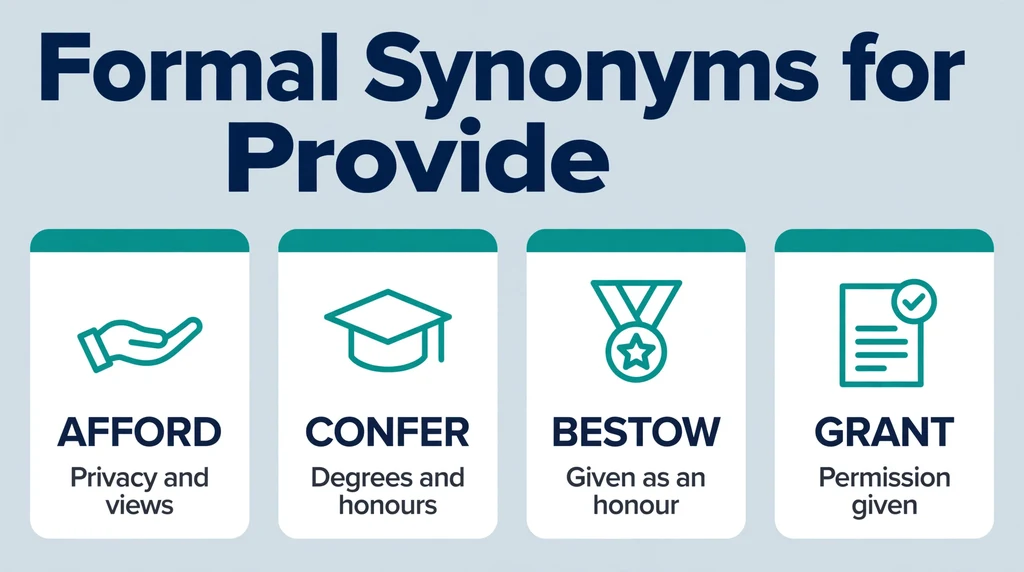
Formal writing leans on provide heavily, so it also needs variety most. The words below raise the tone without changing the meaning. Used well, they make reports, essays and applications sound assured.
Giving as an Effect or Opportunity: Afford, Lend, Yield, Produce and Bring
Sometimes nothing physical changes hands at all. A window seat provides a view, and practice provides confidence. Afford is the classic formal word here. Merriam-Webster even defines provide partly through it: curtains provide privacy, or rather, curtains afford privacy. Cambridge marks this use of afford as formal, so it suits essays and reports.
Lend works for qualities rather than objects. Research lends credibility to a claim, and candles lend a room warmth. Yield means producing a result over time. Savings yield interest, and talks yield an agreement. Produce is plainer and more direct, as in producing evidence in court. Bring sits at the everyday end of this group. A pay rise brings security, and rain brings relief to farmers.
Official and Ceremonial Giving: Grant, Award, Confer, Bestow, Donate, Gift and Contribute
Official giving follows rules, and these verbs show it. Grant means giving something requested or allowed, such as permission, money or a visa. It always involves an authority saying yes. Award means giving a prize or contract after a judgement. Courts award damages, and judges award medals.
Confer and bestow are the most ceremonial pair. Universities confer degrees on graduates in formal ceremonies. Honours are bestowed on very few people, as Cambridge puts it, which gives bestow a lofty feel. Donate means giving to a cause without payment. People donate blood, money and clothes. Gift, used as a verb, is donation’s modern business cousin. Companies gift funds to universities, for example.
Contribute rounds out the group with teamwork. It means giving your part toward a shared total. Everyone contributes money, ideas or effort, and no single giver carries the whole load.
Informal Alternatives: Chip In and Fork Out
At the casual end, two phrasal verbs stand out. Chip in means joining others in paying or helping. Everyone chipped in for a leaving present, for instance. Cambridge labels it informal, so keep it out of formal reports.
Fork out also concerns money, but with a sigh attached. It means paying, often more than you wanted to pay. Collins marks it informal as well. Homeowners fork out for repairs, usually reluctantly, which is exactly the flavour the phrase adds.
Provide in Law and Contracts: The Stipulate Sense
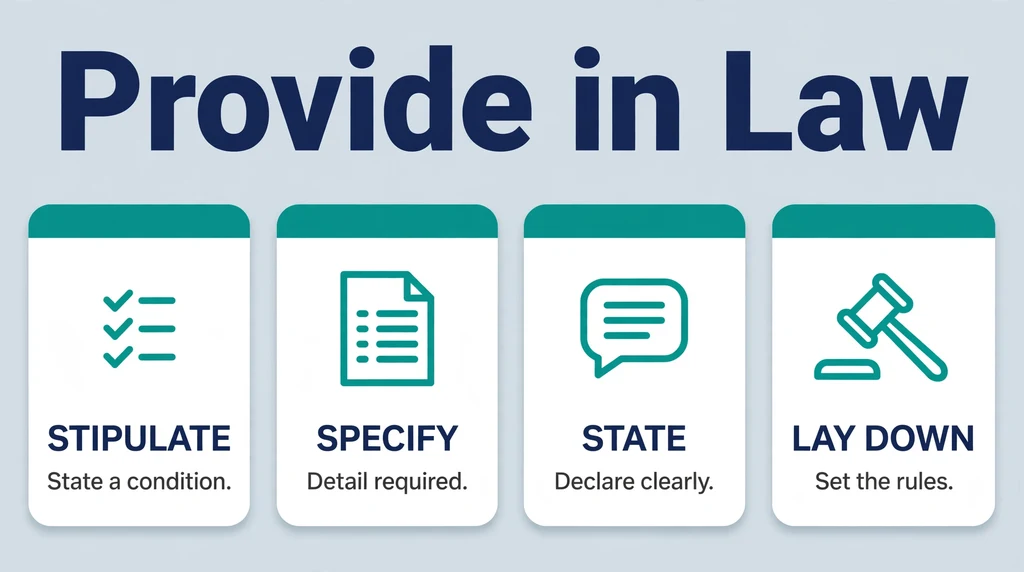
Here is the sense that surprises most readers. In laws and contracts, provide often gives nothing at all. Instead, it states a condition. Merriam-Webster defines this sense plainly: “to have as a condition: stipulate.” Its example reads, “The contract provides that certain deadlines will be met.”
Collins gives the same legal picture. Its example is, “The law provides that all parties must receive equal compensation.” Nothing is handed over in either sentence. The verb simply lays down what the rule says.
The Legal Synonyms: Stipulate, Specify, State and Lay Down
Stipulate is the closest legal match. Rules stipulate the number of foreign entrants, for example. It always sounds formal and binding. Specify adds detail: a clause specifies exactly what action is required. State is the calmest choice, meaning to declare something clearly in writing.
Lay down completes the set. Laws lay down conditions, and contracts lay down procedures. The phrase suggests authority setting rules from above. All four words suit legal summaries, essays about law, and careful business writing.
You will also meet the connector “provided that.” It grew out of this legal sense and means “on the condition that.” A grant is paid provided that the forms arrive on time. Strictly, grammar guides treat “provided that” and “providing that” as equals, though “provided that” is the safer formal choice. Either way, the phrase carries the old stipulation meaning into everyday contracts.
Reading a Clause With Provide in It
Try a real-style clause: “The supplier provides that all goods meet safety standards.” Nothing is being delivered in that sentence. The supplier is stating a binding condition, so “stipulates” can replace “provides” without loss. Now compare “The supplier provides safety gear to all staff.” Here goods change hands, and “supplies” fits better. Spotting which job the verb does is the whole skill. Ask whether something moves, or whether a rule is being set. The answer picks your synonym for you.
Provide For: Support, Preparation and Precaution
The phrasal verb “provide for” deserves its own moment. It does not behave like plain provide, and Merriam-Webster gives it three separate jobs. Mixing them up changes the meaning of a sentence completely.
First, provide for can mean preparing to meet a need. Hosts provide for entertainment at a party, for instance. Here the near words are prepare for and plan for. Second, it can mean supplying support over time. The dictionary’s example is stark: someone “provides for the poor.” Workers provide for their families in this same sense, so support and maintain sit close by.
Third, provide for can make a stipulation. “The constitution provides for an elected two-chamber legislature,” as the dictionary quotes. Here, once again, the verb states what a document allows or requires. Finally, the oldest public use is precaution. The United States Constitution speaks of providing “for the common defense,” which means guarding against future danger.
When a company allows remote work, for example, its policy also provides for busy seasons and staff shortages. Good policies, like good providers, look ahead. That forward look is the heart of every sense in this section.
The family sense deserves one more line, because it fills search boxes daily. “Provide for your family” means earning enough for food, housing, school and care. In that frame, support is the closest everyday partner, and maintain appears in legal phrases about dependants. Neither word covers the preparation or stipulation senses, though, which is why provide for survives as its own phrase.
How to Choose Between Provide, Supply and Give
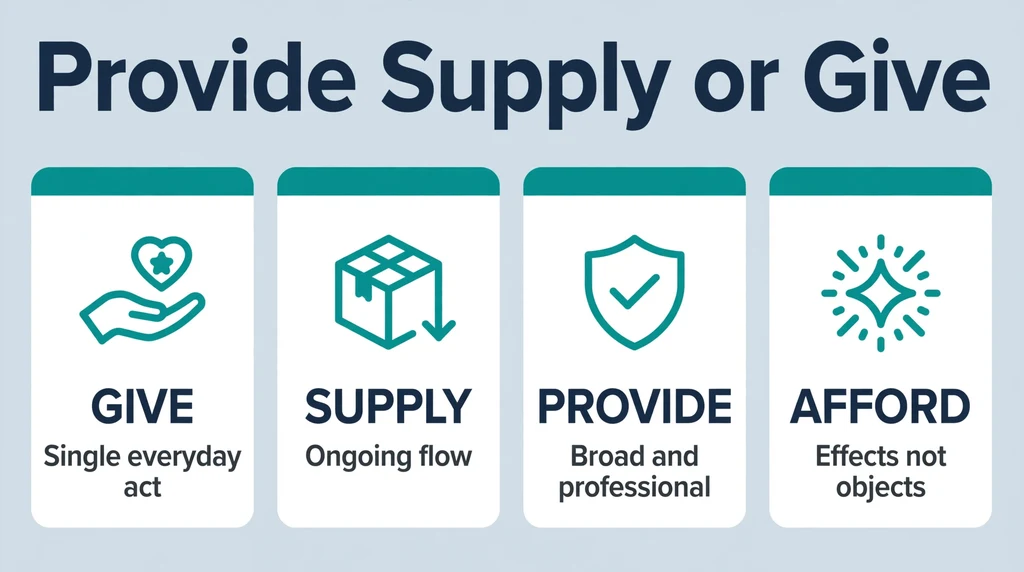
These three verbs overlap more than any others in this guide. Choosing well comes down to three quick questions. Ask them in order, and the right word usually appears.
Question One: Is the Receiver Getting a Thing, or an Effect?
If a person receives an object, all three verbs can work. If the receiver gets an effect, like privacy, confidence or credibility, reach for provide or afford instead. Curtains give privacy sounds slightly odd, for instance. Curtains provide privacy, or afford privacy, sounds natural to most readers.
Question Two: Is It a Single Act, or an Ongoing Flow?
Give suits a single act best. Hand over the money, give the talk, done. Supply suggests a flow that continues. A river supplies a town with water every single day. Provide sits between the two. It can describe one act, as in providing a quote, or a continuing duty, as in providing care.
Question Three: How Formal Is the Setting?
Give is the everyday default and rarely offends. Provide sounds more professional, which is why reports prefer it. Supply sounds commercial or technical. Compare three sentences about the same fact. “The school gives lunches” is plain. “The school provides lunches” is polished. “The school supplies lunches” sounds like a catering contract. Writers who support their claims with the right verb at the right moment sound more precise overall.
A Quick Test You Can Run
Still unsure? Read your sentence aloud and swap in each verb once. The wrong choice usually grates immediately. “The treaty gives that appeals must finish within a year” fails at once, because giving cannot state rules. “The treaty provides that” passes, and “the treaty stipulates that” passes with extra legal weight. Your ear, guided by the three questions above, settles most cases in seconds.
Synonyms for Provide in Professional Writing
Professional documents repeat provide for a reason. It is neutral, clear and safe. Still, variety helps readers stay awake, so rotate the alternatives below by function.
Reports, Essays and Applications
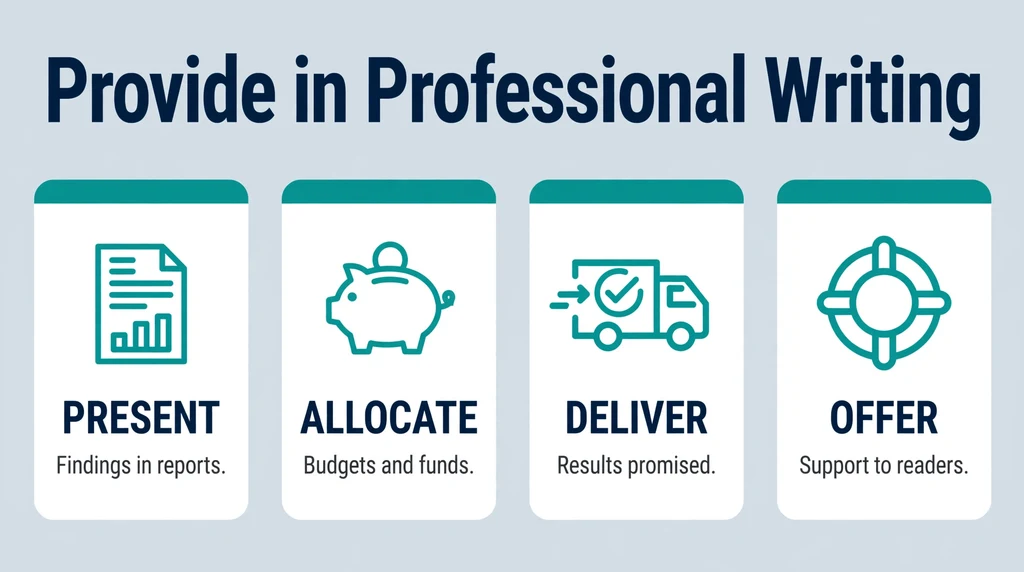
In reports, pair provide with offer, present and deliver. A report presents findings, a service offers support, a team delivers results. In essays, afford, yield and lend lift the tone. In applications and proposals, grant, allocate and specify show official precision.
Watch the frame as you swap words, though. Offer takes no *with*: you offer someone help, never offer someone with help. Supply and provide both accept *with*, while supply also accepts a plain object. “Supply the school with laptops” and “supply laptops to the school” are both correct. Checking the frame after every swap prevents the commonest error in this whole area.
Business and Customer-Facing Writing
Business writing rewards warmth plus clarity. A company that wants to help its customers might say it offers guidance, delivers training, or provides round-the-clock support. Each verb promises something slightly different. Offer invites, deliver guarantees arrival, and provide states a steady fact.
Avoid stuffing formal synonyms into friendly text, however. “We bestow support on our users” sounds pompous, not helpful. Match the word to the relationship, and your writing will sound both professional and human.
Example Sentences: The Synonyms in Action
Seeing the words inside real sentences fixes them in memory. Each setting below uses only the verified verbs from this guide.
At School
The school provides free laptops for new students this year. Teachers furnish each classroom with maps and posters. The library supplies textbooks, while the office distributes timetables on the first day. Parents chip in for the class trip in spring.
In Healthcare
The clinic offers free checks every Friday morning. Nurses administer vaccines and dispense medicine against prescriptions. The hospital provides meals for patients on every ward. A new wing will afford space for forty more beds next year.
In Business
Our firm delivers training to teams across the country. We present a short report after every project ends. The contract stipulates that invoices arrive within thirty days. Meanwhile, the finance team allocates a small budget for travel each quarter.
At Home
Grandma provides Sunday lunch for the whole family. The neighbours pass on extra vegetables from their garden. A thick curtain affords privacy in the front room. When the boiler broke, everyone chipped in so the repair bill got paid quickly.
Antonyms for Provide
Every act of providing has a receiving end. Cambridge lists receive as the direct opposite of this verb family. The receiver takes what the provider gives, so reports often pair the two: one side provides funding, the other receives it.
Two more reversals appear in careful writing. Take away reverses the flow entirely, as when a service takes away a benefit it once provided. Withdraw does similar work in official contexts, since bodies withdraw support, funding or services. Neither word is a glamorous opposite, yet both keep the exchange balanced in formal prose.
Words That Are Not True Synonyms for Provide
Some words travel with provide but should not replace it. This section protects you from the commonest false friends.
Stock up appears in thesaurus lists, including the Collins entry for this verb. Yet stocking up means gathering supplies for your own future use. Nothing reaches another person, so it fails the basic test of providing. A shopkeeper stocks up before winter, but the shop supplies its customers.
Part with is another near miss. It means giving up something you own, often reluctantly. A collector parts with a rare coin. The focus sits on your loss, not on meeting someone’s need, which is why dictionaries keep it at the edge of this family.
Require tempts writers in the legal sense. A contract that provides a deadline does effectively require it. Still, no major thesaurus lists require among the synonyms for that sense. Providing states the condition; requiring enforces it. Keep the two jobs separate for accuracy.
Guarantee makes a promise about the future rather than supplying anything now. A firm can guarantee a service it provides, but the guarantee itself provides nothing. Finally, prepare matched provide only in an old, archaic sense that Merriam-Webster still records. Modern writers should not swap the two outside historical texts.
Frequently Asked Questions
What is the best synonym for provide?
Give is the safest all-purpose synonym, since it fits almost any sentence. For resources and steady flows, supply is usually better. For services and help, offer and deliver sound more precise. The best choice always depends on what is being provided and to whom.
What is a formal synonym for provide?
Afford, render, confer and bestow all sound formal. Afford suits effects and opportunities, as in affording protection. Render suits help and services in official phrases. Confer and bestow suit honours, degrees and titles given in ceremonies.
What is the difference between provide and supply?
Provide is the broader verb. It covers things, services, information and even legal conditions. Supply focuses on goods and resources, often in a continuing flow. A company supplies parts every month, while a website provides information once or always.
What does provide mean in a contract?
In a contract, provide usually means stipulate. It states a condition rather than giving anything. “The contract provides that deadlines will be met” simply means the contract sets that rule. Stipulate, specify and state are its closest legal synonyms.
Is it provide someone something or provide someone with something?
The safest pattern is “provide someone with something,” especially in American English. “Provide something for someone” is equally correct. British English sometimes drops the *with*, but keeping it is never wrong in careful writing.
What is the difference between provide and provide for?
Provide means making something available. Provide for adds extra jobs: supporting someone over time, preparing for a need, or stating an allowance in a document. A parent provides meals, but provides for a family in the wider sense of ongoing support.
Can provide take an object without a person?
Yes, very often. Websites provide information, trees provide shade, and practice provides confidence. In these sentences the receiver is implied or general. The synonyms afford and lend work especially well in this pattern.
What is the opposite of provide?
Receive is the standard opposite, since it names the other side of the exchange. In official writing, withdraw and take away describe the reverse action. A body that withdraws funding stops providing it, for example.
Final Thoughts
Provide earns its place in English because it does so much work gracefully. It hands over uniforms, offers advice, delivers services and even writes the rules in contracts. Yet no single verb should carry a whole document alone. When goods flow steadily, choose supply. When a ceremony is involved, choose confer, award or present. When a rule is being stated, choose stipulate or specify. The Merriam-Webster thesaurus entry for provide is a handy place to double-check these shades of meaning. Keep this guide nearby, match each word to its job, and your writing will sound precise, varied and quietly confident.