Have you ever found yourself writing an email, essay, or social media caption and realized you used the word “old” three times in two sentences? It happens to everyone. You want to describe something that has been around for a while, but the word “old” feels tired and overused.
The good news is that English has dozens of alternatives that can make your writing more precise and engaging. This guide will help you choose the perfect synonym for old in any situation.
What Does “Old” Mean?
Old means having existed for a long time or showing the effects of age. The best synonyms depend on your context. Use “ancient” for extreme age, “vintage” for valuable aged items, for people respectfully, “outdated” for technology, and “former” for previous roles. Always match your word choice to your tone and situation.
Meaning, Tone and Context
- Simple definition: Old describes something that has lived or existed for a long time.
- Part of speech: Old functions primarily as an adjective.
- Tone: The word “old” is neutral but can shift to negative or positive depending on context.
- Formality level: Old is a basic, commonly used word that works in both casual and formal settings.
- Common use cases: You will use old to describe age, time, experience, objects, people, ideas, and past situations.
- Important forms: The comparative form is “older” and the superlative form is “oldest.” These help when comparing two or more things.
When and How to Use “Old”
Use “old” when you need a simple, direct way to describe age or duration. It is the most common and widely understood term for this meaning.
Professional example:
“Our company has been using this old software system for over a decade.”
Personal example:
“My grandmother still wears her old wedding ring every single day.”
Academic example:
“The old theory was replaced after new evidence emerged from the research.”
Creative example:
“The old house stood silently on the hill, holding secrets from another century.”
Social media example:
“Found this old photo from our first road trip together.”
Casual conversation example:
“Let’s watch that old movie you keep talking about.”
Resume example:
“Modernized an old filing system that saved the department hours of work each week.”
Another Word for “Old”
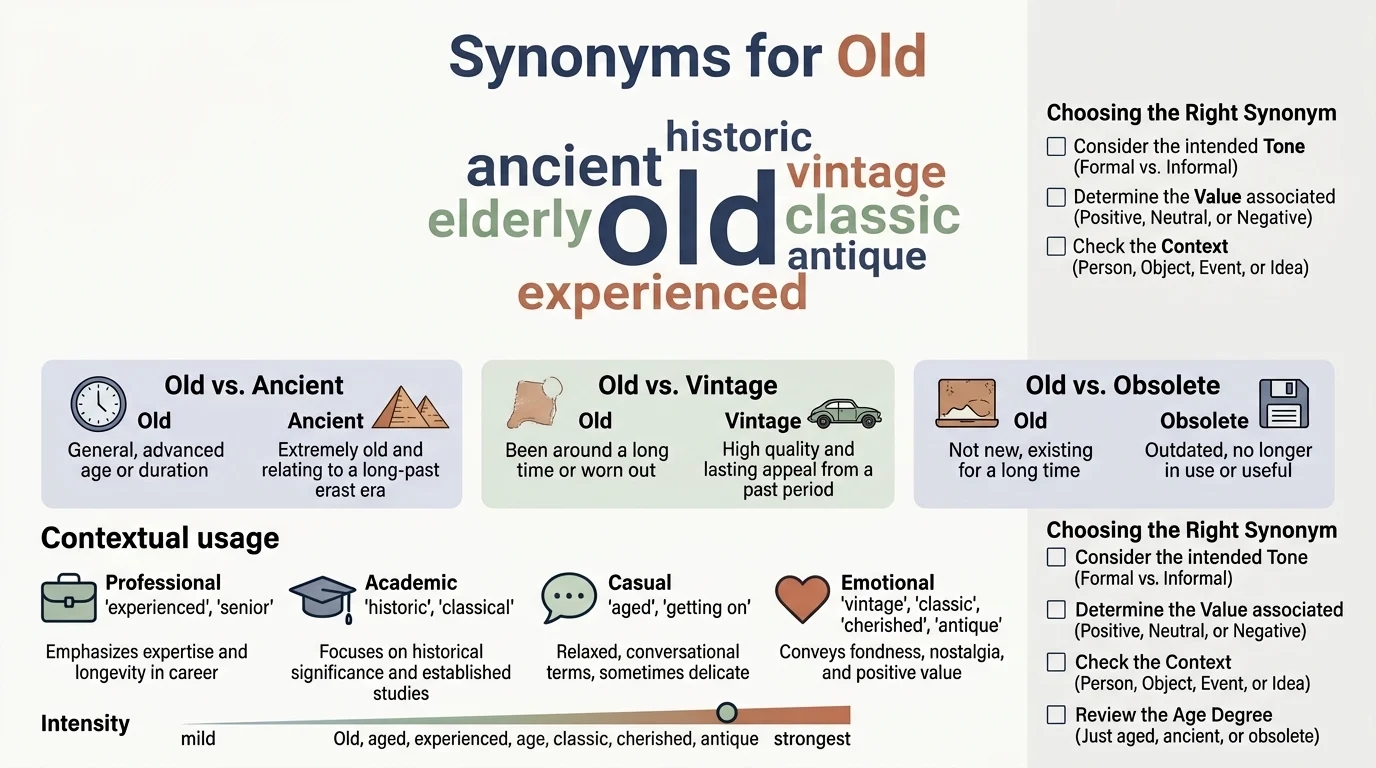
The best single replacement depends entirely on what you are describing and your intended tone.
Professional writing: Use “longstanding” for established practices. Use “legacy” for systems and software.
Academic writing: Use “ancient” for historical periods. Use “archaic” for outdated language or ideas.
Casual conversation: Use “ancient” for humorous emphasis. Use “vintage” for cool older items.
Emotional writing: Use “timeworn” to show sentimental value. Use “aged” to show respect.
Creative writing: Use “antiquated” for old fashioned settings. Use “hoary” for an aged appearance.
Resume or workplace use: Use “experienced” for people. Use “established” for companies. Use “reliable” for methods.
Social media captions: Use “classic” for nostalgic posts. Use “retro” for style. Use “throwback” for memories.
Stronger meaning: Use “ancient,” “primeval,” or “prehistoric” for extreme age.
Softer meaning: Use “mature,” “seasoned,” or “experienced” to soften the idea of age.
When Not to Use “Old”
The word “old” sounds too vague when you need precision. It also sounds too casual in formal writing about sensitive topics.
Avoid “old” when describing people unless you are certain they are comfortable with the term. Use “senior,” or “older adult” instead.
Avoid “old” for technology that is outdated. Use “obsolete,” “antiquated,” or “legacy” for more accurate meaning.
Weak example:
“His old ideas prevented progress.”
Improved example:
“His outdated ideas prevented progress.”
Weak example:
“We need to replace these old computers.”
Improved example:
“We need to replace these obsolete computers.”
Weak example:
“She is an old professional in the field.”
Improved example:
“She is an experienced professional in the field.”
Words Commonly Confused With “Old”
Old vs.
“Old” is general while specifically describes older people with respect. Use for people over about 65. Use “old” for objects, ideas, or any general age reference.
Old vs. Ancient
“Ancient” means extremely old and often refers to historical periods. Use “ancient” for civilizations, artifacts, or things over a thousand years old. Use “old” for everyday time references.
Old vs. Vintage
“Vintage” suggests something old but valuable or high quality. Use “vintage” for collectible items, wine, or classic styles. Use “old” for general age without implied value.
Old vs. Obsolete
“Obsolete” means no longer useful or in production. Use “obsolete” for technology and practices that have been replaced. Use “old” for things that still function but are not new.
Old vs. Aged
“Aged” is more formal and often implies a process of maturing. Use “aged” for cheese, wine, or formal descriptions. Use “old” for more casual references.
Old vs. Former
“Former” refers to previous positions, roles, or states. Use “former” for jobs, relationships, or conditions. Use “old” for physical age or time duration.
Best Synonym by Context for “Old”
| Context | Best Synonym | Why It Works | Example |
|---|---|---|---|
| Formal writing | Longstanding | Shows established duration professionally | The organization has a longstanding commitment to quality |
| Academic writing | Ancient | Provides historical accuracy and precision | Ancient civilizations developed advanced irrigation systems |
| Professional business | Legacy | Describes established systems and practices | We need to update our legacy infrastructure |
| Resume use | Experienced | Highlights valuable skills and knowledge | Experienced project manager with ten years in the field |
| Casual conversation | Old | Simple and universally understood | Let’s grab some old friends for dinner |
| Creative writing | Timeworn | Adds imagery and emotional depth | The timeworn letters revealed a lifelong romance |
| Emotional tone | Cherished | Shows sentimental value and affection | My cherished old photographs bring back memories |
| Strong intensity | Primeval | Conveys extreme ancient origins | The primeval forest has stood for millennia |
| Soft tone | Mature | Shows growth without implying decline | Her mature perspective helped the team succeed |
| Social media captions | Throwback | Creates engagement and nostalgia | Throwback to our summer adventure |
| US usage | Old | Standard American English | That old diner has the best pancakes |
| UK usage | Old | Standard British English | The old pub serves proper Sunday roasts |
| Technology | Antiquated | Shows outdatedness clearly | The antiquated software crashed repeatedly |
| Architecture | Historic | Implies cultural significance and preservation | The historic building was recently renovated |
| Fashion | Retro | Indicates styled after past eras | Her retro outfit turned heads at the party |
Which Synonym Should You Choose?
Choose your synonym based on these key factors.
First, consider what you are describing. For people, use respectful terms like “or “experienced.” For objects, use “vintage” if valuable or “antiquated” if outdated. Ideas, use “longstanding” for established beliefs or “archaic” for outdated concepts.
Second, think about formality. In professional emails, choose “established” or “legacy.” In academic papers, choose “ancient” or “historic.” Casual texts, “old” works perfectly.
Third, consider emotional intensity. If you want to show respect, use “seasoned” or “mature.” If you want to show frustration, use “obsolete” or “outdated.” You want to show affection, use “cherished” or “classic.”
Fourth, evaluate the value judgment. Does the thing being described have positive value? Choose “vintage,” “classic,” or “time honored.” Does it have negative value? Choose “obsolete,” “archaic,” or “antiquated.” Is it neutral? Choose “old” or “former.”
Finally, remember that precision matters. A “former” colleague is not necessarily an “older” colleague. An “ancient” artifact is not the same as an “old” book. Choose words that communicate exactly what you mean.
Real Life Examples of “Old” in Sentences
These examples show how “old” and its synonyms work in different real world situations.
School example:
“The history textbook covered old civilizations but skipped many important details about their daily lives.”
Workplace example:
“Our manager encouraged us to rethink old processes that wasted time and resources.”
Writing example:
“The author’s old writing style felt comforting and familiar to longtime readers.”
Conversation example:
“My uncle tells the same old stories at every family gathering.”
Social media example:
“Throwback to that old selfie from our freshman year.”
Resume example:
“Transformed an old customer database into a modern, efficient system.”
Email example:
“Please review the old proposal and share your feedback by Thursday.”
Storytelling example:
“The old lighthouse keeper knew every ship that passed through the fog.”
Stronger synonym example:
“The primeval forest remained untouched by modern development.”
Softer synonym example:
“Her mature understanding of the situation helped resolve the conflict.”
25 Synonyms for “Old”
| Synonym | Simple Meaning | Best Used For |
|---|---|---|
| Ancient | Very old, from long ago | Historical periods, artifacts |
| Antique | Old and collectible | Furniture, jewelry, valuable objects |
| Archaic | Very old fashioned, outdated | Language, customs, systems |
| Mature | Fully grown or developed | People, plants, opinions |
| Seasoned | Experienced from long practice | Professionals, travelers, veterans |
| Vintage | Old and high quality from a past era | Wine, clothing, cars, collectibles |
| Antiquated | Very old and not useful anymore | Technology, practices, systems |
| Outdated | No longer current or modern | Information, technology, methods |
| Obsolete | No longer produced or used | Technology, equipment, processes |
| Former | Previous, earlier | Positions, jobs, relationships |
| Longstanding | Existing for a long time | Relationships, traditions, practices |
| Historic | Important in history or very old | Buildings, events, documents |
| Timeworn | Damaged or worn by age | Objects, buildings, materials |
| Hoary | Very old and gray or white | Appearance, plants, traditions |
Synonym Groups and Usage Differences
Professional vs. Personal Synonyms
Professional writing demands precision and respect. Choose “established” for companies with long history. Choose “experienced” for skilled employees. Select “legacy” for existing systems.
Personal writing allows more flexibility and emotion. Use “vintage” to show appreciation for older items. Use “classic” for things you love. Select “ancient” humorously for friends or habits.
Professional example:
“Our established client base continues to grow each quarter.”
Personal example:
“This classic album never gets old.”
Formal vs. Conversational Synonyms
Formal writing requires words that sound authoritative and precise. Academic papers prefer “archaic” for outdated concepts. Business reports use “longstanding” for established practices. Legal documents use “former” for previous status.
Conversational writing welcomes simpler, friendlier terms. Text messages use “old” regularly. Social media uses “throwback” and “retro.” Casual emails use “ancient” playfully.
Formal example:
“The archaic tax code requires comprehensive reform.”
Conversational example:
“That movie is so old it’s practically ancient.”
Academic Synonyms
Academic writing values precision and historical accuracy. “Ancient” works for civilizations and historical events. describes early human development. “Medieval” specifies a particular historical period.
Use these words in research papers, history essays, and archaeological studies. They show you understand specific time periods and academic terminology.
Academic examples:
“The ancient Greek philosophers established foundational principles of Western thought.”
“tools reveal early human cognitive development.”
“Medieval architecture reflected the religious values of the period.”
Professional and Business Synonyms
Workplace communication benefits from synonyms that show competence and professionalism. “Experienced” highlights valuable skills. “Longstanding” shows stability. “Legacy” indicates established systems with ongoing importance.
These words are ideal for resumes, cover letters, performance reviews, and business proposals. They demonstrate sophisticated vocabulary while remaining accessible.
Professional examples:
“Our experienced staff handles complex projects efficiently.”
“The longstanding partnership has yielded excellent results.”
“Legacy systems require careful modernization planning.”
Creative or Literary Synonyms
Creative writing thrives on vivid, evocative language. “Timeworn” suggests beauty in decay and age. “Hoary” creates images of ancient, almost mythical age. “Venerable” commands respect for aged wisdom.
These synonyms add texture, emotion, and imagery to fiction, poetry, and descriptive writing. They paint pictures that simple words cannot create.
Creative examples:
“The timeworn manuscript held secrets of the forgotten kingdom.”
“The hoary mountain peaks stood against the twilight sky.”
“The venerable oak tree witnessed centuries of change.”
Slang or Modern Synonyms
Modern English offers colorful alternatives for casual situations. “Old school” describes traditional approaches with respect. “Throwback” works for nostalgic social media posts. “Retro” applies to vintage inspired modern items.
These synonyms are best for social media, casual conversations, and modern content creation. Avoid them in formal writing or professional contexts.
Slang examples:
“He has an old school approach to customer service.”
“This photo is such a throwback to college days.”
“Her retro style blends mid century fashion with modern accessories.”
Strongest vs. Weaker Synonyms
Here is an intensity scale from mild to most extreme.
Mild: Former, previous, longtime. These simply indicate something from the past without emphasizing age.
Moderate: Aged, mature, experienced. These acknowledge age while remaining neutral or positive.
Strong: Ancient, vintage, historic. These emphasize significant age with positive connotations.
Strongest: Primeval, prehistoric, archaic. These stress extreme age and often imply no longer relevant.
Weaker examples:
“My former teacher inspired my love of literature.”
“The aged wine was perfect for the celebration.”
Stronger examples:
“The ancient temple drew thousands of visitors.”
“The primeval forest had never been disturbed by humans.”
Emotional vs. Neutral Synonyms
Emotional synonyms add feeling and perspective to your writing. “Cherished” expresses love and sentimental value. “Venerable” expresses deep respect. “Timeworn” expresses a mixture of age and enduring value.
Neutral synonyms simply state age without judgment. “Old,” “former,” and “previous” are straightforward and factual.
Emotional example:
“My cherished memories of childhood remain vivid and warm.”
Neutral example:
“My old neighborhood has changed significantly over the years.”
Antonyms of “Old”
| Antonym | Meaning | Example Sentence |
|---|---|---|
| New | Recently made or created | The new building features modern architecture and energy efficient windows |
| Young | In early life or development | Young children learn language more quickly than adults do |
| Modern | Belonging to the present time | Modern technology has transformed how we communicate with each other |
| Fresh | New, recently produced or acquired | Fresh ideas revitalized the company’s approach to marketing |
| Current | Happening now or recently | Current research supports this new treatment approach |
| Contemporary | Existing or happening now | Contemporary art challenges traditional definitions of beauty |
| Recent | Happening not long ago | Recent data suggests improved economic conditions |
| Novel | New and original | The novel approach solved a decades old problem |
| Cutting edge | At the forefront of development | Cutting edge medical treatments offer new hope to patients |
| State of the art | Using the most advanced technology | The state of the art laboratory opened last month |
| Up to date | Including the latest information | Our up to date records ensure accurate billing |
| Innovative | Introducing new ideas | Innovative startups are disrupting traditional industries |
| Modernized | Updated to current standards | The modernized airport handles millions of passengers annually |
| Newly formed | Recently created or established | The newly formed committee will address climate concerns |
| Brand new | Completely new and unused | The brand new facility opened its doors to the public today |
Comparison: Old vs. Similar Words
Old vs. Ancient
Main difference: Ancient describes things from a much earlier time period. Old describes anything with age.
Which one is stronger: Ancient is much stronger and suggests thousands of years of age.
Which one is more formal: Both are used formally, but ancient appears more often in historical and academic contexts.
Example for old: “This old photograph shows my grandparents on their wedding day.”
Example for ancient: “Archaeologists discovered an ancient burial site beneath the city.”
Old vs.
Main difference: specifically describes older people respectfully. Old describes anything.
Which one is stronger: is more specific and should be used with care and respect.
Which one is more formal: is more formal and considered more polite for describing people.
Example for old: “We need to replace this old refrigerator.”
Example for : “The residents enjoyed the community garden program.”
Old vs. Vintage
Main difference: Vintage implies high quality and collectible value from an earlier era. Old simply indicates age.
Which one is stronger: Vintage suggests positive value. Old is neutral.
Which one is more formal: Vintage is considered more sophisticated and often used in fashion, wine, and collectibles contexts.
Example for old: “He wore an old jacket to the construction site.”
Example for vintage: “She found a vintage Chanel dress at the boutique.”
Old vs. Obsolete
Main difference: Obsolete means no longer useful or in production. Old may still be useful.
Which one is stronger: Obsolete is more extreme and indicates complete redundancy.
Which one is more formal: Both are formal, but obsolete carries a stronger sense of being fully outdated.
Example for old: “My old laptop still works for basic tasks.”
Example for obsolete: “Floppy disk drives are completely obsolete technology.”
Old vs. Archaic
Main difference: Archaic describes outdated language, customs, or systems. Old simply means aged.
Which one is stronger: Archaic suggests something has been replaced or left behind.
Which one is more formal: Archaic is more formal and specific to cultural and linguistic references.
Example for old: “This old tradition brings our community together.”
Example for archaic: “The archaic language of the original document required translation.”
Old vs. Former
Main difference: Former refers to previous positions, states, or relationships. Old refers to age or duration.
Which one is stronger: Former is more specific and formal.
Which one is more formal: Former is used in formal contexts like job titles and official documents.
Example for old: “My old school was located in the city center.”
Example for former: “My former manager recommended me for this position.”
Common Phrases and Expressions with “Old”
1. Old hand
Meaning: Someone with extensive experience in a particular activity or field.
Example sentence: My uncle is an old hand at repairing classic cars and can fix almost any engine.
2. Old money
Meaning: Wealth inherited over generations, often associated with established families.
Example sentence: The old money families in that neighborhood have owned their mansions for centuries.
3. Old school
Meaning: Traditional, classic, or using methods from an earlier era.
Example sentence: Our company takes an old school approach to customer service with personal phone calls.
4. Old faithful
Meaning: Something or someone that is consistently reliable and dependable.
Example sentence: This old faithful coffee maker has been brewing our morning coffee for twelve years.
5. Of old
Meaning: From a past time or in ancient days.
Example sentence: The legends of old told stories of brave knights and their quests.
6. Old timer
Meaning: A person who has been in a place or activity for a very long time.
Example sentence: The old timer at the barbershop knew everyone who walked through the door.
7. Old flame
Meaning: A former romantic partner who is remembered fondly.
Example sentence: She ran into an old flame at her college reunion and shared memories of their youth.
8. The old country
Meaning: The country a person or family originally came from, often Europe.
Example sentence: My grandmother loved sharing stories about her childhood in the old country.
Common Mistakes to Avoid
1. Using “old” when a more precise synonym is better
Avoid vague descriptions that leave readers guessing. “Ancient,” “vintage,” and “obsolete” are more specific.
Mistake: “The building is very old.”
Fix: “The historic building dates from the eighteenth century.”
2. Confusing “old” with “former”
Do not use “old” when you mean “former” or “previous.” This confusion can be particularly misleading in professional contexts.
Mistake: “My old boss called about a project.”
Fix: “My former boss called about a project.”
3. Using a casual synonym in formal writing
Avoid “old school” or “retro” in academic papers, legal documents, or formal reports. Choose “traditional” or “historic” instead.
Mistake: “The old school approach to education limited innovation.”
Fix: “The traditional approach to education limited innovation.”
4. Using an overly dramatic synonym for a simple situation
Do not use “ancient” or “primeval” for everyday age references. Reserve these strong words for genuinely ancient objects or periods.
Mistake: “My ancient smartphone needs a new battery.”
Fix: “My old smartphone needs a new battery.”
5. Repeating the same word too often
Variety improves writing quality. Mix synonyms to avoid monotony and keep readers engaged.
Mistake: “The old house had old furniture and old photographs.”
Fix: “The historic house had antique furniture and vintage photographs.”
6. Choosing a synonym with the wrong emotional tone
Be careful with how your word choice affects the reader’s emotional response. “Aged” sounds respectful while “obsolete” sounds dismissive.
Mistake: “We hired an obsolete worker.”
Fix: “We hired an experienced worker.”
7. Using slang in academic or professional writing
Avoid “throwback,” “retro,” and “old school” in formal contexts. These words undermine your professional credibility.
Mistake: “Our throwback marketing strategies were effective.”
Fix: “Our traditional marketing strategies were effective.”
FAQs
1. What is the best synonym for old?
The best synonym depends on your context. “Ancient” works for historical things, “vintage” for valuable aged items, and “experienced” for people.
2. What is a formal synonym for old?
Formal synonyms include “longstanding,” “established,” and “former” for positions. “Aged” work respectfully for people.
3. What is an informal synonym for old?
Informal synonyms include “ancient,” “old school,” “retro,” and “throwback.” These work well in casual conversation and social media.
4. What is another word for old in professional writing?
Professional writing benefits from “experienced,” “established,” “legacy,” and “longstanding.” These convey positive associations with age and experience.
5. What is the difference between old and ancient?
Old describes anything with age while ancient describes things from an extremely distant past. Ancient is much stronger and more specific.
6. What is the opposite of old?
The most common opposite of old is “new.” Other opposites include “young,” “modern,” “current,” and “contemporary.”
Conclusion
“Old” is a fundamental English word that appears constantly in everyday communication. But relying on it too heavily makes your writing feel repetitive and imprecise. The best replacement depends entirely on what you are describing and what tone you want to convey. For people, choose respectful words like or “experienced.” For objects, select “vintage” for valuable items or “obsolete” for outdated ones. Ideas, use “longstanding” for established concepts or “archaic” for outdated ones.
Remember that the right word can transform your writing from basic to brilliant. A “timeworn” manuscript carries more emotional weight than an “old” one. A “seasoned” professional commands more respect than an “old” employee. A “vintage” dress sounds more desirable than an “old” dress.
The next time you write, pause before using “old.” Ask yourself what you really mean to say. Choose a synonym that adds precision, emotion, or value to your message. Your readers will notice the difference, and your writing will improve significantly.