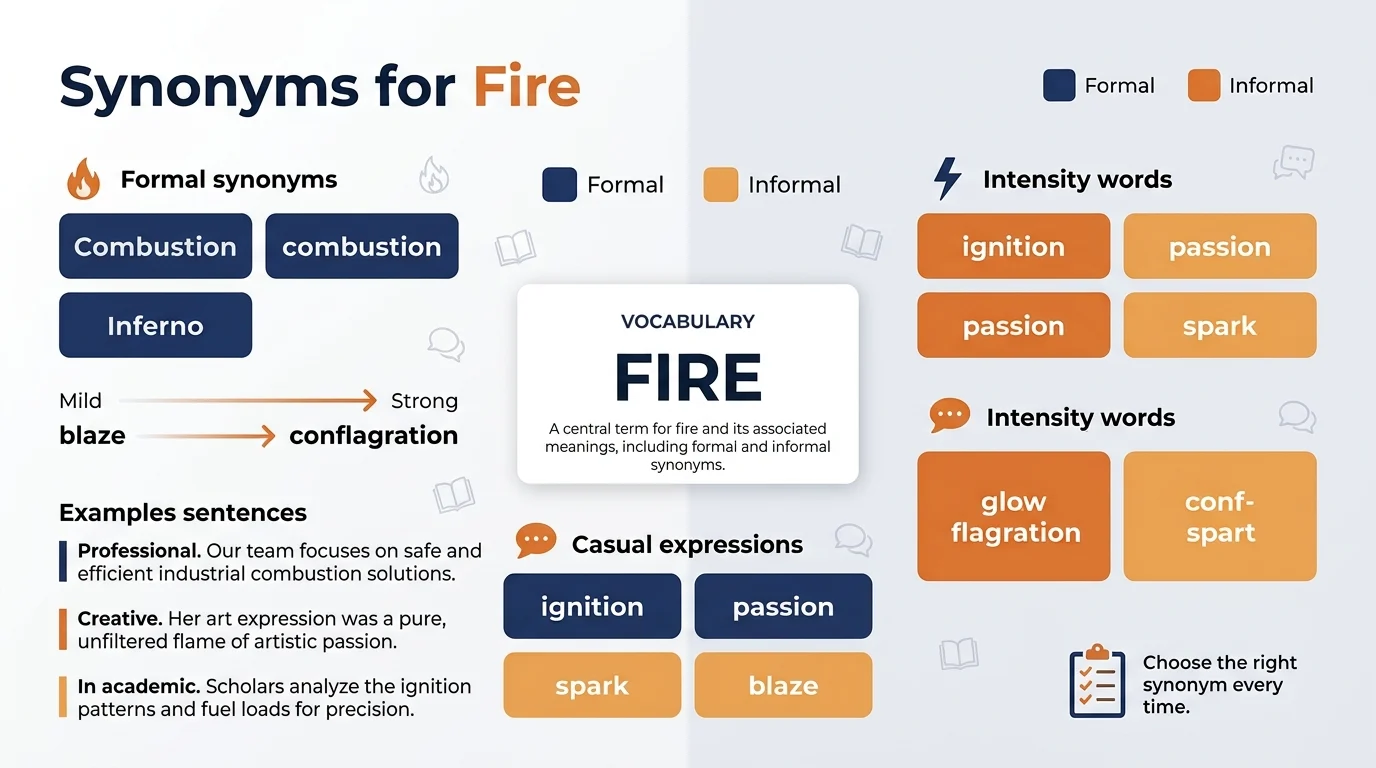
Have you ever caught yourself using the word “fire” over and over again in a single paragraph? You are not alone. Writers, students, and professionals often struggle to find fresh alternatives for this common word. The English language offers dozens of precise synonyms that can make your writing more vivid and engaging.
Whether you are crafting a professional email, writing a creative story, or preparing a resume, choosing the right synonym for fire can transform your message. This guide will help you master every shade of meaning for this powerful word.
What Does “Fire” Mean?
Fire is the rapid chemical reaction that produces heat, light, and flames through combustion. The best synonyms depend on your context: use “blaze” for dramatic intensity, “inferno” for destructive scale, “ignite” for starting action, or “passion” for emotional energy. Each alternative carries distinct connotations.
Meaning, Tone and Context
Simple definition: Fire is a chemical process that releases energy as heat and light. It can also represent strong emotions, energy, or decisive action.
Part of speech: Fire functions as both a noun and a verb. As a noun it describes the physical phenomenon or intense feeling. As a verb it means to discharge, ignite, or dismiss someone.
Tone: Neutral, but the tone shifts dramatically based on context. Physical fire descriptions feel factual. Emotional fire metaphors feel passionate or destructive.
Formality level: Fire itself remains neutral and appropriate in all contexts. However, synonyms range from highly formal to very casual.
Common use cases: Physical descriptions of flames, emotional intensity, workplace terminations, starting engines, inspiring motivation, and shooting weapons.
Important word forms: Fire (noun, verb), fiery (adjective), fires (plural noun), fired (past verb), firing (present verb), fireless (adjective), rekindle (related verb).
When and How to Use “Fire”
Fire works perfectly when you need a direct, clear word that everyone understands. It remains the safest choice for general use. More specialized synonyms often create stronger impressions.
Professional context: “The team needs to fire up their creativity for this project.”
Personal context: “The campfire crackled and warmed our faces on the cold night.”
Academic context: “The scientist studied how fire spreads through different materials.”
Emotional context: “She felt a fire of determination burning inside her chest.”
Creative context: “The sunset painted the sky in shades of fire and gold.”
Social media context: “This new track is absolute fire. You need to hear it.”
Resume context: “I have strong fire safety training and emergency response skills.”
Another Word for Fire
The best single replacement depends entirely on your specific situation.
Professional writing: “Ignition” sounds precise and technical in workplace settings.
Academic writing: “Combustion” provides the scientific accuracy required for research papers.
Casual conversation: “Blaze” adds energy without sounding too formal or dramatic.
Emotional writing: “Passion” captures the internal intensity of fire as a metaphor.
Creative writing: “Inferno” creates powerful imagery for destructive or overwhelming flames.
Resume use: “Motivation” or “drive” work better when describing personal energy.
Social media captions: “Heat” or “flames” often appear in modern casual usage.
Stronger meaning: “Inferno” suggests the most intense and destructive fire possible.
Softer meaning: “Glow” suggests gentle warmth without aggressive burning.
When Not to Use Fire
Fire can sound too vague when you need to describe specific characteristics. It also fails when you require technical precision.
The word feels too casual for formal scientific papers about combustion chemistry. Instead use “oxidation” or “thermal reaction.”
Weak sentence: “The fireplace produced a nice fire.”
Improved sentence: “The fireplace produced a warm, crackling blaze.”
Weak sentence: “Her speech lit a fire in the audience.”
Improved sentence: “Her speech ignited enthusiasm throughout the audience.”
Words Commonly Confused With Fire
Flame vs Fire: Flame refers to the visible, glowing gas part of the fire. Fire describes the complete chemical reaction. Use flame when focusing on appearance and fire for the full phenomenon.
Blaze vs Fire: Blaze suggests a larger, brighter, more intense fire. Use blaze for dramatic effect and fire for neutral descriptions.
Inferno vs Fire: Inferno describes an enormous, uncontrolled, destructive fire. Use inferno only for catastrophic scale. Fire works for all sizes.
Combustion vs Fire: Combustion is the scientific term for the chemical process. Fire is the common word for everyday use. Use combustion in academic writing.
Heat vs Fire: Heat describes the temperature produced. Fire describes the phenomenon itself. Use heat for warmth and fire for the burning process.
Ignite vs Fire: Ignite means to start burning or cause a fire. Fire as a verb can mean the same thing. Use ignite for starting action and fire for ongoing action.
Best Synonym by Context for Fire
| Context | Best Synonym | Why It Works | Example |
|---|---|---|---|
| Formal writing | Combustion | Provides scientific precision and accuracy | The combustion process releases significant thermal energy. |
| Academic writing | Ignition | Describes the initiation of burning with clarity | The ignition temperature determines material flammability. |
| Professional use | Enthusiasm | Captures workplace energy without dramatic intensity | His enthusiasm for the project inspired the entire department. |
| Resume writing | Drive | Shows personal motivation and professional ambition | Strong drive for excellence led to consistent performance. |
| Casual conversation | Blaze | Adds energy while remaining natural and friendly | That bonfire was an incredible blaze last night. |
| Creative writing | Inferno | Creates powerful visual imagery for readers | The inferno consumed the ancient forest in hours. |
| Emotional tone | Passion | Expresses deep feeling and internal intensity | Her passion for justice burned brighter than ever. |
| Strong intensity | Conflagration | Suggests overwhelming destructive scale | The conflagration devastated the entire city block. |
| Soft moderate tone | Glow | Suggests gentle warmth and peaceful energy | The cozy glow of candles filled the room. |
| Social media captions | Heat | Modern, casual, and culturally relevant language | This outfit brings the heat today. |
Which Synonym Should You Choose?
Consider your audience first. Academic readers expect scientific precision. Professional colleagues respond to motivational language. Friends appreciate casual natural phrasing.
Consider your purpose. Describing a destructive event demands dramatic words. Explaining a workplace success requires professional language. Expressing emotion calls for passionate vocabulary.
Consider your emotional intensity. Strong situations need powerful words. Mild situations require softer alternatives.
Consider the sentence structure. Short, direct sentences work with simple synonyms. Complex sentences can support more sophisticated vocabulary.
Real Life Examples of Fire in Sentences
School context: The chemistry teacher explained how fire requires oxygen, fuel, and heat to sustain combustion.
Workplace context: Our marketing campaign ignited customer interest across multiple channels.
Writing context: The author described the fire as a living creature consuming everything in its path.
Conversation context: I could see the fire in his eyes when he talked about his goals.
Social media context: Your performance was absolute fire tonight. Everyone loved it.
Resume context: Maintained fire safety compliance across six facilities.
Email context: Let’s fire off these responses before the end of the day.
Storytelling context: The dying embers glowed like scattered rubies in the darkness.
25 Synonyms for Fire
| Synonym | Simple Meaning | Best Used For | Example Sentence |
|---|---|---|---|
| Blaze | Bright, intense fire | Dramatic descriptions | The blaze illuminated the entire valley. |
| Inferno | Massive destructive fire | Catastrophic events | The inferno raged for three days straight. |
| Flame | Visible burning gas | Visual descriptions | The flame danced in the gentle breeze. |
| Combustion | Chemical burning process | Scientific writing | Complete combustion produces carbon dioxide. |
| Ignition | Act of starting fire | Technical contexts | The ignition system failed to start the engine. |
| Spark | Small burning particle | Starting moments | A single spark can start a massive blaze. |
| Ember | Glowing piece of ash | Romantic or quiet settings | The embers glowed orange in the fireplace. |
| Cinder | Burned piece of material | Describing aftermath | The cinders remained warm for hours. |
| Conflagration | Large destructive fire | Historical or news events | The conflagration destroyed the entire district. |
| Bonfire | Large outdoor fire | Social or ceremonial use | The bonfire celebrated the summer solstice. |
| Campfire | Small outdoor fire | Recreational settings | We roasted marshmallows over the campfire. |
| Pyre | Fire for burning bodies | Funeral or ritual contexts | The funeral pyre sent smoke into the sky. |
| Arson | Criminal fire setting | Legal or crime contexts | The police investigated the arson case. |
| Wildfire | Uncontrolled natural fire | Environmental contexts | The wildfire spread across thousands of acres. |
| Brushfire | Fire in dry vegetation | News or environmental use | The brushfire threatened several homes. |
| Fiery | Having fire characteristics | Descriptive adjectives | Her fiery personality attracted attention. |
| Flaming | Burning with flames | Intense descriptions | The flaming torch lit the path ahead. |
| Scorching | Extremely hot burning | Weather or temperature | The scorching heat made the day unbearable. |
| Searing | Intense burning sensation | Sensation or cooking | The searing pain lasted only seconds. |
Synonym Groups and Usage Differences
Professional vs. Personal Synonyms
Professional settings favor “enthusiasm,” “drive,” or “motivation.” These words convey energy without physical fire imagery. Personal contexts allow “passion,” “burning,” or “fire within” for emotional expression. Choose professional words for work emails and personal words for private conversations.
Formal vs. Conversational Synonyms
Formal reports require “combustion,” “ignition,” or “thermal reaction.” These terms demonstrate technical knowledge. Conversational use embraces “blaze,” “flames,” or “heat.” These words sound natural in everyday speech. Academic papers prefer formal terms. Social media posts thrive on conversational choices.
Academic Synonyms
Academic writing demands “combustion reaction,” “oxidation,” or “thermal decomposition.” These terms provide scientific precision. Research papers about fire behavior should use “flame spread,” “ignition temperature,” and “heat release rate.” Technical accuracy matters more than creative expression in academic contexts.
Professional and Business Synonyms
Business communication benefits from “enthusiasm,” “energy,” and “drive.” These words describe workplace motivation without dramatic overstatement. “Ignite” works well for starting initiatives. “Fuel” describes sustained effort. Use these terms in presentations, meetings, and professional documents.
Creative or Literary Synonyms
Creative writers enjoy “inferno,” “blaze,” and “conflagration.” These words build vivid imagery. “Ember” creates romantic mood. “Spark” suggests beginning. “Smoldering” builds tension. Literary works use these synonyms to paint pictures in readers’ minds.
Slang or Modern Synonyms
Modern slang uses “fire” itself to mean excellent or exciting. “Flames” describes intense attraction. “Heat” suggests fashion or music excellence. These terms work in casual social media contexts but fail in professional writing.
Strongest vs. Weaker Synonyms
Intensity scale from mild to strongest:
Glow, spark, flame, blaze, inferno, conflagration.
Glow offers gentle warmth. Conflagration suggests overwhelming destruction. Choose based on the intensity level you need.
Emotional vs. Neutral Synonyms
Emotional synonyms include “passion,” “burning,” and “fiery desire.” These words express internal feeling. Neutral synonyms include “combustion,” “ignition,” and “thermal reaction.” These terms describe physical processes without emotional weight.
Antonyms of Fire
| Antonym | Meaning | Example Sentence |
|---|---|---|
| Extinguish | To put out fire | The firefighters worked to extinguish the flames. |
| Quench | To suppress or satisfy | Rain helped quench the burning forest. |
| Douse | To pour liquid on | They doused the campfire with water. |
| Smother | To cover and suffocate | Sand will smother a small fire quickly. |
| Stifle | To suppress or restrain | The lack of oxygen stifled the combustion. |
| Subdue | To bring under control | The crew subdued the blaze within hours. |
| Suppress | To stop or prevent | The sprinkler system suppresses fire automatically. |
| Water | To apply water | They watered the burning brush thoroughly. |
| Cool | To reduce temperature | The cool air slowed the fire’s spread. |
| Quash | To put down completely | Authorities quashed the fire quickly. |
| Choke | To prevent breathing | The smoke choked the fire’s oxygen supply. |
| Suffocate | To deprive of air | The fire suffocated in the sealed room. |
| Dampen | To moisten and reduce | Rain dampened the fire’s intensity. |
| Deaden | To reduce force or effect | The thick walls deadened the fire’s noise. |
| Pacify | To calm or appease | The fire department pacified the flames. |
Comparison: Fire vs. Similar Words
Fire vs. Flame
The main difference is scope. Fire describes the entire phenomenon. Flame describes just the visible part. Fire is more comprehensive. Flame is more specific. Use fire for complete situations and flame for visual descriptions.
Fire example: “The campfire kept us warm all night.”
Flame example: “The candle flame flickered in the darkness.”
Fire vs. Blaze
Blaze suggests greater intensity and brightness. Fire works for any size. Blaze implies large, dramatic, impressive burning. Choose blaze for emphasis and fire for neutral use.
Fire example: “The small fire in the fireplace was comforting.”
Blaze example: “The blaze could be seen from miles away.”
Fire vs. Inferno
Inferno suggests overwhelming destructive power. Fire can be controlled. Inferno implies catastrophe. Use inferno for disaster and fire for normal situations.
Fire example: “The kitchen fire was contained quickly.”
Inferno example: “The warehouse inferno took days to control.”
Fire vs. Heat
Heat describes temperature. Fire describes the burning process. Use heat for warmth and fire for the actual flame.
Heat example: “The stove produced intense heat.”
Fire example: “The stove fire cooked our dinner perfectly.”
Fire vs. Passion
Passion describes emotional intensity. Fire describes physical burning. Use passion for feelings and fire for physical phenomena.
Passion example: “His passion for music inspired everyone.”
Fire example: “The fire in the fireplace crackled cheerfully.”
Fire vs. Ignite
Ignite means to start a fire. Fire can mean the burning itself. Use ignite for beginning and fire for ongoing burning.
Ignite example: “The match will ignite the kindling.”
Fire example: “The fire burned for hours.”
Common Phrases and Expressions with Fire
1. Catch Fire
Meaning: To begin burning or to become exciting.
Example sentence: The paper caught fire immediately.
2. Fire Away
Meaning: To begin asking questions or speaking.
Example sentence: Feel free to fire away with your questions.
3. Under Fire
Meaning: Being criticized or attacked.
Example sentence: The manager came under fire for his decisions.
4. Breathe Fire
Meaning: To speak with intense anger.
Example sentence: The coach breathed fire at the losing team.
5. Light a Fire Under
Meaning: To motivate or pressure someone.
Example sentence: The deadline lit a fire under the team.
6. Where There’s Smoke, There’s Fire
Meaning: Rumors usually have some truth.
Example sentence: People are talking, and where there’s smoke there’s fire.
7. Fired Up
Meaning: Excited or enthusiastic.
Example sentence: The crowd was fired up for the concert.
8. Out of the Frying Pan and into the Fire
Meaning: Moving from a bad situation to a worse one.
Example sentence: He left one stressful job and landed in another. It was out of the frying pan and into the fire.
Common Mistakes to Avoid
Using fire when a more precise synonym is better: General use of fire creates vague writing. Choose “blaze” for brightness, “inferno” for destruction, or “spark” for small beginnings.
Confusing fire with flame: Remember that fire is the whole phenomenon. Flame is just the visible gas. Use flame when describing appearance and fire for the complete process.
Using a casual synonym in formal writing: “Blaze” does not belong in scientific papers. Use “combustion” or “ignition” for academic work.
Using an overly dramatic synonym for a simple situation: “Inferno” sounds ridiculous for a candle. Save dramatic words for dramatic situations.
Repeating the same word too often: Variety improves writing. Alternate between “fire,” “blaze,” “flame,” and other appropriate synonyms.
Choosing a synonym with the wrong emotional tone: “Conflagration” sounds too destructive for a cozy fireplace. Match emotional weight to your situation.
Using slang in academic or professional writing: Avoid “fire” as slang for excellent in formal contexts. Save casual language for appropriate settings.
FAQs
What is the best synonym for fire?
The best synonym depends on context. “Blaze” works for dramatic effect. “Combustion” suits scientific writing. “Passion” fits emotional expression.
What is a formal synonym for fire?
“Combustion” and “ignition” are formal synonyms suitable for academic and technical contexts.
What is an informal synonym for fire?
“Blaze,” “flames,” and “heat” are informal synonyms for casual conversations and social media.
What is another word for fire in professional writing?
“Enthusiasm,” “drive,” or “ignition” work well in professional writing depending on your specific meaning.
What is the difference between fire and blaze?
Blaze suggests a larger, brighter, more intense fire. Fire is the general term for all burning phenomena.
What is the opposite of fire?
“Extinguish,” “quench,” and “douse” are common opposites of fire.
Conclusion
Fire is a versatile word with countless synonyms that add precision and power to your communication. Physical fire requires words like “combustion,” “blaze,” and “inferno” for accurate description. Emotional fire calls for “passion,” “drive,” and “enthusiasm” to express internal energy.
The key to choosing the right synonym lies in understanding your context, audience, and purpose. A well chosen synonym transforms ordinary writing into compelling communication.
Always verify definitions using trusted dictionaries such as Cambridge, Oxford, Merriam Webster, Collins, or Britannica before publishing. These sources ensure accuracy and appropriate usage.
Remember that variety improves your writing. Challenge yourself to use at least one new synonym for fire in your next piece of writing.