Few words work as hard as really. We lean on it when we mean very, when we swear something is true, and when we want a promise to sound certain. The trouble starts when one page uses it twelve times and every sentence sounds the same.
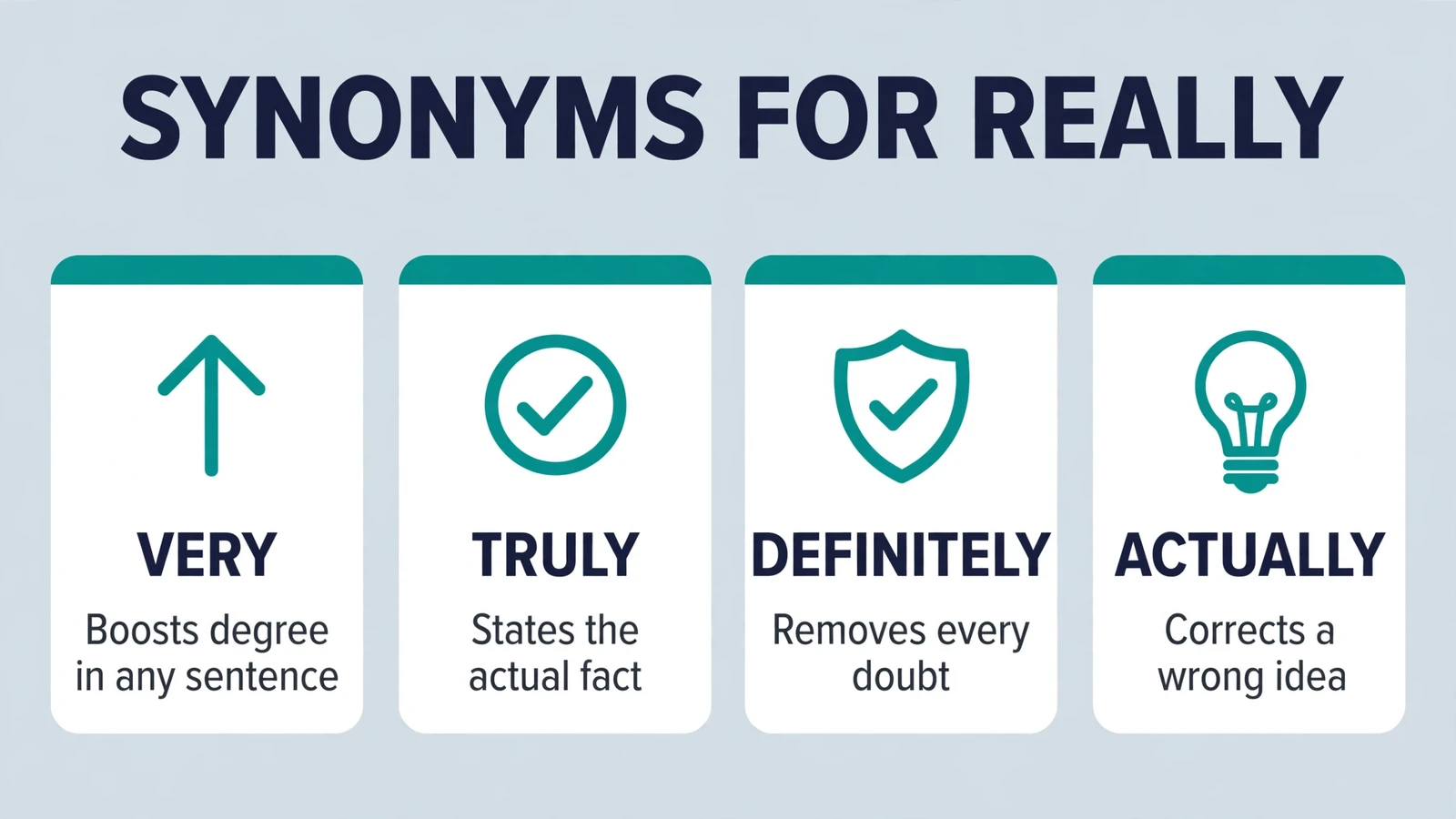
The best all-round synonyms for really are very, truly, genuinely, actually, definitely, extremely, certainly and indeed. Each one fits a different job, though. Very and extremely boost degree. Truly and genuinely speak about truth. Definitely and certainly remove doubt.
This guide sorts more than 100 synonyms for really by the job they do. You will find quick picks first, then grouped lists with examples, essay-ready replacements, and the near misses that are not true synonyms at all.
Synonyms for Really at a Glance: Quick Reference Table
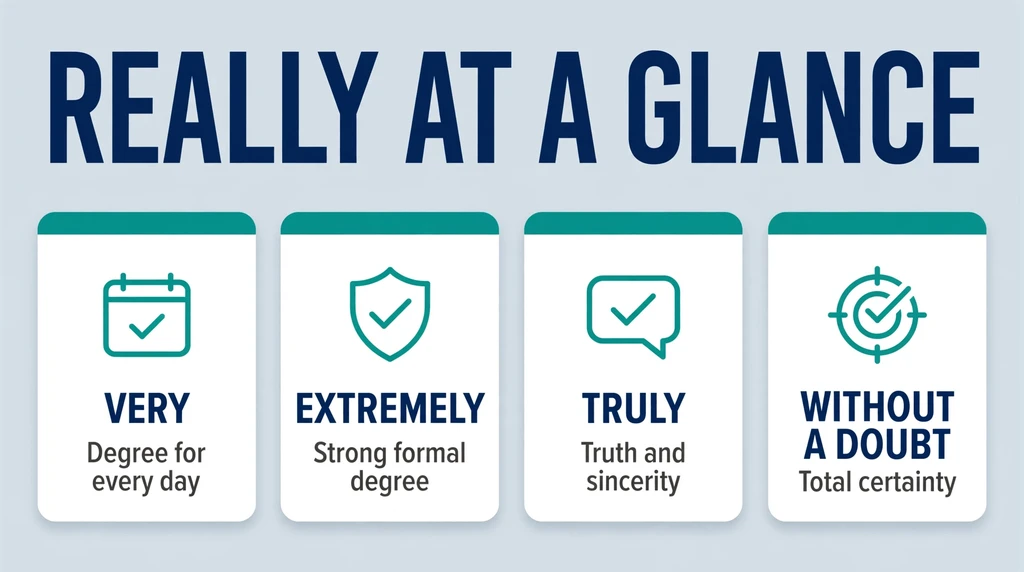
Start here when you need a fast swap. The table below holds the 30 most useful synonyms for really, each with its job and the place it fits best. The grouped sections after the table explain the fine differences.
| Word | What it does | Best for |
|---|---|---|
| very | boosts degree | everyday speech and writing |
| extremely | very strong degree | formal and neutral writing |
| highly | strong degree, professional tone | reports, reviews, essays |
| truly | in actual fact, sincerely | heartfelt statements |
| genuinely | honestly and really | feelings, apologies |
| actually | states the real fact | correcting a wrong idea |
| indeed | confirms and emphasizes | formal writing |
| definitely | no doubt at all | promises, decisions |
| certainly | sure and confident | polite emphasis |
| absolutely | total agreement or degree | strong replies |
| honestly | speaking truthfully | confessions, opinions |
| incredibly | degree that surprises | praise, stories |
| remarkably | degree worth noticing | essays, reviews |
| greatly | strong degree, formal | formal writing |
| exceedingly | very great degree | literary, formal |
| utterly | complete degree | total states, strong negatives |
| immensely | huge degree | enjoyment, gratitude |
| considerably | clear, measurable degree | reports, comparisons |
| significantly | important degree of change | academic writing |
| especially | singles one thing out | emphasis on a detail |
| particularly | stronger than especially | formal emphasis |
| terribly | strong degree, British flavor | informal British speech |
| awfully | strong degree, informal | casual speech |
| seriously | strong degree, informal | casual emphasis |
| surely | confident expectation | arguments, persuasion |
| undoubtedly | beyond question | formal certainty |
| unquestionably | cannot be doubted | formal certainty |
| positively | certain and definite | firm statements |
| in fact | states the truth plainly | essays, explanations |
| without a doubt | total certainty phrase | speeches, conclusions |
The pattern behind the table
Notice the pattern in the table. About a third of the words push degree upward. Another third talk about truth. The rest settle questions of certainty. Picking the right synonym for really starts with knowing which third your sentence needs. Most writers lean on the same six or seven of these words again and again. The rest are specialists, saved for the sentences that deserve them.
The Three Meanings of Really
Really looks simple, yet dictionaries split it into clear senses. Cambridge lists the degree sense first for learners and labels it A1, the level of the earliest English lessons. The same entry gives a truth sense at B1: really used when you say what the truth of a situation is. Merriam-Webster’s dictionary traces the word back to the 15th century, and it is built from the adjective real plus the ending -ly.
Really as a degree word
In its commonest job, really strengthens the word after it. It means very or very much. “The soup is really hot” says more than “The soup is hot.” “I really want to go” pushes the wanting harder than a plain statement would. Degree words like this one are called intensifiers, and really is the intensifier most speakers reach for first.
Really as a truth word
Really also testifies. It tells the listener that what follows is the actual fact, not a guess or a polite fiction. “I really did lock the door” answers a doubt. “She really thinks so” reports a genuine belief, not a performance. In this sense, really stands close to truly, genuinely and actually, and it often appears when someone might otherwise be doubted.
Really as emphasis and reaction
Finally, really removes doubt and adds force. “You really should rest” is advice with weight behind it. Standing alone with a question mark, “Really?” asks for confirmation and shows surprise at the same time. Cambridge lists this reaction use on its own, because the single word carries a whole conversation: is that true, and since when?
One word, three positions
Really is flexible because it can sit in several places. Before an adjective, it works as a degree word: a really cold morning. Before a main verb, it usually testifies or emphasizes: I really did call her back. At the start of a sentence, it sets a tone of protest or confession: Really, the noise has to stop. Word order gives readers a clue about the job, so a good synonym swap keeps the replacement in the same seat.
Stress does quiet work, too. Say “I really did lock it” with weight on did, and really points at the truth. Say “I really need sleep” with weight on really itself, and it points at degree. Listeners hear the difference instantly. That is why the synonyms in this guide are sorted by job rather than alphabetically: the job is what the stress was marking.
Degree Synonyms for Really: Very, Extremely, Highly and More
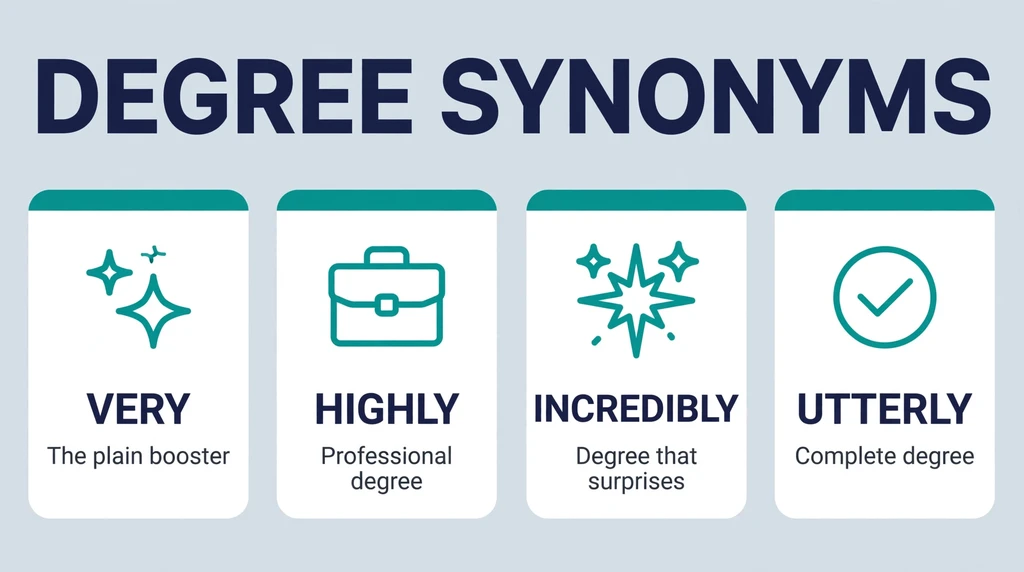
Use this group when really means very or to a great degree. Merriam-Webster gives this sense as “to a great degree,” with really tired as its example. The words below climb from everyday choices to strong and formal ones, and each gloss tells you how much force the word adds.
Everyday degree words
These five swaps work almost anywhere really works.
- very: the plainest degree booster of all; safe in every register. The team played very well.
- so: warm, spoken degree; best before adjectives in conversation. The baby is so cute.
- greatly: strong degree with a formal polish; common with verbs like improve, appreciate and suffer. The new road greatly reduced travel time.
- highly: strong degree in professional settings; pairs with likely, skilled, competitive and recommended. She is a highly respected surgeon.
- extremely: degree near the top of the scale; the safest strong swap in essays and reports. The exam was extremely difficult.
For a deeper list built only around this job, see our guide to synonyms for very, which sorts degree words by strength.
Stronger degree words
When extremely still feels weak, these words push further or add a shade of meaning.
- incredibly: degree so high it strains belief; natural in praise. The view from the roof was incredibly clear.
- remarkably: degree that deserves notice; a favorite in reviews. The old engine still runs remarkably well.
- exceptionally: degree beyond the usual standard. He showed exceptionally good judgment.
- exceedingly: very great degree; formal and slightly literary. The instructions were exceedingly clear.
- immensely: huge degree; often with enjoyment, power or gratitude. They enjoyed the concert immensely.
- enormously: degree on a massive scale. Prices vary enormously between cities.
- vastly: degree across a wide gap, usually in comparisons. The sequel is vastly better than the original.
- utterly: complete degree; loves strong states and negatives. The room fell utterly silent.
- tremendously: great degree with energy behind it. The reforms helped tremendously.
- inordinately: degree beyond the normal amount; formal. The meeting lasted inordinately long.
- considerably: a clear, measurable step up or down; ideal for reports. Sales rose considerably this spring.
- significantly: degree large enough to matter; the academic favorite. The results differ significantly.
- substantially: degree in amount or importance. The plan cut costs substantially.
- markedly: degree an observer can plainly see. Her tone changed markedly.
- notably: degree worth singling out. The roads were notably quieter.
Measured and complete degree words
A second family measures degree, completes it, or states it with unusual force. These words suit reports, essays and careful prose, because they suggest a scale rather than a shout.
- profoundly: deep, far-reaching degree. The speech profoundly moved the crowd.
- deeply: degree felt at the core; pairs with grateful, sorry, moved. We are deeply grateful for your help.
- thoroughly: degree carried through completely. Rinse the rice thoroughly.
- decidedly: degree with a firm, settled quality. The mood turned decidedly chilly.
- especially: picks one case out and raises it above the rest. The roads are busy, especially on Fridays.
- particularly: like especially, with a more formal step. I particularly liked the final chapter.
- eminently: degree to a high and deserving level; formal. He is eminently qualified for the post.
- surpassingly: degree beyond all rivals; rare and literary. A surpassingly beautiful valley.
- fantastically: degree beyond realistic expectation. The scheme worked fantastically well.
- noticeably: degree visible to anyone watching. The patient breathed noticeably easier.
- sorely: degree of strong need or feeling; classic in “sorely missed” and “sorely tempted.” The old captain was sorely missed by his crew.
- badly: strong degree with verbs of wanting and needing. We badly need rain this month.
- fiercely: degree with force and heat; suits competition and loyalty. The title was fiercely contested.
- downright: degree stated bluntly, often for faults. His reply was downright rude.
Complete degree words
A final degree family closes the scale completely, leaving nothing in reserve.
- absolutely: complete degree with adjectives like certain, perfect and necessary. The plan is absolutely essential.
- totally: complete degree; relaxed in speech, acceptable in most writing. I totally forgot about the call.
- completely: degree with nothing left over. The road was completely empty.
- entirely: complete degree, slightly formal. I entirely agree with the decision.
- altogether: degree taken as a whole. The trip was altogether unforgettable.
- wholly: complete degree; formal twin of entirely. The claim proved wholly false.
One more page pairs naturally with this section: our list of synonyms for extremely ranks the strongest degree words from mild to extreme.
Degree words that add surprise
Three degree words carry a raised eyebrow inside them. Surprisingly fits results nobody predicted: the cheap seeds surprisingly won. Astonishingly goes further, for degree that shocks: astonishingly few tickets sold. Amazingly sits between them and suits good news: amazingly, the lost dog came home. Reach for these when the degree is not just high but unexpected. News writers and reviewers lean on this small family because each word reports a fact and a feeling at the same time.
Informal degree words
Speech has its own stock of intensifiers, and several carry warnings.
- terribly: strong degree in British speech; can sound negative, so test the sentence. I am terribly sorry.
- awfully: informal degree, again commoner in British use. It is awfully kind of you.
- seriously: casual emphasis, mostly American. That cake is seriously good.
- desperately: degree with urgency; best for needs and wants. They desperately wanted a win.
- intensely: degree with concentrated force. She intensely disliked the noise.
- pretty: informal degree, mainly American; in British use it can weaken instead. The hike was pretty steep.
- quite: degree in American use; in British use it often softens, as in “quite good” meaning fairly good.
- real: adverb in informal American speech: a real nice day. Keep it out of formal writing.
- rattling: old-fashioned British degree, surviving in “a rattling good story.”
- super: bright, youthful degree in casual speech. The tickets were super cheap.
- mighty: folksy degree, regional in flavor. That was mighty kind of you.
- majorly: playful modern degree in speech. He majorly messed up.
- way: youth slang degree before comparatives: way better, way too late.
Register is the whole game with this family. One informal intensifier can warm a blog post or a speech, while three in a row make careful prose sound careless. Use them one at a time, and keep them out of legal, medical and academic writing altogether.
Truth Synonyms for Really: Truly, Genuinely, Actually and More
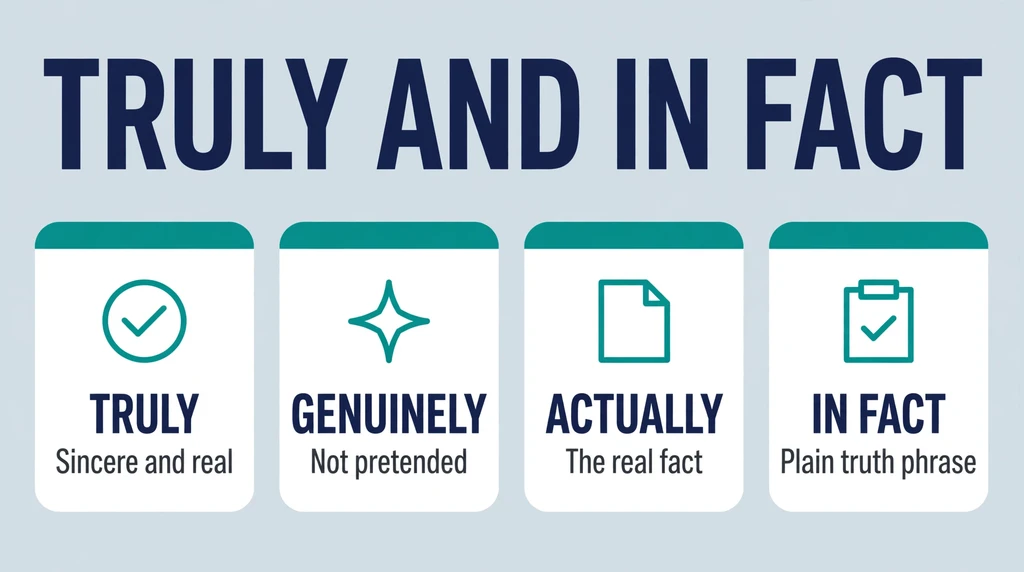
Switch to this group when really testifies that something is the actual fact. Merriam-Webster phrases this sense as “in actual fact,” and Collins groups it under “in reality.” These words promise the listener: no exaggeration, no polite fog, just what is so.
Everyday truth words
- truly: in a true and sincere way; the closest all-round match for really in this sense. I truly believe we can finish.
- genuinely: in a way that is real and not pretended. He was genuinely shocked by the news.
- actually: states the fact, often against what was assumed. The shop actually opens at nine.
- indeed: confirms a statement and adds weight; slightly formal. The rumors were indeed true.
- honestly: speaking in a truthful way; opens opinions and confessions. Honestly, I forgot the meeting.
- truthfully: in line with the truth; common before “I do not know.” Truthfully, the plan worries me.
- sincerely: from the heart, without pretense; classic in letters. I sincerely hope you recover soon.
- legitimately: in a way that is genuine and allowed. She legitimately earned the title.
- authentically: in a way true to the original or to oneself. The dish tastes authentically homemade.
Our companion guide to synonyms for actually goes deeper on the fact-stating family. Notice, too, how often these truth words stand beside verbs of thinking and feeling: truly believe, genuinely shocked, honestly think. That pattern makes sense. Truth claims matter most exactly where belief and feeling are involved, and readers listen hardest at those moments.
Phrases that state the fact
Sometimes the honest swap is a phrase, not a single word.
- in fact: the workhorse fact phrase of essays and explanations. In fact, the road closes at dusk.
- in reality: contrasts appearance with the truth underneath. The job looks easy; in reality, it takes years to master.
- in actuality: the formal twin of in reality.
- in truth: a slightly literary way to confess the fact. In truth, I was nervous.
- in effect: true in result, whatever the label says.
- as a matter of fact: friendly, spoken fact-setting.
- in point of fact: formal and precise, common in British writing.
- in actual fact: doubled emphasis on the fact itself.
- in all sincerity: promises honest intent before a hard truth.
- to be sure: concedes a fact honestly before adding a “but.” To be sure, the plan costs money.
Precision words: exactly, just and simply
Three small words sit near really without matching its main senses. Exactly confirms precision: that is exactly what I meant. Just narrows the claim to one precise point: I just called to say thanks. Simply strips away everything extra: the answer is simply no. Writers swap these in when the sentence needs accuracy more than strength.
Old-fashioned and literary truth words
Verily once did the daily work of truly, and Collins marks it archaic. It survives in historical fiction, scripture echoes and playful speech. Veritably is its heavier cousin, meaning in a way that can be verified as true. Both words raise the temperature of formality at once, so save them for effect, never for plain statements.
Emphasis Synonyms for Really: Definitely, Absolutely and More
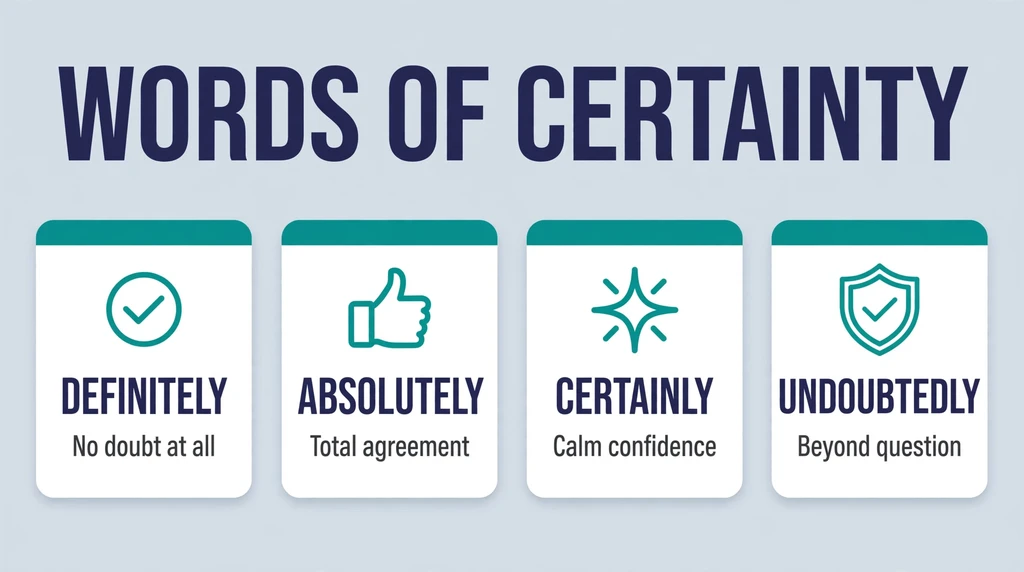
The third job of really is force. Merriam-Webster defines this sense as “without any question,” and Collins groups its words under “certainly.” Use this family when a sentence must close the debate: promises, verdicts, decisions and strong agreement. A well-chosen certainty word can also rescue a weak sentence, because it tells the reader the writer has stopped hedging.
Confident certainty words
- definitely: the direct heir of really in this sense; no room left for doubt. I will definitely attend.
- certainly: sure and gracious at once; the polite strong answer. We certainly appreciate your patience.
- surely: expects agreement and gently argues for it. Surely we can find a better way.
- positively: certain in a firm, official tone. He positively refused to leave.
- assuredly: certain with calm confidence; formal. Success will most assuredly follow.
- categorically: stated without conditions or exceptions. The mayor categorically denied the claim.
Beyond question
- undoubtedly: beyond doubt; the essay writer’s certainty word. He is undoubtedly the finest player here.
- unquestionably: cannot be questioned; a step more formal than undoubtedly.
- undeniably: impossible to deny, usually before a fact or quality. The evidence is undeniably strong.
- unequivocally: stated with no hidden second meaning. She unequivocally rejected the offer.
- unmistakably: so clear it cannot be mistaken for anything else. The accent was unmistakably local.
- indubitably: the grand, old-fashioned certainty word; use sparingly. Indubitably, Watson, the trail is fresh.
- doubtlessly: without doubt, a smooth formal variant of undoubtedly.
- for certain: plain spoken certainty: I know for certain that he left.
- of course: certainty presented as obvious to everyone. Of course the bridge is safe.
Words from this shelf should be spent carefully. One undoubtedly in an essay sounds authoritative. Four in a page start to sound like protesting too much, and sharp readers begin to doubt the very claims the words were meant to protect.
Total-certainty phrases
- without a doubt: the most common full-strength phrase in speech and writing.
- beyond a doubt: the same strength with a formal lift.
- beyond the shadow of a doubt: the longest, most dramatic form; suits speeches and verdicts.
- without doubt: the clipped formal version.
- without qualification: certainty with no exceptions attached; legal in flavor.
- with certainty: measured and calm: we can say with certainty.
- flat-out: blunt spoken certainty, often before a refusal or a verdict; think of a flat-out lie.
Answering a surprised “Really?”
Sometimes really is not in your sentence at all. It arrives as a one-word question, and the synonyms become answers. Seriously confirms with matching energy. Honestly vouches for the teller. No kidding agrees while laughing at the surprise. You don’t say plays along, sometimes sincerely, sometimes teasing. Is that so asks for a little more before believing. In chat and slang, for real and you bet close the exchange with confidence. Match the energy of the question while you answer: a flat reply to an excited “Really?” can sound like doubt instead of agreement.
What to Write Instead of Really in Essays and Formal Writing
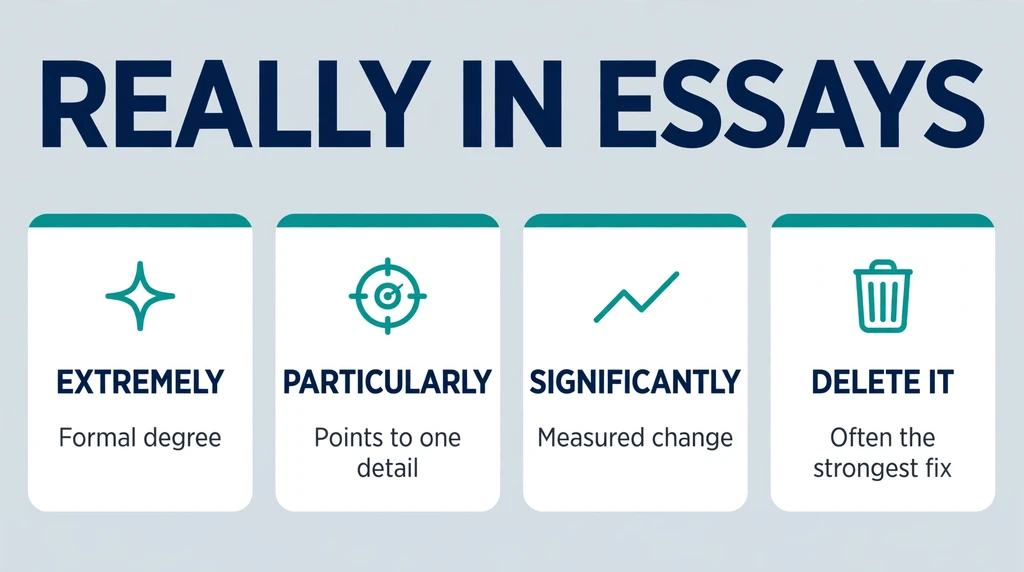
Teachers circle really for a fair reason. The word reports that a degree is high, but it never says how high, and it adds no picture, number or evidence. Formal writing rewards precision, so the fix is not a fancier twin. The fix is choosing a word that measures, or cutting really and letting a stronger main word carry the sentence. Writing guides make the same point: LanguageTool lists extremely, particularly and significantly among the upgrades that sharpen a vague really.
Direct swaps by job
Match the swap to the job really was doing. For degree, write extremely, highly, particularly, significantly or considerably. For truth, write indeed, in fact, genuinely or truly. For certainty, write certainly, undoubtedly or unquestionably. Each swap keeps the meaning while lifting the register, because formal readers trust measured words more than loud ones.
The stronger move: upgrade or delete
Often the best replacement is no adverb at all. “Really important” becomes crucial. “Really big” becomes enormous. “Really quickly” becomes rapidly, or simply fast with a deadline attached. Deleting works too: “The results really show a pattern” tightens into “The results show a clear pattern.” Try the deletion test on every really in a draft. If the sentence loses nothing, the word was decoration.
Before and after
- Really good evidence → compelling evidence, or extremely strong evidence when degree must stay.
- The policy really affected small farms → The policy significantly affected small farms, with figures to follow.
- He was really sure of the answer → He was absolutely sure of the answer.
- This is really a problem → This is indeed a problem, or better, name the problem itself.
- The lecture was really interesting → The lecture was genuinely fascinating, or particularly strong in its final third.
Evidence beats adverbs altogether. When a draft says the app is really popular, a figure does the work better: the app has two million users. Numbers, names and concrete details persuade examiners and editors in a way no intensifier can, because they can be checked. Reach for really only after the evidence is already on the page. Really is not banned from good writing. It sounds natural in reflective essays, dialogue and personal statements, where a spoken voice is a strength. The goal is choice, not fear: every really in the final draft should be there on purpose.
How to Choose the Right Synonym for Really
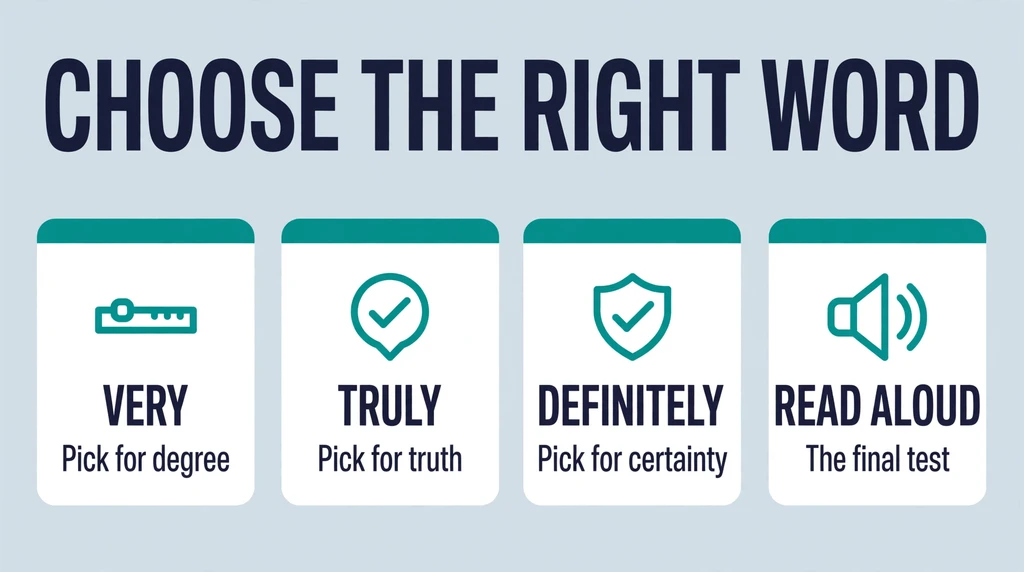
Three questions settle almost every choice.
First, name the job. Ask what really is doing in the sentence. If it raises degree, stay in the degree family: very, extremely, highly, incredibly. If it swears to a fact, use the truth family: truly, genuinely, actually, in fact. If it closes an argument, use the certainty family: definitely, certainly, undoubtedly.
Second, check the register. A lab report and a birthday toast should not sound alike. Formal settings favor extremely, significantly, indeed and undoubtedly. Friendly settings welcome terribly, awfully, seriously and way. Literary writing can hold exceedingly, eminently and even verily, while legal or official prose prefers unquestionably and without qualification.
Third, swap and reread. Put the candidate in the sentence and read it aloud. The right word keeps the meaning and matches the music. Watch these pairs:
- I am really sorry → I am truly sorry (sincerity) or deeply sorry (degree of feeling).
- The road is really dangerous → The road is extremely dangerous (measured) or seriously dangerous (spoken warning).
- She really believes him → She genuinely believes him (no pretending) or honestly believes him (truthful report).
- We will really win → We will definitely win (a promise) or surely win (a confident appeal).
- I really like the design → I particularly like the design (one detail stands out) or I genuinely love the design (the feeling itself is real).
A thirty-second checklist
Before you settle on a swap, run three checks. One: does the new word match the job, degree, truth or certainty? Two: does it match the setting, formal, friendly or literary? Three: does the sentence still say exactly what you meant, with nothing added and nothing lost? A swap that passes all three checks is the right synonym. A swap that fails the third check is a decoration, and decorations are what editing exists to remove.
If two candidates both fit, choose the plainer one. Precision impresses readers more than rarity, and a thesaurus is a toolbox, not a costume box.
Antonyms of Really
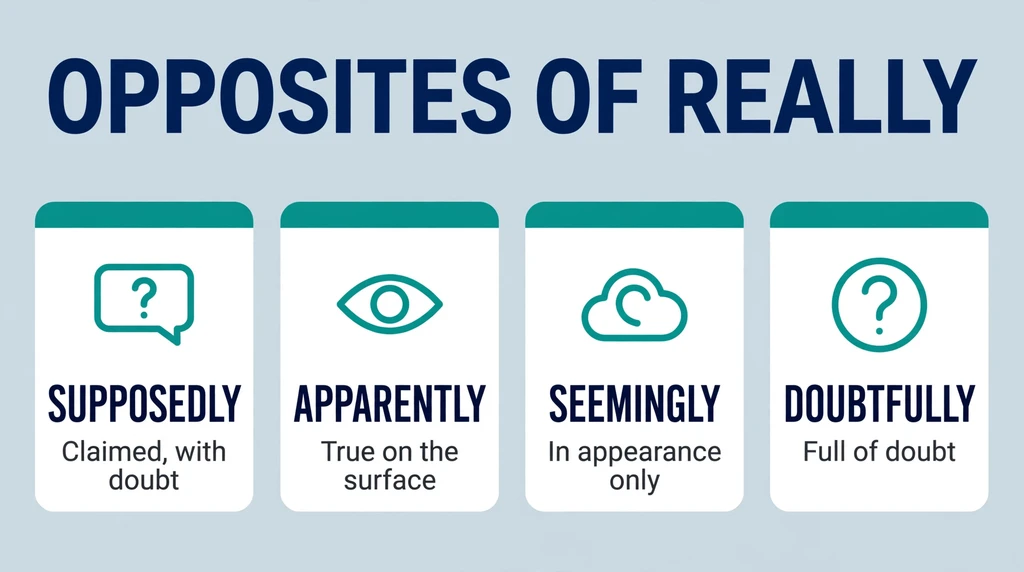
The opposites of really gather on the side of appearance and doubt, which tells you what really stands for. Merriam-Webster lists supposedly, apparently, seemingly, ostensibly and outwardly as its antonyms, and thesauri add doubtfully.
- supposedly: claimed to be true, with doubt attached.
- apparently: true as far as the surface shows.
- seemingly: true in appearance, perhaps not in fact.
- ostensibly: presented as true, with a hint of a hidden reason.
- outwardly: true on the outside only.
- doubtfully: in a way full of doubt.
Put the pairs side by side and the contrast teaches itself. “He is really an expert” vouches for the man. “He is supposedly an expert” quietly invites doubt about him. The sentence barely changes, the stance reverses completely, and the adverb did all of the work.
In daily speech, the working opposite is the phrase itself: “Not really.” It can mean no, not much, or not in fact, and it answers half the questions English speakers ask each other. A flat “Not really” can refuse an offer, soften a judgment or correct a guess, which is why tone matters so much when you say it.
Common Mistakes With Really and Its Synonyms
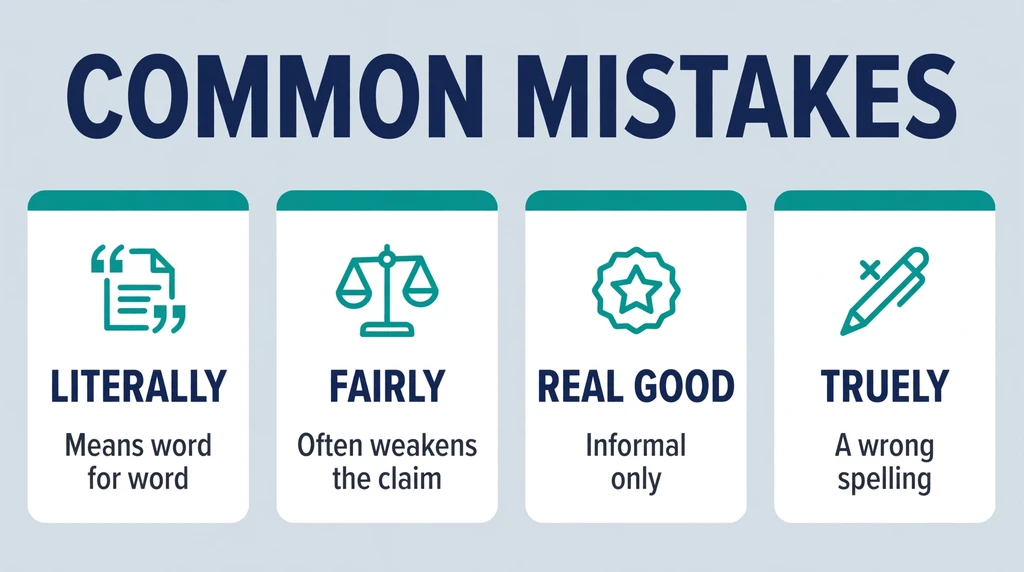
Good swaps can still go wrong. These are the errors that slip past even careful writers.
Swaps that change the meaning
Reaching for literally. Literally means word for word, true in the strict sense. Collins defines its core senses as exactly, strictly and faithfully. Using it as a louder really (“I literally died laughing”) is common in speech, but formal readers may take it as an error. Save literally for statements that must be read word for word.
Trusting weak words to strengthen. Fairly, quite and pretty look like degree words, yet in much British use they soften: “quite good” can mean only fairly good. A writer who swaps really for fairly may accidentally halve the claim.
Choosing excessively. This degree word carries a verdict of too much. “Excessively kind” hints at a problem, while “really kind” does not. Match not just the strength but the judgment inside the word.
Form, spelling and tone mistakes
Writing real before adjectives in formal work. “A real nice day” uses real as an adverb, a pattern Cambridge describes as informal and especially American. In essays and reports, write really, very or a stronger adjective instead.
Spelling truly with an e. The word is truly, never “truely.” The e of true drops before -ly, the same pattern seen in duly and wholly.
Stacking intensifiers. “Really very extremely tired” piles three boosts on one adjective and ends up weaker, not stronger. One measured word, or a stronger adjective such as exhausted, always wins.
Correcting people with actually. Actually states facts, but it also implies that someone was wrong. “Actually, the meeting is Tuesday” can sting. When no correction is needed, truly, genuinely or in fact delivers the fact without the friction.
Misspelling definitely as “definately.” Certainty words attract spelling errors of their own. Definitely keeps the i of finite inside it and contains no letter a at all. A misspelled certainty word quietly weakens the claim it was meant to strengthen, so this one is worth memorizing.
Frequently Asked Questions
What is the best synonym for really?
There is no single best synonym, because really does three jobs. For degree, extremely and very are the safest picks. For truth, truly and genuinely fit best. For certainty, definitely is the closest match. Choosing by job, not by habit, gives the strongest result every time. If one everyday answer were forced, very would cover the most ground with the least risk.
What is a formal synonym for really?
For degree, use extremely, highly, significantly or considerably. For truth, indeed and in fact carry formal weight. For certainty, undoubtedly and unquestionably are the standard formal choices. All of them appear in academic and professional writing without raising eyebrows.
What can I use instead of really in an essay?
Swap by job first: extremely for degree, indeed for truth, certainly for certainty. Then try the stronger move of upgrading the main word, turning “really important” into “crucial.” Finally, test deleting really altogether. Many essay sentences grow clearer the moment the word leaves.
What is the difference between really and truly?
Truly centers on truth and sincerity: a truly honest answer, a truly democratic system. Really covers that ground too, but it also works as a plain degree word in “really tired,” where truly sounds stiff. Truly is slightly more formal, and it is spelled without an e.
What is the difference between really and actually?
Actually presents a fact, often one that corrects an assumption: the shop actually opens at nine. Really emphasizes or intensifies without correcting anyone: I really enjoyed the shop. If nobody held a wrong idea, really is usually the kinder and cleaner choice.
Is really an informal word?
Not exactly. Really is neutral, and it appears in quality journalism and serious books. Formal writing avoids it for a different reason: it is vague. It claims a high degree without measuring it, so precise writers replace it with words that carry evidence, such as significantly or a stronger adjective.
What is the opposite of really?
For truth claims, the opposites are supposedly, apparently and seemingly, which present something as true only on the surface. For certainty, doubtfully stands opposite. In everyday replies, the natural opposite is the phrase “not really,” which can mean no, not much, or not in fact.
What is a stronger word than really?
For degree, incredibly, exceedingly and utterly all push harder than really. For certainty, unquestionably and unequivocally carry more force. Stronger is not always better, though. A measured word like significantly often convinces readers more than a louder one, especially in essays and reports.
Final Thoughts
Really earns its place in English, but it should never be the only tool in the box. Degree, truth and certainty each have sharper words waiting: extremely and incredibly for strength, truly and genuinely for honesty, definitely and undoubtedly for conviction. Pick by job, match the register, and reread before you commit. Keep the quick table open the next time you edit a draft, and give each swap ten honest seconds of thought. Do that, and the word really stops being a habit and starts being a choice. For the full dictionary treatment of this word, including its complete synonym lists by sense, see the Merriam-Webster Thesaurus entry for really.