You have just received an unexpected gift from a colleague. You want to respond with appreciation, but you have already used “grateful” three times this week in emails. Your vocabulary feels stuck on repeat.
This happens to writers, professionals, and students every day. Expressing thanks should feel genuine, not robotic. Repeating the same word drains the emotional weight from your message. Whether you are writing a thank you note, crafting a professional email, or adding captions to social media, having a rich vocabulary for gratitude makes your communication more impactful.
This guide explores more than 50 synonyms for grateful. You will learn the exact meaning, tone, and context for each alternative. You will discover which words fit formal letters, which work best in casual conversations, and which add emotional depth to your writing. By the end, you will never struggle to find the right word for appreciation again.
What Does “Grateful” Mean?
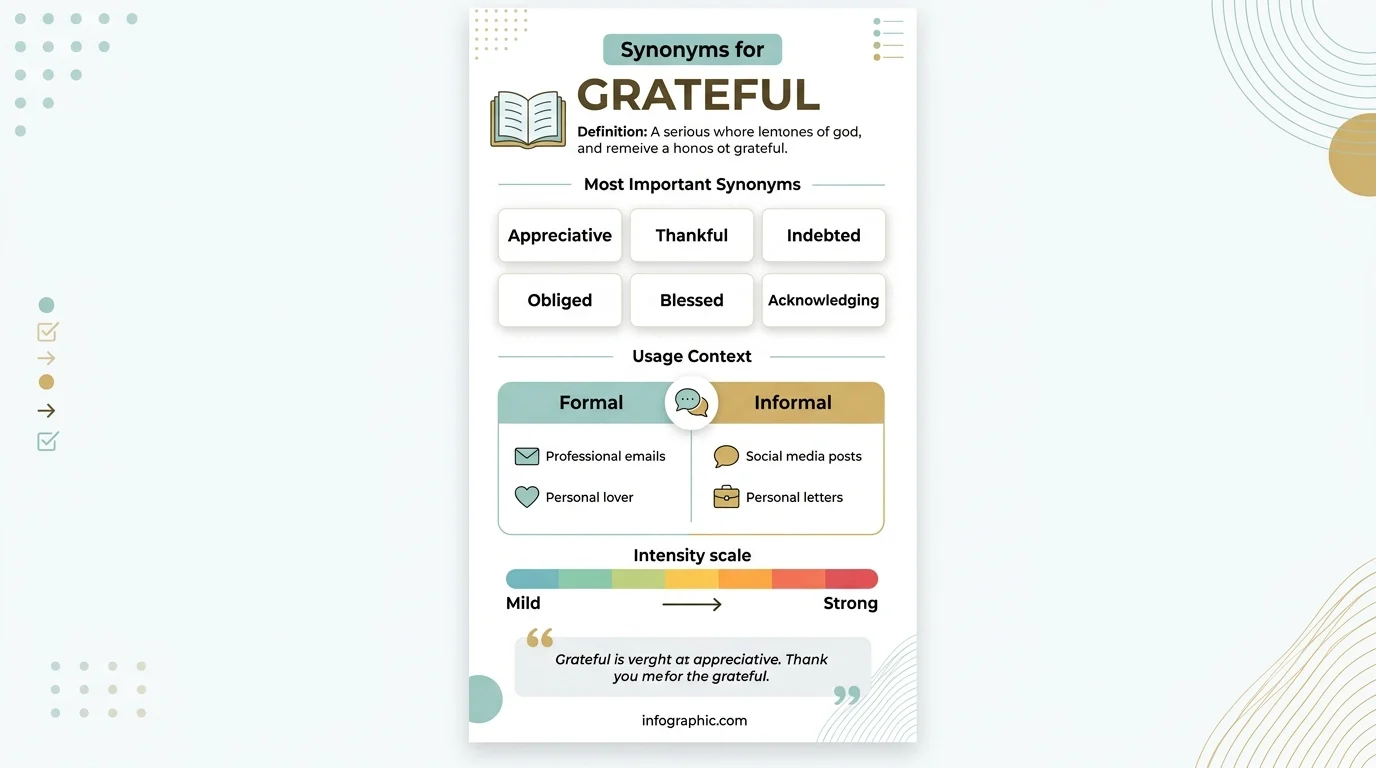
Grateful means feeling or showing appreciation for something received or experienced. The best synonyms depend on your context. For formal writing, use appreciative or obliged. For casual settings, try thankful or blessed. In professional communication, choose indebted or appreciative. For emotional depth, select touched or moved. Academic writing favors cognizant or mindful of benefits received.
Meaning, Tone and Context
Simple Definition
Grateful describes a positive feeling of thankfulness toward someone who has given you something or done something kind for you.
Part of Speech
Grateful is an adjective. It modifies nouns and pronouns to describe a state of appreciation.
Tone
Grateful has a warm, positive, and sincere tone. It conveys genuine appreciation without being overly emotional or dramatic.
Formality Level
Grateful sits comfortably in the middle of the formality scale. It works well in professional emails, casual conversations, and personal letters. It is neither too stiff nor too casual.
Common Use Cases
- Thank you notes and letters
- Professional correspondence
- Social media captions
- Speeches and toasts
- Personal conversations
- Customer service responses
- Job interview follow ups
Important Word Forms
- Gratitude (noun): The state of being grateful
- Gratefully (adverb): In a grateful manner
- Ungrateful (adjective): Not showing appreciation
- Gratify (verb): To give pleasure or satisfaction
When and How to Use “Grateful”
Grateful is your default choice when you want to express sincere appreciation in most situations. It is versatile and widely understood. The word works best when you want to acknowledge someone’s kindness, help, or gift without adding extra emotional weight.
Use grateful when you want to sound polite and warm but not overly dramatic. It is the safest choice for most professional and personal situations.
Professional Context
“I am grateful for the opportunity to interview for this position.”
Personal Context
“I am so grateful for your support during my recovery.”
Academic Context
“We are grateful to the research participants who made this study possible.”
Emotional Context
“She felt deeply grateful for her family’s unwavering love.”
Creative Context
“His grateful heart overflowed with quiet joy.”
Social Media Caption
“Grateful for this beautiful view and the people who made it possible.”
Email Context
“I am grateful for your quick response and helpful guidance.”
Another Word for “Grateful”
The best single replacement for grateful depends entirely on your situation. Here are the top alternatives for each context.
Professional Writing
Appreciative is the strongest alternative. It shows recognition of value without sounding overly emotional.
Academic Writing
Indebted works well when you need to acknowledge significant contributions to your work.
Casual Conversation
Thankful feels natural and warm without being too formal or stiff.
Emotional Writing
Touched conveys deep personal feeling and genuine emotional response.
Creative Writing
Blessed adds a spiritual or fortunate quality to expressions of thanks.
Resume or Workplace
Obliged shows professional courtesy and recognition of assistance received.
Social Media Captions
Grateful itself remains the most popular choice, but blessed works well in lifestyle content.
Stronger Meaning
Indebted suggests you feel a strong sense of duty or obligation because of the kindness received.
Softer Meaning
Pleased offers a mild form of appreciation without the weight of deep gratitude.
When Not to Use “Grateful”
Grateful sounds too vague when you want to express specific reasons for your appreciation. It can feel too weak in situations where you owe someone a significant debt of kindness. The word may also seem too formal in extremely casual settings.
Consider these examples where a more precise synonym would improve the sentence.
Vague Example
“I am grateful for your help.”
Better
“I appreciate your detailed feedback on my presentation.”
Too Weak Example
“I am grateful for your lifelong mentorship.”
Better
“I am deeply indebted to you for your lifelong mentorship.”
Too Formal Example
“I am grateful you invited me to the party.”
Better
“Thanks so much for inviting me to the party.”
Words Commonly Confused With “Grateful”
Grateful vs. Thankful
Grateful focuses on appreciation for something received from another person. Thankful emphasizes relief or satisfaction about a positive outcome. You are grateful to someone. You are thankful for something.
Grateful vs. Appreciative
Appreciative specifically recognizes the value or worth of something. Grateful captures the emotional response to kindness. Appreciative is slightly more analytical.
Grateful vs. Indebted
Indebted suggests you owe something in return. Grateful simply means you feel appreciation without implying obligation.
Grateful vs. Obliged
Obliged carries a sense of duty or necessity. Grateful is purely about appreciation. Obliged feels more formal and often implies a favor was done.
Grateful vs. Moved
Moved implies a stronger emotional reaction. Grateful is warmer and more about appreciation. Moved suggests your feelings were deeply affected.
Grateful vs. Blessed
Blessed has religious or spiritual undertones. Grateful is secular and focuses on interpersonal kindness. Blessed implies divine favor or extraordinary good fortune.
Best Synonym by Context for “Grateful”
| Context | Best Synonym | Why It Works | Example |
|---|---|---|---|
| Formal Writing | Appreciative | Shows recognition of value professionally | “We are appreciative of your generous contribution.” |
| Academic Writing | Indebted | Acknowledges significant scholarly help | “I am indebted to my advisors for their guidance.” |
| Professional or Business Use | Obliged | Conveys professional courtesy and duty | “I am obliged to you for your timely assistance.” |
| Resume | Appreciative | Demonstrates positive professional relationships | “Appreciative of mentorship received during training.” |
| Casual Conversation | Thankful | Feels natural and warm in everyday speech | “I am so thankful we met.” |
| Creative Writing | Blessed | Adds depth and fortune to appreciation | “She felt blessed by the kindness of strangers.” |
| Emotional Tone | Touched | Conveys genuine emotional response | “I was truly touched by your thoughtful gesture.” |
| Strong Intensity | Indebted | Shows profound sense of duty and gratitude | “I am forever indebted to you.” |
| Soft or Moderate | Pleased | Offers mild appreciation without strong emotion | “I am pleased with your efforts.” |
| Social Media Captions | Grateful | Still the most authentic and widely used choice | “Grateful for this moment.” |
| US Usage | Grateful | Standard American English usage | Common in all contexts |
| UK Usage | Grateful | Identical usage in British English | Equally common |
Which Synonym Should You Choose?
Choosing the right synonym depends on four key factors.
First, consider your audience. Formal writing requires appreciative or obliged. Casual conversations welcome thankful or blessed. Professional settings call for appreciative or indebted.
Second, think about emotional intensity. Use touched or moved for deep emotional responses. Choose pleased or thankful for moderate appreciation. Select indebted for situations where you feel a significant sense of duty.
Third, examine your sentence structure. Shorter sentences benefit from simpler words like thankful. Longer, more complex sentences can support formal options like appreciative.
Fourth, consider the relationship. Close friends respond well to warm words like blessed. Professional colleagues appreciate formal terms like obliged. Strangers or new acquaintances respond best to grateful or appreciative.
Real Life Examples of “Grateful” in Sentences
School
“Jenna felt deeply appreciative when her professor offered extra help before the final exam.”
Workplace
“Marcus was obliged to his team for completing the project ahead of schedule.”
Writing
“The author expressed her indebtedness to the editor who shaped her manuscript.”
Conversation
“I am so thankful you were there when I needed someone to talk to.”
Social Media
“Feeling incredibly blessed to celebrate this milestone with all of you.”
Resume
“Appreciative of the professional development opportunities provided by my previous employer.”
“I am truly grateful for your willingness to review my application materials.”
Storytelling
“The old man felt moved to tears by the simple kindness of his neighbor.”
25 Synonyms for “Grateful”
| Synonym | Simple Meaning | Best Used For | Example Sentence |
|---|---|---|---|
| Appreciative | Recognizing value | Professional writing | “I am appreciative of your detailed feedback.” |
| Thankful | Feeling relief or satisfaction | Casual conversation | I am thankful we made it safely home.” |
| Indebted | Owing gratitude or duty | Strong appreciation | “I am deeply indebted to my mentor.” |
| Obliged | Feeling bound to thank someone | Formal situations | “I am obliged to you for your assistance.” |
| Touched | Emotionally affected | Personal responses | “I was touched by your kind words.” |
| Blessed | Fortunate and favored | Creative expression | “We feel blessed to have you in our lives.” |
| Moved | Deeply affected emotionally | Emotional writing | “She was moved by the unexpected gift.” |
| Pleased | Mildly satisfied | Moderate appreciation | “I am pleased with your progress.” |
| Acknowledging | Recognizing contributions | Academic writing | “We are acknowledging our research assistants.” |
| Beholden | Feeling morally obligated | Strong duty | “I am beholden to you for your sacrifice.” |
| Gratified | Pleased and satisfied | Formal appreciation | “I am gratified by the positive response.” |
| Appreciatory | Showing appreciation | Descriptive writing | “Her appreciatory smile said everything.” |
| Overwhelmed | Deeply emotional | Intense gratitude | “I was overwhelmed by your generosity.” |
| Devoted | Faithfully appreciative | Long term relationships | “I am devoted to those who helped me.” |
| Endebted | Feeling of owing | Formal contexts | “We remain endebted to our supporters.” |
| Satisfied | Content with help received | Professional use | “I am satisfied with the outcome.” |
| Comforted | Feeling reassured | Emotional situations | “I felt comforted by your presence.” |
| Supported | Feeling backed by others | Team environments | “I felt supported by my colleagues.” |
| Fortunate | Lucky and appreciative | Casual use | “I feel fortunate to have you.” |
| Enriched | Improved by others | Personal growth | “My life is enriched by your friendship.” |
| Gracious | Kind and courteous | Social situations | “I am gracious for your hospitality.” |
| Delighted | Very pleased | Positive responses | “I am delighted by your thoughtfulness.” |
| Warmhearted | Showing kindness | Emotional contexts | “Her warmhearted gesture touched us all.” |
| Compassionate | Understanding and grateful | Empathetic situations | “I am compassionate toward your efforts.” |
| Emotional | Deeply feeling gratitude | Personal writing | “I became emotional reading your message.” |
Synonym Groups and Usage Differences
Professional vs. Personal Synonyms
Professional synonyms like appreciative and obliged focus on workplace relationships and formal communication. Personal synonyms like touched and blessed emphasize emotional connections and private relationships. Choose professional synonyms for emails, meetings, and business writing. Select personal synonyms for letters, conversations, and social media.
Formal vs. Conversational Synonyms
Formal synonyms include obliged, beholden, and appreciative. These words sound appropriate in reports, essays, speeches, and professional documents. Conversational synonyms include thankful, blessed, and pleased. These words feel natural in texts, casual emails, and everyday conversation. Formal words show respect. Conversational words show warmth.
Academic Synonyms
Academic writing benefits from precise synonyms like appreciative, indebted, and acknowledging. These words sound scholarly and measured. They suit research papers, dissertations, and academic presentations. Avoid overly emotional words like touched or moved in academic contexts. Stick to words that emphasize recognition and professional respect.
Professional and Business Synonyms
Business communication works best with appreciative, obliged, and gratified. These words sound professional without being cold. Use them in emails, performance reviews, presentations, and cover letters. They show gratitude while maintaining professional boundaries. Avoid indebted or beholden in business settings unless the situation truly warrants it.
Creative or Literary Synonyms
Creative writing welcomes descriptive synonyms like blessed, touched, moved, overwhelmed, and enriched. These words add imagery and emotional depth to your writing. They work well in poetry, fiction, personal essays, and memoirs. Creative synonyms help readers feel the emotion behind the gratitude.
Slang or Modern Synonyms
Modern casual expressions include “so grateful,” “super thankful,” and “major appreciation.” These work in text messages, social media, and informal conversations. They are acceptable among friends and peers. Avoid them in professional or academic writing. They sound too casual and may undermine your credibility.
Strongest vs. Weaker Synonyms
Create an intensity scale from mild to strongest.
Mild: pleased, satisfied, appreciative
Moderate: grateful, thankful, obliged
Strong: indebted, beholden, touched
Strongest: overwhelmed, moved, enriched
Choose milder words for routine appreciation. Use stronger words for significant gestures or life changing events.
Emotional vs. Neutral Synonyms
Emotional synonyms include touched, moved, overwhelmed, and blessed. These words carry deep feeling and personal connection. Neutral synonyms include appreciative, obliged, and acknowledging. These words stay factual and professional. Emotional words work in personal contexts. Neutral words suit professional settings.
Antonyms of “Grateful”
| Antonym | Meaning | Example Sentence |
|---|---|---|
| Ungrateful | Not showing appreciation | “He was ungrateful for all the help he received.” |
| Thankless | Not deserving or receiving thanks | “It was a thankless job with little recognition.” |
| Unappreciative | Failing to recognize value | “She remained unappreciative of his efforts.” |
| Discontent | Not satisfied or thankful | “The discontent employee complained constantly.” |
| Demanding | Always wanting more | “His demanding nature exhausted his colleagues.” |
| Entitled | Believing you deserve everything | “Her entitled attitude offended everyone.” |
| Selfish | Thinking only of yourself | “His selfish behavior hurt those around him.” |
| Unthankful | Not expressing thanks | “The unthankful child received no further gifts.” |
| Dissatisfied | Not pleased with what you have | “She remained dissatisfied despite the promotion.” |
| Grudging | Reluctant to acknowledge | “He gave a grudging acknowledgment of her success.” |
| Resentful | Bitter about others’ kindness | “Her resentful response surprised everyone.” |
| Inappreciative | Not showing appreciation | “The inappreciative audience barely clapped.” |
| Unmindful | Not noticing others’ contributions | “He was unmindful of his team’s hard work.” |
| Disobliging | Unwilling to help | “Her disobliging response ended the conversation.” |
| Unmoved | Not emotionally affected | “He remained unmoved by her generous gift.” |
Comparison: Grateful vs. Similar Words
Grateful vs. Thankful
The main difference lies in the object of appreciation. You are grateful to someone. You are thankful for something. Grateful focuses on the giver. Thankful focuses on the outcome. Thankful is slightly more casual and emotional. Grateful is more formal and measured.
Example for grateful: “I am grateful to my parents for their support.”
Example for thankful: “I am thankful we arrived safely.”
Grateful vs. Appreciative
Appreciative shows you recognize the value of something. Grateful shows you feel emotional warmth about it. Appreciative is more analytical. Grateful is more personal. Appreciative works better in professional reviews. Grateful works better in personal messages.
Example for appreciative: “I am appreciative of your detailed analysis.”
Example for grateful: “I am grateful for your friendship.”
Grateful vs. Indebted
Indebted implies you owe something in return. Grateful carries no such obligation. Indebted is stronger and more formal. Use indebted when someone has made a significant sacrifice. Use grateful for everyday kindness.
Example for indebted: “I am deeply indebted to my mentor.”
Example for grateful: “I am grateful for your advice.”
Grateful vs. Obliged
Obliged suggests a social or professional duty to thank someone. Grateful is purely about feeling appreciation. Obliged often implies you must return the favor. Grateful just means you feel thankful. Obliged is more formal and businesslike.
Example for obliged: “I am obliged to you for the referral.”
Example for grateful: “I am grateful you thought of me.”
Grateful vs. Touched
Touched implies a deeper emotional reaction. Grateful is warmer and more about appreciation. Touched suggests someone’s kindness moved you emotionally. Touched is more personal and intimate.
Example for touched: “I was touched by your thoughtful gesture.”
Example for grateful: “I am grateful for your support.”
Grateful vs. Blessed
Blessed has religious or spiritual connotations. Grateful is secular and widely accepted. Blessed implies divine favor or extraordinary fortune. Grateful focuses on human kindness and everyday appreciation.
Example for blessed: “I feel blessed to have this opportunity.”
Example for grateful: “I am grateful for this opportunity.”
Common Phrases and Expressions with “Grateful”
1. Grateful for the opportunity
Meaning: Expressing appreciation for a chance or opening.
Example sentence: “I am grateful for the opportunity to work with such talented colleagues.”
2. Deeply grateful
Meaning: Feeling strong and profound appreciation.
Example sentence: “We are deeply grateful for your generous donation.”
3. Grateful beyond words
Meaning: Feeling so appreciative that words cannot express it.
Example sentence: “Her kindness left me grateful beyond words.”
4. Forever grateful
Meaning: Expressing lasting appreciation that will never fade.
Example sentence: “I will be forever grateful for the lessons you taught me.”
5. Truly grateful
Meaning: Expressing sincere and honest appreciation.
Example sentence: “I am truly grateful for all your help.”
6. Grateful heart
Meaning: A person who naturally feels and shows appreciation.
Example sentence: “She has a grateful heart and acknowledges every kindness.”
7. Grateful for small mercies
Meaning: Appreciating minor blessings during difficult times.
Example sentence: “We were grateful for small mercies during the challenging project.”
8. Grateful to have someone
Meaning: Appreciating the presence or support of a person.
Example sentence: “I am so grateful to have you in my life.”
Common Mistakes to Avoid
1. Using Grateful When a More Precise Synonym Is Better
“I am grateful you sent the report” sounds too vague for workplace communication. Use “I appreciate your prompt submission of the report” for clearer professional communication.
2. Confusing Grateful with Thankful
“I am grateful for my promotion” is correct. “I am thankful for my promotion” works too, but grateful emphasizes the people who helped you. Thankful emphasizes the positive outcome.
3. Using a Casual Synonym in Formal Writing
“I feel blessed to submit this proposal” sounds unprofessional. Use “I am appreciative of the opportunity to submit this proposal” instead.
4. Using an Overly Dramatic Synonym for a Simple Situation
“I am deeply indebted to you for holding the door” sounds excessive. Use “I appreciate you holding the door” for everyday kindness.
5. Repeating the Same Word Too Often
“I am grateful for your help. grateful for your advice. I am grateful for your support.” This repetition sounds robotic. Use diverse synonyms like appreciative, thankful, and obliged to create variety.
6. Choosing a Synonym with the Wrong Emotional Tone
“I am obliged to you for your friendship” sounds cold and duty bound. Use “I am grateful for your friendship” to convey genuine warmth.
7. Using Slang in Academic or Professional Writing
“I am super thankful for your guidance” sounds too casual for academic writing. Use “I am appreciative of your guidance” for a more scholarly tone.
FAQs
1. What is the best synonym for grateful?
The best synonym depends on context. Use appreciative for professional settings. thankful for casual situations. Use indebted for strong expressions of duty and gratitude.
2. What is a formal synonym for grateful?
Obliged and appreciative are the most formal synonyms for grateful. They work well in professional correspondence and formal speeches.
3. What is an informal synonym for grateful?
Thankful and blessed are informal synonyms that work well in casual conversation, text messages, and social media posts.
4. What is another word for grateful in professional writing?
Appreciative is the strongest professional alternative. It shows recognition of value without sounding overly emotional or casual.
5. What is the difference between grateful and thankful?
Grateful emphasizes appreciation toward a person. Thankful emphasizes satisfaction with an outcome. Grateful is more formal and relationship focused.
6. What is the opposite of grateful?
The most direct opposite is ungrateful. Other opposites include unappreciative, thankless, discontent, and entitled.
Conclusion
Grateful remains a powerful and versatile word for expressing appreciation. It sits comfortably in nearly every context from formal letters to casual conversations. However, expanding your vocabulary with synonyms like appreciative, thankful, indebted, touched, and blessed allows you to communicate with greater precision and emotional depth.
The right synonym depends on your audience, emotional intensity, and situation. Professional settings call for appreciative and obliged. Personal moments welcome touched and blessed. Strong situations demand indebted and overwhelmed. Everyday gratitude finds its best expression in thankful and appreciative.
Remember that variety keeps your writing fresh and engaging. Choose words that match the emotional weight of your message. Match your vocabulary to your relationship with the recipient. Practice using different synonyms in your daily communication. Your gratitude will sound more genuine, more thoughtful, and more memorable.
Start your vocabulary journey today. Replace one repetition of grateful with a more precise synonym. Notice how the word changes the tone and impact of your message. Your readers will appreciate the effort you put into expressing your thanks.