Have you ever caught yourself using the word “appreciate” over and over in emails, essays, or everyday conversations? You are not alone. Many writers, students, and professionals fall into the habit of repeating this useful but overused verb.
Finding the right synonym for appreciate can transform your writing from ordinary to outstanding. The word carries multiple meanings, from valuing something to understanding its importance or even increasing in value over time. This guide helps you choose the perfect alternative for every situation you encounter.
Whether you are crafting a thank you note, writing a performance review, or describing personal growth, having a rich vocabulary of synonyms gives you more precision and emotional range. Let us explore the many ways to express appreciation, gratitude, recognition, and value.
What Does “Appreciate” Mean?
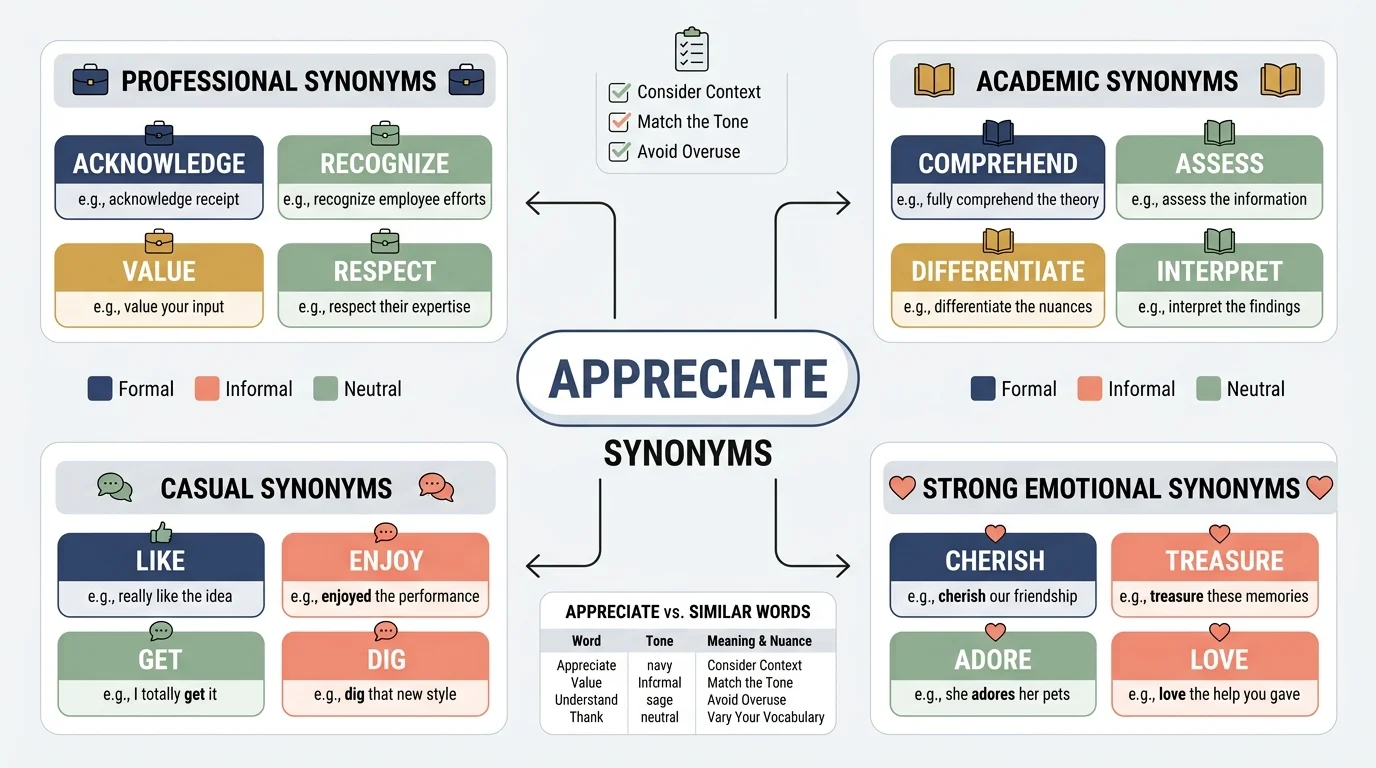
To appreciate means to recognize the full worth, importance, or value of something or someone. It can also mean to express gratitude or to understand a situation fully. The best synonyms depend on your context: formal writing favors words like value and esteem, casual conversation uses thanks or digs, and professional settings often use recognize or acknowledge.
Meaning, Tone and Context
Simple Definition
Appreciate has three main meanings. First, it means to feel grateful for something. Second, it means to recognize the true value or importance of a person, object, or idea. Third, it can mean to increase in value over time, particularly in financial or economic contexts.
Part of Speech
Appreciate is a verb. Its noun forms include appreciation and appreciativeness. The adjective form is appreciative. The adverb form is appreciatively.
Tone
The tone of appreciate is generally positive, warm, and respectful. It conveys sincerity, thoughtfulness, and emotional intelligence. However, the tone shifts based on context. In professional emails, it sounds polite and courteous. In academic writing, it sounds analytical and thoughtful. casual conversation, it sounds friendly and genuine.
Formality Level
Appreciate sits comfortably in the middle of the formality spectrum. It works well in both formal and informal settings. You can use it in business correspondence, academic essays, personal letters, and everyday speech without sounding out of place.
Common Use Cases
People use appreciate most often in expressions of gratitude, acknowledgments, performance evaluations, personal reflections, relationship communication, customer service interactions, and financial discussions about asset value.
Important Word Forms
The word appreciate has several useful forms. Appreciation functions as the noun. Appreciative serves as the adjective. Appreciatively works as the adverb. The antonym deprecate offers an opposite meaning. The related term depreciation refers to a decrease in value.
When and How to Use “Appreciate”
You should use appreciate when you want to express genuine gratitude, recognize someone’s effort, or show that you understand the significance of something. The word works best when you mean what you say and want your message to feel sincere and thoughtful.
Here are realistic examples showing how appreciate fits into different contexts.
Professional Email Example
I truly appreciate your detailed feedback on the project proposal. Your insights will help us improve the final submission significantly.
Personal Letter Example
I appreciate everything you have done for our family during this difficult time. Your kindness means more than words can express.
Academic Context Example
Scholars appreciate the complexity of climate change models and their implications for future policy decisions.
Creative Writing Example
She learned to appreciate the quiet moments of solitude that her busy city life rarely offered.
Social Media Caption Example
Taking a moment to appreciate the little things that make life beautiful. Good coffee, great friends, and sunny mornings.
Resume Statement Example
I appreciate the opportunity to lead cross functional teams and deliver results that exceeded client expectations.
Casual Conversation Example
I really appreciate you picking up my mail while I was away. You saved me from a lot of stress.
Another Word for “Appreciate”
The best single replacement for appreciate depends entirely on your context and intended meaning. Here are direct suggestions for various situations.
Professional Writing
Use value or recognize. Both words convey respect and acknowledgment without emotional excess. Value emphasizes importance, while recognize highlights awareness and credit.
Academic Writing
Use comprehend or acknowledge. These words sound precise and analytical. Comprehend suggests deep understanding, while acknowledge indicates recognition of facts or contributions.
Casual Conversation
Use thank or dig. Thank works for direct gratitude, while dig offers a relaxed, informal way to express enjoyment or appreciation.
Emotional Writing
Use cherish or treasure. These words carry deep emotional weight and convey strong personal attachment or gratitude.
Creative Writing
Use admire or relish. Admire suggests respect and positive regard, while relish conveys enjoyment and savoring of experiences.
Resume or Workplace Use
Use recognize or acknowledge. These words demonstrate professional awareness and credit giving without seeming overly sentimental.
Social Media Captions
Use love or dig. Love works for strong positive feelings, while dig adds a casual, trendy vibe that fits social platforms.
Stronger Meaning
Use esteem or prize. Both words suggest high regard and significant value. Esteem carries respect, while prize suggests holding something as precious.
Softer Meaning
Use note or notice. These words indicate mild recognition without strong emotional attachment or deep gratitude.
When Not to Use “Appreciate”
Appreciate sounds too vague when you need to describe specific actions or qualities. For example, instead of saying “I appreciate your help,” you could say “I value your practical advice and quick response.”
The word feels too casual for formal legal or technical documents that require precise terminology. In these contexts, words like acknowledge or recognize provide more clarity.
Appreciate becomes too weak when you feel intense gratitude or admiration. Stronger alternatives like cherish, treasure, or revere better capture deep emotional responses.
The word seems too formal for very casual text messages between close friends. Short alternatives like thanks or cool work better in these relaxed exchanges.
Appreciate may sound repetitive if you use it multiple times in a single piece of writing. Varying your vocabulary with appropriate synonyms keeps your language fresh and engaging.
The word can feel generic in performance reviews or recommendation letters. Specific action words like commend, praise, or highlight demonstrate more thoughtful evaluation.
Appreciate does not work well when you need to express criticism or neutral observation. It carries a positive connotation that conflicts with negative or objective assessments.
Words Commonly Confused With “Appreciate”
Appreciate vs. Thank
Thank focuses specifically on expressing gratitude to someone for something they have done. Appreciate is broader and can refer to valuing things, ideas, or situations without direct gratitude. Use thank when you address a person directly, and use appreciate when you recognize worth or value.
Appreciate vs. Value
Value suggests that something has importance or worth to you, while appreciate adds an element of understanding or enjoyment. Value works well for professional contexts, while appreciate fits personal or emotional situations better.
Appreciate vs. Acknowledge
Acknowledge means to recognize or admit the existence or truth of something. Appreciate goes further by adding positive regard or gratitude. Use acknowledge for factual recognition, and use appreciate for emotional or grateful recognition.
Appreciate vs. Recognize
Recognize means to identify someone or something as already known or to acknowledge the existence of something. Appreciate suggests deeper understanding and positive valuation. Recognize works for identification, while appreciate works for gratitude and value perception.
Appreciate vs. Admire
Admire focuses on respect and approval for someone’s qualities or achievements. Appreciate covers a wider range of meanings including gratitude and understanding. Admire works for looking up to people, while appreciate works for valuing experiences and kindness.
Appreciate vs. Cherish
Cherish means to protect and care for something lovingly or to hold something dear. It is much stronger and more emotional than appreciate. Cherish works for deep personal attachments, while appreciate fits everyday gratitude and value recognition.
Best Synonym by Context for “Appreciate”
| Context | Best Synonym | Why It Works | Example |
|---|---|---|---|
| Formal Writing | Esteem | Carries respect and high regard without emotional excess | The committee esteems your contributions to the research field. |
| Academic Writing | Comprehend | Suggests deep intellectual understanding and analysis | Students must comprehend the historical context of these events. |
| Professional Business | Recognize | Highlights awareness and credit giving in workplace settings | We recognize your exceptional performance this quarter. |
| Resume or Job Search | Acknowledge | Shows professional humility and gratitude for opportunities | I acknowledge the mentorship that shaped my career path. |
| Casual Conversation | Thank | Direct and friendly expression of gratitude | Thank you for helping me move last weekend. |
| Creative Writing | Relish | Adds enjoyment and sensory appreciation to descriptions | She relished the warm sunshine on her face. |
| Emotional Tone | Cherish | Conveys deep personal attachment and heartfelt gratitude | I cherish every moment we have shared together. |
| Strong Intensity | Treasure | Indicates the highest level of value and importance | I treasure your friendship more than you know. |
| Soft or Moderate | Note | Shows mild recognition without strong emotion | I note your efforts to improve team communication. |
| Social Media Captions | Dig | Casual and trendy expression of enjoyment | Digging this new coffee shop in my neighborhood. |
| US English Usage | Appreciate | Common and widely accepted across all contexts | I appreciate your honest feedback on this matter. |
| UK English Usage | Value | Slightly more formal and widely used in British English | We value your continued support of our charity. |
Which Synonym Should You Choose?
Choosing the right synonym for appreciate starts with understanding your purpose. Are you expressing gratitude, recognizing value, or demonstrating understanding?
Consider your audience first. Professional settings call for formal synonyms like value, recognize, or acknowledge. Casual conversations allow for thanks, dig, or cool.
Think about emotional intensity. For strong feelings, choose cherish or treasure. For mild recognition, choose note or notice.
Evaluate your sentence context. Are you talking about people, ideas, experiences, or financial assets? Each situation may call for a different synonym.
Check your writing tone. Academic writing needs precise words like comprehend. Creative writing benefits from vivid words like relish. Business writing requires professional words like esteem.
Consider word frequency. Repeating the same synonym can bore your reader. Mix formal and informal synonyms appropriately to maintain interest.
Trust your ear. Read your sentence aloud with each potential synonym. The right choice will sound natural and convey exactly what you mean.
Real Life Examples of “Appreciate” in Sentences
School Context
The history professor helped students appreciate how cultural exchanges shaped modern societies.
Workplace Context
Our team leader makes sure everyone feels appreciated for their unique contributions to each project.
Writing Context
Writers appreciate the value of precise word choice and invest time in vocabulary development.
Conversation Context
I really appreciate you explaining that concept to me. It makes so much more sense now.
Social Media Context
Appreciating the little wins today. Small steps lead to big accomplishments.
Resume Context
I appreciate opportunities to mentor junior colleagues and support their professional growth.
Email Context
We appreciate your patience as we resolve this technical issue. Thank you for your understanding.
Storytelling Context
The old man appreciated the simple rhythm of his days, finding joy in morning coffee and evening walks.
Stronger Synonym Example
I cherish the guidance my mentor provided during my early career years. Her wisdom shaped my professional identity.
Softer Synonym Example
I note your suggestion about improving our meeting structure. We will consider it for future planning.
25 Synonyms for “Appreciate”
| Synonym | Simple Meaning | Best Used For | Example Sentence |
|---|---|---|---|
| Value | To consider something important or beneficial | Professional writing and general use | I value your honest feedback on my presentation. |
| Acknowledge | To recognize or admit the existence of something | Formal and professional contexts | We acknowledge your significant contribution to this project. |
| Recognize | To identify or acknowledge something as valid | Workplace and academic settings | The board recognized her outstanding leadership skills. |
| Esteem | To regard with respect or admiration | Formal writing and professional recommendations | I esteem your judgment and advice on this matter. |
| Cherish | To hold dear and protect lovingly | Emotional and personal writing | She cherished the handwritten letters from her grandmother. |
| Treasure | To value highly and keep safe | Strong emotional expression | I treasure the memories we created during our travels. |
| Admire | To regard with respect and approval | Describing positive qualities in others | I admire your dedication to environmental conservation. |
| Relish | To enjoy something greatly | Creative writing and vivid descriptions | He relished the challenge of learning a new language. |
| Comprehend | To understand fully | Academic and analytical writing | Scientists comprehend the complexity of climate patterns. |
| Savor | To enjoy something thoroughly | Sensory and experiential descriptions | She savored every bite of the delicious home cooked meal. |
| Prize | To value something highly | Strong appreciation and valuation | I prize my independence and ability to make choices freely. |
| Respect | To hold in high regard | Professional and personal relationships | We respect our colleagues diverse perspectives and ideas. |
| Honor | To regard with great respect | Formal acknowledgments and ceremonies | We honor the contributions of our volunteers. |
| Glorify | To praise or honor highly | Religious or poetic contexts | The community glorifies the achievements of its members. |
| Revere | To feel deep respect or admiration | Very strong emotional and spiritual contexts | Many people revere historical figures who fought for justice. |
| Applaud | To express approval or praise | Public recognition and encouragement | We applaud your efforts to improve community safety. |
| Commend | To praise officially or formally | Professional recommendations and reviews | I commend your team for completing the project early. |
| Praise | To express warm approval or admiration | General positive feedback | The manager praised employees for their hard work. |
| Thank | To express gratitude to someone | Direct expressions of appreciation | I thank you for your generous support and encouragement. |
| Dig | To like or appreciate casually | Informal conversation and social media | I really dig the new design of your website. |
| Love | To like very much | Strong positive expression in casual contexts | I love how you decorated your new apartment. |
| Enjoy | To take pleasure in something | Everyday experiences and activities | I enjoy spending time with my colleagues after work. |
| Favor | To prefer or regard with approval | Professional and polite contexts | We favor candidates with diverse skill sets. |
| Regard | To consider or think of in a specified way | Formal and careful language | I regard your opinion highly in this matter. |
| Notice | To become aware of something | Mild recognition without strong emotion | I notice your attention to detail in every project. |
Synonym Groups and Usage Differences
Professional vs. Personal Synonyms
Professional settings favor synonyms that sound respectful and objective. Words like recognize, acknowledge, and value work well in business environments. They show appreciation without becoming overly emotional.
Personal contexts allow warmer, more emotional synonyms. Words like cherish, treasure, and savor express deep feelings and personal attachment. These words create intimacy and convey genuine heartfelt appreciation.
Formal vs. Conversational Synonyms
Formal writing requires elevated language. Esteem, honor, and commend fit academic papers, official documents, and formal speeches. These words maintain professionalism and gravitas.
Conversational language prefers simpler, more direct words. Thank, dig, and love work perfectly in casual speech, text messages, and friendly emails. They sound natural and unpretentious.
Academic Synonyms
Academic writing values precision and intellectual depth. Comprehend, recognize, and regard communicate careful analysis and thoughtful evaluation. These words help scholars express complex ideas clearly.
Academic synonyms avoid emotional excess. They focus on understanding, evaluation, and critical thinking rather than personal feelings or gratitude.
Professional and Business Synonyms
Workplace communication needs specific action oriented words. Recognize, acknowledge, value, and commend help managers praise employees and colleagues express appreciation professionally.
Business synonyms should sound confident and respectful. They avoid emotional intensity while conveying genuine recognition of effort and achievement.
Creative or Literary Synonyms
Creative writing benefits from vivid and emotional language. Relish, savor, cherish, and treasure paint pictures with words. They add depth, texture, and feeling to descriptive passages.
These synonyms help writers create atmosphere and convey character emotions effectively. They turn simple appreciation into memorable literary moments.
Slang or Modern Synonyms
Modern casual language offers relaxed alternatives. Dig works well in informal conversation and social media. Cool, love, and vibing with express contemporary appreciation.
Slang synonyms suit casual contexts only. Avoid them in formal writing, professional communication, and academic work. They undermine credibility in serious settings.
Strongest vs. Weaker Synonyms
An intensity scale helps you choose the right emotional level. Mild synonyms include note, notice, and regard. These express simple awareness without strong feeling.
Moderate synonyms include value, recognize, and appreciate. These convey genuine regard and thoughtful acknowledgment.
Strong synonyms include cherish, treasure, revere, and glorify. These express deep emotional attachment and intense appreciation.
Emotional vs. Neutral Synonyms
Emotional synonyms carry personal feeling and warmth. Cherish, treasure, and savor connect to the heart. They work well in personal letters, creative writing, and relationship communication.
Neutral synonyms focus on objective value and understanding. Value, recognize, and acknowledge stay factual and professional. They suit business writing, academic work, and formal contexts.
Antonyms of “Appreciate”
| Antonym | Meaning | Example Sentence |
|---|---|---|
| Deprecate | To express disapproval of something | The manager tends to deprecate new ideas without proper consideration. |
| Disparage | To speak of someone or something negatively | Critics disparage the film for its weak plot and poor acting. |
| Belittle | To make someone or something seem unimportant | Good leaders never belittle their team members contributions. |
| Undervalue | To consider less important than deserved | Companies sometimes undervalue the importance of employee well being. |
| Overlook | To fail to notice or consider | The review overlooked several important details in the proposal. |
| Disregard | To pay no attention to something | Please do not disregard safety regulations in your work. |
| Ignore | To refuse to take notice of something | She chose to ignore the helpful advice from her mentor. |
| Neglect | To fail to care for properly | Many people neglect the importance of regular exercise. |
| Scorn | To feel or express contempt for something | He scorned the efforts of volunteers who tried to help. |
| Ridicule | To subject someone to mockery | The comedian ridiculed politicians without offering solutions. |
| Devalue | To reduce the value of something | Economic instability can devalue investments significantly. |
| Depreciate | To decrease in value over time | The car will depreciate rapidly after its first year of ownership. |
| Denigrate | To criticize unfairly | The article denigrates the contributions of minority researchers. |
| Slight | To insult someone by treating them with disrespect | He slighted his colleague by ignoring her presentation. |
| Dismiss | To treat as unworthy of consideration | The committee dismissed his concerns without proper discussion. |
Comparison: Appreciate vs. Similar Words
Appreciate vs. Value
The main difference lies in scope. Appreciate includes emotional gratitude and understanding, while value focuses on importance and worth. Appreciate is broader and more personal. Value works better in professional contexts where worth matters more than feeling.
Appreciate is stronger emotionally. Value stays more neutral and objective. Appreciate fits personal letters and thank you notes. Value suits business meetings and performance reviews.
Example with appreciate: I appreciate your patience during our long discussion.
Example with value: We value efficiency and clear communication in our team.
Appreciate vs. Acknowledge
Acknowledge means to recognize or admit existence or truth. Appreciate adds positive regard and gratitude to recognition. Acknowledge works for factual admissions. Appreciate works for grateful recognition.
Acknowledge is more formal and neutral. Appreciate carries warmth and positive feeling. Use acknowledge in legal documents. Use appreciate in thank you messages.
Example with appreciate: I appreciate your willingness to help with this project.
Example with acknowledge: We acknowledge receipt of your application materials.
Appreciate vs. Recognize
Recognize means to identify something as already known or to acknowledge its validity. Appreciate goes deeper into valuing and understanding. Recognize identifies. Appreciate evaluates and feels.
Recognize works for talent and achievement. Appreciate works for kindness and support. Recognize stays factual. Appreciate adds emotion.
Example with appreciate: She appreciates the complexity of the situation.
Example with recognize: I recognize your hard work and dedication to this cause.
Appreciate vs. Admire
Admire focuses on respect and approval for qualities or achievements. Appreciate covers gratitude, understanding, and value recognition. Admire looks up to people. Appreciate values experiences and kindness.
Admire is more specific to positive evaluation. Appreciate is broader in meaning. Admire suits descriptions of role models. Appreciate suits expressions of thanks.
Example with appreciate: I appreciate the time you spent explaining this topic.
Example with admire: I admire your ability to stay calm under pressure.
Appreciate vs. Cherish
Cherish means to protect and care for something lovingly. It is much stronger and more personal than appreciate. Cherish implies deep emotional attachment. Appreciate suggests thoughtful regard.
Cherish works for close relationships and precious memories. Appreciate works for daily gratitude and professional recognition. Cherish is intense. Appreciate is moderate.
Example with appreciate: I appreciate your kindness and generosity.
Example with cherish: I cherish every moment we spend together as a family.
Appreciate vs. Thank
Thank specifically expresses gratitude to someone for something they have done. Appreciate can express gratitude but also covers valuing objects, ideas, and situations. Thank addresses people directly. Appreciate can address people, things, or abstract concepts.
Thank is more specific to interpersonal gratitude. Appreciate is broader and more versatile. Use thank for direct expressions. Use appreciate for more general recognition.
Example with appreciate: I appreciate the beauty of this artwork.
Example with thank: I thank you for the beautiful gift you gave me.
Common Phrases and Expressions with “Appreciate”
1. I appreciate it
Meaning: A common and sincere way to express gratitude directly to someone.
Example sentence: Thank you for covering my shift today. I really appreciate it.
2. Much appreciated
Meaning: A concise and informal way to say thank you. It expresses gratitude without being overly wordy.
Example sentence: Your help with the move was much appreciated.
3. I appreciate your time
Meaning: A polite way to thank someone for giving their attention or effort to a matter.
Example sentence: I appreciate your time and valuable insights during our meeting.
4. Appreciate the effort
Meaning: To recognize and value the work someone has put into something.
Example sentence: I appreciate the effort you put into preparing this detailed report.
5. Deeply appreciate
Meaning: To feel very strong gratitude or recognition, emphasizing depth of feeling.
Example sentence: We deeply appreciate your generous donation to our campaign.
6. Come to appreciate
Meaning: To gradually develop understanding or gratitude for something over time.
Example sentence: Many people come to appreciate classical music as they grow older.
7. Appreciate the gesture
Meaning: To value the thoughtfulness behind someone’s action, even if the outcome was not perfect.
Example sentence: I appreciate the gesture, even though the plan did not work out.
Common Mistakes to Avoid
1. Using appreciate when a more precise synonym is better
Many writers default to appreciate when a more specific word would improve clarity. Instead of saying “I appreciate your help,” consider “I value your practical advice” or “I recognize your consistent support.” Specific synonyms convey more meaning and show thoughtful word choice.
2. Confusing appreciate with depreciate
These two words have opposite meanings. Appreciate means to increase in value or recognize worth, while depreciate means to decrease in value or belittle. Mixing them up can cause serious confusion, especially in financial or professional writing.
3. Using a casual synonym in formal writing
Casual words like dig, love, or cool have no place in formal documents, academic papers, or professional correspondence. These synonyms undermine your credibility and make your writing seem unprofessional. Reserve casual synonyms for social media, text messages, and friendly conversation.
4. Using an overly dramatic synonym for a simple situation
Not every situation calls for cherishing or treasuring. Using intense synonyms for minor favors or ordinary experiences can seem insincere or exaggerated. Match your word choice to the actual level of gratitude or value you feel.
5. Repeating the same synonym too often
Repetition makes writing dull and monotonous. Even the best synonyms lose their impact when overused. Vary your vocabulary by choosing different appropriate synonyms throughout your writing. Keep a list of alternatives handy for quick reference.
6. Choosing a synonym with the wrong emotional tone
Every synonym carries a specific emotional weight. Using a warm synonym like cherish in a professional performance review might seem inappropriate. Using a neutral synonym like note in a thank you letter might seem cold and unfeeling. Always consider the emotional tone your situation requires.
7. Using slang in academic or professional writing
Slang synonyms like dig have no place in serious writing contexts. They lower your writing quality and suggest a lack of professionalism. Use standard English synonyms for all formal, academic, and professional communication.
FAQs
What is the best synonym for appreciate?
The best synonym depends on your context. For gratitude, use thank or value. understanding, use comprehend or recognize. For deep emotion, use cherish or treasure. Choose based on your specific situation.
What is a formal synonym for appreciate?
Formal synonyms include esteem, acknowledge, regard, and commend. These words work well in official documents, academic papers, professional correspondence, and formal speeches where polished language is expected.
What is an informal synonym for appreciate?
Informal synonyms include dig, love, and cool. These casual alternatives work in text messages, social media captions, friendly conversations, and relaxed written communication where formal language would seem out of place.
What is another word for appreciate in professional writing?
Professional writing calls for words like value, recognize, acknowledge, and commend. These synonyms sound respectful and appropriate for workplace communication, business reports, performance reviews, and professional emails.
What is the difference between appreciate and value?
Appreciate is broader and includes emotional gratitude and understanding. Value focuses specifically on importance and worth. Appreciate feels more personal, while value stays more neutral and business oriented.
What is the opposite of appreciate?
The opposite of appreciate depends on the meaning. For gratitude or value, antonyms include deprecate, disparage, undervalue, disregard, and depreciate. The best opposite depends on your specific context.
Conclusion
Appreciate is a versatile word that expresses gratitude, recognition, and value perception. Its power lies in its warmth and sincerity, but overusing it can weaken your writing. The key to better vocabulary is choosing the right synonym for each specific context.
Formal situations call for words like value, recognize, and esteem. Casual settings welcome words like dig, love, and cool. Deep emotion requires cherish and treasure. Professional communication needs acknowledge and commend.
Pay attention to tone, formality, emotional intensity, and audience when selecting synonyms. Practice using different alternatives in your daily writing and conversation. Build a personal vocabulary list of your favorite synonyms for appreciate.
Remember that the most powerful word choice is the one that sounds natural and conveys exactly what you mean. Trust your judgment and keep expanding your vocabulary skills. Your communication will become more precise, engaging, and effective with every new word you master.
Vocabulary tip: Keep a small notebook or digital document with your preferred synonyms for common words like appreciate. Review it weekly and practice using new alternatives in your writing. This simple habit will transform your vocabulary over time.