Have you ever caught yourself using the word “weird” over and over again in an email, a story, or a casual conversation? You are not alone. Most English learners and even native speakers rely on this one word to describe anything unusual, strange, or out of the ordinary.
The problem is that “weird” does not fit every situation equally well. A mysterious coworker, a confusing movie plot, or an eerie sound in the dark all deserve more precise language. This guide will help you master 50+ synonyms for weird so you can write, speak, and express yourself with clarity and confidence.
You will learn exactly which word to use in professional emails, academic essays, creative stories, social media captions, and everyday conversations.
What Does “Weird” Mean?
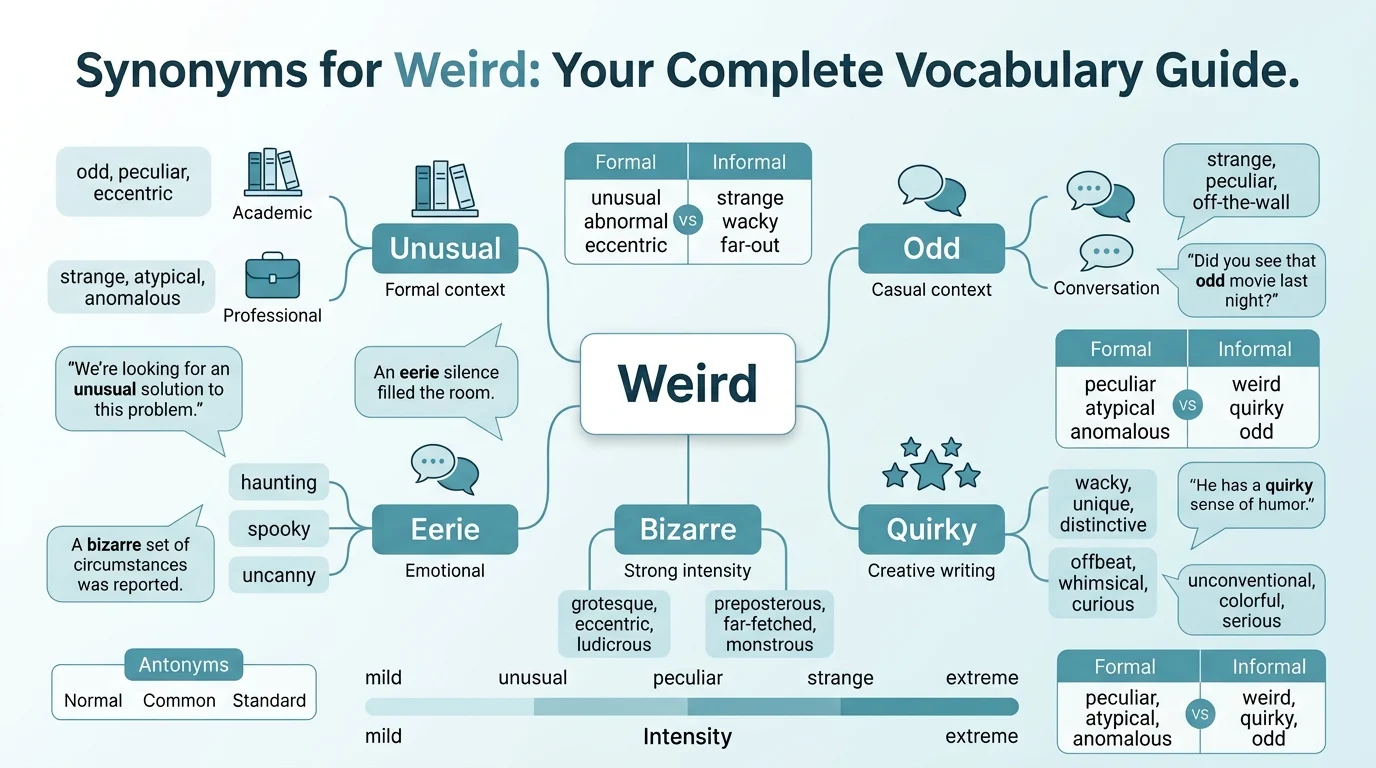
“Weird” means something strange, unusual, or difficult to explain in a normal way. For formal writing, choose “unusual” or “peculiar.” For casual conversation, “odd” or “bizarre” work well. emotional situations, use “eerie” or “uncanny.” professional contexts, select “unconventional” or “atypical.” The best synonym depends entirely on your tone, audience, and the specific situation you are describing.
Meaning, Tone and Context
Simple definition
“Weird” describes something that is strange, mysterious, or outside what is considered normal or ordinary.
Part of speech
“Weird” is primarily an adjective. The noun form is “weirdness.” The adverb form is “weirdly.”
Tone
The tone is generally neutral to slightly negative, but it depends heavily on context. It can express curiosity, mild confusion, discomfort, or even admiration depending on how you use it.
Formality level
“Weird” is informal. It works well in casual conversation, social media, and personal writing. It is too casual for most academic papers, professional reports, or formal speeches.
Common use cases
You will hear “weird” in everyday conversations about people, events, movies, food, behavior, and experiences. It is also popular in storytelling, personal essays, and online comments.
Important word forms
Adjective: weird. Noun: weirdness. Adverb: weirdly. Verb: to weird someone out, which is a casual phrasal verb meaning to make someone feel uneasy or strange.
When and How to Use “Weird”
“Weird” should be used when you want to describe something that is out of the ordinary in a way that feels slightly mysterious or unexplainable. It is best for informal situations. Reserve it for daily conversations, personal messages, social media posts, and creative writing that does not demand formal language.
Professional example
The client’s request was a bit weird, but we managed to fulfill it on time.
Personal example
I had a weird dream last night where I could fly over my old neighborhood.
Academic example
The researcher noticed a weird pattern in the data that did not match any previous findings.
Emotional example
She felt a weird sense of relief after finally quitting her stressful job.
Creative example
The abandoned house had a weird glow coming from its attic windows at midnight.
Social media example
This new coffee shop has a weird but amazing combination of flavors in their drinks.
Casual conversation example
That movie was so weird. I still do not understand the ending.
Another Word for “Weird”
The best single replacement for “weird” depends entirely on your context and desired tone.
Professional writing
Use “unconventional” for workplace contexts and “atypical” for data driven reports.
Academic writing
Use “anomalous” for research findings and “peculiar” for descriptive academic work.
Casual conversation
Use “odd” or “bizarre” as natural everyday alternatives.
Emotional writing
Use “eerie” for unsettling situations and “uncanny” for things that feel strangely familiar.
Creative writing
Use “surreal” for dreamlike scenes and “otherworldly” for fantasy settings.
Resume or workplace use
Use “unconventional” to describe creative approaches and “distinctive” to highlight unique strengths.
Social media captions
Use “quirky” for playful content and “offbeat” for artistic posts.
Stronger meaning
Use “bizarre,” “grotesque,” or “absurd” when you need to emphasize extreme strangeness.
Softer meaning
Use “unusual,” “curious,” or “uncommon” for a more neutral and less dramatic description.
When Not to Use “Weird”
There are many situations where “weird” sounds too vague, too casual, or simply the wrong word to use. Relying on “weird” weakens your writing and makes you sound less precise. Here are some scenarios where you should avoid it.
Vague descriptions
“Weird” does not tell your reader exactly what is strange. If you say “The food tasted weird,” nobody knows if it was sour, bitter, spicy, or stale. Use more specific language instead.
Professional reports
Avoid “weird” in performance reviews, client proposals, or business presentations. It sounds unprofessional and imprecise. Use “unusual,” “atypical,” or “unexpected.”
Academic writing
Professors and academic journals expect formal vocabulary. “Weird” is too casual for essays, research papers, or theses. Use “anomalous,” “divergent,” or “exceptional.”
Emotional discomfort
If you want to describe fear or unease, “weird” does not capture the intensity. Use “eerie,” “creepy,” or “unnerving” instead.
Negative judgments
If you mean something is bad, offensive, or inappropriate, “weird” is too soft. Use “disturbing,” “disconcerting,” or “troubling.”
Words Commonly Confused With “Weird”
Weird vs. Strange
“Strange” is slightly more formal than “weird” and feels more objective. “Weird” often implies a sense of personal reaction or mild discomfort. Use “strange” in more neutral, observational contexts and “weird” for personal reactions.
Weird vs. Odd
“Odd” is a gentle, neutral word that simply means different from the usual. “Weird” has a slightly stronger emotional charge and often implies something inexplicable. Use “odd” when you want to be polite and mild.
Weird vs. Bizarre
“Bizarre” is much stronger than “weird.” It describes something extremely strange or wildly out of the ordinary. Use “bizarre” when something is shocking or hard to believe.
Weird vs. Eerie
“Eerie” describes something that feels creepy, ghostly, or unsettling. It is emotional and atmospheric. “Weird” is more general. Use “eerie” for frightening or mysterious moods.
Weird vs. Quirky
“Quirky” has a positive, charming tone. It describes endearing or amusing unusualness. “Weird” can be neutral or negative. Use “quirky” for positive, playful strangeness.
Weird vs. Unusual
“Unusual” is a neutral, factual word. It simply means not common. “Weird” carries a subjective, emotional response. Use “unusual” for objective observations.
Best Synonym by Context for “Weird”
| Context | Best Synonym | Why It Works | Example |
|---|---|---|---|
| Formal writing | Unusual | This word is neutral, professional, and widely accepted in formal contexts. | The committee noted an unusual trend in the survey responses. |
| Academic writing | Anomalous | This word describes deviations from expected patterns with scientific precision. | The anomalous results required further investigation by the research team. |
| Professional business | Unconventional | This word highlights creativity and innovation in workplace settings. | Her unconventional approach to marketing significantly increased our sales. |
| Resume writing | Distinctive | This word frames uniqueness as a valuable professional asset. | My distinctive problem solving method earned recognition from senior management. |
| Casual conversation | Odd | This word is natural, friendly, and perfect for everyday dialogue. | Is it odd that I still remember every detail of that day? |
| Creative writing | Surreal | This word adds dreamlike, artistic imagery to descriptive passages. | The surreal landscape looked like a painting come to life. |
| Emotional tone | Eerie | This word captures feelings of unease and mystery effectively. | An eerie silence filled the room as the fog rolled in. |
| Strong intensity | Bizarre | This word conveys extreme strangeness and shocking content. | The bizarre incident left everyone completely speechless. |
| Soft moderate tone | Curious | This word expresses gentle interest rather than judgmental strangeness. | She had a curious habit of collecting vintage postcards. |
| Social media captions | Quirky | This word appeals to positive, playful, and relatable content. | This quirky little café serves the best matcha latte in town. |
Which Synonym Should You Choose?
Choosing the right synonym for “weird” comes down to four main factors.
Consider your meaning
Ask yourself what kind of strangeness you want to express. Is it simply different, unexpectedly familiar, unsettling, or shockingly strange? Choose a word that matches your exact meaning.
Consider your audience
Are you writing for a professor, a boss, a friend, or social media followers? Formal audiences require formal synonyms like “unusual” or “atypical.” Casual audiences accept “odd” or “bizarre.
Consider the emotional intensity
Are you describing something mildly curious or deeply disturbing? Match your word to the emotional weight of the situation. Use “curious” for mild interest and “grotesque” for intense discomfort.
Consider your sentence structure
Some synonyms fit better in certain grammatical positions. “Uncanny” often appears with “resemblance” or “similarity.” “Peculiar” sounds natural before nouns. Test your word choices by reading sentences aloud.
Real Life Examples of “Weird” in Sentences
School
The history teacher showed us a peculiar artifact from ancient Egypt that nobody could identify.
Workplace
His unconventional presentation style surprised everyone but ultimately won over the investors.
Writing
The eerie atmosphere of the novel kept me reading late into the night.
Conversation
I met a quirky artist at the festival who paints portraits using coffee instead of paint.
Social media
This offbeat little bookshop has become my favorite hidden gem in the city.
Email
I noticed a curious discrepancy in the numbers you sent over. Could we review them together?
Storytelling
The bizarre creature moved through the shadows with an unnatural grace.
25 Synonyms for “Weird”
| Synonym | Simple Meaning | Best Used For | Example Sentence |
|---|---|---|---|
| Unusual | Not common or ordinary | Neutral, general descriptions | The unusual architecture attracted tourists from around the world. |
| Odd | Slightly different from normal | Casual conversation | I found it odd that nobody answered the door. |
| Bizarre | Extremely strange and surprising | Strong, dramatic descriptions | The bizarre coincidence left us all speechless. |
| Peculiar | Distinctly strange in a noticeable way | Descriptive writing | She had a peculiar way of organizing her books by color. |
| Eerie | Creepy and mysterious | Emotional, atmospheric writing | An eerie fog settled over the empty town. |
| Quirky | Charmingly unusual and playful | Positive, social media content | His quirky personality made him popular among colleagues. |
| Surreal | Dreamlike and fantastical | Creative and artistic writing | The surreal sunset painted the sky in impossible colors. |
| Uncanny | Strange because it is familiar yet unusual | Describing odd similarities | The uncanny resemblance between the two strangers was striking. |
| Grotesque | Disturbingly ugly or strange | Describing unpleasant things | The grotesque statue frightened the children at the museum. |
| Offbeat | Unconventional and unconventional | Creative and alternative contexts | The offbeat comedy attracted a devoted cult following. |
| Curious | Strange in an interesting way | Polite, inquisitive descriptions | A curious noise came from the attic during the night. |
| Outlandish | Extremely strange and unlikely | Describing unbelievable things | His outlandish theory about the ancient ruins shocked historians. |
| Weird | General strangeness | Everyday casual use | The weird weather ruined our outdoor picnic plans. |
| Abnormal | Not normal in a statistical sense | Academic and scientific writing | Abnormal cell growth was detected during the examination. |
| Eccentric | Unconventional in an interesting way | Describing colorful personalities | The eccentric millionaire wore mismatched socks to his own wedding. |
Synonym Groups and Usage Differences
Professional vs. Personal Synonyms
Professional contexts require neutral, objective language. Use “unusual,” “atypical,” “unconventional,” “distinctive,” and “unorthodox” in emails, reports, presentations, and meetings. Personal contexts allow more emotional and casual words like “odd,” “bizarre,” “quirky,” and “eerie.” Save the emotional intensity for your personal stories and conversations.
Formal vs. Conversational Synonyms
Formal synonyms include “aberrant,” “anomalous,” “deviant,” and “atypical.” These words appear in academic papers, legal documents, medical reports, and professional journals. They demonstrate precise vocabulary and command of language. Conversational synonyms include “odd,” “bizarre,” “quirky,” and “funny.” These words feel natural in everyday speech, text messages, and social media posts.
Academic Synonyms
Academic writing demands precision and objectivity. The best academic synonyms for “weird” are “anomalous,” “aberrant,” “atypical,” “deviant,” and “exceptional.” Use these words in research papers, essays, theses, and scholarly articles. They describe statistical deviations, unusual findings, and unexpected patterns with scientific credibility.
Professional and Business Synonyms
Workplace communication requires professionalism and clarity. Use “unconventional” to describe creative solutions. Use “unusual” for general observations. “atypical” for data analysis. Use “unorthodox” for innovative methods. “distinctive” to highlight unique strengths. These words impress employers and clients while maintaining a professional tone.
Creative or Literary Synonyms
Creative writing thrives on vivid, imaginative language.”surreal” for dreamlike scenes.”eerie” for atmospheric suspense. “uncanny” for mysterious familiarity.”otherworldly” for fantasy settings. Use “phantasmagorical” for wildly imaginative descriptions. These words add emotional depth and artistic quality to your stories.
Slang or Modern Synonyms
Modern slang synonyms include “out there,” “off the wall,” “out of left field,” “trippy,” and “wacky.” These expressions are acceptable in casual conversations, friendly texts, and informal social media posts. Avoid them in professional, academic, or formal contexts. They sound too casual for serious writing.
Strongest vs. Weaker Synonyms
Intensity scale from mild to strongest:
Mild: unusual, curious, uncommon, odd, peculiar.
Moderate: weird, strange, eccentric, quirky, offbeat.
Strong: bizarre, outlandish, surreal, grotesque, freakish.
Extreme: aberrant, deviant, unnatural, uncanny.
Choose your intensity level based on how strange you want to sound. Match the word to the actual situation.
Emotional vs. Neutral Synonyms
Emotional synonyms add feeling and personal reaction to your writing. These include “eerie” for fear, “uncanny” for disquieting familiarity, “grotesque” for disgust, “surreal” for wonder, and “bizarre” for shock. Neutral synonyms stay objective and factual. These include “unusual,” “atypical,” “abnormal,” “anomalous,” and “uncommon.” Use neutral words for academic and professional writing. Use emotional words for creative and personal writing.
Antonyms of “Weird”
| Antonym | Meaning | Example Sentence |
|---|---|---|
| Normal | Conforming to a standard or typical pattern | The test results were perfectly normal and within expected ranges. |
| Ordinary | Common and not unusual in any way | It was just an ordinary Tuesday with nothing remarkable happening. |
| Typical | Representing the usual or expected type | Her typical morning routine included coffee and a quick workout. |
| Regular | Occurring at normal intervals or in a normal way | He was a regular customer at the local diner every morning. |
| Common | Occurring frequently or widely | That kind of mistake is common among new employees. |
| Conventional | Following traditional rules and standards | They preferred a conventional wedding ceremony in a church. |
| Standard | Accepted as normal or usual | The standard procedure requires three signatures on the form. |
| Usual | Habitual or commonly occurring | His usual seat at the bar was empty that evening. |
| Average | Ordinary and not exceptional | The average student completed the assignment in two hours. |
| Familiar | Well known and easily recognized | The familiar smell of coffee filled the entire kitchen. |
| Natural | Existing in accordance with nature | Her natural talent for singing impressed everyone at the audition. |
| Expected | Regarded as likely or probable | The expected outcome was a peaceful resolution to the conflict. |
| Routine | Performed as a regular procedure | The routine inspection revealed no problems with the equipment. |
| Customary | According to established customs or practices | It was customary to shake hands when meeting new colleagues. |
| Unremarkable | Not worthy of attention or notice | The unremarkable building hid a beautiful garden inside its walls. |
Comparison: Weird vs. Similar Words
Weird vs. Strange
Main difference: “Strange” feels more objective and observational. “Weird” carries a personal sense of unease or confusion. “Strange” often describes something simply different from what is known. “Weird” describes something that feels inexplicable or slightly unsettling.
Which one is stronger: “Weird” has a slightly stronger emotional charge in most contexts.
Which one is more formal: “Strange” is more formal and academic.
Example for weird: The weird sensation in my arm made me visit the doctor.
Example for strange: A strange object appeared on the radar screen.
Weird vs. Odd
Main difference: “Odd” is gentler and more neutral. “Weird” has a stronger emotional undertone. “Odd” simply means unusual or different from normal. “Weird” often implies something mysterious or hard to understand.
Which one is stronger: “Weird” is stronger and more subjective.
Which one is more formal: “Odd” is slightly more formal than “weird.”
Example for weird: The weird smell coming from the basement worried me.
Example for odd: He had an odd habit of clicking his pen during meetings.
Weird vs. Bizarre
Main difference: “Bizarre” is dramatically stronger. It describes extreme strangeness that surprises or shocks you. “Weird” is milder and more general. Use “bizarre” for truly wild, unbelievable situations.
Which one is stronger: “Bizarre” is much stronger and more dramatic.
Which one is more formal: “Bizarre” is acceptable in formal writing but still sounds intense.
Example for weird: The weird noise kept me awake all night.
Example for bizarre: The bizarre costume featured blinking lights and moving parts.
Weird vs. Eerie
Main difference: “Eerie” specifically describes something frightening, ghostly, or mysterious. It creates an atmosphere of fear or discomfort. “Weird” is more general. Use “eerie” for spooky, unsettling situations.
Which one is stronger: “Eerie” carries a stronger emotional impact of fear.
Which one is more formal: Both are acceptable in creative writing, but “eerie” is more literary.
Example for weird: The weird statue stood in the middle of the park.
Example for eerie: An eerie silence fell over the abandoned hospital.
Weird vs. Quirky
Main difference: “Quirky” has a positive, charming tone. It describes unusual habits or features that are amusing or endearing. “Weird” can be neutral or negative. Use “quirky” for positive, playful strangeness.
Which one is stronger: “Weird” can be stronger depending on context, but “quirky” is always mild.
Which one is more formal: Neither is formal, but “quirky” is more acceptable in casual professional contexts.
Example for weird: The weird new intern sat alone during lunch.
Example for quirky: The quirky cafe served coffee in vintage teacups.
Weird vs. Unusual
Main difference: “Unusual” is objective and factual. It simply means not common or typical. “Weird” is subjective and emotional. Use “unusual” when you want to state a fact. Use “weird” when you want to express a personal reaction.
Which one is stronger: “Weird” has more emotional strength.
Which one is more formal: “Unusual” is much more formal and professional.
Example for weird: I felt weird after eating that unfamiliar dish.
Example for unusual: The weather pattern this year is highly unusual.
Common Phrases and Expressions with “Weird”
1. Weird out
Meaning: To make someone feel uncomfortable or confused.
Example: His constant staring really weirds me out during team meetings.
2. Get weird
Meaning: To become strange, unusual, or chaotic.
Example: The party started getting weird after midnight when people began dancing on tables.
3. Weird and wonderful
Meaning: Strangely attractive or interesting.
Example: The city is full of weird and wonderful characters that tourists love to meet.
4. Strange but true
Meaning: Something odd that is nonetheless factual.
Example: His story was strange but true, and it made everyone reconsider their assumptions.
5. Weird science
Meaning: Unconventional or bizarre scientific experiments or theories.
Example: The documentary explored weird science projects from the 1970s.
6. Weird world
Meaning: A phrase used to express surprise at the strangeness of life.
Example: It is a weird world where people can earn millions for posting short videos online.
Common Mistakes to Avoid
1. Using “weird” when a more precise synonym exists
Stop defaulting to “weird” for every strange situation. Replace it with “eerie” for spooky moments, “bizarre” for shocking events, “quirky” for charming oddities, and “unusual” for neutral observations. Your writing will become much more vivid and professional.
2. Confusing “weird” with “odd” or “strange”
These words are not exact replacements in every context. “Odd” is gentler and more observational. “Strange” is more formal and objective. “Weird” is more personal and emotional. Match the word to your exact meaning and audience.
3. Using casual synonyms in formal writing
Do not use “weird,” “quirky,” “offbeat,” or “bizarre” in academic papers, official reports, or professional proposals. Formal contexts require formal synonyms such as “unusual,” “atypical,” “anomalous,” or “unconventional.” Your credibility depends on word choice.
4. Using overly dramatic synonyms for simple situations
Avoid “bizarre,” “grotesque,” “freakish,” or “outlandish” for minor, everyday strangeness. These words sound exaggerated and melodramatic. Reserve them for truly shocking, intense, or extreme situations.
5. Repeating the same word too often
Variety keeps your writing engaging. If you have already used “weird,” try “peculiar,” “curious,” or “unusual” in the next sentence. A rich vocabulary prevents repetition and boredom.
6. Choosing a synonym with the wrong emotional tone
Do not use “eerie” for a funny story or “quirky” for a frightening experience. Match the emotional tone of your synonym to the actual mood of the situation. This prevents confusion and miscommunication.
7. Using slang in academic or professional writing
Avoid “out there,” “off the wall,” “trippy,” or “wacky” in any formal context. These words sound immature and unprofessional. Stick to standard, accepted vocabulary for academic and workplace communication.
8. Using culturally charged words like carelessly
Avoid using to describe people, cultures, or customs, as it can imply a judgment of otherness or inferiority. It is safer to use “foreign,” “unfamiliar,” or “non-native” for objects, or simply “peculiar” or “fascinating” when discussing cultural differences. Reserve for animals, plants, or scientific classifications where it is purely descriptive.
FAQs
1. What is the best synonym for weird?
The best synonym depends on your context. “Unusual” works for formal writing, “odd” works for casual conversation, “bizarre” works for strong emphasis, and “quirky” works for positive, playful descriptions.
2. What is a formal synonym for weird?
Formal synonyms include “unusual,” “atypical,” “anomalous,” “abnormal,” “unconventional,” and “aberrant.” Use these in academic papers, professional reports, and official documents.
3. What is an informal synonym for weird?
Informal synonyms include “odd,” “bizarre,” “funny,” “kooky,” “quirky,” and “offbeat.” Use these in everyday conversations, text messages, and casual social media posts.
4. What is another word for weird in professional writing?
Use “unconventional” for creative approaches, “atypical” for data analysis, “unusual” for general observations, and “distinctive” for unique strengths. These words sound professional and credible.
5. What is the difference between weird and strange?
“Weird” feels more personal and emotional. “Strange” feels more objective and observational. “Strange” is also more formal and commonly appears in academic and professional writing.
6. What is the opposite of weird?
The direct opposite is “normal.” Other antonyms include “ordinary,” “typical,” “regular,” “common,” “conventional,” “standard,” “usual,” and “average.” Choose the best based on your specific context.
Conclusion
“Weird” is a versatile but overused word that deserves a stronger vocabulary family. Now you know 50+ synonyms for weird ranging from formal academic terms to casual modern slang. You understand exactly which words to use in professional emails, academic essays, creative stories, social media posts, and everyday conversations. Remember that context, audience, and emotional tone should always guide your word choice. A formal report needs “unusual” or “atypical.” A creative story needs “eerie” or “surreal.” A social media caption needs “quirky” or “offbeat.” Start replacing “weird” with more precise synonyms today. Your writing will become clearer, more professional, and much more engaging. The right word makes all the difference.