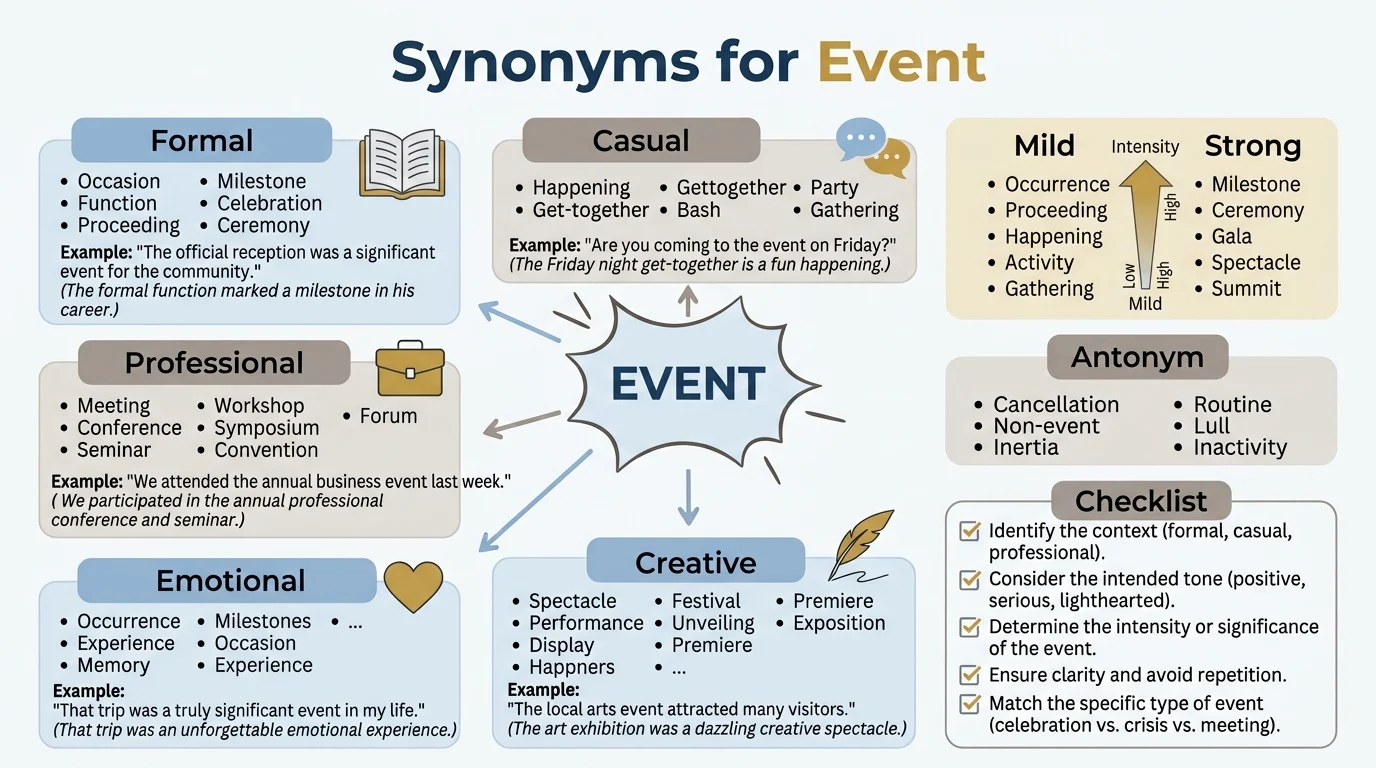
Have you ever written a sentence and realized you used the word “event” three times in two paragraphs? You are not alone. Most writers, students, and professionals struggle with this common word. Finding fresh alternatives can transform dull writing into engaging content.
The right synonym helps you sound more precise and professional. This guide provides over 50 powerful synonyms for event with clear examples and practical usage tips for every situation.
What Does “Event” Mean?
An event is something that happens or takes place, especially something important, notable, or planned. The best synonyms depend on your context. For formal writing, use occurrence or proceeding. For casual conversation, try affair or function. In professional settings, choose gathering or conference. For emotional impact, use occasion or milestone.
Meaning, Tone and Context
- Simple definition: An event is any happening, occurrence, or planned activity that takes place at a specific time and place. It can range from everyday happenings to major life milestones.
- Part of speech: Event is a noun.
- Tone: Event has a neutral tone. It does not carry strong positive or negative emotional weight on its own.
- Formality level: Event is moderately formal. It works in both professional and casual contexts without sounding too stiff or too informal.
- Common use cases: Event appears in announcements, invitations, reports, news articles, academic writing, and everyday conversation. People use it to describe meetings, celebrations, performances, accidents, discoveries, and social gatherings.
- Important word forms: Event itself is a noun. Related forms include eventual (adjective), eventually (adverb), and eventful (adjective). The opposite form is uneventful, which describes something boring or lacking notable happenings.
When and How to Use “Event”
Use event when you need a general, neutral word for something that happens. It works best when the specific nature of the happening is less important than the fact that it occurred. Event is safe, clear, and widely understood.
Here are realistic examples:
Professional context
The company’s annual networking event attracted over 300 industry leaders.
Personal context
My sister’s wedding was the most beautiful event I have ever attended.
Academic context
The researcher documented every significant event during the five year study.
Emotional context
Graduation felt like a life changing event that marked my transition to adulthood.
Creative context
The storm was an event that changed the landscape of the small coastal town.
Social media context
Excited to share highlights from last night’s incredible event with all of you.
Resume context
Coordinated a major fundraising event that raised over 50000 dollars for local charities.
Another Word for “Event”
The best single replacement for event depends entirely on your context and purpose. Here are specific recommendations for different situations:
Professional writing: Use meeting, conference, or session to sound businesslike and purposeful.
Academic writing: Use occurrence, phenomenon, or incident to convey precision and objectivity.
Casual conversation: Use thing, deal, or gig for relaxed, everyday speech.
Emotional writing: Use occasion, milestone, or moment to add sentimental weight.
Creative writing: Use spectacle, affair, or happening to add color and imagery.
Resume or workplace: Use initiative, project, or campaign to highlight your role and achievements.
Social media captions: Use gathering, celebration, or experience to connect with readers emotionally.
Stronger meaning: Use landmark, breakthrough, or turning point to emphasize importance.
Softer meaning: Use activity, session, or function to downplay significance.
When Not to Use “Event”
Event becomes a problem when you need specificity. It sounds vague and weak in situations where precision matters.
Too vague example: We had an event at work.
Better: We had a training session at work.
Event feels too casual in formal legal or official documents. It also sounds too formal for intimate personal moments. Overusing event makes your writing repetitive and boring.
Weak example: The event was fun.
Improved: The celebration was joyful and memorable.
Event rarely adds emotional weight. It lacks the power to convey excitement, tragedy, or importance without additional adjectives.
Words Commonly Confused With “Event”
Event vs. Occurrence
Event suggests planning or significance. Occurrence simply means anything that happens. Occurrence sounds more clinical and neutral.
Event vs. Incident
Incident often implies something negative, unexpected, or problematic. Event remains neutral. Use incident only for accidents, conflicts, or unusual happenings.
Event vs. Affair
Affair can mean a social gathering or a romantic relationship. Event is safer for professional writing. Affair works well for creative or social contexts.
Event vs. Occasion
Occasion carries more emotional weight and often implies celebration or importance. Event stays neutral. Use occasion when you want to highlight significance or sentiment.
Event vs. Function
Function is more formal and often describes official or professional gatherings. Event is broader. Function works well for workplace or official settings.
Event vs. Activity
Activity describes actions or tasks rather than a specific happening. Event focuses on a single occurrence. Activity is more general and ongoing.
Best Synonym by Context for “Event”
| Context | Best Synonym | Why It Works | Example |
|---|---|---|---|
| Formal writing | Occurrence | Sounds precise and objective without emotional bias | The occurrence of seismic activity prompted immediate evacuation |
| Academic writing | Phenomenon | Suggests something observable and worthy of study | The phenomenon was documented across multiple research sites |
| Professional business | Conference | Clearly indicates a formal business gathering | Our annual sales conference will be held in Chicago |
| Resume writing | Initiative | Shows leadership and proactive action | Launched a diversity initiative that improved workplace culture |
| Casual conversation | Gig | Informal and approachable for everyday talk | I have a gig at the community center this weekend |
| Creative writing | Spectacle | Adds visual drama and excitement to descriptions | The parade was a spectacular spectacle of color and music |
| Emotional tone | Milestone | Carries deep personal significance and achievement | Her first book publication was a major milestone in her career |
| Strong intensity | Landmark | Emphasizes historical or cultural importance | The peace agreement was a landmark in international relations |
| Soft moderate tone | Gathering | Gentle and inclusive without hype or pressure | Join us for a casual gathering at the park on Saturday |
| Social media captions | Celebration | Evokes joy and makes content engaging | Sharing highlights from our epic team celebration last night |
| US usage | Event | Standard across all US contexts | The local food festival event drew thousands of visitors |
| UK usage | Function | More commonly used in British professional settings | The charity function raised funds for community projects |
Which Synonym Should You Choose?
Choosing the right synonym starts with asking yourself three questions.
First, what is the emotional tone? Do you need neutral, positive, celebratory, or serious language? Event is neutral. Celebration adds joy. Incident suggests trouble. Milestone adds achievement.
Second, who is your audience? Professional colleagues expect formal words like conference or proceeding. Friends understand casual words like gig or thing. Academic readers prefer precise words like occurrence or phenomenon.
Third, what is the purpose? If you are describing a planned gathering, choose function or gathering. you are highlighting importance, choose landmark or milestone. If you are being objective, choose occurrence or incident.
Avoid the temptation to use fancy words just to sound smart. The best synonym is the one your audience understands immediately. Clarity beats complexity every time.
Real Life Examples of “Event” in Sentences
School setting
The school’s annual science fair event showcased impressive student projects and inventions.
Workplace setting
Our team organized a professional development event focused on leadership skills.
Writing context
The author described the historical event with vivid detail and emotional depth.
Conversation context
Did you hear about the big event downtown this weekend? Everyone is going.
Social media context
Thrilled to announce an exclusive event for our loyal followers and supporters.
Resume context
Managed a company wide event that improved employee engagement by 30 percent.
Email context
Please mark your calendars for the upcoming event scheduled for November 15.
Storytelling context
The unexpected event changed the course of their lives forever.
25 Synonyms for “Event”
| Synonym | Simple Meaning | Best Used For | Example Sentence |
|---|---|---|---|
| Occasion | A particular time when something happens | Social gatherings and celebrations | Her retirement was a joyful occasion for the whole department |
| Occurrence | Something that happens or takes place | Formal or scientific writing | The occurrence of such weather patterns is increasingly common |
| Affair | A social gathering or public event | Social and creative contexts | The charity affair attracted prominent community members |
| Function | A formal social or official gathering | Professional and formal events | The annual fundraising function was held at the grand hotel |
| Gathering | A group of people coming together | Casual and inclusive events | The neighborhood gathering was friendly and welcoming |
| Conference | A formal meeting for discussion | Professional and academic events | The technology conference featured industry leaders as speakers |
| Seminar | A small group meeting for training | Educational and professional settings | The writing seminar helped participants improve their skills |
| Workshop | An interactive training session | Hands on learning events | The art workshop gave everyone a chance to create something |
| Meeting | A planned gathering for discussion | Everyday workplace events | The morning meeting started promptly at nine o’clock |
| Ceremony | A formal ritual or celebration | Official and traditional events | The graduation ceremony was emotional and inspiring |
| Celebration | A joyful event marking happiness | Festive and positive occasions | The birthday celebration lasted well into the night |
| Festival | A public celebration with entertainment | Cultural and community events | The music festival featured bands from around the world |
| Convention | A large formal assembly of people | Professional and industry events | The annual convention attracted participants from 50 countries |
| Exhibition | A public display of items or art | Cultural and creative events | The art exhibition showcased local talent |
| Gala | A grand social or charitable event | Elegant and formal occasions | The charity gala raised funds for children’s hospitals |
| Soiree | An evening social gathering | Elegant and intimate events | The literary soiree featured readings from local authors |
| Reception | A formal social gathering after a ceremony | Wedding and official events | The wedding reception was held at a beautiful country estate |
| Forum | A meeting for public discussion | Civic and professional events | The community forum addressed important local issues |
| Symposium | An academic conference for experts | Academic and research events | The philosophy symposium brought together international scholars |
| Session | A period of activity or meeting | Professional and educational events | The afternoon session focused on practical applications |
| Performance | A public entertainment show | Artistic and cultural events | The theater performance received standing ovations |
| Competition | An event where people compete | Sports and skill based events | The chess competition attracted talented players |
| Rally | A large public gathering for support | Political and social events | The climate rally drew thousands of concerned citizens |
| Summit | A high level meeting of leaders | Diplomatic and executive events | The economic summit addressed global trade issues |
| Showcase | An event displaying talent or products | Marketing and creative events | The product showcase introduced innovative new designs |
Synonym Groups and Usage Differences
Professional vs. Personal Synonyms
Professional synonyms like conference, seminar, and meeting suggest structure, purpose, and organization. They work in workplace emails, business reports, and formal announcements. Personal synonyms like gathering, celebration, and get together suggest warmth, connection, and informality. They work for social invitations and personal storytelling.
Formal vs. Conversational Synonyms
Formal synonyms include occurrence, proceeding, function, and symposium. These sound educated and precise. Use them in reports, academic papers, legal documents, and professional speeches. Conversational synonyms include thing, deal, gig, and do. These sound natural and approachable. Use them with friends, family, and casual audiences.
Academic Synonyms
Academic writing prefers precise, objective words. Phenomenon describes events worthy of study. Occurrence provides neutral observation. Experiment describes controlled scientific events. Symposium and conference describe academic gatherings. These words demonstrate scholarly precision.
Professional and Business Synonyms
Business communication requires clarity and professionalism. Conference suggests a formal meeting. Workshop indicates training. Seminar implies education. Summit suggests high importance. Meeting is safe for everyday use. Forum encourages discussion. These words project competence and credibility.
Creative or Literary Synonyms
Creative writing benefits from vivid, evocative words. Spectacle suggests visual drama. Pageant implies color and ceremony. Affair adds intrigue. Occasion adds sentiment. Milestone suggests importance. These words paint pictures and stir emotions. Use them to make descriptions memorable.
Slang or Modern Synonyms
Slang synonyms include gig, thing, bash, and do. These words work in casual conversation, social media, and informal writing. They feel current and approachable. Do not use them in professional documents, academic papers, or formal speeches. Know your audience before choosing informal language.
Strongest vs. Weaker Synonyms
Mild synonyms describe ordinary happenings. Words like occurrence and activity carry little emotional weight. Moderate synonyms include gathering and function. Strong synonyms include landmark, milestone, breakthrough, and phenomenon. These words suggest importance and significance. Choose strength based on the actual importance of the event.
Emotional vs. Neutral Synonyms
Neutral synonyms stay objective and factual. Occurrence, function, and activity describe events without emotion. Emotional synonyms add feeling. Celebration suggests joy. Tragedy implies sadness. Triumph indicates success. Disaster signals failure. Choose emotional words to connect with readers. Choose neutral words to remain objective.
Antonyms of “Event”
| Antonym | Meaning | Example Sentence |
|---|---|---|
| Inaction | Lack of action or activity | The manager grew frustrated with the team’s inaction |
| Routine | A regular, unremarkable sequence of actions | The morning routine never changed |
| Boredom | A state of being uninterested or unengaged | The repetitive tasks caused boredom among workers |
| Stillness | Absence of movement or activity | The stillness of the countryside was peaceful |
| Monotony | Lack of variety or interest | The monotony of daily life inspired her to travel |
| Stagnation | Lack of development or progress | The company suffered from years of stagnation |
| Lull | A temporary period of calm or inactivity | The afternoon lull meant less customer traffic |
| Calm | A peaceful state without disturbance | The calm after the storm felt surreal |
| Quiet | Absence of noise or activity | The quiet library was perfect for studying |
| Normalcy | A usual or expected state of affairs | Life returned to normalcy after the festival ended |
| Inactivity | State of not being active | The doctor warned against prolonged inactivity |
| Nothingness | Complete absence of events | The emptiness of the schedule felt strange |
| Drudgery | Boring, repetitive work or routine | The drudgery of data entry tired everyone |
| Standstill | Complete halt of movement or activity | Traffic came to a standstill during the accident |
| Regularity | The quality of happening at fixed times | The regularity of his schedule never changed |
Comparison: Event vs. Similar Words
Event vs. Occurrence
Occurrence sounds more clinical and detached. It describes anything that happens without judgment about importance. Event often implies planning or significance. Occurrence works for scientific or objective writing. Event works for general use.
Example with event: The company planned a major event for employees.
Example with occurrence: The occurrence of earthquakes in this region is well documented.
Event vs. Incident
Incident suggests something negative, unexpected, or problematic. It often describes accidents, conflicts, or unusual situations. Event remains neutral. Use incident when something went wrong. Use event for planned or neutral happenings.
Example with event: The community event brought people together.
Example with incident: The incident caused serious damage to the building.
Event vs. Affair
Affair can mean a social gathering or a romantic relationship. This double meaning makes affair risky in professional writing. Event is safer and clearer. Affair adds intrigue and works well for creative writing about social gatherings.
Example with event: The charity event raised awareness.
Example with affair: The garden affair was elegant and charming.
Event vs. Occasion
Occasion carries more emotional weight. It often implies celebration, importance, or sentimental value. Event stays neutral and factual. Choose occasion when you want to emphasize significance or emotional impact.
Example with event: The event started at noon.
Example with occasion: Her birthday was a special occasion for the entire family.
Event vs. Function
Function suggests a more formal, official gathering. It often describes professional or organizational events. Event is broader and more general. Function works best in formal business or social contexts.
Example with event: The school sponsored a community event.
Example with function: The official function required formal attire.
Event vs. Activity
Activity describes actions or tasks. It often refers to ongoing or repeated actions. Event describes a single happening or occurrence. Activity feels more general and continuous. Event feels more specific and time bound.
Example with event: The fundraising event was a success.
Example with activity: The activity kept the children busy for hours.
Common Phrases and Expressions with “Event”
1. Current event
Meaning: An important happening in the news or present time.
Example sentence: Teachers encouraged students to discuss current events in class.
2. Sporting event
Meaning: A competition or match involving sports.
Example sentence: The city hosted several major sporting events last year.
3. Life event
Meaning: A significant personal happening like marriage, birth, or graduation.
Example sentence: Buying a house is a major life event for most people.
4. Social event
Meaning: A gathering for socializing and entertainment.
Example sentence: The garden party was the social event of the season.
5. Special event
Meaning: An event with particular importance or distinction.
Example sentence: The museum planned a special event for its anniversary.
6. Turn of events
Meaning: An unexpected change in circumstances.
Example sentence: The surprising turn of events left everyone confused.
7. Main event
Meaning: The most important part of a series of activities.
Example sentence: The championship match was the main event of the evening.
8. Chain of events
Meaning: A series of connected happenings leading to a result.
Example sentence: A chain of events led to the company’s success.
Common Mistakes to Avoid
1. Using event when a more precise word fits better
Your writing becomes vague and weak. Replace event with specific words like meeting, celebration, or incident. Precision improves clarity and impact.
2. Confusing event with incident
Incident implies negativity or trouble. Event stays neutral. Do not describe a joyful celebration as an incident. That would be confusing and incorrect.
3. Using casual synonyms in formal writing
Words like gig, thing, or bash have no place in professional documents. They undermine your credibility. Save casual words for personal conversations.
4. Using overly dramatic synonyms for simple situations
Not every gathering is a spectacle or a milestone. Using grand words for ordinary events makes you sound insincere. Match the word to the actual importance.
5. Repeating event too often in one paragraph
Variety improves your writing. Rotate between synonyms like gathering, meeting, function, and occasion. This keeps readers engaged and interested.
6. Choosing a synonym with the wrong emotional tone
Using celebration for a serious meeting sounds inappropriate. Using disaster for a small problem is dramatic. Match emotional tone to the actual situation.
7. Using slang in academic or professional writing
Words like thing, deal, and gig are unacceptable in formal contexts. They make you sound unprofessional and careless. Always consider your audience.
FAQs
What is the best synonym for event?
The best synonym depends on context. Use gathering for social occasions, conference for professional meetings, and occurrence for formal writing.
What is a formal synonym for event?
Occurrence, proceeding, and function are formal alternatives. They work well in legal, academic, and official documents.
What is an informal synonym for event?
Gig, thing, and bash are informal alternatives. Use them with friends and in casual writing only.
What is another word for event in professional writing?
Conference, meeting, seminar, workshop, and session are excellent professional alternatives.
What is the difference between event and occasion?
Occasion carries more emotional weight and importance. Event stays neutral and factual.
What is the opposite of event?
Inaction, stillness, routine, and monotony represent the absence of significant happenings.
Conclusion
Event is a useful, versatile word that works in countless situations. But relying on it too often makes your writing boring and imprecise. The 50 plus synonyms in this guide give you the power to choose the perfect word for every context. Remember to consider your audience, purpose, and emotional tone before making your choice. A well chosen synonym can transform ordinary writing into clear, engaging, and professional communication.
Practical vocabulary tip: Pick three new synonyms from this guide and use them in writing this week. Practice makes perfect. Your vocabulary will grow quickly with consistent effort.