Have you ever read an email or an essay that kept repeating the phrase “for example”? It makes the writing feel dull and repetitive.
You can do better than that.
Imagine you are writing a cover letter and want to show your skills. You use “for example” three times in one paragraph. That is a missed opportunity to sound sophisticated and precise.
English learners and professionals alike struggle with this common phrase. The good news is that there are many powerful synonyms for for example that can elevate your writing instantly.
This guide will help you master those alternatives. You will learn the best words for every situation, from academic essays to casual texts.
What Does “For Example” Mean?
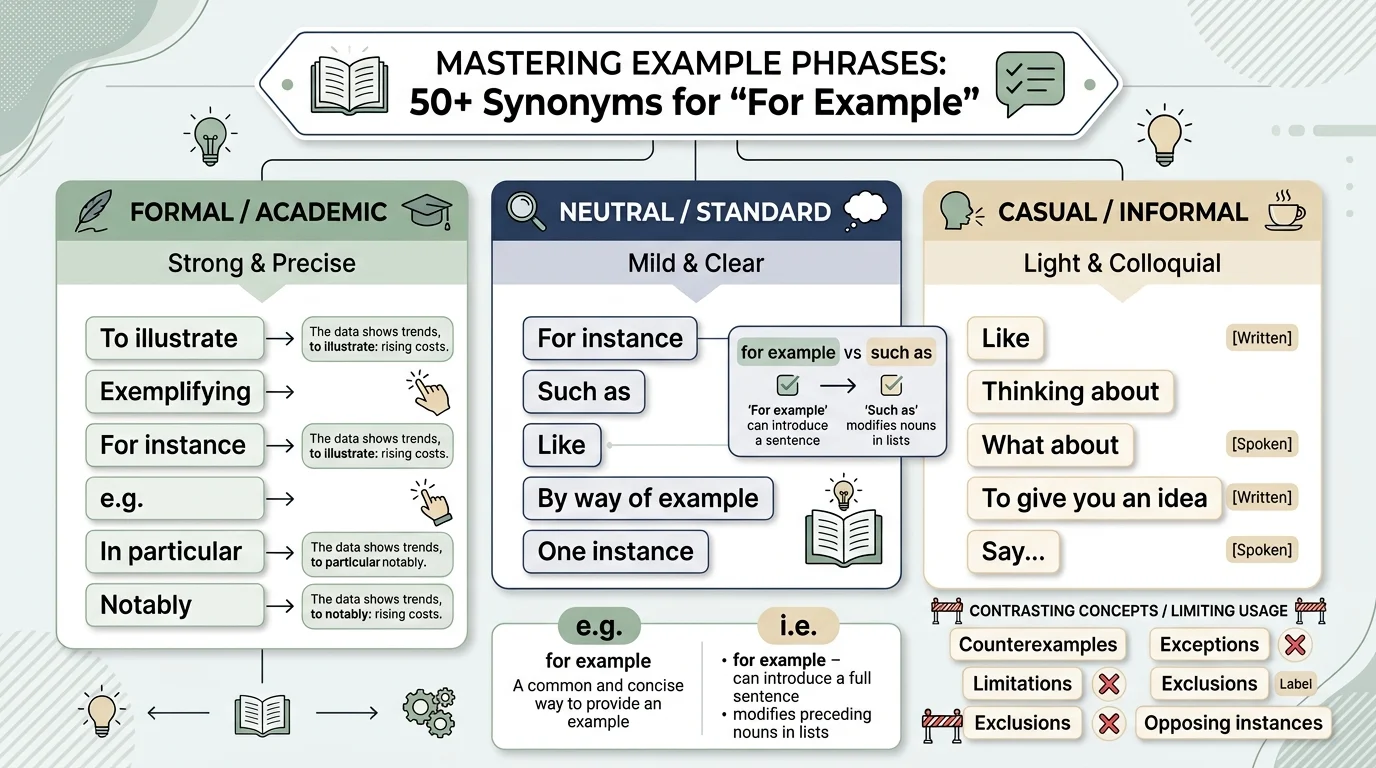
“For example” is a transitional phrase used to introduce a specific instance that supports or clarifies a general statement. The best synonyms for for example depend on your context. Use “for instance” in casual writing, “such as” when listing items, and “to illustrate” in formal or academic work.
Meaning, Tone and Context
The phrase “for example” serves a crucial role in writing. It signals to the reader that a specific case or illustration is coming to support your point.
- Simple definition: An expression used to introduce a representative case or instance.
- Part of speech: Transitional phrase (conjunctive adverbial).
- Tone: Neutral and universally applicable.
- Formality level: Ranges from informal to formal depending on the synonym chosen.
- Common use cases: Essays, presentations, emails, reports, and everyday conversation.
- Important word forms: The phrase itself is fixed. Related forms include the verb “exemplify” and the noun “example.”
When and How to Use “For Example”
You use this phrase to make abstract ideas concrete. It helps your reader understand exactly what you mean by providing evidence or a clear case.
Here are some realistic examples of using the base phrase or its synonyms in different contexts.
Professional: We need to improve our customer retention strategies. For instance, we could implement a loyalty rewards program.
Academic: Many classic novels explore themes of social injustice. To illustrate, consider Charles Dickens’ “Oliver Twist.”
Personal: I love trying new types of food. For example, I recently discovered a fantastic Ethiopian restaurant downtown.
Creative: The city was full of forgotten stories. Take the old clock tower on Maple Street, for example.
Social Media: There are so many ways to be more sustainable. For example, you can start by carrying a reusable water bottle.
Resume: I have experience with project management tools. For example, I used Asana to coordinate a team of ten people.
Casual Conversation: My dog is a picky eater. Like, for example, he refuses to eat anything that isn’t covered in gravy.
Another Word for “For Example”
The best single replacement depends on the context of your writing. You cannot use the same synonym for every situation.
Here are direct suggestions for different writing scenarios:
- Professional writing: “For instance”
- Academic writing: “To illustrate”
- Casual conversation: “Like”
- Emotional writing: “Consider”
- Creative writing: “Take” (as in, “take this…”)
- Resume or workplace: “Such as”
- Social media captions: “E.g.,” or “Like”
- Stronger meaning: “To demonstrate”
- Softer meaning: “As an example”
When Not to Use “For Example”
You should avoid “for example” when it sounds too vague or weak. Overusing it can make your argument seem flimsy.
Consider this vague sentence: “The company has many benefits. For example, we have a good culture.”
A more precise synonym improves the sentence dramatically. “The company offers substantial benefits, such as comprehensive health insurance and unlimited paid time off.”
The second version is concrete and persuasive. The first version leaves the reader wanting more detail.
Also, avoid using “for example” in a conclusion or summary. You should be making a final point, not introducing new evidence.
Words Commonly Confused With “For Example”
Many words are used in similar ways but have distinct meanings. Understanding these differences will sharpen your writing.
Compare “for example” with these commonly confused related words.
- For example vs. Such as: “Such as” is used to introduce a partial list. “For example” introduces a specific instance to prove a point. “For example” often introduces a full sentence or a larger idea, while “such as” lists items within a sentence.
- For example vs. Like: “Like” is a more casual synonym for for example, but it is often used for comparisons. In formal writing, “like” as a synonym for for example is generally discouraged. Use “such as” instead.
- For example vs. For instance: These are nearly identical. “For instance” is often used to introduce a specific scenario or a case, while “for example” can be used for both scenarios and lists. They are largely interchangeable.
- For example vs. E.g.: “E.g.” is the Latin abbreviation for “exempli gratia.” It means “for example.” It is used within parentheses or in citations, but it is not used in the flow of a sentence. Write “e.g.,” not “eg.”
- For example vs. I.e.: “I.e.” stands for “id est” and means “that is.” It is used to clarify or restate something. It is not a synonym for for example. Never use “i.e.” to introduce an example.
- For example vs. Namely: “Namely” is used to specify something. It means “that is to say” and is used to introduce more specific details about the point you just made. It is a stronger form of “i.e.”
Best Synonym by Context for “For Example”
Choosing the right alternative is all about context. Here is a table to help you select the best word for your specific situation.
| Context | Best Synonym | Why It Works | Example |
|---|---|---|---|
| Formal Writing | To illustrate | It sounds sophisticated and purposeful. | The policy has been effective. To illustrate, employee satisfaction scores have risen by 20 percent. |
| Academic Writing | As demonstrated by | It emphasizes evidence and proof. | The results are clear. As demonstrated by the data in Figure 1, the trend is undeniable. |
| Professional Business | For instance | It is clear, professional, and widely accepted. | We have several options for expansion. For instance, we could open a new branch in Austin. |
| Resume Use | Such as | It concisely introduces a list of specific skills or achievements. | I have managed complex projects, such as the launch of our flagship mobile app. |
| Casual Conversation | Like | It is natural and fits everyday speech. | I enjoy outdoor hobbies, like hiking and camping. |
| Creative Writing | Take | It is direct and engaging, as if inviting the reader to consider an example. | The city is full of secrets. Take the abandoned subway station on 42nd Street. |
| Emotional Tone | Consider | It asks the reader to think about a specific case, creating empathy. | We must think about the victims. Consider the family who lost their home. |
| Strong Intensity | To demonstrate | It shows that you are providing proof or evidence. | He is a great leader. To demonstrate, he turned around a failing department. |
| Soft Moderate Tone | As a case in point | It is a clear but gentle way to introduce an example. | The program is a success. As a case in point, enrollment has doubled. |
| Social Media Captions | E.g., | It saves space and looks modern and concise. | Love all kinds of music, e.g., rock, jazz, and classical. |
| US vs. UK Usage | For example | The phrase is the same in both US and UK English. The synonyms “like” and “such as” are also common in both. “E.g.” is used universally. |
Which Synonym Should You Choose?
Your choice depends on several factors. Think about your audience and your goal.
First, consider the formality of your document. In a research paper, use “to illustrate.” In an email to a friend, use “like.”
Second, consider the emotional weight of the example. If you want to persuade, use “to demonstrate.” If you want to be neutral, use “for instance.”
Third, think about the structure of your sentence. Are you listing items? Use “such as.” Are you introducing a full scenario? Use “for instance.”
Finally, avoid repetition. The best writing uses a variety of transitions. Mix up your choices to keep the reader engaged.
Real Life Examples of “For Example” in Sentences
Here are examples of the base phrase and its synonyms across different real life situations. Notice how the synonym sets the tone for the entire sentence.
School: Historical events often have complex causes. For instance, the American Revolution was caused by a combination of economic and political factors.
Workplace: We are looking for candidates with strong soft skills. To illustrate, we value communication and teamwork above specific technical knowledge in the first round.
Conversation: I’m trying to eat healthier. Like, I’m cutting out sugar and eating more vegetables.
Social Media: Goal setting is so important. For example, setting a daily writing goal of 500 words can be life changing.
Email: The project is behind schedule. For instance, we have not yet received the final approval from the client.
Storytelling: The hero was offered a deal. Take the classic “deal with the devil” stories, for example.
25 Synonyms for “For Example”
Here is a comprehensive list of synonyms. Each one has a unique explanation and a natural example sentence to show you how to use it.
| Synonym | Simple Meaning | Best Used For | Example Sentence |
|---|---|---|---|
| For instance | To introduce a specific case | General use, neutral | Many fruits are rich in vitamin C. For instance, an orange contains over 100 percent of your daily requirement. |
| Such as | To give a specific example from a larger group | Listing items within a sentence | The store sells a variety of produce, such as apples, bananas, and grapes. |
| To illustrate | To paint a picture or clarify with an example | Formal and academic writing | The economy is struggling. To illustrate, inflation has reached a ten year high. |
| Like | A casual comparison or example | Informal conversation and writing | I love action movies, like the ones with car chases. |
| E.g., | The abbreviation for “exempli gratia” | Footnotes, citations, and parentheticals | I love citrus fruits (e.g., oranges, lemons, limes). |
| As demonstrated by | To show something is proven by the example | Formal and technical writing | The theory is sound. As demonstrated by the study, the results are consistent. |
| As a case in point | To introduce a specific, relevant example | Persuasive and professional writing | He is a dedicated worker. As a case in point, he finished the project ahead of schedule. |
| Including | To introduce part of a group | General use, lists | I have many hobbies, including reading, painting, and swimming. |
| Namely | To specify exactly what you mean | Clarification and specification | We need to focus on one thing, namely, improving our customer service. |
| Consider | To ask the reader to think about a case | Persuasive and emotional writing | Think about the environment. Consider the impact of plastic waste on our oceans. |
| Take | To invite the reader to examine a case | Creative and conversational writing | The problem is expensive. Take the cost of housing in New York City. |
| To cite | To reference something as evidence | Formal, scholarly writing | The author makes a strong point. To cite one example, he mentions the decline in bee populations. |
| As an example | A straightforward synonym | Neutral and simple writing | There are many benefits. As an example, it can save you money. |
| To exemplify | To show a model or ideal case | Formal and academic writing | The artist is known for his abstract work. To exemplify, look at his famous “Blue” series. |
| By way of illustration | An extended formal phrase | Very formal speeches and documents | The process is complex. By way of illustration, let me walk you through the life cycle of a product. |
Synonym Groups and Usage Differences
Professional vs. Personal Synonyms
Professional synonyms like “to illustrate” and “for instance” create a formal tone. Personal synonyms like “like” and “take” are more intimate and casual. In a business report, use “for instance.” In a personal blog post, use “like.”
Formal vs. Conversational Synonyms
Formal synonyms include “to illustrate,” “as demonstrated by,” and “to exemplify.” These are perfect for reports, essays, and speeches. Conversational synonyms include “like,” “take,” and “say.” These are great for texts, emails to friends, and everyday speech. Avoid using “like” as a synonym for for example in formal essays.
Academic Synonyms
In academic writing, precision is key. Use “as demonstrated by,” “to illustrate,” or “to exemplify.” These words show that you are providing evidence. You can also use “namely” to specify a particular point.
Professional and Business Synonyms
For business emails and presentations, choose “for instance,” “such as,” and “including.” These are professional and widely understood. “Such as” is excellent for listing skills on a resume.
Creative or Literary Synonyms
Creative writers can use “take,” “consider,” or “picture this.” These engage the reader’s imagination. “Take” invites the reader to look at a specific example. “Consider” is thoughtful and persuasive.
Slang or Modern Synonyms
Like” is the primary modern and slang synonym for for example. It is acceptable in very casual situations and on social media. However, you should almost never use it in formal writing. Other modern phrases include “say” and “think of.”
Strongest vs. Weaker Synonyms
Some synonyms carry more weight than others. “To demonstrate” is a strong and confident word. “As an example” is neutral and weaker in comparison. Choose “to demonstrate” when you are building a powerful argument.
Emotional vs. Neutral Synonyms
Emotional synonyms like “consider” and “take” ask for empathy. Neutral synonyms like “for instance” and “such as” are factual and do not carry emotional weight. Use “consider” when you want your reader to feel something about the example.
Antonyms of “For Example”
While not a direct opposite, these words or phrases signal a contrast or conclusion rather than an example.
| Antonym | Meaning | Example Sentence |
|---|---|---|
| Generally | In a general sense | Generally, people like to feel appreciated. |
| Overall | Considering everything | Overall, the project was a success. |
| On average | Typically or normally | On average, we receive 50 applications per day. |
| In conclusion | To summarize | In conclusion, the evidence supports the hypothesis. |
| Briefly | In a short or concise way | Briefly, the plan is to expand overseas. |
| To summarize | To give a concise statement | To summarize, we need to increase our budget. |
| In general | Usually or for the most part | In general, students find the class difficult. |
| Essentially | At its core | Essentially, the problem is a lack of funding. |
| Broadly | In a wide context | Broadly speaking, the economy is improving. |
| As a whole | Taken altogether | The team as a whole performed well. |
| In short | In a few words | In short, we are behind schedule. |
| Fundamentally | At the most basic level | Fundamentally, we need to improve our product. |
| Accordingly | As a result | Accordingly, we have changed our strategy. |
| Consequently | As a result | Consequently, sales have increased. |
| Therefore | For that reason | Therefore, we must act now. |
Comparison: For Example vs. Similar Words
For Example vs. Such As
Main difference: “For example” introduces a specific instance to prove a point. “Such as” introduces a partial list of examples within a sentence.
Which one is stronger: “For example” is stronger for building an argument. “Such as” is stronger for listing items.
Which one is more formal: “For example” is more formal.
Example sentence for “such as”: I need to buy some groceries, such as milk and eggs.
Example sentence for “for example”: The store has a good selection of dairy products. For example, they carry organic milk.
For Example vs. For Instance
Main difference: They are almost identical. “For instance” often introduces a hypothetical or specific scenario. “For example” is a bit more general. Many writers use them interchangeably.
Which one is stronger: Neither is significantly stronger. Both are neutral.
Which one is more formal: Both are equally formal.
Example sentence for “for instance”: We could improve our website. For instance, we could add a live chat feature.
Example sentence for “for example”: The website needs improvement. For example, the navigation is confusing.
For Example vs. Like
Main difference: “Like” is a casual comparison. It is often used as slang in modern English. “For example” is formal and correct.
Which one is stronger: “For example” is stronger and more professional.
Which one is more formal: “For example” is much more formal. Avoid “like” in professional writing.
Example sentence for “like”: The food in Italy is great, like the pasta in Rome.
Example sentence for “for example”: Italian food is popular for good reason. For example, the fresh pasta is world renowned.
For Example vs. Namely
Main difference: “Namely” is used to specify a particular item. It means “that is” or “specifically.” “For example” is used to introduce an instance.
Which one is stronger: “Namely” is stronger for clarification.
Which one is more formal: Both are formal.
Example sentence for “namely”: We need to correct one thing, namely, the spelling errors.
Example sentence for “for example”: We have a few corrections to make. For example, there is a spelling error on page one.
For Example vs. E.g.
Main difference: “E.g.” is an abbreviation. It is used inside parentheses, citations, or notes. It is not used in the natural flow of a sentence. “For example” is used in the sentence flow.
Which one is stronger: “For example” is stronger in a sentence.
Which one is more formal: “E.g.” is academic and formal, but it is a technical convention.
Example sentence for “e.g.,”: We learned about several Impressionist artists (e.g., Monet, Renoir).
Example sentence for “for example”: The Impressionists were revolutionary. For example, Monet’s use of light was groundbreaking.
For Example vs. To illustrate
Main difference: “To illustrate” emphasizes the act of showing or painting a picture with your words. “For example” is simply to give a case. “To illustrate” is more vivid.
Which one is stronger: “To illustrate” is stronger and more evocative.
Which one is more formal: “To illustrate” is more formal and academic.
Example sentence for “to illustrate”: The artist’s vision was unique. To illustrate, he used shadows in a completely new way.
Example sentence for “for example”: The artist was unique. For example, he used shadows in a new way.
Common Phrases and Expressions with “For Example”
1. Let me give you an example
Meaning: A direct and personal introduction to an example.
Example sentence: This is a common problem. Let me give you an example.
2. To give you an idea
Meaning: Used to clarify or quantify a statement.
Example sentence: The house is very large. To give you an idea, it has six bedrooms.
3. A good example of this is
Meaning: Used to highlight a specific, positive instance.
Example sentence: The company values innovation. A good example of this is their new drone delivery service.
4. This is evident in
Meaning: To show that something is proven by an example.
Example sentence: The culture is inclusive. This is evident in their hiring practices.
5. Consider the case of
Meaning: A formal and persuasive way to introduce an example.
Example sentence: We need to understand employee burnout. Consider the case of a workaholic.
6. One such example is
Meaning: Used to introduce a singular item from a known group.
Example sentence: Many cities are implementing green initiatives. One such example is Austin, Texas.
Common Mistakes to Avoid
Here are practical mistakes to avoid when using synonyms for “for example.”
- Using “like” in formal writing. It is considered too casual. Use “for instance” or “such as” instead.
- Confusing “i.e.” with “e.g.” This is a very common error. I.e.” means “that is.” “E.g.” means “for example.”
- Using a casual synonym in an academic paper. Do not use “like” or “take” in a research paper.
- Using an overly dramatic synonym for a simple situation. Do not say “to demonstrate” when you are just listing your hobbies.
- Repeating the same synonym for example. Vary your language. Use “for instance,” “such as,” and “to illustrate” to keep the reader engaged.
- Using a synonym with the wrong emotional tone. Do not use the persuasive “consider” when you are simply stating a fact.
- Using slang in professional communication. Avoid “like” in a resume or cover letter.
FAQs
What is the best synonym for “for example”?
The best synonym for for example depends on context. For formal writing, use “for instance.” casual writing, use “like.” For academic writing, use “to illustrate.”
What is a formal synonym for “for example”?
The most common formal synonyms are “for instance,” “to illustrate,” and “as demonstrated by.” These phrases are perfect for reports and essays.
What is an informal synonym for “for example”?
The most informal synonym is “like.” You can also use “say” or “take” in casual conversation.
What is another word for “for example” in professional writing?
Professional writing benefits from “for instance” and “such as.” These are clear and neutral. They fit well in emails and workplace presentations.
What is the difference between “for example” and “such as”?
“For example” introduces a specific instance to support a point. “Such as” introduces a partial list of items within a sentence. “For example” often introduces a full sentence.
What is the opposite of “for example”?
There is no direct opposite. However, words like “generally,” “in conclusion,” and “overall” signal a shift away from specific instances and toward a summary or broader point.
Conclusion
You have many tools at your disposal to avoid the repetitive “for example.” The best alternatives depend on your audience and your goal.
Use “for instance” for a neutral, professional tone. “such as” to list items concisely. Use “to illustrate” to add academic weight. Use “like” only when writing to a friend.
The most important vocabulary tip is to consider the context before you choose a word. A perfect word in one situation can be a mistake in another.
Start by picking just two new synonyms from this list. Practice using them in your writing this week. Soon, they will become natural alternatives.
Enjoy mastering the art of precise vocabulary.
2 thoughts on “50+ Synonyms for For Example | Meanings, Examples, and Best Alternatives”