Have you ever caught yourself using “for example” three times in a single paragraph?
You are not alone. Most writers, students, and professionals fall into this habit.
Finding new ways to introduce examples makes your writing stronger and more engaging. It shows range and precision.
This guide gives you over 50 synonyms for example, organized by context and tone. You will learn exactly which word fits your sentence every time.
What Does Example Mean?
An example is a specific instance that represents a broader idea or illustrates a point. The best synonym depends on your context. For formal writing, use “for instance” or “such as.” Casual conversation, try “like” or “say.” For professional documents, choose “to illustrate” or “as demonstrated by.”
Meaning, Tone and Context
Simple Definition
An example is a representative case that demonstrates a rule, explains a concept, or supports an argument.
Part of Speech
The word “example” functions as a noun. The related verb form is “exemplify,” and the adjective form is “exemplary.”
Tone
The word “example” has a completely neutral tone. It carries no positive or negative emotional weight.
Formality Level
“Example” works across all formality levels, from casual conversation to academic papers.
Common Use Cases
You will use this word when clarifying ideas, supporting arguments, providing evidence, giving instructions, teaching concepts, or explaining procedures.
Important Word Forms
The noun “example” has the plural “examples.” The verb “exemplify” means to serve as an example. The adjective “exemplary” means serving as a desirable model.
When and How to Use “Example”
Use “example” whenever you need to show your reader or listener exactly what you mean. This word works as a bridge between abstract ideas and concrete reality.
Here are realistic examples of “example” in different contexts.
Academic context
The researcher provided a clear example of how climate change affects migration patterns.
Professional context
Our quarterly report includes an example of successful client retention strategies.
Casual conversation context
Take this example: my brother started his business with just five hundred dollars.
Email context
I have attached an example of the contract format we typically use.
Creative writing context
The sunset was a perfect example of nature’s ability to create art without effort.
Social media caption context
This outfit is a great example of how to style neutrals for fall.
Resume context
Created training materials with real world examples to improve employee comprehension.
Another Word for “Example”
Choosing the right alternative depends heavily on your writing situation. Here are the best single replacements based on context.
Professional writing
Choose “illustration” when you want to sound polished and precise. It works well in business reports and presentations.
Academic writing
Select “instance” for scholarly work. It sounds analytical and objective.
Casual conversation
Use “like” when speaking informally. It feels natural and conversational.
Emotional writing
Choose “symbol” when your example carries deeper meaning or represents a feeling.
Creative writing
Select “sample” when describing a small piece of something larger.
Resume or workplace use
Pick “demonstration” to highlight your ability to show concrete results.
Social media captions
Use “case” for quick, punchy introductions to your point.
Stronger meaning
Choose “prototype” or “archetype” to emphasize that something is the perfect model.
Softer meaning
Use “sample” to suggest a small, noncommittal representation.
When Not to Use “Example”
Sometimes the word “example” sounds too vague or overused. Here is when you should reach for a more precise synonym.
When you need to emphasize uniqueness
Saying “this is an example of great design” sounds weak compared to “this is a masterpiece of design.”
When you want to sound authoritative
In expert writing, “this demonstrates” carries more weight than “this is an example of.”
When you are making a single strong point
Repeating “example” throughout a paragraph dilutes your impact. Vary your language.
When the context is emotional
A “symbol” or “representation” adds feeling where “example” feels cold.
Weak sentence
Her kindness is an example of good leadership.
Improved sentence
Her kindness demonstrates the heart of effective leadership.
Words Commonly Confused With “Example”
Many words related to “example” carry distinct meanings. Understanding these differences helps you choose the right word every time.
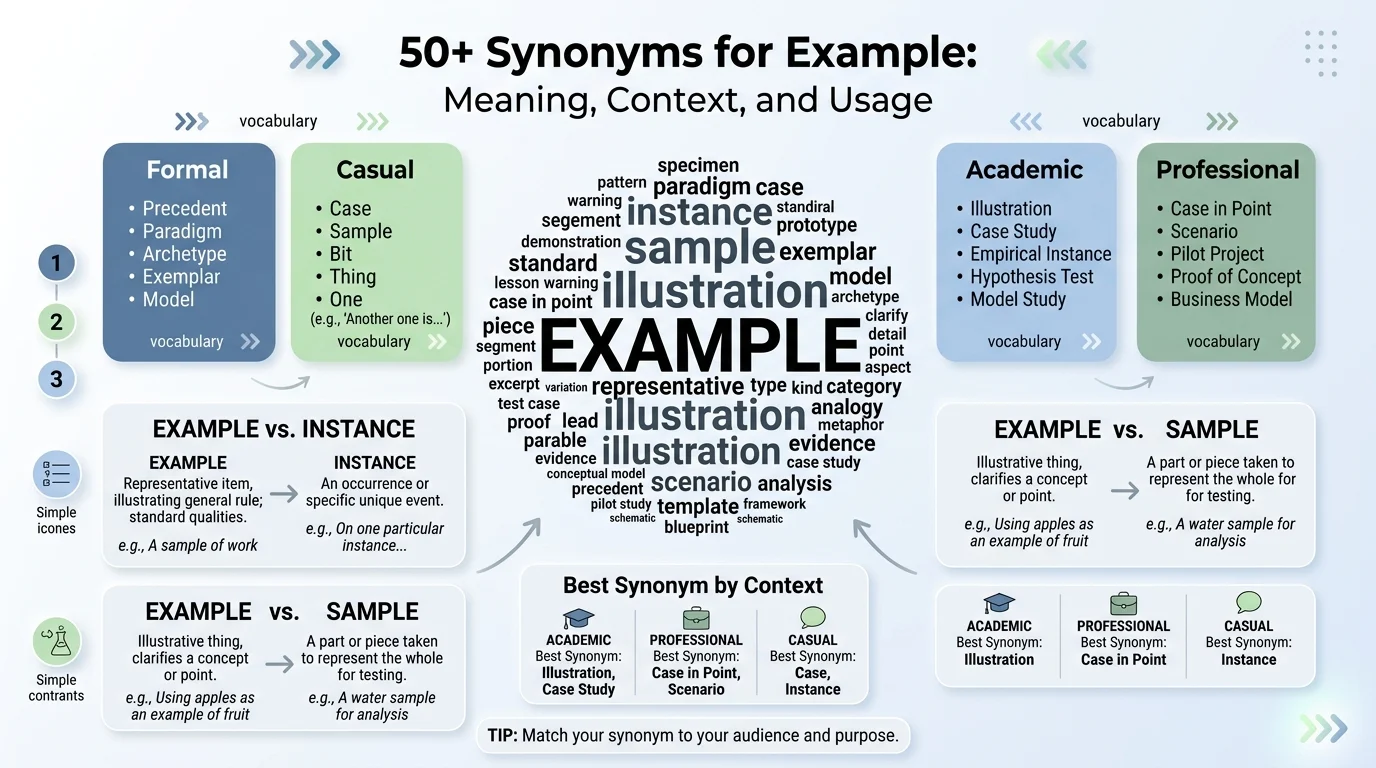
Example vs. Instance
An instance is a specific occurrence of something. An example is used to illustrate a rule. Instance focuses on occurrence. Example focuses on teaching or clarifying. Use “instance” when discussing a single event. Use “example” when making a point.
Example vs. Sample
A sample is a small part taken from a larger whole. An example is a representative case. Sample implies physical or statistical representation. Example implies illustration. Use “sample” for data or products. Use “example” for ideas or concepts.
Example vs. Illustration
An illustration visually or verbally clarifies something. An example serves as a model. Illustration emphasizes explanation. Example emphasizes representation. Use “illustration” for visual or vivid explanations. Use “example” for standard representation.
Example vs. Prototype
A prototype is the first version used to test a concept. An example is a representative case. Prototype implies development. Example implies demonstration. Use “prototype” for early versions. Use “example” for typical cases.
Example vs. Precedent
A precedent is an earlier event used as a guide. An example is a model for behavior. Precedent focuses on history and rules. Example focuses on demonstration. Use “precedent” for legal or historical references. Use “example” for general teaching.
Example vs. Case
A case is an instance requiring discussion or investigation. An example is used for explanation. Case implies complexity. Example implies clarity. Use “case” for analysis. Use “example” for instruction.
Best Synonym by Context for “Example”
| Context | Best Synonym | Why It Works | Example |
|---|---|---|---|
| Formal writing | For instance | It sounds polished and professional | Many factors affect outcomes, for instance, resource allocation. |
| Academic writing | As demonstrated by | It adds authority and evidence | The hypothesis was confirmed, as demonstrated by the data. |
| Professional business | To illustrate | It sounds strategic and intentional | To illustrate our growth, consider last year’s revenue. |
| Resume writing | As shown in | It highlights concrete achievements | Increased efficiency, as shown in our quarterly metrics. |
| Casual conversation | Like | It feels natural and effortless | I enjoy quiet hobbies, like reading and gardening. |
| Creative writing | Such as | It adds descriptive richness | The garden featured vibrant flowers, such as roses and lilies. |
| Emotional tone | Symbol of | It adds deeper meaning | Her patience was a symbol of her love. |
| Strong intensity | Epitome of | It suggests perfection | His work is the epitome of dedication. |
| Soft moderate tone | Including | It feels gentle and inclusive | Bring supplies, including pens and notebooks. |
| Social media captions | Say | It sounds conversational and trendy | Pair this top with anything, say, jeans or a skirt. |
| US usage | For example | It is the standard American phrasing | Many cities, for example, New York, have tall buildings. |
| UK usage | For instance | It is equally common in British English | Many cities, for instance, London, have rich history. |
Which Synonym Should You Choose?
Selecting the right synonym for “example” requires thinking about your audience and purpose. Here is a practical decision guide.
Consider your audience
Write for professionals? Choose “to illustrate” or “as demonstrated by.” Write for friends? Use “like” or “say.” Academic readers expect “for instance” or “such as.”
Consider your tone
Need to sound neutral? Stick with “for example.” Want to add emotion? Use “symbol” or “representation.” Want to sound strong? Choose “epitome” or “quintessential.”
Consider your sentence structure
Some synonyms fit naturally in the middle of sentences. “Such as” works well mid sentence. Others work better at the beginning. “For example” starts sentences smoothly.
Consider your desired impact
Want to emphasize uniqueness? Use “one of a kind.” Want to show importance? Use “case in point.” Want to simplify? Use “to name a few.”
Consider your frequency
Avoid using the same synonym twice in one paragraph. Rotate between formal and informal options based on your overall writing style.
Real Life Examples of “Example” in Sentences
Here are practical sentences showing how “example” and its synonyms work across different situations.
School context
The teacher gave several examples of persuasive writing techniques.
Workplace context
Our team leader provided examples of effective client communication.
Writing context
Good writers use examples to bring abstract concepts to life.
Conversation context
Take my sister, for example, she learned Spanish in six months.
Social media context
This recipe is proof that healthy food can taste amazing.
Resume context
Developed training modules with practical examples for new employees.
Email context
I have included examples of the design options we discussed.
Storytelling context
The old house was a living example of forgotten history.
25 Synonyms for “Example”
| Synonym | Simple Meaning | Best Used For | Example Sentence |
|---|---|---|---|
| For instance | As an example | Academic writing | Many animals hibernate, for instance, bears and hedgehogs. |
| Such as | Like these | Descriptive writing | The store sells organic goods, such as fruits and vegetables. |
| To illustrate | To clarify with an example | Professional writing | To illustrate, consider our sales growth over five years. |
| Like | Similar to | Casual conversation | I love travel destinations like Japan and Italy. |
| Say | For example | Social media captions | Choose a neutral color, say, beige or gray. |
| As demonstrated by | Shown through | Academic writing | The theory works, as demonstrated by recent studies. |
| Case in point | A perfect example | Formal writing | Her success is a case in point for hard work. |
| Including | Containing as part of | Professional writing | Multiple factors, including budget, affect the decision. |
| Namely | Specifically | Formal writing | Three departments, namely sales and marketing, attended. |
| In particular | Specifically | Academic writing | One factor matters most, in particular, customer feedback. |
| As an example | To give a sample | Neutral writing | As an example, look at our competitor’s strategy. |
| To name a few | Some examples | Casual writing | We offer many services, to name a few, consulting and training. |
| As a case | As an instance | Professional writing | As a case, consider our recent product launch. |
| Exemplified by | Shown by | Academic writing | This trend is exemplified by rising global temperatures. |
| Illustrative of | Serving as an example | Formal writing | These results are illustrative of the overall pattern. |
| Representative of | Typical of a group | Academic writing | This sample is representative of the population. |
| Typical example | A common case | Neutral writing | This is a typical example of modern architecture. |
| Classic example | A well known case | Creative writing | The story is a classic example of gothic literature. |
| Prime example | The best case | Professional writing | Her leadership is a prime example of effective management. |
| Perfect example | An ideal case | Emotional writing | Their friendship is a perfect example of loyalty. |
| Clear example | An obvious case | Educational writing | This is a clear example of cause and effect. |
| Good example | A positive case | Casual writing | That is a good example of teamwork. |
| Specific example | A precise case | Academic writing | We need a specific example to support this claim. |
| Concrete example | A tangible case | Professional writing | Provide a concrete example of your success. |
| Notable example | An important case | Formal writing | One notable example is the company’s sustainability efforts. |
Synonym Groups and Usage Differences
Professional vs. Personal Synonyms
Professional synonyms emphasize precision and objectivity. Words like “to illustrate” and “as demonstrated by” work in business settings.
Personal synonyms feel warmer and more relatable. Words like “like” and “say” fit conversations and personal writing.
Choose professional terms for reports, emails to superiors, and formal presentations. Choose personal terms for friendly communication and social media.
Formal vs. Conversational Synonyms
Formal synonyms include “for instance,” “namely,” and “as demonstrated by.” These words appear in academic papers, legal documents, and official speeches.
Conversational synonyms include “like,” “say,” and “to name a few.” These terms work in texts, casual emails, and everyday speech.
Never use “like” as a synonym for example in academic writing. Professors and editors often mark this as a style error.
Academic Synonyms
Academic writing demands precision and evidence. Strong academic synonyms include “as demonstrated by,” “exemplified by,” and “in particular.”
These words signal that you are presenting evidence, not just offering opinions. They add weight to your arguments.
Use “for instance” when you want to introduce a specific piece of evidence. Use “such as” when listing multiple supporting items.
Professional and Business Synonyms
Business communication values clarity and efficiency. Effective professional synonyms include “to illustrate,” “including,” and “case in point.”
These words help you make persuasive points in presentations, proposals, and reports. They sound strategic and intentional.
Use “to illustrate” when you are about to share a compelling story or data point. Use “including” when listing key items.
Creative or Literary Synonyms
Creative writing benefits from vivid and descriptive synonyms. Words like “symbol of,” “representation,” and “embodiment” add depth.
These words transform simple examples into powerful images. They help readers connect emotionally with your ideas.
Use “symbol” when your example represents something larger. Use “archetype” when describing a perfect model.
Slang or Modern Synonyms
Modern casual English offers informal alternatives like “literally” and “low key” in some contexts. However, these words rarely function as direct synonyms for example.
Most slang terms lack the clarity needed for effective examples. Stick to standard English for clear communication.
When writing for social media, “say” and “like” remain your safest casual choices.
Strongest vs. Weaker Synonyms
This intensity scale shows how synonyms for “example” range from mild to powerful.
Mild synonyms include “like” and “including.” These words gently introduce examples without emphasis.
Moderate synonyms include “for instance” and “such as.” These words clearly signal an example without overstatement.
Strong synonyms include “epitome,” “quintessential,” and “ultimate example.” These words emphasize perfection or ideal status.
Choose strong synonyms when you want to make a bold point. Choose mild synonyms for simple clarification.
Emotional vs. Neutral Synonyms
Neutral synonyms include “for example,” “such as,” and “for instance.” These words state facts without emotional coloring.
Emotional synonyms include “symbol,” “embodiment,” and “representation.” These words add feeling and significance.
Use neutral terms for objective writing. Use emotional terms for personal stories and persuasive pieces.
Antonyms of “Example”
| Antonym | Meaning | Example Sentence |
|---|---|---|
| Exception | A case that does not follow the rule | This result is the exception, not the example. |
| Anomaly | A deviation from the normal | The data point was an anomaly in the pattern. |
| Aberration | A departure from what is typical | His behavior was an aberration from his usual calm. |
| Deviant | Something that differs from the standard | This approach is a deviant from traditional methods. |
| Outlier | A value that stands apart from others | The statistic was an outlier in the research data. |
| Contradiction | The opposite of a supporting case | Her actions were a contradiction to her words. |
| Opposite | The direct reverse | This theory is the opposite of established knowledge. |
| Counterexample | A case that disproves a claim | The scientist found a counterexample to the hypothesis. |
| Irregularity | An unusual or atypical case | The irregularity in the data needed investigation. |
| Peculiarity | A distinctive but atypical feature | The peculiarity of the case made it unique. |
| Uniqueness | The quality of being one of a kind | The uniqueness of his approach set him apart. |
| Original | Something not derived from a model | This design is original, not based on existing examples. |
| Misrepresentation | An inaccurate portrayal | The statement was a misrepresentation of the facts. |
| Distortion | A twisted or altered version | The report contained a distortion of the evidence. |
| Misstatement | An incorrect claim | Her comment was a misstatement of the company policy. |
Comparison: Example vs. Similar Words
Example vs. Instance
The main difference lies in purpose. An example teaches or clarifies. An instance simply describes an occurrence.
“Instance” feels more factual and less instructional. “Example” feels more educational and explanatory.
Which one is stronger?
Neither is stronger. They serve different purposes.
Which one is more formal?
Both are formal, but “instance” appears more often in analytical writing.
sentence for example
This painting is a classic example of Renaissance art.
Example sentence for instance
We experienced only one instance of equipment failure.
Example vs. Sample
A sample represents a physical or statistical subset. An example represents an idea or concept.
Samples are measurable and quantifiable. Examples are illustrative and explanatory.
Which one is stronger?
“Sample” carries scientific weight. “Example” carries teaching weight.
Which one is more formal?
“Sample” sounds more technical and formal.
sentence for example
This behavior is an example of aggressive marketing.
sentence for sample
The lab tested a random sample of the products.
Example vs. Illustration
An illustration makes something clear through visual or verbal description. An example serves as a model.
Illustrations often include details and vivid language. Examples may be brief and direct.
Which one is stronger?
“Illustration” suggests more detail and creativity.
Which one is more formal?
Both are formal, but “illustration” appears more often in creative and descriptive writing.
sentence for example
He used a simple example to explain the concept.
Example sentence for illustration
The professor used an illustration of a river to explain erosion.
Example vs. Prototype
A prototype is a preliminary version created for testing. An example is a representative case.
Prototypes exist before final products. Examples exist to represent existing products.
Which one is stronger?
“Prototype” suggests innovation and development.
Which one is more formal?
“Prototype” sounds technical and specialized.
sentence for example
This city is a good example of urban planning.
Example sentence for prototype
The company unveiled a prototype of the new device.
Example vs. Precedent
A precedent is a past event used to guide current decisions. An example is a model for behavior.
Precedents carry legal and historical weight. Examples carry educational weight.
Which one is stronger?
“Precedent” suggests authority and obligation.
Which one is more formal?
“Precedent” is highly formal and legal.
sentence for example
Her style is an example of minimalist design.
Example sentence for precedent
The court ruling set a precedent for similar cases.
Example vs. Case
A case is a specific situation requiring analysis. An example is used to illustrate a general point.
Cases often involve complexity and investigation. Examples involve clarification and teaching.
Which one is stronger?
“Case” suggests depth and complexity.
Which one is more formal?
Both are formal, but “case” appears more often in legal and medical writing.
Example sentence for example
This is a simple example of how the system works.
Example sentence for case
The doctor reviewed the patient’s case carefully.
Common Phrases and Expressions with “Example”
1. For Example
Meaning: This phrase introduces a specific instance that supports your statement.
Example sentence: Many fruits are rich in vitamin C, for example, oranges and strawberries.
2. Set a Good Example
Meaning: To behave in a way that others should copy.
Example sentence: The supervisor sets a good example by arriving early every day.
3. Make an Example Of
Meaning: To punish someone to warn others.
Example sentence: The manager made an example of the rule breaker to discourage others.
4. Follow Someone’s Example
Meaning: To copy someone’s behavior or actions.
Example sentence: The younger students follow their mentor’s example in the lab.
5. Example to Others
Meaning: A person whose behavior serves as a model.
Example sentence: She is an example to others through her volunteer work.
6. Prime Example
Meaning: The best possible illustration of something.
Example sentence: The company is a prime example of sustainable business practices.
7. Case in Point
Meaning: An example that proves a point you are making.
Example sentence: The recent election results are a case in point for voter engagement.
8. Classic Example
Meaning: A well known instance that represents a category.
Example sentence: The novel is a classic example of Victorian literature.
Common Mistakes to Avoid
1. Using “Like” in Formal Writing
“Like” works well in conversation but fails in academic and professional contexts. Always choose “for instance” or “such as” in formal documents.
2. Confusing “Example” and “Sample”
A sample is a portion of a whole. An example is a representative case. Use “sample” for data and physical items. Use “example” for ideas and behavior.
3. Using a Casual Synonym in Academic Writing
Words like “say” and “to name a few” sound too informal for essays and research papers. Stick with “for instance” and “such as.”
4. Using an Overly Dramatic Synonym for Simple Situations
Calling every example an “epitome” or “quintessential” weakens the impact of these strong words. Save them for truly outstanding cases.
5. Repeating the Same Phrase Too Often
Even a perfect synonym becomes dull through overuse. Rotate between “for example,” “for instance,” “such as,” and “to illustrate” to keep your writing fresh.
6. Choosing a Synonym with the Wrong Emotional Tone
Using “symbol” when you mean “sample” adds unintended emotion. Always consider the feeling your synonym carries.
7. Using Slang in Professional Writing
Words like “literally” or “basically” have no place in formal examples. Keep your synonyms clear and standard.
FAQs
What is the best synonym for example?
“For instance” works well in most contexts. It is formal enough for academic writing yet natural enough for conversation.
What is a formal synonym for example?
“For instance” and “as demonstrated by” are excellent formal choices. They add authority and precision to your writing.
What is an informal synonym for example?
“Like” and “say” are the most common informal synonyms. Use them in casual conversation and social media posts.
What is another word for example in professional writing?
“To illustrate” and “case in point” sound strategic and professional. They work well in business reports and presentations.
What is the difference between example and instance?
An example teaches or clarifies a rule. An instance simply notes an occurrence. Examples are instructional. Instances are factual.
What is the opposite of example?
“Exception” is the most direct opposite. An exception does not follow the general rule that an example represents.
Conclusion
The word “example” connects abstract ideas to concrete reality. It helps your reader or listener understand exactly what you mean.
Choosing the right synonym makes your writing more precise and engaging. You gain credibility when you vary your language and match your word choice to your audience.
Remember to consider your context, tone, and purpose. Formal writing demands “for instance” and “such as.” Casual conversation welcomes “like” and “say.” Professional documents benefit from “to illustrate” and “as demonstrated by.”
Start paying attention to how you introduce examples. You will notice when you overuse one phrase. Replace it with a better synonym. Your writing will become stronger, clearer, and more effective.