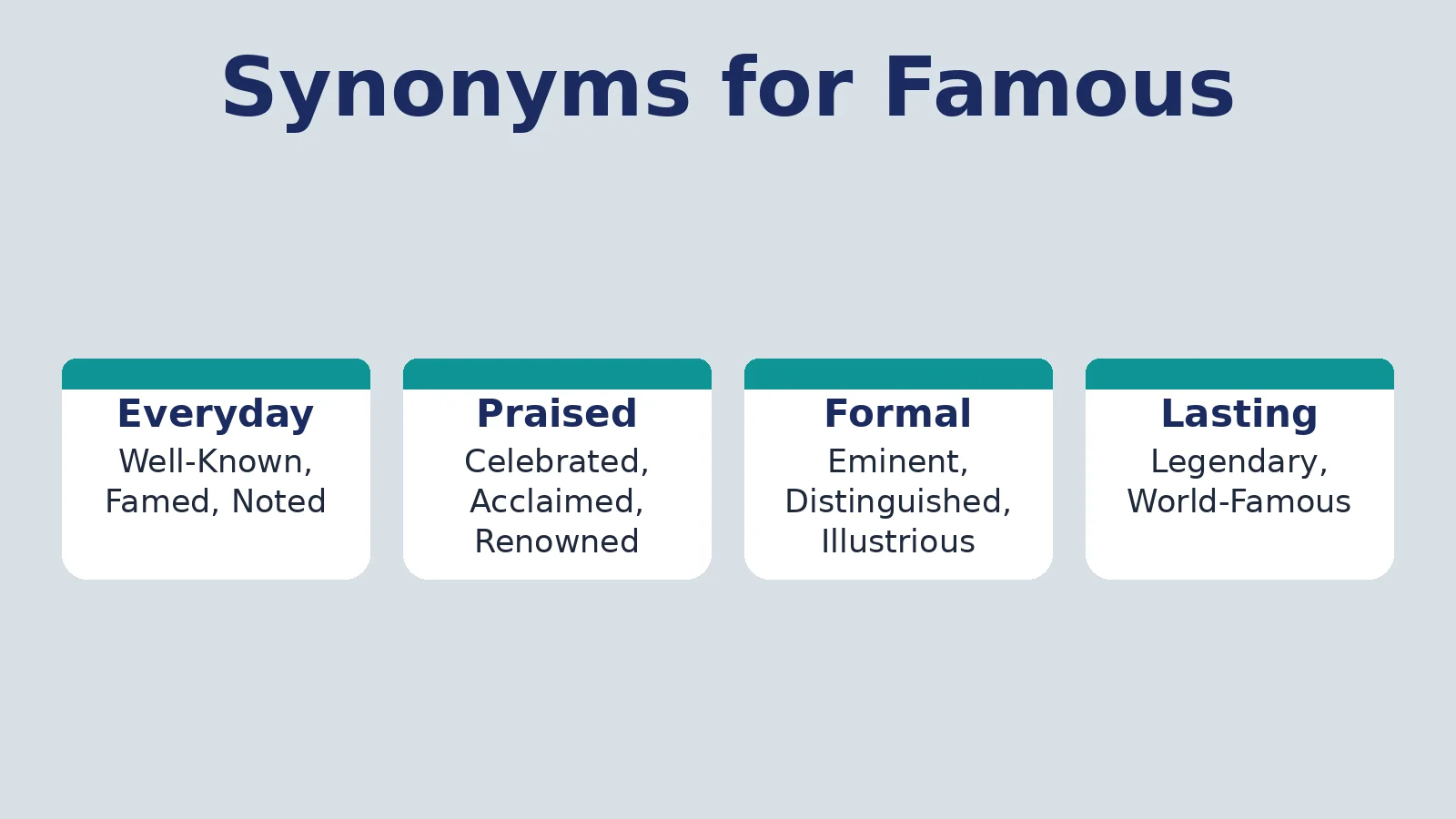
Famous is one of the first praise words English learners meet, and one of the first to wear out. A famous singer, a famous bridge, a famous recipe: the word fits all three, yet it flatters none of them precisely. The strongest synonyms for famous include well-known, renowned, celebrated, legendary, noted, eminent, illustrious, and distinguished. Each one describes a different kind of fame, though, and the differences matter. Some promise praise, some promise only attention, and two of them are not compliments at all.
This guide sorts more than 40 synonyms for famous by tone and register. You will find the everyday words, the formal words, the legendary words, and the words for fame that went wrong. Every entry comes with a plain meaning, and the key words add example sentences, so you can pick the exact shade your sentence needs.
Top Synonyms for Famous: Quick Reference
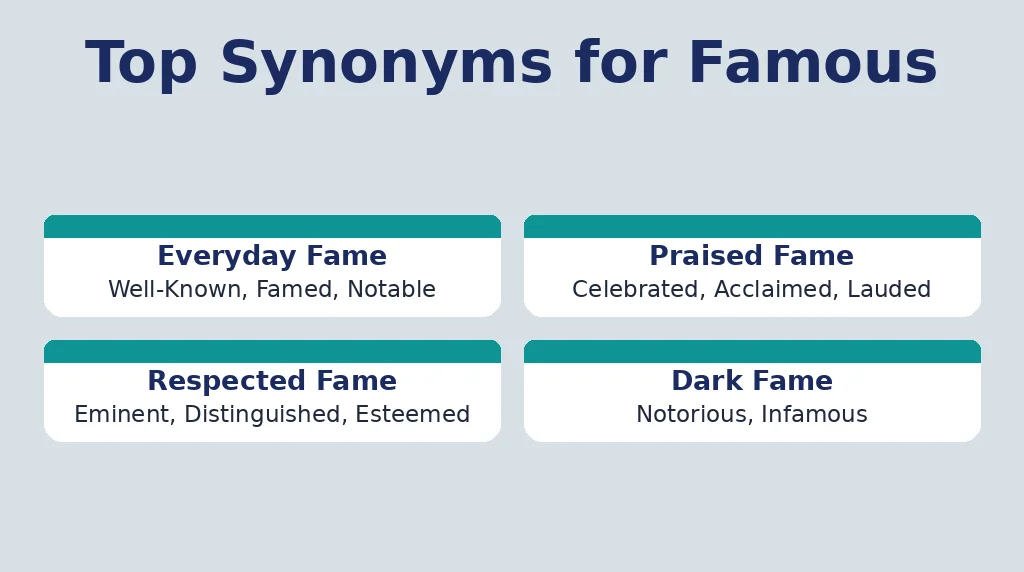
The table below covers the 26 synonyms readers reach for most often. Start here for a quick replacement. The sections after it sort the full list into finer groups by tone.
| Word | Meaning in one line | Best for |
|---|---|---|
| Well-known | Known by many people | Everyday, neutral fame |
| Famed | Famous, slightly literary | Writing, history |
| Renowned | Famous and admired, with glory | Formal praise |
| Celebrated | Famous and praised in print | Artists, writers, chefs |
| Noted | Known and respected for something | Experts, places |
| Notable | Worth noticing, well known | Figures, achievements |
| Popular | Liked and followed by many | Trends, people, places |
| Acclaimed | Praised widely by critics or public | Books, films, performers |
| Lauded | Praised highly and publicly | Winners, leaders |
| Honored | Given public respect and awards | Artists, veterans, scholars |
| Esteemed | Respected and admired | Professionals, elders |
| Revered | Deeply respected, almost sacred | Founders, saints, elders |
| Distinguished | Famous for excellence | Scientists, officers, guests |
| Eminent | Famous and respected in a field | Doctors, judges, scholars |
| Illustrious | Famous with lasting honor and glory | Heroes, careers, families |
| Prominent | Important and easily noticed | Leaders, members, figures |
| Leading | Among the best or first in a field | Experts, firms, brands |
| Noteworthy | Worth paying attention to | Achievements, cases |
| Outstanding | Exceptionally good and noticed | Performances, students |
| Legendary | Very famous, talked about for years | Athletes, musicians, heroes |
| World-famous | Known across the whole world | Landmarks, brands, stars |
| High-profile | Famous through public importance | Cases, trials, politicians |
| Much-publicized | Widely covered by the media | Events, scandals, launches |
| Big-name | Famous and commercially powerful | Actors, brands, sponsors |
| Notorious | Famous for something bad | Criminals, failures |
| Infamous | Famous for something evil or shocking | Killers, betrayals, scandals |
What Does Famous Mean?
At its heart, famous means known far and wide. That is the shared meaning Merriam-Webster gives for this whole family of words. Cambridge says it more plainly: famous describes someone or something known about by many people. Collins adds the idea of recognition: a famous person is known to or recognized by many people, even by strangers who have never met them.
That last detail separates fame from ordinary knowledge. Your neighbors know your face, but that knowledge stays inside one street. Fame begins when the recognition escapes the circle of people who could possibly meet you. A famous face is one that strangers can name in an airport, a classroom, or a photograph. Scale, not quality, is the core of the word.
Merriam-Webster adds a warning that most synonym lists skip. Famous, it says, implies little more than the fact of being widely and popularly known, and sometimes only briefly. In other words, famous by itself promises attention, not merit. The words around it in this guide supply the merit, the honor, or the disgrace. Choosing among them is how a writer tells readers what kind of fame they are looking at.
Two small grammar points complete the picture. Before a noun, well-known takes a hyphen: a well-known actor. After a verb, the hyphen drops: the actor is well known. And famous usually pairs with for to name the reason: famous for her voice, famous for its beaches. When a sentence names no reason at all, plain famous or well-known is usually the honest choice.
Reach, Depth and Duration
Three measures hide inside every fame word, and naming them helps you choose later. Reach asks how far the name has traveled: one valley, one country, or the world. Depth asks how firmly people hold the name: a face they half recognize, or a life story they can retell. Duration asks how long the fame will survive: one season, one career, or several centuries.
Plain famous claims reach without promising depth or duration. Legendary claims all three, which is why it sounds so much heavier. Noted claims depth inside a small circle instead. When a fame word sounds wrong in your sentence, one of these three measures is usually the mismatch. The choose section near the end turns this idea into a quick test you can run on any swap.
Everyday Synonyms for Famous
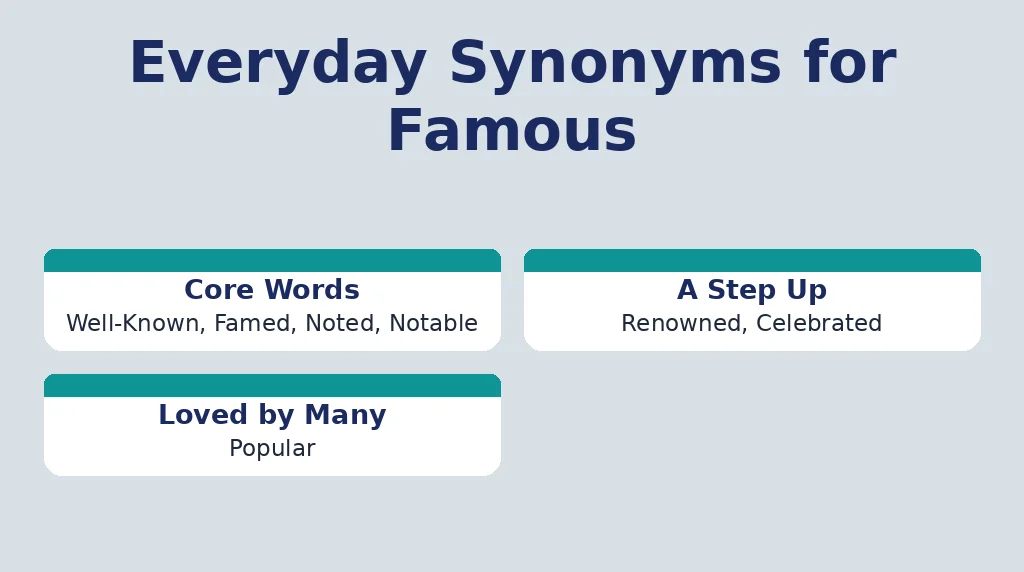
Most sentences need fame at walking pace: a person, place, or dish that plenty of people know, with no ceremony attached. This family covers that everyday ground. The words here are safe in speech, in schoolwork, and in most writing.
The Core Words
These four carry the plain meaning of famous with the least extra baggage. Reach for them first whenever you simply need a fresher word.
- Well-known: known by many people, the calmest member of the family. Example: It is a well-known café near the station.
- Famed: famous, with a slightly literary shine. Example: The town is famed for its lighthouse and its storms.
- Noted: known and quietly respected for a particular thing. Example: The noted botanist led the walk herself.
- Notable: important enough to be noticed and remembered. Example: He is a notable voice in the housing debate.
Famed deserves one caution. It sounds a little bookish in casual speech, where well-known does the same job without the costume. In writing about history, food, and travel, though, famed feels right at home. Famed for its spices is a phrase no reader stumbles over.
Popular: The Friendly Neighbor
One everyday word sits at the edge of this family, close enough to cause constant mix-ups.
- Popular: liked, enjoyed, and followed by many people. Example: The night market is popular with students.
Thesauri do list popular beside famous, and in loose speech the two trade places daily. Strictly, though, popular is about affection, while famous is about recognition. A tax office can be famous without being popular at all. A gifted street musician can be popular in one square and unknown everywhere else. The choose section below gives this pair a full test, because school essays lose marks over it every year.
Notice, too, how often fame pairs with money in everyday speech. The classic phrase rich and famous exists because the two ideas travel together in stories and songs. Our guide to synonyms for rich covers the money half of that pairing, for sentences where the bank balance matters as much as the name.
Fame in One Town or One Trade
Everyday fame is often local, and the core words handle that scale gracefully. A plumber can be well-known across a district without a single stranger recognizing him. A bakery can be famed on one street, in the joking way neighbors talk, and the slight exaggeration harms nobody. Speech allows that stretch because listeners can see the real scale for themselves.
Writing needs more care, since readers cannot see your street. If the fame is local, say so inside the sentence: well-known in the valley, noted among climbers, popular at the marina. The small place phrase does the honest work, and the everyday word stays true. Save the unqualified famous for names that a general reader could reasonably be expected to know already.
Celebrated and Acclaimed: Famous and Praised
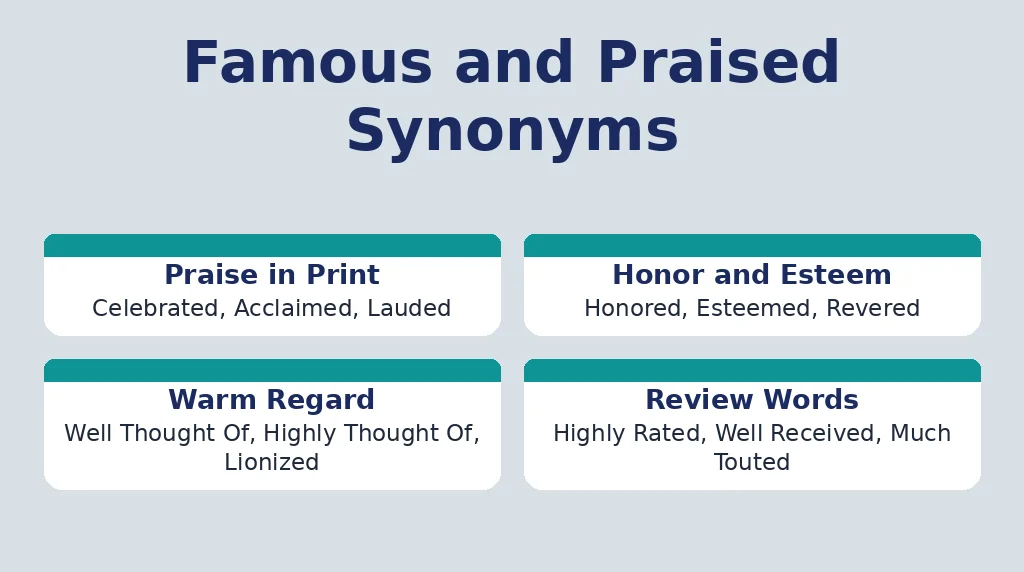
This family adds applause to attention. Every word here says two things at once: many people know the name, and the knowing comes with praise. Biographies, reviews, and award citations live inside this family.
Praise in Print
Merriam-Webster notes that celebrated implies notice and attention especially in print. That print flavor runs through the whole group. These are the words reviewers reach for.
- Celebrated: famous and praised, especially in writing. Example: The celebrated novelist finally visited her hometown.
- Acclaimed: praised widely by critics or by the public. Example: His acclaimed memoir sold out in a week.
- Lauded: praised highly and publicly. Example: The lauded rescue team received medals.
- Praised: spoken of with approval by many voices. Example: Her praised performance opened the festival.
- Extolled: praised with great enthusiasm, slightly formal. Example: The extolled chef kept the menu simple.
A brilliant performance often starts this climb toward celebrated status. The guide to synonyms for brilliant gathers the words for that first spark, before the fame arrives. Keep the order straight in your own sentences: talent first, praise second, fame last. Reversing the order makes profiles sound like advertisements.
Honor and Esteem
A second group trades applause for respect. These words suit people whose fame rests on a life’s work rather than a single season of attention.
- Honored: given public respect, awards, or ceremonies. Example: The honored painter opened the new gallery.
- Esteemed: respected and admired by colleagues and public. Example: An esteemed surgeon trained half the hospital.
- Revered: respected so deeply that criticism feels out of place. Example: The revered founder still visits the school yearly.
- Lionized: treated as a celebrity and fussed over socially. Example: The lionized poet enjoyed every dinner invitation.
- Well thought of: held in warm regard by many people. Example: The well thought of mayor retired to applause.
- Highly thought of: regarded with great respect. Example: A highly thought of judge, she rarely gave interviews.
The Review Words
Critics and committees have their own small dialect of praise. These words appear in reviews, shortlists, and award announcements.
- Highly rated: given top marks by reviewers or users. Example: The highly rated hostel fills up by March.
- Well received: welcomed warmly by audiences or readers. Example: Her well received debut led to a second novel.
- Much vaunted: praised loudly in advance, sometimes with irony. Example: The much vaunted sequel disappointed many fans.
- Much touted: promoted heavily as the next big thing. Example: The much touted striker scored on his debut.
Vaunted and touted carry a raised eyebrow. Both can hint that the praise ran ahead of the proof, so careful writers use them when a little doubt is welcome. Acclaimed and celebrated, by contrast, report praise that has already landed.
Distinguished and Eminent: Formal Synonyms for Famous
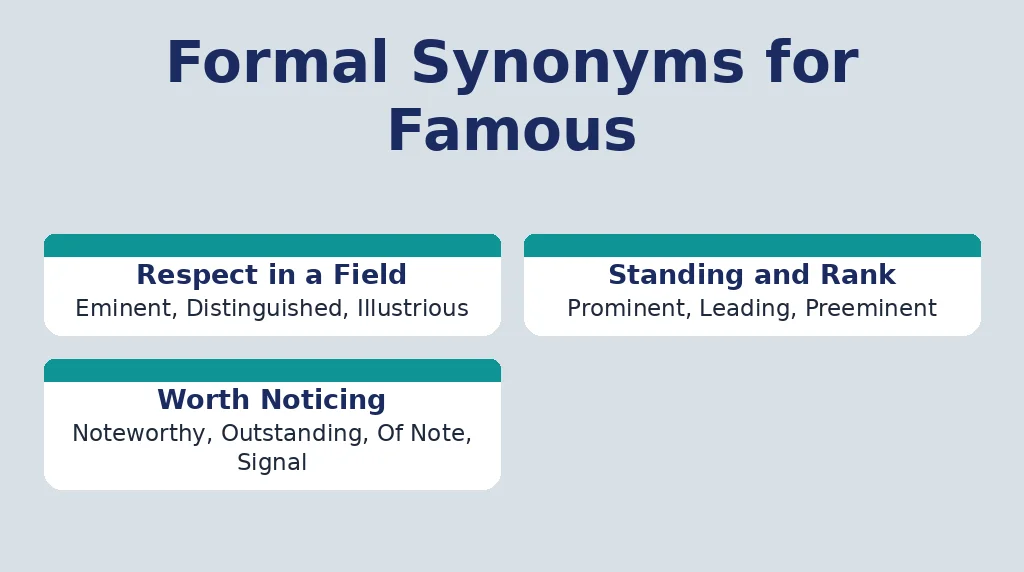
Formal fame works differently from popular fame. Nobody here is a celebrity. These words describe people whose names carry weight inside a profession, a university, or a nation, because their work earned that weight over years.
Respect Inside a Field
Cambridge makes the key point about eminent: it describes someone famous inside a particular job or area of study, usually because they are respected there. The rest of this group shares that field-bound flavor.
- Eminent: famous and respected at the top of a field. Example: An eminent cardiologist reviewed the case.
- Distinguished: famous because of acknowledged excellence. Example: The distinguished historian chaired the panel.
- Illustrious: famous with enduring honor and glory attached. Example: He came from an illustrious line of sailors.
- Reputable: having a good reputation that people trust. Example: Use a reputable dealer for rare coins.
Merriam-Webster sharpens the shades further. Distinguished implies acknowledged excellence or superiority. Eminent implies even greater prominence for outstanding quality or character. Illustrious stresses enduring honor and glory attached to a deed or a person. In practice, that makes illustrious the grandest of the three, and the one most at home in ceremonies and histories.
Standing and Rank
Other formal words measure position rather than praise. They say where the person stands in the field, and they suit reports, rankings, and serious journalism.
- Prominent: important, visible, and easily noticed. Example: A prominent lawyer took the case.
- Leading: among the first and best in a field. Example: She is a leading researcher in solar storage.
- Preeminent: standing above all others in a field. Example: He was the preeminent violin maker of his century.
- Outstanding: exceptionally good and therefore noticed. Example: An outstanding student won the national prize.
- Noteworthy: worth paying attention to. Example: The report lists three noteworthy exceptions.
- Of note: known and worth mentioning, a compact formal phrase. Example: A scholar of note addressed the hall.
- Signal: remarkable and clearly standing out, formal and rare. Example: They won a signal victory that spring.
Prominent is the workhorse of this set, because it blends fame with importance, exactly as Cambridge describes. A prominent figure is known partly because the role itself is visible. Leading and preeminent, meanwhile, make a claim about rank, so use them only when the ranking is real. Calling every expert leading empties the word within a page.
Formal Words in Ceremonies and Citations
Set speeches have their own customs, and this family supplies them. An awards citation introduces a distinguished guest, honors an illustrious career, and praises an eminent judge, all in a single paragraph. The pattern works because each word adds a different layer: standing, glory, and field-wide respect. Rotating the three keeps a long citation from sounding like a stuck record.
Obituaries and retirement speeches lean on the same set, with revered added for warmth. A revered teacher and an illustrious alumna can share one stage without competing, because the words measure different things. When you write ceremonial prose, pick the layer you actually mean, and let one strong word do the work of three weak ones.
Legendary and World-Famous: Fame That Lasts
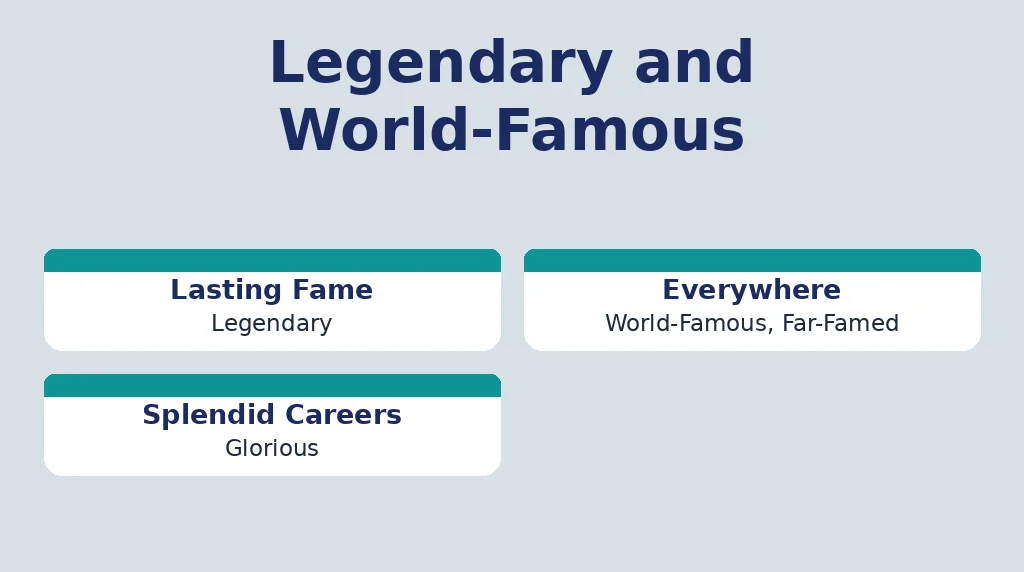
Some fame outlives its owner. This small family covers reputations that keep growing after the person has retired, or even centuries after the events themselves. The words here promise duration, not just reach.
- Legendary: very famous and admired, talked about for years. Example: The legendary goalkeeper still signs autographs weekly.
- World-famous: known across the whole world. Example: They stayed in a world-famous hotel by the harbor.
- Far-famed: famous over a great distance, literary in flavor. Example: The far-famed springs drew travelers for centuries.
- Glorious: famous because of splendid achievement, slightly elevated. Example: She looks back on a glorious career in radio.
Cambridge defines legendary as very famous and admired or spoken about, which captures both halves of the word. Legendary carries a second meaning too: belonging to legend, like King Arthur or Robin Hood. Context usually separates the two, since a legendary singer is a real person, while a legendary sword may never have existed. Writers can even play on the overlap, but only when readers will catch the joke.
World-famous makes the boldest claim in this whole guide, so it needs the boldest evidence. A world-famous landmark truly appears in guidebooks on every continent. A world-famous sandwich shop, on the other hand, is usually famous on one street. Save the word for the first case, and the claim will keep its shine.
Famous in the Public Eye
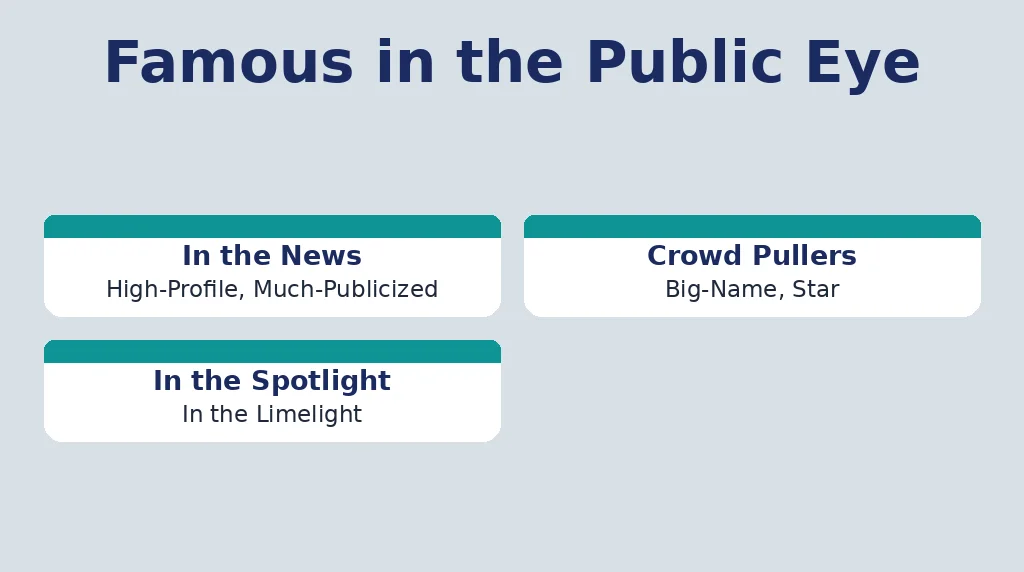
Modern fame often comes from coverage rather than achievement. This family describes that media-made visibility. None of these words promises talent, honor, or staying power. They report attention, and attention only.
- High-profile: famous because of public importance or a public case. Example: A high-profile trial filled the court steps with cameras.
- Much-publicized: covered widely by newspapers and media. Example: The much-publicized wedding took over the weekend news.
- Big-name: commercially famous, able to draw crowds or sponsors. Example: Two big-name actors joined the charity match.
- Star: treated like a star, as in a star witness or a star player. Example: The star chef cooked for one night only.
- In the limelight: receiving public attention right now. Example: After years of quiet work, she found herself in the limelight.
These words pair naturally with the machinery of fame: interviews, launches, trials, and scandals. Because coverage fades, the family also suits temporary fame. A high-profile case may be forgotten in a year, and a singer in the limelight this spring may be unknown by winter. When your sentence needs fame with an expiry date, this is the family to open.
Fifteen Minutes: Temporary Fame
Every reader knows the old joke that everyone will be famous for fifteen minutes. The public-eye family is where that joke lives in vocabulary form. Much-publicized and big-name describe the machinery at full speed, while in the limelight catches the bright moment itself. None of them says anything about next year.
Writers can use that built-in expiry honestly. A much-publicized launch tells readers the noise was real, without claiming the product mattered. A big-name signing tells fans the club bought attention as well as talent. When the fame later fades, your earlier sentence still reads true, because you only ever claimed the spotlight, not the legacy. That restraint is what separates reporting from hype.
Famous for Something Bad
Two words in this guide are warnings, not compliments. They describe people and things that are famous because something went wrong, and dictionaries mark them clearly.
- Notorious: famous for something bad or questionable. Example: The crossing is notorious for accidents in fog.
- Infamous: famous for something evil, shocking, or disgraceful. Example: The infamous betrayal still angers the town.
Merriam-Webster explains that notorious frequently adds to famous an implication of questionableness or evil. Cambridge puts the pair together: infamous and notorious are usually used when someone is famous for something bad. Between the two, infamous is the stronger and darker word in modern use. A notorious cheat is disapproved of. An infamous massacre is condemned outright. Save infamous for deeds that deserve that weight, and notorious will cover the rest of the family’s dirty work.
Bad fame also has its lighter corner. A cook can be notorious for burning toast, and a teacher can be notorious for Monday quizzes. The word stays negative, yet the scale of the offense turns it playful. Context does all the work here: readers forgive the joke because the stakes are tiny. With real crimes and real victims, that playfulness vanishes, and the words return to full strength. Match the weight of the word to the weight of the deed, and this family will never embarrass you.
How to Choose the Right Synonym for Famous
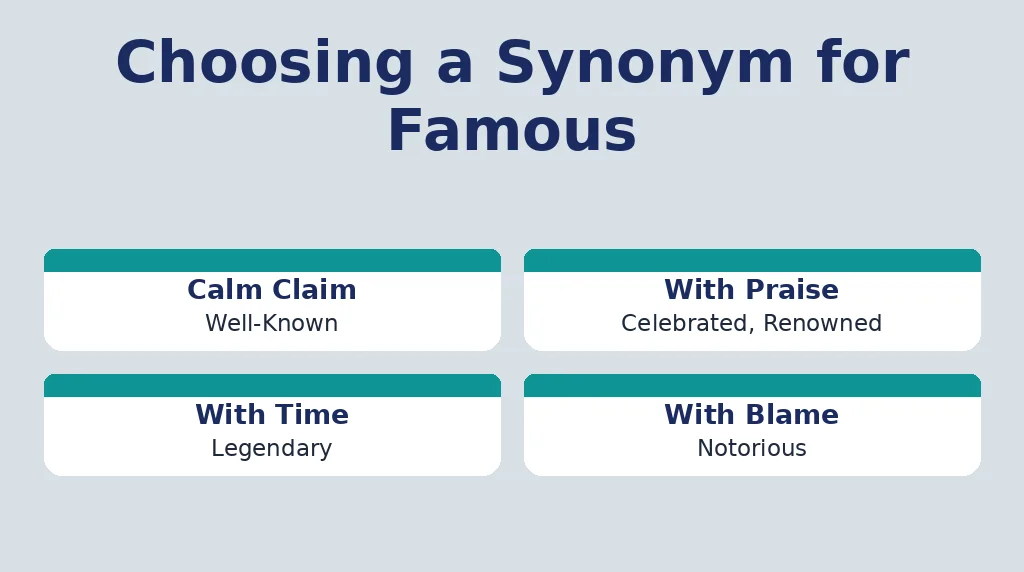
With more than 40 options, choosing matters more than collecting. Four quick questions narrow the field fast. Is the fame wide or deep? Does it come with praise, respect, or blame? How long will it last? And finally, how formal is your reader?
Paired examples show how one swap can change the verdict on the same person:
- She is a famous singer. Crowds know her name.
- She is a well-known singer. The same claim, said calmly.
- She is a celebrated singer. Critics praise her in print.
- She is a renowned singer. Her fame carries glory and admiration.
- She is a legendary singer. People will tell stories about her for decades.
- She is a notorious singer. Now the fame sounds like a scandal.
The biography never changed, yet each version hands the reader a different judgment. That is the real work these words do.
Famous vs Popular vs Renowned
Three words cause most of the confusion, so they deserve a direct comparison. Famous measures recognition: how many people know the name. Popular measures affection: how many people like, follow, or buy. A famous referee may be deeply unpopular, and a popular local baker may be unknown one town away. Renowned measures recognition plus honor, and it usually implies time. New stars are famous first. Renowned arrives later, if the work holds up. If the reputation is smaller and warmer than fame, step down to the family in our guide to synonyms for known, where familiar and acknowledged do quieter work.
The One-Second Test
Before you swap famous for any word in this guide, run one quick check. Ask what the replacement adds. If it adds praise you cannot prove, step back to well-known. If it adds rank you cannot defend, step back to prominent or noted. If it adds blame you did not intend, run back at once, because notorious and infamous never travel as compliments.
Then ask the time question. Fame words carry hidden clocks. Famed and celebrated describe a present reputation. Renowned and illustrious describe one that has already survived some years. Legendary describes one that has survived its owner. A word whose clock disagrees with your sentence will sound wrong even when its meaning looks right on paper. This small test takes seconds, and it catches nearly every bad swap in this family.
| Situation | Strong first choice |
|---|---|
| A landmark everyone knows | World-famous |
| A praised living artist | Celebrated |
| A top expert in a field | Eminent |
| A hero of long ago | Legendary |
| A name in the news daily | High-profile |
| Fame from a crime | Infamous |
| A face everyone recognizes | Well-known |
Famous in Essays, Stories and Professional Writing
Different kinds of writing reward different shades of fame. Essays, for example, value precision and a measured tone. A student essay can call Darwin an eminent scientist, which sounds exact and calm. The same essay would wobble with big-name or star, because those words belong to entertainment pages. Formal words like distinguished, renowned, and illustrious serve academic writing best, as long as the claims stay honest.
Stories reward the opposite approach. Fiction lives on the edges of the family, where legendary promises myth and notorious promises trouble. A legendary smuggler and a notorious smuggler walk into a novel with different weather around them. Dialogue, meanwhile, should sound like speech. Real people say famous, well-known, and big-name. They rarely say illustrious outside a joke or a ceremony.
Professional writing sits between the two. Reports and serious journalism lean on prominent, leading, and of note, because those words claim standing without gush. Marketing copy reaches for celebrated and acclaimed, and careful readers discount it slightly for that reason. Press releases love much touted and world-famous, which is exactly why editors treat both with suspicion. Let the document decide the register, and then let the register pick the word.
An Old-Fashioned Sense: When Famous Meant Excellent
One corner of this word’s history surprises modern readers. In older English, famous could simply mean excellent or first-rate. Collins still lists excellent among its synonyms. Readers of older novels meet sentences about a famous victory, a famous dinner, or a famous time, where no crowd and no reputation is involved at all. The writer only means that the thing was splendid.
Treat that sense as a museum piece. Enjoy it when you meet it in classic books, and use it in jokes if your audience knows the trick. In modern essays, reports, and exams, though, famous should keep its modern meaning of widely known. Writing “we had a famous lunch” today will mostly earn a puzzled look, followed by a question about who was there.
Antonyms for Famous
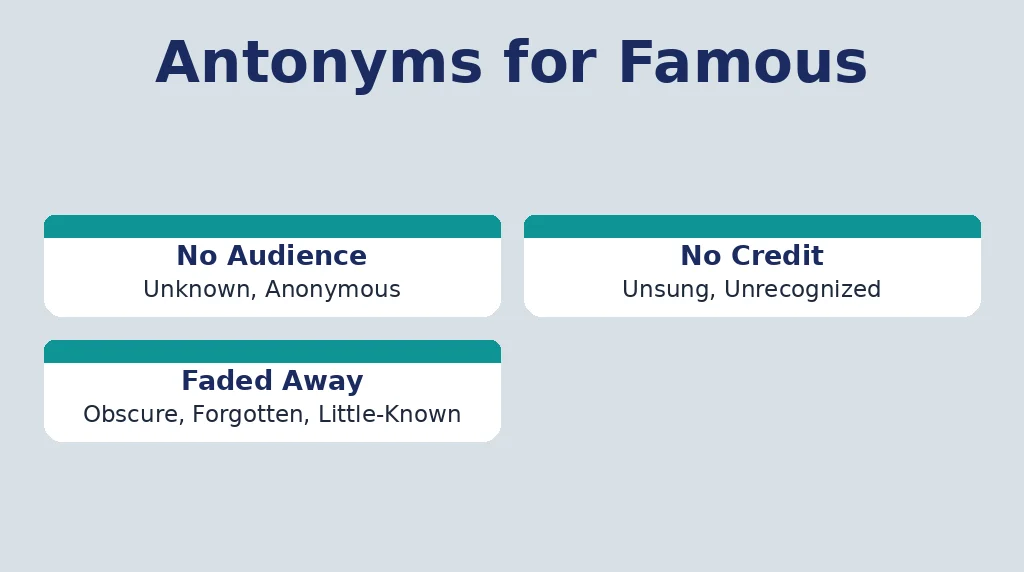
The clearest opposites of famous describe people and things that nobody knows. Unknown is the general opposite: an unknown singer, an unknown village. Anonymous fits people whose names are withheld or never learned, and Cambridge uses it as the natural contrast in its own example about rising from poor and anonymous to rich and famous. Obscure fits talent that exists without an audience: an obscure poet may be superb and still unread.
Two more opposites cover credit rather than reach. Unsung describes heroes and workers whose deeds deserve fame that never arrived. Unrecognized fits achievement that institutions have failed to acknowledge so far. For things rather than people, little-known and forgotten do the daily work: a little-known clause in a contract, a forgotten inventor whose patents changed an industry.
A quick test helps in practice. If a word can finish the sentence “once famous, now” in a natural way, it is probably a true antonym. Forgotten and obscure pass the test at once. Popular fails it, because popularity is fame’s neighbor, not its opposite.
Common Mistakes: Words That Are Not True Synonyms for Famous
Accuracy matters in a synonym guide, so this section clears up the words that often sneak into famous lists wrongly.
Popular is the most common wrong swap. As the choose section shows, popular measures liking, while famous measures knowing. A famous traffic jam is a strange idea, but a notorious one makes sense, and a popular beach is liked rather than merely known. Keep the two measures separate, and both words stay sharp.
Infamous is not a stronger famous. Many learners read in- as a booster and use infamous to mean extremely famous. It actually means famous for something bad, as the bad-fame section explains. Calling a beloved teacher infamous reverses your compliment into an accusation.
Celebrity fails on grammar alone. It is a noun naming the person, not an adjective describing them. A celebrity chef is fine, because celebrity works as a noun modifier there. But a dish cannot be very celebrity, and a town cannot become celebrity. Use famous, well-known, or big-name instead.
Conspicuous looks tempting in thesaurus lists under notable, but it means easy to see, not widely known. A conspicuous stain is visible to everyone in the room and famous to none of them. Visibility inside one scene is not fame across a public.
One last trap is timing. Writers call a brand-new singer renowned in her first month of success. Renowned implies glory that has settled and lasted, so the word needs time to be true. Famous can be instant. Renowned cannot.
Frequently Asked Questions
What is the best synonym for famous?
There is no single best word, because fame comes in different flavors. Well-known is the safest everyday swap. Celebrated adds praise, renowned adds honor, and legendary adds time. Match the flavor, and the sentence will sound right.
What is a formal word for famous?
Renowned, distinguished, and eminent are the standard formal choices. Eminent suits experts inside a field, distinguished stresses excellence, and illustrious adds lasting glory. Reports also use prominent and of note for standing without praise.
What is the difference between famous and popular?
Famous means known by many people. Popular means liked by many people. A person can be famous and unpopular at the same time, like a strict referee. A local baker can be popular in one town and unknown everywhere else.
What is the difference between famous and renowned?
Both mean widely known, but renowned adds glory and admiration. Merriam-Webster notes that renowned implies more acclamation than plain famous. Renowned also suggests the fame has lasted, while famous can be brief.
What is a word for famous for something bad?
Notorious is the everyday choice, and infamous is the stronger one. A notorious road is known for accidents. An infamous crime is known for evil. Neither word works as a compliment.
Does infamous mean very famous?
No. Infamous means famous for a bad reason, not famous to a high degree. It is also pronounced IN-fuh-mus, with the stress at the start. Using it for a hero or a hero product will reverse your meaning.
What is the opposite of famous?
Unknown is the general opposite. Anonymous fits people whose names are not known, obscure fits talent without an audience, and unsung fits heroes who never received credit. Forgotten fits fame that has faded away.
Final Thoughts
Famous is a plain word standing in front of a rich crowd. Once you sort its synonyms by praise, respect, duration, and blame, the right choice usually steps forward on its own. Call the landmark world-famous, the artist celebrated, the scientist eminent, and the scandal infamous, and each word will carry exactly the fame you mean.
For an even deeper list with related words and near-synonyms, the Merriam-Webster Thesaurus entry for famous is a reliable next step. Keep this guide bookmarked too, and your fame sentences will never sound flat again.