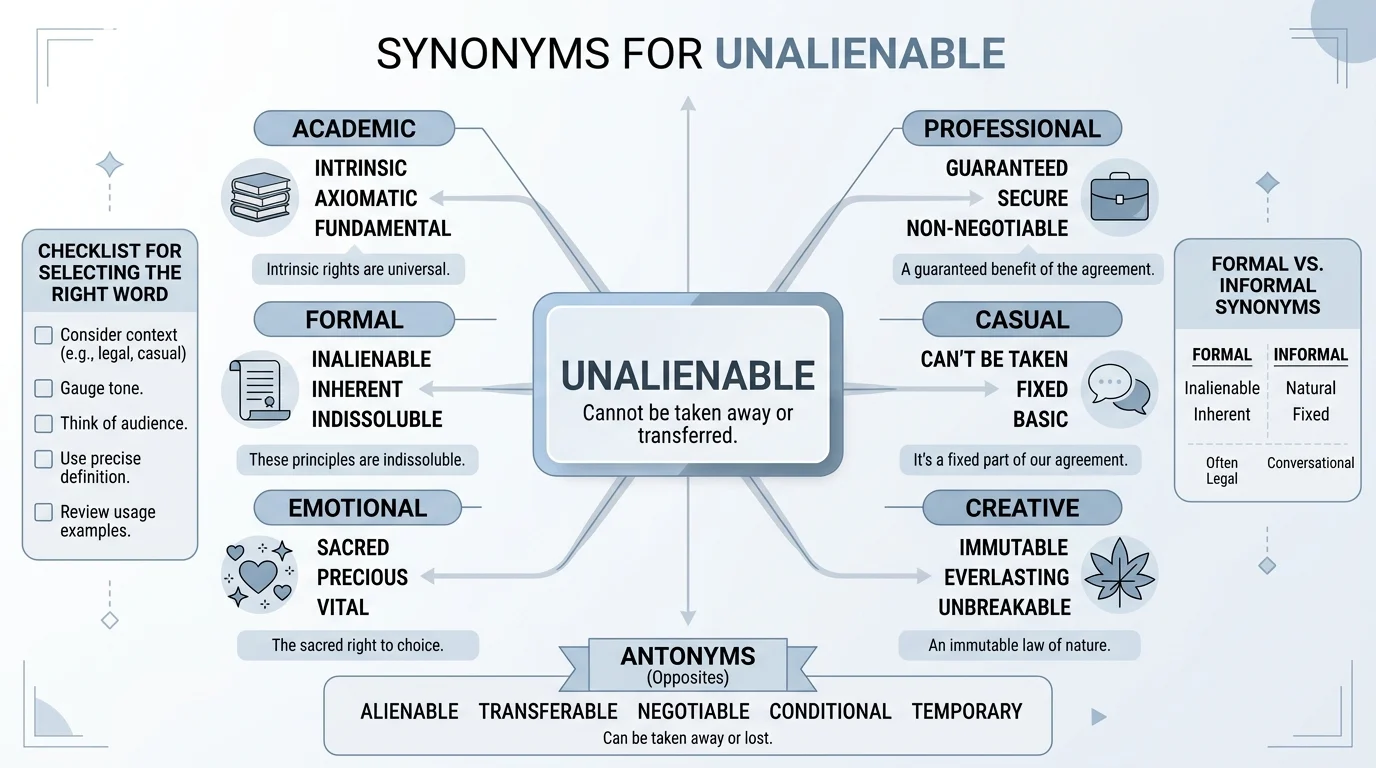
Have you ever found yourself repeating the word “unalienable” in an essay, speech, or professional document? You know the meaning, but something feels off. The word sounds heavy, legalistic, and perhaps too formal for your audience. You need alternatives that carry the same weight without sounding like a constitutional scholar. This guide solves that problem.
Whether you are writing a legal brief, crafting a persuasive essay, or simply trying to expand your vocabulary, understanding the synonyms of unalienable will transform your communication. The right word choice makes your message clearer, more engaging, and more appropriate for your specific audience.
We will explore the exact meaning of unalienable, when to use it, and when to choose a different word. You will discover formal alternatives for academic writing, conversational options for everyday speech, and powerful synonyms for emotional impact. By the end, you will never struggle to find the perfect word again.
What Does “Unalienable” Mean?
Unalienable means something that cannot be taken away, transferred, or denied. It refers to fundamental rights that belong to every person by nature of their humanity. The best synonyms include inalienable for formal legal contexts, inherent for academic writing, and undeniable for everyday conversation. Choose based on your audience and purpose.
Meaning, Tone and Context
Simple Definition
Unalienable describes rights or qualities that are inseparable from a person. These are things that cannot be surrendered, sold, or revoked by any external authority. The concept appears most famously in the United States Declaration of Independence, which refers to “unalienable Rights” including Life, Liberty, and the pursuit of Happiness.
Part of Speech
Unalienable is an adjective. It modifies nouns like rights, freedoms, or principles. The word is almost always used to describe abstract concepts rather than physical objects.
Tone
The tone is formal, serious, and legalistic. Unalienable carries significant historical and philosophical weight. It sounds authoritative and definitive. The word creates a sense of permanence and inviolability.
Formality Level
Unalienable is highly formal. You will find it in legal documents, political speeches, philosophical treatises, and academic writing. It is rarely used in casual conversation or informal writing. Using it in everyday speech may sound pretentious or overly dramatic.
Common Use Cases
Political discourse and legal writing are the primary domains. You will encounter unalienable in discussions about human rights, constitutional law, civil liberties, and philosophical debates about natural law. It appears in historical documents and formal declarations.
Important Word Forms
The noun form is unalienability. This describes the quality of being unalienable. The adverb form is unalienably. The synonym inalienable is more common in modern usage, though both are correct. The opposite concept is alienable, meaning something that can be transferred or taken away.
When and How to Use “Unalienable”
Unalienable works best when you need to emphasize that a right or quality is absolutely fundamental and cannot be compromised. Reserve this word for situations where you need maximum authority and seriousness. Do not use it for trivial matters or everyday choices.
Here are realistic examples of unalienable in different contexts:
Professional Context
The constitution guarantees certain unalienable rights that no government can infringe upon.
Academic Context
Philosophers argue whether freedom of thought is an unalienable human attribute.
Legal Context
The court ruled that privacy is an unalienable aspect of personal autonomy under the law.
Political Context
Citizens demanded recognition of their unalienable right to participate in governance.
Philosophical Context
The concept of unalienable dignity forms the foundation of modern human rights frameworks.
Historical Context
The Declaration of Independence established unalienable rights as a core American principle.
Persuasive Context
We must protect the unalienable freedoms that define our society and our values.
Another Word for “Unalienable”
The best single replacement depends entirely on your context. No single word captures all the meaning of unalienable in every situation. Here are the strongest alternatives by context:
Professional Writing
Inalienable is the most direct professional synonym. It carries the same legal weight and is actually more common in modern legal documents.
Academic Writing
Inherent works well in academic contexts. It suggests something built into the very nature of a person or thing without the heavy legal connotations.
Casual Conversation
Undeniable is a good casual choice. It means something cannot be disputed or denied, though it lacks the legal permanence of unalienable.
Emotional Writing
Sacred adds emotional and moral weight. It suggests something worthy of protection and reverence.
Creative Writing
Inviolable creates a sense of strength and protection. It suggests something that cannot be violated or broken.
Resume or Workplace Use
Nonnegotiable works for workplace contexts. It suggests terms or conditions that cannot be compromised.
Social Media Captions
Untouchable can work for social media. It suggests something beyond criticism or interference.
Stronger Meaning
Sacrosanct is stronger than unalienable. It carries religious or moral inviolability.
Softer Meaning
Fundamental is softer. It suggests basic importance without the absolute permanence of unalienable.
When Not to Use “Unalienable”
Unalienable sounds out of place in many contexts. Using it incorrectly can make you sound pompous or overly dramatic. The word is too formal for everyday conversation. It is too heavy for casual writing. It is too legalistic for creative descriptions.
Consider this example of poor usage:
“Having pizza for dinner is my unalienable right.”
This sounds absurd because pizza preference is trivial. A better choice is “nonnegotiable” or “undeniable” if you want to express strong preference. The word should be reserved for fundamental human rights and serious principles.
Another common mistake is using unalienable when you simply mean “important” or “essential.” The word carries a specific legal and philosophical meaning. Do not dilute its power by using it inappropriately.
Words Commonly Confused With “Unalienable”
Several words are often confused with unalienable. Understanding the differences will help you choose the right word every time.
Unalienable vs. Inalienable
These words are essentially synonyms. Inalienable is more common in modern usage. Both mean cannot be taken away. The difference is purely stylistic preference. Inalienable appears more frequently in contemporary legal writing. Unalienable carries a more historical and formal tone.
Unalienable vs. Inherent
Inherent means existing as a natural part of something. It does not carry the legal meaning of being impossible to take away. Inherent suggests something is built in. Unalienable suggests something is protected from removal. Use inherent for natural qualities. Use unalienable for legal or moral rights.
Unalienable vs. Indefeasible
Indefeasible is a legal term meaning cannot be annulled or made void. It applies to property rights and claims. Unalienable applies more broadly to human rights and principles. Indefeasible is more technical and specific to property law.
Unalienable vs. Inviolable
Inviolable means something that must not be violated or profaned. It suggests protection from harm. Unalienable suggests protection from removal or transfer. Inviolable focuses on preventing violation. Unalienable focuses on preventing transfer or surrender.
Unalienable vs. Absolute
Absolute means complete and total. It does not specifically mean cannot be taken away. Absolute rights might theoretically be surrendered. Unalienable rights cannot be surrendered. Absolute is broader. Unalienable is more specific about permanence.
Unalienable vs. Sacrosanct
Sacrosanct suggests religious or moral inviolability. It carries a stronger emotional and spiritual weight. Unalienable is more legal and political. Sacrosanct is better for moral principles. Unalienable is better for legal and political rights.
Best Synonym by Context for “Unalienable”
This table shows the best synonym for unalienable based on your specific writing situation.
| Context | Best Synonym | Why It Works | Example |
|---|---|---|---|
| Formal Writing | Inalienable | Most direct legal equivalent with modern usage | The constitution protects inalienable human rights. |
| Academic Writing | Inherent | Suggests natural, built in qualities without legal weight | Inherent dignity belongs to every human being. |
| Professional Business | Nonnegotiable | Clear, firm, and appropriate for workplace terms | Employee safety is a nonnegotiable company policy. |
| Resume Writing | Fundamental | Highlights core values without legal formality | I believe in fundamental fairness in all business dealings. |
| Casual Conversation | Undeniable | Accessible and clear for everyday speech | Her talent is undeniable, no matter what anyone says. |
| Creative Writing | Inviolable | Adds protective imagery and emotional depth | The forest remained inviolable against all intruders. |
| Emotional Tone | Sacred | Conveys deep moral and emotional significance | Their bond was sacred and could not be broken. |
| Strong Intensity | Sacrosanct | Maximum intensity with moral or religious overtones | The right to free expression is sacrosanct in our society. |
| Moderate Tone | Essential | Balanced and clear without legal formality | Access to education is essential for human development. |
| Social Media Captions | Untouchable | Modern, punchy, and attention grabbing | Your worth is untouchable, no matter what they say. |
| US Usage | Inalienable | More common in modern American legal writing | The court recognized inalienable privacy rights. |
| UK Usage | Inalienable | Preferred in British legal and political contexts | British law protects certain inalienable civil liberties. |
Which Synonym Should You Choose?
Choosing the right synonym requires considering four factors: meaning, formality, emotional intensity, and audience. Your decision should match the situation perfectly.
Consider Your Meaning
Ask yourself what you truly want to communicate. Are you talking about legal rights? Use inalienable. Are you describing natural qualities? Use inherent. Are you making a firm workplace rule? Use nonnegotiable. Match the word to your exact meaning.
Consider Formality
Formal contexts like legal briefs and political speeches demand formal words like inalienable or inviolable. Academic writing accepts inherent and fundamental. Casual conversation welcomes undeniable and untouchable. Match your word to your audience expectations.
Consider Emotional Intensity
Words exist on a spectrum from neutral to emotional. Fundamental is neutral. Sacred is highly emotional. Inviolable is protective. Untouchable is modern. Choose the intensity that matches your message. Avoid emotional words for neutral topics.
Consider Professional Value
Professional writing requires precision. Choose inalienable for legal accuracy. nonnegotiable for workplace firmness. Choose fundamental for clear communication. Avoid overly emotional or casual words in professional contexts.
Consider Sentence Context
Look at your surrounding sentences. Does unalienable fit the rhythm and tone? If not, a synonym might work better. Test each option by reading it aloud. The best word sounds natural in context.
Real Life Examples of “Unalienable” in Sentences
These examples show how unalienable and its synonyms work across different real life situations. Notice how each context requires a different approach.
School Context
The civics teacher explained that certain unalienable rights form the foundation of American democracy.
Workplace Context
The company policy states that mutual respect is a nonnegotiable requirement for all employees.
Writing Context
Writers should understand that intellectual property rights are inalienable under copyright law.
Conversation Context
Honestly, her commitment to the project is absolutely undeniable and inspires everyone around her.
Social Media Context
Your voice matters and your perspective is untouchable in this creative space.
Email Context
We want to emphasize that patient confidentiality is a fundamental and inviolable principle of our practice.
Storytelling Context
The ancient covenant was considered sacred and could never be broken by any earthly power.
Legal Brief Context
The plaintiff argues that the right to privacy is inalienable and cannot be waived by contractual agreement.
15 Synonyms for “Unalienable”
This table provides exactly 15 accurate synonyms with unique explanations and natural example sentences.
| Synonym | Simple Meaning | Best Used For | Example Sentence |
|---|---|---|---|
| Inalienable | Cannot be taken away or transferred | Legal and political writing | Human rights are inalienable and universal. |
| Inherent | Existing as a natural and permanent quality | Academic and philosophical writing | Creativity is an inherent quality of human intelligence. |
| Inviolable | Cannot be violated or broken | Protective and formal contexts | The treaty established inviolable borders between nations. |
| Nonnegotiable | Not open to discussion or compromise | Workplace and professional contexts | Safety protocols are nonnegotiable in this industry. |
| Undeniable | Cannot be disputed or denied | Casual and persuasive contexts | The evidence of climate change is undeniable. |
| Sacred | Worthy of religious or moral reverence | Emotional and spiritual contexts | Freedom of worship is sacred to many communities. |
| Untouchable | Beyond criticism or interference | Modern and social media contexts | Her reputation in the industry is untouchable. |
| Sacrosanct | Regarded as too important to change | Strong moral and legal contexts | The principle of confidentiality is sacrosanct in law. |
| Fundamental | Basic and essential | General and professional contexts | Access to clean water is a fundamental human need. |
| Essential | Absolutely necessary and important | Moderate and clear contexts | Fair treatment is essential in any workplace. |
| Indefeasible | Cannot be annulled or made void | Legal property and rights contexts | The land title is indefeasible under state law. |
| Absolute | Complete and total without limitation | Strong general contexts | The right to free speech is not absolute in all situations. |
| Intrinsic | Belonging naturally; essential | Academic and philosophical contexts | Intrinsic value exists in every human life. |
| Imprescriptible | Cannot be lost through time or disuse | Legal and historical contexts | Certain imprescriptible rights exist from birth. |
| Indisputable | Not subject to debate or question | Persuasive and argumentative contexts | The facts are indisputable and beyond challenge. |
Synonym Groups and Usage Differences
Professional vs. Personal Synonyms
Professional synonyms like inalienable, indefeasible, and inviolable work best in legal documents, corporate policies, and official communications. These words project authority and precision. Personal synonyms like sacred, untouchable, and undeniable work better in conversations, personal writing, and emotional contexts. They connect with readers on a human level.
Formal vs. Conversational Synonyms
Formal synonyms include inalienable, inviolable, indefeasible, and imprescriptible. These appear in reports, essays, speeches, and legal documents. They signal expertise and seriousness. Conversational synonyms include undeniable, untouchable, and absolute. These work in texts, emails, and casual writing. They sound natural and approachable.
Academic Synonyms
Academic writing values precision and clarity. Inherent and intrinsic are excellent choices for scholarly work. They suggest natural qualities without legal baggage. Fundamental and essential also work well in academic contexts. These words are precise without being overly technical.
Professional and Business Synonyms
Nonnegotiable dominates professional and business contexts. It is clear, firm, and appropriate for workplace communication. Fundamental and essential also work well in business writing. These words convey importance without legal formality.
Creative or Literary Synonyms
Creative writing benefits from evocative language. Inviolable creates powerful imagery of protection and strength. Sacred adds emotional and moral depth. Untouchable feels modern and edgy. These synonyms add descriptive power to narratives and poetry.
Slang or Modern Synonyms
Untouchable functions as a modern synonym in casual speech and social media. It suggests something beyond criticism or interference. This word works well in informal contexts but is inappropriate for formal writing. Avoid slang synonyms in academic or professional documents.
Strongest vs. Weaker Synonyms
Here is an intensity scale from mild to strongest:
Mild: Essential, Fundamental
Moderate: Inherent, Intrinsic, Undeniable
Strong: Nonnegotiable, Absolute, Indefeasible
Strongest: Inalienable, Inviolable, Sacrosanct
Choose the intensity that matches your message. Strongest words should be reserved for truly fundamental principles.
Emotional vs. Neutral Synonyms
Emotional synonyms include sacred, inviolable, and sacrosanct. These words carry moral weight and emotional resonance. They work well in persuasive and inspirational writing. Neutral synonyms include inherent, intrinsic, and essential. These words stay factual and clear. They work best in objective professional and academic writing.
Antonyms of “Unalienable”
This table provides 15 accurate antonyms with meanings and example sentences.
| Antonym | Meaning | Example Sentence |
|---|---|---|
| Alienable | Capable of being transferred or taken away | Property rights are alienable under certain conditions. |
| Revocable | Capable of being canceled or withdrawn | The permit is revocable if safety standards are violated. |
| Temporary | Lasting for a limited time | The temporary measures will expire at the end of the year. |
| Transferable | Capable of being moved to another person | These membership benefits are transferable to family members. |
| Surrendered | Given up voluntarily | They surrendered their rights under the contract. |
| Contingent | Dependent on certain conditions | The agreement is contingent on final approval. |
| Conditional | Subject to specific requirements | The offer is conditional upon background checks. |
| Forfeitable | Capable of being lost as a penalty | The deposit is forfeitable if you cancel the order. |
| Voidable | Capable of being declared invalid | The contract is voidable due to misrepresentation. |
| Divestible | Capable of being stripped away | Certain rights are divestible under the new law. |
| Relinquishable | Capable of being let go or given up | These privileges are relinquishable upon request. |
| Subject | Under the control or authority of another | The decision is subject to judicial review. |
| Mortal | Subject to death or decay | All mortal possessions eventually pass away. |
| Finite | Having limits or bounds | The agreement covers a finite period of time. |
| Changeable | Capable of being altered or modified | Company policies are changeable as circumstances evolve. |
Comparison: Unalienable vs. Similar Words
This section compares unalienable with six similar words to clarify subtle differences.
Unalienable vs. Inalienable
Main Difference
These are essentially synonyms with the same meaning. Inalienable is more common in modern legal writing. Unalienable has a more historical and formal tone. Both words mean cannot be taken away.
Which One Is Stronger
Both carry equal strength. The choice is stylistic rather than substantive.
Which One Is More Formal
Unalienable feels slightly more formal due to its historical associations. Inalienable is more standard in contemporary legal documents.
Example Sentence for Unalienable
The Declaration of Independence refers to unalienable rights granted by the Creator.
Example Sentence for Inalienable
Modern constitutions typically protect inalienable human rights.
Unalienable vs. Inherent
Main Difference
Inherent means existing naturally as a permanent quality. Unalienable adds the legal meaning of being impossible to take away. Inherent describes what is. Unalienable describes what cannot be removed.
Which One Is Stronger
Unalienable is stronger because it explicitly denies the possibility of removal. Inherent is more descriptive and neutral.
Which One Is More Formal
Unalienable is more formal due to its legal connotations. Inherent is academic and descriptive.
Example Sentence for Unalienable
The right to life is unalienable and cannot be surrendered.
Example Sentence for Inherent
Curiosity is an inherent quality of human nature.
Unalienable vs. Nonnegotiable
Main Difference
Nonnegotiable means not open to discussion or compromise. Unalienable means impossible to take away. Nonnegotiable applies to terms and conditions. Unalienable applies to fundamental rights.
Which One Is Stronger
Unalienable is stronger because it invokes legal and moral permanence. Nonnegotiable is firm but more limited in scope.
Which One Is More Formal
Unalienable is more formal. Nonnegotiable is appropriate in both professional and casual contexts.
Example Sentence for Unalienable
Religious freedom is an unalienable right in democratic societies.
Example Sentence for Nonnegotiable
Safety standards are nonnegotiable in our manufacturing process.
Unalienable vs. Sacred
Main Difference
Sacred implies religious or moral reverence. Unalienable implies legal and political permanence. Sacred is emotional and spiritual. Unalienable is legal and philosophical.
Which One Is Stronger
Both are strong but in different ways. Sacred carries moral absolute authority. Unalienable carries legal absolute authority.
Which One Is More Formal
Unalienable is more formal in legal contexts. Sacred is more formal in religious and moral contexts.
Example Sentence for Unalienable
The constitution guarantees unalienable rights to all citizens.
Example Sentence for Sacred
The family bond is sacred in many cultural traditions.
Unalienable vs. Inviolable
Main Difference
Inviolable means cannot be violated or profaned. Unalienable means cannot be taken away. Inviolable focuses on protection from harm. Unalienable focuses on permanence of ownership or possession.
Which One Is Stronger
Inviolable is stronger in terms of protection. Unalienable is stronger in terms of permanence.
Which One Is More Formal
Both are highly formal. Inviolable appears more in religious and moral contexts. Unalienable appears more in legal and political contexts.
Example Sentence for Unalienable
The right to privacy is unalienable under the law.
Example Sentence for Inviolable
The sanctuary remained inviolable against all threats.
Unalienable vs. Fundamental
Main Difference
Fundamental means basic and essential. Unalienable means basic, essential, and impossible to take away. Fundamental lacks the legal meaning of permanence. Unalienable adds the specific meaning of protection from removal.
Which One Is Stronger
Unalienable is stronger due to its legal and philosophical weight. Fundamental is more general.
Which One Is More Formal
Unalienable is more formal. Fundamental is appropriate in nearly all contexts.
Example Sentence for Unalienable
Freedom of expression is an unalienable right in our society.
Example Sentence for Fundamental
Access to education is a fundamental human need.
Common Phrases and Expressions with “Unalienable”
1. Unalienable Rights
Meaning
Rights that cannot be taken away or surrendered by any person or government.
Example Sentence
The constitution was designed to protect the unalienable rights of every citizen.
2. Unalienable Principle
Meaning
A fundamental belief or standard that cannot be compromised.
Example Sentence
Respect for human dignity is an unalienable principle of our organization.
3. Unalienable Freedom
Meaning
Liberty that cannot be restricted or removed by any authority.
Example Sentence
They fought for unalienable freedoms that would last for generations.
4. Unalienable Value
Meaning
A worth that cannot be diminished or taken from a person.
Example Sentence
Every human being possesses unalienable value regardless of circumstance.
5. Unalienable Truth
Meaning
A fact that cannot be disputed or denied.
Example Sentence
Equality is an unalienable truth that should guide our laws.
6. Unalienable Belief
Meaning
A conviction that cannot be shaken or removed.
Example Sentence
Her unalienable belief in justice motivated her entire career.
7. Unalienable Dignity
Meaning
A worth and respect that cannot be stripped from any person.
Example Sentence
The organization works to protect the unalienable dignity of all patients.
8. Unalienable Birthright
Meaning
A right that belongs to every person from the moment of birth.
Example Sentence
Citizenship is an unalienable birthright that cannot be revoked.
Common Mistakes to Avoid
1. Using Unalienable for Trivial Matters
Reserve unalienable for fundamental rights and principles. Using it for casual preferences sounds absurd and undermines the word’s power.
Incorrect
I have an unalienable right to choose the movie tonight.
Correct
I have an undeniable preference for action movies, but I understand we need to agree as a group.
2. Confusing Unalienable with Inherent
These words are not always interchangeable. Inherent describes natural qualities. Unalienable adds the meaning of being impossible to take away.
Incorrect
The unalienable curiosity of children makes them excellent learners.
Correct
The inherent curiosity of children makes them excellent learners.
3. Using a Casual Synonym in Formal Writing
Casual synonyms like untouchable and undeniable rarely work in legal or academic documents. Choose formal synonyms like inalienable or inviolable instead.
Incorrect
The untouchable rights of citizens must be protected by law.
Correct
The inalienable rights of citizens must be protected by law.
4. Using Overly Dramatic Synonyms for Simple Situations
Words like sacred and sacrosanct carry heavy emotional and moral weight. Using them for routine matters sounds exaggerated and ridiculous.
Incorrect
My morning coffee ritual is sacrosanct and cannot be interrupted.
Correct
My morning coffee routine is essential for starting the day properly.
5. Repeating the Same Word Too Often
Variety improves your writing. If you use unalienable multiple times in a document, consider replacing some instances with synonyms like inherent, fundamental, or essential.
Incorrect
The unalienable right to speech, the unalienable right to assembly, and the unalienable right to petition are all protected.
Correct
The unalienable right to speech, the fundamental right to assembly, and the protected right to petition are all guaranteed.
6. Choosing a Synonym with the Wrong Emotional Tone
Different synonyms carry different emotional weight. Sacred is emotional and spiritual. Fundamental is neutral and clear. Inalienable is legal and formal. Match the emotional tone to your purpose.
Incorrect
We have a sacred policy about submitting expense reports.
Correct
We have a nonnegotiable policy about submitting expense reports.
7. Using Slang in Academic or Professional Writing
Untouchable and absolute might work in casual contexts but they lack precision for professional writing. Choose precise synonyms for formal documents.
Incorrect
The untouchable principles of scientific inquiry guide our research.
Correct
The inviolable principles of scientific inquiry guide our research.
FAQs
What is the best synonym for unalienable?
Inalienable is the best direct synonym for most formal contexts. It carries identical meaning and is more common in modern legal writing.
What is a formal synonym for unalienable?
Inviolable and indefeasible are excellent formal synonyms. They appear in legal documents and formal political discourse.
What is an informal synonym for unalienable?
Undeniable and untouchable work well in casual conversation. They convey the sense of something beyond dispute or interference.
What is another word for unalienable in professional writing?
Nonnegotiable works best in professional contexts. It is clear, firm, and appropriate for workplace communication.
What is the difference between unalienable and inalienable?
There is no meaningful difference. Inalienable is more common in modern usage. Unalienable has a more historical and formal tone. Choose based on your audience and context.
What is the opposite of unalienable?
Alienable is the direct opposite. It means capable of being transferred or taken away. Revocable and temporary are also antonyms.
Conclusion
Unalienable describes fundamental rights and principles that cannot be taken away, transferred, or surrendered. The word carries significant legal and philosophical weight. It appears in historical documents like the Declaration of Independence and remains relevant in modern discussions of human rights and civil liberties.
The best synonym depends entirely on your context. Inalienable works for formal legal writing. Inherent suits academic discourse. Nonnegotiable fits professional communication. Undeniable serves casual conversation. Sacred and inviolable add emotional depth. Untouchable feels modern and punchy. Choose your word based on your audience, your purpose, and the level of formality required.
Pay attention to tone and intensity. Reserve strongest words for truly fundamental principles. Match your emotional tone to your message. Avoid overusing any single word. Variety improves your writing and keeps your readers engaged. Always verify definitions using trusted dictionaries like Cambridge, Oxford, Merriam Webster, Collins, or Britannica before publishing.
The practical tip is simple: read your sentence aloud with each synonym option. The best word sounds natural, fits your context, and communicates exactly what you intend. Your vocabulary is a powerful tool. Choose your words carefully and watch your communication improve dramatically.