Ever wished you could step inside your favorite fantasy story and control what happens next? Imagine exploring a haunted castle, becoming a powerful wizard, or leading a rebellion in a world you created yourself. With AI Dungeon, your imagination can become an interactive adventure. If you need alternatives for “fun”, see our guide to synonyms for fun.
AI Dungeon is an AI-powered storytelling game that lets you shape a story through your own actions, dialogue, and ideas. Instead of following a fixed storyline, you can guide your character, meet unexpected challenges, and explore different possibilities with each turn. You can start a new adventure from scratch or choose a ready-made scenario from the community.
For even more word choices, explore our guide to synonyms of specter.
For even more word choices, explore our guide to synonyms of oxymoron.
For even more word choices, explore our guide to synonyms of unalienable.
For even more word choices, explore our guide to synonyms of herring.
But how does AI Dungeon work, and how can beginners get the most out of it? The platform uses AI to generate story responses based on your inputs. Its editing, retry, and memory tools can also help you correct unwanted results and maintain story continuity. However, the AI may sometimes forget details or produce unexpected twists, so clear prompts make a real difference.
In this guide, you’ll learn how to play AI Dungeon, explore its key features, overcome common storytelling problems, and create more immersive adventures in 2026. Whether you love role-playing games or creative writing, your next story starts with an idea.
Quick Answer
AI Dungeon is an AI-powered text adventure game and interactive storytelling platform. It generates narrative responses based on your actions, dialogue, and story instructions. Players can explore ready-made scenarios, create custom adventures, develop fictional characters, and influence how their stories unfold. Its main appeal is open-ended gameplay, which lets you shape your adventure instead of following a predetermined storyline.
What Is AI Dungeon?
AI Dungeon is a platform designed for interactive fiction, AI roleplay, and creative storytelling. It combines text-based gameplay with generative artificial intelligence to create adventures that change according to player input.
In a traditional adventure game, developers write the main storyline and define which actions a player can perform. You usually progress through predetermined scenes, missions, and dialogue options.
AI Dungeon approaches storytelling differently. You can enter an action or write a line of dialogue, and the AI generates a response that continues the adventure. Your decisions help shape the characters, conflicts, locations, and events that appear in the story.
For example, imagine playing as a traveler who enters an abandoned castle. You might search for hidden treasure, question a mysterious guard, explore a secret passage, or attempt to negotiate with a ghost. Each decision can lead the narrative in a different direction.
AI Dungeon as an AI Text Adventure Game
AI Dungeon belongs to the broader category of AI text adventure games. These games rely heavily on written descriptions, player choices, and generated narrative responses rather than conventional gameplay alone.
Its core concepts include:
- Interactive storytelling: You influence the plot through your actions and decisions.
- AI-generated narratives: Artificial intelligence creates story continuations based on your input.
- Role-playing: You can adopt a character, choose a personality, and interact with fictional characters.
- World-building: You can develop locations, factions, cultures, and fictional histories.
- Open-ended gameplay: You can experiment with ideas beyond the boundaries of a fixed storyline.
- Creative writing: You can use the platform to explore plots, dialogue, and fictional scenes.
These features make AI Dungeon appealing to both gamers and people interested in AI-assisted writing.
How Does AI Dungeon Work?
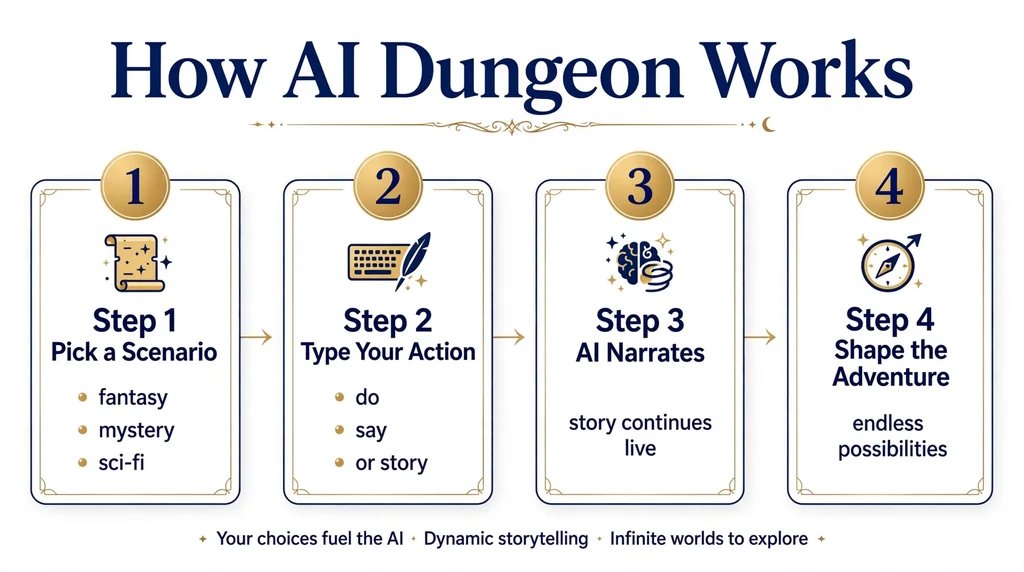
AI Dungeon uses generative AI models to produce text based on the context of an adventure. The model processes information from your recent actions, the existing story, and relevant instructions to generate a response.
The exact result depends on your input, the selected AI model, and the context available to the system.
1. You Provide an Action or Story Prompt
Every adventure begins with an idea. You might choose a ready-made scenario or start a new story using a setting and character of your choice.
For example, you could enter:
“I am a detective investigating a series of mysterious disappearances in a quiet coastal town.”
This gives the AI a basic setting, a character role, and a central problem. It can then introduce locations, suspects, clues, and other story elements.
2. The AI Generates a Narrative Response
After you submit an action, the AI generates text that continues the adventure. It may describe what happens, introduce a new character, reveal information, or present an unexpected complication.
For example, searching an abandoned lighthouse might reveal a strange symbol carved into the wall. Asking a local fisherman about the symbol might uncover an old legend.
The AI does not necessarily follow a predetermined script. Instead, it responds to the information available in the current story context.
3. You Decide What Happens Next
You can continue investigating, change your approach, speak to another character, or introduce a new event.
This creates a repeating gameplay cycle:
Your input → AI-generated response → Your next decision → Continued story
The process makes AI Dungeon feel like an interactive narrative rather than a conventional text adventure with a limited set of choices.
4. You Guide the Story With Additional Instructions
You can influence the generated narrative by providing specific details about the setting, character motivations, writing style, and intended direction.
However, the AI may occasionally forget information, repeat passages, or introduce contradictions. Story summaries, plot instructions, and Story Cards can help maintain consistency during longer adventures.
How to Play AI Dungeon
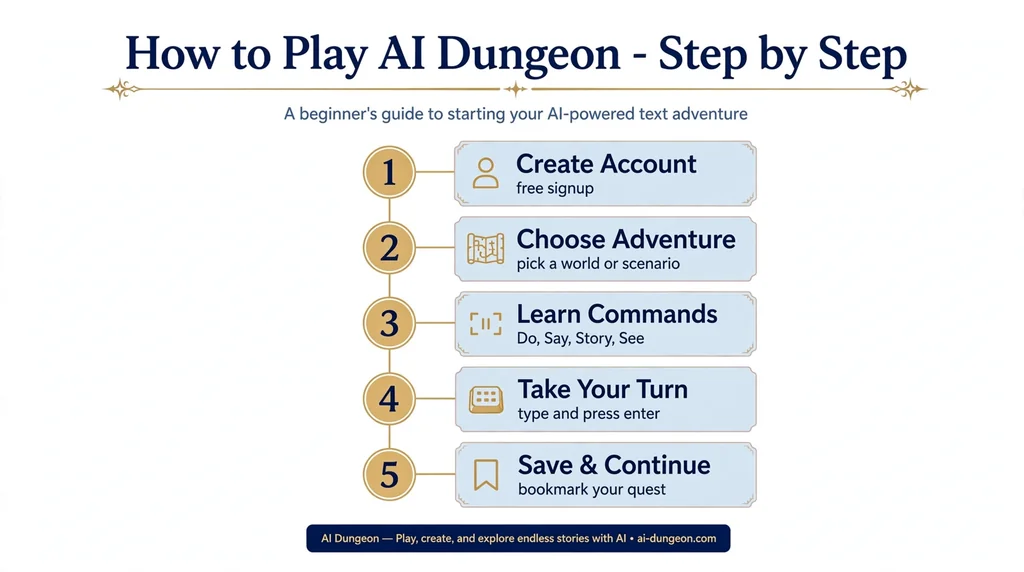
Getting started with AI Dungeon is relatively straightforward. You do not need advanced writing skills or technical knowledge to begin an adventure.
Step 1: Open AI Dungeon and Start an Adventure
Open the platform and use the available options to start a new adventure. You can choose a quick-start experience or explore published scenarios created by other users.
Ready-made scenarios are useful when you want to begin playing without developing an entire world yourself.
Step 2: Choose Your Setting and Character
Select a setting that matches your interests. Depending on the available options, you might choose fantasy, science fiction, mystery, horror, or another fictional genre.
Next, establish your character’s identity and role.
For example, your character could be:
- A wizard searching for a forbidden spell.
- A detective investigating a suspicious disappearance.
- A space explorer stranded on an unknown planet.
- A medieval knight protecting a distant kingdom.
- A journalist uncovering a hidden conspiracy.
A clear character concept gives your adventure a useful starting point.
Step 3: Enter Your First Action
Once your adventure begins, provide an action or narrative instruction. AI Dungeon offers different input modes that help you control how your character participates in the story.
You can perform an action, speak to another character, write a passage directly, or generate an image where the relevant feature is available.
For example, you might write:
“I walk into the crowded tavern and ask the bartender whether anyone has seen a traveler wearing a silver mask.”
The AI may describe the bartender’s response, introduce other people in the tavern, or reveal a clue.
Step 4: Read the Response and Continue
Read the generated passage and decide what your character should do next. You can follow a clue, investigate a location, begin a conversation, or change the direction of the story.
You are not limited to choosing from a short list of predefined options. You can describe your intended action in your own words.
Step 5: Refine Unsatisfactory Responses
AI-generated content is not always perfect. Sometimes a response may contradict previous events, misunderstand an instruction, or produce dialogue that feels unnatural.
Use the available controls, such as Retry, Undo, Edit, or Erase where applicable, to revise the story and test another direction.
Learning how to guide the AI is an important part of getting better results from AI Dungeon.
Main Features of AI Dungeon
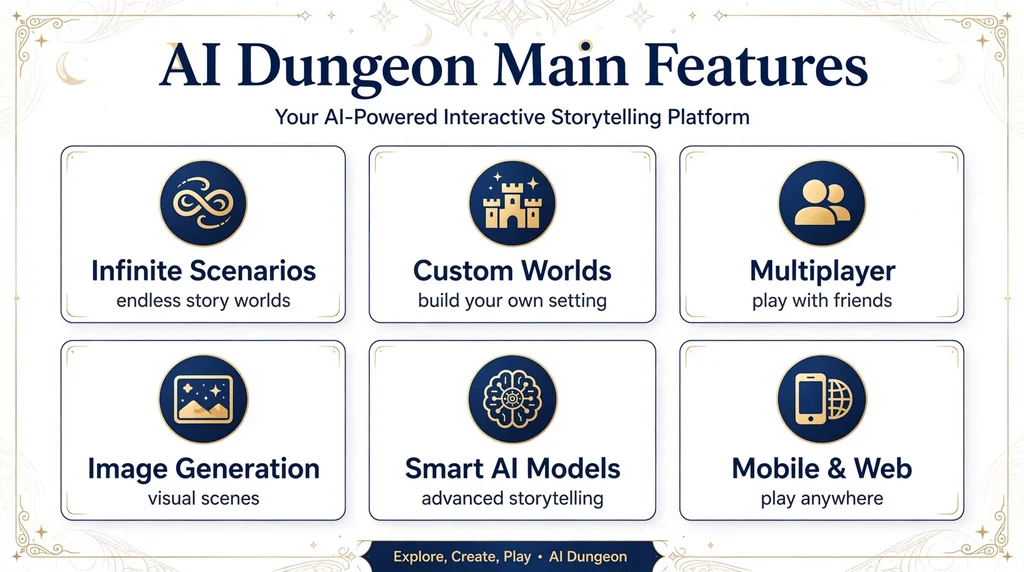
AI Dungeon combines interactive gameplay with tools for customizing stories and managing narrative continuity.
1. Interactive Storytelling
Interactive storytelling is the platform’s central feature. You participate in a developing narrative instead of simply reading a completed story.
Your actions can influence character relationships, reveal information, create conflicts, and change the direction of an adventure.
For example, helping a stranger might earn the trust of a future ally. Ignoring the same character could lead to a different sequence of events.
These possibilities make each adventure dependent on your choices and the AI’s responses.
2. AI Story Generator
The AI story generator produces narrative text based on your instructions and the existing context.
You can use it to explore different genres, develop fictional situations, generate dialogue, and continue scenes that you have already written.
This feature is especially helpful when you have a basic plot idea but do not know what should happen next.
However, AI Dungeon does not guarantee a perfectly structured novel or a consistent storyline. You may need to revise generated passages and provide additional instructions to achieve your intended result.
3. Do, Say, Story, and See Input Modes
AI Dungeon provides several input modes that serve different purposes.
| Input Mode | What It Does |
|---|---|
| Do | Describes an action performed by your character. |
| Say | Provides dialogue spoken by your character. |
| Story | Lets you write narrative text directly into the adventure. |
| See | Lets you provide a prompt for AI-generated imagery. |
Do is useful for physical actions, such as opening a door, drawing a sword, or searching a room.
Say works well when you want to speak with another character. You can ask questions, negotiate, argue, or reveal information through dialogue.
Story gives you more direct control over the narrative. You can write a scene, establish an event, or guide the AI toward a particular outcome.
See adds a visual element by generating an image from a suitable prompt, where available.
These modes offer different ways to shape an adventure without relying on a single style of input.
4. Custom Scenarios
Scenarios provide starting points for new adventures. They can establish a setting, character roles, background information, and the initial situation.
You can explore published scenarios or create your own, depending on the platform’s available creation tools.
For example, a custom scenario might place you in a kingdom where magic is forbidden. Another might introduce you as the captain of a damaged spaceship.
Custom scenarios are useful when you want to create a repeatable setup or share a particular storytelling experience with other players.
5. Story Cards and World-Building
Story Cards help the AI access important details about characters, locations, factions, and other elements of a fictional world.
They can be particularly valuable in longer adventures where the story introduces many recurring characters or complex settings.
Imagine writing a fantasy adventure with a kingdom called Eldoria. Your Story Cards might explain the kingdom’s history, describe its ruling family, and identify its major rival factions.
When relevant trigger keywords appear, the corresponding information can be included in the AI’s context.
This helps reinforce important details and reduce inconsistencies, although it does not guarantee that the model will remember everything correctly.
6. Plot Components and Story Instructions
AI Dungeon includes tools for guiding narrative generation. Depending on the current interface, these can include AI Instructions, Story Summary, Plot Essentials, and Author’s Note.
Each serves a different purpose.
- AI Instructions: Explain how the AI should approach the story or generate responses.
- Story Summary: Records important events and broader plot developments.
- Plot Essentials: Stores key facts that should remain central to the adventure.
- Author’s Note: Provides concise guidance about the story’s tone, setting, or style.
For example, you could instruct the AI to write a slow-building mystery, maintain a serious tone, and avoid revealing the culprit too early.
These details give the model a clearer direction and help you maintain a more consistent experience.
7. Retry, Undo, Edit, and Other Controls
AI Dungeon offers controls for managing generated content and adjusting your adventure.
Retry can generate another response when the current passage does not work. Undo can reverse recent actions, while editing tools let you correct text or adjust the narrative. Redo may restore actions that you previously reversed.
Continue options can also help move an adventure forward when you want the AI to generate more story text.
The precise controls and their behavior can depend on the current interface. Still, their main purpose is to give you more control over the direction and quality of your story.
What Can You Do With AI Dungeon?
AI Dungeon supports several types of interactive fiction. Your experience depends largely on the scenario, your prompts, and the direction you want the AI to take.
Fantasy Adventures
Create a fantasy world with ancient kingdoms, magical creatures, powerful artifacts, and dangerous quests.
You could play as a young wizard, a wandering knight, or a thief searching for a lost treasure. Story Cards and plot instructions can help maintain consistent world-building.
Science Fiction Stories
Explore distant planets, space stations, advanced technology, and unfamiliar civilizations.
You might command a damaged spacecraft, investigate an alien signal, or negotiate with an artificial intelligence that controls a distant colony.
Mystery and Detective Fiction
Create investigations around missing people, suspicious events, hidden motives, and unexpected discoveries.
You can question suspects, examine clues, and build theories as the story unfolds. Clear instructions help establish whether you want a realistic investigation or a more imaginative mystery.
Horror and Suspense
AI Dungeon can generate atmospheric scenarios involving abandoned buildings, isolated towns, strange creatures, and unexplained events.
You can guide the pace by describing the setting, establishing a serious tone, and asking the AI to reveal information gradually.
Character Roleplay
The platform also supports character-focused storytelling. You can create a personality, establish relationships, and interact with fictional characters through dialogue and actions.
This can help you explore character development, emotional conflicts, and alternative storylines.
Creative Writing and Brainstorming
AI Dungeon can serve as a creative writing aid when you need inspiration for a novel, short story, or fictional world.
You can test different character decisions, explore alternative endings, or develop a scene before rewriting it in your own style.
It works best as a creative partner rather than an unquestionable source of polished writing.
Tips for Getting Better Results From AI Dungeon
The quality of an AI-generated adventure depends partly on how clearly you communicate your intentions. These techniques can make stories more focused and enjoyable.
Write Specific Prompts
Broad instructions leave more room for unexpected interpretations.
Instead of writing, “I explore the forest,” provide additional details:
“I follow a narrow trail through the dark forest, looking for footprints near the abandoned cabin while keeping an eye out for danger.”
The more relevant information you include, the easier it is for the AI to follow your intended direction.
Establish Your Character’s Goals
Give your character a clear reason to act. Goals create direction and help the adventure feel more purposeful.
For example, a detective looking for a missing witness has a stronger narrative objective than a detective wandering through a city without a plan.
Maintain a Consistent Setting
Describe important rules about your fictional world. If magic is rare, technology is restricted, or a kingdom is at war, keep those details available through your instructions and relevant story information.
Use Story Cards for important recurring characters, places, and background details.
Guide the Tone and Writing Style
Tell the AI whether you want a humorous adventure, a serious mystery, a dramatic fantasy, or a fast-paced science fiction story.
You can also request shorter descriptions, more dialogue, or a particular narrative perspective.
Specific instructions generally provide better guidance than vague preferences.
Review and Edit Generated Text
Do not treat every AI response as final. Correct contradictions, remove repetitive passages, and refine dialogue when necessary.
Retry or editing controls can help you recover from weak outputs without abandoning an interesting adventure.
Avoid Overloading the AI With Details
Although context and instructions can improve consistency, too many competing directions can make it harder to maintain a clear narrative.
Focus on details that matter most: the character’s objective, the world’s essential rules, significant relationships, and the intended story direction.
Is AI Dungeon Free?

AI Dungeon offers free access alongside paid membership options. The features and limits available to you can depend on your account, membership tier, selected AI model, and the platform’s current policies.
Free access can be a practical starting point for people who want to explore AI-generated storytelling before committing to a paid plan.
Paid memberships may provide additional benefits, such as higher context limits or access to other features and models, depending on the current plan.
Because membership benefits can change, check the details displayed in your account before choosing a subscription. Do not assume that every AI model or advanced feature is available without limits.
Is AI Dungeon Available on Mobile?
AI Dungeon supports mobile use as well as browser-based access. A mobile app may be available for your device, depending on the platform’s current distribution and regional availability.
On mobile devices, you can enter prompts, read generated stories, and interact with the adventure through the available interface.
The experience may differ slightly between desktop and mobile because of screen size, controls, and interface design.
If you plan to play longer adventures on a phone, consider text readability and how easily you can manage story settings, instructions, and Story Cards.
Advantages and Limitations of AI Dungeon
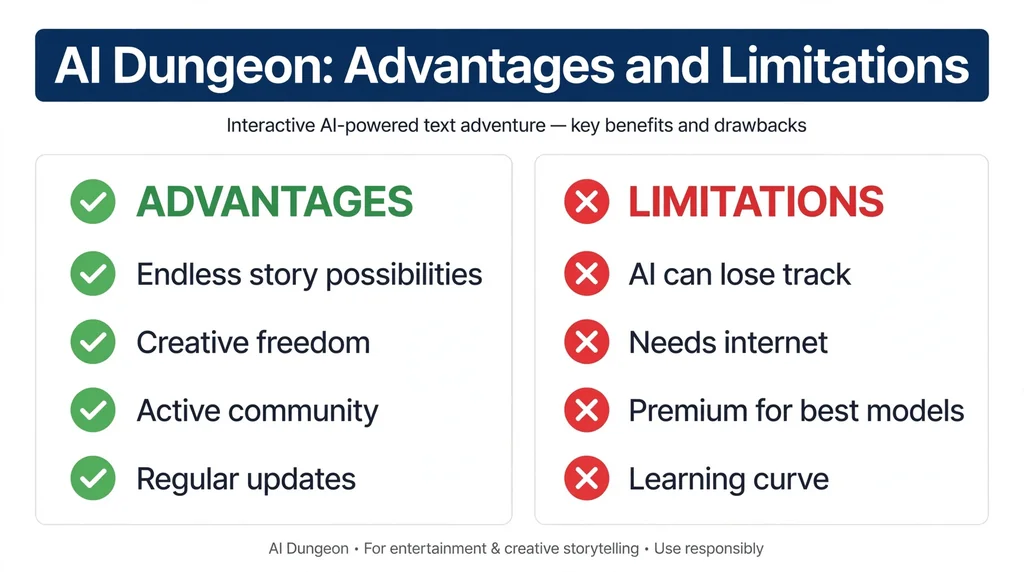
AI Dungeon offers considerable creative freedom, but its limitations are important to understand.
Advantages
Open-ended storytelling: You can describe original actions and explore story directions that may not exist in traditional games.
Creative flexibility: The platform supports multiple genres, character concepts, settings, and narrative styles.
Custom world-building: Scenarios, Story Cards, and plot instructions help you shape more detailed fictional worlds.
Interactive roleplay: You can participate in character conversations and influence relationships through your actions.
Writing inspiration: AI-generated responses can help you brainstorm scenes, develop plots, and overcome creative blocks.
Flexible gameplay: You can move between dialogue, actions, and direct storytelling instead of following a fixed sequence of choices.
Limitations
Inconsistent story details: The AI may forget earlier events or contradict established facts.
Repetitive responses: Some generated passages may repeat ideas or fail to advance the plot.
Variable output quality: Responses can range from creative and useful to confusing or irrelevant.
Context limitations: The model cannot always consider every previous passage or story detail when generating a response.
Subscription restrictions: Particular models, context sizes, or features may require a paid membership.
Need for user guidance: Stronger adventures often require thoughtful prompts, corrections, and ongoing direction.
Understanding these limitations helps set realistic expectations. AI Dungeon provides a flexible storytelling experience, but it does not eliminate the need for player decisions and occasional editing.
AI Dungeon Alternatives
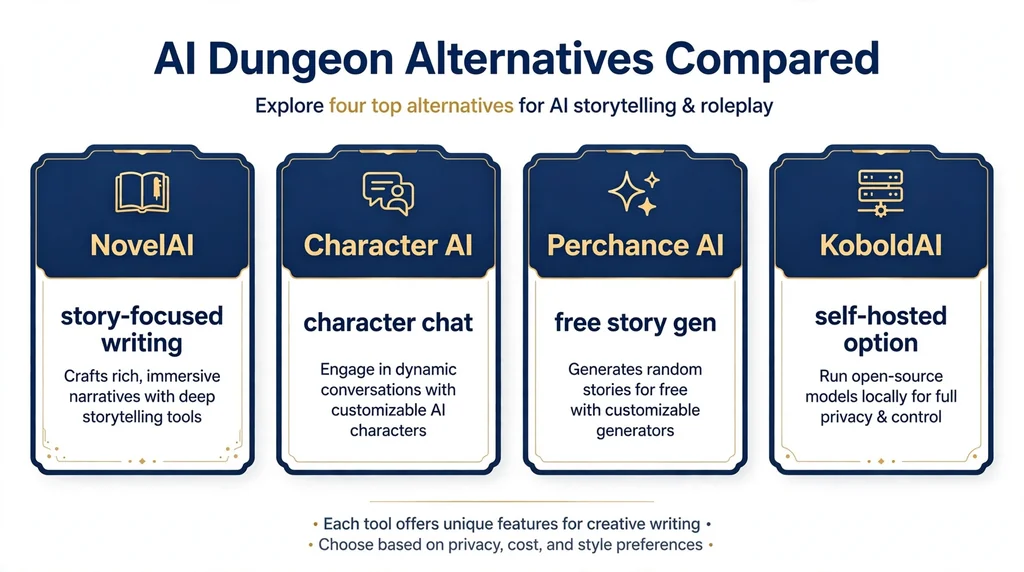
AI Dungeon is one option within the broader AI storytelling and roleplay category. Other platforms may be worth considering when you want different writing tools, character interactions, or gameplay systems.
| Platform or Category | Main Focus |
|---|---|
| NovelAI | AI-assisted writing and fiction creation. |
| Character.AI | Conversational interactions with AI characters. |
| DreamGen | AI roleplay and story generation. |
| AI story generators | Creating narrative text from prompts. |
| Traditional text adventure games | Interactive stories with more predefined rules and outcomes. |
These options are not identical to AI Dungeon. Some prioritize writing assistance, while others focus on conversations or structured gameplay.
When comparing platforms, consider the freedom to guide stories, character consistency, model options, privacy settings, pricing, and ease of use.
The best option depends on whether your main goal is interactive gaming, character roleplay, or writing complete fictional works.
AI Dungeon vs. Traditional Text Adventure Games
Traditional text adventure games often use predefined locations, commands, puzzles, and story branches. Your choices determine which existing paths you follow.
AI Dungeon uses generative AI to create responses from your input. This allows you to describe actions that may not appear among predefined options.
For example, a conventional text adventure might let you choose between opening a door and examining a window. In AI Dungeon, you could try negotiating with someone behind the door, searching for another entrance, or creating an entirely different approach.
The trade-off is predictability. Traditional games may offer more carefully designed puzzles, consistent progression, and fixed win conditions. AI Dungeon provides greater freedom but can produce unexpected or inconsistent results.
Neither approach is universally better. The right choice depends on whether you prefer structured game mechanics or open-ended storytelling.
Privacy and Responsible Use
As with other online platforms, it is worth reviewing AI Dungeon’s current privacy policy, account settings, and content preferences before using it extensively.
Avoid entering passwords, financial information, sensitive personal details, or confidential material into story prompts. Fictional storytelling does not require you to disclose real-world secrets.
If you create or publish scenarios, review the available visibility and sharing settings. A private adventure, an unlisted adventure, and a publicly published scenario may have different audiences.
You should also check content preferences and model settings to understand which options are available for your intended experience.
These precautions help you use AI-generated storytelling more thoughtfully without assuming that every type of content or setting receives the same treatment.
Who Should Use AI Dungeon?
AI Dungeon may appeal to people who enjoy creating stories through interaction rather than reading a fixed narrative.
It can be a good fit for:
- Fantasy and science fiction fans who want to explore original fictional worlds.
- Roleplay enthusiasts who enjoy developing characters and interacting with fictional personalities.
- Creative writers who want inspiration for dialogue, plot twists, and scenes.
- Text adventure players who prefer describing their own actions rather than selecting limited options.
- World-building enthusiasts who enjoy developing fictional locations, cultures, and histories.
- AI enthusiasts who want to experiment with generative storytelling.
However, players who prefer strict rules, predictable combat systems, detailed inventory management, or carefully balanced progression may prefer a conventional RPG or a more structured AI game.
The central appeal of AI Dungeon is its flexible narrative experience rather than traditional game mechanics alone.
Frequently Asked Questions About AI Dungeon
1. What Is AI Dungeon Used For?
AI Dungeon is used for AI-generated adventures, interactive storytelling, fictional roleplay, character development, and creative writing experiments.
2. Can You Play AI Dungeon for Free?
Yes, AI Dungeon offers a free access option, although the available models, usage limits, context sizes, and features may differ from paid memberships.
3. How Do You Start a Story in AI Dungeon?
Start a new adventure or choose a published scenario, establish your character and setting, then enter actions or narrative instructions to guide the AI.
4. Can You Create Your Own Stories in AI Dungeon?
Yes, you can create custom adventures and scenarios, guide generated narratives, develop characters, and use Story Cards to organize important world-building information.
5. Is AI Dungeon a Traditional Role-Playing Game?
AI Dungeon is primarily an open-ended AI storytelling and roleplaying platform. Its focus is narrative freedom rather than the structured mechanics found in many conventional RPGs.
Final Thoughts
AI Dungeon brings artificial intelligence and interactive fiction together in a flexible storytelling experience. It lets you create characters, explore fictional worlds, develop scenarios, and guide adventures through your own actions and instructions.
Its biggest strength is creative freedom. You can experiment with fantasy, science fiction, mystery, horror, and character-driven roleplay without depending entirely on a predetermined storyline. Features such as Story Cards, plot instructions, and editing controls can also help you shape more consistent adventures.
However, AI-generated stories are not always coherent or predictable. You may need to refine prompts, correct mistakes, and maintain important details as an adventure grows.
If you enjoy text adventure games, AI roleplay, or creative writing, AI Dungeon is worth exploring. The experience is most rewarding when you treat the AI as a storytelling partner and remain actively involved in shaping the narrative.
Related synonym guides: synonyms of humble.