Have you ever used the word “oxymoron” repeatedly in an essay, social media caption, or professional email and felt like it was losing its impact? Many writers, students, and professionals fall into the trap of overusing this fascinating term.
Expanding your vocabulary with synonyms of oxymoron helps you communicate more precisely and keep your audience engaged.
What Does “Oxymoron” Mean?
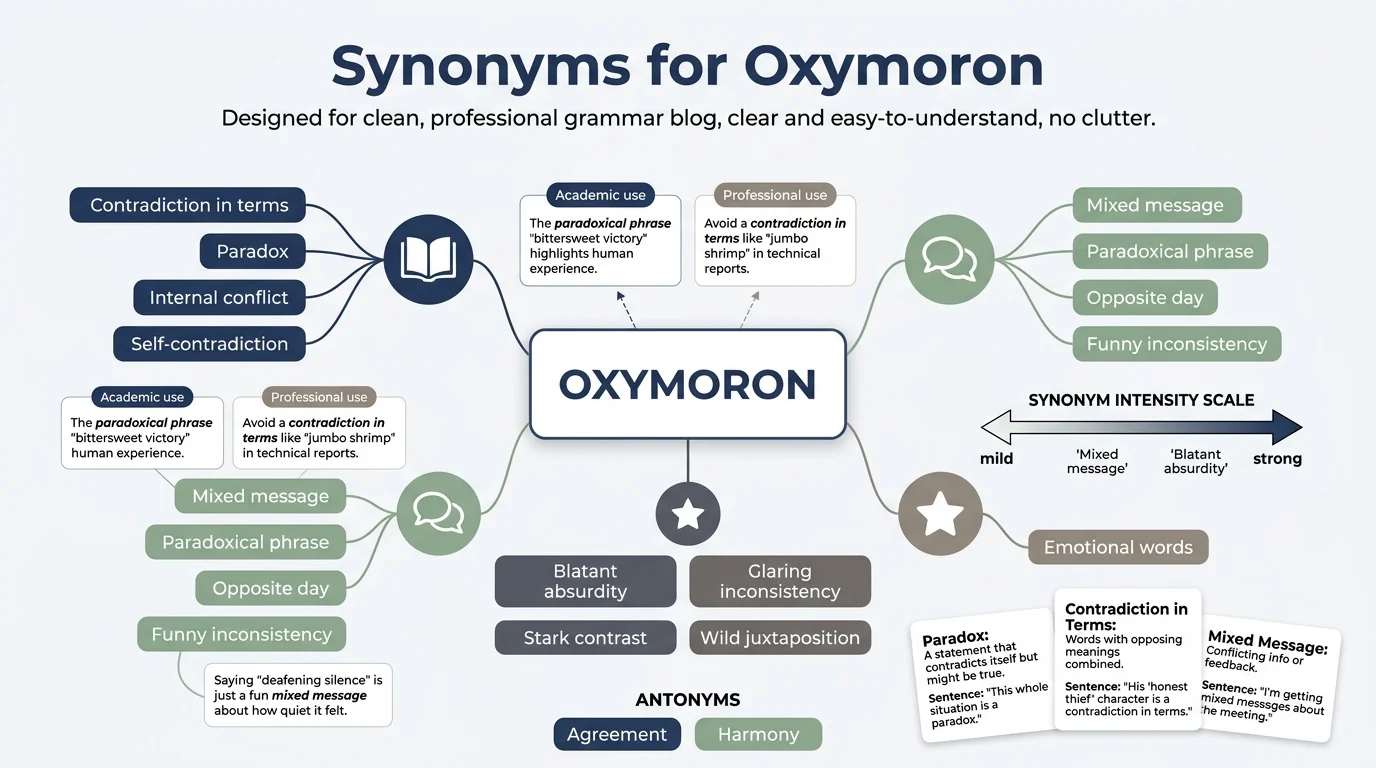
An oxymoron is a figure of speech that combines two opposite or contradictory terms to create a dramatic or thought provoking effect. The best synonyms of oxymoron include contradiction, paradox, irony, incongruity, and juxtaposition.
Meaning, Tone and Context
Simple Definition
An oxymoron is a rhetorical device that places conflicting words side by side to produce a surprising or meaningful phrase. Examples include “deafening silence,” “bittersweet,” and “living dead.”
Part of Speech
Oxymoron is primarily used as a noun. The plural form is oxymorons.
Formality Level
Oxymoron is a formal term commonly found in academic writing, literary analysis, and rhetorical discussions. It is less common in casual conversation.
Common Use Cases
You will encounter oxymorons in literature, poetry, speeches, advertising, and everyday expressions. Writers use them to create dramatic tension, highlight paradoxes, or add poetic depth to language.
Important Word Forms
The adjective form is “oxymoronic.”
When and How to Use “Oxymoron”
It works best in academic essays, literary critiques, and rhetorical analyses.
Here are realistic examples of using “oxymoron” across different contexts:
- Academic context: The professor explained that “jumbo shrimp” is a classic oxymoron used to illustrate linguistic contradictions.
- Professional context: The marketing team realized their campaign slogan, “virtual reality,” contained an oxymoron that made it memorable.
- Personal context: My friend described her relationship as a “love hate” situation, which is a perfect oxymoron for her emotional state.
- Creative context: The poet deliberately used the oxymoron “cold fire” to evoke a sense of emotional conflict in the reader.
- Social media context: Her tweet called the new policy an oxymoron because it promised freedom with excessive restrictions.
- Casual context: Calling that boring movie “awfully good” is an oxymoron that confuses people who hear it.
- Resume context: I demonstrated my understanding of rhetorical devices by analyzing the oxymoron in a famous political speech.
Another Word for “Oxymoron”
The best single replacement for oxymoron depends on your specific meaning and context. Here are direct suggestions for different situations:
- Professional writing: Use “antithesis” when discussing opposing ideas in business strategy or policy analysis.
- Academic writing: Use “paradox” for philosophical or logical discussions that involve seemingly contradictory truths.
- Casual conversation: Use “mismatch” or “clash” when describing contradictory situations informally.
- Emotional writing: Use “irony” when highlighting the unexpected or contradictory nature of a situation.
- Creative writing: Use “juxtaposition” when describing contrasting elements placed together for artistic effect.
- Resume or workplace: Use “contrariety” to demonstrate sophisticated vocabulary in cover letters or professional documents.
- Social media captions: Use “contradiction” for short, clear statements that grab attention.
- Stronger meaning: Use “antinomy” when referring to a fundamental contradiction between two principles.
- Softer meaning: Use “incongruity” when the contradiction is subtle or mild.
When Not to Use “Oxymoron”
Do not use “oxymoron” in casual conversation where simpler words like “contradiction” or “mismatch” would be clearer. The formal tone of oxymoron can sound pretentious or overly academic in everyday situations.
Example of imprecise usage: “The new office dress code is an oxymoron.”
Using a more precise synonym improves clarity and ensures your audience understands your meaning without confusion.
Words Commonly Confused With “Oxymoron”
Here are four commonly confused words and their differences:
Oxymoron vs. Paradox
An oxymoron is a phrase with contradictory words, like “deafening silence.” A paradox is a statement that seems self contradictory but contains a hidden truth, like “less is more.” Use oxymoron for brief phrases and paradox for complex statements.
Oxymoron vs. Juxtaposition
Juxtaposition places two different things together for contrast without necessarily creating a contradiction. Use juxtaposition for general contrast and oxymoron for direct word opposites.
Oxymoron vs. Antithesis
Antithesis balances two opposing ideas in parallel structure, such as “it was the best of times, it was the worst of times.” Use antithesis for balanced contrasts and oxymoron for condensed phrase level contradictions.
Oxymoron vs. Contradiction
Contradiction is a broader term meaning any statement that denies itself. Use contradiction for general logic errors and oxymoron specifically for rhetorical devices with opposing word pairs.
Best Synonym by Context for “Oxymoron”
| Context | Best Synonym | Why It Works | Example |
|---|---|---|---|
| Formal Writing | Antithesis | It conveys a balanced opposition of ideas | The policy presents an antithesis between economic growth and environmental protection |
| Academic Writing | Paradox | It suggests intellectual depth and philosophical complexity | The paradox of democracy is that it requires educated citizens to function properly |
| Professional Business | Inconsistency | It highlights practical problems in policies or strategies | The inconsistency in their mission statement confused potential investors |
| Resume Writing | Contrariety | It demonstrates advanced vocabulary and analytical thinking | Analyzed contrarieties in corporate messaging to improve brand clarity |
| Casual Conversation | Mismatch | It is simple and relatable for everyday discussions | The mismatch between his words and actions annoyed everyone |
| Creative Writing | Juxtaposition | It emphasizes artistic arrangement of contrasting elements | The juxtaposition of light and shadow created a haunting image |
| Emotional Tone | Irony | It captures the emotional weight of unexpected contradictions | The irony of the situation made her smile through tears |
| Strong Intensity | Antinomy | It suggests a deep, unresolvable contradiction | The antinomy of free will and determinism haunted his philosophy |
| Soft Moderate Tone | Incongruity | It implies a gentle or subtle contradiction | The incongruity of his formal suit and casual sneakers made him stand out |
| Social Media Captions | Contradiction | It is concise and attention grabbing for short content | The contradiction in her latest post got everyone talking |
| US Usage | Oxymoron | Standard American English for literary and rhetorical contexts | The phrase “act naturally” is a classic American example |
| UK Usage | Oxymoron | Same meaning with slightly more common use in British literary circles | British comedians often use the oxymoron to create humor |
Which Synonym Should You Choose?
Choosing the right synonym for oxymoron depends on several factors.
Consider your audience first. Academic readers expect terms like paradox or antithesis, while general readers understand contradiction or mismatch more easily. Think about the emotional intensity you want to convey. Use stronger words like antinomy for deep philosophical contradictions and softer words like incongruity for mild contrasts.
Formality matters significantly in professional settings. Choose antithesis for formal reports, contradiction for business emails, and mismatch for casual team conversations. Context also guides your choice. Use juxtaposition in creative writing to emphasize artistic contrast and inconsistency in policy discussions to highlight practical problems.
Finally, consider sentence clarity. Simpler words often work better in straightforward statements, while complex terms add sophistication to analytical writing. When in doubt, read your sentence aloud and ask yourself if the word sounds natural and clear.
Real Life Examples of “Oxymoron” in Sentences
School Context: During literature class, the teacher asked us to identify the oxymoron in the poem’s opening lines and explain its effect.
Workplace Context: The CEO called the company’s commitment to innovation and tradition a genuine oxymoron during the quarterly meeting.
Writing Context: The writer used the oxymoron “living death” to describe the protagonist’s emotional state after losing her family.
Conversation Context: My grandfather called the idea of a “silent alarm” an oxymoron and laughed at the absurdity.
Social Media Context: His viral tweet called the new health drink an oxymoron because it promised flavor without taste.
Resume Context: Developed training materials that explained rhetorical devices including the oxymoron for new communications interns.
Email Context: I wrote in my email that the contradictory instructions were an oxymoron that confused the entire department.
Storytelling Context: The narrator described the villain’s “kind cruelty” as an oxymoron that revealed his complex personality.
15 Synonyms
| Synonym | Simple Meaning | Best Used For | Example Sentence |
|---|---|---|---|
| Contradiction | A statement that opposes itself | General writing and conversation | The policy was a contradiction of everything the company claimed to value |
| Paradox | A statement that seems false but is true | Philosophical and academic writing | The paradox of tolerance is that we must tolerate intolerant views to maintain tolerance |
| Antithesis | Direct opposite of an idea | Formal essays and rhetorical analysis | His actions were the antithesis of everything he preached |
| Juxtaposition | Placing things together for contrast | Creative writing and art criticism | The juxtaposition of wealth and poverty in the city was jarring |
| Irony | Contrast between expectation and reality | Emotional and conversational writing | The irony of her success was that it came from her biggest failure |
| Incongruity | Lack of harmony or consistency | Mild contradictions and subtle contrasts | The incongruity of his cheerful demeanor at a funeral was unsettling |
| Contrariety | State of being opposed | Formal and professional writing | The contrariety between their words and actions was immediately obvious |
| Antinomy | Fundamental contradiction between principles | Philosophical and legal discussions | The antinomy between freedom and security remains unresolved |
| Mismatch | Incompatible combination | Casual conversation and everyday use | The mismatch in their political views caused frequent arguments |
| Clash | Sharp conflict or opposition | Informal writing and headlines | The clash between tradition and innovation divided the committee |
| Inconsistency | Lack of logical coherence | Professional and analytical writing | The inconsistency in his argument weakened his entire position |
| Dissonance | Lack of harmony or agreement | Emotional and psychological contexts | The dissonance between her public image and private life was striking |
| Opposition | Resistance or contrast | General and formal use | The opposition of these two concepts created interesting discussion |
| Discrepancy | Unexpected difference | Factual and data driven writing | The discrepancy in the reports made everyone suspicious |
| Conflict | Serious disagreement or opposition | Strong emotional and situational writing | The conflict between duty and desire made his decision impossible |
Synonym Groups and Usage Differences
Professional vs. Personal Synonyms
Professional settings call for precise and formal alternatives like antithesis, contrariety, and inconsistency. Personal conversations often work better with simpler words like mismatch, clash, or contradiction. Use professional synonyms in memos, reports, and presentations while saving casual alternatives for team chats and informal emails.
Formal vs. Conversational Synonyms
Formal synonyms include antithesis, antinomy, and contrariety for essays, speeches, and research papers. Conversational synonyms like mismatch, clash, and contradiction fit everyday dialogue perfectly.writing demands paradox and juxtaposition while texts and social media prefer shorter, punchier alternatives.
Academic Synonyms
Academic writing benefits from paradox, antithesis, and juxtaposition. These terms demonstrate sophisticated understanding of rhetorical devices and philosophical concepts. Use them in research papers, literary critiques, and analytical essays to sound authoritative and precise.
Professional and Business Synonyms
Business communication relies on inconsistency, discrepancy, and contrariety. These words highlight practical problems in strategies, policies, and communications without sounding overly academic. Emails, reviews, and presentations benefit from this professional vocabulary.
Creative or Literary Synonyms
Creative writers should embrace juxtaposition, irony, and dissonance. These terms add emotional depth and artistic texture to prose and poetry. They help create vivid imagery and convey complex emotional states effectively.
Slang or Modern Synonyms
Modern synonyms like “head scratcher” or “mind bender” are acceptable in very casual contexts but rarely appropriate for formal writing. Use them sparingly in social media posts or personal conversations with close colleagues.
Strongest vs. Weaker Synonyms
Intensity scale from mild to strongest: incongruity (mildest), mismatch, contradiction, irony, paradox, antithesis, antinomy (strongest). Choose milder terms for subtle contrasts and stronger terms for fundamental opposition.
Emotional vs. Neutral Synonyms
Emotional synonyms include irony, dissonance, and conflict, which carry strong feeling. Neutral synonyms include contradiction, inconsistency, and contrariety, which remain factual and objective. Match your emotional tone to your topic and audience.
Antonyms of “Oxymoron”
| Antonym | Meaning | Example Sentence |
|---|---|---|
| Agreement | State of harmony or accord | The agreement between their statements restored trust |
| Consistency | Logical coherence without contradiction | Her consistency in argument made her a compelling speaker |
| Harmony | Pleasing arrangement of parts | The harmony of the colors created a peaceful atmosphere |
| Accordance | Compliance or conformity with something | His actions were in accordance with his principles |
| Congruity | State of fitting together perfectly | The congruity of the design elements created elegant unity |
| Unity | State of being joined as a whole | The unity of purpose among the team produced excellent results |
| Agreement | Mutual understanding or consent | The agreement between the parties resolved the dispute |
| Alignment | Proper positioning in relation to something | The alignment of their goals made collaboration easy |
| Compatibility | Ability to exist together without conflict | The compatibility of their personalities surprised everyone |
| Correspond | Match or be similar | The accounts correspond perfectly with each other |
| Cohesion | Unity or logical connection | The cohesion of the argument made it persuasive |
| Concord | Agreement or harmony between people | The concord among the committee members was remarkable |
| Consistency | Uniformity of thought or action | The consistency of his work earned him a promotion |
| Symmetry | Balanced and harmonious arrangement | The symmetry of the building impressed the architects |
| Uniformity | State of being consistent throughout | The uniformity of the data made analysis straightforward |
Comparison: Oxymoron vs. Similar Words
Oxymoron vs. Paradox
Main difference: Oxymoron is a short phrase with contradictory words, while paradox is a longer statement containing hidden truth. Oxymoron is stronger in creating immediate word level contrast, and paradox is more formal in philosophical discussions. Oxymoron example: “The oxymoron ‘deafening silence’ creates tension.” Paradox example: “The paradox ‘this statement is false’ challenges logic.”
Oxymoron vs. Irony
Main difference: Irony highlights discrepancies between expectation and reality, while oxymoron places opposing words together. Irony is stronger for emotional impact, and oxymoron is more formal as a rhetorical device. Irony example: “The irony of firefighter’s house burning down was tragic.” Oxymoron example: “The oxymoron ‘bittersweet’ described her feelings perfectly.”
Oxymoron vs. Juxtaposition
Main difference: Juxtaposition places different elements together for contrast, while oxymoron specifically uses contradictory words. Juxtaposition is stronger for visual or artistic descriptions, and oxymoron is more formal in literary analysis. Juxtaposition example: “The juxtaposition of old and new buildings created interesting cityscape.” Oxymoron example: “The oxymoron ‘living death’ captured his despair.”
Oxymoron vs. Antithesis
Main difference: Antithesis balances opposing ideas in parallel structure, while oxymoron uses compressed contradictory word pairs. Antithesis is stronger for formal speeches and essays, and oxymoron is more common in everyday language. Antithesis example: “To err is human, to forgive divine shows antithesis.” Oxymoron example: “The oxymoron ‘wise fool’ describes the character perfectly.”
Oxymoron vs. Contradiction
Main difference: Contradiction is a broader term for any self denying statement, while oxymoron specifically describes rhetorical word pairs. Contradiction is stronger for logical arguments, and oxymoron is more formal in literary contexts. Contradiction example: “His statement was a contradiction he said both yes and no.” Oxymoron example: “The oxymoron ‘original copy’ amused the editor.”
Oxymoron vs. Dissonance
Main difference: Dissonance often refers to psychological or emotional conflict, while oxymoron applies to language and words. Dissonance is stronger for psychological descriptions, and oxymoron is more formal for literary analysis. Dissonance example: “The dissonance between her beliefs and actions caused anxiety.” Oxymoron example: “The oxymoron ‘joyful sorrow’ expressed her complex emotions.”
Common Phrases and Expressions with “Oxymoron”
1. Living Dead
Meaning: A person who is alive but lacks vitality or purpose. Example sentence: The exhausted worker felt like the living dead after consecutive overtime shifts.
2. Bittersweet
Meaning: A combination of pleasure and pain. Example sentence: Graduation felt bittersweet, full of pride and sadness.
3. Deafening Silence
Meaning: A silence so heavy or awkward that it feels overwhelming. Example sentence: The deafening silence in the room followed her surprising announcement.
4. Original Copy
Meaning: A phrase that contradicts itself, often used humorously. Example sentence: The editor laughed at the request for an original copy of the document.
5. Controlled Chaos
Meaning: A situation that appears chaotic but is actually managed. Example sentence: The event planning team operated in controlled chaos to meet the deadline.
6. Open Secret
Meaning: Information that is supposedly secret but widely known. Example sentence: Their relationship was an open secret in the office.
7. Awfully Good
Meaning: Surprisingly excellent in a contradictory way. Example sentence: The movie was awfully good despite its terrible reviews.
Common Mistakes to Avoid
1. Using oxymoron when a more precise synonym works better
Writers often default to oxymoron when simpler words like contradiction or mismatch would be clearer. Choose the most accurate word for your specific meaning.
2. Confusing oxymoron with paradox
These terms are not interchangeable. Use oxymoron for short contradictory phrases and paradox for complex statements with hidden truth.
3. Using casual synonyms in formal writing
Words like clash or mismatch have no place in academic essays or professional reports. Choose antithesis or contrariety instead.
4. Using overly dramatic synonyms for simple situations
Antinomy is too strong for describing a minor difference in opinion. Save powerful words for genuinely deep contradictions.
5. Repeating the same word too often
Using oxymoron repeatedly in a single paragraph creates monotony. Vary your vocabulary with appropriate synonyms to maintain reader interest.
6. Choosing a synonym with wrong emotional tone
Using dissonance for a humorous situation creates confusion. Match your word’s emotional weight to your topic.
7. Using slang in academic or professional writing
Avoid modern alternatives like “head scratcher” in serious contexts. Stick to standard synonyms in formal documents.
8. Using oxymoron incorrectly in casual speech
Some people misuse oxymoron to describe any confusing situation. Use it specifically for contradictory word pairs.
FAQs
1. What is the best synonym for oxymoron?
The best synonym depends on context. Use contradiction for general use, paradox for philosophy, and antithesis for formal writing.
2. What is a formal synonym for oxymoron?
Antithesis and contrariety are formal alternatives that work well in academic and professional writing.
3. What is an informal synonym for oxymoron?
Mismatch and clash are informal alternatives suitable for casual conversation and everyday use.
4. What is another word for oxymoron in professional writing?
Inconsistency and contrariety are excellent choices for business and professional contexts.
5. What is the difference between oxymoron and paradox?
Oxymoron uses contradictory word pairs, while paradox presents a seemingly false statement containing hidden truth.
6. What is the opposite of oxymoron?
Agreement, consistency, and harmony are antonyms representing logical coherence and unity.
Conclusion
An oxymoron combines contradictory terms to create dramatic effect and memorable phrases. The best synonyms include contradiction for general use, paradox for philosophical depth, and antithesis for formal contexts. Understanding tone, formality, and emotional intensity helps you choose the perfect word for every situation.
Remember that vocabulary variety strengthens your writing and communication skills. Whether you are drafting an academic essay, composing a business email, or crafting a social media post, selecting the right synonym elevates your message. Practice using these alternatives to develop a richer, more precise vocabulary that serves you in any professional or personal context.