Do you catch yourself using “wonderful” over and over again in your emails, essays, or daily conversations? You are not alone. Many English learners and even native speakers rely on this one word to describe everything from a good cup of coffee to a life changing opportunity.
The problem is that overusing “wonderful” makes your language feel flat and repetitive. It fails to capture the specific shade of meaning you actually want to express. Whether you are writing a professional email, crafting a social media caption, or polishing a college essay, you need a richer vocabulary to communicate with precision and impact.
This guide will give you the best synonyms for wonderful, explain exactly when to use each one, and help you avoid common mistakes that weaken your writing.
What Does Wonderful Mean?
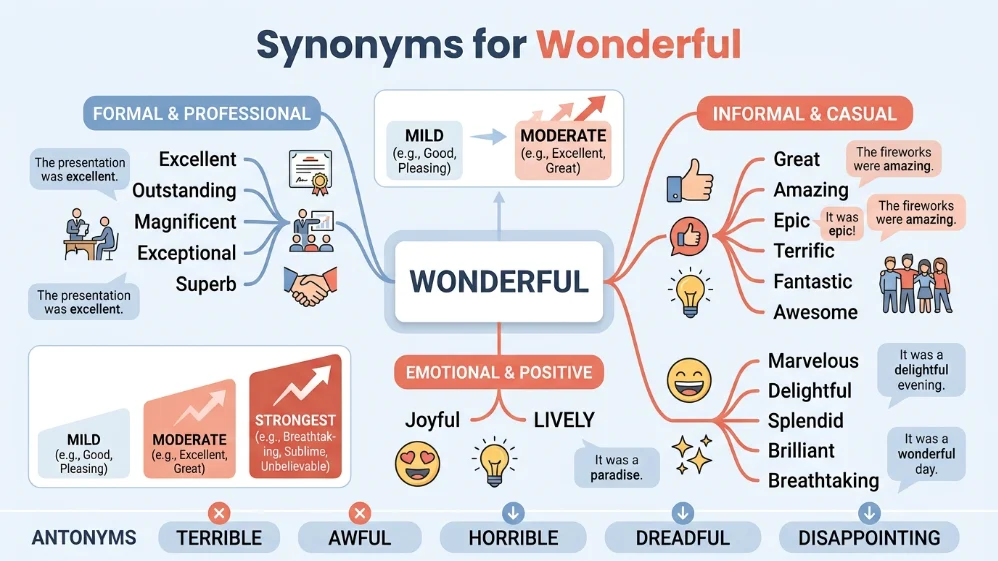
Wonderful describes something that is exceptionally good, pleasing, or remarkable. It expresses strong positive feelings. The best synonyms depend on your context. For formal writing use excellent or outstanding. For casual conversation use great or amazing. Emotional situations use marvelous or delightful. For professional settings use exceptional or superb.
Meaning, Tone and Context
Simple definition: Wonderful means inspiring delight, admiration, or amazement. It describes things that are extremely good or pleasant.
Part of speech: It is primarily an adjective.
Tone: Positive and enthusiastic.
Formality level: Neutral to moderately informal. “Wonderful” works in many situations but can feel too casual for very formal academic papers or legal documents.
Common use cases: You use wonderful to describe experiences, events, people, performances, meals, vacations, news, and feelings. It works well in personal writing, friendly emails, reviews, and conversational English.
Important word forms: The word “wonder” is the noun form and “wonderfully” is the adverb. You can also use “wondrous” which is a more literary or poetic adjective.
When and How to Use “Wonderful”
You should use “wonderful” when you want to express genuine enthusiasm and approval. It works best for positive experiences that are not just good but truly memorable.
Professional context: We had a wonderful meeting with the client and resolved all outstanding issues.
Personal context: Thank you so much for the wonderful birthday gift. I absolutely love it.
Academic context: The professor gave a wonderful lecture on Renaissance art and its cultural significance.
Emotional context: I felt wonderful after spending the afternoon with my grandmother.
Creative context: The sunset painted a wonderful canvas of orange and purple across the sky.
Social media context: Just had a wonderful dinner at that new Italian place downtown.
Casual context: What a wonderful surprise to see you here.
Another Word for “Wonderful”
The best single replacement for “wonderful” depends entirely on what you want to communicate. Here are the top choices for different situations.
Professional writing: Excellent
You can describe a report, presentation, or performance as excellent to convey high quality and competence.
Academic writing: Outstanding
Use this to highlight exceptional research, analysis, or scholarly contributions.
Casual conversation: Great
This is the most natural and versatile replacement for everyday speech.
Emotional writing: Marvelous
This word adds warmth and heartfelt appreciation to personal stories.
Creative writing: Splendid
Use this to add elegance and visual richness to descriptive passages.
Resume or workplace: Exceptional
You should use this to describe achievements, skills, or results that stand out.
Social media captions: Amazing
This is modern and engaging for short, enthusiastic posts.
Stronger meaning: Extraordinary
Use this when something is truly rare and goes beyond normal expectations.
Softer meaning: Nice
Use this for mild approval when you want to be polite but not overly enthusiastic.
When Not to Use “Wonderful”
You should avoid “wonderful” when the situation calls for a more precise or measured word. It sounds too vague in formal academic writing where you need specific descriptive language. It also feels too enthusiastic for neutral or mildly positive feedback.
Example of a weak sentence: The results of the experiment were wonderful.
Improved sentence: The results of the experiment were statistically significant and highly encouraging.
Another weak example: Her performance was wonderful.
Improved sentence: Her performance was technically flawless and emotionally resonant.
You should also avoid “wonderful” when you need to communicate objectivity. In business reports or scientific writing, words like “satisfactory” or “notable” work better because they sound factual rather than emotional.
Words Commonly Confused With “Wonderful”
Wonderful vs. Great
Wonderful carries a slightly warmer and more emotional tone. Great is more general and commonly used. You can say “great job” in a casual workplace, but “wonderful job” feels more personal and heartfelt.
Wonderful vs. Amazing
Amazing often implies surprise or astonishment. Wonderful focuses more on pleasure and delight. A magic trick is amazing. A cozy family dinner is wonderful.
Wonderful vs. Beautiful
Beautiful specifically relates to visual appearance or sensory appeal. Wonderful applies to experiences, events, and abstract qualities. A painting is beautiful. A vacation can be wonderful.
Wonderful vs. Excellent
Excellent is more formal and objective. It suggests meeting high standards. Wonderful is more subjective and emotional. An excellent student earns top grades. A wonderful student is a joy to teach.
Wonderful vs. Fantastic
Fantastic is more enthusiastic and informal. It often expresses excitement. Wonderful feels more sincere and heartfelt. A fantastic party is energetic. A wonderful party is warm and memorable.
Wonderful vs. Terrific
Terrific is slightly more energetic and casual. Wonderful sounds more thoughtful and reflective. Both are positive, but wonderful tends to carry more depth.
Best Synonym by Context for “Wonderful”
| Context | Best Synonym | Why It Works | Example |
|---|---|---|---|
| Formal writing | Excellent | Sounds professional and objective | The committee presented an excellent proposal |
| Academic writing | Outstanding | Conveys exceptional quality in scholarship | Her research produced outstanding results |
| Professional business | Superb | Implies superior quality and polish | The team delivered a superb presentation |
| Resume or workplace | Exceptional | Highlights rare and valuable performance | Achieved exceptional sales growth in Q3 |
| Casual conversation | Great | Natural and widely understood | That sounds like a great idea |
| Creative writing | Splendid | Adds elegance and visual appeal | The garden was splendid in full bloom |
| Emotional tone | Marvelous | Expresses warm personal feelings | We had a marvelous time together |
| Strong intensity | Extraordinary | Communicates rare and remarkable quality | An extraordinary achievement for a rookie |
| Soft moderate tone | Pleasant | Gentle and unassuming approval | We had a pleasant afternoon walk |
| Social media captions | Amazing | Modern, energetic, and shareable | Amazing view from the top of the mountain |
Which Synonym Should You Choose?
Your choice depends on three factors: formality, emotional intensity, and the specific quality you want to highlight.
Consider your audience first. Are you writing to a professor, a boss, a friend, or a social media following? Use exceptional or excellent for professional audiences. Use great or amazing for friends and casual readers.
Think about emotional intensity. Do you want to express mild approval or deep admiration? Use pleasant or nice for mild situations. Use extraordinary or phenomenal for moments that truly stunned you.
Match the word to the specific quality. If you are describing beauty, use gorgeous. If you are describing performance, use outstanding. If you are describing an experience, use delightful.
Test your word choice. Read the sentence aloud with the synonym. Does it sound natural? Does it convey exactly what you mean? If it feels forced or exaggerated, choose a different word.
Real Life Examples of “Wonderful” in Sentences
School setting: The teacher gave wonderful feedback on my research paper and encouraged me to submit it for publication.
Workplace setting: We received wonderful reviews from our clients about the new software interface.
Writing context: She has a wonderful ability to make complex topics accessible to beginners.
Casual conversation: It was wonderful to catch up with everyone at the family reunion.
Social media: Spent a wonderful weekend exploring the national park. Already planning our next trip.
Email: Thank you for the wonderful opportunity to present at the conference. I truly appreciate it.
Storytelling: The small town had a wonderful charm that made every visitor feel at home.
Stronger synonym example: The orchestra delivered an extraordinary performance that left the audience speechless.
25 Synonyms for “Wonderful”
| Synonym | Simple Meaning | Best Used For | Example Sentence |
|---|---|---|---|
| Excellent | Very high quality | Professional and academic writing | The restaurant received excellent reviews from food critics |
| Outstanding | Exceptionally good | Recognizing top performance | She gave an outstanding presentation at the conference |
| Exceptional | Unusually good | Resumes and professional achievements | His exceptional leadership skills drove the project forward |
| Superb | Excellent and impressive | Formal and descriptive writing | The hotel offered superb service and luxurious accommodations |
| Marvelous | Extremely pleasing | Emotional and personal situations | We had a marvelous vacation exploring the coastal towns |
| Splendid | Impressive and beautiful | Creative and descriptive writing | The ballroom was splendid with crystal chandeliers |
| Great | Very good | Everyday casual conversation | You did a great job on that project |
| Amazing | Surprising and impressive | Social media and informal praise | The view from the mountain was absolutely amazing |
| Fantastic | Extremely good | Enthusiastic and friendly contexts | What a fantastic idea for the team building event |
| Terrific | Excellent and energetic | Casual positive feedback | We had a terrific time at the concert |
| Fabulous | Extremely pleasing | Informal and expressive situations | She looked fabulous in her new dress |
| Delightful | Pleasing and enjoyable | Describing experiences or people | The garden party was a delightful summer event |
| Glorious | Magnificent and beautiful | Describing nature or achievements | The sunset was a glorious display of color |
| Admirable | Deserving respect and approval | Recognizing character or effort | His commitment to helping others is admirable |
| Impressive | Earning admiration | Describing achievements or skills | Her knowledge of the subject is impressive |
| Remarkable | Worthy of attention | Formal and academic contexts | The study produced remarkable findings |
| Stunning | Extremely impressive or beautiful | Visual descriptions and reactions | The architecture of the cathedral is stunning |
| Breathtaking | Astonishingly beautiful | Describing landscapes and views | The view from the cliff was breathtaking |
| Phenomenal | Extraordinary and impressive | Highly enthusiastic praise | The athlete had a phenomenal season |
| Exquisite | Extremely beautiful and delicate | Art, food, and refined descriptions | The pastry chef created an exquisite dessert |
| Magnificent | Grand and impressive | Formal and descriptive writing | The palace was a magnificent example of Baroque architecture |
| Prodigious | Remarkably large or impressive | Formal and literary contexts | His prodigious talent was recognized early |
| Peachy | Very good | Informal and playful conversation | Everything is just peachy with the new arrangement |
| Swell | Excellent | Old fashioned casual approval | That sounds like a swell plan to me |
| Awe inspiring | Filling with wonder | Emotional and descriptive writing | The Grand Canyon is an awe inspiring natural wonder |
Synonym Groups and Usage Differences
Professional vs. Personal Synonyms
Professional words like excellent, outstanding, and exceptional belong in resumes, performance reviews, and business communications. They maintain objectivity while still conveying high praise.
Personal words like marvelous, delightful, and lovely are better for letters, journal entries, and conversations with people you know well. They express warmth and genuine emotion.
Formal vs. Conversational Synonyms
Formal contexts call for excellent, superb, and outstanding. These words fit reports, speeches, and academic essays.
Conversational contexts welcome great, amazing, fantastic, and terrific. These words sound natural in texts, casual emails, and friendly chats.
Academic Synonyms
Academic writing benefits from words like exceptional, outstanding, remarkable, and noteworthy. These terms sound precise and scholarly without being overly emotional. You can also use “notable” or “commendable” in academic feedback.
Professional and Business Synonyms
Excellent, superb, and outstanding work well in workplace communication. You can also use “impressive” for specific achievements, “praiseworthy” for effort, and “commendable” for positive qualities.
Creative or Literary Synonyms
Creative writing offers rich options like splendid, glorious, exquisite, and magnificent. These words add imagery and descriptive depth. You can also use “wondrous” for a poetic touch or “transcendent” for spiritual or profound experiences.
Slang or Modern Synonyms
Modern slang includes words like dope, lit, fire, and sick. These are appropriate only for very casual, informal contexts with friends or social media audiences. You should never use slang in professional or academic writing.
Strongest vs. Weaker Synonyms
Mildest: Nice, pleasant, agreeable, satisfactory, acceptable
Moderate: Great, fine, good, lovely, enjoyable
Strong: Marvelous, splendid, superb, excellent, outstanding
Strongest: Extraordinary, phenomenal, breathtaking, magnificent, awe inspiring
Emotional vs. Neutral Synonyms
Emotional synonyms include marvelous, delightful, glorious, and breathtaking. They add warmth and personal feeling.
Neutral synonyms include excellent, notable, commendable, and acceptable. They stay factual and professional without emotional weight.
Antonyms of “Wonderful”
| Antonym | Meaning | Example Sentence |
|---|---|---|
| Terrible | Extremely bad | The service at that restaurant was terrible |
| Awful | Very unpleasant | We had an awful experience with the airline |
| Horrible | Causing horror or disgust | The weather was horrible during our hike |
| Dreadful | Extremely bad or unpleasant | The movie received dreadful reviews from critics |
| Mediocre | Of moderate quality | The performance was mediocre at best |
| Poor | Below standard | The candidate made a poor impression |
| Bad | Not good | The traffic was bad this morning |
| Unpleasant | Not enjoyable | The meeting left an unpleasant atmosphere |
| Disappointing | Failing to meet expectations | The final episode was disappointing |
| Inferior | Lower in quality | The cheaper product was clearly inferior |
| Miserable | Very unhappy or unpleasant | The conditions in the camp were miserable |
| Lousy | Very poor quality | He did a lousy job on the repairs |
| Subpar | Below expected standards | Her performance was subpar this season |
| Unremarkable | Not worthy of notice | The food was unremarkable and forgettable |
| Unimpressive | Not attracting admiration | The presentation was unimpressive overall |
Comparison: “Wonderful” vs. Similar Words
Wonderful vs. Amazing
Main difference: Amazing emphasizes surprise and astonishment. Wonderful emphasizes pleasure and delight. An amazing magic trick leaves you stunned. A wonderful meal leaves you satisfied and happy.
Which one is stronger: Amazing can feel stronger due to the element of surprise. However, wonderful has more emotional warmth and depth.
Which one is more formal: Wonderful is slightly more formal than amazing. Amazing can appear in professional contexts but sounds more conversational.
Example with wonderful: The orchestra performed a wonderful piece that moved the entire audience.
Example with amazing: It is amazing that she learned to play the piano in just six months.
Wonderful vs. Excellent
Main difference: Excellent is objective and measures against a standard. Wonderful is subjective and relates to personal feelings.
Which one is stronger: Both are strong in different ways. Excellent means top tier quality. Wonderful means deeply pleasing.
Which one is more formal: Excellent is more formal and widely used in professional contexts.
Example with wonderful: The team had a wonderful time celebrating their success.
Example with excellent: The team delivered excellent results this quarter.
Wonderful vs. Great
Main difference: Great is broader and more general. Wonderful is warmer and more specific in its emotional appeal.
Which one is stronger: Wonderful carries more emotional weight and sincerity.
Which one is more formal: Great is more casual. Wonderful sits between casual and formal but leans toward the warmer side.
Example with wonderful: We shared a wonderful conversation over coffee.
Example with great: We had a great conversation.
Wonderful vs. Superb
Main difference: Superb implies a higher standard of quality and refinement. Wonderful focuses more on how something makes you feel.
Which one is stronger: Superb can sound more impressive in professional contexts. Wonderful sounds more personal.
Which one is more formal: Superb is more formal and often appears in reviews, critiques, and professional assessments.
Example with wonderful: The holiday season felt wonderful this year.
Example with superb: The chef prepared a superb five course meal.
Wonderful vs. Fantastic
Main difference: Fantastic is more energetic, enthusiastic, and informal. Wonderful is sincere, warm, and thoughtful.
Which one is stronger: Both are strong positives. Fantastic feels more exciting and immediate.
Which one is more formal: Wonderful is more formal than fantastic. You can use wonderful in professional emails. Fantastic is best for friends and casual contexts.
Example with wonderful: Your support throughout this process has been wonderful.
Example with fantastic: That is a fantastic idea for the weekend.
Wonderful vs. Breathtaking
Main difference: Breathtaking specifically refers to something so beautiful or impressive it takes your breath away. Wonderful is broader and includes experiences, events, and abstract qualities.
Which one is stronger: Breathtaking is usually stronger because it denotes a physical or emotional reaction.
Which one is more formal: Wonderful is more formal and versatile. Breathtaking is descriptive and often used in creative writing.
Example with wonderful: The wedding was a wonderful celebration of love.
Example with breathtaking: The mountain view at sunrise was breathtaking.
Common Phrases and Expressions with “Wonderful”
1. A wonderful time
Meaning: An enjoyable and memorable experience.
Example sentence: We had a wonderful time exploring the old city.
2. A wonderful idea
Meaning: An excellent or brilliant suggestion.
Example sentence: That is a wonderful idea for the charity event.
3. A wonderful opportunity
Meaning: A valuable chance to do something positive.
Example sentence: This internship is a wonderful opportunity to gain real experience.
4. A wonderful surprise
Meaning: An unexpected and pleasant event.
Example sentence: The party was a wonderful surprise that brought everyone together.
5. A wonderful person
Meaning: Someone who is kind, generous, and admirable.
Example sentence: She is a wonderful person who always helps others.
6. A wonderful day
Meaning: A day filled with positive events and emotions.
Example sentence: We had a wonderful day at the beach with the family.
7. A wonderful memory
Meaning: A happy and cherished recollection.
Example sentence: That summer remains a wonderful memory for all of us.
Common Mistakes to Avoid
1. Using “wonderful” when a more precise synonym is better.
Instead of “wonderful weather,” consider “beautiful weather” for clear skies or “pleasant weather” for mild conditions.
2. Confusing “wonderful” with “wondrous.”
Wondrous is more literary and poetic. It suggests something that inspires wonder on a grand scale. Use it for mythical, mystical, or deeply awe inspiring things.
3. Using a casual synonym in formal writing.
Avoid “amazing” or “fantastic” in academic papers or legal documents. Use “excellent” or “exceptional” to maintain professionalism.
4. Using an overly dramatic synonym for a simple situation.
Saying “extraordinary” about a normal lunch makes you sound exaggerated. Reserve strong words for genuinely remarkable events.
5. Repeating the same word too often.
Even “wonderful” becomes boring when you use it five times in a paragraph. Vary your vocabulary to keep readers engaged.
6. Choosing a synonym with the wrong emotional tone.
Saying “magnificent” about a casual work meeting sounds forced. Use “productive” or “positive” instead.
7. Using slang in academic or professional writing.
Words like “lit” or “dope” have no place in professional communication. Save them for social media and close friends.
FAQs
What is the best synonym for wonderful?
The best synonym depends on your context. Use excellent for professional writing, great for casual conversation, and extraordinary for intense praise.
What is a formal synonym for wonderful?
Excellent, outstanding, superb, and exceptional are the best formal synonyms for wonderful.
What is an informal synonym for wonderful?
Great, amazing, fantastic, and terrific are informal synonyms that work well in casual speech.
What is another word for wonderful in professional writing?
Outstanding, superb, exceptional, and impressive are excellent choices for professional contexts.
What is the difference between wonderful and amazing?
Wonderful expresses delight and pleasure. Amazing expresses surprise and astonishment.
What is the opposite of wonderful?
The most direct opposites are terrible, awful, dreadful, and horrible.
Conclusion
Wonderful is a positive and versatile adjective that expresses delight, admiration, and approval. However, using it repeatedly weakens your language and fails to capture the specific quality you want to describe. The best synonym depends on your context, audience, and emotional intensity. Choose excellent for formal situations, great for casual conversations, marvelous for emotional moments, and extraordinary for truly rare experiences. The more precise your word choice, the more effective your communication becomes. Start replacing “wonderful” with more specific alternatives today and watch your writing and speaking become clearer, richer, and more engaging. Remember to verify any unfamiliar words with trusted dictionaries before using them in important documents.