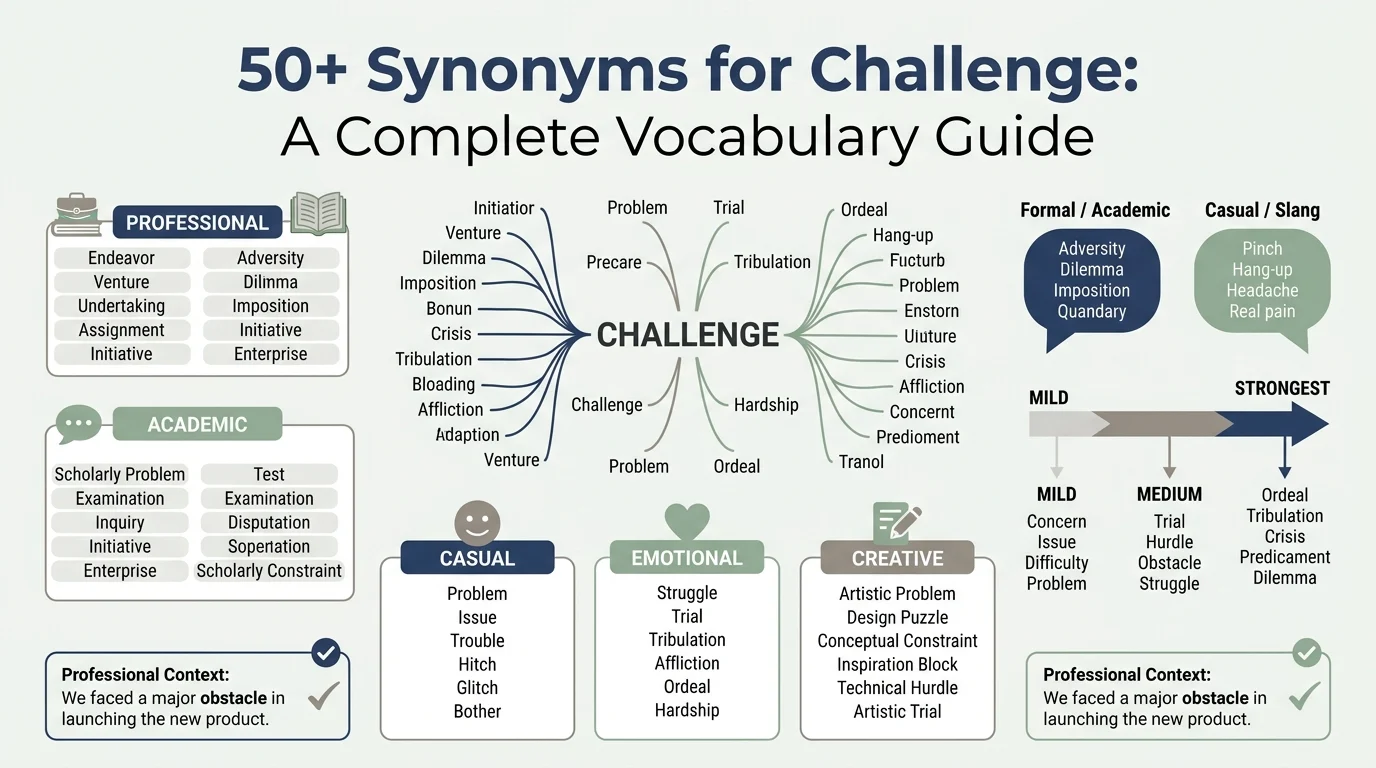
Do you keep repeating the word “challenge” in your emails, essays, or conversations? You are not alone. Many writers, students, and professionals rely on this single word far too often. But English offers dozens of precise alternatives that can make your communication clearer and more impactful.
Imagine you are writing a cover letter. You want to highlight how you handled a difficult project. Using “challenge” once is fine. Using it three times in one paragraph makes your writing feel repetitive and lazy. The right synonym can transform a dull sentence into something memorable.
This guide will help you move beyond “challenge.” You will learn the exact meaning of the word, explore over fifty synonyms, and understand exactly which word fits each situation. Whether you are writing a business report, an academic essay, or a casual text, you will find the perfect replacement here.
By the end of this article, you will never overuse “challenge” again. You will have a rich vocabulary of alternatives that match your intended tone, emotion, and formality level.
What Does “Challenge” Mean?
A challenge is a task or situation that tests your abilities, demands effort, or requires you to overcome obstacles. For formal writing, use “obstacle” or “difficulty.” professional settings, choose “opportunity” or “initiative.” casual conversation, say “tough spot” or “hurdle.” For academic contexts, select “complexity” or “problematic issue.” emotional impact, use “ordeal” or “trial.”
Meaning, Tone and Context
Simple Definition
A challenge is anything that requires special effort, skill, or determination to overcome. It can be a difficult task, a competitive situation, or a problem that tests your capabilities.
Part of Speech
Challenge functions as both a noun and a verb. As a noun, it refers to the difficult thing itself. As a verb, it means to question, dispute, or invite someone to compete.
Tone
The word “challenge” is generally neutral but leans slightly positive in professional contexts. It suggests opportunity and growth rather than pure difficulty.
Formality Level
“Challenge” works across all formality levels. It is appropriate in casual conversation, business emails, academic papers, and formal speeches.
Common Use Cases
People use “challenge” to describe work projects, personal goals, academic assignments, competitive situations, and life obstacles. It appears frequently in resumes, performance reviews, motivational content, and problem solving discussions.
Important Word Forms
- Adjective: challenging
- Noun: challenger
- Verb: to challenge
- Adverb: challengingly
- Opposite: ease, solution, advantage
When and How to Use “Challenge”
Use “challenge” when you want to describe a difficult task without sounding overly negative. The word carries a sense of opportunity and growth. It suggests that the difficulty is worth facing.
Here are realistic examples across different contexts:
Professional Context
“Leading the merger integration was the biggest challenge of my career.”
Academic Context
“The research presented a significant challenge due to limited historical records.”
Personal Context
“Learning to cook healthy meals on a budget has been an enjoyable challenge.”
Emotional Context
“Moving to a new country alone was both a challenge and a gift.”
Creative Context
“The artist embraced the challenge of painting with only primary colors.”
Resume Context
“Successfully overcame the challenge of reducing operational costs by fifteen percent.”
Social Media Context
“Day ten of my fitness challenge and I am feeling stronger every day.”
Email Context
“We anticipate several challenges with the new software rollout.”
Another Word for “Challenge”
The best single replacement depends entirely on your context and intended meaning. Here are the most effective alternatives for different situations.
Professional Writing
Use “obstacle” when you want to sound pragmatic and solution focused. “The main obstacle was budget approval.” For a more positive spin, use “opportunity.” “We viewed the tight deadline as an opportunity to innovate.”
Academic Writing
Use “complexity” when discussing intricate problems. “The complexity of the data required new analytical methods.” “Problematic issue” works well for research limitations.
Casual Conversation
Use “hurdle” for everyday difficulties. “Getting everyone to agree was the biggest hurdle.” “Tough spot” works for informal discussions about personal situations.
Emotional Writing
Use “ordeal” when describing a painful or difficult experience. “The recovery process was a prolonged ordeal.” “Trial” suggests a testing period that builds character.
Creative Writing
Use “quest” for adventurous challenges. “His quest for knowledge led him across the continent.” “Crucible” implies a transformative, intense challenge.
Resume and Workplace
Use “initiative” to highlight proactive challenge solving. “I took the initiative to restructure our workflow.” “Test” works for demonstrating skills. “The project was a true test of my leadership.”
Social Media Captions
Use “grind” for daily effort challenges. “The content creation grind never stops.” “Hustle” works for entrepreneurial challenges.
Stronger Meaning
Use “gauntlet” for a series of intense challenges. “Running the marathon was a gauntlet of physical and mental obstacles.”
Softer Meaning
Use “setback” for minor challenges. “We experienced a small setback with the delivery schedule.”
When Not to Use “Challenge”
Sometimes “challenge” sounds too vague or too optimistic for the situation. Here is when you should choose a more precise synonym.
When the Situation Is Trivial
Calling a minor inconvenience a “challenge” sounds dramatic and insincere. Instead of saying “Finding parking was a challenge,” say “Finding parking was difficult.” The simpler word fits the small problem.
When the Situation Is Truly Negative
“Challenge” implies opportunity and growth. For genuinely bad situations, use “crisis,” “catastrophe,” or “disaster.” Do not say “The flood presented a challenge” when people lost their homes. Say “The flood caused a crisis.”
When You Need Specificity
“Challenge” is generic. If you can name the specific problem, do so. Instead of “The main challenge was communication,” say “The main issue was miscommunication between departments.”
When You Want to Sound Objective
In scientific or technical writing, “challenge” can sound subjective. Use “limitation,” “constraint,” or “variable” for neutral precision.
When the Tone Should Be Firm
In legal or formal notices, “challenge” sounds weak. Use “dispute,” “objection,” or “noncompliance” to convey seriousness.
Words Commonly Confused With “Challenge”
Many words seem similar to “challenge” but have distinct meanings. Understanding these differences will help you choose the right word every time.
Problem
A problem is a general difficulty that needs a solution. A challenge implies that overcoming the difficulty offers some benefit or growth. “Problem” is more negative than “challenge.” Use “problem” for obstacles you want to fix. Use “challenge” for obstacles you want to conquer.
Difficulty
Difficulty describes how hard something is. A challenge is the hard thing itself. “Difficulty” focuses on the effort required. “Challenge” focuses on the task or situation. Use “difficulty” when emphasizing struggle. Use “challenge” when emphasizing opportunity.
Obstacle
An obstacle is a physical or figurative barrier that blocks progress. A challenge can be a barrier, but it can also be a complex task or competitive situation. “Obstacle” specifically means something standing in your way. “Challenge” is broader.
Hurdle
A hurdle is a temporary obstacle that you jump over. A challenge can be more substantial and long lasting. “Hurdle” suggests something manageable and brief. “Challenge” suggests something more significant.
Opportunity
An opportunity is a favorable situation. A challenge can become an opportunity, but it starts as a difficulty. “Opportunity” is purely positive. “Challenge” is neutral to positive.
Trial
A trial is a test of your character, endurance, or patience. A challenge can be a trial, but a trial often implies suffering or hardship. “Trial” has a more serious, emotional tone than “challenge.”
Best Synonym by Context for “Challenge”
Choose the right word for your specific situation using this comprehensive table.
| Context | Best Synonym | Why It Works | Example |
|---|---|---|---|
| Formal Writing | Obstacle | Sounds objective and professional | The primary obstacle to implementation was funding. |
| Academic Writing | Complexity | Emphasizes intellectual difficulty | The complexity of the data required advanced analysis. |
| Professional Writing | Initiative | Shows proactive problem solving | She took the initiative to resolve the scheduling conflict. |
| Resume | Test | Demonstrates proven capability | The project was a true test of my project management skills. |
| Casual Conversation | Hurdle | Feels natural and conversational | Getting everyone to agree was a major hurdle. |
| Creative Writing | Crucible | Adds dramatic, transformative imagery | The war became a crucible for the young soldier. |
| Emotional Tone | Ordeal | Conveys personal struggle and endurance | The recovery was a long and painful ordeal. |
| Strong Intensity | Gauntlet | Suggests multiple successive challenges | He ran the gauntlet of corporate politics. |
| Soft Tone | Setback | Minimizes the difficulty | We experienced a minor setback with delivery. |
| Social Media | Grind | Feels modern and relatable | The daily content grind never stops. |
| US Usage | Obstacle | Preferred in American business writing | The obstacle was greater than we anticipated. |
Which Synonym Should You Choose?
Selecting the perfect synonym requires considering four key factors. Here is a practical decision guide.
Consider Your Meaning
What exactly are you describing? A physical barrier requires “obstacle.” A complex problem needs “complexity.” A painful experience demands “ordeal.” Be specific about what you mean, and the right word will follow.
Consider Your Formality
Formal reports need “obstacle” or “difficulty.” Academic papers prefer “complexity” or “problematic issue.” Casual conversations welcome “hurdle” or “tough spot.” Match your word to your audience.
Consider Your Emotional Intensity
Mild situations call for “setback” or “difficulty.” Moderate challenges work with “hurdle” or “test.” Intense struggles need “ordeal,” “trial,” or “gauntlet.” Choose the word that matches the emotional weight.
Consider Your Professional Value
In resumes and performance reviews, choose words that show growth and capability. “Initiative” and “opportunity” present challenges as chances to shine. “Obstacle” shows you can identify roadblocks. “Test” demonstrates proven skill.
Real Life Examples of “Challenge” in Sentences
These examples show how “challenge” and its work in authentic situations. Notice how stronger synonyms elevate the writing.
School Context
“The advanced mathematics course presented a significant intellectual complexity for most students.”
Workplace Context
“Navigating the new software system proved to be our biggest operational obstacle this quarter.”
Creative Writing Context
“The barren landscape became a crucible for the explorer’s survival instincts.”
Conversation Context
“Getting the kids to bed on time is always my biggest nightly hurdle.”
Social Media Context
“Day thirty of my writing challenge and I am still going strong.”
Resume Context
“Spearheaded a company wide initiative to reduce energy consumption by twenty percent.”
Email Context
“We have identified several potential constraints that could delay the product launch.”
Storytelling Context
“Her journey from poverty to prosperity was an emotional ordeal that transformed her completely.”
25 Synonyms
This table provides a wide range of alternatives organized by tone, usage, and formality.
| Synonym | Simple Meaning | Best Used For | Example Sentence |
|---|---|---|---|
| Obstacle | A barrier blocking progress | Professional, business writing | The main obstacle was securing enough funding. |
| Difficulty | A hard or demanding situation | General, neutral usage | We encountered unexpected difficulties during testing. |
| Hurdle | A temporary barrier to overcome | Casual, everyday conversation | Finding a qualified candidate was our biggest hurdle. |
| Test | A situation that proves ability | Resumes, performance reviews | The project was a true test of my leadership. |
| Trial | A difficult experience that tests character | Emotional, personal writing | The illness was a painful trial for the family. |
| Ordeal | A prolonged, severe difficulty | Emotional, dramatic contexts | The hurricane recovery was a terrible ordeal. |
| Complexity | An intricate, detailed problem | Academic, technical writing | The complexity of the system required expert analysis. |
| Problem | A general issue needing solution | Neutral, everyday usage | The problem was more serious than we thought. |
| Dilemma | A difficult choice between options | Ethical, decision making contexts | We faced a dilemma between cost and quality. |
| Predicament | A difficult, awkward situation | Casual, conversational | His lateness put us in a real predicament. |
| Quandary | A state of uncertainty | Intellectual, thoughtful contexts | I was in a quandary about which path to take. |
| Obstruction | Something that blocks movement | Physical, concrete contexts | The fallen tree was an obstruction on the road. |
| Barrier | A limit or boundary | Social, organizational contexts | Language was a barrier to effective communication. |
| Impediment | A hindrance to progress | Formal, legal contexts | His criminal record was an impediment to employment. |
| Hardship | Severe suffering or deprivation | Serious, social contexts | The family endured great hardship during the war. |
| Adversity | Misfortune or difficulty | Inspirational, motivational | She overcame adversity with grace and courage. |
| Struggle | A determined effort against difficulty | Personal, emotional contexts | His struggle with addiction was heartbreaking. |
| Battle | An intense effort to overcome | Dramatic, forceful contexts | The battle against climate change continues. |
| Gauntlet | A series of difficult challenges | Literary, metaphorical contexts | She ran the gauntlet of media scrutiny. |
| Crusade | A determined, long term effort | Motivational, ambitious contexts | His crusade for justice lasted decades. |
| Initiative | A proactive approach to challenge | Professional, resume contexts | She launched an initiative to improve diversity. |
| Opportunity | A chance for growth or progress | Positive, professional contexts | The crisis presented an opportunity for innovation. |
| Setback | A temporary reversal of progress | Neutral, mild contexts | We experienced a minor setback with the timeline. |
| Constraint | A limiting factor or restriction | Technical, analytical contexts | Budget constraints limited our options. |
| Limit | A point beyond which you cannot go | Straightforward, clear contexts | Time was the main limit on our research. |
Synonym Groups and Usage Differences
Professional vs. Personal Synonyms
Professional contexts require words like “obstacle,” “constraint,” and “initiative.” These sound objective and businesslike. Personal contexts work better with “struggle,” “ordeal,” and “hurdle.” These words feel emotional and relatable. Choose “obstacle” for a boardroom presentation. Choose “struggle” for a conversation with a friend.
Formal vs. Conversational Synonyms
Formal writing demands “impediment,” “obstruction,” and “difficulty.” These words appear in reports, legal documents, and academic papers. Conversational English uses “hurdle,” “tough spot,” and “predicament.” These feel natural in everyday speech. Never use “impediment” in a casual text message. Never use “predicament” in a formal research paper.
Academic Synonyms
Academic writing values precision and neutrality. “Complexity” describes intricate systems. “Problematic issue” introduces research limitations. “Variable” identifies factors that affect outcomes. “Constraint” names limiting conditions. These words sound objective and scholarly. They avoid emotional language and focus on analysis.
Professional and Business Synonyms
Business communication benefits from positive, action oriented words. “Initiative” shows proactive leadership. “Opportunity” frames challenges as growth chances. “Test” demonstrates capability. “Obstacle” identifies problems clearly. These words work well in emails, presentations, resumes, and performance reviews. They show competence and confidence.
Creative or Literary Synonyms
Creative writing thrives on vivid, imaginative language. “Crucible” suggests transformation through fire. “Gauntlet” implies running through attacks. “Quest” evokes adventure and purpose. “Battle” creates dramatic conflict. “Ordeal” adds emotional weight. These words paint pictures in the reader’s mind. They add depth and intensity to storytelling.
Slang or Modern Synonyms
Modern English offers casual alternatives like “grind” and “hustle.” These words describe daily, ongoing efforts. “Grind” refers to repetitive hard work. “Hustle” implies energetic, entrepreneurial effort. These words work well on social media and in casual conversation. Avoid them in formal writing and professional emails.
Strongest vs. Weaker Synonyms
Intensity matters when choosing synonyms. Here is a scale from mild to strongest.
Mild: setback, difficulty, problem
Moderate: obstacle, hurdle, test
Strong: trial, ordeal, adversity
Strongest: crucible, gauntlet, battle, crisis
Use mild words for everyday situations. Use strongest words for life changing events. Match the intensity to the actual difficulty.
Emotional vs. Neutral Synonyms
Emotional synonyms add feeling and personal connection. “Ordeal,” “trial,” and “struggle” convey human experience. “Adversity” suggests overcoming misfortune. Neutral synonyms stay factual and objective. “Obstacle,” “constraint,” and “difficulty” present problems without emotion. Choose emotional words for personal narratives and motivational content. Choose neutral words for reports and technical documents.
Antonyms of “Challenge”
Understanding opposites helps clarify meaning. Here are fifteen antonyms for “challenge” organized with definitions and examples.
| Antonym | Meaning | Example Sentence |
|---|---|---|
| Solution | An answer to a problem | We found a solution to the scheduling conflict. |
| Advantage | A favorable position | His experience gave him a clear advantage. |
| Benefit | A positive outcome | The new policy provided benefit to all employees. |
| Asset | A useful or valuable thing | Her language skills were a major asset. |
| Ease | Freedom from difficulty | The project proceeded with surprising ease. |
| Opportunity | A favorable situation | The promotion was a great opportunity. |
| Success | A favorable outcome | The campaign was a resounding success. |
| Victory | A win over difficulty | The final vote was a victory for our team. |
| Comfort | A state of physical or mental ease | She lived in comfort after her promotion. |
| Certainty | A known, established fact | The data provided certainty about our direction. |
| Clarity | Clear understanding | The explanation brought clarity to the issue. |
| Advantage | Superior position | His connections gave him an unfair advantage. |
| Breakthrough | A significant advance | The research represented a major breakthrough. |
| Support | Assistance or backup | We received full support from management. |
| Guarantee | A promise of outcome | The contract included a performance guarantee. |
Comparison: Challenge vs. Similar Words
These comparisons will help you distinguish “challenge” from related words. Understanding the nuances will improve your word choices.
Challenge vs. Problem
The main difference is attitude. A “problem” is something wrong that needs fixing. A “challenge” is something difficult that offers growth. “Problem” is negative. “Challenge” is neutral to positive. Use “problem” for obstacles you want to eliminate. Use “challenge” for obstacles you want to overcome.
“Problem” is more common in everyday speech. “Challenge” appears more frequently in professional and motivational contexts. “Problem” focuses on the issue itself. “Challenge” focuses on the effort required to address it.
Example with “problem”: The broken printer was a problem for the whole office.
Example with “challenge”: Reducing printer waste was an environmental challenge.
Challenge vs. Obstacle
An “obstacle” specifically blocks progress toward a goal. A “challenge” can be any difficult task, not just a barrier. “Obstacle” implies something standing in your way. “Challenge” implies something requiring effort and skill.
“Obstacle” is more concrete and physical. “Challenge” is more abstract and varied. Use “obstacle” when something prevents forward movement. Use “challenge” when something tests your abilities.
Example with “obstacle”: The language barrier was an obstacle to our negotiations.
Example with “challenge”: Learning Japanese was an exciting challenge.
Challenge vs. Difficulty
“Difficulty” describes the level of hardness. “Challenge” describes the hard task itself. “Difficulty” measures effort. “Challenge” names the situation.
“Difficulty” is more objective and neutral. “Challenge” often implies opportunity. Use “difficulty” when focusing on struggle. Use “challenge” when focusing on the task.
Example with “difficulty”: We completed the project with great difficulty.
Example with “challenge”: Completing the project on time was our biggest challenge.
Challenge vs. Hurdle
A “hurdle” is a temporary, manageable obstacle. A “challenge” can be more significant and long lasting. “Hurdle” suggests something you jump over and move on. “Challenge” suggests something you work through.
“Hurdle” is more casual and conversational. “Challenge” works across all formality levels. Use “hurdle” for small, brief difficulties. Use “challenge” for larger, more complex situations.
Example with “hurdle”: Getting approval was just the first hurdle.
Example with “challenge”: The entire project was a massive challenge.
Challenge vs. Trial
A “trial” is a test of character, endurance, or patience. A “challenge” can be a trial, but trials often involve suffering. “Trial” has serious, emotional undertones. “Challenge” is more neutral and professional.
“Trial” implies hardship and testing. “Challenge” implies opportunity and growth. Use “trial” for difficult personal experiences. Use “challenge” for professional or academic difficulties.
Example with “trial”: The cancer treatment was a grueling trial.
Example with “challenge”: The cancer treatment presented many physical challenges.
Challenge vs. Opportunity
An “opportunity” is favorable. A “challenge” starts as difficult. The key difference is perspective. Seeing a challenge as an opportunity is a mindset shift.
“Opportunity” is purely positive. “Challenge” is neutral or mildly positive. Use “opportunity” when emphasizing benefits. Use “challenge” when acknowledging difficulty.
Example with “opportunity”: The merger created new opportunities for growth.
Example with “challenge”: The merger presented significant integration challenges.
Common Phrases and Expressions with “Challenge”
These common expressions will help you use “challenge” naturally in various contexts.
1. Rise to the challenge
Meaning: Successfully deal with a difficult situation.
Example sentence: The team rose to the challenge and delivered the project early.
2. Face a challenge
Meaning: Confront a difficult situation.
Example sentence: Small businesses often face challenges when expanding internationally.
3. Meet the challenge
Meaning: Deal with a challenge successfully.
Example sentence: Our new software meets the challenge of managing remote teams.
4. Take on a challenge
Meaning: Accept or begin a difficult task.
Example sentence: I decided to take on the challenge of running a marathon.
5. Present a challenge
Meaning: Create or offer a difficulty.
Example sentence: The new regulations present a challenge for the industry.
6. Overcome a challenge
Meaning: Successfully deal with and move past difficulty.
Example sentence: She overcame every challenge that came her way.
7. Daunting challenge
Meaning: A challenge that seems frighteningly difficult.
Example sentence: Starting a business is a daunting challenge for many people.
8. Significant challenge
Meaning: A challenge that is important and substantial.
Example sentence: Climate change is the most significant challenge of our time.
Common Mistakes to Avoid
Many writers make predictable errors when using “challenge” . Avoid these common pitfalls.
Mistake 1: Using “Challenge” When a Precise Synonym Is Better
Generic use of “challenge” weakens your writing. Instead of saying “We faced many challenges,” specify them. “We faced budget constraints, staffing shortages, and supply chain issues.” Specificity is always stronger than vagueness.
Mistake 2: Confusing “Challenge” With “Problem”
“Problem” is negative. “Challenge” is neutral or positive. Do not call a serious crisis a “challenge.” That minimizes the severity. Do not call a minor issue a “problem.” That exaggerates the difficulty. Match the word to the actual situation.
Mistake 3: Using Casual Synonyms in Formal Writing
Words like “hurdle” and “grind” have their place. That place is casual conversation and social media. Do not use them in academic papers, legal documents, or formal reports. Choose “obstacle,” “difficulty,” or “impediment” instead.
Mistake 4: Using Overly Dramatic Synonyms for Simple Situations
Calling a traffic jam an “ordeal” is excessive. Calling a busy day a “battle” is hyperbolic. Save strong words like “crucible,” “gauntlet,” and “ordeal” for genuinely serious situations. Use milder words for everyday difficulties.
Mistake 5: Repeating the Same Word Too Often
Repetition bores readers. If you write “challenge” three times in one paragraph, your writing feels lazy. Use synonyms to add variety. Choose “obstacle,” “difficulty,” “test,” or “hurdle” to keep your writing fresh.
Mistake 6: Choosing a Synonym With the Wrong Emotional Tone
Every synonym carries emotional weight. “Obstacle” is neutral. “Ordeal” is heavy. “Setback” is mild. “Battle” is intense. Choose the word that matches your emotional intent. Do not use an intense word for a mild situation. Do not use a mild word for an intense situation.
Mistake 7: Using Slang in Academic or Professional Writing
Slang words like “hustle” and “grind” are acceptable in casual content. They have no place in academic essays, business reports, or professional emails. Save these words for social media and friendly conversations.
FAQs
What is the best synonym for “challenge”?
The best synonym depends on your context. For professional writing, use “obstacle.” casual conversation, use “hurdle.” For academic contexts, use “complexity.” emotional impact, use “ordeal.”
What is a formal synonym for “challenge”?
Formal synonyms include “impediment,” “obstruction,” “difficulty,” and “constraint.” These words appear in legal documents, academic papers, and professional reports. They sound objective and serious.
What is an informal synonym for “challenge”?
Informal synonyms include “hurdle,” “tough spot,” “predicament,” and “grind.” These words work well in everyday conversation, text messages, and social media posts. They feel natural and conversational.
What is another word for “challenge” in professional writing?
Professional writing benefits from “obstacle,” “initiative,” “opportunity,” and “test.” “Obstacle” identifies barriers clearly. “Initiative” shows proactive problem solving. “Opportunity” frames challenges positively.
What is the difference between “challenge” and “obstacle”?
A challenge is any difficult task or situation. An obstacle specifically blocks progress toward a goal. All obstacles are challenges, but not all challenges are obstacles. Use “obstacle” for barriers. Use “challenge” for any demanding task.
What is the opposite of “challenge”?
The opposite of challenge includes “solution,” “advantage,” “benefit,” “asset,” and “ease.” These words describe favorable situations without difficulty. They represent the absence of struggle or the presence of helpful conditions.
Conclusion
Challenge is a versatile and useful word. It describes anything from minor daily difficulties to life changing struggles. But relying on this single word limits your expression and makes your writing repetitive.
The English language offers dozens of precise alternatives. Use “obstacle” for professional barriers.”hurdle” for casual difficulties. “complexity” for academic problems. Use “ordeal” for emotional struggles. Match your word to your context, formality, and emotional intensity.
Strong writers choose the exact word for every situation. They avoid vague, generic language. consider their audience and purpose. They use synonyms to add variety and precision.
Start expanding your vocabulary today. The next time you write “challenge,” ask yourself if a more specific word would work better. Your readers will notice the difference. Your writing will become clearer, more engaging, and more professional.