Have you ever stared at a blank page while writing an email, an essay, or a social media caption, wondering if there is a better way to describe something that keeps slipping away? You know the feeling. The word is right there, but it refuses to be pinned down. That is exactly what it means when something is elusive. Whether you are a student working on an assignment, a professional drafting a report, or a content creator searching for the perfect phrase, understanding the synonyms of elusive can transform your writing. Choosing the right synonym does more than avoid repetition. It sharpens your message, clarifies your tone, and helps your reader understand exactly what you mean. This guide will help you master every shade of meaning this versatile word offers.
What Are the Best Synonyms of “Elusive”?
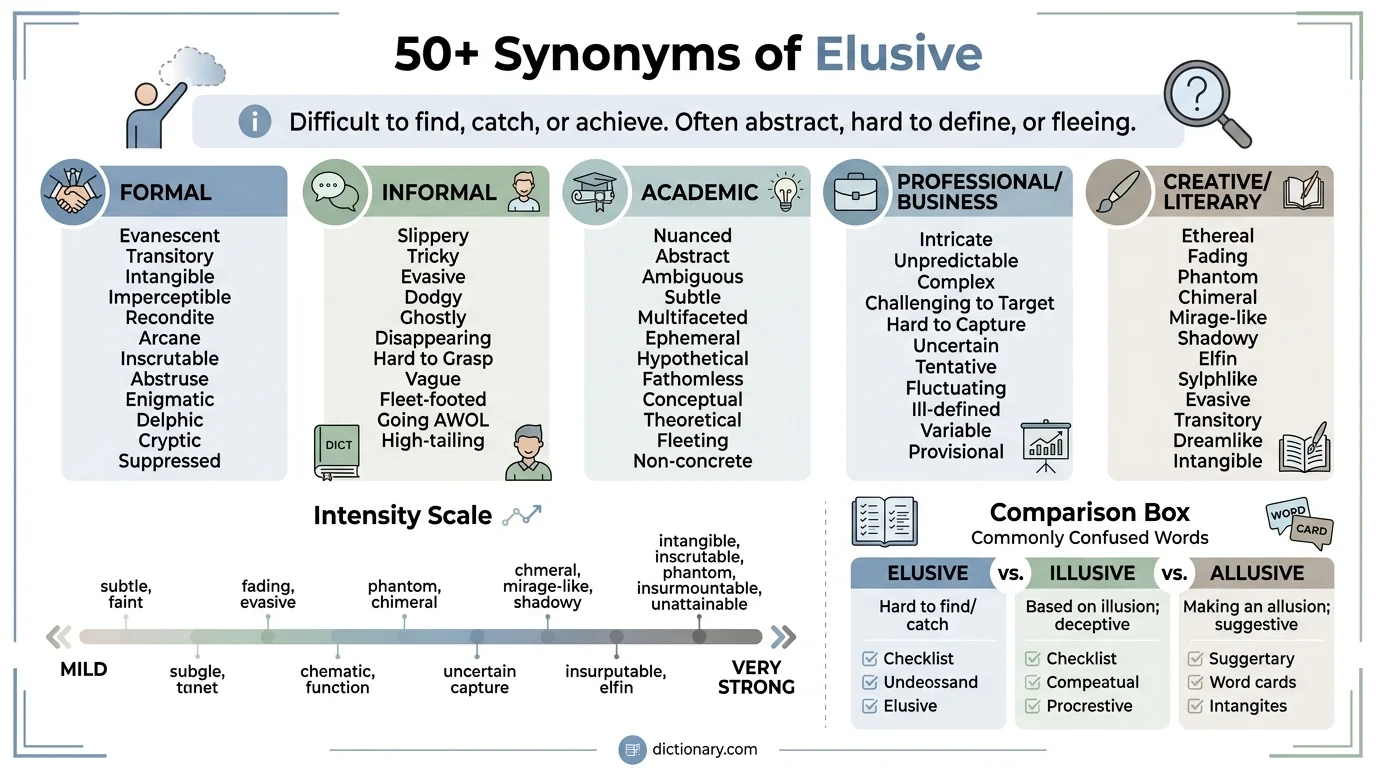
Elusive means difficult to find, catch, achieve, or remember. Its tone is neutral, though it can carry a hint of frustration or mystery depending on context. For formal writing, choose intangible or unattainable. For casual conversation, use slippery or tricky. In academic work, subtle or abstruse works well. For professional communication, evasive or hard to pin down are strong choices. Emotional writing benefits from fleeting or ghostly, while creative writing can use ethereal or shadowy.
Meaning, Tone, and Context
Simple Definition
Elusive describes anything that is hard to find, catch, achieve, or remember. It can refer to physical things like animals or criminals, abstract ideas like concepts or memories, or goals like success or happiness.
Part of Speech
Adjective.
Overall Tone
Neutral. The word itself does not carry strong positive or negative emotion, but the context often adds a layer of frustration, mystery, or admiration.
Formality Level
Semi-formal to formal. Elusive appears frequently in academic writing, journalism, and professional contexts. It is also used in everyday conversation without sounding stiff.
Common Uses
Native English speakers use elusive to describe:
- Animals that are hard to track or observe
- Criminals or suspects who avoid capture
- Goals or achievements that remain out of reach
- Memories that are difficult to recall
- Concepts or ideas that are hard to define
- Answers or solutions that are not easy to find
Word Forms
- Noun: elusiveness
- Adverb: elusively
- Related verb: elude (to escape or avoid)
- Opposite form: accessible, attainable, clear
When and How to Use “Elusive”
Choose elusive when you want to describe something that resists easy capture, understanding, or achievement. It works best when the difficulty is inherent to the thing itself, not caused by someone actively avoiding you.
Here are seven realistic examples across different contexts.
Professional:
“The project’s key metric remained elusive despite multiple rounds of data analysis.”
Academic:
“A precise definition of consciousness has proven elusive for philosophers and neuroscientists alike.”
Workplace:
“Finding a candidate with all the required skills has been surprisingly elusive this hiring season.”
Personal:
“That elusive sense of peace finally came during my morning walk by the lake.”
Email:
“I have been trying to schedule a meeting with the client, but a mutually available time continues to be elusive.”
Resume:
“Developed creative strategies to acquire elusive high-value clients in competitive markets.”
Social Media:
“Chasing that elusive perfect golden hour shot. Wish me luck.”
Best Synonyms of “Elusive”
No synonym is identical in every situation. The best choice depends on your audience, your purpose, and the specific shade of meaning you want to convey. Here are the top recommendations for different contexts.
Professional Writing
Hard to pin down is the most natural choice. It sounds professional without being overly formal and clearly communicates that something is difficult to define or locate.
Academic Writing
Subtle works well when describing ideas that are difficult to grasp because they are fine or delicate. Abstruse is stronger and suggests the idea is purposely complex or obscure.
Business Communication
Evasive is appropriate when describing someone who avoids direct answers. Unattainable fits goals or targets that remain out of reach.
Casual Conversation
Slippery is the go-to choice. It is informal, easy to understand, and vividly describes something or someone that keeps getting away.
Emotional Writing
Fleeting captures the sadness or beauty of something that passes quickly. Ghostly adds a haunting quality.
Creative Writing
Ethereal suggests something delicate, otherworldly, and almost too beautiful to grasp. Shadowy implies mystery and darkness.
Resume Writing
High-value or strategic can replace elusive when describing clients or opportunities you successfully pursued.
Workplace Communication
Hard to reach or difficult to secure are clear and direct alternatives that everyone understands.
Stronger Meaning
Unobtainable and inaccessible emphasize that something is not just difficult but nearly impossible to get.
Softer Meaning
Subtle and vague tone down the difficulty and focus more on the lack of clarity.
When Not to Use “Elusive”
When the Word Sounds Too General
If you are describing something that is simply unclear, elusive might be too dramatic.
Better choice: vague or unclear
Original: “The instructions were elusive.”
Improved: “The instructions were vague and difficult to follow.”
When the Word Sounds Too Vague
Elusive covers many types of difficulty. If you need to be specific about whether something is hard to find, hard to understand, or hard to achieve, choose a more precise word.
Better choice: hard to find, hard to understand, or hard to achieve
Original: “The answer was elusive.”
Improved: “The answer was hard to find in the available research.”
When the Word Sounds Too Formal
In casual conversation or text messages, elusive can feel out of place.
Better choice: tricky or hard to get
Original: “That restaurant is elusive.”
Improved: “That restaurant is tricky to get a reservation at.”
When the Word Sounds Too Informal
In formal reports or academic papers, avoid casual synonyms like slippery or tricky.
Better choice: intangible or unattainable
Original: “The solution remained slippery.”
Improved: “A viable solution remained unattainable.”
When the Word Sounds Too Weak
If something is truly impossible to achieve, elusive might understate the situation.
Better choice: impossible, unreachable
Original: “The goal was elusive.”
Improved: “The goal proved unreachable given current constraints.”
When the Word Sounds Outdated
Elusive does not have major outdated connotations, but overusing it can make your writing feel repetitive or clichéd.
Words Commonly Confused With “Elusive”
Elusive vs Evasive
Difference: Elusive describes something that is hard to find or grasp. Evasive describes someone who deliberately avoids giving direct answers or being caught.
When to Use It: Use elusive for things or concepts that naturally resist capture. Use evasive for people who are intentionally avoiding something.
Example: “The elusive bird was spotted only twice.” / “The politician gave evasive answers to every question.”
Elusive vs Illusive
Difference: Elusive means hard to catch or understand. Illusive means based on an illusion, not real or deceptive.
When to Use It: Use elusive when something exists but is hard to find. Use illusive when something is not actually real.
Example: “Happiness can be elusive for some people.” / “The promise of easy wealth proved illusive.”
Elusive vs Subtle
Difference: Elusive emphasizes difficulty in finding or grasping. Subtle emphasizes delicacy and the need for careful attention to perceive.
When to Use It: Use elusive for things that actively resist capture. Use subtle for things that are there but require close observation.
Example: “The meaning of the poem remained elusive.” / “There was a subtle shift in her tone.
Elusive vs Fleeting
Difference: Elusive emphasizes the difficulty of capture. Fleeting emphasizes the short duration of something.
When to Use It: Use elusive when something keeps getting away. Use fleeting when something passes by quickly.
Example: “The answer continued to be elusive.” / “I caught a fleeting glimpse of the sunset.”
Elusive vs Intangible
Difference: Elusive can apply to physical things like animals or criminals. Intangible specifically refers to things that have no physical form.
When to Use It: Use elusive for both physical and abstract things. Use intangible only for abstract concepts.
Example: “The elusive thief escaped again.” / “Trust is an intangible quality that is hard to measure.”
Elusive vs Abstruse
Difference: Elusive covers a wide range of difficulty. Abstruse specifically means difficult to understand because of complexity or obscurity.
When to Use It: Use elusive for general difficulty. Use abstruse for intellectual complexity.
Example: “The solution remained elusive.” / “The professor’s abstruse lecture confused everyone.”
Best Synonyms of “Elusive” by Context
| Context | Best Synonym | Why It Works | Example |
|---|---|---|---|
| Formal writing | Intangible | Sounds sophisticated and precise | “The intangible benefits of the program were significant.” |
| Academic writing | Subtle | Conveys nuance and careful observation | “The study revealed subtle differences between the two groups.” |
| Professional communication | Hard to pin down | Clear and widely understood | “The client’s requirements have been hard to pin down.” |
| Business emails | Difficult to secure | Direct and professional | “A meeting time has been difficult to secure.” |
| Resume writing | Strategic | Positions you as proactive | “Secured strategic partnerships with elusive industry leaders.” |
| Workplace communication | Hard to reach | Straightforward and neutral | “The department head has been hard to reach this week.” |
| Casual conversation | Slippery | Vivid and informal | “My keys have been slippery all morning.” |
| Everyday speaking | Tricky | Simple and natural | “Finding a good plumber is tricky.” |
| Creative writing | Ethereal | Adds beauty and mystery | “An ethereal light flickered through the trees.” |
| Storytelling | Shadowy | Creates atmosphere and suspense | “A shadowy figure moved through the fog.” |
| Emotional writing | Fleeting | Captures poignancy and loss | “Their fleeting moment of happiness was unforgettable.” |
| Strong emphasis | Unattainable | Conveys impossibility | “Perfection is an unattainable standard.” |
| Mild tone | Vague | Softens the difficulty | “The instructions were somewhat vague.” |
| Social media captions | Hard to catch | Relatable and conversational | “Trying to get a hard-to-catch shot of my dog.” |
| American English | Elusive | Standard across all contexts | “Success has been elusive for the team.” |
How to Choose the Best Synonym of “Elusive”
Choosing the right synonym comes down to four questions.
What exactly are you describing? If you are describing a physical thing like an animal or a person, choose slippery, hard to find, or evasive. If you are describing an idea or concept, choose subtle, intangible, or *abstruse.
Who is your audience? For professional or academic readers, choose intangible, unattainable, or subtle. For friends or casual readers, choose tricky or hard to get.
How much emotion do you want to convey? For strong emotion, choose fleeting or ghostly. For neutral communication, choose hard to pin down or difficult to secure.
How difficult is the thing you are describing? For mild difficulty, choose vague or subtle. For extreme difficulty, choose unobtainable or *inaccessible.
The best synonym is the one that communicates your intended meaning most clearly to your specific reader. When in doubt, read your sentence aloud with each option and choose the one that sounds most natural.
Real Life Examples of “Elusive”
School: “The answer to the bonus question remained elusive until the final minutes of the exam.”
College: “For many students, a healthy work-life balance is an elusive goal during finals week.”
Workplace: “The marketing team finally cracked the elusive code to reaching Gen Z consumers.”
Business: “Our company has been chasing an elusive 20 percent market share for three years.”
Email: “I wanted to follow up on my previous message, but a clear path forward has been elusive.”
Resume: “Successfully negotiated contracts with elusive overseas suppliers, increasing profit margins by 15 percent.”
Conversation: “Have you seen my glasses? They have been absolutely elusive today.”
Storytelling: “The sailor spent his life searching for the elusive island marked on the ancient map.”
Blogging: “Finding the perfect work-from-home setup can feel like an elusive dream.”
Social Media: “Currently hunting for that elusive perfect coffee shop for my morning routine.”
18 Best Synonyms of “Elusive”
Synonyms of “Elusive” by Usage
Professional vs Personal Synonyms
In professional settings, choose words that sound competent and clear. Intangible, unattainable, and hard to pin down work well in reports, emails, and meetings. In personal conversations, slippery, tricky, and hard to get sound more natural and relatable.
Formal vs Conversational Synonyms
Formal writing like reports, essays, and business presentations benefits from intangible, abstruse, and unattainable. Conversational contexts like texting, casual emails, and everyday speech call for slippery, tricky, and hard to catch.
Academic Synonyms
For research papers, essays, and academic discussions, choose subtle, abstruse, or intangible. These words sound authoritative and precise. Subtle works well for describing fine distinctions. Abstruse fits complex theories. Intangible suits abstract concepts.
Professional and Business Synonyms
In resumes, interviews, and client communications, choose strategic, high-value, or hard to secure. These words position you as someone who overcomes challenges. Unattainable works for describing ambitious goals. Evasive fits descriptions of difficult competitors or clients.
Creative and Literary Synonyms
For storytelling, fiction, and poetry, choose ethereal, shadowy, ghostly, or enigmatic. These words add emotion, imagery, and atmosphere. Ethereal suggests beauty and delicacy. Shadowy creates mystery. Ghostly adds a haunting quality. Enigmatic suggests intrigue.
Slang or Modern Synonyms
Elusive does not have widely used slang equivalents. In very informal speech, slippery and tricky are the closest natural options. Avoid forcing slang where none naturally exists.
Strongest to Mildest Synonyms
Mild: vague, subtle, obscure
Moderate: tricky, hard to find, elusive
Strong: evasive, slippery, baffling
Very Strong: unattainable, inaccessible, unobtainable
The emotional intensity increases as you move from mild to very strong. Mild synonyms suggest something is simply unclear. Strong synonyms suggest active resistance or near impossibility.
Emotional vs Neutral Synonyms
Emotional Synonyms: fleeting, ghostly, ethereal, shadowy, enigmatic. These words carry emotional weight and are best used in creative writing, storytelling, and personal expression.
Neutral Synonyms: evasive, slippery, subtle, intangible, baffling, tricky, shifty, obscure, vague, unattainable, inaccessible, abstruse. These words communicate information without adding strong emotion. They are appropriate for professional, academic, and everyday communication.
Antonyms of “Elusive”
| Antonym | Meaning | Example Sentence |
|---|---|---|
| Accessible | Easy to reach or obtain | “The information was accessible to everyone.” |
| Attainable | Possible to achieve | “With hard work, the goal became attainable.” |
| Clear | Easy to understand | “Her instructions were clear and easy to follow.” |
| Definite | Clearly stated or decided | “We need a definite answer by Friday.” |
| Obvious | Easily seen or understood | “The solution was obvious once explained.” |
| Tangible | Perceptible by touch or clear | “We need tangible evidence to support the claim.” |
| Understandable | Able to be comprehended | “His frustration was understandable.” |
| Reachable | Able to be reached | “The summit was reachable with proper gear.” |
| Apparent | Clearly visible or understood | “The benefits were apparent to all.” |
| Straightforward | Simple and easy to do | “The process was straightforward and efficient.” |
| Easy | Not difficult | “Finding the location was surprisingly easy.” |
| Available | Able to be used or obtained | “The resources were available to all students.” |
| Evident | Clearly seen or understood | “The improvement was evident after one week.” |
| Plain | Easy to see or understand | “The truth was plain to everyone in the room.” |
| Direct | Straightforward and honest | “She gave a direct answer without hesitation.” |
Comparison: “Elusive” vs Similar Words
Elusive vs Evasive
Main Difference: Elusive is about the difficulty of finding or grasping something. Evasive is about intentional avoidance.
Which Is Stronger? Evasive implies deliberate action, which can feel more intentional and therefore stronger in certain contexts.
Which Is More Formal? Both are formal, but evasive is more commonly used in legal and professional contexts.
When to Use Each: Use elusive for things that are naturally hard to catch. Use evasive for people who are actively avoiding something.
Examples:
Elusive: “The elusive answer finally came to me.”
Evasive: “The CEO gave evasive answers during the press conference.”
Elusive vs Illusive
Main Difference: Elusive means hard to find. Illusive means not real or based on illusion.
Which Is Stronger? Illusive is stronger because it questions existence itself.
Which Is More Formal? Both are formal, though illusive is less common.
When to Use Each: Use elusive when something exists but is hard to find. Use illusive when something is deceptive or unreal.
Examples:
Elusive: “The elusive butterfly landed briefly on the flower.”
Illusive: “The promise of overnight success proved illusive.”
Elusive vs Subtle
Main Difference: Elusive emphasizes the difficulty of capture. Subtle emphasizes the need for careful observation.
Which Is Stronger? Elusive is stronger because it suggests active resistance.
Which Is More Formal? Both are formal and commonly used in academic writing.
When to Use Each: Use elusive when something keeps getting away. Use subtle when something is there but requires attention to notice.
Examples:
Elusive: “The meaning of the poem remained elusive.”
Subtle: “The painting contained subtle details that rewarded close viewing.”
Elusive vs Fleeting
Main Difference: Elusive focuses on difficulty of capture. Fleeting focuses on short duration.
Which Is Stronger? Neither is inherently stronger; they emphasize different qualities.
Which Is More Formal? Both are formal and literary.
When to Use Each: Use elusive when something resists being caught. Use fleeting when something passes quickly.
Examples:
Elusive: “The solution continued to be elusive.”
Fleeting: “We shared a fleeting glance across the room.”
Elusive vs Intangible
Main Difference: Elusive can describe physical and abstract things. Intangible specifically describes things without physical form.
Which Is Stronger? Elusive is stronger when describing difficulty. Intangible is more precise about lack of physical form.
Which Is More Formal? Intangible is more formal and commonly used in business and economics.
When to Use Each: Use elusive for general difficulty. Use intangible for abstract concepts.
Examples:
Elusive: “The elusive criminal escaped again.”
Intangible: “Goodwill is an intangible asset on the balance sheet.”
Elusive vs Abstruse
Main Difference: Elusive covers many types of difficulty. Abstruse specifically means difficult to understand because of complexity.
Which Is Stronger? Abstruse is stronger and more specific about intellectual difficulty.
Which Is More Formal? Abstruse is more formal and academic.
When to Use Each: Use elusive for general difficulty. Use abstruse for complex, hard-to-understand ideas.
Examples:
Elusive: “The answer remained elusive despite multiple attempts.”
Abstruse: “The professor’s abstruse lectures confused the entire class.”
Common Phrases and Expressions with “Elusive”
Elusive goal
Meaning: A goal that is very difficult to achieve.
Example Sentence: “Winning the championship has been the team’s elusive goal for a decade.”
Elusive dream
Meaning: A dream or aspiration that seems always out of reach.
Example Sentence: “She spent years chasing her elusive dream of opening a bakery.”
Elusive answer
Meaning: An answer that is hard to find or define.
Example Sentence: “The professor posed a question with an elusive answer.”
Elusive concept
Meaning: An idea that is difficult to define or understand.
Example Sentence: “Justice is an elusive concept that philosophers have debated for centuries.”
Remain elusive
Meaning: To continue to be hard to find, catch, or achieve.
Example Sentence: “Despite extensive research, a cure remains elusive.”
Prove elusive
Meaning: To turn out to be difficult to find or achieve.
Example Sentence: “A solution to the problem proved elusive for the engineering team.”
Elusive quality
Meaning: A characteristic that is hard to define or pin down.
Example Sentence: “The actor had an elusive quality that made him fascinating to watch.”
Elusive suspect
Meaning: A criminal who is hard to capture.
Example Sentence: “The police have been tracking the elusive suspect for months.”
Common Mistakes to Avoid
1: Choosing a Vague Synonym Instead of a Precise One
Incorrect: “The instructions were elusive.”
Better: “The instructions were vague and left many questions unanswered.”
Why: Elusive suggests active difficulty. Vague suggests lack of clarity. If the instructions are simply unclear, vague is more accurate.
2: Confusing Elusive with Evasive
Why: Evasive describes intentional avoidance by people. Concepts cannot be evasive. Use elusive for abstract things.
Incorrect: “The concept was evasive.”
Better: “The concept was elusive.”
3: Using an Informal Synonym in Formal Writing
Incorrect: “The solution remained slippery.”
Better: “A viable solution remained unattainable.”
Why: Slippery is too informal for academic or professional writing. Choose more formal synonyms for serious contexts.
4: Selecting an Overly Dramatic Synonym
Incorrect: “The coffee shop was elusive.”
Better: “The coffee shop was hard to find.”
Why: Elusive suggests significant difficulty or mystery. Using it for everyday situations sounds exaggerated.
5: Repeating the Same Word Too Often
Incorrect: “The elusive answer was in an elusive book written by an elusive author.”
Better: “The hard-to-find answer was in an obscure book written by a reclusive author.”
Why: Repeating elusive makes writing dull. Use synonyms to keep your writing fresh and engaging.
6: Choosing a Synonym with the Wrong Emotional Tone
Incorrect: “The fleeting victory was celebrated by the team.”
Better: “The hard-won victory was celebrated by the team.”
Why: Fleeting suggests something passes quickly. A victory celebration suggests lasting achievement. Choose a synonym that matches the emotional tone.
7: Using Slang in Academic or Professional Writing
Incorrect: “The data was slippery and hard to analyze.”
Better: “The data was difficult to analyze due to its complexity.”
Why: Slippery is too casual for academic or professional contexts. Use precise, formal language in these settings.
Frequently Asked Questions
1. What are the best synonyms of “elusive”?
The best synonyms depend on your context. Formal writing, use intangible or unattainable. For casual conversation, use slippery or tricky. For academic work, use subtle or abstruse. Professional communication, use evasive or hard to pin down.
2. What are the best formal synonyms of “elusive”?
The best formal synonyms include intangible, unattainable, abstruse, and subtle. These words sound sophisticated and precise, making them ideal for academic papers, business reports, and professional correspondence.
3. What are common informal synonyms of “elusive”?
Common informal synonyms include slippery, tricky, hard to get, and hard to catch. These words are natural in everyday conversation, text messages, and casual social media posts.
4. What is another word for “elusive” in professional writing?
In professional writing, hard to pin down, difficult to secure, and unattainable are excellent choices. They sound professional without being overly formal and clearly communicate the difficulty involved.
5. What is the difference between “elusive” and “evasive”?
Elusive means difficult to find, catch, or understand. Evasive means deliberately avoiding direct answers or capture. Elusive describes a quality of the thing itself. Evasive describes intentional behavior by a person.
6. What is the opposite of “elusive”?
The opposite of elusive includes accessible, attainable, clear, definite, obvious, and tangible. These words describe things that are easy to find, understand, or achieve.
Conclusion
Elusive is a versatile word that describes anything difficult to find, catch, achieve, or remember. Its neutral tone and semi-formal register make it useful across many contexts, from academic papers to everyday conversation. The best synonyms of elusive depend entirely on your audience, your purpose, and the specific shade of meaning you want to convey. Formal writing, choose intangible or unattainable. For casual conversation, choose slippery or tricky. For academic work, choose subtle or abstruse. Professional communication, choose evasive or hard to pin down. No synonym works perfectly in every situation. The key to strong writing is choosing the word that communicates your intended meaning most clearly to your specific reader. As you expand your vocabulary, pay attention to how skilled writers use synonyms in context. Notice which words they choose and why. Over time, choosing the right word will become second nature.
7 thoughts on “50+ Synonyms of Elusive | Meanings, Uses, Examples, and Best Alternatives”