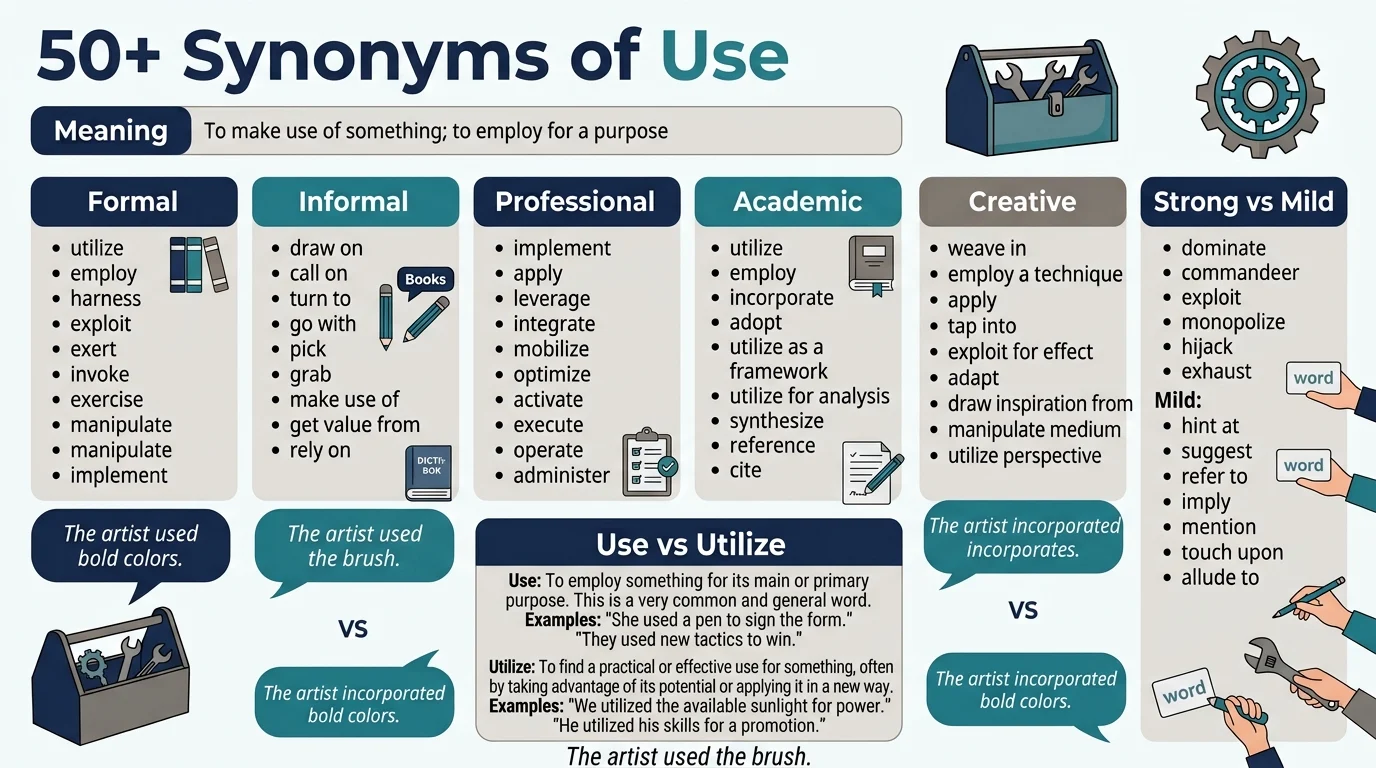
Have you ever read back an email or an essay and realized you wrote the word “use” five times in two paragraphs? It happens to everyone. You are drafting a professional message, a school assignment, or a social media caption, and that one small word keeps appearing. Repeating the same word makes your writing feel flat and uninspired. Finding the right synonyms of use can transform your sentences from repetitive to remarkable.
The English language offers dozens of alternatives, but each one carries a different tone, level of formality, and specific meaning. Choosing the wrong synonym can make you sound overly formal, too casual, or even confusing. This guide helps you understand every option so you can write with precision and confidence.
What Are the Best Synonyms of “Use”?
The word “use” means to put something into service or to employ something for a purpose. The best synonyms depend on your context. For professional writing, choose “employ” or “utilize.” Casual conversation, “apply” or “put to use” work well. For academic writing, select “employ” or “draw on.” Emotional or creative writing, consider “wield” or “harness.” Always match your word to your audience and purpose.
Meaning, Tone, and Context
Simple Definition
“Use” means to take something and employ it for a specific purpose. You can use a tool, a method, a skill, or even a person’s time. The word also functions as a noun meaning the act of using something or the purpose for which something is used.
Part of Speech
“Use” works as both a verb and a noun. As a verb, it describes the action of employing something. As a noun, it refers to the act itself or the purpose served.
Overall Tone
The word “use” is neutral. It does not carry strong positive or negative emotions on its own. The tone depends entirely on the context and surrounding words. You can use it in almost any situation without sounding inappropriate.
Formality Level
“Use” is neutral in formality. It works in formal reports, casual conversations, academic papers, and everyday texting. This versatility makes it useful but also vague. More specific synonyms often communicate your meaning more clearly.
Common Uses
Native English speakers use “use” constantly. You hear it in workplaces, classrooms, homes, and social settings. People use it to describe actions, purposes, functions, and even relationships. It appears in phrases like “use your time wisely,” “use this tool,” and “make use of your skills.”
Word Forms
- Noun: use (the act of using something)
- Verb: use (to employ something for a purpose)
- Adjective: useful, usable
- Adverb: usefully
When and How to Use “Use”
“Use” is your default choice when no other word fits better. It works in almost every situation. However, relying on it too often makes your writing feel repetitive and unsophisticated. Use it when you need a simple, clear, and neutral word that everyone understands.
Here are realistic examples showing how “use” appears in different contexts.
Professional: We need to use our resources more efficiently to meet the quarterly targets.
Academic: Researchers use statistical analysis to validate their findings.
Workplace: Please use the new software system for all client record entries.
Personal: I use this recipe whenever I want to impress dinner guests.
Email: Can we use the conference room for tomorrow morning’s presentation?
Resume: Used project management tools to coordinate cross-functional teams.
Social Media: Use these tips to grow your audience organically.
Best Synonyms of “Use”
No synonym is identical in every situation. Each alternative carries a unique shade of meaning, tone, and level of formality. Here are the best synonyms for specific contexts.
Professional writing: Choose “employ.” It sounds polished and deliberate without being pretentious.
Academic writing: Select “employ” or “draw on.” These words convey careful, methodical usage.
Business communication: Use “apply” or “implement.” These words suggest putting ideas or methods into action.
Casual conversation: Say “put to use” or “make use of.” These phrases sound natural and conversational.
Emotional writing: Choose “wield” or “harness.” These words suggest power, control, or intentional direction.
Creative writing: Select “deploy” or “employ.” These words add variety and sophistication to descriptive passages.
Resume writing: Use “utilized,” “applied,” or “employed.” These words demonstrate active, purposeful action.
Workplace communication: Say “apply” or “operate.” These words clearly describe using tools, systems, or procedures.
Stronger meaning: Choose “exploit” or “capitalize on.” These words suggest using something to maximum advantage.
Softer meaning: Select “make use of” or “put to use.” These phrases sound gentler and less direct.
When Not to Use “Use”
Sometimes “use” is not the best choice. The word can sound too general, too vague, or simply weak compared to more precise alternatives.
When the word sounds too vague: If you are describing a specific action, “use” does not communicate what you really mean.
Incorrect: She used her intelligence to solve the problem.
Better: She applied her intelligence to solve the problem.
“Applied” suggests focused, deliberate effort rather than a generic action.
When the word sounds too weak: If you want to convey strong, effective action, “use” lacks impact.
Incorrect: The team used the new strategy to increase sales.
Better: The team implemented the new strategy to increase sales.
“Implemented” sounds more decisive and action-oriented.
When the word sounds too informal: In very formal writing, such as legal documents or official reports, “use” can feel casual.
Incorrect: The agency will use the funds for community programs.
Better: The agency will allocate the funds for community programs.
“Allocate” sounds more official and precise.
When the word sounds outdated: In modern professional writing, “utilize” is often overused and can sound pretentious. In most cases, “use” works better.
Words Commonly Confused With “Use”
Several words are often confused with “use” because they share similar meanings. Understanding the differences helps you choose the right word every time.
Use vs Utilize
Difference: “Utilize” means to use something in a way that is not its original intended purpose or to make effective use of something. “Use” is the general term for employing something for any purpose.
When to Use It: Use “utilize” only when you mean using something in an unconventional or highly effective way. In most cases, “use” is the better choice.
Example: She utilized a paperclip as a makeshift lock pick. He used the computer to write his report.
Use vs Employ
Difference: “Employ” suggests a more formal, deliberate, or systematic use of something. It often implies engaging a person, method, or resource for a specific purpose.
When to Use It: Choose “employ” in professional, academic, or formal writing when you want to sound polished and intentional.
Example: The company employs advanced analytics to predict market trends. I use my phone for daily tasks.
Use vs Apply
Difference: “Apply” means to put something to practical use, often in a specific situation or to a particular surface, object, or problem.
When to Use It: Use “apply” when describing the practical implementation of knowledge, skills, rules, or substances.
Example: Apply the ointment to the affected area twice daily. Use this software to edit your photos.
Use vs Exploit
Difference: “Exploit” means to use something to full advantage, often in a way that is selfish, unfair, or unethical. It can also mean making the most of a resource or opportunity.
When to Use It: Use “exploit” when the usage is particularly advantageous or when it carries a negative connotation of taking unfair advantage.
Example: The company exploited a loophole in the tax code. Use your strengths to advance your career.
Use vs Operate
Difference: “Operate” specifically refers to using machinery, equipment, or systems. It suggests controlling or running something mechanical or technical.
When to Use It: Choose “operate” when describing the action of running machines, vehicles, or complex systems.
Example: He operates heavy machinery at the construction site. Use the remote to change the channel.
Use vs Wield
Difference: “Wield” means to hold and use a weapon, tool, or power with skill and control. It implies physical handling or the exercise of influence or authority.
When to Use It: Use “wield” in creative, descriptive, or literary contexts where you want to emphasize skillful control or power.
Example: The leader wields considerable influence in the industry. Use a hammer to drive the nail.
Best Synonyms of “Use” by Context
| Context | Best Synonym | Why It Works | Example |
|---|---|---|---|
| Formal writing | Employ | Sounds polished and deliberate | The committee employed a rigorous methodology. |
| Academic writing | Draw on | Suggests using knowledge or resources | Researchers draw on existing literature. |
| Professional communication | Apply | Implies practical implementation | Apply these principles to your daily work. |
| Business emails | Make use of | Sounds professional yet approachable | Please make use of the shared drive. |
| Resume writing | Utilized | Demonstrates active, purposeful action | Utilized data analytics to improve efficiency. |
| Workplace communication | Operate | Clear and specific for tools and systems | Operate the equipment according to safety guidelines. |
| Casual conversation | Put to use | Natural and conversational | I put my new skills to use immediately. |
| Everyday speaking | Make use of | Common and easily understood | Make use of the leftover ingredients. |
| Creative writing | Deploy | Adds sophistication and variety | The author deployed vivid imagery throughout. |
| Storytelling | Wield | Suggests power and control | He wielded his influence wisely. |
| Emotional writing | Harness | Implies channeling energy or power | Harness your passion to fuel your work. |
| Strong emphasis | Exploit | Suggests maximum advantage | Exploit every opportunity for growth. |
| Mild tone | Put to use | Gentle and unassuming | Put your talents to use in the community. |
| Social media captions | Apply | Short, clear, and actionable | Apply these tips for better results. |
How to Choose the Best Synonym of “Use”
Choosing the right synonym starts with understanding your purpose. Ask yourself these questions before you write.
What is your intended meaning? Are you describing a simple action or a complex process? Simple actions call for simple words.
Who is your audience? Professionals expect formal language. Friends appreciate casual phrasing. Match your word to your reader.
What emotional tone do you want? Do you need a neutral word or something with more power? Stronger synonyms like “wield” and “harness” add energy.
How formal should your writing be? Academic papers and business reports require more formal choices like “employ.” Text messages and social media posts work better with casual options like “put to use.”
Does the word sound natural? Read your sentence aloud. If the synonym feels forced or awkward, choose a different one.
The best synonym communicates your exact meaning while matching the tone and expectations of your audience. When in doubt, “use” remains a safe, clear choice.
Real Life Examples of “Use”
Seeing “use” and its synonyms in real contexts helps you understand how they work. Here are examples from everyday situations.
School: Students often use flashcards to memorize vocabulary. (Neutral, clear)
Better: Students employ flashcards to reinforce vocabulary retention. (More formal, academic)
College: I use the library for most of my research. (Casual)
Better: I draw on the library’s extensive resources for my research. (More sophisticated)
Workplace: We use this software for all our accounting needs. (Simple)
Better: We utilize this software to streamline our accounting operations. (More professional)
Business: The company uses customer feedback to improve products. (Basic)
Better: The company applies customer feedback to refine product development. (More intentional)
Email: I will use your suggestions in the final draft. (Neutral)
Better: I will incorporate your suggestions into the final draft. (More collaborative)
Resume: Used social media to promote brand awareness. (Weak)
Better: Leveraged social media platforms to drive brand awareness and engagement. (Stronger, more impactful)
Conversation: You should use this app for tracking your workouts. (Casual)
Better: You should try using this app for tracking your workouts. (More conversational)
Storytelling: She used her charm to win over the crowd. (Simple)
Better: She wielded her charm like a weapon, captivating the entire audience. (More vivid, descriptive)
Blogging: Use these strategies to grow your email list. (Direct)
Better: Implement these strategies to expand your email subscriber base. (More authoritative)
Social Media: Use hashtags to increase your reach. (Standard)
Better: Leverage hashtags to amplify your content’s visibility. (More strategic)
18 Best Synonyms of “Use”
| Synonym | Simple Meaning | Best Used For | Example Sentence |
|---|---|---|---|
| Apply | Put something into practical operation | Professional and academic writing | Apply this method to achieve consistent results. |
| Employ | Make use of in a formal or deliberate way | Formal, academic, and professional contexts | The study employed a sample of 500 participants. |
| Utilize | Use something effectively or for a different purpose | Resume writing and professional communication | Utilized cross-functional teams to accelerate product delivery. |
| Operate | Control and run machinery or systems | Technical and workplace contexts | Operate the forklift only if you are certified. |
| Wield | Hold and use with skill or power | Creative and descriptive writing | She wields considerable authority in the department. |
| Harness | Control and use energy, power, or resources | Emotional and motivational writing | Harness your creativity to solve complex problems. |
| Deploy | Bring into effective action or use | Strategic and military contexts | Deploy your team’s strengths where they matter most. |
| Draw on | Use as a source or resource | Academic and research writing | Draw on previous research to support your argument. |
| Make use of | Use something available to you | Everyday conversation and casual writing | Make use of the free resources available online. |
| Put to use | Apply something practically | Casual and instructional contexts | Put your language skills to use during your travels. |
| Exploit | Use to full advantage, often unfairly | Business and strategic contexts | Exploit market gaps before competitors catch on. |
| Leverage | Use something to maximum advantage | Business and professional writing | Leverage your network to find new opportunities. |
| Implement | Put a plan or system into effect | Business and project management | Implement the new policy starting next quarter. |
| Exercise | Use a right, power, or option | Legal and formal contexts | Exercise your right to vote in every election. |
| Avail oneself of | Take advantage of an opportunity | Formal and literary contexts | Avail yourself of the training programs offered. |
| Bring into play | Cause something to become active or involved | Strategic and creative writing | Bring your negotiation skills into play during the meeting. |
| Call upon | Use someone’s skills or knowledge | Professional and formal contexts | Call upon your expertise when making difficult decisions. |
| Turn to | Go to someone or something for help or use | Conversational and everyday contexts | Turn to this guide whenever you need writing advice. |
Synonyms of “Use” by Usage
Professional vs Personal Synonyms
Professional settings demand words that sound competent and deliberate. “Employ,” “utilize,” and “apply” work well in emails, reports, and presentations. These words convey intention and professionalism.
Personal conversations call for simpler, more natural options. “Make use of,” “put to use,” and “turn to” sound friendly and approachable. Save the formal alternatives for the office.
Formal vs Conversational Synonyms
Formal writing includes reports, essays, academic papers, and official documents. Choose “employ,” “exercise,” or “avail oneself of” for these contexts. These words add weight and authority to your writing.
Conversational writing includes texts, social media posts, and casual emails. “Make use of,” “put to use,” and “turn to” sound natural and unpretentious. They help you connect with readers on a personal level.
Academic Synonyms
Academic writing requires precision and authority. “Employ” suggests a careful, methodological approach. “Draw on” indicates using sources or knowledge deliberately. “Apply” shows practical implementation of theories or methods. These words signal scholarly rigor and careful thinking.
Professional and Business Synonyms
Resumes, interviews, and business communications benefit from strong, active words. “Leverage” suggests using something to maximum advantage. “Implement” indicates putting plans into action. “Utilize” demonstrates effective resource management. These words make you sound capable and results-oriented.
Creative and Literary Synonyms
Storytelling, fiction, and descriptive writing thrive on vivid language. “Wield” suggests power and control. “Deploy” implies strategic placement. “Harness” evokes energy and potential. These words add color and emotion to your writing, making scenes and characters more memorable.
Slang or Modern Synonyms
“Use” does not have widely recognized slang equivalents in modern English. Some informal phrases like “tap into” or “rock” (as in “rock that software”) appear in casual contexts, but these are not standard synonyms. Avoid slang in professional or academic writing.
Strongest to Mildest Synonyms
Understanding the intensity of each synonym helps you choose the right emotional weight for your message.
Mild: Make use of, put to use, turn to. These phrases are gentle and unassuming. They describe simple actions without adding pressure or drama.
Moderate: Use, apply, employ, operate. These words are neutral and straightforward. They communicate clearly without strong emotional overtones.
Strong: Utilize, deploy, harness. These words suggest active, purposeful, and effective use. They add energy and intentionality to your writing.
Very Strong: Exploit, leverage, wield. These words imply strategic advantage, power, or control. They carry significant weight and should be used carefully.
Emotional vs Neutral Synonyms
Emotional Synonyms: “Wield,” “harness,” and “exploit” carry emotional weight. “Wield” suggests power and control. “Harness” evokes channeling energy or potential. “Exploit” implies taking full advantage, often with a hint of ruthlessness. Use these when you want to create impact or convey strong feelings.
Neutral Synonyms: “Use,” “apply,” “employ,” and “operate” simply communicate information. They do not add emotional coloring to your sentences. Choose these when you need clarity and objectivity.
Antonyms of “Use”
| Antonym | Meaning | Example Sentence |
|---|---|---|
| Ignore | Pay no attention to | Ignore the distractions and focus on your work. |
| Neglect | Fail to care for properly | Neglect your health and you will regret it. |
| Misuse | Use incorrectly or improperly | Misuse of company resources can lead to termination. |
| Misapply | Apply wrongly or inappropriately | Misapply this formula and your results will be inaccurate. |
| Waste | Use without purpose or benefit | Waste your time on trivial matters. |
| Squander | Waste recklessly | Squander your savings and you will have nothing left. |
| Conserve | Protect from harm or depletion | Conserve energy by turning off unused lights. |
| Save | Keep for future use | Save your receipts for tax purposes. |
| Preserve | Maintain in original state | Preserve the historical documents in a climate-controlled room. |
| Withhold | Refuse to give or grant | Withhold your approval until you review the details. |
| Reject | Refuse to accept or use | Reject the proposal if it does not meet your standards. |
| Abandon | Give up completely | Abandon the old methods and embrace new approaches. |
| Discard | Throw away as worthless | Discard any expired materials. |
| Disuse | State of not being used | The equipment fell into disuse after the upgrade. |
| Nonuse | Failure to use | Nonuse of available resources hurts productivity. |
Comparison: “Use” vs Similar Words
Use vs Utilize
Main Difference: “Use” is the general word for employing something for any purpose. “Utilize” specifically means to use something effectively or in a way that is not its original intended purpose.
Which Is Stronger? “Utilize” sounds stronger and more intentional, but it is often overused.
Which Is More Formal? “Utilize” is considered more formal, though many style guides recommend avoiding it in favor of “use”.
When to Use Each: Use “use” in most situations. Use “utilize” only when you mean using something in an unconventional or highly effective way.
Examples:
Use: Use a pen to write your signature.
Utilize: Utilize a paperclip to reset the device.
Use vs Employ
Main Difference: “Employ” suggests a more formal, deliberate, or systematic use of something. It often implies engaging a person, method, or resource for a specific purpose.
Which Is Stronger? “Employ” sounds more deliberate and intentional.
Which Is More Formal? “Employ” is more formal and is preferred in academic and professional writing.
When to Use Each: Use “employ” when you want to sound polished and intentional. Use “use” for everyday situations.
Examples:
Use: Use this template for your report.
Employ: Employ a systematic approach to data analysis.
Use vs Apply
Main Difference: “Apply” means to put something to practical use, often in a specific situation or to a particular surface, object, or problem.
Which Is Stronger? “Apply” suggests more direct, hands-on action.
Which Is More Formal? Both are neutral, but “apply” often appears in instructional and professional contexts.
When to Use Each: Use “apply” when describing practical implementation. Use “use” for general actions.
Examples:
Use: Use this software to edit photos.
Apply: Apply the lessons learned to your daily work.
Use vs Exploit
Main Difference: “Exploit” means to use something to full advantage, often in a way that is selfish, unfair, or unethical. It can also mean making the most of a resource or opportunity.
Which Is Stronger? “Exploit” is much stronger and carries significant emotional weight.
Which Is More Formal? “Exploit” is formal but often carries negative connotations.
When to Use Each: Use “exploit” carefully when the usage is particularly advantageous or when it carries a negative connotation.
Examples:
Use: Use your skills to help others.
Exploit: Exploit every opportunity to advance your career.
Use vs Operate
Main Difference: “Operate” specifically refers to using machinery, equipment, or systems. It suggests controlling or running something mechanical or technical.
Which Is Stronger? “Operate” is more specific and technical.
Which Is More Formal? “Operate” is neutral but is commonly used in technical and professional contexts.
When to Use Each: Use “operate” when describing the action of running machines or systems. Use “use” for general actions.
Examples:
Use: Use the remote to change the channel.
Operate: Operate the machinery according to the manual.
Use vs Wield
Main Difference: “Wield” means to hold and use a weapon, tool, or power with skill and control. It implies physical handling or the exercise of influence or authority.
Which Is Stronger? “Wield” is much stronger and more vivid.
Which Is More Formal? “Wield” is neutral but is more common in literary and descriptive contexts.
When to Use Each: Use “wield” in creative or descriptive writing to emphasize skillful control or power. Use “use” for simple actions.
Examples:
Use: Use a hammer to drive the nail.
Wield: Wield your influence to create positive change.
Common Phrases and Expressions with “Use”
| Phrase | Meaning | Example Sentence |
|---|---|---|
| Make use of | Take advantage of something available | Make use of the free resources on our website. |
| Put to use | Apply something practically | Put your new skills to use in your next project. |
| Use up | Consume completely | We used up all the supplies before the project ended. |
| Use your head | Think carefully | Use your head before making a hasty decision. |
| Use your discretion | Decide based on your judgment | Use your discretion when handling sensitive information. |
| Use and abuse | Take advantage of something or someone excessively | Some companies use and abuse their temporary workers. |
| Use it or lose it | Skills or abilities decline without practice | Practice your language skills regularly, or use it or lose it. |
Common Mistakes to Avoid
1: Choosing “utilize” when “use” works better
Many writers choose “utilize” to sound more professional. In most cases, “use” is the simpler and better choice.
Incorrect: We will utilize the new software for our accounting needs.
Better: We will use the new software for our accounting needs.
“Use” is clearer and less pretentious.
2: Using “exploit” when you mean “use”
“Exploit” carries a negative connotation of taking unfair advantage. Using it when you mean a neutral action can confuse your reader.
Incorrect: We exploited the training materials to improve our skills.
Better: We used the training materials to improve our skills.
“Used” is neutral and appropriate.
3: Using “employ” in casual conversation
“Employ” sounds overly formal in everyday speech. It can make you sound stiff or pretentious.
Incorrect: I employed my phone to call my mom.
Better: I used my phone to call my mom.
“Used” sounds natural and conversational.
4: Repeating “use” too often in a single paragraph
Repetition makes your writing dull and unprofessional. Vary your word choices.
Incorrect: We use this tool for data entry. We also use it for reporting. We use it every day.
Better: We use this tool for data entry. We also employ it for reporting. We rely on it every day.
Varying your language keeps your writing engaging.
5: Choosing a synonym with the wrong emotional tone
Strong synonyms like “wield” and “harness” add power and emotion. Using them in neutral contexts can feel over the top.
Incorrect: I wielded a fork to eat my salad.
Better: I used a fork to eat my salad.
“Wielded” sounds dramatic and inappropriate for a simple action.
6: Using slang in professional writing
Informal phrases like “tap into” or “rock” have no place in business emails, resumes, or academic papers.
Incorrect: We tapped into the new system to improve productivity.
Better: We implemented the new system to improve productivity.
Professional writing requires professional language.
7: Forgetting that “use” has multiple meanings
“Use” can mean “employ,” “consume,” or even “exploit.” Make sure your synonym matches your exact meaning.
Incorrect: She used the entire cake. (Ambiguous: ate it or employed it?)
Better: She consumed the entire cake. (Clear: she ate it.)
Choose precise words to avoid confusion.
Frequently Asked Questions
1. What are the best synonyms of “use”?
The best synonyms depend on your context. Formal writing, choose “employ.” For casual conversation, choose “make use of.” For professional writing, choose “utilize” or “apply.” Always match the synonym to your audience and purpose.
2. What are the best formal synonyms of “use”?
The best formal synonyms include “employ,” “utilize,” “exercise,” and “avail oneself of.” These words appear in academic papers, business reports, and official documents. They convey precision and professionalism.
3. What are common informal synonyms of “use”?
Common informal synonyms include “make use of,” “put to use,” and “turn to.” These phrases sound natural in everyday conversation, text messages, and casual emails. They help you communicate clearly without sounding stiff.
4. What is another word for “use” in professional writing?
In professional writing, choose “employ,” “utilize,” or “apply.” These words demonstrate active, purposeful action. They make your writing sound competent and deliberate, which is essential in resumes, emails, and business reports.
5. What is the difference between “use” and “utilize”?
“Use” is the general word for employing something for any purpose. “Utilize” means to use something effectively or in a way that is not its original intended purpose. In most cases, “use” is the better choice.
6. What is the opposite of “use”?
Common antonyms include “ignore,” “neglect,” “misuse,” “waste,” and “squander.” These words describe failing to use something properly or using it incorrectly. Choose the antonym that best matches your intended meaning.
Conclusion
“Use” is one of the most common words in the English language, and for good reason. It is simple, clear, and works in almost any situation. But relying on it too often makes your writing feel repetitive and uninspired. The best synonyms of use include “employ” for formal contexts, “apply” for practical implementation, “utilize” for effective resource use, and “wield” for creative or powerful actions. No single synonym works perfectly in every situation. The right choice depends on your audience, your tone, and your purpose.
Before you write your next sentence, ask yourself what you really mean. Choose the word that communicates your message with the greatest clarity and impact. Your readers will notice the difference.