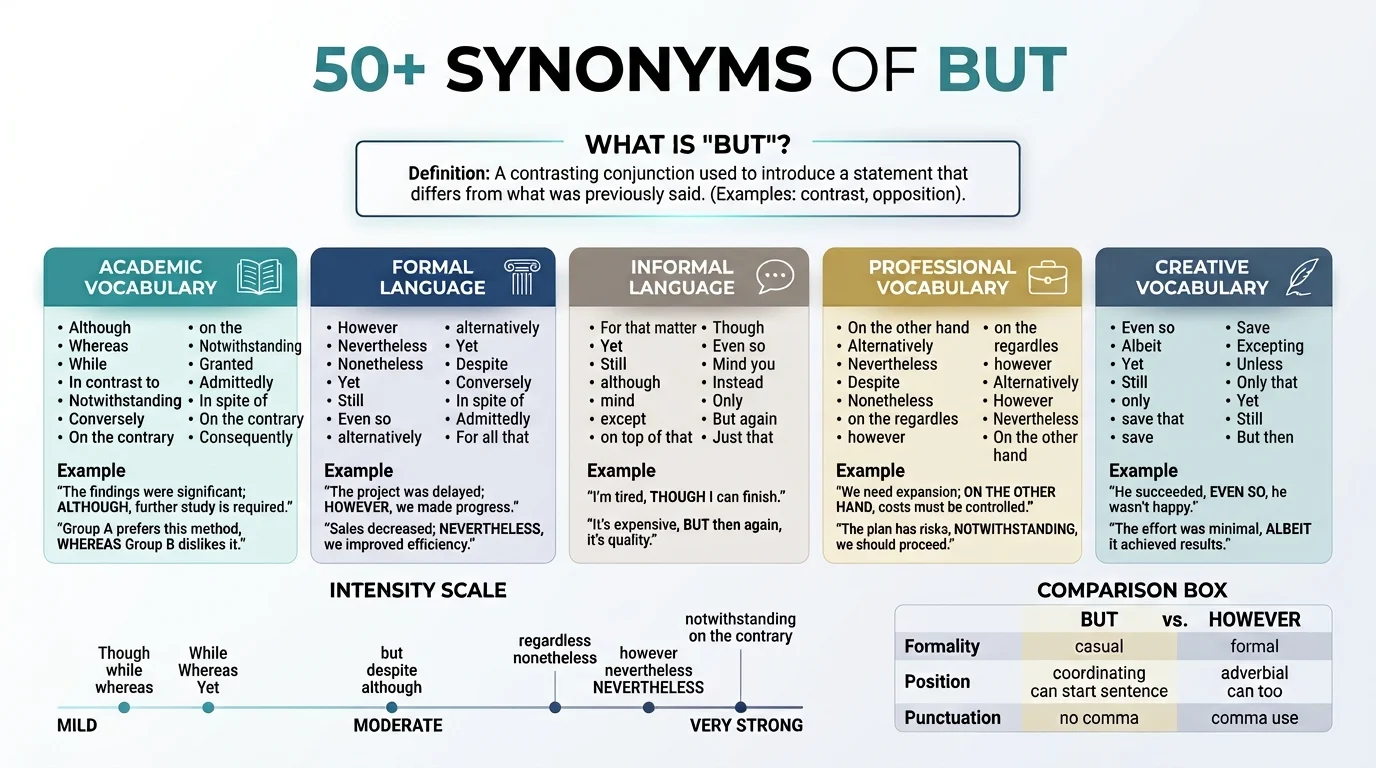
Have you ever read back an email or an essay and noticed you used the word “but” in almost every other sentence? It happens to everyone. You write a strong paragraph, but then you connect another idea, but then you add a contrasting point, and before you know it, “but” has taken over your writing. This small three‑letter word is one of the most common in the English language, and while it serves an essential purpose, overusing it makes your writing feel repetitive and lazy. Finding better synonyms of but is one of the quickest ways to improve your clarity, tone, and overall communication style. The right alternative can make your writing sound more professional, more thoughtful, or more natural depending on the situation.
What Are the Best Synonyms of “But”?
“But” is a conjunction used to introduce contrast, exception, or opposition between two ideas. For formal writing, choose however or nevertheless. For casual conversation, use though or yet. In academic work, although and whereas work well. For professional communication, nonetheless and on the other hand are strong choices.
Meaning, Tone, and Context
Simple Definition
“But” is a conjunction that connects two statements or clauses while showing that the second one contrasts with, contradicts, or adds an exception to the first one. It can also function as a preposition meaning “except” or an adverb meaning “only” or “just”.
Part of Speech
- Conjunction (most common): connects two contrasting ideas
- Preposition: means “except” (e.g., Everyone but John was there)
- Adverb: means “only” or “just” (e.g., She is but a child)
Overall Tone
Neutral. “But” itself does not carry strong emotional weight. It simply signals a shift or contrast. However, the tone of your sentence changes depending on which synonym you choose.
Formality Level
Neutral to informal. “But” is appropriate in almost any context, but in very formal academic or legal writing, stronger alternatives are often preferred.
Common Uses
Native English speakers use “but” constantly in:
- Everyday conversation
- Email writing
- Social media posts
- Blog articles
- Professional reports
- Academic essays
- Storytelling
Word Forms
- Noun (rare): No ifs, ands, or buts (meaning objections or excuses)
- Conjunction: I wanted to go, but I was tired.
- Preposition: Everyone but Sarah showed up.
- Adverb: We have but one chance.
When and How to Use “But”
Choose “but” when you need a simple, direct way to show contrast between two ideas. It works in almost every context because it is neutral, clear, and widely understood. However, if you find yourself using it repeatedly, consider swapping in a more precise synonym.
7 Realistic Examples by Context
Professional
We met our quarterly targets, but we fell short on customer satisfaction scores.
Academic
The study produced significant results, but the sample size was too small to draw definitive conclusions.
Workplace
I agree with your proposal, but I have a few concerns about the timeline.
Personal
I really wanted to attend the party, but I had a terrible headache.
Thank you for your application, but we have decided to move forward with another candidate.
Resume
Managed a team of twelve, but consistently delivered projects under budget.
The movie got terrible reviews, but I actually loved it.
Best Synonyms of “But”
No two synonyms are identical in every situation. Each alternative carries its own shade of meaning, level of formality, and emotional weight. Here are the best choices for specific contexts.
Professional Writing
However is the most versatile and widely accepted formal alternative. It works in reports, emails, and presentations. Use it to introduce a contrasting point without sounding abrupt.
Academic Writing
Nevertheless and nonetheless are excellent for academic papers because they emphasize that the second point holds true despite the first. Although is another strong choice for introducing a contrasting clause.
Business Communication
On the other hand helps when you are comparing two options or perspectives. It feels balanced and thoughtful rather than confrontational.
Casual Conversation
Though is the most natural conversational alternative. You can place it at the end of a sentence for a relaxed, spoken feel.
Emotional Writing
Yet carries a sense of surprise or unexpectedness. It adds a touch of drama or emotion to your contrast.
Creative Writing
Still and even so work well in storytelling. They suggest that despite everything, something remains true.
Resume Writing
Yet can highlight surprising achievements. Junior candidate, yet led three major initiatives.
Workplace Communication
Nonetheless shows professionalism while acknowledging a challenge.
Stronger Meaning
Notwithstanding is the strongest formal alternative. It means “in spite of” and carries significant weight.
Softer Meaning
Though softens the contrast and sounds less definitive.
When Not to Use “But”
When It Sounds Too General
❌ The product is innovative, but it has some flaws.
The word “but” does not tell the reader how serious the flaws are.
✅ The product is innovative, yet it suffers from several critical usability issues.
When It Sounds Too Vague
❌ She is qualified, but she lacks experience.
This does not explain what kind of experience is missing.
✅ She is qualified; however, she lacks hands‑on project management experience.
When It Sounds Too Informal
❌ The data supports our hypothesis, but more research is needed.
In academic writing, “however” or “nevertheless” sounds more authoritative.
✅ The data supports our hypothesis; nevertheless, more research is needed.
When It Sounds Too Weak
❌ The team worked hard, but they missed the deadline.
This statement feels flat and does not emphasize the effort.
✅ The team worked tirelessly, yet they still missed the deadline.
When It Sounds Outdated
Using “but” as an adverb meaning “only” (I have but one wish) sounds old‑fashioned in modern American English. Use “only” or “just” instead.
Words Commonly Confused With “But”
But vs However
Difference: “But” is a coordinating conjunction that joins two independent clauses. “However” is a conjunctive adverb that typically starts a new sentence or follows a semicolon.
When to Use Each: Use “but” for simple, direct contrasts. Use “however” when you want a more formal transition.
Example:
- But: I wanted to go, but I was sick.
- However: I wanted to go; however, I was sick.
But vs Yet
Difference: “Yet” often implies that the contrast is surprising or unexpected. “But” is more neutral.
When to Use Each: Use “yet” when you want to emphasize that something is remarkable or surprising.
Example:
- But: He is young, but he is wise.
- Yet: He is young, yet he speaks with wisdom beyond his years.
But vs Although
Difference: “Although” introduces a subordinate clause and can appear at the beginning of a sentence. “But” connects two equal clauses.
When to Use Each: Use “although” when you want to lead with the contrasting idea.
Example:
- But: It was raining, but we went for a walk.
- Although: Although it was raining, we went for a walk.
But vs Nevertheless
Difference: “Nevertheless” is more formal and emphasizes that the second point remains true in spite of the first.
When to Use Each: Use “nevertheless” in formal writing when you want to stress resilience or persistence.
Example:
- But: The task was hard, but they finished it.
- Nevertheless: The task was hard; nevertheless, they finished it on time.
But vs Whereas
Difference: “Whereas” is used to compare two different things side by side, often in a structured way.
When to Use Each: Use “whereas” when you are comparing two distinct subjects or categories.
Example:
- But: She likes coffee, but he likes tea.
- Whereas: She likes coffee, whereas her brother prefers tea.
But vs Still
Difference: “Still” emphasizes that something continues despite an obstacle.
When to Use Each: Use “still” when you want to highlight persistence or continuation.
Example:
- But: It was difficult, but I kept going.
- Still: It was difficult; still, I kept going.
Best Synonyms of “But” by Context
| Context | Best Synonym | Why It Works | Example |
|---|---|---|---|
| Formal writing | However | Widely accepted and professional | The proposal is strong; however, it needs revision. |
| Academic writing | Nevertheless | Emphasizes contrast despite evidence | The results were inconclusive; nevertheless, they suggest a trend. |
| Professional communication | Nonetheless | Formal and respectful | The project faced delays; nonetheless, we delivered on time. |
| Business emails | On the other hand | Balanced and thoughtful | We could expand now; on the other hand, waiting might be safer. |
| Resume writing | Yet | Highlights surprising achievements | Junior employee, yet promoted twice in one year. |
| Workplace communication | Though | Natural and approachable | It is a risk, though I think it is worth taking. |
| Casual conversation | Though (at end) | Relaxed and conversational | I am tired. I will come, though. |
| Everyday speaking | But | Simple and direct | I called, but no one answered. |
| Creative writing | Still | Suggests persistence | The storm raged; still, they pressed on. |
| Storytelling | Even so | Adds dramatic weight | He had lost everything; even so, he smiled. |
| Emotional writing | Yet | Adds surprise or wonder | She was afraid, yet she stepped forward. |
| Strong emphasis | Notwithstanding | Very formal and powerful | Notwithstanding the opposition, the bill passed. |
| Mild tone | Though | Softens the contrast | It is expensive, though it is worth it. |
| Social media captions | But | Short and punchy | Loved the food, but the service was slow. |
How to Choose the Best Synonym of “But”
Choosing the right synonym comes down to four questions.
1. Who is your audience? For professors, clients, or executives, choose however, nevertheless, or nonetheless. For friends or social media, choose though or yet.
2. How formal is your writing? Formal writing demands however, nevertheless, or whereas. Informal writing allows though, yet, and even but itself.
3. What emotion do you want to convey? Use yet for surprise, still for persistence, and nevertheless for resilience.
4. Are you comparing or contrasting? Use whereas or on the other hand for direct comparisons. Use however or but for general contrast.
The best synonym is the one that communicates your intended meaning most clearly without drawing attention to itself.
Real Life Examples of “But”
School
I studied for three hours, but I still did not understand the math problem.
College
The professor is strict, but she is incredibly fair and helpful.
Workplace
We received positive feedback, but the client requested several major changes.
Business
Our revenue grew this quarter, but profit margins shrank due to rising costs.
I appreciate your interest in the position, but we have decided to hire internally.
Resume
Managed a $2 million budget, but reduced overall spending by 15 percent.
Conversation
I wanted to grab dinner, but I have to finish this report first.
Storytelling
The knight was wounded, but he refused to retreat from the battlefield.
Blogging
The recipe is simple, but the results are absolutely restaurant‑quality.
The hike was brutal, but the view from the top made it all worthwhile.
18 Best Synonyms of “But”
| Synonym | Simple Meaning | Best Used For | Example Sentence |
|---|---|---|---|
| However | Introduces a contrast in a formal way | Professional and academic writing | The data is clear; however, we need more time to analyze it. |
| Nevertheless | In spite of that | Formal writing emphasizing resilience | The weather was terrible; nevertheless, the event was a success. |
| Nonetheless | In spite of that | Professional and academic contexts | She had no experience; nonetheless, she got the job. |
| Yet | Indicates surprising or unexpected contrast | Emotional or dramatic writing | He is only twenty‑two, yet he runs a successful company. |
| Though | Introduces contrast in a casual way | Conversation and informal writing | It is cold outside. I will go for a walk, though. |
| Still | Emphasizes continuation despite obstacles | Creative and conversational writing | The odds were against us; still, we kept fighting. |
| Although | Introduces a contrasting clause | Academic and formal writing | Although the experiment failed, we learned a great deal. |
| Whereas | Compares two different things | Structured comparisons | She prefers city life, whereas he loves the countryside. |
| On the other hand | Presents an alternative perspective | Balanced discussions and business writing | We could invest in marketing; on the other hand, we could improve our product. |
| Even so | Despite what was just said | Storytelling and creative writing | He had no formal training; even so, he built a masterpiece. |
| Notwithstanding | In spite of | Very formal and legal writing | Notwithstanding the objections, the committee approved the plan. |
| Except | With the exception of | Indicating exclusion | Everyone attended the meeting except Michael. |
| Only | No more than | Indicating a limitation | She is but a beginner—she has only just started learning. |
| Simply | Merely; just | Casual conversation | It is not a bug; it is simply a feature we have not documented yet. |
| Barring | Except if; unless | Formal exclusion | Barring any delays, we should finish by Friday. |
| Save | Except | Literary or formal writing | All save one agreed to the proposal. |
| Albeit | Although; even if | Formal writing introducing a concession | The solution was effective, albeit expensive. |
| Be that as it may | Despite that | Formal and spoken English | The evidence is weak; be that as it may, we cannot ignore it. |
Synonyms of “But” by Usage
Professional vs Personal Synonyms
In professional settings, choose however, nevertheless, nonetheless, or on the other hand. These words sound polished and measured. In personal conversations, though and yet sound more natural and less stiff.
Formal vs Conversational Synonyms
Formal: however, nevertheless, nonetheless, notwithstanding, whereas, albeit.
Conversational: though, yet, still, but.
Academic Synonyms
Nevertheless, nonetheless, although, and whereas are preferred in academic writing because they sound authoritative and precise. However is also widely accepted but should be used carefully to avoid comma splices.
Professional and Business Synonyms
However is the go‑to for business writing. Nevertheless and nonetheless work well in performance reviews and client communications. On the other hand is excellent for presentations and proposals where you are comparing options.
Creative and Literary Synonyms
Yet, still, even so, and albeit add color and emotion to creative writing. They help you build tension, show persistence, or introduce surprising twists.
Slang or Modern Synonyms
There are no widely used slang equivalents for “but” in modern American English. However, in very casual speech, people sometimes use though at the end of a sentence (I am tired. I will come, though.) as a relaxed alternative.
Strongest to Mildest Synonyms
Mild → Moderate → Strong → Very Strong
- Mild: though, but
- Moderate: yet, still, however
- Strong: nevertheless, nonetheless, on the other hand
- Very Strong: notwithstanding, albeit, be that as it may
Emotional vs Neutral Synonyms
Emotional Synonyms: yet (surprise), still (persistence), even so (resilience). These words carry feeling and help you connect with your reader.
Neutral Synonyms: however, nevertheless, nonetheless, on the other hand. These words simply communicate information without adding emotional weight.
Use emotional synonyms when you want to engage your reader’s feelings. Use neutral synonyms when you want to present facts objectively.
Antonyms of “But”
| Antonym | Meaning | Example Sentence |
|---|---|---|
| And | Adds information without contrast | I wanted to go, and I went. |
| Also | In addition | She is qualified, and she also has experience. |
| Furthermore | In addition to what was said | The proposal is strong; furthermore, it is cost‑effective. |
| Moreover | In addition to what was said | The plan is practical; moreover, it is innovative. |
| In addition | Adding to what was said | We need more staff; in addition, we need better equipment. |
| Additionally | As an extra point | The product is reliable; additionally, it is affordable. |
| Plus | In addition to | She has the skills, plus she has the right attitude. |
| Likewise | In the same way | He supports the idea; likewise, she agrees. |
| Similarly | In a similar manner | The first study found this; similarly, the second confirmed it. |
| Consequently | As a result | We missed the deadline; consequently, we lost the client. |
| Therefore | For that reason | The evidence is clear; therefore, we must act. |
| Thus | As a result | The experiment succeeded; thus, the hypothesis was confirmed. |
| Hence | For this reason | The costs are too high; hence, we need a new approach. |
| Accordingly | In a way that is appropriate | The rules have changed; accordingly, we must update our procedures. |
| Subsequently | Afterward | The plan was approved; subsequently, work began immediately. |
Comparison: “But” vs Similar Words
But vs However
Main Difference: “But” is a conjunction; “however” is a conjunctive adverb.
Which Is Stronger? “However” carries slightly more formal weight but is not necessarily stronger in meaning.
Which Is More Formal? “However” is more formal.
When to Use Each: Use “but” for simple, direct contrasts. Use “however” for polished, professional writing.
Examples:
- But: I like the idea, but I have concerns.
- However: I like the idea; however, I have concerns.
But vs Yet
Main Difference: “Yet” implies surprise or unexpectedness.
Which Is Stronger? “Yet” is emotionally stronger because it highlights unexpected contrast.
Which Is More Formal? Both are neutral, but “yet” appears more often in literary writing.
When to Use Each: Use “but” for neutral contrast. Use “yet” when the contrast is surprising.
Examples:
- But: She is young, but she is talented.
- Yet: She is young, yet she has won three awards.
But vs Although
Main Difference: “Although” introduces a subordinate clause and can start a sentence.
Which Is Stronger? Neither is stronger; they serve different grammatical roles.
Which Is More Formal? “Although” is slightly more formal.
When to Use Each: Use “but” to connect two equal clauses. Use “although” to subordinate one idea to another.
Examples:
- But: It was raining, but we went out.
- Although: Although it was raining, we went out.
But vs Nevertheless
Main Difference: “Nevertheless” means “in spite of that” and is more formal.
Which Is Stronger? “Nevertheless” is stronger because it emphasizes that the second point holds true despite everything.
Which Is More Formal? “Nevertheless” is much more formal.
When to Use Each: Use “but” in everyday writing. Use “nevertheless” in academic or professional contexts when you want to stress persistence.
Examples:
- But: The task was hard, but they finished.
- Nevertheless: The task was hard; nevertheless, they finished ahead of schedule.
But vs Whereas
Main Difference: “Whereas” is used for direct comparisons between two distinct things.
Which Is Stronger? Neither; they serve different purposes.
Which Is More Formal? “Whereas” is more formal and structured.
When to Use Each: Use “but” for general contrast. Use “whereas” when you are comparing two specific subjects side by side.
Examples:
- But: She likes coffee, but he likes tea.
- Whereas: She likes coffee, whereas her brother prefers tea.
But vs Still
Main Difference: “Still” emphasizes that something continues despite an obstacle.
Which Is Stronger? “Still” is emotionally stronger because it implies persistence.
Which Is More Formal? Both are neutral, but “still” is more common in conversation.
When to Use Each: Use “but” for simple contrast. Use “still” when you want to highlight perseverance.
Examples:
- But: It was difficult, but I tried.
- Still: It was difficult; still, I kept trying.
Common Phrases and Expressions with “But”
Nothing but
Meaning: Only; nothing other than.
Example Sentence: She has nothing but praise for her new manager.
All but
Meaning: Almost; nearly everything except.
Example Sentence: The project is all but finished; we just need to review the final draft.
Anything but
Meaning: Not at all; the opposite of.
Example Sentence: The service was anything but quick; we waited over an hour.
But for
Example Sentence: But for your help, we would never have completed this on time.
But then
Meaning: Used to add a different or surprising thought.
Example Sentence: She is incredibly talented; but then, she has been practicing since childhood.
No ifs, ands, or buts
Meaning: No excuses or objections.
Example Sentence: You need to finish this report by noon, no ifs, ands, or buts.
Common Mistakes to Avoid
1: Choosing a Vague Synonym
Incorrect: The product is good, however it has issues.
Better: The product is good; however, it has several usability issues.
Why: “However” needs proper punctuation. Without a semicolon or period, you create a comma splice.
2: Confusing “But” with “Although”
Incorrect: But it was raining, we went outside.
Better: Although it was raining, we went outside.
Why: “But” cannot introduce a subordinate clause at the beginning of a sentence.
3: Using Informal Synonyms in Formal Writing
Incorrect: The study is comprehensive, though more research is needed.
Better: The study is comprehensive; nevertheless, more research is needed.
Why: “Though” sounds conversational. In academic writing, “nevertheless” or “however” is more appropriate.
4: Selecting an Overly Dramatic Synonym
Incorrect: I missed the bus, yet I took the next one.
Better: I missed the bus, but I took the next one.
Why: “Yet” implies surprise. Missing a bus and taking the next one is not surprising enough to justify “yet.”
5: Repeating the Same Word Too Often
Incorrect: I wanted to go, but I was tired. But I decided to go anyway. But then I regretted it.
Better: I wanted to go, but I was tired. Nevertheless, I decided to go anyway. However, I regretted it immediately.
Why: Repeating “but” makes your writing sound lazy and unpolished.
6: Choosing a Synonym with the Wrong Emotional Tone
Incorrect: The weather was terrible, but we had fun.
Better: The weather was terrible; still, we had fun.
Why: “Still” emphasizes that you had fun despite the weather. “But” does not carry that same emotional weight.
7: Using Slang in Professional Writing
Incorrect: We missed the deadline, though we got it done.
Better: We missed the deadline; nevertheless, we completed the project.
Why: “Though” is too casual for professional communication. “Nevertheless” sounds more competent and polished.
Frequently Asked Questions
1. What are the best synonyms of “but”?
The best synonyms depend on your context. Formal writing, use however or nevertheless. For casual conversation, use though or yet. For academic work, use although or whereas. Each synonym of but serves a different purpose.
2. What are the best formal synonyms of “but”?
The best formal synonyms of but are however, nevertheless, nonetheless, notwithstanding, and whereas. These words are appropriate for academic papers, business reports, and professional correspondence.
3. What are common informal synonyms of “but”?
Common informal synonyms of but include though, yet, and still. These words sound natural in conversation, text messages, and casual writing. You can also use but itself in most informal situations.
4. What is another word for “but” in professional writing?
In professional writing, however is the most common and versatile alternative. Nevertheless and nonetheless work well when you want to emphasize that something remains true despite obstacles.
5. What is the difference between “but” and “however”?
The main difference is grammatical. “But” is a conjunction that joins two clauses directly. “However” is a conjunctive adverb that typically starts a new sentence or follows a semicolon. “However” also sounds more formal.
6. What is the opposite of “but”?
The opposites of “but” are words that add information without contrast, such as and, also, furthermore, moreover, and in addition. These words show agreement or continuation rather than opposition.
Conclusion
“But” is a small word with a big job. It signals contrast, introduces exceptions, and helps you navigate between opposing ideas. While it is perfectly fine to use “but” in most situations, relying on it too heavily makes your writing feel repetitive and uninspired. The best synonyms of but—however, nevertheless, yet, though, although, and others—give you the flexibility to match your tone to your audience and purpose.
No synonym works perfectly in every situation. The key is to think about who you are writing for, what emotion you want to convey, and how formal your context requires you to be. Choose the word that communicates your message most clearly, and your writing will instantly feel more polished and professional.
One practical tip: the next time you write an email or an essay, search for every instance of “but” and ask yourself whether a more precise synonym would improve the sentence. You will be surprised how much stronger your writing becomes.
Definitions, meanings, and usage recommendations should be verified with trusted language references before publication. Recommended sources include Cambridge Dictionary, Oxford English Dictionary, Merriam‑Webster, Collins Dictionary, and Britannica.