Have you ever found yourself writing an email, essay, or social media caption and realized you have used the same word three times in two paragraphs? That feeling of repetition can make your writing feel flat and uninspired. When you want to describe something that seems to be everywhere, the word “ubiquitous” often comes to mind. But relying on it repeatedly weakens your impact. Exploring the synonyms of ubiquitous opens up a world of more precise, tone-appropriate alternatives that can elevate your communication instantly.
What Are the Best Synonyms of “Ubiquitous”?
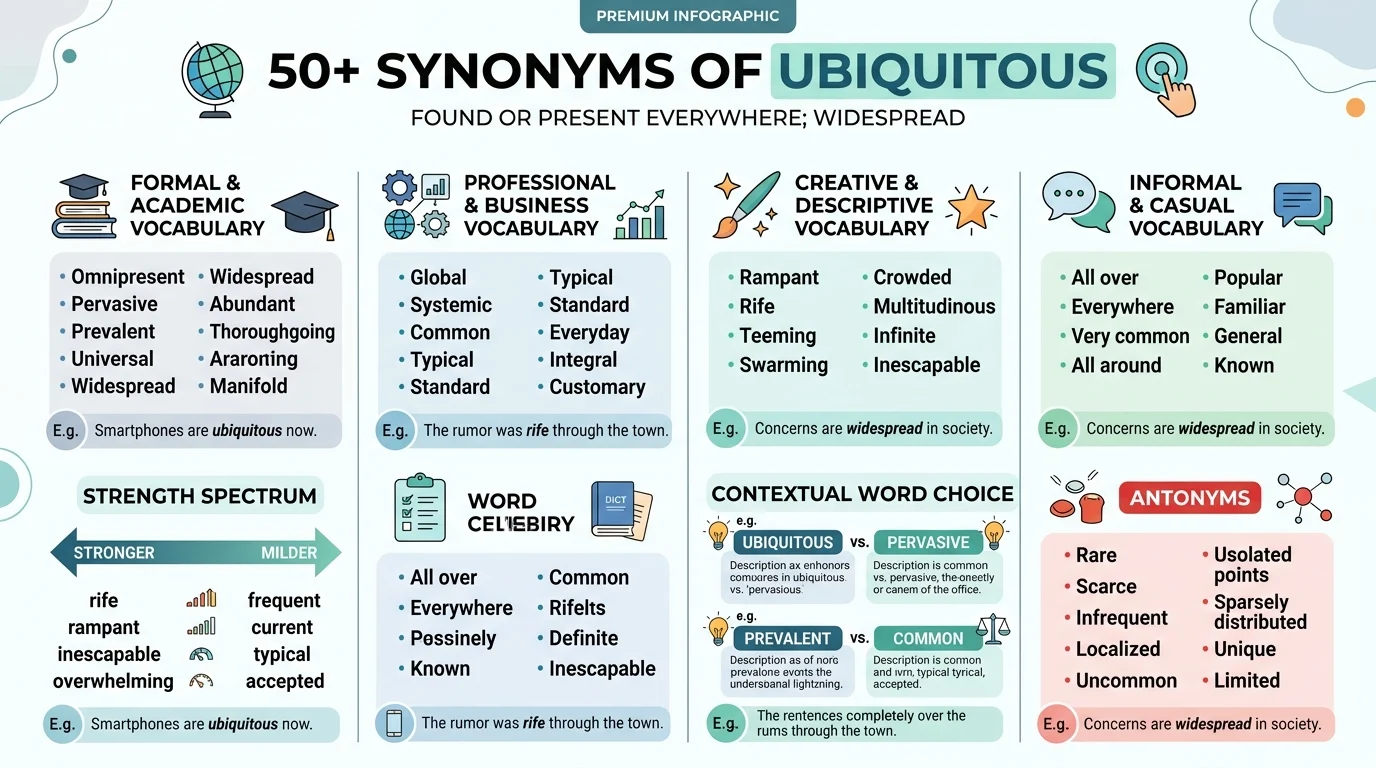
Ubiquitous means being present or found everywhere at the same time. It is a formal-to-neutral adjective describing things that are widespread and commonly encountered. Formal writing, choose “omnipresent” or “pervasive.” For casual conversation, use “everywhere” or “commonplace.” For professional contexts, “widespread” and “universal” work best. Creative writing, try “ever-present” or “all-pervading.”
Meaning, Tone, and Context
Simple Definition
Ubiquitous describes something that exists or is found everywhere at the same time. When you call something ubiquitous, you are saying it is so common that you encounter it constantly, almost without exception.
Part of Speech
Ubiquitous is an adjective. The noun form is “ubiquity” (or “ubiquitousness”), and the adverb form is “ubiquitously”.
Overall Tone
Ubiquitous carries a neutral to slightly formal tone. It does not inherently express positivity or negativity. Instead, it simply communicates frequency and reach. However, depending on what you describe, the word can take on positive connotations (ubiquitous access to information) or negative ones (ubiquitous surveillance).
Formality Level
Ubiquitous is formal to neutral. You will encounter it frequently in academic writing, journalism, professional reports, and IELTS essays. In casual conversation, it can sound slightly stiff, so many native speakers opt for simpler alternatives like “everywhere” or “common”. Cambridge Dictionary even notes it as “formal or humorous,” suggesting that in informal settings, it is often used deliberately for effect.
Common Uses
Native English speakers commonly use ubiquitous to describe:
- Technology and its prevalence (“smartphones are ubiquitous”)
- Cultural trends and fashion (“the ubiquitous denim jacket”)
- Natural phenomena (“ubiquitous fog” or “ubiquitous proteins in nature”)
- Media presence (“ubiquitous advertising”)
- Social phenomena (“ubiquitous social media“)
Word Forms
| Form | Word |
|---|---|
| Adjective | ubiquitous |
| Adverb | ubiquitously |
| Noun | ubiquity / ubiquitousness |
When and How to Use “Ubiquitous”
Choose “ubiquitous” when you want to emphasize that something appears in many places simultaneously and is so common that it feels inescapable. It works best in formal writing, analytical contexts, and descriptive passages where you need a single word to convey widespread presence.
Here are seven realistic examples showing how to use ubiquitous in different contexts:
Professional: “The company’s branding has become ubiquitous across all major social media platforms, making it instantly recognizable to consumers.”
Academic: “In contemporary urban environments, fast-food chains are ubiquitous, raising important questions about public health and food accessibility.”
Workplace: “With remote work now ubiquitous, our team has adapted to collaborating across four different time zones seamlessly.”
Personal: “Every time I visit my grandmother’s house, I notice how ubiquitous family photographs are on every wall and table.”
Email: “Given that video conferencing has become ubiquitous in our industry, I recommend we schedule a virtual check-in for next week.”
Resume: “Developed marketing strategies that made our brand ubiquitous in the competitive wellness space, increasing market share by 22%.”
Social Media: “Has anyone else noticed how ubiquitous those minimalist aesthetic posts have become on Instagram lately?”
Best Synonyms of “Ubiquitous”
No synonym is identical in every situation. Each alternative carries its own shade of meaning, tone, and emotional weight. Here are the best synonyms for specific contexts:
Professional writing: “Widespread” is the safest and most versatile choice. It communicates broad distribution without sounding overly dramatic or academic.
Academic writing: “Pervasive” works well because it suggests something spreading throughout and influencing an entire area or group.
Business communication: “Universal” implies that something applies to or exists everywhere without exception, making it ideal for describing policies, standards, or market reach.
Casual conversation: “Everywhere” is the most natural and direct alternative. Native speakers use it constantly in everyday speech.
Emotional writing: “Inescapable” adds a layer of feeling, suggesting that the ubiquitous thing is impossible to avoid, which can be positive or negative depending on context.
Creative writing: “Ever-present” has a poetic, timeless quality that works beautifully in descriptive and narrative writing.
Resume writing: “Widespread” or “extensive” sounds professional and measurable without exaggeration.
Workplace communication: “Commonplace” is straightforward and neutral, perfect for everyday office conversations.
Stronger meaning: “Omnipresent” is the most absolute synonym, implying presence everywhere at all times, often with philosophical or religious undertones.
Softer meaning: “Common” or “ordinary” tones down the intensity while still conveying that something is frequently encountered.
When Not to Use “Ubiquitous”
There are several situations where ubiquitous is not the best choice. Here is when to avoid it and what to use instead:
When the word sounds too formal: In casual text messages or friendly conversations, ubiquitous can feel out of place. Instead of saying “Coffee shops are ubiquitous in this neighborhood,” say “Coffee shops are everywhere in this neighborhood.”
When the word sounds too vague: Ubiquitous tells readers something is everywhere but does not specify where or how. Instead of “Social media is ubiquitous,” try “Social media is integrated into nearly every aspect of modern life” for more precision.
When the word sounds too weak: If you need to emphasize that something is not just common but unavoidable, ubiquitous may not carry enough weight. Instead of “Stress is ubiquitous in the workplace,” say “Stress is pervasive in the workplace” to suggest it spreads through every corner of the organization.
When the word sounds too strong: Describing something as ubiquitous when it is merely common can exaggerate your point. Instead of “Pumpkin spice is ubiquitous in autumn,” say “Pumpkin spice is very popular in autumn” or “Pumpkin spice is everywhere in autumn.”
When an outdated usage applies: Ubiquitous is a relatively modern word, entering English in the mid-19th century. While not outdated itself, using it in historical contexts where simpler language fits better may feel anachronistic.
Words Commonly Confused With “Ubiquitous”
Ubiquitous vs Omnipresent
Difference: Omnipresent is more absolute and often carries religious or philosophical connotations, suggesting presence everywhere at all times. Ubiquitous is more practical and describes things that are commonly found in many places.
When to Use It: Use omnipresent for divine, spiritual, or abstract concepts. Use ubiquitous for everyday phenomena.
Example (omnipresent): “In many faiths, the divine spirit is considered omnipresent.”
Example (ubiquitous): “Smartphones have become ubiquitous in modern society.”
Ubiquitous vs Pervasive
Difference: Pervasive suggests something spreading widely and often implies an unwelcome or penetrating influence. Ubiquitous is more neutral and simply indicates presence everywhere.
When to Use It: Use pervasive for negative influences, problems, or things that spread through every part of something. Use ubiquitous for neutral or positive widespread phenomena.
Example (pervasive): “Corruption has become pervasive throughout the government.”
Example (ubiquitous): “Wireless internet is ubiquitous in urban areas.”
Ubiquitous vs Prevalent
Difference: Prevalent means widespread in a particular area at a particular time. Ubiquitous suggests presence everywhere, without the temporal or geographic limitation.
When to Use It: Use prevalent when discussing something common in a specific place or period. Use ubiquitous when describing something found everywhere.
Example (prevalent): “The flu is prevalent during winter months.”
Example (ubiquitous): “Plastic waste is ubiquitous in the world’s oceans.”
Ubiquitous vs Universal
Difference: Universal means involving everyone or everything without exception. Ubiquitous means found in many places but does not necessarily apply to everyone or everything.
When to Use It: Use universal for rules, principles, or experiences that apply to all. Use ubiquitous for things that are simply found everywhere.
Example (universal): “Access to clean water is a universal human right.”
Example (ubiquitous): “Coffee shops are ubiquitous in this city.”
Ubiquitous vs Widespread
Difference: Widespread is broader and less intense. It simply means distributed over a large area. Ubiquitous implies a more complete presence everywhere.
When to Use It: Use widespread for general distribution. Use ubiquitous when you want to emphasize that something is truly everywhere.
Example (widespread): “The practice of recycling is widespread in Europe.”
Example (ubiquitous): “The sound of traffic is ubiquitous in New York City.”
Ubiquitous vs Commonplace
Difference: Commonplace suggests something is ordinary and unremarkable because it is so frequently encountered. Ubiquitous emphasizes the reach and presence rather than the ordinariness.
When to Use It: Use commonplace when you want to highlight that something is unexceptional. Use ubiquitous when you want to emphasize how far something extends.
Example (commonplace): “Taking selfies has become commonplace among teenagers.”
Example (ubiquitous): “Surveillance cameras are ubiquitous in London.”
Best Synonyms of “Ubiquitous” by Context
| Context | Best Synonym | Why It Works | Example |
|---|---|---|---|
| Formal writing | Omnipresent | Carries absolute, scholarly weight | “The influence of classical philosophy is omnipresent in Western thought.” |
| Academic writing | Pervasive | Suggests deep, spreading influence | “Pervasive inequality remains a central challenge in economic research.” |
| Professional communication | Widespread | Clear, measurable, and neutral | “Our client base is widespread across North America and Europe.” |
| Business emails | Universal | Implies comprehensive application | “Our remote work policy has become universal across all departments.” |
| Resume writing | Extensive | Suggests broad reach and achievement | “Developed extensive distribution networks across 12 countries.” |
| Workplace communication | Commonplace | Straightforward and unpretentious | “Virtual meetings have become commonplace in our weekly workflow.” |
| Casual conversation | Everywhere | Natural and conversational | “You see those shoes everywhere these days.” |
| Everyday speaking | Common | Simple and universally understood | “It is pretty common to see food delivery apps being used now.” |
| Creative writing | Ever-present | Poetic and evocative | “The ever-present hum of the city never truly faded.” |
| Storytelling | All-pervading | Creates atmosphere and immersion | “An all-pervading sense of mystery hung over the old mansion.” |
| Emotional writing | Inescapable | Adds emotional weight and urgency | “The inescapable reality of climate change confronts us daily.” |
| Strong emphasis | Omnipresent | Maximum intensity and absoluteness | “The brand’s omnipresent advertising campaign dominated every channel.” |
| Mild tone | Ordinary | Softens the claim of prevalence | “Smartphones are an ordinary sight in most households now.” |
| Social media captions | Everywhere | Short, punchy, and relatable | “Obsessed with this aesthetic. It is everywhere right now.” |
| American English | Widespread | The most common and natural choice | “Widespread adoption of electric vehicles is changing the auto industry.” |
How to Choose the Best Synonym of “Ubiquitous”
Choosing the right synonym depends on answering a few key questions about your writing situation.
Consider your meaning. Are you describing literal physical presence or figurative influence? For physical presence, “widespread” or “everywhere” works best. For figurative influence, try “pervasive” or “omnipresent.”
Consider your tone. Are you writing formally or casually? Formal contexts call for “omnipresent,” “pervasive,” or “universal.” Casual contexts call for “everywhere,” “common,” or “commonplace.”
Consider your audience. Who will read your words? Academic audiences appreciate “pervasive” and “omnipresent.” Business audiences respond well to “widespread” and “universal.” General audiences understand “everywhere” and “common” immediately.
Consider your emotional strength. Do you want to sound neutral, strong, or emotional? Neutral choices include “widespread” and “commonplace.” Stronger choices include “omnipresent” and “inescapable.” Emotional choices include “ever-present” and “all-pervading.”
Consider your writing purpose. Are you informing, persuading, or entertaining? Informative writing benefits from “widespread” and “universal.” Persuasive writing gains power from “inescapable” and “pervasive.” Creative writing thrives with “ever-present” and “all-pervading.”
Choose the word that communicates your intended message most clearly. The best synonym is not the fanciest one. It is the one your reader will understand instantly in your specific context.
Real Life Examples of “Ubiquitous”
Here are realistic examples showing how ubiquitous and its synonyms appear in everyday situations.
School: “The teacher explained that bacteria are ubiquitous in the environment, which is why handwashing is so important.” Improved: “The teacher explained that bacteria are pervasive in the environment, which is why handwashing is so important.” (“Pervasive” emphasizes the spreading, unavoidable nature of bacteria.)
College: “On campus, coffee culture is ubiquitous, with students lining up at cafes between every class.” Improved: “On campus, coffee culture is everywhere, with students lining up at cafes between every class.” (“Everywhere” sounds more natural for describing the college experience.)
Workplace: “The use of project management software has become ubiquitous in our office.” Improved: “The use of project management software has become widespread in our office.” (“Widespread” sounds professional and measured.)
Business: “Our advertising campaign made the brand ubiquitous across all major cities.” Improved: “Our advertising campaign made the brand universal across all major cities.” (“Universal” suggests comprehensive market penetration.)
Email: “Since video calls are ubiquitous now, let us schedule a quick virtual meeting.” Improved: “Since video calls are commonplace now, let us schedule a quick virtual meeting.” (“Commonplace” fits the casual email tone better.)
Resume: “Led a marketing initiative that made our products ubiquitous in the Southeast Asian market.” Improved: “Led a marketing initiative that made our products widespread in the Southeast Asian market.” (“Widespread” sounds more professional and verifiable.)
Conversation: “Have you noticed how ubiquitous those meal delivery apps have become?” Improved: “Have you noticed how everywhere those meal delivery apps have become?” (“Everywhere” is the natural way to say this in conversation.)
Storytelling: “The ubiquitous sound of crickets filled the summer night air.” Improved: “The ever-present sound of crickets filled the summer night air.” (“Ever-present” adds a poetic, timeless quality to the description.)
Blogging: “Minimalist decor has become ubiquitous in home design blogs.” Improved: “Minimalist decor has become pervasive in home design blogs.” (“Pervasive” suggests the trend has spread everywhere and influenced everything.)
Social Media: “Is it just me, or is that song ubiquitous on every Reel right now?” Improved: “Is it just me, or is that song everywhere on every Reel right now?” (“Everywhere” is the natural, relatable choice for social media.)
18 Best Synonyms of “Ubiquitous”
| Synonym | Simple Meaning | Best Used For | Example Sentence |
|---|---|---|---|
| Omnipresent | Present everywhere at all times | Philosophical, religious, or absolute contexts | “The omnipresent nature of digital surveillance raises privacy concerns.” |
| Pervasive | Spreading widely throughout an area or group | Describing influences, problems, or trends | “A pervasive sense of optimism swept through the organization.” |
| Widespread | Distributed over a large area | General professional and academic writing | “The practice is widespread among healthcare professionals.” |
| Universal | Existing everywhere or involving everyone | Policies, standards, and global phenomena | “Universal access to education remains an important goal.” |
| Ever-present | Always present; never absent | Creative, poetic, and descriptive writing | “The ever-present threat of wildfires haunts California residents.” |
| Commonplace | Ordinary and frequently encountered | Everyday writing and conversation | “Electric cars are becoming commonplace on our roads.” |
| All-pervading | Spreading through everything | Intense, dramatic, or atmospheric descriptions | “An all-pervading silence filled the ancient library.” |
| Inescapable | Impossible to avoid or ignore | Emotional or urgent writing | “The inescapable truth is that change is necessary.” |
| Boundless | Having no limits or boundaries | Expansive, positive descriptions | “The boundless reach of the internet connects billions of people.” |
| All-present | Present everywhere | Religious or spiritual contexts | “The all-present spirit of the ancestors guided their decisions.” |
| Rife | Widespread, often in a negative sense | Describing problems or undesirable things | “Rumors were rife throughout the office before the announcement.” |
| Extensive | Covering a large area or范围 | Professional and business writing | “The company has an extensive network of retail locations.” |
| Prevalent | Widespread in a particular area or time | Scientific and academic writing | “This disease is prevalent in tropical regions.” |
| Ordinary | Normal and unexceptional | Casual, everyday descriptions | “Smartphones are an ordinary part of modern life.” |
| Routine | Happening regularly as part of a process | Workplace and procedural contexts | “Security checks have become routine at the airport.” |
| Familiar | Well-known and commonly encountered | Describing things people recognize | “The familiar sight of food trucks lines the city streets.” |
| Global | Worldwide in scope | International business and issues | “Global brands dominate the consumer market.” |
| Ubiquitous | Found everywhere | When the exact word is the right choice | “Wi-Fi is ubiquitous in hotels and cafes across the country.” |
Synonyms of “Ubiquitous” by Usage
Professional vs Personal Synonyms
Professional synonyms work best in workplaces, reports, and formal documents. “Widespread,” “extensive,” and “universal” are safe, professional choices that communicate clearly without sounding exaggerated. Use them in performance reviews, client communications, and business presentations.
Personal synonyms sound better in everyday conversations and casual writing. “Everywhere,” “common,” and “commonplace” feel natural and unpretentious. Use them when texting friends, posting on social media, or chatting with colleagues.
Formal vs Conversational Synonyms
Formal synonyms fit reports, essays, business writing, presentations, and professional emails. “Omnipresent,” “pervasive,” and “universal” carry authority and precision. They are ideal for academic papers, corporate documents, and formal speeches.
Conversational synonyms fit casual conversations, texting, and informal writing. “Everywhere,” “all over,” and “common” are simple, direct, and easily understood. Native speakers use these constantly in daily life.
Academic Synonyms
For research, essays, reports, and academic discussions, choose precise vocabulary that sounds authoritative. “Pervasive” suggests something spreading through and influencing an entire field. “Prevalent” indicates widespread occurrence in a specific context. “Omnipresent” carries philosophical weight. These synonyms demonstrate sophisticated vocabulary while maintaining academic rigor.
Professional and Business Synonyms
For resumes, interviews, meetings, presentations, performance reviews, client communication, and business emails, choose strong, professional alternatives. “Widespread” is versatile and safe. “Extensive” suggests breadth and achievement. “Universal” implies comprehensive reach. These choices sound confident and competent without exaggeration.
Creative and Literary Synonyms
For storytelling, fiction, poetry, descriptive writing, and speeches, choose expressive alternatives that add emotion and imagery. “Ever-present” creates a sense of timelessness. “All-pervading” builds atmosphere. “Inescapable” adds emotional weight. These synonyms help paint vivid pictures and evoke strong feelings in readers.
Slang or Modern Synonyms
There are no widely recognized slang synonyms for ubiquitous. However, in very casual speech, people might say “it is everywhere” or “it is all over the place.” In texting, abbreviations like “everywhere” are common. Avoid slang in formal, academic, or professional writing.
Strongest to Mildest Synonyms
Mild → Moderate → Strong → Very Strong
- Mild: Ordinary, common, familiar
- Moderate: Commonplace, routine, widespread
- Strong: Pervasive, prevalent, universal
- Very Strong: Omnipresent, inescapable, ever-present, all-pervading, boundless
The emotional intensity increases as you move up the scale. Mild synonyms simply state frequency. Moderate synonyms add a sense of range. Strong synonyms suggest deep influence or reach. Very strong synonyms imply absoluteness and inevitability.
Emotional vs Neutral Synonyms
Emotional Synonyms: “Inescapable,” “ever-present,” “all-pervading,” and “boundless” carry strong feelings. “Inescapable” suggests helplessness or urgency. “Ever-present” evokes nostalgia or timelessness. Use these when you want your reader to feel something.
Neutral Synonyms: “Widespread,” “commonplace,” “universal,” and “prevalent” simply communicate information. They state facts without adding emotional weight. Use these when you want to inform rather than persuade or move your reader.
Antonyms of “Ubiquitous”
| Antonym | Meaning | Example Sentence |
|---|---|---|
| Rare | Not occurring very often | “True moments of silence are rare in a busy city.” |
| Scarce | Insufficient in quantity or availability | “Clean drinking water is scarce in many developing regions.” |
| Uncommon | Not frequently encountered | “Seeing a payphone is uncommon in most cities today.” |
| Limited | Confined to a small area or number | “The species has a limited habitat in the rainforest.” |
| Localized | Restricted to a particular place | “The outbreak remained localized to a single neighborhood.” |
| Infrequent | Not happening often | “Power outages are infrequent in this well-maintained grid.” |
| Exceptional | Unusual and not typical | “Her talent is exceptional, not something you see every day.” |
| Extraordinary | Very unusual or remarkable | “The view from the summit was extraordinary and unforgettable.” |
| Isolated | Separate and alone; not widespread | “The community remained isolated from mainstream culture.” |
| Sporadic | Occurring occasionally and irregularly | “Sporadic rainfall made farming difficult this season.” |
| Confined | Kept within limits; restricted | “The damage was confined to a small section of the building.” |
| Seldom | Not often; rarely | “She seldom leaves the house without her phone.” |
| Unfamiliar | Not known or recognized | “The customs were unfamiliar to the visiting tourists.” |
| Singular | Exceptionally good or great; remarkable | “His approach to the problem was singular and effective.” |
| Unique | Being the only one of its kind | “Each snowflake is unique in its crystalline structure.” |
Comparison: “Ubiquitous” vs Similar Words
Ubiquitous vs Omnipresent
Main Difference: Omnipresent is more absolute and often refers to divine or spiritual presence everywhere at all times. Ubiquitous is more practical and describes things commonly found in many places.
Which Is Stronger? Omnipresent is stronger because it implies absolute, unqualified presence everywhere.
Which Is More Formal? Omnipresent is more formal and often appears in philosophical, theological, or very serious academic writing.
When to Use Each: Use omnipresent for abstract, spiritual, or absolute concepts. Use ubiquitous for everyday phenomena.
Examples:
- Ubiquitous: “Coffee shops are ubiquitous in this city.”
- Omnipresent: “The omnipresent force of gravity shapes the universe.”
Ubiquitous vs Pervasive
Main Difference: Pervasive suggests something spreading widely and often implies a negative or unwelcome influence. Ubiquitous is neutral and simply indicates presence everywhere.
Which Is Stronger? Pervasive can feel stronger because it suggests active spreading and penetration.
Which Is More Formal? Both are formal, but pervasive is more common in academic and analytical writing.
When to Use Each: Use pervasive for problems, negative influences, or things that spread through systems. Use ubiquitous for neutral or positive widespread phenomena.
Examples:
- Ubiquitous: “Wireless internet is ubiquitous in urban areas.”
- Pervasive: “A pervasive sense of anxiety affected the entire workforce.”
Ubiquitous vs Prevalent
Main Difference: Prevalent means widespread in a particular area at a particular time. Ubiquitous suggests presence everywhere without temporal or geographic limitation.
Which Is Stronger? Ubiquitous is stronger because it implies a more complete and universal presence.
Which Is More Formal? Both are formal, but prevalent is very common in scientific and medical writing.
When to Use Each: Use prevalent when discussing something common in a specific context. Use ubiquitous when describing something found everywhere.
Examples:
- Ubiquitous: “Plastic pollution is ubiquitous in the world’s oceans.”
- Prevalent: “The flu is prevalent during winter months.”
Ubiquitous vs Universal
Main Difference: Universal means involving everyone or everything without exception. Ubiquitous means found in many places but does not necessarily apply to everyone.
Which Is Stronger? Universal is stronger because it implies no exceptions.
Which Is More Formal? Both are formal, but universal is common in philosophical, legal, and policy discussions.
When to Use Each: Use universal for rules, principles, or experiences that apply to all. Use ubiquitous for things found everywhere.
Examples:
- Ubiquitous: “Smartphones are ubiquitous in modern society.”
- Universal: “Access to education is a universal right.”
Ubiquitous vs Widespread
Main Difference: Widespread is broader and less intense. It simply means distributed over a large area. Ubiquitous implies a more complete presence everywhere.
Which Is Stronger? Ubiquitous is stronger because it suggests total presence rather than just broad distribution.
Which Is More Formal? Widespread is slightly less formal and more versatile across contexts.
When to Use Each: Use widespread for general distribution. Use ubiquitous when you want to emphasize that something is truly everywhere.
Examples:
- Ubiquitous: “The sound of traffic is ubiquitous in New York City.”
- Widespread: “The practice of recycling is widespread in Europe.”
Ubiquitous vs Commonplace
Main Difference: Commonplace suggests something is ordinary and unremarkable because it is so frequently encountered. Ubiquitous emphasizes reach and presence.
Which Is Stronger? Ubiquitous is stronger because it emphasizes the extent of presence rather than just ordinariness.
Which Is More Formal? Ubiquitous is more formal. Commonplace is neutral and works in both formal and casual contexts.
When to Use Each: Use commonplace when highlighting ordinariness. Use ubiquitous when emphasizing how far something extends.
Examples:
- Ubiquitous: “Surveillance cameras are ubiquitous in London.”
- Commonplace: “Taking selfies has become commonplace among teenagers.”
Common Phrases and Expressions with “Ubiquitous”
Ubiquitous presence
Meaning: The state of being found everywhere.
Example Sentence: “The ubiquitous presence of social media has transformed how we communicate.”
Ubiquitous technology
Meaning: Technology that is found everywhere and integrated into daily life.
Example Sentence: “Smartphones represent the most ubiquitous technology of the twenty-first century.”
Ubiquitous computing
Meaning: A concept where computing occurs everywhere rather than on a single device.
Example Sentence: “Ubiquitous computing has made it possible to access information from virtually anywhere.”
Ubiquitous in nature
Meaning: Found naturally everywhere.
Example Sentence: “Certain bacteria are ubiquitous in nature and can be found in soil, water, and air.”
Ubiquitous throughout
Meaning: Present everywhere within a particular area or system.
Example Sentence: “The practice is ubiquitous throughout the healthcare industry.”
Become ubiquitous
Meaning: To become found everywhere over time.
Example Sentence: “Online shopping has become ubiquitous in the last decade.”
Seemingly ubiquitous
Meaning: Appearing to be everywhere, even if not literally.
Example Sentence: “The seemingly ubiquitous advertisements followed her from website to website.”
Common Mistakes to Avoid
1: Choosing a vague synonym instead of a precise one.
Incorrect: “Social media is common.” (Too vague; common could mean many things.)
Better: “Social media is ubiquitous in modern society.” (Precise; it communicates that social media is everywhere.)
Why it is better: “Ubiquitous” gives the reader a clear picture of prevalence, while “common” leaves too much to interpretation.
2: Confusing ubiquitous with a similar word.
Incorrect: “The omnipresent coffee shop on every corner serves excellent espresso.” (Omnipresent is too strong for a coffee shop.)
Better: “The ubiquitous coffee shop on every corner serves excellent espresso.”
Why it is better: “Ubiquitous” fits everyday phenomena. “Omnipresent” suggests divine or absolute presence.
3: Using an informal synonym in formal writing.
Incorrect: “The issue is everywhere in academic literature.” (Too casual for academic writing.)
Better: “The issue is pervasive in academic literature.”
Why it is better: “Pervasive” sounds scholarly and precise, matching the formal tone of academic writing.
4: Selecting an overly dramatic synonym.
Incorrect: “The inescapable presence of smartphones in our lives is notable.” (Too dramatic for a neutral observation.)
Better: “The ubiquitous presence of smartphones in our lives is notable.”
Why it is better: “Ubiquitous” conveys the idea without emotional exaggeration. “Inescapable” suggests something negative or urgent.
5: Repeating the same word too often.
Incorrect: “The brand is ubiquitous in stores. Its logo is ubiquitous online. Its products are ubiquitous in homes.”
Better: “The brand is ubiquitous in stores. Its logo is pervasive online. Its products are widespread in homes.”
Why it is better: Varying synonyms keeps writing fresh and engaging while maintaining clarity.
6: Choosing a synonym with the wrong emotional tone.
Incorrect: “The ever-present joy of the celebration filled the room.” (Does not fit; ever-present suggests something constant and perhaps ominous.)
Better: “The pervasive joy of the celebration filled the room.”
Why it is better: “Pervasive” suggests something spreading through and filling a space, which fits a positive emotion like joy.
7: Using slang in academic or professional writing.
Incorrect: “The trend is all over the place in the industry.” (Too casual for professional writing.)
Better: “The trend is widespread in the industry.”
Why it is better: “Widespread” sounds professional and measured, appropriate for business contexts.
Frequently Asked Questions
1. What are the best synonyms of ubiquitous?
The best synonyms depend on your context. Formal writing, choose “omnipresent” or “pervasive.” For casual conversation, use “everywhere” or “commonplace.” Professional contexts, “widespread” and “universal” work well. For creative writing, try “ever-present” or “all-pervading.”
2. What are the best formal synonyms of ubiquitous?
The best formal synonyms are “omnipresent,” “pervasive,” and “universal.” “Omnipresent” carries philosophical weight. “Pervasive” suggests deep, spreading influence. “Universal” implies application to everyone or everything without exception. These words work well in academic papers, reports, and professional documents.
3. What are common informal synonyms of ubiquitous?
The most common informal synonyms are “everywhere,” “common,” and “commonplace.” Native speakers use “everywhere” constantly in everyday conversation. “Common” is simple and universally understood. “Commonplace” suggests something is ordinary and frequently encountered. These alternatives sound natural in casual writing and speech.
4. What is another word for ubiquitous in professional writing?
In professional writing, “widespread” is the safest and most versatile alternative. “Extensive” works well for describing reach and achievement. “Universal” is ideal for policies and standards. These choices sound professional, measurable, and confident without exaggeration.
5. What is the difference between ubiquitous and omnipresent?
Omnipresent is more absolute and often carries religious or philosophical connotations, suggesting presence everywhere at all times. Ubiquitous is more practical and describes things commonly found in many places. Use omnipresent for divine or abstract concepts. Use ubiquitous for everyday phenomena like technology or trends.
6. What is the opposite of ubiquitous?
The direct opposite of ubiquitous is “rare,” meaning not occurring very often. Other antonyms include “scarce,” “uncommon,” “limited,” and “localized.” These words describe things that are not found everywhere or are confined to specific places.
Conclusion
Ubiquitous is a powerful adjective that describes things found everywhere at the same time. It is a formal-to-neutral word that works well in academic writing, journalism, and professional contexts. However, no single synonym works perfectly in every situation. The best choice depends on your audience, tone, and purpose.
Formal writing, choose “omnipresent” or “pervasive.” For casual conversation, use “everywhere” or “commonplace.” Professional contexts, “widespread” and “universal” are safe and effective. For creative writing, “ever-present” and “all-pervading” add emotion and imagery.
Exploring the synonyms of ubiquitous expands your vocabulary and makes your writing more precise and engaging. The next time you reach for “ubiquitous,” take a moment to consider whether a more specific alternative might serve your purpose better. Your readers will notice the difference.