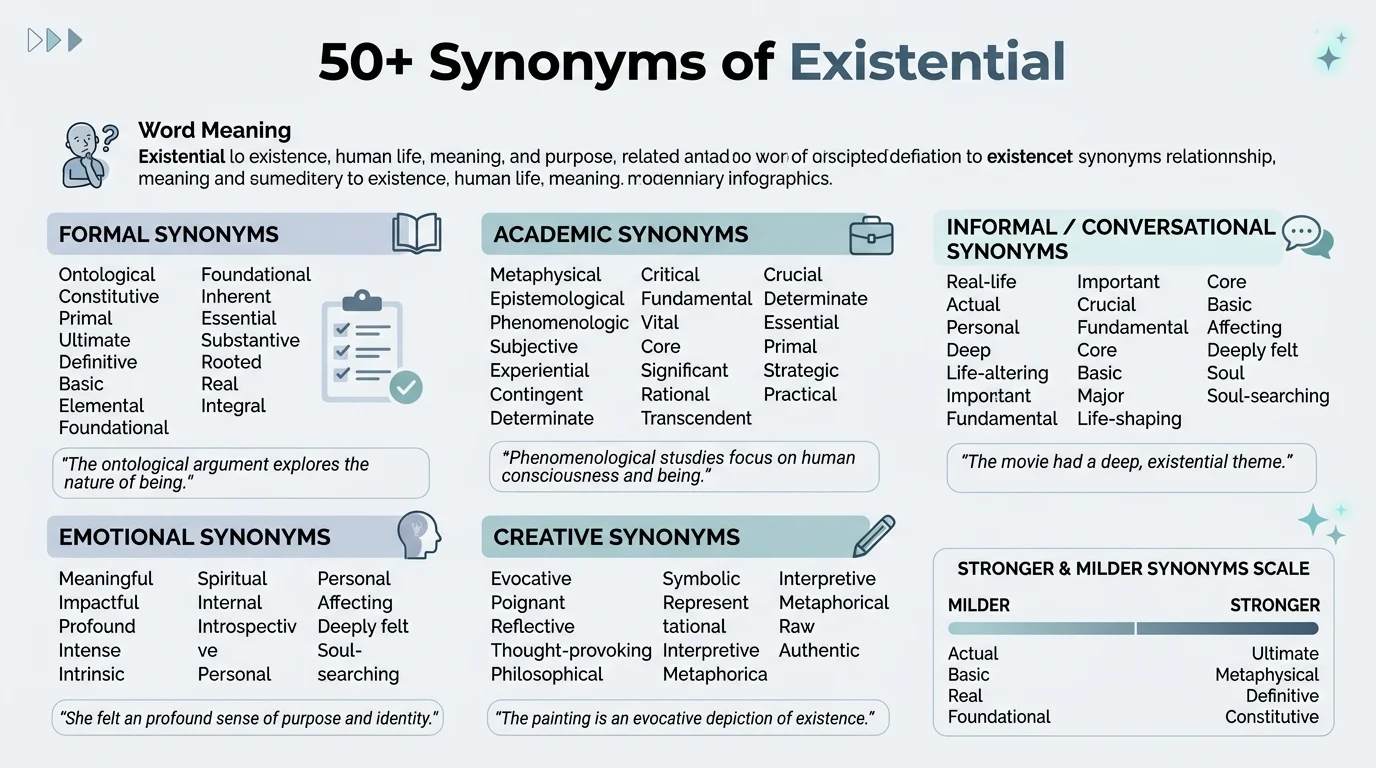
Have you ever found yourself writing an email, an essay, or a social media caption and realized you have used the word “existential” three times in two paragraphs? You are not alone. Many writers, students, and professionals rely on the same vocabulary when discussing deep topics. But repeating the same word makes your writing feel flat and uninspired. Learning the best synonyms of existential will help you communicate more clearly and sound more natural in any situation. Whether you are drafting a business report, a college essay, or a thoughtful blog post, choosing the right synonym can change the entire tone of your message.
What Are the Best Synonyms of “Existential”?
“Existential” relates to human existence, experience, and the search for meaning. For formal writing, use “ontological” or “fundamental.” For casual conversation, try “life-related” or “personal.” In professional settings, “critical” or “foundational” work well. For emotional writing, “visceral” and “poignant” add depth. For academic work, “empirical” and “phenomenological” are precise choices.
Meaning, Tone, and Context
Simple Definition
Existential is an adjective that relates to existence, especially human existence. It describes things connected to the fact of being alive, the nature of life, and the search for meaning. The word also appears in philosophy to describe the ideas of existentialism, which emphasize individual freedom, choice, and personal responsibility.
Part of Speech
Adjective
Overall Tone
Existential is neutral but often leans serious or philosophical. It can feel weighty because it touches on life, death, meaning, and purpose.
Formality Level
Formal to semi-formal. You will find it in academic writing, philosophical discussions, news articles, and professional reports. It is less common in casual conversation unless you are discussing deep topics.
Common Uses
Native English speakers use “existential” in several ways:
- To describe threats to survival, such as an “existential threat” to a company or civilization
- To discuss philosophical questions about meaning and purpose
- To describe personal crises involving identity and direction
- In logic and linguistics to indicate existence
- To refer to experiences grounded in real life rather than theory
Word Forms
- Noun: existentialism, existentialist
- Adjective: existential
- Adverb: existentially
- Related forms: existence, existent, existing
When and How to Use “Existential”
Choose “existential” when you want to emphasize that something relates to the very nature of existence or survival. It works best in serious discussions about life, meaning, threats, or philosophical ideas. Here are seven realistic examples.
Professional: The company faces an existential threat from new competitors entering the market.
Academic: The philosopher’s work addresses existential questions about freedom and responsibility.
Workplace: Our department needs to address the existential challenges that could affect our long-term viability.
Personal: After turning forty, he went through an existential crisis and questioned everything he had built.
Email: I believe we are overlooking an existential risk in our current strategy that requires immediate attention.
Resume: Led the team through an existential restructuring that secured the organization’s future.
Social Media: Late-night thoughts always turn existential. Does anyone else lie awake wondering what it all means?
Best Synonyms of “Existential”
No synonym works perfectly in every situation. Each alternative carries a slightly different tone, level of formality, and emotional weight. Here are the best synonyms for specific contexts.
Professional writing: Fundamental – It conveys importance without the philosophical weight.
Academic writing: Ontological – This precise term fits philosophy and serious scholarly work.
Business communication: Critical – It signals urgency and importance clearly.
Casual conversation: Life-related – Simple and natural for everyday talk.
Emotional writing: Visceral – Adds depth and feeling to personal reflections.
Creative writing: Poignant – Brings emotional resonance to storytelling.
Resume writing: Transformational – Suggests meaningful change and impact.
Workplace communication: Foundational – Emphasizes core importance without being dramatic.
Stronger meaning: Catastrophic – Use when describing extreme threats or consequences.
Softer meaning: Personal – Use when the focus is on individual experience rather than universal existence.
When Not to Use “Existential”
When the Word Sounds Too General
If you are describing something that is simply important but not related to existence or survival, “existential” is too strong.
Less effective: The new software update is an existential improvement for our workflow.
Better: The new software update is a fundamental improvement for our workflow.
Why: “Fundamental” communicates importance without overstating the impact.
When the Word Sounds Too Vague
In business writing, “existential” can sound unclear if you do not specify what is being threatened.
Less effective: We are facing existential issues in our supply chain.
Better: We are facing critical issues in our supply chain that could disrupt operations.
Why: “Critical” is more precise and actionable in a business context.
When the Word Sounds Too Formal
In casual conversation, “existential” can make you sound pretentious.
Less effective: I am having an existential moment about what to eat for dinner.
Better: I am having a serious moment about what to eat for dinner.
Why: “Serious” fits the casual tone while still conveying weight.
When the Word Sounds Too Weak
If you are describing a life-or-death situation, “existential” may not feel strong enough.
Less effective: The hurricane posed an existential danger to the coastal town.
Better: The hurricane posed a catastrophic danger to the coastal town.
Why: “Catastrophic” better conveys the extreme severity.
When the Word Is Outdated
In some contexts, “existential” can feel overly philosophical or old-fashioned.
Less effective: His existential ponderings at the party bored everyone.
Better: His deep philosophical ponderings at the party bored everyone.
Why: “Deep philosophical” sounds more natural in modern conversation.
Words Commonly Confused With “Existential”
Existential vs. Existent
Difference: “Existential” relates to the nature of existence itself. “Existent” simply means something that exists.
When to Use It: Use “existent” when you only need to say that something is real or present. Use “existential” when discussing the nature or meaning of existence.
Example (existential): The documentary raised existential questions about humanity’s future.
Example (existent): The existent data supports our initial hypothesis.
Existential vs. Existing
Difference: “Existing” describes things that are currently present or in use. “Existential” describes the fundamental nature of being.
When to Use It: Use “existing” for current conditions. Use “existential” for deeper philosophical or survival-related discussions.
Example (existential): Climate change is an existential threat to coastal cities.
Example (existing): We need to update our existing policies.
Existential vs. Essential
Difference: “Essential” means absolutely necessary. “Existential” relates to existence or survival.
When to Use It: Use “essential” when something is required. Use “existential” when something threatens the very existence of something else.
Example (existential): The pandemic created an existential crisis for small businesses.
Example (essential): Good communication is essential for team success.
Existential vs. Experiential
Difference: “Experiential” relates to personal experience and observation. “Existential” relates to existence itself.
When to Use It: Use “experiential” when describing learning or knowledge gained through experience. Use “existential” for broader questions about being.
Example (existential): The novel explores existential themes of freedom and choice.
Example (experiential): The course offers experiential learning through real-world projects.
Best Synonyms of “Existential” by Context
| Context | Best Synonym | Why It Works | Example |
|---|---|---|---|
| Formal writing | Ontological | Precise philosophical term | The ontological implications of the theory are significant. |
| Academic writing | Phenomenological | Captures experience-based inquiry | The study used a phenomenological approach to understand patient experiences. |
| Professional communication | Foundational | Conveys core importance clearly | Trust is foundational to our client relationships. |
| Business emails | Critical | Signals urgency and importance | We need to address this critical issue immediately. |
| Resume writing | Transformational | Suggests meaningful impact | Led transformational changes that doubled revenue. |
| Workplace communication | Fundamental | Emphasizes basic importance | This is a fundamental requirement for the project. |
| Casual conversation | Life-related | Natural and approachable | We had a life-related conversation about our goals. |
| Everyday speaking | Personal | Relatable and simple | This feels like a personal question more than a logical one. |
| Creative writing | Poignant | Adds emotional depth | The poignant moment changed everything for the character. |
| Storytelling | Visceral | Creates strong emotional impact | The visceral fear in the scene was unforgettable. |
| Emotional writing | Heartfelt | Conveys genuine feeling | Her heartfelt reflections moved everyone in the room. |
| Strong emphasis | Catastrophic | Conveys extreme danger or consequence | The catastrophic failure ended the project. |
| Mild tone | Individual | Focuses on the personal level | This is an individual matter, not a universal one. |
| Social media captions | Deep | Short and relatable | Having some deep thoughts tonight. |
How to Choose the Best Synonym of “Existential”
Choosing the right synonym depends on several factors.
Consider your meaning. Are you discussing survival, philosophy, personal experience, or something else? Match the synonym to your specific meaning.
Think about your tone. Do you want to sound formal, casual, emotional, or neutral? Choose words that fit the tone you are aiming for.
Know your audience. Academic readers expect precise terms like “ontological” or “phenomenological.” Business readers prefer “critical” or “foundational.” Friends and family appreciate simpler words like “personal” or “deep.”
Assess emotional strength. Do you need a mild word like “personal” or a strong word like “catastrophic”? Match the intensity to the situation.
Consider your writing purpose. Are you writing a report, a story, an email, or a social post? Different purposes call for different vocabulary.
Read your sentence aloud. If the synonym sounds awkward or forced, try a different one. Natural-sounding language always wins.
Real Life Examples of “Existential”
School: The teacher asked us to write about existential questions that have no easy answers.
College: Her philosophy paper explored existential themes in modern literature.
Workplace: The restructuring was an existential moment for the entire department.
Business: The startup faced an existential challenge when its main investor pulled out.
Email: I hope we can discuss the existential risks our project faces before the next meeting.
Resume: Spearheaded existential transformation initiatives that improved efficiency by 40%.
Conversation: “Lately, I have been having some existential thoughts about my career path.”
Storytelling: The protagonist’s existential journey took her across three continents and into the depths of her own soul.
Blogging: Why do we keep asking existential questions when we know there are no definitive answers?
Social Media: Existential crisis mode: activated. Send help or snacks.
18 Best Synonyms of “Existential”
| Synonym | Simple Meaning | Best Used For | Example Sentence |
|---|---|---|---|
| Ontological | Relating to the nature of being | Academic philosophy | The ontological argument has been debated for centuries. |
| Fundamental | Basic and important | Professional writing | This is a fundamental principle of our organization. |
| Critical | Extremely important or serious | Business communication | We are at a critical juncture in our development. |
| Foundational | Forming the basis of something | Workplace contexts | Trust is foundational to any healthy relationship. |
| Personal | Relating to an individual | Casual conversation | This feels like a personal matter rather than a professional one. |
| Experiential | Based on experience | Educational contexts | The program offers experiential learning opportunities. |
| Empirical | Based on observation | Academic research | The empirical evidence supports the hypothesis. |
| Phenomenological | Relating to conscious experience | Psychology and philosophy | Her phenomenological analysis revealed new insights. |
| Visceral | Felt deeply and instinctively | Creative writing | The visceral reaction was immediate and powerful. |
| Poignant | Evoking a keen sense of sadness or regret | Emotional writing | The poignant scene brought tears to my eyes. |
| Humanistic | Emphasizing human values | Social sciences | The humanistic approach focuses on individual potential. |
| Life-oriented | Focused on life and living | Everyday speaking | Her life-oriented perspective keeps things grounded. |
| Transformational | Causing major change | Resume writing | His transformational leadership saved the company. |
| Individualistic | Emphasizing the individual | Philosophical discussion | The individualistic nature of the decision was clear. |
| Decisive | Settling an issue or producing a definite result | Professional contexts | This is a decisive moment for our team. |
| Ultimate | Final or most extreme | Strong emphasis | The ultimate consequence was unavoidable. |
| Catastrophic | Involving great damage or suffering | Describing disasters | The catastrophic failure shocked everyone. |
| Metaphysical | Relating to abstract or spiritual matters | Philosophical writing | The metaphysical questions remain unanswered. |
Synonyms of “Existential” by Usage
Professional vs Personal Synonyms
In professional settings, choose words that sound serious and competent. “Fundamental,” “critical,” and “foundational” work well because they convey importance without sounding dramatic. In personal conversations, simpler words like “personal,” “deep,” or “life-related” feel more natural and less pretentious.
Formal vs Conversational Synonyms
For reports, essays, and business writing, use formal options like “ontological,” “empirical,” or “phenomenological.” These terms sound authoritative and precise. For casual conversations, texting, and social media, choose conversational options like “deep,” “personal,” or “life-changing.” These words connect with readers without alienating them.
Academic Synonyms
Academic writing demands precision. “Ontological” and “phenomenological” are standard terms in philosophy and psychology. “Empirical” works well in scientific research. “Metaphysical” suits discussions that go beyond the physical world. These words sound authoritative because they are the accepted terminology in their fields.
Professional and Business Synonyms
In resumes, interviews, and business communication, choose words that demonstrate impact and clarity. “Transformational” suggests meaningful change. “Critical” signals urgency. “Foundational” conveys core importance. “Decisive” shows leadership. These words help you sound professional and competent.
Creative and Literary Synonyms
For storytelling and creative writing, choose words that evoke emotion and imagery. “Visceral” creates a powerful physical reaction. “Poignant” adds emotional depth. “Humanistic” connects to shared human values. “Individualistic” emphasizes personal agency. These words bring your writing to life.
Slang or Modern Synonyms
“Existential” does not have widely recognized slang equivalents. In casual contexts, people might say “deep” or “heavy” to describe existential thoughts. However, these are informal and should not be used in professional or academic writing.
Strongest to Mildest Synonyms
Mild: Personal, life-oriented, individual
Moderate: Fundamental, foundational, experiential, humanistic
Strong: Critical, decisive, ontological, metaphysical
Very Strong: Catastrophic, ultimate, transformational
The emotional intensity increases as you move from mild to very strong. Choose the level that matches the seriousness of your topic.
Emotional vs Neutral Synonyms
Emotional Synonyms: Visceral, poignant, heartfelt, catastrophic, transformational – These words carry strong feelings and should be used when you want to evoke an emotional response.
Neutral Synonyms: Fundamental, foundational, ontological, empirical, experiential – These words simply communicate information without adding emotional weight. Use them in reports, academic papers, and professional communication where objectivity matters.
Antonyms of “Existential”
Comparison: “Existential” vs Similar Words
Existential vs Fundamental
Main Difference: “Existential” relates to existence or survival. “Fundamental” relates to being basic or essential.
Which Is Stronger? “Existential” is stronger because it implies a threat to existence itself.
Which Is More Formal? Both are formal, but “existential” is more specialized.
When to Use Each: Use “existential” for survival-related topics. Use “fundamental” for basic principles.
Existential: Climate change is an existential threat to island nations.
Fundamental: Honesty is a fundamental value in our organization.
Existential vs Critical
Main Difference: “Critical” means extremely important or serious. “Existential” specifically relates to existence or survival.
Which Is Stronger? “Existential” is stronger in the context of survival. “Critical” is broader.
Which Is More Formal? Both are formal, but “critical” is more common in business.
When to Use Each: Use “existential” when survival is at stake. Use “critical” for high importance.
Existential: The species faces an existential threat from habitat loss.
Critical: The project is at a critical stage and needs your attention.
Existential vs Ontological
Main Difference: “Existential” relates to human existence and experience. “Ontological” specifically relates to the nature of being in philosophy.
Which Is Stronger? Both are equally strong in philosophical contexts.
Which Is More Formal? “Ontological” is more formal and academic.
When to Use Each: Use “existential” for broader discussions about life and meaning. Use “ontological” for precise philosophical arguments.
Existential: The film explores existential themes of freedom and choice.
Ontological: The ontological argument attempts to prove God’s existence through reason alone.
Existential vs Experiential
Main Difference: “Existential” relates to existence itself. “Experiential” relates to personal experience.
Which Is Stronger? “Existential” carries more weight in philosophical discussions.
Which Is More Formal? Both are formal, but “existential” appears more often in philosophy.
When to Use Each: Use “existential” for questions about being. Use “experiential” for learning through experience.
Existential: The novel deals with existential questions about identity.
Experiential: The workshop offers experiential learning opportunities.
Existential vs Personal
Main Difference: “Existential” relates to universal questions about existence. “Personal” relates to an individual’s private life.
Which Is Stronger? “Existential” is stronger and more philosophical.
Which Is More Formal? “Existential” is more formal. “Personal” works in any context.
When to Use Each: Use “existential” for big philosophical questions. Use “personal” for individual matters.
Existential: She struggled with existential questions about her purpose.
Personal: This is a personal matter between us.
Existential vs Visceral
Main Difference: “Existential” relates to existence and meaning. “Visceral” relates to deep instinctive feelings.
Which Is Stronger? “Visceral” is stronger in emotional impact. “Existential” is stronger in philosophical weight.
Which Is More Formal? Both are formal, but “existential” is more academic.
When to Use Each: Use “existential” for intellectual discussions. Use “visceral” for emotional descriptions.
Existential: The crisis raised existential questions about our future.
Visceral: The horror film created a visceral reaction in the audience.
Common Phrases and Expressions with “Existential”
Existential crisis
Meaning: A period of deep questioning about the meaning and purpose of life.
Example Sentence: After losing his job, he fell into an existential crisis that lasted for months.
Existential threat
Meaning: A danger that threatens the very existence of something.
Example Sentence: The new competitor poses an existential threat to our business model.
Existential angst
Meaning: Deep anxiety about the meaning of life and human existence.
Example Sentence: The character’s existential angst drove the entire plot of the novel.
Existential question
Meaning: A profound question about existence, meaning, or purpose.
Example Sentence: The teacher encouraged students to ask existential questions about their values.
Existential despair
Meaning: Hopelessness about the meaning or purpose of existence.
Example Sentence: The philosopher’s writings are filled with existential despair.
Existential dread
Meaning: A feeling of fear or unease about existence.
Example Sentence: The thought of an empty universe filled him with existential dread.
Existential risk
Meaning: A risk that threatens the survival of humanity or a significant part of it.
Example Sentence: Scientists study existential risks like asteroid impacts and pandemics.
Common Mistakes to Avoid
Choosing a Vague Synonym
Incorrect: The company is facing an existential issue with its new product.
Better: The company is facing a critical issue with its new product.
Why: “Critical” is more precise and actionable.
Confusing “Existential” with “Existent”
Incorrect: The existential data supports our conclusion.
Better: The existent data supports our conclusion.
Why: “Existent” means “existing.” “Existential” means “relating to existence.”
Using an Informal Synonym in Formal Writing
Incorrect: The research addresses deep questions about human nature.
Better: The research addresses fundamental questions about human nature.
Why: “Fundamental” sounds more academic and professional.
Selecting an Overly Dramatic Synonym
Incorrect: The new policy creates an existential crisis for the department.
Better: The new policy creates significant challenges for the department.
Why: “Significant challenges” is more realistic and less dramatic.
Repeating the Same Word Too Often
Incorrect: The existential threat is real. The existential questions remain. The existential crisis deepens.
Better: The existential threat is real. The underlying questions remain. The crisis deepens.
Why: Variety keeps your writing engaging.
Choosing the Wrong Emotional Tone
Incorrect: The team faced a catastrophic delay in the project.
Better: The team faced a significant delay in the project.
Why: “Catastrophic” is too strong for a simple delay.
Using Slang in Academic Writing
Incorrect: The study explores deep stuff about human existence.
Better: The study explores fundamental questions about human existence.
Why: “Fundamental questions” is appropriate for academic writing.
Frequently Asked Questions
What are the best synonyms of “existential”?
The best synonyms depend on your context. Use “ontological” for philosophy, “fundamental” for general writing, “critical” for business, and “visceral” for emotional descriptions. No single synonym works in every situation.
What are the best formal synonyms of “existential”?
The best formal synonyms include “ontological,” “phenomenological,” “empirical,” and “metaphysical.” These terms are precise and appropriate for academic, philosophical, and professional writing.
What are common informal synonyms of “existential”?
Common informal synonyms include “deep,” “personal,” “life-related,” and “heavy.” These words work well in casual conversation, social media, and personal writing.
What is another word for “existential” in professional writing?
In professional writing, use “fundamental,” “critical,” “foundational,” or “decisive.” These words convey importance and urgency without the philosophical weight of “existential.”
What is the difference between “existential” and “fundamental”?
“Existential” relates to existence or survival. “Fundamental” relates to being basic or essential. “Existential” implies a threat to existence itself, while “fundamental” simply describes core importance.
What is the opposite of “existential”?
The opposite of “existential” includes “nonexistent,” “imaginary,” “fictional,” “unreal,” and “superficial.” These words describe things that lack existence, reality, or depth.
Conclusion
“Existential” is a versatile word that relates to existence, human experience, and the search for meaning. The best synonyms of existential depend on your context, audience, and purpose. Formal writing, choose “ontological” or “fundamental.” For professional settings, use “critical” or “foundational.” For casual conversation, try “personal” or “deep.” Remember that no synonym works perfectly in every situation. The key to great writing is choosing words that match your meaning, tone, and audience. The next time you reach for “existential,” ask yourself what you really mean and choose the word that communicates it most clearly.