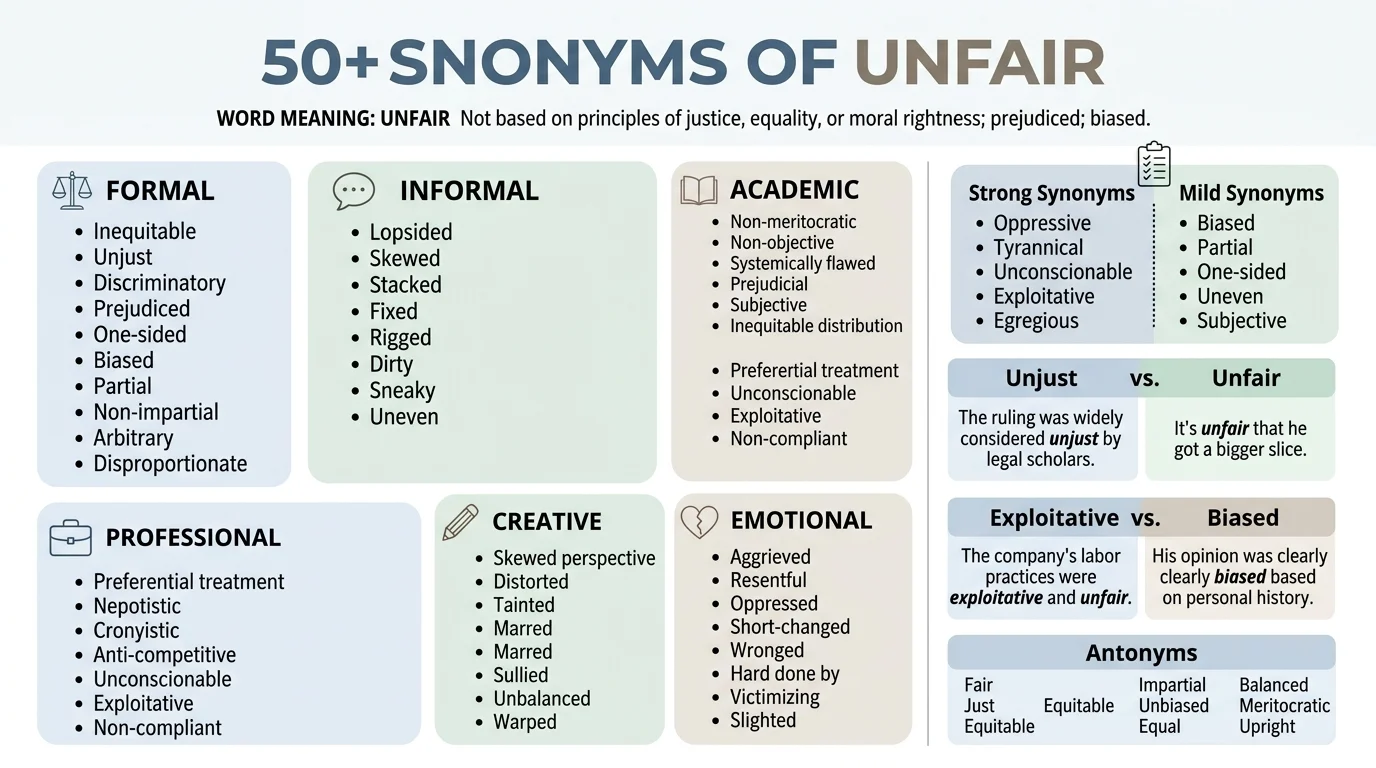
Have you ever been writing an email, an essay, or a social media post and found yourself typing the word “unfair” over and over again? It happens to everyone. You know the situation feels wrong, but you cannot think of a better word to describe it. This is exactly why understanding the synonyms of unfair can transform your writing.
Choosing the right synonym does more than just avoid repetition. It helps you communicate the exact shade of meaning you intend. Whether you are writing a formal complaint, a casual text message, or an academic paper, the right word makes your message clearer and more powerful.
What Are the Best Synonyms of “Unfair”?
Unfair means not morally right or not treating people equally. It describes situations where someone receives an undeserved advantage or disadvantage. The best synonyms depend on context: use unjust for formal or legal matters, biased for one-sided treatment, discriminatory for unequal treatment based on identity, inequitable for formal writing, and unreasonable for everyday situations.
Meaning, Tone, and Context
Simple Definition: Unfair describes actions, rules, or situations that are not morally right because they do not treat people equally. When something is unfair, it gives an advantage to one person or group while treating another poorly.
Part of Speech: Adjective
Overall Tone: Negative. The word carries disapproval and signals that something is wrong or unjust.
Formality Level: Neutral. “Unfair” works in almost any setting, from casual conversation to professional writing. However, more formal contexts often call for stronger alternatives like “inequitable” or “unjust”.
Common Uses: Native English speakers use “unfair” in countless situations. You might call a grading system unfair, describe a workplace policy as unfair, or complain that a game’s rules are unfair. It appears in everyday speech, news reports, business discussions, and personal conversations.
Word Forms:
- Adjective: unfair
- Adverb: unfairly
- Noun: unfairness
- Opposite: fair
When and How to Use “Unfair”
Choose “unfair” when you want to describe something that violates basic principles of fairness and equality. It works well in both spoken and written English across most contexts. Here are seven realistic examples:
Professional: “The promotion process felt unfair because internal candidates received more information than external applicants.”
Academic: “The study concluded that the school’s disciplinary system was unfair to students from minority backgrounds.”
Workplace: “It seems unfair that some employees receive flexible hours while others do not.”
Personal: “It is unfair that my brother gets to stay up later than I do.”
Email: “I am writing to express my concern about what I believe is an unfair distribution of project responsibilities.”
Resume: (Avoid using “unfair” directly in a resume. Instead, describe the situation and use stronger vocabulary like “inequitable” or “unjustified.”)
Social Media: “This new policy is completely unfair to small business owners.”
Best Synonyms of “Unfair”
No synonym is identical to “unfair” in every situation. Each alternative carries its own tone, intensity, and appropriate context. Here is how to choose the best synonym for different writing situations.
Professional Writing: Use inequitable. This formal word sounds precise and serious. It works well in business reports, policy documents, and professional correspondence.
Academic Writing: Choose unjust. This word carries weight and authority. It fits essays, research papers, and discussions about social issues, laws, or historical events.
Business Communication: Use unreasonable. This practical word describes expectations, demands, or policies that go beyond what is fair or sensible.
Casual Conversation: Say not fair. This simple phrase sounds natural and conversational. It is the most common way Americans express unfairness in everyday speech.
Emotional Writing: Choose unconscionable. This strong word expresses outrage and moral condemnation. Use it sparingly when you want to emphasize extreme unfairness.
Creative Writing: Use one-sided. This descriptive word paints a clear picture of imbalance and partiality. It works well in storytelling and narrative writing.
Resume Writing: (Avoid calling situations “unfair” directly. Instead, describe the issue using professional vocabulary like inequitable, unjustified, or discriminatory when relevant.)
Workplace Communication: Use biased. This word specifically describes unfair treatment that stems from personal preference or prejudice.
Stronger Meaning: Choose oppressive, unconscionable, or iniquitous for situations involving severe injustice.
Softer Meaning: Choose unreasonable, undeserved, or uncalled for for milder situations.
When Not to Use “Unfair”
When the word sounds too general: “Unfair” can feel vague in formal writing. It does not always communicate the specific nature of the injustice.
Instead, use: Inequitable or unjust
Rewrite: “The policy is unfair” → “The policy is inequitable and disproportionately affects low-income families.”
When the word sounds too informal: In academic papers or legal documents, “unfair” may not carry enough authority.
Instead, use: Unjust or discriminatory
Rewrite: “The judge’s decision was unfair” → “The judge’s decision was unjust and violated established legal principles.”
When the word sounds too weak: If you are describing a serious moral wrong, “unfair” does not capture the severity.
Instead, use: Unconscionable or oppressive
Rewrite: “The treatment of workers was unfair” → “The treatment of workers was unconscionable and demands immediate action.”
When the word sounds too strong: In minor everyday situations, “unfair” can sound overly dramatic.
Instead, use: Unreasonable or undeserved
Rewrite: “It is unfair that I have to work late” → “It is unreasonable to expect me to work late without notice.”
Words Commonly Confused With “Unfair”
Unfair vs Unjust
Difference: “Unjust” is more formal and serious. It refers to violations of moral or legal principles, while “unfair” covers a broader range of situations.
When to Use It: Use “unjust” for laws, court decisions, wars, and systemic issues.
Example: “The court’s ruling was unjust and ignored crucial evidence.”
Unfair vs Biased
Difference: “Biased” specifically describes unfairness caused by personal preference, prejudice, or a lack of objectivity.
When to Use It: Use “biased” when a person or source shows partiality.
Example: “The reporter gave a biased account of the debate.”
Unfair vs Discriminatory
Difference: “Discriminatory” refers specifically to unfair treatment based on characteristics like race, gender, age, or religion.
When to Use It: Use “discriminatory” in legal, social, and workplace contexts involving protected characteristics.
Example: “The company’s hiring practices were found to be discriminatory.”
Unfair vs Inequitable
Difference: “Inequitable” is a formal word that describes systemic unfairness in distribution or treatment.
When to Use It: Use “inequitable” in formal writing, policy discussions, and academic contexts.
Example: “The current funding model is inequitable and fails to serve rural communities.”
Unfair vs Prejudiced
Difference: “Prejudiced” describes unfair attitudes or treatment based on preconceived opinions, often about groups of people.
When to Use It: Use “prejudiced” when discussing personal bias against individuals or groups.
Example: “The manager was prejudiced against older workers.”
Unfair vs Unreasonable
Difference: “Unreasonable” describes expectations, demands, or rules that lack logical justification.
When to Use It: Use “unreasonable” for practical situations involving excessive demands or illogical rules.
Example: “The deadline is unreasonable given the complexity of the project.”
Best Synonyms of “Unfair” by Context
How to Choose the Best Synonym of “Unfair”
Choosing the right synonym comes down to four key factors.
First, consider your audience. Are you writing for a professor, a boss, a friend, or the general public? Formal audiences expect words like “inequitable” and “unjust.” Casual audiences respond better to “not fair” or “unreasonable.”
Second, think about the severity of the situation. Mild unfairness calls for “unreasonable” or “uncalled for.” Serious injustice demands “unconscionable,” “oppressive,” or “iniquitous.”
Third, identify the specific type of unfairness. Is it about bias? Use “biased” or “prejudiced.” Is it about unequal distribution? Use “inequitable.” Is it about legal or moral violations? Use “unjust.”
Fourth, match the tone of your writing. Academic and professional writing benefits from formal vocabulary. Creative writing welcomes descriptive words like “one-sided” or “slanted.” Casual writing calls for simple, clear language.
The best synonym is the one that communicates your intended meaning most clearly to your specific reader.
Real Life Examples of “Unfair”
School: “The teacher’s grading system seemed unfair because she did not provide clear rubrics for assignments.”
Improved: “The teacher’s grading system was inequitable because students received different standards for the same assignments.”
College: “Many students felt the housing lottery was unfair to upperclassmen.”
Improved: “Many students felt the housing lottery was biased against upperclassmen.”
Workplace: “It is unfair that some employees receive bonuses while others do not.”
Improved: “The bonus structure is inequitable and fails to recognize contributions from all departments.”
Business: “The contract terms were unfair to smaller suppliers.”
Improved: “The contract terms were unconscionable and placed an undue burden on smaller suppliers.”
Email: “I believe the decision was unfair and should be reviewed.”
Improved: “I believe the decision was unjust and warrants immediate review.”
Conversation: “It is unfair that you got to go first.”
Improved: “It is not fair that you got to go first.”
Storytelling: “The villagers faced unfair treatment from the new governor.”
Improved: “The villagers faced oppressive treatment from the new governor.”
Blogging: “This new algorithm change is unfair to content creators.”
Improved: “This new algorithm change is unreasonably harsh on content creators.”
Social Media: “This policy is unfair to everyone.”
Improved: “This policy is discriminatory and hurts the very people it claims to help.”
18 Best Synonyms of “Unfair”
Synonyms of “Unfair” by Usage
Professional vs Personal Synonyms
In professional settings, choose formal words like inequitable, unjust, and discriminatory. These terms sound serious and precise. They work well in reports, emails to clients, and formal complaints.
In personal conversations, simpler words like not fair, unreasonable, and uncalled for sound natural. Americans rarely say “inequitable” when talking with friends. They say, “That is not fair” or “That is unreasonable.”
Formal vs Conversational Synonyms
Formal synonyms for reports, essays, and business writing include inequitable, unjust, unjustifiable, wrongful, and discriminatory.
Conversational synonyms for texting, casual emails, and everyday speech include not fair, unreasonable, uncalled for, and simply unfair itself.
Academic Synonyms
Academic writing demands precision and authority. The best academic synonyms include inequitable, unjust, discriminatory, and systemic. These words signal that you understand the broader implications of unfairness. They sound authoritative and research-based.
Professional and Business Synonyms
In resumes, interviews, and business communication, choose words that sound professional without being overly emotional. Inequitable works for policy discussions. Unreasonable fits negotiation contexts. Unjust carries weight in formal complaints. Unethical is appropriate for describing improper business practices.
Creative and Literary Synonyms
Writers and storytellers can choose more vivid alternatives. One-sided paints a clear picture. Slanted suggests manipulation. Oppressive conveys weight and severity. Partisan works for political or competitive narratives. These words add color and emotion to descriptive writing.
Slang or Modern Synonyms
There are no widely used slang synonyms for “unfair.” Americans sometimes say “that is whack” or “that is bogus,” but these terms sound dated or informal. For modern, casual English, “not fair” remains the most natural choice.
Strongest to Mildest Synonyms
Mild: Uncalled for, unreasonable, undeserved
Moderate: Unfair, biased, partial, one-sided
Strong: Unjust, inequitable, discriminatory, prejudiced
Very Strong: Unconscionable, oppressive, iniquitous, wrongful
The intensity scale helps you match the word to the severity of the situation. Use mild words for minor complaints. Use very strong words for serious injustice.
Emotional vs Neutral Synonyms
Emotional Synonyms: Unconscionable, oppressive, iniquitous, wrongful. These words express anger, outrage, or moral condemnation. Use them when you want to emphasize how wrong something feels.
Neutral Synonyms: Inequitable, unreasonable, unjustified, uncalled for. These words simply communicate unfairness without adding strong emotion. Use them in professional, academic, or objective writing.
Antonyms of “Unfair”
| Antonym | Meaning | Example Sentence |
|---|---|---|
| Fair | Just and impartial | “The judge made a fair decision.” |
| Just | Morally right and fair | “The settlement was just.” |
| Equitable | Fair and impartial | “The distribution was equitable.” |
| Impartial | Not biased toward any side | “The referee remained impartial.” |
| Objective | Based on facts, not opinions | “The report was objective.” |
| Unbiased | Free from prejudice | “The investigation was unbiased.” |
| Reasonable | Based on good judgment | “The request was reasonable.” |
| Justified | Having a valid reason | “The criticism was justified.” |
| Balanced | Treating all sides equally | “The coverage was balanced.” |
| Right | Morally good or fair | “It was the right thing to do.” |
| Honest | Truthful and fair | “He gave an honest assessment.” |
| Ethical | Morally correct | “The practice was ethical.” |
| Proper | Correct and appropriate | “The proper procedure was followed.” |
| Legitimate | Lawful and justified | “The claim was legitimate.” |
| Deserved | Rightfully earned or merited | “She received the recognition she deserved.” |
Comparison: “Unfair” vs Similar Words
Unfair vs Unjust
Main Difference: “Unjust” carries more weight and formality. It refers to violations of moral, legal, or societal principles. “Unfair” covers a broader range of everyday situations.
Which Is Stronger? “Unjust” is stronger. It implies a violation of justice itself.
Which Is More Formal? “Unjust” is more formal. It appears in legal documents, academic writing, and serious discussions.
When to Use Each: Use “unfair” for everyday situations like games, rules, and personal treatment. Use “unjust” for laws, court decisions, wars, and systemic injustice.
Examples:
- Unfair: “It is unfair that she got extra time on the test.”
- Unjust: “The court’s ruling was unjust and violated basic human rights.”
Unfair vs Biased
Main Difference: “Biased” specifically points to unfairness caused by personal preference, prejudice, or lack of objectivity. “Unfair” is a broader term.
Which Is Stronger? Neither is inherently stronger. “Biased” is more specific.
Which Is More Formal? Both are neutral. “Biased” is common in professional and academic contexts.
When to Use Each: Use “biased” when you want to emphasize that a person, source, or process lacks objectivity. Use “unfair” for general situations.
Examples:
- Unfair: “The grading system is unfair.”
- Biased: “The teacher was biased against students who asked questions.”
Unfair vs Discriminatory
Main Difference: “Discriminatory” specifically refers to unfair treatment based on characteristics like race, gender, age, or religion. “Unfair” is a general term.
Which Is Stronger? “Discriminatory” is stronger because it implies illegal or morally unacceptable bias.
Which Is More Formal? “Discriminatory” is more formal and often appears in legal contexts.
When to Use Each: Use “discriminatory” when unfairness targets specific protected groups. Use “unfair” for general situations.
Examples:
- Unfair: “The policy is unfair to part-time workers.”
- Discriminatory: “The policy is discriminatory against women.”
Unfair vs Inequitable
Main Difference: “Inequitable” is a formal word describing systemic unfairness in distribution or treatment. “Unfair” is the everyday term.
Which Is Stronger? Both convey similar intensity. “Inequitable” sounds more formal and precise.
Which Is More Formal? “Inequitable” is much more formal.
When to Use Each: Use “inequitable” in formal writing, policy discussions, and academic contexts. Use “unfair” in everyday speech and writing.
Examples:
- Unfair: “The system is unfair.”
- Inequitable: “The system is inequitable and disproportionately harms marginalized communities.”
Unfair vs Prejudiced
Main Difference: “Prejudiced” describes unfair attitudes or treatment based on preconceived opinions, often about groups of people. “Unfair” is broader.
Which Is Stronger? “Prejudiced” is stronger because it implies deep-seated bias.
Which Is More Formal? Both are neutral. “Prejudiced” is common in social and psychological contexts.
When to Use Each: Use “prejudiced” when discussing bias against individuals or groups. Use “unfair” for general situations.
Examples:
Unfair vs Unreasonable
Main Difference: “Unreasonable” describes expectations, demands, or rules that lack logical justification. “Unfair” covers moral and ethical violations.
Which Is Stronger? “Unfair” is generally stronger because it implies moral wrongness.
Which Is More Formal? Both are neutral. “Unreasonable” is common in business and everyday contexts.
When to Use Each: Use “unreasonable” for practical situations involving excessive demands or illogical rules. Use “unfair” for moral or ethical issues.
Examples:
- Unfair: “The punishment was unfair.”
- Unreasonable: “The deadline is unreasonable.”
Common Phrases and Expressions with “Unfair”
Unfair advantage
Meaning: An advantage that is not earned or deserved.
Example Sentence: “The team gained an unfair advantage by practicing on the field before the game.”
Unfair treatment
Meaning: Being treated in a way that is not just or equal.
Example Sentence: “Employees complained about unfair treatment from their supervisor.”
Unfair dismissal
Meaning: Being fired from a job without a valid reason.
Example Sentence: “She filed a claim for unfair dismissal after being let go without cause.”
Unfair competition
Meaning: Business practices that are dishonest or give an unjust advantage.
Example Sentence: “The company was accused of unfair competition for stealing trade secrets.”
Unfair trade practices
Meaning: Business activities that are deceptive or harm consumers.
Example Sentence: “The government investigates unfair trade practices to protect consumers.”
Unfair criticism
Meaning: Criticism that is not deserved or is based on bias.
Example Sentence: “The politician dismissed the attacks as unfair criticism.”
Below the belt
Meaning: Unfair or unsportsmanlike.
Example Sentence: “That comment was below the belt and completely unnecessary.”
Raw deal
Meaning: Unfair treatment.
Example Sentence: “Small businesses got a raw deal from the new regulations.”
Common Mistakes to Avoid
1: Choosing a vague synonym instead of a precise one
Incorrect: “The system is unfair.”
Better: “The system is inequitable and favors wealthy districts.”
Why: The second sentence tells the reader exactly what kind of unfairness exists.
2: Confusing “unfair” with “unequal”
Incorrect: “The distribution of resources is unfair.”
Better: “The distribution of resources is unequal.”
Why: “Unequal” simply describes difference. “Unfair” implies moral wrongness. Use the word that matches your meaning.
3: Using an informal synonym in formal writing
Incorrect: “The court’s decision was not fair.”
Better: “The court’s decision was unjust.”
Why: “Not fair” sounds too casual for legal or academic contexts.
4: Selecting an overly dramatic synonym
Incorrect: “It is oppressive that I have to work late.”
Better: “It is unreasonable that I have to work late.”
Why: “Oppressive” is too strong for minor inconveniences.
5: Repeating the same word too often
Incorrect: “The policy is unfair. The implementation is unfair. The results are unfair.”
Better: “The policy is inequitable. The implementation is biased. The results are unjust.”
Why: Varying your vocabulary makes your writing more engaging and precise.
6: Choosing a synonym with the wrong emotional tone
Incorrect: “The teacher’s grading was discriminatory.”
Better: “The teacher’s grading was biased.”
Why: “Discriminatory” implies bias against protected characteristics. Use it only when that is true.
7: Using slang in academic or professional writing
Incorrect: “The whole situation is bogus.”
Better: “The situation is unjust.”
Why: Slang sounds unprofessional in formal contexts.
Frequently Asked Questions
1. What are the best synonyms of “unfair”?
The best synonyms depend on your context. Use unjust for formal and legal matters, biased for favoritism, discriminatory for identity-based unfairness, inequitable for formal writing, and unreasonable for everyday situations.
2. What are the best formal synonyms of “unfair”?
The best formal synonyms include inequitable, unjust, unjustifiable, wrongful, and discriminatory. These words sound authoritative and precise in academic, legal, and professional writing.
3. What are common informal synonyms of “unfair”?
Common informal synonyms include not fair, unreasonable, uncalled for, and simply unfair. Americans use these words in casual conversation, texting, and everyday speech.
4. What is another word for “unfair” in professional writing?
In professional writing, use inequitable for policy discussions, unreasonable for negotiations, unethical for business practices, and unjust for formal complaints. Choose based on the specific situation.
5. What is the difference between “unfair” and “unjust”?
“Unjust” is more formal and serious than “unfair.” Use “unjust” for legal, moral, and societal issues like laws and court decisions. Use “unfair” for everyday situations like games, rules, and personal treatment.
6. What is the opposite of “unfair”?
The most direct opposite is fair. Other antonyms include just, equitable, impartial, unbiased, reasonable, and balanced. Choose based on the specific type of fairness you want to describe.
Conclusion
“Unfair” describes situations that are not morally right because they do not treat people equally. It is a useful word, but it is not always the best choice.
The best synonym depends on your context, audience, and the severity of the situation. Unjust for formal and legal matters. Use biased for favoritism. Use discriminatory for identity-based unfairness. Inequitable for formal writing. Use unreasonable for everyday situations.
No single synonym works perfectly in every situation. The key is to choose the word that communicates your intended meaning most clearly to your reader. Consider your audience, the tone of your writing, and the specific type of unfairness you are describing.
One practical tip: Before you write, ask yourself what kind of unfairness you are describing. Is it about bias, distribution, morality, or practicality? Your answer will guide you to the right synonym.