Have you ever caught yourself using the same word over and over again in an email, an essay, or a social media post? It happens to everyone. You write “realization” three times in one paragraph, and the whole thing starts to feel flat. That is where exploring the synonyms of epiphany can transform your writing.
The word “epiphany” carries a special weight. It describes a sudden, striking moment of understanding. Choosing the right synonym helps you capture exactly what that moment felt like. Whether you need formal vocabulary for a business report, creative language for a story, or a casual word for a conversation, this guide will help you pick the perfect alternative for every situation.
What Are the Best Synonyms of “Epiphany”?
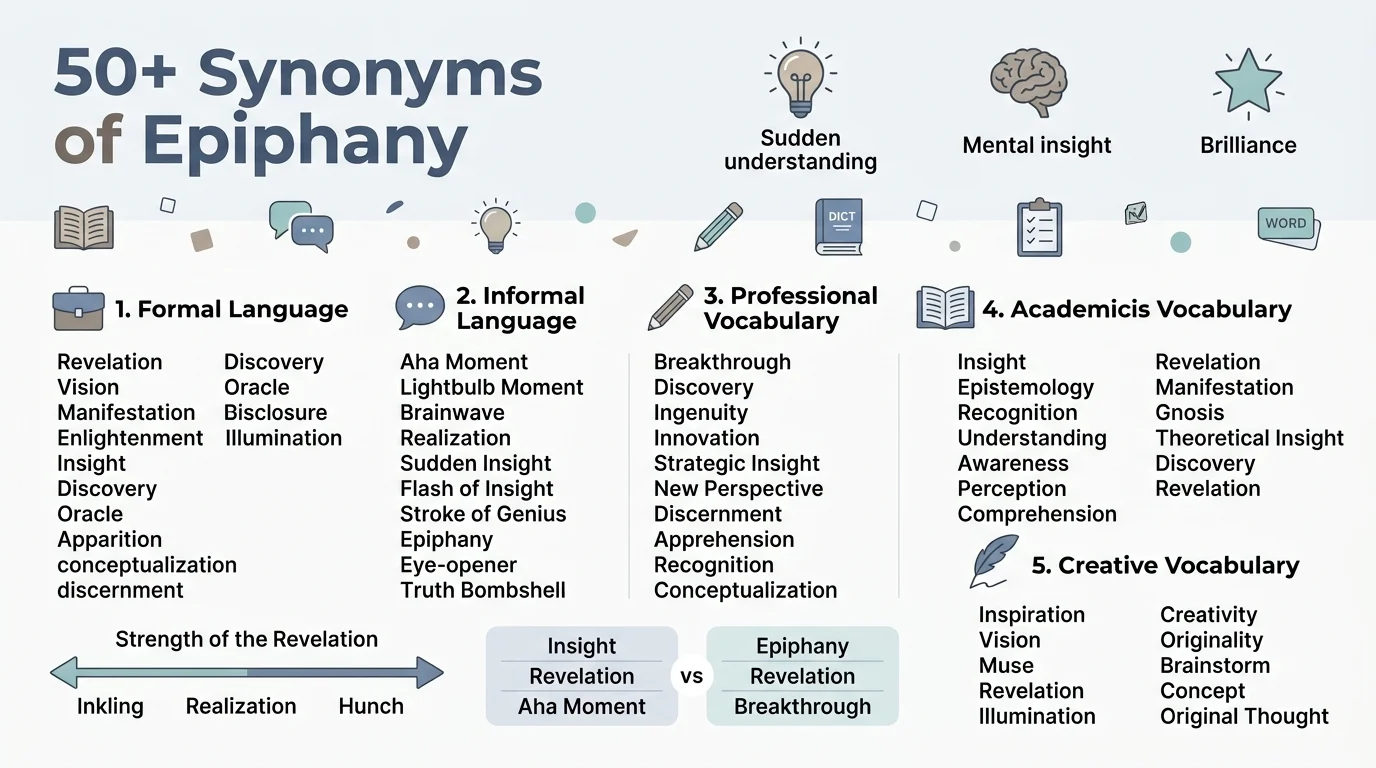
An epiphany is a sudden moment of clear understanding or insight. Formal writing, choose “revelation.” For casual conversation, use “a-ha moment.” For academic work, select “discovery.”Professional settings, “breakthrough” works well. Emotional contexts, “awakening” fits best.
Meaning, Tone, and Context
Simple Definition
An epiphany is a sudden, powerful moment when you understand something clearly for the first time. It often feels like a mental light switching on.
Part of Speech
Noun
Overall Tone
Neutral to positive. The word carries an uplifting feeling because it describes gaining understanding. It suggests clarity and personal growth.
Formality Level
Semi-formal. You can use epiphany in professional writing, but it sounds more natural in personal or creative contexts. It feels slightly elevated compared to everyday conversation words.
Common Uses
Native English speakers use epiphany to describe:
- Personal realizations about life choices
- Creative breakthroughs in art or writing
- Scientific or academic discoveries
- Emotional moments of understanding
- Spiritual or philosophical insights
Word Forms
- Noun: epiphany
- Related forms: epiphanic (adjective)
- There is no common verb form of epiphany
When and How to Use “Epiphany”
Choose epiphany when you want to emphasize the suddenness and significance of a moment of understanding. It works best for moments that feel genuinely important, not for minor realizations.
Professional Context
After reviewing the sales data, I had an epiphany about why our conversion rates were falling.
Academic Context
The researcher’s epiphany came when she noticed the pattern in the data that everyone else had missed.
Workplace Context
My epiphany happened during the team meeting when I finally understood the client’s real concerns.
Personal Context
The epiphany that I needed to change careers hit me on a quiet Sunday morning.
Email Context
I wanted to share an epiphany I had about our project direction that might save us weeks of work.
Resume Context
Developed a new approach to client retention after a strategic epiphany about customer needs.
Social Media Context
Just had a major epiphany about why my morning routine wasn’t working. Time for a change.
Best Synonyms of “Epiphany”
No synonym perfectly matches epiphany in every situation. Each alternative carries its own shade of meaning, tone, and emotional weight. Here are the best choices for different contexts.
Professional Writing: Breakthrough
This word suggests overcoming an obstacle and making progress. It sounds action-oriented and results-focused.
Academic Writing: Discovery
Discovery emphasizes the finding of new knowledge. It sounds objective and scholarly.
Business Communication: Insight
Insight suggests practical understanding that can be applied. It feels professional without being dramatic.
Casual Conversation: A-ha Moment
This phrase feels natural and relatable. It captures the suddenness of epiphany without sounding formal.
Emotional Writing: Awakening
Awakening suggests a deeper personal transformation. It carries emotional weight and intensity.
Creative Writing: Revelation
Revelation implies something being shown or made known. It works beautifully in storytelling.
Resume Writing: Transformation
This word shows how the moment of understanding led to positive change. It emphasizes results.
Workplace Communication: Clarity
Clarity focuses on the outcome of understanding rather than the moment itself. It sounds practical and useful.
Stronger Meaning: Enlightenment
This suggests profound, life-changing understanding. It is much stronger than epiphany.
Softer Meaning: Realization
Realization is milder and more common. It works for everyday moments of understanding.
When Not to Use “Epiphany”
Epiphany is not always the best choice. Here are situations where it falls short and what to use instead.
When the Realization Is Minor
Epiphany sounds too dramatic for small everyday realizations. It suggests something significant.
Too Dramatic: “I had an epiphany that I needed to buy milk.”
Better: “I realized I needed to buy milk.”
The smaller word fits the smaller moment.
When Writing in a Very Formal Tone
Epiphany can feel slightly personal or emotional for some formal business documents. It may sound out of place.
Less Effective: “The quarterly report provided an epiphany about our costs.”
Better: “The quarterly report provided valuable insight into our costs.”
Insight sounds more professional in this context.
When the Understanding Was Gradual
Epiphany describes a sudden moment. If the understanding developed slowly, choose a different word.
Inaccurate: “After months of study, I had an epiphany about grammar.”
Better: “After months of study, I developed a deep understanding of grammar.”
The gradual process does not match the sudden nature of epiphany.
When Trying to Sound Objective
Epiphany carries personal, emotional connotations. For neutral, objective writing, choose a more factual word.
Too Personal: “The data gave us an epiphany.”
Better: “The data led us to a significant conclusion.”
When the Audience Prefers Simple Language
Some audiences respond better to straightforward vocabulary. In these cases, simpler alternatives work better.
Too Complex: “My epiphany changed everything.”
Better: “I suddenly understood what I needed to do.”
Words Commonly Confused With “Epiphany”
Epiphany vs Revelation
Difference: Epiphany describes the internal experience of understanding. Revelation describes something being made known from outside.
When to Use Epiphany: When the understanding comes from within. “I had an epiphany about my career path.”
When to Use Revelation: When information is presented from an external source. “The documents contained a startling revelation.”
Epiphany vs Insight
Difference: Epiphany focuses on the sudden moment. Insight focuses on the understanding itself.
When to Use Epiphany: To emphasize the sudden nature of understanding. “The epiphany came to me in the shower.”
When to Use Insight: To emphasize the understanding or perspective gained. “Her insight helped us solve the problem.”
Epiphany vs Realization
Difference: Realization is much milder and more common. Epiphany suggests something more profound.
When to Use Epiphany: For genuinely significant moments. “The epiphany that I was in the wrong relationship changed my life.”
When to Use Realization: For everyday understandings. I had a realization that I left my keys at home.”
Epiphany vs Discovery
Difference: Discovery focuses on finding something new. Epiphany focuses on understanding something clearly.
When to Use Epiphany: When the focus is on mental understanding. “The epiphany helped me see the pattern.”
When to Use Discovery: When the focus is on finding something previously unknown. “The discovery of the artifact changed history.”
Epiphany vs Breakthrough
Difference: Breakthrough emphasizes overcoming an obstacle. Epiphany emphasizes the moment of understanding.
When to Use Epiphany: When the focus is on the mental moment. “Her epiphany about the problem came suddenly.”
When to Use Breakthrough: When the focus is on progress and results. “The team finally achieved a breakthrough.”
Epiphany vs Awakening
Difference: Awakening suggests a personal transformation. Epiphany can be about any kind of understanding.
When to Use Epiphany: For moments of understanding about various topics. “I had an epiphany about the math problem.”
When to Use Awakening: For moments of personal or spiritual transformation. “The experience led to a spiritual awakening.”
Best Synonyms of “Epiphany” by Context
| Context | Best Synonym | Why It Works | Example |
|---|---|---|---|
| Formal writing | Revelation | Sounds sophisticated and precise | The study provided a revelation about treatment effectiveness |
| Academic writing | Discovery | Emphasizes finding new knowledge | Her discovery changed the field of research |
| Professional communication | Insight | Suggests practical understanding | His insight improved our entire strategy |
| Business emails | Clarity | Focuses on understanding outcomes | This gave us clarity on our next steps |
| Resume writing | Transformation | Shows personal growth and results | Achieved a professional transformation through strategic thinking |
| Workplace communication | Breakthrough | Emphasizes overcoming challenges | Our breakthrough came during the brainstorming session |
| Casual conversation | A-ha moment | Sounds natural and relatable | I had an a-ha moment about why I was so tired |
| Everyday speaking | Realization | Simple and widely understood | I came to the realization that I needed more sleep |
| Creative writing | Enlightenment | Adds depth and significance | The enlightenment came like a flash of lightning |
| Storytelling | Awakening | Creates emotional resonance | His awakening changed everything he believed |
| Emotional writing | Epiphany | The original word carries emotional weight | The epiphany brought tears to her eyes |
| Strong emphasis | Revelation | Suggests dramatic uncovering | It was a complete revelation to him |
| Mild tone | Realization | Gentle and understated | A small realization made all the difference |
| Social media captions | Game-changer | Modern and engaging | This idea was a total game-changer for me |
| American English | A-ha moment | Widely recognized and used | I had an a-ha moment while reading that article |
How to Choose the Best Synonym of “Epiphany”
Choosing the right synonym depends on several factors. Here is a practical decision guide.
Consider Your Audience
- For professional colleagues: Choose “insight” or “breakthrough”
- For academic readers: Choose “discovery” or “revelation”
- For casual conversations: Choose “a-ha moment” or “realization”
- For creative readers: Choose “enlightenment” or “awakening”
Your Purpose
- To show personal growth: Choose “transformation” or “awakening”
- To share new understanding: Choose “insight” or “clarity”
- To emphasize suddenness: Choose “epiphany” or “revelation”
- To downplay significance: Choose “realization” or “discovery”
the Emotional Tone
- For strong emotional impact: Choose “revelation” or “enlightenment”
- For neutral, factual tone: Choose “discovery” or “insight”
- For positive, uplifting tone: Choose “breakthrough” or “awakening”
Consider the Context
- Resume writing: Choose “transformation” or “breakthrough”
- Email writing: Choose “insight” or “clarity”
- Storytelling: Choose “enlightenment” or “revelation”
- Business reports: Choose “insight” or “discovery”
Ask Yourself These Questions
- How significant was the moment?
- Who will read this?
- What impression do I want to create?
- Does the word match the tone of my writing?
- Does the word sound natural in this context?
The best synonym is the one that communicates your exact meaning without drawing attention to itself.
Real Life Examples of “Epiphany”
School
The student had an epiphany during the lecture that finally explained the complicated formula.
Stronger: The student experienced a breakthrough during the lecture that finally explained the formula.
College
My epiphany about choosing a major came while volunteering at the hospital.
Stronger: My awakening about choosing a major came while volunteering at the hospital.
Workplace
The manager’s epiphany about team structure led to a complete reorganization.
Stronger: The manager’s insight about team structure led to a complete reorganization.
Business
The company’s epiphany about customer needs transformed their product line.
Stronger: The company’s revelation about customer needs transformed their product line.
I wanted to share an epiphany I had about our project timeline.
Stronger: I wanted to share an insight I had about our project timeline.
Resume
Experienced a professional epiphany that reshaped my entire career approach.
Stronger: Experienced a professional transformation that reshaped my entire career approach.
Conversation
I had an epiphany about why I keep making the same mistake.
Natural: I had a realization about why I keep making the same mistake.
Storytelling
The epiphany came to her in a dream, changing everything she believed.
Stronger: The revelation came to her in a dream, changing everything she believed.
Blogging
My biggest epiphany about productivity came from the simplest habit change.
Stronger: My biggest breakthrough about productivity came from the simplest habit change.
Social Media
Just had an epiphany about what I need to do differently.
Natural: Just had an a-ha moment about what I need to do differently.
18 Best Synonyms of “Epiphany”
| Synonym | Simple Meaning | Best Used For | Example Sentence |
|---|---|---|---|
| Revelation | A surprising and previously unknown fact being made known | Formal writing, storytelling | The revelation about his past changed everyone’s opinion |
| Breakthrough | An important development that solves a problem | Professional, business | The breakthrough in our research came unexpectedly |
| Insight | A clear, deep understanding of something | Professional writing, business | Her insight helped us see the solution immediately |
| Discovery | Finding or learning something new | Academic, scientific | The discovery of the pattern changed the study |
| Realization | Becoming aware of something clearly | Everyday conversation | I came to the realization that I needed help |
| Awakening | Becoming aware of something important | Emotional, personal writing | The experience was a powerful awakening for him |
| Enlightenment | The state of having deep knowledge or understanding | Creative, philosophical | He achieved enlightenment about his true purpose |
| Clarity | Clear understanding without confusion | Professional, business | The meeting gave us clarity on our direction |
| Recognition | Acknowledging or realizing something | Formal, professional | His recognition of the issue was the first step |
| Awareness | Having knowledge or perception of something | Neutral, general | The awareness of the problem changed everything |
| Understanding | The ability to comprehend something | General, all-purpose | My understanding of the topic deepened significantly |
| A-ha moment | A sudden moment of clarity and understanding | Casual, social media | I had an a-ha moment while taking a shower |
| Inspiration | A sudden creative or intellectual stimulus | Creative writing | The inspiration for the story came from nowhere |
| Eureka moment | A sudden moment of discovery or solution | Casual, creative | The scientist had a eureka moment in the lab |
| Revelation | Something that is revealed or made known | Formal, religious | The revelation shocked everyone who heard it |
| Epiphanic moment | A moment of sudden understanding | Formal, descriptive | The epiphanic moment changed her entire perspective |
| Brainwave | A sudden clever idea or insight | Casual, conversational | He had a brainwave about how to fix the problem |
| Flash | A sudden, brief moment of understanding | Creative, descriptive | The flash of understanding came in an instant |
Synonyms of “Epiphany” by Usage
Professional vs Personal Synonyms
Professional Synonyms:
- Breakthrough
- Insight
- Clarity
- Discovery
- Recognition
These words sound objective and results-focused. They work well in business writing, reports, and professional communication.
Personal Synonyms:
- Awakening
- Realization
- A-ha moment
- Enlightenment
- Inspiration
These words feel more emotional and relatable. They work well in personal writing, conversations, and storytelling.
Formal vs Conversational Synonyms
Formal Synonyms (for reports, essays, and business writing):
- Revelation
- Discovery
- Recognition
- Enlightenment
- Clarity
These words sound authoritative and precise. They fit academic papers, business reports, and formal presentations.
Conversational Synonyms (for casual conversations and texting):
- A-ha moment
- Realization
- Brainwave
- Eureka moment
- Flash
These words sound natural and approachable. They fit everyday conversations, social media, and informal writing.
Academic Synonyms
- Discovery
- Revelation
- Recognition
- Enlightenment
- Insight
These words sound scholarly and precise. They work well in research papers, academic essays, and scholarly discussions. They avoid emotional language and focus on the intellectual aspect of understanding.
Professional and Business Synonyms
- Breakthrough
- Insight
- Clarity
- Discovery
- Recognition
These words show action and results. They work well in resumes, interviews, meetings, and business emails. They suggest practical value and forward movement.
Creative and Literary Synonyms
- Revelation
- Enlightenment
- Awakening
- Flash
- Inspiration
These words add emotional depth and imagery. They work well in fiction, poetry, descriptive writing, and speeches. They help create vivid, memorable moments in storytelling.
Slang or Modern Synonyms
A-ha moment
Meaning: A sudden moment of understanding. This is widely used in casual American English.
Brainwave
Meaning: A sudden clever idea. This is more common in British English but understood in American English.
Eureka moment
Meaning: A moment of sudden discovery. This phrase is recognizable and playful.
Where to use these: Social media, casual conversations, creative writing, personal blogs.
Where to avoid these: Academic writing, formal business reports, professional emails, resumes.
Strongest to Mildest Synonyms
Mild:
- Realization
- Awareness
- Understanding
- Clarity
Moderate:
- Insight
- Discovery
- Recognition
- Inspiration
Strong:
- Breakthrough
- Revelation
- Enlightenment
Very Strong:
- Awakening
- Transformation
The emotional intensity increases as you move down the scale. Choose milder words for everyday situations. Choose stronger words for moments that truly changed your perspective or life.
Emotional vs Neutral Synonyms
Emotional Synonyms:
- Awakening
- Revelation
- Enlightenment
- Transformation
- Inspiration
These words express stronger feelings and personal impact. They work well in personal stories, emotional writing, and creative works.
Neutral Synonyms:
- Discovery
- Insight
- Clarity
- Recognition
- Understanding
These words simply communicate information without adding emotion. They work well in professional writing, academic work, and objective reports.
Antonyms of “Epiphany”
| Antonym | Meaning | Example Sentence |
|---|---|---|
| Confusion | Lack of understanding | The explanation only increased his confusion |
| Ignorance | Lack of knowledge or awareness | Her ignorance of the topic was surprising |
| Misunderstanding | Incorrect interpretation | The misunderstanding caused serious problems |
| Bewilderment | State of being confused | He stared in bewilderment at the instructions |
| Disorientation | Loss of clear understanding | The news left her in a state of disorientation |
| Uncertainty | Lack of certainty | The uncertainty made it hard to decide |
| Ambiguity | Open to multiple interpretations | The ambiguity of the statement frustrated everyone |
| Obscurity | Unclear or unknown quality | The obscurity of the subject made study difficult |
| Fog | Unclear thinking or understanding | My mind was in a fog after the long meeting |
| Delusion | A false belief | His delusion about the situation was obvious |
| Stupor | State of mental dullness | He sat in a stupor, unable to understand |
| Unawareness | Lack of knowledge or perception | Her unawareness of the issue was concerning |
| Misconception | Incorrect or false understanding | The misconception was common among students |
| Blankness | Total lack of understanding | The blankness in his eyes showed he didn’t get it |
| Perplexity | State of being puzzled | The complex problem caused great perplexity |
Comparison: “Epiphany” vs Similar Words
Epiphany vs Revelation
Main Difference: Epiphany focuses on the internal experience of understanding. Revelation focuses on external information being made known.
Which Is Stronger? Revelation is stronger because it suggests dramatic or surprising information. Epiphany is more personal and internal.
Which Is More Formal? Revelation is more formal. It appears more frequently in academic and religious contexts.
When to Use Each:
- Use epiphany for personal moments of understanding
- Use revelation for dramatic discoveries or surprising information
Examples:
- Epiphany: The epiphany came when I finally understood why I was unhappy.
- Revelation: The revelation about the company’s finances shocked everyone.
Epiphany vs Insight
Main Difference: Epiphany emphasizes the sudden moment. Insight emphasizes the quality of understanding itself.
Which Is Stronger? Epiphany is stronger because it suggests a dramatic, sudden moment. Insight is more moderate and steady.
Which Is More Formal? Insight is more formal and professional. It is widely used in business and academic writing.
When to Use Each:
- Use epiphany when you want to emphasize the sudden, dramatic moment
- Use insight when you want to emphasize valuable understanding
Examples:
- Epiphany: The epiphany struck him like a lightning bolt.
- Insight: Her insight into the problem proved invaluable.
Epiphany vs Realization
Main Difference: Realization is much milder and more common. Epiphany suggests profound significance.
Which Is Stronger? Epiphany is much stronger. It suggests a life-changing or deeply important moment.
Which Is More Formal? Both are semi-formal, but epiphany sounds more sophisticated.
When to Use Each:
- Use epiphany for genuinely significant moments
- Use realization for everyday moments of understanding
Examples:
- Epiphany: The epiphany about my life’s purpose came during meditation.
- Realization: I had a realization that I left my phone at home.
Epiphany vs Discovery
Main Difference: Discovery focuses on finding something new. Epiphany focuses on understanding something clearly.
Which Is Stronger? Epiphany is stronger emotionally. Discovery is more factual and objective.
Which Is More Formal? Discovery is more formal and academic.
When to Use Each:
- Use epiphany for mental understanding
- Use discovery for finding new information or objects
Examples:
- Epiphany: The epiphany helped me understand my motivations.
- Discovery: The discovery of the fossil changed our understanding of history.
Epiphany vs Breakthrough
Main Difference: Breakthrough emphasizes overcoming an obstacle. Epiphany emphasizes the moment of understanding.
Which Is Stronger? Breakthrough is stronger in terms of action and results. Epiphany is stronger in terms of personal experience.
Which Is More Formal? Breakthrough is more professional and results-focused.
When to Use Each:
- Use epiphany for the mental moment of understanding
- Use breakthrough for the progress that results from understanding
Examples:
- Epiphany: The epiphany about the problem came at 3 AM.
- Breakthrough: The breakthrough in the project happened the next morning.
Epiphany vs Awakening
Main Difference: Awakening suggests personal transformation. Epiphany can be about any kind of understanding.
Which Is Stronger? Awakening is stronger because it suggests fundamental change.
Which Is More Formal? Epiphany is slightly more formal. Awakening is more personal and emotional.
When to Use Each:
- Use epiphany for moments of understanding about various topics
- Use awakening for moments of personal or spiritual transformation
Examples:
- Epiphany: The epiphany about the math problem helped me pass the test.
- Awakening: The spiritual awakening changed how she lived her life.
Common Phrases and Expressions with “Epiphany”
Epiphany of the mind
Meaning: A sudden moment of mental clarity or understanding.
Example Sentence: The epiphany of the mind came when he least expected it.
Moment of epiphany
Meaning: The specific moment when sudden understanding occurs.
Example Sentence: Her moment of epiphany changed everything she thought she knew.
Had an epiphany
Meaning: Experienced a sudden moment of understanding.
Example Sentence: I had an epiphany about why I was procrastinating.
Great epiphany
Meaning: A significant and important moment of understanding.
Example Sentence: The great epiphany about his career came during his vacation.
Personal epiphany
Meaning: A moment of understanding about one’s own life.
Example Sentence: Her personal epiphany led her to make major life changes.
Spiritual epiphany
Meaning: A moment of understanding about spiritual or religious matters.
Example Sentence: The spiritual epiphany transformed his entire worldview.
Creative epiphany
Meaning: A sudden moment of creative inspiration.
Example Sentence: The creative epiphany gave him the idea for his best painting.
Common Mistakes to Avoid
Choosing a Vague Synonym Instead of a Precise One
Incorrect: “I had a feeling about what to do.”
Better: “I had an epiphany about what to do.”
The vague word “feeling” does not capture the sudden clarity that epiphany suggests.
Confusing Epiphany with a Similar Word
Incorrect: “The teacher’s epiphany about the answer came from the textbook.”
Better: “The teacher’s discovery of the answer came from the textbook.”
When the understanding comes from an external source, “discovery” or “revelation” fits better.
Using an Informal Synonym in Formal Writing
Incorrect: “The research led to an a-ha moment for the team.”
Better: “The research led to a significant breakthrough for the team.”
“A-ha moment” sounds too casual for academic or professional writing.
Selecting an Overly Dramatic Synonym
Incorrect: “I had an enlightenment about where I put my keys.”
Better: “I had a realization about where I put my keys.”
Enlightenment is too dramatic for small everyday situations.
Repeating the Same Word Too Often
Incorrect: “My epiphany about work led to another epiphany about my relationships.”
Better: “My epiphany about work led to a new understanding about my relationships.”
Variety in word choice makes writing more engaging.
Choosing the Wrong Emotional Tone
Incorrect: “The client had a spiritual awakening about our billing process.”
Better: “The client had a clear insight about our billing process.”
Spiritual awakening is too emotional for this professional context. Insight fits the situation better.
Using Slang in Professional Writing
Incorrect: “My brainwave about the project came during lunch.”
Better: “My insight about the project came during lunch.”
“Brainwave” sounds too casual for professional communication.
Frequently Asked Questions
What are the best synonyms of epiphany?
The best synonyms depend on your context. For formal writing, use “revelation.” For professional settings, use “breakthrough” or “insight.” Casual conversations, use “a-ha moment.” For emotional writing, use “awakening.”
What are the best formal synonyms of epiphany?
The best formal synonyms include “revelation,” “discovery,” “recognition,” and “enlightenment.” These words sound authoritative and precise. They work well in academic papers, business reports, and professional presentations.
What are common informal synonyms of epiphany?
Common informal synonyms include “a-ha moment,” “brainwave,” “eureka moment,” and “realization.” These words sound natural and approachable. They work well in everyday conversations, social media, and casual writing.
What is another word for epiphany in professional writing?
In professional writing, use “breakthrough,” “insight,” or “clarity.” These words sound objective and results-focused. They help you communicate understanding without sounding overly personal or emotional.
What is the difference between epiphany and revelation?
Epiphany focuses on the internal experience of understanding. Revelation focuses on external information being made known. Use epiphany for personal moments and revelation for dramatic discoveries or surprising information.
What is the opposite of epiphany?
The opposites of epiphany include “confusion,” “ignorance,” “misunderstanding,” “uncertainty,” and “bewilderment.” These words describe a lack of understanding or clarity. Use them when you want to contrast with moments of sudden insight.
Conclusion
Epiphany describes those powerful moments when everything suddenly becomes clear. It is a word that captures the joy and relief of understanding something important for the first time. The right synonym depends on your audience, your purpose, and the tone you want to create.
Professional writing, choose “insight” or “breakthrough.” For casual conversation, choose “a-ha moment” or “realization.” For creative writing, choose “revelation” or “awakening.” Academic work, choose “discovery” or “enlightenment.” No synonym works perfectly in every situation, so always consider your context.
The best vocabulary improvement tip is simple. Read widely and notice how skilled writers choose their words. Pay attention to the synonyms they select in different contexts. With practice, choosing the perfect synonym for epiphany becomes second nature. Your writing will become clearer, more precise, and more engaging.