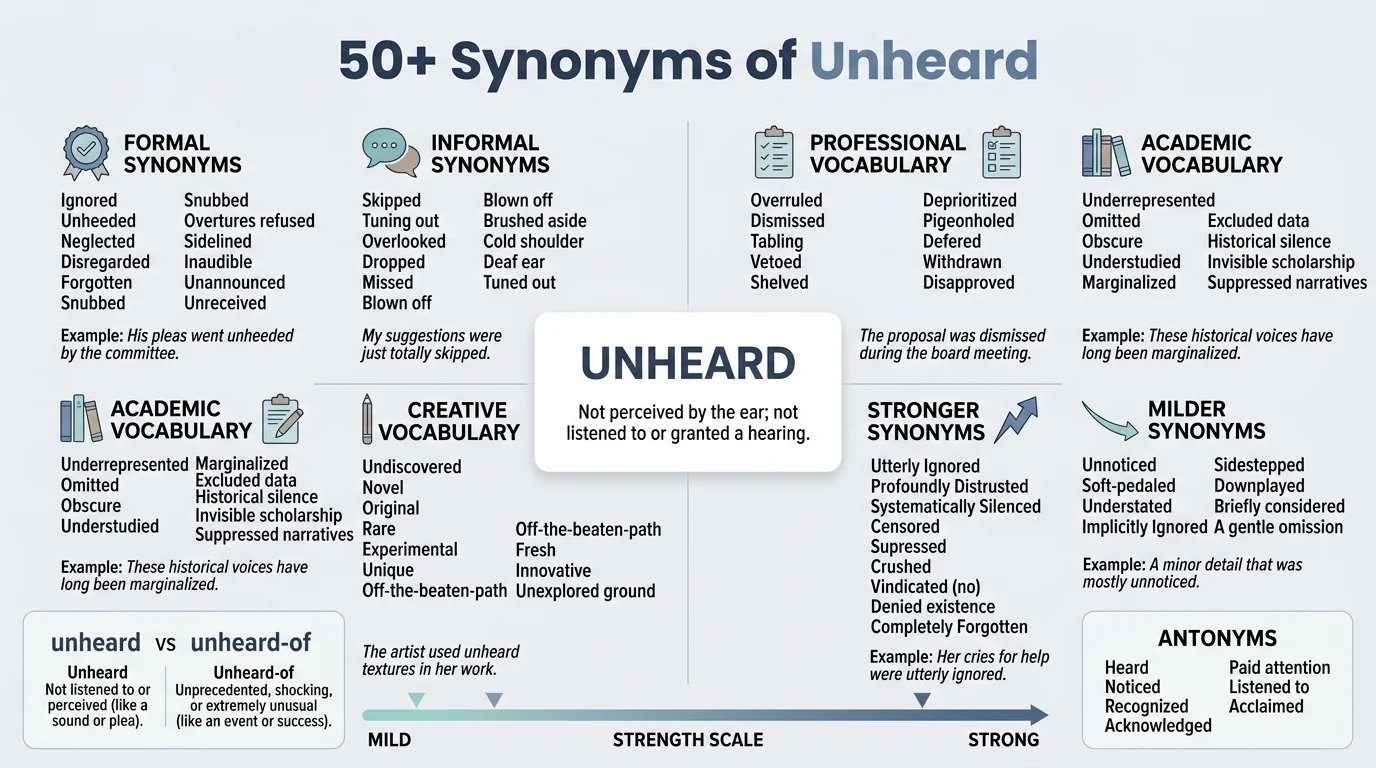
Have you ever found yourself writing an email, an essay, or a social media caption and realized you have used the same word three times in two sentences? That repetitive feeling is frustrating, and it makes your writing sound flat. Whether you are drafting a professional report, composing a college application essay, or simply trying to express yourself more clearly, reaching for the right word matters. Choosing a precise synonym of unheard can transform a vague statement into something powerful and memorable. This guide will help you understand what “unheard” truly means and show you exactly which synonym fits every situation, so you never have to guess again.
What Are the Best Synonyms of “Unheard”?
“Unheard” means not heard or not listened to. Formal writing, choose “inaudible” for physical sound or “unheeded” for ignored concerns. For casual conversation, use “ignored” or “overlooked.” Creative writing, try “unnoticed” or “unsung.” The best synonym depends entirely on your meaning and audience.
Meaning, Tone, and Context
Simple Definition
It can refer to sounds that are too quiet to detect or to voices, opinions, and pleas that people choose to ignore.
Part of Speech
Adjective.
Overall Tone
Neutral to slightly negative. The word can express simple factual absence of sound or carry a critical tone when it describes ignored voices.
Formality Level
Neutral. “Unheard” works in both formal and informal settings, though some synonyms are more formal or more casual.
Common Uses
Native English speakers use “unheard” in two main ways.
Word Forms
- Unheard (adjective): The basic form.
- Unheard-of (adjective): A related idiom meaning unprecedented or completely unknown.
When and How to Use “Unheard”
Choose “unheard” when you want to describe either a literal absence of sound or a figurative lack of attention. The word works best when you need a straightforward, neutral term that fits most contexts.
Here are seven realistic examples:
- Professional: The employee’s suggestions went unheard during the chaotic meeting.
- Academic: The researcher’s findings remained unheard outside her narrow field of study.
- Workplace: His warning about the budget shortfall went unheard until it was too late.
- Personal: She whispered her apology, but it went unheard in the crowded room.
- Email: I want to make sure my concerns do not go unheard by the management team.
- Resume: Avoid using “unheard” on a resume unless describing an overlooked achievement; instead, use “unrecognized” or “undervalued.”
- Social Media: So many talented artists remain unheard in today’s oversaturated music industry.
Best Synonyms of “Unheard”
No synonym works perfectly in every situation. The right choice depends on your meaning, tone, audience, and context. Here are the best synonyms for specific writing situations.
Professional Writing
Unheeded – This word carries a formal tone and clearly communicates that someone ignored a warning, request, or piece of advice. It sounds more authoritative than “ignored” in business contexts.
Academic Writing
Unnoticed – In academic contexts, “unnoticed” works well for describing research, trends, or patterns that have escaped attention. It implies a passive lack of recognition rather than active dismissal.
Business Communication
Disregarded – This synonym suggests that someone actively chose to ignore information or input. It carries a slightly stronger critical tone than “overlooked.”
Casual Conversation
Ignored – Direct, simple, and widely understood. “Ignored” is the most natural choice for everyday speech.
Emotional Writing
Unsung – This word carries a sense of quiet heroism or unrecognized effort. It works beautifully when describing people whose contributions have not received proper acknowledgment.
Creative Writing
Unnoticed – Versatile and evocative, “unnoticed” paints a picture of something existing quietly without drawing attention.
Resume Writing
Unrecognized – Use this when describing achievements that did not receive the acknowledgment they deserved. It sounds professional and measured.
Workplace Communication
Overlooked – This synonym suggests a mistake or oversight rather than intentional disregard. It is a softer, more diplomatic choice.
Stronger Meaning
Disregarded – This word implies active dismissal and carries more weight than “overlooked.”
Softer Meaning
Overlooked – This suggests a simple failure to notice rather than intentional ignoring.
When Not to Use “Unheard”
When the Word Sounds Too General
If you mean that someone actively refused to listen, “unheard” does not capture that intentionality.
Less Effective: Her complaints went unheard.
Better: Her complaints were dismissed by the committee.
Why: “Dismissed” conveys active rejection, not just a lack of hearing.
When the Word Sounds Too Vague
If you are describing a sound that is physically impossible to detect, “unheard” is vague.
Less Effective: The sound was unheard.
Better: The sound was inaudible from that distance.
When the Word Sounds Too Weak
Less Effective: Their voices were unheard.
Better: Their voices were suppressed.
Why: “Suppressed” implies active silencing, not passive neglect.
When the Word Sounds Too Formal or Too Informal
“Unheard” is neutral, so it rarely sounds too formal or informal. However, in very casual texting, “ignored” is more natural. In very formal legal or academic writing, “unheeded” or “unnoticed” may sound more precise.
When the Word Is Outdated
The archaic sense of “unheard” meaning “unheard-of” is no longer common. Use “unheard-of” instead when you mean unprecedented or unknown.
Words Commonly Confused With “Unheard”
Unheard vs Inaudible
Difference: “Unheard” means not heard, while “inaudible” means impossible to hear due to being too quiet or too far away.
Example (Unheard): Her cries for help went unheard.
Example (Inaudible): His whisper was inaudible from across the room.
Unheard vs Unheard-of
Difference: “Unheard” means not heard or not listened to. “Unheard-of” means unprecedented, completely unknown, or extremely unusual.
When to Use It: Use “unheard” for sounds or ignored voices. Use “unheard-of” for events, situations, or achievements that are remarkable or unprecedented.
Example (Unheard): The warning went unheard.
Example (Unheard-of): It is unheard-of for a rookie to win that award.
Unheard vs Ignored
Difference: “Unheard” focuses on the lack of hearing or attention. “Ignored” focuses on the deliberate act of paying no attention.
When to Use It: Use “unheard” when you want to emphasize that something did not reach anyone’s ears or attention. Use “ignored” when you want to emphasize that someone actively chose not to respond.
Example (Unheard): The announcement went unheard in the noisy cafeteria.
Example (Ignored): She ignored his repeated text messages.
Unheard vs Overlooked
Difference: “Unheard” specifically relates to hearing or listening. “Overlooked” relates to failing to notice or consider something more broadly.
When to Use It: Use “unheard” for auditory matters or ignored voices. Use “overlooked” for mistakes, details, or people that were not noticed.
Example (Unheard): The minority community’s concerns went unheard.
Example (Overlooked): An important detail was overlooked in the report.
Unheard vs Unnoticed
Difference: “Unheard” is specific to hearing. “Unnoticed” covers all senses and general awareness.
When to Use It: Use “unheard” when hearing is the relevant sense. Use “unnoticed” when something escaped general attention.
Example (Unheard): The doorbell went unheard over the music.
Example (Unnoticed): The typo went unnoticed until the document was printed.
Unheard vs Unheeded
Difference: “Unheard” means not heard. “Unheeded” means not listened to or not taken into consideration.
When to Use It: Use “unheeded” specifically when advice, warnings, or requests are ignored. It implies that someone heard but chose not to act.
Example (Unheard): The phone call went unheard.
Example (Unheeded): His advice went unheeded by the team.
Best Synonyms of “Unheard” by Context
| Context | Best Synonym | Why It Works | Example |
|---|---|---|---|
| Formal writing | Unheeded | Sounds authoritative and precise | The committee’s recommendations went unheeded. |
| Academic writing | Unnoticed | Suggests passive lack of recognition | The correlation remained unnoticed in previous studies. |
| Professional communication | Disregarded | Implies active dismissal | The safety concerns were disregarded. |
| Business emails | Overlooked | Diplomatic and soft | I apologize if this detail was overlooked. |
| Resume writing | Unrecognized | Professional and measured | My contributions went unrecognized in the annual review. |
| Workplace communication | Ignored | Direct and clear | The employee’s suggestions were ignored. |
| Casual conversation | Ignored | Natural and widely understood | She ignored me all day. |
| Everyday speaking | Not heard | Simple and clear | My question was not heard. |
| Creative writing | Unnoticed | Evocative and versatile | The stranger slipped through the crowd unnoticed. |
| Storytelling | Unsung | Adds emotional depth | The unsung heroes of the revolution. |
| Emotional writing | Unsung | Carries quiet heroism | Her unsung efforts kept the project alive. |
| Strong emphasis | Disregarded | Conveys active dismissal | The evidence was disregarded entirely. |
| Mild tone | Overlooked | Suggests an honest mistake | His contribution was simply overlooked. |
| Social media captions | Ignored | Short and punchy | Don’t let your voice be ignored. |
How to Choose the Best Synonym of “Unheard”
Choosing the right synonym starts with asking yourself one question: What exactly do I mean?
If you mean a sound that cannot be detected, choose inaudible. This is the most precise word for physical sound that is too quiet or too distant to hear.
If you mean that someone or something did not receive attention, consider whether the lack of attention was passive or active. For passive oversight, choose overlooked or unnoticed. For active dismissal, choose disregarded or ignored.
This word specifically describes ignored guidance.
If you are writing creatively and want to evoke emotion, choose unsung. This word carries a sense of unrecognized value and quiet dignity.
If you are writing formally for business or academic purposes, avoid casual words like “ignored” and choose unheeded, disregarded, or unnoticed instead.
Always consider your audience. A corporate report demands precision. A text message demands simplicity. A novel demands emotional resonance. Match your synonym to your purpose.
Real Life Examples of “Unheard”
School
The student’s question went unheard over the chatter in the classroom.
College
Her groundbreaking research remained unheard outside her small academic department.
Workplace
The intern’s innovative idea was unheard by the senior managers during the rushed presentation.
Business
Customer complaints that go unheard can damage a company’s reputation over time.
I want to ensure that my perspective is not unheard in this decision-making process.
Resume
My efforts to streamline operations went unrecognized by the previous management.
Conversation
He spoke softly, and his words went unheard in the crowded restaurant.
Storytelling
She walked through the village unheard and unseen, a ghost among the living.
Blogging
Too many talented writers remain unheard in today’s crowded digital landscape.
Social Media
Your voice matters. Do not let it go unheard.
18 Best Synonyms of “Unheard”
Synonyms of “Unheard” by Usage
Professional vs Personal Synonyms
In professional settings, choose words that sound measured and authoritative. Unheeded, disregarded, and unacknowledged work well in reports, emails, and meetings. In personal conversations, simpler words like ignored, overlooked, and not heard sound more natural.
Formal vs Conversational Synonyms
For formal writing such as reports, essays, and business presentations, use unheeded, disregarded, unremarked, or unnoted. These words sound precise and professional. For casual conversations and texting, ignored and overlooked are the most natural choices.
Academic Synonyms
In academic writing, precision matters. Unnoticed works well for describing research gaps. Unremarked suits literary analysis. Obscure fits discussions of unknown texts or authors. These words sound authoritative and demonstrate careful word choice.
Professional and Business Synonyms
For resumes, interviews, meetings, and client communication, choose unrecognized, unacknowledged, or overlooked. These words sound professional without being harsh. Disregarded works when you need to emphasize that someone actively ignored important information.
Creative and Literary Synonyms
For storytelling, fiction, and poetry, choose unsung, unnoticed, or obscure. These words add emotional depth and imagery. Unsung carries a sense of quiet heroism. Obscure suggests mystery and discovery. Unnoticed paints a picture of quiet existence.
Slang or Modern Synonyms
No common slang synonyms exist for “unheard.” The word itself is standard English. In very informal contexts, “ignored” or “brushed off” work well.
Strongest to Mildest Synonyms
Mild: Overlooked, unnoted, unremarked
Moderate: Unheard, unnoticed, ignored
Strong: Disregarded, unheeded, unacknowledged
Very Strong: Neglected, dismissed, suppressed
The emotional intensity changes as you move up the scale. “Overlooked” suggests an honest mistake. “Disregarded” suggests active dismissal. “Neglected” suggests ongoing failure to care.
Emotional vs Neutral Synonyms
Emotional Synonyms
Unsung – Carries warmth and appreciation for unrecognized effort.
Neglected – Carries sadness or frustration about lack of care.
These words work best when you want to evoke feeling and connect with readers on an emotional level.
Neutral Synonyms
No emotion.
Unnoted – Simply describes something not recorded. No emotion.
Unremarked – Simply describes something not commented on. No emotion.
These words work best when you want to communicate information without adding emotional weight.
Antonyms of “Unheard”
| Antonym | Meaning | Example Sentence |
|---|---|---|
| Heard | Perceived by the ear | The announcement was heard by everyone in the room. |
| Audible | Able to be heard | Her voice was barely audible but clear enough. |
| Recognized | Acknowledged as valid or important | His contributions were finally recognized. |
| Acknowledged | Accepted or admitted to be true | The issue was acknowledged by management. |
| Celebrated | Widely praised or honored | The artist is celebrated around the world. |
| Known | Familiar or famous | The author is known for her innovative style. |
| Noticed | Observed or detected | The typo was noticed before publication. |
| Attended to | Given attention or consideration | All concerns were attended to promptly. |
| Considered | Taken into account | Every viewpoint was considered in the discussion. |
| Listened to | Heard with attention | The community was listened to by the council. |
| Famous | Widely known | The singer became famous overnight. |
| Renowned | Widely known and esteemed | The professor is renowned for her research. |
| Popular | Liked or admired by many | The podcast is popular with young audiences. |
| Public | Known to or shared by all | The information was made public. |
| Familiar | Well known from previous experience | The tune sounded familiar to everyone. |
Comparison: “Unheard” vs Similar Words
Unheard vs Inaudible
Main Difference: “Unheard” means not heard. “Inaudible” means impossible to hear.
Which Is Stronger? “Inaudible” is stronger because it describes a physical impossibility.
Which Is More Formal? Both are neutral, though “inaudible” is more technical.
Examples:
- Unheard: Her plea went unheard by the judge.
- Inaudible: The whisper was inaudible from more than ten feet away.
Unheard vs Unheard-of
Main Difference: “Unheard” relates to hearing or listening. “Unheard-of” means unprecedented or completely unknown.
Which Is Stronger? “Unheard-of” is stronger because it describes something remarkable.
Which Is More Formal? Both are neutral.
When to Use Each: Use “unheard” for ignored voices or undetected sounds. Use “unheard-of” for extraordinary events or unknown people.
Examples:
- Unheard: Their voices went unheard.
- Unheard-of: It is unheard-of to see such generosity.
Unheard vs Ignored
Main Difference: “Unheard” focuses on the lack of hearing. “Ignored” focuses on deliberate inattention.
Which Is More Formal? “Unheard” is more formal.
When to Use Each: Use “unheard” when the key point is that no one heard. Use “ignored” when someone actively chose not to respond.
Examples:
- Unheard: The warning went unheard in the chaos.
- Ignored: He ignored the warning completely.
Unheard vs Overlooked
Main Difference: “Unheard” is specific to hearing. “Overlooked” applies to any kind of oversight.
Which Is More Formal? Both are neutral.
When to Use Each: Use “unheard” for auditory matters.
Examples:
- Unheard: The phone rang unheard.
- Overlooked: A key fact was overlooked.
Unheard vs Unnoticed
Main Difference: “Unheard” is specific to hearing. “Unnoticed” covers all senses.
Which Is More Formal? Both are neutral.
When to Use Each: Use “unheard” when hearing is the relevant sense. Use “unnoticed” when something escaped general awareness.
Examples:
- Unheard: The alarm went unheard.
- Unnoticed: The change went unnoticed by everyone.
Unheard vs Unheeded
Main Difference: “Unheard” means not heard. “Unheeded” means not listened to or taken into account.
When to Use Each: Use “unheeded” specifically for ignored advice, warnings, or requests.
Examples:
- Unheard: The doorbell went unheard.
- Unheeded: His warnings went unheeded.
Common Phrases and Expressions with “Unheard”
Go Unheard
Example Sentence: Her concerns went unheard by the administration.
Remain Unheard
Meaning: To stay not heard or not listened to.
Example Sentence: The minority community’s voices remain unheard in this debate.
Leave Unheard
Meaning: To not listen to or consider something.
Example Sentence: Do not leave any complaint unheard.
Unheard Cries
Meaning: Cries for help that no one hears or responds to.
Example Sentence: The unheard cries of the vulnerable population demand our attention.
Unheard Voices
Example Sentence: The organization gives a platform to unheard voices.
Unheard Pleas
Example Sentence: His unheard pleas for mercy moved no one.
Unheard-of
Meaning: Unprecedented or completely unknown.
Example Sentence: It is unheard-of for a company to offer such generous benefits.
Common Mistakes to Avoid
1: Choosing a Vague Synonym Instead of a Precise One
Incorrect: The sound was not heard.
Better: The sound was inaudible.
2: Confusing “Unheard” with “Unheard-of”
Incorrect: The discovery was unheard before.
Better: The discovery was unheard-of before.
Why: “Unheard-of” means unprecedented. “Unheard” means not heard.
3: Using an Informal Synonym in Formal Writing
Incorrect: The committee ignored the recommendations. (In a formal report)
Better: The committee disregarded the recommendations.
Why: “Disregarded” sounds more professional and authoritative.
4: Selecting an Overly Dramatic Synonym
Incorrect: The typo was neglected. (Too strong for a small error)
Better: The typo was overlooked.
Why: “Overlooked” is milder and more appropriate for minor mistakes.
5: Repeating the Same Word Too Often
Incorrect: The warning went unheard. The advice went unheard. The request went unheard.
Better: The warning went unheeded. The advice was disregarded. The request went ignored.
Why: Varying synonyms makes writing more engaging and precise.
6: Choosing a Synonym with the Wrong Emotional Tone
Why: “Overlooked” is softer and less accusatory.
7: Using Slang in Academic or Professional Writing
Incorrect: The data got brushed off. (In an academic paper)
Better: The data was disregarded.
Why: “Brushed off” is too casual for academic writing.
Frequently Asked Questions
What are the best synonyms of “unheard”?
The best synonyms depend on your context. Formal writing, use “unheeded” or “disregarded.” For casual conversation, use “ignored” or “overlooked.” For creative writing, try “unsung” or “unnoticed.”
What are the best formal synonyms of “unheard”?
These words sound authoritative and precise in professional and academic writing.
What are common informal synonyms of “unheard”?
Common informal synonyms include “ignored,” “overlooked,” and “not heard.” These words are simple, direct, and natural in everyday conversation.
What is another word for “unheard” in professional writing?
In professional writing, choose “unheeded,” “disregarded,” or “unacknowledged.” These words sound measured, authoritative, and appropriate for business communication.
What is the difference between “unheard” and “unheeded”?
“Unheard” means not heard. “Unheeded” means not listened to or taken into account. “Unheeded” implies that someone heard but chose not to act, making it stronger and more specific.
What is the opposite of “unheard”?
Other opposites include “audible,” “recognized,” “acknowledged,” and “noticed,” depending on whether you mean physical sound or attention.
Conclusion
“Unheard” is a versatile adjective that describes both physical sounds that go undetected and voices that go ignored. The right synonym depends on your meaning, your audience, and your purpose. Formal writing, choose “unheeded” or “disregarded.” For casual conversation, choose “ignored” or “overlooked.” For creative writing, choose “unsung” or “unnoticed.” No single synonym works in every situation, so take a moment to consider what you truly mean. The best vocabulary choice is the one that communicates your intended message with clarity and precision. Remember that even the most careful writers sometimes reach for the same word repeatedly. When you catch yourself using “unheard” too often, consult this guide and choose a more precise synonym of unheard that fits your context perfectly.
Definitions, meanings, and usage recommendations should be verified with trusted language references before publication. Recommended sources include Cambridge Dictionary, Oxford English Dictionary, Merriam-Webster, Collins Dictionary, and Britannica.