You are writing an email to a new client, and you want to sound professional and enthusiastic. You type, “I am excited to work with you.” Then you pause. You have used the word “excited” three times already this week in different messages. You need another word, but nothing else comes to mind. This happens to almost everyone at some point.
The good news is that English has a rich vocabulary of words that can replace “excited.” The best synonyms of excited can help you sound more professional, more precise, and more engaging in every situation. Choosing the right word is not just about avoiding repetition. It is about communicating the exact level of enthusiasm, formality, and emotion you intend to convey.
In this guide, you will learn the meaning of “excited,” discover the best synonyms for every context, and gain the confidence to choose the perfect word every time.
What Are the Best Synonyms of “Excited”?
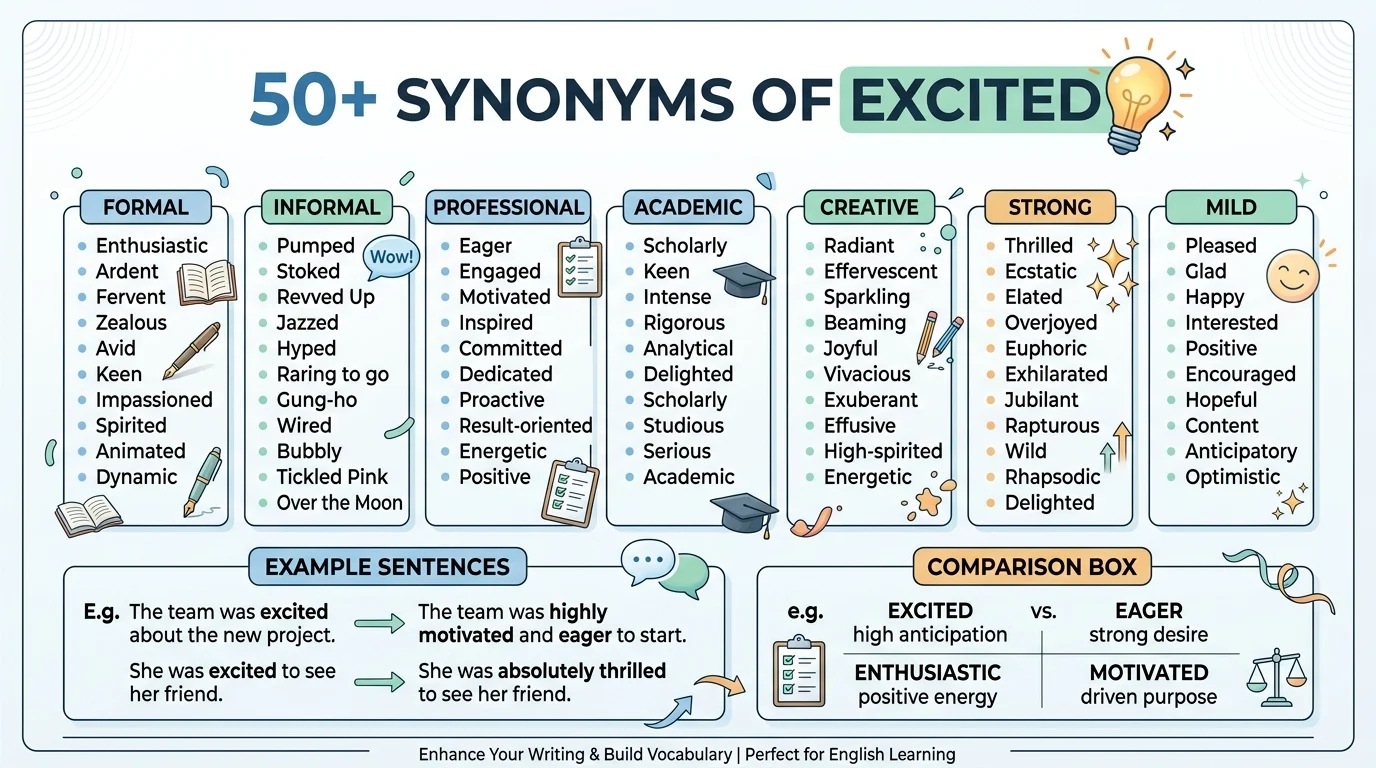
“Excited” means feeling happy and enthusiastic about something. The best synonym depends on your context. Professional writing, use “enthusiastic” or “eager.” For academic work, try “keen” or “motivated.” For casual conversation, “pumped” or “stoked” work well. Strong emotion, choose “thrilled” or “ecstatic.”
Meaning, Tone, and Context
Simple Definition
If you are excited, you are feeling happy and enthusiastic about something that is happening or will happen.
Part of Speech
Adjective
Overall Tone
Positive
Formality Level
Neutral to informal. “Excited” is appropriate in most everyday situations but can feel too casual in very formal academic papers or legal documents.
Common Uses
Native English speakers use “excited” to describe feelings about events, opportunities, news, or activities. Common phrases include “excited about,” “excited to,” and “excited for.”
Word Forms
- Excitement (noun): The feeling of being excited.
- Exciting (adjective): Causing excitement.
- Excitedly (adverb): In an excited manner.
When and How to Use “Excited”
Choose “excited” when you want to express genuine happiness and enthusiasm in a straightforward way. It works well in most informal and semi-formal situations. Here are seven realistic examples.
Professional
“I am excited to present our quarterly results to the board.”
Academic
“The research team is excited about the preliminary findings of the study.”
Workplace
“We are excited to welcome our new colleagues to the department.”
Personal
“I am so excited to see my family during the holidays.”
“I am excited to connect with you and discuss the partnership opportunity.”
Resume
“Excited to apply my skills in a fast-paced marketing environment.”
“Excited to announce that I have accepted a new position!”
Best Synonyms of “Excited”
No synonym is identical in every situation. The best word depends on your audience, purpose, and the level of emotion you want to express. Here are the best recommendations for specific contexts.
Professional Writing
Enthusiastic is the best choice. It conveys positive energy while maintaining professionalism and composure.
“I am enthusiastic about leading this project.”
Academic Writing
Keen works well. It shows sharp interest and eagerness in a sophisticated manner.
“Researchers are keen to explore this new area of study.”
Business Communication
Eager is excellent. It communicates readiness and willingness to engage.
“Our team is eager to begin implementing the new strategy.”
Casual Conversation
Pumped is a great informal option that conveys high energy and excitement.
“I am pumped for the concert tonight.”
Emotional Writing
Thrilled expresses extremely happy and excited feelings.
“She was thrilled to receive the award.”
Creative Writing
Exhilarated adds a sense of invigoration and intense excitement.
“He felt exhilarated after completing the marathon.”
Resume Writing
Motivated emphasizes drive and determination while sounding professional.
“Motivated professional with five years of experience in digital marketing.”
Workplace Communication
Inspired works well when you want to convey that an idea or opportunity has sparked your interest.
“I feel inspired by the company’s vision for sustainability.”
Stronger Meaning
Ecstatic conveys overwhelming happiness and joy.
“They were ecstatic when they won the championship.”
Softer Meaning
Interested is a milder alternative that shows curiosity without strong emotion.
“I am interested in learning more about the opportunity.”
When Not to Use “Excited”
When It Sounds Too General
If you are writing a resume or cover letter, “excited” is often too vague. It does not tell the employer anything specific about your skills or qualifications.
When It Sounds Too Informal
In formal academic papers or official business documents, “excited” can feel out of place.
- Instead use: “keen,” “interested,” or “committed.”
When It Sounds Too Weak
If you want to convey extreme happiness, “excited” may not be strong enough.
- Instead use: “thrilled,” “ecstatic,” or “overjoyed.”
When It Sounds Too Strong
In some professional settings, expressing too much emotion can seem unprofessional.
When It Is Outdated
“Excited” is never outdated, but in formal writing, more precise words are often preferred.
Words Commonly Confused With “Excited”
Excited vs Enthusiastic
Difference: “Excited” is an emotional response, while “enthusiastic” is a mindset or sustained interest.
When to Use It: Use “enthusiastic” for a longer-term, more stable interest.
Example: “She is enthusiastic about her career in medicine.”
Excited vs Eager
Difference: “Eager” implies readiness and willingness to take action, while “excited” focuses more on the emotional state.
When to Use It: Use “eager” when you want to show preparedness.
Example: “He is eager to start his new role.”
Excited vs Thrilled
Difference: “Thrilled” is much stronger and implies intense, pleasurable excitement.
When to Use It: Use “thrilled” for major, positive events.
Example: “We were thrilled to hear the good news.”
Excited vs Anxious
Difference: “Anxious” implies worry or nervousness, while “excited” is positive.
When to Use It: Use “anxious” when there is concern, not excitement.
Example: “She is anxious about the exam results.”
Excited vs Agitated
Difference: “Agitated” means troubled or nervous, often in a negative way.
When to Use It: Use “agitated” for restless or upset feelings.
Example: “He seemed agitated about the delay.”
Excited vs Overexcited
Difference: “Overexcited” means too excited, to the point of losing sensible behavior.
When to Use It: Use “overexcited” when excitement becomes excessive.
Example: “The children were overexcited and could not sleep.”
Best Synonyms of “Excited” by Context
| Context | Best Synonym | Why It Works | Example |
|---|---|---|---|
| Formal writing | Enthusiastic | Conveys positive energy while maintaining professionalism. | “The committee is enthusiastic about the proposal.” |
| Academic writing | Keen | Shows sharp, sophisticated interest. | “Scholars are keen to examine this phenomenon.” |
| Professional communication | Motivated | Emphasizes drive and results. | “I am motivated to contribute to this project.” |
| Business emails | Eager | Communicates readiness and willingness. | “I am eager to discuss the next steps.” |
| Resume writing | Inspired | Shows passion sparked by opportunity. | “Inspired marketing professional with a track record of success.” |
| Workplace communication | Engaged | Shows active involvement and interest. | “The team is engaged in the new initiative.” |
| Casual conversation | Pumped | Conveys high energy in an informal way. | “I am pumped for the game tonight.” |
| Everyday speaking | Excited | The most common and natural choice. | “I am excited about the party.” |
| Creative writing | Exhilarated | Adds a sense of invigoration. | “She felt exhilarated by the mountain air.” |
| Storytelling | Electrified | Creates vivid, powerful imagery. | “The crowd was electrified by the performance.” |
| Emotional writing | Thrilled | Expresses extremely happy excitement. | “They were thrilled to announce their engagement.” |
| Strong emphasis | Ecstatic | Conveys overwhelming joy. | “He was ecstatic about the promotion.” |
| Mild tone | Interested | Shows curiosity without strong emotion. | “I am interested in the new policy.” |
| Social media captions | Stoked | Modern, informal, and energetic. | “Stoked to share this news with all of you!” |
| American English | Pumped | Widely used and understood in the US. | “The players were pumped for the finals.” |
How to Choose the Best Synonym of “Excited”
Choosing the right synonym is simple if you ask yourself a few questions.
Who is your audience? If you are writing to a professor or a client, choose “enthusiastic” or “keen.” If you are texting a friend, “pumped” or “stoked” is fine.
What is your purpose? If you want to show readiness, choose “eager.” If you want to show deep interest, choose “passionate.” If you want to show motivation, choose “motivated.”
How strong is the emotion? Use “interested” for mild feelings, “excited” for moderate feelings, and “ecstatic” or “thrilled” for very strong feelings.
What is the tone of your writing? Formal writing calls for “enthusiastic” or “keen.” Informal writing allows for “pumped” or “jazzed.”
Always choose the word that communicates your intended message most clearly and naturally.
Real Life Examples of “Excited”
School
“The students were excited about the field trip to the science museum.”
College
“She was excited to start her first semester at university.”
Workplace
“The staff was excited to implement the new software system.”
Business
“The investors were excited about the company’s growth potential.”
“I am excited to collaborate with you on this initiative.”
Resume
“Enthusiastic professional eager to contribute to a dynamic team.”
Conversation
“I am so excited to try that new restaurant downtown.”
Storytelling
“Her heart raced with excitement as she opened the letter.”
Blogging
“I am excited to share my latest travel adventure with you.”
“Thrilled to announce that my book is now available for pre-order!”
18 Best Synonyms of “Excited”
| Synonym | Simple Meaning | Best Used For | Example Sentence |
|---|---|---|---|
| Thrilled | Extremely happy and excited | Emotional writing, major announcements | “We were thrilled to hear our first grandchild had been born.” |
| Enthusiastic | Showing intense and eager enjoyment | Professional and academic writing | “He was very enthusiastic about the idea of moving to Spain.” |
| Eager | Wanting to do something very much | Business communication, resumes | “She was eager to help.” |
| Pumped | Extremely excited and enthusiastic (informal, US) | Casual conversation, social media | “The players were pumped that they were going to finals.” |
| Keen | Very interested and eager | Academic and formal writing | “He took an avid interest in the project.” |
| Motivated | Very eager to achieve something | Resumes, professional writing | “Motivated professional seeking new challenges.” |
| Thrilled | Extremely pleased and excited | Personal and emotional contexts | “I was so thrilled to get a good report from him.” |
| Exhilarated | Very happy and excited, often after physical activity | Creative writing, storytelling | “I’ve never seen fans so exhilarated by a win.” |
| Inspired | Filled with the urge to do something creative | Professional and creative writing | “She felt inspired to start her own business.” |
| Passionate | Having very strong feelings or beliefs | Resumes, emotional writing | “He is passionate about environmental conservation.” |
| Jazzed | Very excited and enthusiastic (informal, US) | Casual conversation, social media | “She’s totally jazzed that she gets to go on the cruise.” |
| Avid | Very enthusiastic and interested | Academic and professional writing | “He took an avid interest in the project.” |
| Overjoyed | Extremely happy | Personal and emotional contexts | “They were overjoyed at the news.” |
| Ecstatic | Feeling or expressing overwhelming happiness | Strong emotional expression | “She was ecstatic about her promotion.” |
| Animated | Full of life and energy | Descriptive writing, storytelling | “Everyone became more animated.” |
| Stoked | Very excited and enthusiastic (slang) | Casual conversation, social media | “I am stoked about the concert.” |
| Elated | Extremely happy and excited | Emotional and personal contexts | “She felt elated after receiving the award.” |
| Zealous | Having or showing great energy and enthusiasm | Professional and academic writing | “He was zealous in his pursuit of excellence.” |
Synonyms of “Excited” by Usage
Professional vs Personal Synonyms
Professional: enthusiastic, motivated, eager, keen, inspired, engaged, committed, passionate
Personal: pumped, stoked, jazzed, thrilled, psyched, fired up
In the workplace, choose words that sound composed and purposeful. With friends, choose words that sound energetic and fun.
Formal vs Conversational Synonyms
Formal (reports, essays, business writing, presentations, emails): enthusiastic, keen, motivated, inspired, committed, avid
Conversational (texting, casual conversations): pumped, stoked, jazzed, psyched, fired up, hyped
Academic Synonyms
For research, essays, reports, and academic discussions, choose precise vocabulary that sounds authoritative. “Keen,” “avid,” “enthusiastic,” and “motivated” are excellent choices. They convey serious interest without emotional excess.
Professional and Business Synonyms
For resumes, interviews, meetings, presentations, performance reviews, client communication, and business emails, choose words that show drive and professionalism.
- Enthusiastic: shows positive energy
- Eager: shows readiness
- Motivated: shows drive
- Inspired: shows passion
- Committed: shows dedication
Creative and Literary Synonyms
For storytelling, fiction, poetry, descriptive writing, and speeches, choose expressive alternatives that add emotion and imagery.
- Exhilarated: adds invigoration
- Electrified: adds powerful energy
- Animated: adds liveliness
- Aflame: adds burning passion
Slang or Modern Synonyms
- Pumped: very excited and enthusiastic (informal, US)
- Stoked: very excited and enthusiastic (slang)
- Jazzed: very excited and enthusiastic (informal, US)
- Psyched: very excited (informal)
Use slang with friends or on social media. Avoid it in professional, academic, or formal writing.
Strongest to Mildest Synonyms
Mild
Interested → Curious → Positive → Optimistic
Moderate
Excited → Enthusiastic → Eager → Keen
Strong
Thrilled → Pumped → Exhilarated → Passionate
Very Strong
Ecstatic → Overjoyed → Elated → Euphoric
Understanding this scale helps you choose the right word for the right level of emotion.
Emotional vs Neutral Synonyms
Emotional Synonyms (express stronger feelings)
Thrilled, ecstatic, overjoyed, elated, passionate, pumped, stoked, jazzed
Use these when you want to convey strong positive feelings.
Neutral Synonyms (communicate information without adding strong emotion)
Interested, curious, keen, motivated, engaged, committed
Use these in professional or academic settings where you want to sound composed and objective.
Antonyms of “Excited”
| Antonym | Meaning | Example Sentence |
|---|---|---|
| Calm | Not excited, nervous, or upset | “She remained calm during the presentation.” |
| Bored | Feeling weary because one is unoccupied | “He was bored by the long lecture.” |
| Uninterested | Not interested | “She seemed uninterested in the conversation.” |
| Apathetic | Showing or feeling no emotion | “The voters were apathetic about the election.” |
| Indifferent | Having no particular interest | “He was indifferent to the outcome.” |
| Unenthusiastic | Not showing enthusiasm | “The response was unenthusiastic.” |
| Disinterested | Not interested | “She appeared disinterested in the proposal.” |
| Unexcited | Not excited | “He was unexcited about the trip.” |
| Relaxed | Free from tension and anxiety | “She felt relaxed after the yoga class.” |
| Composed | Calm and in control of one’s feelings | “He remained composed throughout the interview.” |
| Detached | Not emotionally involved | “She took a detached view of the situation.” |
| Lethargic | Affected by lethargy; sluggish | “He felt lethargic after the heavy meal.” |
| Passive | Accepting without active response | “She took a passive role in the discussion.” |
| Stoic | Enduring pain without showing feelings | “He remained stoic despite the bad news.” |
| Placid | Calm and peaceful | “The lake was placid and still.” |
Comparison: “Excited” vs Similar Words
Excited vs Enthusiastic
Main Difference: “Excited” is an emotional response, while “enthusiastic” is a more sustained mindset.
Which Is Stronger? “Excited” can be stronger in the moment, but “enthusiastic” suggests deeper, longer-lasting interest.
Which Is More Formal? “Enthusiastic” is more formal.
When to Use Each: Use “excited” for immediate reactions. Use “enthusiastic” for ongoing interests.
Examples:
- Excited: “I am excited about the party tonight.”
- Enthusiastic: “She is enthusiastic about her career.”
Excited vs Eager
Main Difference: “Eager” implies readiness to act, while “excited” focuses on emotion.
Which Is Stronger? “Excited” often feels more emotional.
Which Is More Formal? “Eager” is slightly more formal.
When to Use Each: Use “eager” to show preparedness. Use “excited” to show emotion.
Examples:
- Excited: “He is excited about the trip.”
- Eager: “He is eager to start the project.”
Excited vs Thrilled
Main Difference: “Thrilled” is much more intense.
Which Is Stronger? “Thrilled” is stronger.
Which Is More Formal? Both are acceptable, but “thrilled” is often used for major events.
When to Use Each: Use “excited” for everyday enthusiasm. Use “thrilled” for major positive news.
Examples:
- Excited: “I am excited to see the movie.”
- Thrilled: “I am thrilled to announce my engagement.”
Excited vs Anxious
Main Difference: “Anxious” implies worry, while “excited” is positive.
Which Is Stronger? Both can be strong, but “anxious” is negative.
Which Is More Formal? “Anxious” is formal.
When to Use Each: Use “anxious” when there is concern. Use “excited” when there is happiness.
Examples:
- Excited: “She is excited about the interview.”
- Anxious: “She is anxious about the interview.”
Excited vs Passionate
Main Difference: “Passionate” implies deep, enduring feeling, while “excited” is often temporary.
Which Is Stronger? “Passionate” is stronger and deeper.
Which Is More Formal? “Passionate” is formal.
When to Use Each: Use “passionate” for long-term interests or beliefs. Use “excited” for immediate reactions.
Examples:
- Excited: “I am excited about the new project.”
- Passionate: “I am passionate about environmental conservation.”
Excited vs Keen
Main Difference: “Keen” suggests sharp, intellectual interest, while “excited” is more emotional.
Which Is Stronger? “Excited” is often more emotional.
Which Is More Formal? “Keen” is more formal.
When to Use Each: Use “keen” in academic or professional contexts. Use “excited” in everyday contexts.
Examples:
- Excited: “I am excited to attend the conference.”
- Keen: “I am keen to attend the conference.”
Common Phrases and Expressions with “Excited”
Phrase: Excited about
Meaning: Feeling enthusiasm for a future event or situation.
Example Sentence: “The children were excited about going to the zoo.”
Phrase: Excited to
Meaning: Feeling enthusiasm for doing something.
Example Sentence: “He said he is excited to return to San Diego.”
Phrase: Excited for
Meaning: Feeling enthusiasm for something (informal).
Example Sentence: “Are you excited for your first Oscar nomination?”
Phrase: Get excited
Meaning: To become enthusiastic.
Example Sentence: “The fans began to get excited as the game started.”
Phrase: Nothing to get excited about
Meaning: Not especially good.
Example Sentence: “It’s a competent enough first novel but nothing to get excited about.”
Common Mistakes to Avoid
1: Choosing a Vague Synonym
Incorrect: “I am thrilled about the meeting.” (If it is a routine meeting, “thrilled” is too strong.)
Better: “I am eager about the meeting.” (Shows readiness without overstatement.)
Why: “Thrilled” implies intense excitement, which may not fit every situation.
2: Confusing “Excited” with “Anxious”
Incorrect: “I am anxious to start my new job.” (If you mean happy, not worried.)
Better: “I am excited to start my new job.” (Shows positive emotion.)
Why: “Anxious” implies worry, not enthusiasm.
3: Using Informal Synonyms in Formal Writing
Incorrect: “I am pumped to submit this proposal.” (Too casual for a business proposal.)
Better: “I am enthusiastic about submitting this proposal.” (Professional and appropriate.)
Why: “Pumped” is informal slang and sounds unprofessional in formal contexts.
4: Selecting an Overly Dramatic Synonym
Incorrect: “I am ecstatic about the team lunch.” (Too strong for a routine event.)
Better: “I am looking forward to the team lunch.” (Appropriate and natural.)
Why: “Ecstatic” implies overwhelming joy, which is too much for a simple lunch.
5: Repeating the Same Word Too Often
Incorrect: “I am excited about the project. I am excited to work with the team. I am excited about the results.”
Better: “I am enthusiastic about the project. I am eager to work with the team. I am excited about the results.”
Why: Varying your word choice makes your writing more engaging.
6: Choosing a Synonym with the Wrong Emotional Tone
Incorrect: “I am passionate about attending the workshop.” (Too strong for a short event.)
Better: “I am interested in attending the workshop.” (Milder and more appropriate.)
Why: “Passionate” implies deep, enduring feeling, which may not fit a short workshop.
7: Using Slang in Academic or Professional Writing
Incorrect: “I am stoked to present my research.” (Too casual for an academic presentation.)
Better: “I am keen to present my research.” (Formal and appropriate.)
Why: “Stoked” is slang and should be avoided in academic or professional contexts.
Frequently Asked Questions
1. What are the best synonyms of “excited”?
The best synonyms of excited depend on your context. Professional writing, use “enthusiastic” or “eager.” For casual conversation, use “pumped” or “stoked.” For strong emotion, use “thrilled” or “ecstatic.”
2. What are the best formal synonyms of “excited”?
The best formal synonyms include “enthusiastic,” “keen,” “motivated,” “avid,” and “committed.” These words convey positive energy while maintaining a professional tone.
3. What are common informal synonyms of “excited”?
Common informal synonyms include “pumped,” “stoked,” “jazzed,” “psyched,” and “fired up.” These are best for casual conversations, texting, and social media.
4. What is another word for “excited” in professional writing?
In professional writing, use “enthusiastic,” “eager,” “motivated,” or “inspired.” These words show drive and positive energy without sounding overly emotional.
5. What is the difference between “excited” and “enthusiastic”?
“Excited” is an emotional response, while “enthusiastic” is a more sustained mindset. “Excited” is often temporary, while “enthusiastic” suggests longer-term interest.
6. What is the opposite of “excited”?
The opposite of excited includes “calm,” “bored,” “uninterested,” “apathetic,” and “unenthusiastic.”
Conclusion
“Excited” is a useful word that describes the feeling of happiness and enthusiasm about something. But using the same word too often can make your writing feel repetitive and less precise. By learning the best synonyms of excited, you can communicate more clearly and effectively in every situation.
The right synonym depends on your audience, your purpose, and the strength of your emotion. Professional settings, choose “enthusiastic” or “eager.” For casual conversations, choose “pumped” or “stoked.” For strong emotions, choose “thrilled” or “ecstatic.”
No synonym works perfectly in every situation. The key is to choose the word that best fits your context and conveys your intended message. Keep expanding your vocabulary, and your writing will become more engaging and impactful.