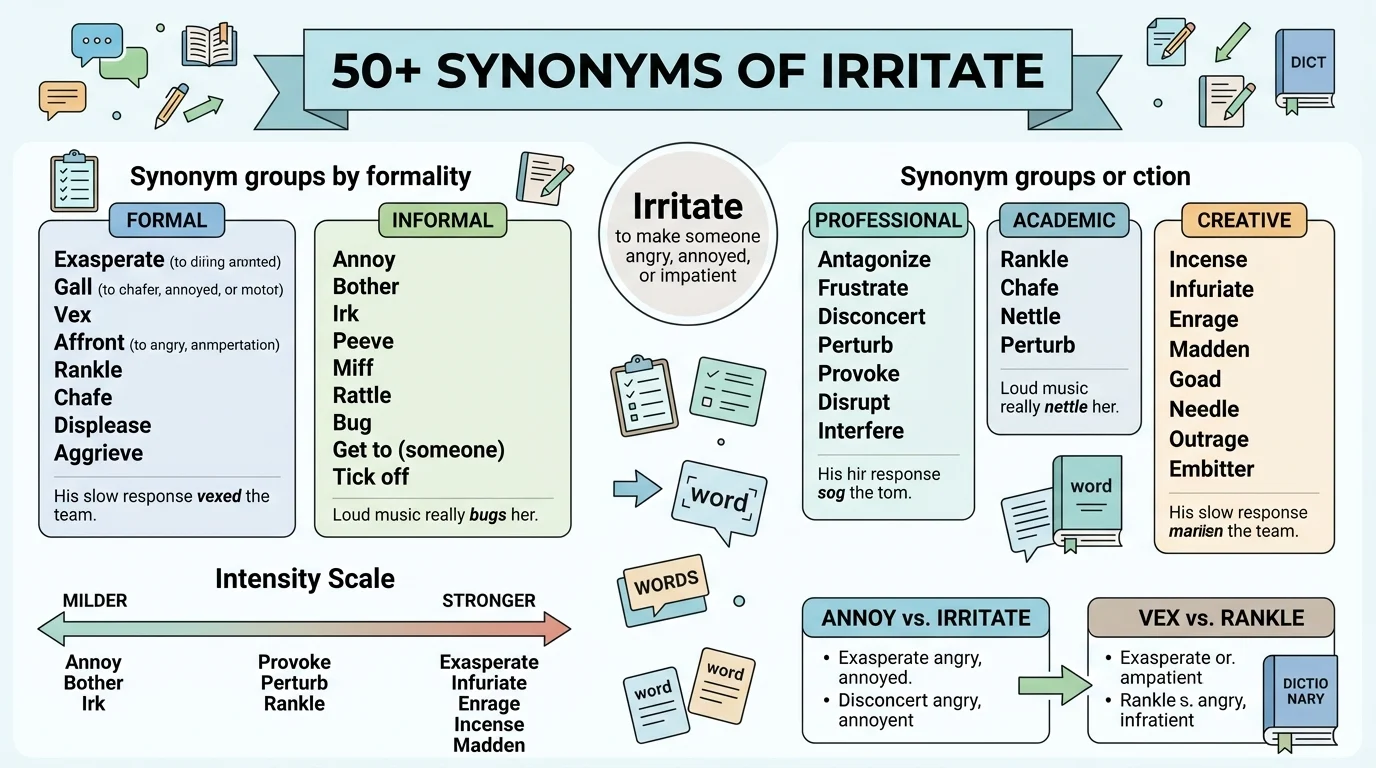
Have you ever written an email, an essay, or a social media caption and found yourself using the word “irritate” over and over again? You know there has to be a better word, but you cannot quite find the right one. This happens to writers, students, and professionals all the time. The English language offers a rich variety of words that capture different shades of annoyance, frustration, and anger. Understanding the synonyms of irritate can transform your writing from repetitive and vague to precise and powerful. Choosing the right word does more than just expand your vocabulary. It helps you communicate your exact feelings, adjust your tone for different audiences, and avoid misunderstandings. Whether you are writing a formal business report, a casual text message, or a creative story, the right synonym makes all the difference.
What Are the Best Synonyms of “Irritate”?
To irritate means to make someone impatient, angry, or annoyed. For formal writing, choose “exasperate” or “irk.” For casual conversation, use “bug” or “bother.” In professional settings, “aggravate” or “provoke” work well. For stronger emotions, select “infuriate” or “enrage.” For milder tones, pick “annoy” or “peeve.”
Meaning, Tone, and Context
Simple Definition
To irritate means to provoke impatience, anger, or displeasure in someone. It can also refer to causing physical soreness or inflammation, such as when a harsh soap irritates your skin.
Part of Speech
Verb (transitive and intransitive). Related forms include irritated (adjective), irritating (adjective), and irritation (noun).
Overall Tone
Negative. The word always describes an unpleasant reaction.
Formality Level
Neutral. Irritate” works in both formal and informal contexts, though more precise synonyms exist for each setting.
Common Uses
Native English speakers use “irritate” in many everyday situations:
- Describing someone’s annoying habits
- Talking about physical skin reactions
- Expressing frustration with delays or interruptions
- Discussing interpersonal conflicts
- Explaining why something is bothersome
Word Forms
- Verb: irritate, irritates, irritated, irritating
- Noun: irritation
- Adjective: irritated, irritating
- Adverb: irritatingly
When and How to Use “Irritate”
Choose “irritate” when you want to describe a feeling of annoyance that is noticeable but not overwhelming. The word suggests a gradual buildup of frustration rather than an instant explosion of anger. Here are seven realistic examples showing how to use “irritate” in different contexts.
Professional: The constant interruptions during the meeting began to irritate the project manager.
Academic: The researcher found that inconsistent data collection methods irritated her colleagues in the department.
Workplace: It irritates me when team members fail to update the shared calendar.
Personal: My brother’s habit of leaving dirty dishes in the sink really irritates me.
Email: I apologize if my previous message irritated you; that was not my intention.
Resume: Avoid using vague language that might irritate hiring managers who read hundreds of applications.
Social Media: Nothing irritates me more than people who post spoilers without warning.
Best Synonyms of “Irritate”
No synonym is identical to “irritate” in every situation. Each alternative carries a slightly different tone, intensity, or level of formality. Here are the best recommendations for specific contexts.
Professional writing: “Exasperate” is the best choice because it conveys frustration that tests patience without sounding overly emotional.
Academic writing: “Provoke” works well in scholarly work because it suggests a cause-and-effect relationship.
Business communication: “Aggravate” is direct and professional, making it suitable for emails and reports.
Casual conversation: “Bug” is the most natural and friendly option for everyday speech.
Emotional writing: “Infuriate” captures intense anger and works well in personal narratives.
Creative writing: “Nettle” adds a literary flair and suggests a sharp but brief annoyance.
Resume writing: Avoid “irritate” entirely. Use “challenge” or “motivate” instead to maintain a positive tone.
Workplace communication: “Rile” is effective for describing situations that agitate employees.
Stronger meaning: “Enrage” or “incense” convey extreme anger.
Softer meaning: “Bother” or “peeve” describe mild annoyance.
When Not to Use “Irritate”
Sometimes “irritate” is not the best word for the situation. Understanding when to avoid it helps you communicate more effectively.
When the word sounds too general: If you need to describe a specific type of annoyance, “irritate” may feel vague. Instead of saying “The noise irritated me,” try “The constant buzzing grated on my nerves.” This paints a clearer picture.
When the word sounds too vague: In academic or technical writing, “irritate” lacks precision. Use “exacerbate” when describing how something worsens a problem.
When the word sounds too formal: In casual conversations or text messages, “irritate” can feel stiff. Use “bug” or “annoy” instead.
When the word sounds too informal: In formal reports or official documents, “irritate” may seem too casual. Choose “exasperate” or “provoke” for a more authoritative tone.
When the word sounds too weak: If the situation involves intense anger, “irritate” is not strong enough. Use “infuriate” or “enrage” to match the emotional weight.
When the word sounds too strong: For minor inconveniences, “irritate” can exaggerate the feeling. Use “bother” or “peeve” to keep the tone appropriate.
When the word is outdated: “Irritate” remains current, but in some creative contexts, older synonyms like “vex” may feel more fitting.
Words Commonly Confused With “Irritate”
Several words are often confused with “irritate.” Understanding the differences helps you choose the right one.
Vs. Annoy
- Difference: “Annoy” is slightly milder and more general. “Irritate” often implies a gradual buildup of frustration.
- When to Use It: Use “annoy” for minor, everyday frustrations. Use “irritate” when the feeling builds over time.
- Example: “His constant humming annoyed me.” vs. “His constant humming throughout the entire meeting irritated me.”
Vs. Exasperate
- Difference: “Exasperate” is much stronger. It suggests irritation that tests a person’s patience to the breaking point.
- When to Use It: Use “exasperate” when someone has lost or nearly lost their self-control.
- Example: “The delay irritated me.” vs. “The endless delays exasperated me to the point of tears.”
Irritate vs. Provoke
- Difference: “Provoke” implies a deliberate action that stirs a strong reaction, often anger.
- When to Use It: Use “provoke” when someone intentionally causes a reaction.
- Example: “His comments irritated her.” vs. “His comments were designed to provoke her.”
Vs. Aggravate
- Difference: “Aggravate” can mean to make a problem worse, in addition to meaning to annoy.
- When to Use It: Use “aggravate” when something worsens an existing situation.
- Example: “The noise irritated me.” vs. “The noise aggravated my headache.”
Irritate vs. Vex
- Difference: “Vex” is an older, more literary word that suggests persistent annoyance.
- When to Use It: Use “vex” in formal or creative writing for a classic tone.
- Example: “The problem irritated the team.” vs. “The problem vexed the team for weeks.”
Irritate vs. Nettle
- Difference: “Nettle” suggests a sharp but brief annoyance, like a sting.
- When to Use It: Use “nettle” in creative or descriptive writing.
- Example: “Her comment irritated him.” vs. “Her sharp comment nettled him.”
Best Synonyms of “Irritate” by Context
| Context | Best Synonym | Why It Works | Example |
|---|---|---|---|
| Formal writing | Exasperate | Conveys frustration that tests patience | The committee was exasperated by the repeated delays. |
| Academic writing | Provoke | Suggests a clear cause-and-effect relationship | The findings provoked a strong reaction among scholars. |
| Professional communication | Aggravate | Direct and business-appropriate | The lack of clear instructions aggravated the entire team. |
| Business emails | Irk | Formal yet concise | Your email irked me because it overlooked my main question. |
| Resume writing | Motivate | Positive alternative that avoids negative tone | I motivated my team to meet tight deadlines. |
| Workplace communication | Rile | Captures agitation among employees | The new policy riled the staff. |
| Casual conversation | Bug | Friendly and natural | It really bugs me when people are late. |
| Everyday speaking | Bother | Simple and universally understood | Does it bother you when I chew loudly? |
| Creative writing | Nettle | Adds literary flair and sharpness | Her careless remark nettled him. |
| Storytelling | Gall | Suggests deep resentment | Their smugness galled her. |
| Emotional writing | Infuriate | Captures intense anger | The injustice infuriated her. |
| Strong emphasis | Enrage | Conveys extreme anger | The decision enraged the entire community. |
| Mild tone | Peeve | Describes minor irritation | It peeves me when people interrupt. |
| Social media captions | Annoy | Short and relatable | Nothing annoys me more than bad Wi-Fi. |
| American English | Bug | Widely used and understood | Stop bugging me about that. |
How to Choose the Best Synonym of “Irritate”
Choosing the right synonym depends on several factors. Here is a practical decision guide.
Consider the meaning: What exactly are you trying to say? Are you describing a mild annoyance or intense anger? Choose a synonym that matches the precise feeling.
Consider the tone: Are you writing formally or casually? Formal settings call for words like “exasperate” or “irk.” Casual settings allow for “bug” or “bother.”
Consider the audience: Who will read or hear your words? A professional audience expects precise, measured language. Friends and family appreciate natural, conversational words.
Consider the emotional strength: How strong is the feeling you want to express? “Bother” is mild. “Infuriate” is extreme. Match the intensity to the situation.
Consider the writing purpose: Are you informing, persuading, or entertaining? Different purposes call for different word choices.
Consider the level of formality: Academic and business writing require formal synonyms. Social media and texting allow informal options.
Consider natural sounding usage: The best synonym is one that sounds natural in the context. Read your sentence aloud. If it sounds awkward, try a different word.
Real Life Examples of “Irritate”
Seeing “irritate” and its synonyms in real contexts helps you understand how to use them effectively. Here are examples from various situations.
School: The teacher’s repetitive instructions irritated the students who already understood the assignment.
College: Late-night noise from the dormitory hallway irritated the students who had exams the next morning.
Workplace: The constant email notifications irritated everyone in the open-plan office.
Business: The client’s frequent changes to the project scope irritated the design team.
Email: “I hope this does not irritate you, but I need to request an extension on the deadline.”
Resume: Instead of saying “I was irritated by inefficiencies,” write “I identified and resolved process inefficiencies.”
Conversation: “It really irritates me when you scroll through your phone while I am talking to you.”
Storytelling: The creaking floorboard irritated him every night, a small but persistent reminder of the house’s age.
Blogging: “Nothing irritates a reader more than a blog post filled with typos and grammatical errors.”
Social Media: “People who don’t use turn signals irritate me beyond belief.”
18 Best Synonyms of “Irritate”
| Synonym | Simple Meaning | Best Used For | Example Sentence |
|---|---|---|---|
| Annoy | To cause slight anger or impatience | Everyday situations | It annoys me when people chew with their mouths open. |
| Bother | To cause trouble or worry | Casual conversation | Does it bother you if I open the window? |
| Exasperate | To irritate intensely | Formal writing | The constant delays exasperated the project manager. |
| Provoke | To deliberately stir anger | Academic and professional | His remarks provoked a heated debate. |
| Aggravate | To annoy or make worse | Business communication | The lack of feedback aggravated the team. |
| Irk | To irritate formally | Formal emails and reports | The decision irked several board members. |
| Rile | To agitate or upset | Workplace situations | The new schedule riled the employees. |
| Peeve | To annoy mildly | Everyday speech | It peeves me when people don’t say thank you. |
| Bug | To annoy persistently | Informal conversation | Stop bugging me about that. |
| Gall | To irritate deeply | Creative writing | Their arrogance galled him. |
| Nettle | To sting or provoke | Literary writing | Her sharp words nettled him. |
| Vex | To trouble or annoy | Formal or creative writing | The unresolved issue vexed the committee. |
| Inflame | To provoke strong emotion | Emotional writing | The speech inflamed the crowd. |
| Infuriate | To make extremely angry | Strong emphasis | The injustice infuriated her. |
| Enrage | To provoke intense anger | Extreme situations | The decision enraged the community. |
| Incense | To make very angry | Emotional or dramatic writing | The policy incensed the activists. |
| Fret | To worry or annoy | Descriptive writing | The constant noise fretted him. |
| Pique | To provoke or stimulate | Formal or creative writing | Her curiosity was piqued by the mystery. |
Synonyms of “Irritate” by Usage
Professional vs Personal Synonyms
In professional settings, choose words that sound measured and objective. “Exasperate,” “irk,” and “provoke” work well in business communication. In personal conversations, “bug,” “bother,” and “annoy” feel more natural and friendly. Using overly formal synonyms in personal settings can make you sound stiff. Using informal synonyms in professional settings can make you sound unprofessional.
Formal vs Conversational Synonyms
Formal synonyms suitable for reports, essays, and business writing:
- Exasperate
- Provoke
- Irk
- Vex
- Pique
Conversational synonyms suitable for casual conversations and texting:
- Bug
- Bother
- Annoy
- Peeve
- Rile
Academic Synonyms
Academic writing demands precision and authority. These synonyms work well in research papers, essays, and scholarly discussions.
- Provoke: Suggests a clear causal relationship
- Exasperate: Conveys frustration that tests patience
- Vex: Adds a formal, scholarly tone
- Aggravate: Useful when discussing worsening conditions
Professional and Business Synonyms
These synonyms are ideal for resumes, interviews, meetings, presentations, performance reviews, client communication, and business emails.
- Exasperate: Shows that a situation tested your patience without sounding overly emotional
- Irk: Concise and professional
- Provoke: Useful for describing cause-and-effect in business contexts
- Aggravate: Direct and business-appropriate
Creative and Literary Synonyms
Writers and storytellers can use these expressive alternatives to add emotion and imagery.
- Nettle: Suggests a sharp, stinging annoyance
- Gall: Implies deep resentment and bitterness
- Vex: Adds a classic, literary quality
- Inflame: Suggests strong emotional arousal
- Pique: Often used to describe provoked curiosity or interest
Slang or Modern Synonyms
Slang synonyms for “irritate” are limited, but a few informal options exist.
- Bug: Widely used in American English to mean annoy persistently
- Get under someone’s skin: Means to irritate someone deeply
- Drive someone up the wall: Means to irritate someone intensely
Avoid these in formal or professional writing. They are best reserved for casual conversations and informal settings.
Strongest to Mildest Synonyms
Here is an intensity scale showing synonyms from mildest to strongest.
Mild:
- Bother
- Annoy
- Peeve
Moderate:
- Irk
- Bug
- Rile
- Aggravate
Strong:
- Exasperate
- Provoke
- Nettle
- Vex
Very Strong:
- Infuriate
- Enrage
- Gall
- Incense
- Inflame
Emotional vs Neutral Synonyms
Emotional Synonyms (express stronger feelings):
- Infuriate
- Enrage
- Gall
- Incense
- Inflame
Use these when you want to convey intense anger or strong emotional reactions. They are suitable for personal narratives, emotional writing, and dramatic contexts.
Neutral Synonyms (communicate information without adding emotion):
- Annoy
- Bother
- Irk
- Aggravate
Use these when you simply want to state that something caused annoyance without exaggerating the emotional response. They are suitable for professional, academic, and everyday contexts.
Antonyms of “Irritate”
| Antonym | Meaning | Example Sentence |
|---|---|---|
| Soothe | To calm or comfort | The gentle music soothed her nerves. |
| Calm | To make peaceful | A deep breath helped calm his frustration. |
| Please | To make happy | The good news pleased everyone in the room. |
| Comfort | To console or reassure | Her kind words comforted him during a difficult time. |
| Pacify | To bring peace | The manager tried to pacify the angry customer. |
| Mollify | To reduce anger | His apology mollified her slightly. |
| Assuage | To lessen intensity | The explanation assuaged their concerns. |
| Appease | To satisfy or calm | The concessions appeased the protestors. |
| Delight | To please greatly | The surprise party delighted her. |
| Gratify | To give pleasure | The recognition gratified his efforts. |
| Reassure | To restore confidence | The doctor reassured the worried patient. |
| Relax | To make less tense | The warm bath relaxed her tired muscles. |
| Cheer | To make happier | The good news cheered everyone. |
| Content | To make satisfied | The meal contented the hungry travelers. |
| Enchant | To delight greatly | The beautiful scenery enchanted the visitors. |
Comparison: “Irritate” vs Similar Words
Irritate vs Annoy
Main Difference: “Annoy” is milder and more general. “Irritate” often implies a gradual buildup of frustration.
Which Is Stronger? “Irritate” is slightly stronger.
Which Is More Formal? Both are neutral, but “irritate” can sound more formal in certain contexts.
When to Use Each: Use “annoy” for minor, everyday frustrations. Use “irritate” when the feeling builds over time or when describing physical reactions.
Examples:
- Irritate: “The constant buzzing of the fly irritated me throughout the movie.”
- Annoy: “It annoys me when you forget to close the door.”
Irritate vs Exasperate
Main Difference: “Exasperate” is much stronger. It suggests irritation that tests a person’s patience to the breaking point.
Which Is Stronger? “Exasperate” is significantly stronger.
Which Is More Formal? Both are formal, but “exasperate” is more formal.
When to Use Each: Use “irritate” for general annoyance. Use “exasperate” when someone has lost or nearly lost their self-control.
Examples:
- Irritate: “The delay irritated me.”
- Exasperate: “The endless delays exasperated me to the point of tears.”
Irritate vs Provoke
Main Difference: “Provoke” implies a deliberate action that stirs a strong reaction.
Which Is Stronger? “Provoke” is stronger.
Which Is More Formal? Both are formal.
When to Use Each: Use “irritate” for unintentional annoyance. Use “provoke” when someone intentionally causes a reaction.
Examples:
- Irritate: “His constant questions irritated the teacher.”
- Provoke: “His constant questions were designed to provoke the teacher.”
Irritate vs Aggravate
Main Difference: “Aggravate” can mean to make a problem worse, in addition to meaning to annoy.
Which Is Stronger? “Aggravate” is slightly stronger.
Which Is More Formal? Both are neutral.
When to Use Each: Use “irritate” for emotional annoyance. Use “aggravate” when something worsens an existing situation.
Examples:
- Irritate: “The noise irritated me.”
- Aggravate: “The noise aggravated my headache.”
Irritate vs Vex
Main Difference: “Vex” is an older, more literary word that suggests persistent annoyance.
Which Is Stronger? Similar in strength.
Which Is More Formal? “Vex” is more formal and literary.
When to Use Each: Use “irritate” in everyday contexts. Use “vex” in formal or creative writing for a classic tone.
Examples:
- Irritate: “The problem irritated the team.”
- Vex: “The problem vexed the team for weeks.”
Irritate vs Nettle
Main Difference: “Nettle” suggests a sharp but brief annoyance, like a sting.
Which Is Stronger? Similar in strength, but “nettle” is more vivid.
Which Is More Formal? “Nettle” is more literary.
When to Use Each: Use “irritate” for general contexts. Use “nettle” in creative or descriptive writing.
Examples:
- Irritate: “Her comment irritated him.”
- Nettle: “Her sharp comment nettled him.”
Common Phrases and Expressions with “Irritate”
: Get on someone’s nerves
Meaning: To irritate someone persistently
Example Sentence: His constant whistling really gets on my nerves.
: Rub someone the wrong way
Meaning: To irritate or annoy someone
Example Sentence: Her arrogant attitude rubbed me the wrong way.
: Drive someone up the wall
Meaning: To irritate someone intensely
Example Sentence: The construction noise outside is driving me up the wall.
: Get under someone’s skin
Meaning: To irritate someone deeply
Example Sentence: His smug comments really got under her skin.
Phrase: Grind someone’s gears
Meaning: To irritate or annoy someone
Example Sentence: People who don’t use turn signals really grind my gears.
Phrase: Push someone’s buttons
Meaning: To deliberately provoke or irritate someone
Example Sentence: He knows exactly how to push her buttons.
Common Mistakes to Avoid
1: Choosing a vague synonym instead of a precise one.
- Incorrect: “The situation irritated me.”
- Better: “The situation exasperated me because it tested my patience repeatedly.”
- Why: The second sentence is more specific and conveys the true intensity of the feeling.
2: Confusing “irritate” with “exacerbate.”
- Incorrect: “The new policy irritated the problem.”
- Better: “The new policy exacerbated the problem.”
- Why: “Exacerbate” means to make a problem worse. “Irritate” means to annoy someone.
3: Using an informal synonym in formal writing.
- Incorrect: “The client’s demands bugged the team.”
- Better: “The client’s demands irritated the team.”
- Why: “Bug” is too informal for professional communication.
4: Selecting an overly dramatic synonym.
- Incorrect: “The typo in the report enraged me.”
- Better: “The typo in the report annoyed me.”
- Why: “Enrage” is too strong for a minor inconvenience.
5: Repeating the same word too often.
- Incorrect: “The noise irritated me. The noise irritated my coworkers. The noise irritated everyone.”
- Better: “The noise irritated me. It annoyed my coworkers. It exasperated everyone in the office.”
- Why: Varying your word choice makes your writing more engaging.
6: Choosing a synonym with the wrong emotional tone.
- Incorrect: “The delay infuriated me slightly.”
- Better: “The delay irritated me slightly.”
- Why: “Infuriate” means extreme anger and cannot be modified by “slightly.”
7: Using slang in academic or professional writing.
- Incorrect: “The professor’s feedback got under my skin.”
- Better: “The professor’s feedback irritated me.”
- Why: Slang is inappropriate in formal academic contexts.
Frequently Asked Questions
1. What are the best synonyms of “irritate”?
The best synonyms depend on context. Formal writing, use “exasperate” or “irk.” For casual conversation, use “bug” or “bother.” For strong emphasis, use “infuriate” or “enrage.”
2. What are the best formal synonyms of “irritate”?
The best formal synonyms are “exasperate,” “irk,” “provoke,” and “vex.” These words convey annoyance in a measured, professional way suitable for reports, essays, and business communication.
3. What are common informal synonyms of “irritate”?
Common informal synonyms include “bug,” “annoy,” “bother,” and “peeve.” These words are natural and friendly, making them ideal for casual conversations, text messages, and social media posts.
4. What is another word for “irritate” in professional writing?
In professional writing, “exasperate” is an excellent choice. It conveys frustration that tests patience without sounding overly emotional. “Aggravate” and “irk” are also effective in business contexts.
5. What is the difference between “irritate” and “exasperate”?
“Irritate” means to cause mild to moderate annoyance. “Exasperate” means to irritate to the point where self-control is threatened or lost. “Exasperate” is significantly stronger and implies extreme frustration.
6. What is the opposite of “irritate”?
The opposite of “irritate” is “soothe,” “calm,” “please,” or “pacify.” These words describe actions that reduce anger, bring peace, or make someone feel comfortable and satisfied.
Conclusion
The word “irritate” describes the feeling of impatience, annoyance, or anger that arises when something or someone bothers you. But as you have seen, the English language offers a wealth of synonyms that capture different shades of this feeling. From the mild “bother” to the intense “infuriate,” each synonym has its place. The best synonyms of irritate depend on your audience, your tone, and your purpose. No single synonym works perfectly in every situation. The key to effective communication is choosing the word that most accurately conveys your intended meaning. So next time you feel the urge to use “irritate,” pause and consider whether a more precise word might serve you better. Your readers, listeners, and colleagues will appreciate the clarity.