Have you ever been writing an essay, a business email, or a social media post and found yourself using the word “propaganda” over and over? Maybe you are describing political messaging, corporate advertising, or even a friend’s overly persuasive argument. Repeating the same word makes your writing feel dull and imprecise. That is exactly when you need a strong list of synonyms of propaganda. Choosing the right alternative can transform your communication, making it clearer, more professional, and more engaging for your audience.
What Are the Best Synonyms of “Propaganda”?
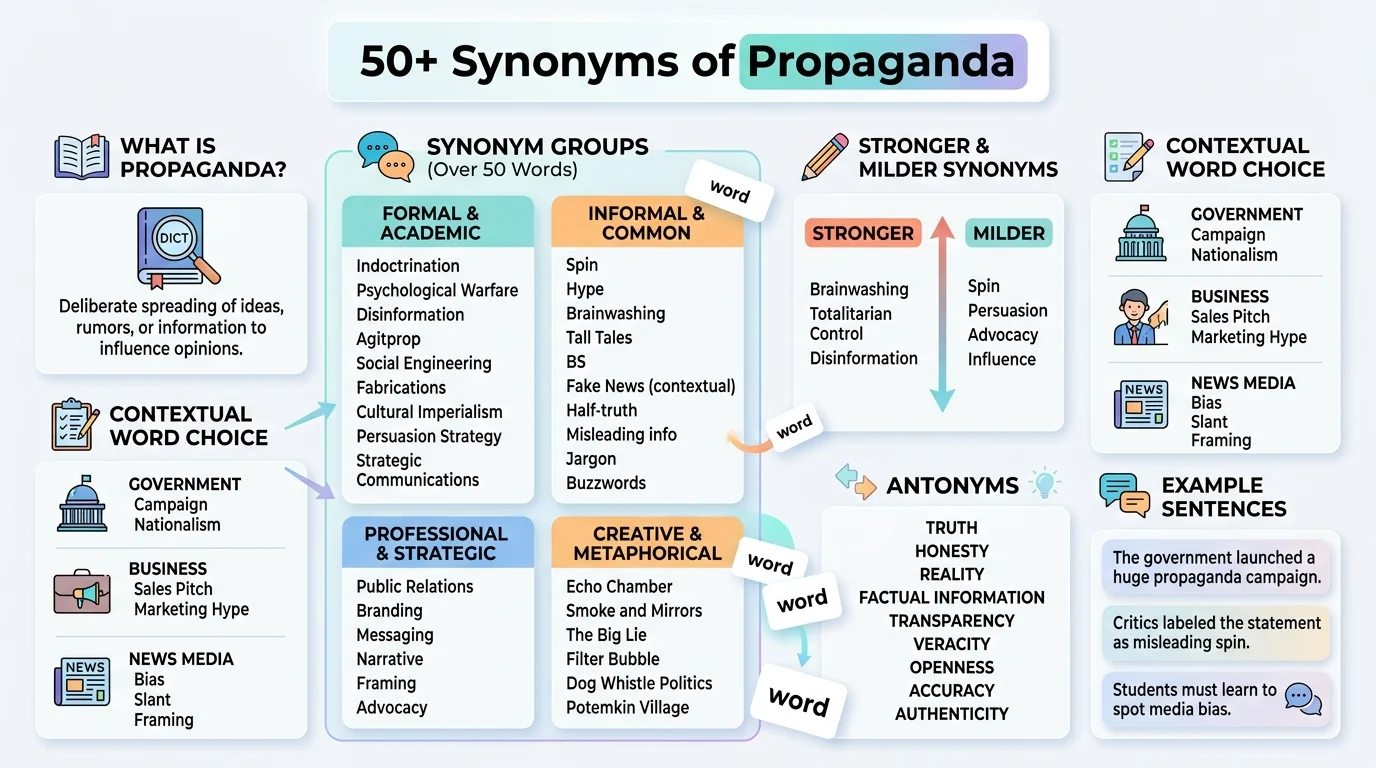
Propaganda is information, often biased or misleading, spread to promote a political cause, point of view, or specific agenda. The best synonym depends on your context. For formal writing, use “disinformation” or “indoctrination.” For casual conversation, try “spin” or “hype.” In professional settings, “publicity” or “promotion” work well. For academic work, “agitprop” or “brainwashing” are stronger choices.
Meaning, Tone, and Context
Simple Definition: Propaganda is the systematic spread of information, ideas, or rumors to influence public opinion and further a specific agenda. The information is often biased, exaggerated, or even false.
Part of Speech: Noun (usually uncountable)
Overall Tone: Generally negative. While the word originally had a neutral meaning related to spreading religious faith, it has become strongly pejorative in modern English. It implies manipulation and a lack of objectivity.
Formality Level: Neutral to formal. It is appropriate in academic, political, and journalistic writing but can also be used in everyday conversation when discussing politics or media.
Common Uses:
- Discussing political campaigns and government messaging
- Analyzing media and advertising strategies
- Describing historical events, especially wartime communication
- Critiquing corporate or institutional messaging
Word Forms:
- Noun: propaganda
- Verb: propagandize (to spread propaganda)
- Adjective: propagandistic
- Noun (person): propagandist
When and How to Use “Propaganda”
Choose “propaganda” when you want to emphasize that information is being used manipulatively to serve a particular interest, often at the expense of truth or balance. Here are seven realistic examples:
- Professional: The company’s internal memo was pure propaganda designed to boost employee morale during the merger.
- Academic: The historian’s research focused on the propaganda techniques used by totalitarian regimes in the 20th century.
- Workplace: I’m tired of the management’s propaganda about our “flexible” work culture when we can’t even take a proper lunch break.
- Personal: My uncle keeps sharing political propaganda on social media, and I’m not sure how to respond.
- Email: Please review the attached report on the opposition’s propaganda campaign before our strategy meeting.
- Resume: Developed and executed a counter-propaganda strategy that increased public trust in the organization by 15%.
- Social Media: This video isn’t news; it’s just propaganda dressed up as journalism.
Best Synonyms of “Propaganda”
No synonym is identical in every situation. The best choice depends on your specific meaning, audience, and tone.
- Professional Writing: Publicity or Promotion. These terms focus on the act of spreading information without the strong negative connotation of manipulation.
- Academic Writing: Disinformation or Indoctrination. These are precise, serious terms that fit analytical discussions.
- Business Communication: Advertising or Marketing. These are neutral, everyday terms for promotional activities.
- Casual Conversation: Spin or Hype. These are informal and capture the idea of biased presentation.
- Emotional Writing: Brainwashing or Manipulation. These words carry a strong emotional charge and imply a loss of free will.
- Creative Writing: Agitprop or Newspeak. These have a literary, dystopian feel, perfect for fiction or satire.
- Resume Writing: Strategic Communication or Public Affairs. These are professional euphemisms that describe the function without the negative baggage.
- Workplace Communication: Messaging or Narrative. These are modern, neutral terms for the stories organizations tell.
- Stronger Meaning: Brainwashing or Disinformation. Use these when you want to emphasize deception and control.
- Softer Meaning: Publicity or Promotion. Use these when you simply mean “getting the word out” without implying malice.
When Not to Use “Propaganda”
Using “propaganda” when it is too strong, too vague, or too formal can undermine your message. Here are four situations to avoid it.
1. When describing simple advertising.
Using “propaganda” for a normal product commercial is overly dramatic and inaccurate.
- Less Effective: The propaganda for the new soda features smiling people on a beach.
- Better: The advertising for the new soda features smiling people on a beach.
- Why: “Advertising” is the standard, neutral term for commercial promotion.
2. When the information is factual and balanced.
“Propaganda” implies bias. Calling objective reporting “propaganda” is incorrect and can make you sound conspiratorial.
- Less Effective: The government’s public health announcement about vaccines was just propaganda.
- Better: The government’s public health announcement about vaccines provided clear, factual information.
- Why: “Propaganda” is inappropriate for information that is accurate and not misleading.
3. When you need a neutral term in a professional setting.
Using “propaganda” in a business meeting can sound unprofessional and accusatory.
- Less Effective: Our competitor’s propaganda is making us look bad.
- Better: Our competitor’s marketing campaign is making us look bad.
- Why: “Marketing campaign” is a more professional and neutral term for business communication.
4. When the word feels outdated.
In some contexts, “propaganda” can feel like a relic of the Cold War. Modern alternatives like “spin” or “narrative” often sound more current.
- Less Effective: The senator’s propaganda is confusing the voters.
- Better: The senator’s spin is confusing the voters.
- Why: “Spin” is a more contemporary term for presenting information in a biased way.
Words Commonly Confused With “Propaganda”
| Word | Difference | When to Use It | Example |
|---|---|---|---|
| Persuasion | Persuasion is interactive and aims to satisfy both parties, while propaganda is one-sided and manipulative. | Use when the goal is mutual understanding and agreement. | The debate team used logic and evidence for persuasion, not propaganda. |
| Public Relations (PR) | PR is a professional field focused on building a positive image. It can involve propaganda but is generally more transparent. | Use when referring to the legitimate practice of managing an organization’s reputation. | The company hired a PR firm to handle the crisis, not to spread propaganda. |
| Education | Education aims to teach critical thinking, while propaganda aims to instill a specific belief without question. | Use when referring to the legitimate transfer of knowledge and skills. | The course provided education on media literacy, helping students spot propaganda. |
| Journalism | Journalism seeks to report facts objectively, while propaganda promotes a specific agenda. | Use when referring to the ethical practice of gathering and reporting news. | The journalist’s investigation uncovered the truth behind the government’s propaganda. |
Best Synonyms of “Propaganda” by Context
| Context | Best Synonym | Why It Works | Example |
|---|---|---|---|
| Formal writing | Disinformation | It is precise and serious, focusing on the deliberate spread of false information. | The committee’s report exposed a widespread disinformation campaign. |
| Academic writing | Indoctrination | It implies a systematic effort to instill beliefs, fitting for scholarly analysis. | The study examined the role of indoctrination in the state’s education system. |
| Professional communication | Publicity | It is a standard, neutral term for getting information to the public. | The new product launch generated a lot of positive publicity. |
| Business emails | Promotion | It is a common, positive term for marketing activities. | We need to increase the promotion of our upcoming webinar. |
| Resume writing | Strategic Communication | It sounds professional and describes the function without negative connotations. | Led strategic communication efforts that improved stakeholder engagement. |
| Workplace communication | Messaging | It is a modern, neutral term for the ideas a company or team is communicating. | We need to align our messaging across all departments. |
| Casual conversation | Spin | It is informal and perfectly captures the idea of presenting facts in a biased way. | The politician’s spin on the issue was hard to believe. |
| Everyday speaking | Hype | It is a common, informal word for exaggerated promotion. | Don’t believe all the hype about that new restaurant. |
| Creative writing | Agitprop | It has a literary, historical feel, perfect for fiction or satire. | The novel’s villain used agitprop to turn the populace against the king. |
| Storytelling | Propaganda | The word itself can be used effectively to create a sense of manipulation and control. | The regime’s propaganda painted the rebels as monsters. |
| Emotional writing | Brainwashing | It is a powerful, emotional word that implies a loss of free will. | The cult’s brainwashing techniques were terrifying. |
| Strong emphasis | Manipulation | It is a strong word that emphasizes control and deception. | The speech was a clear manipulation of the public’s fears. |
| Mild tone | Advertising | It is the most neutral and common term for commercial promotion. | I saw an advertisement for that product on TV. |
| Social media captions | Narrative | It is a trendy, modern word for the story someone is trying to tell. | Don’t let the media’s narrative control your opinion. |
| American English | Spin | This is a very common, informal American term for biased political commentary. | The pundits are already putting their spin on the election results. |
How to Choose the Best Synonym of “Propaganda”
Choosing the right synonym comes down to four key factors:
- Your Meaning: Are you talking about false information (disinformation), biased presentation (spin), or just promotion (publicity)?
- Your Audience: Are you writing for academics (indoctrination), colleagues (messaging), or friends (hype)?
- Your Tone: Do you want to sound neutral (advertising), critical (propaganda), or strongly emotional (brainwashing)?
- Your Purpose: Are you trying to inform, persuade, or entertain?
Always choose the word that communicates your intended message most clearly and appropriately for your situation.
Real Life Examples of “Propaganda”
Seeing the word in action helps you understand its nuance. Here are examples from various real-world situations.
- School: Our history teacher showed us examples of World War II propaganda posters.
- College: The political science lecture analyzed the role of propaganda in modern democracies.
- Workplace: The CEO’s speech felt more like propaganda than a genuine update on the company’s health.
- Business: The company’s latest ad campaign is a masterclass in propaganda, making their product seem revolutionary.
- Email: I’m forwarding you an article that debunks the propaganda surrounding the new policy.
- Resume: Orchestrated a public information campaign to counteract enemy propaganda.
- Conversation: “Don’t listen to him; that’s just propaganda from the oil industry.”
- Storytelling: The dystopian novel depicted a society controlled by relentless government propaganda.
- Blogging: In my latest blog post, I explain how to identify propaganda in the news.
- Social Media: This post is not journalism; it’s propaganda. Do your own research.
18 Best Synonyms of “Propaganda”
| Synonym | Simple Meaning | Best Used For | Example Sentence |
|---|---|---|---|
| Disinformation | Deliberately false information spread to deceive. | Formal writing, journalism, and political analysis. | The intelligence agency tracked a disinformation campaign from a foreign state. |
| Indoctrination | Teaching someone to accept a set of beliefs uncritically. | Academic writing and discussions of education or cults. | The regime’s indoctrination of children began at a very young age. |
| Brainwashing | Forcible or intense indoctrination to change beliefs. | Emotional writing, storytelling, and strong criticism. | The prisoners of war were subjected to intense brainwashing. |
| Spin | A biased interpretation of events to favor one side. | Casual conversation, political commentary, and journalism. | The press secretary’s spin on the scandal was unconvincing. |
| Hype | Extravagant or intensive publicity or promotion. | Everyday speaking, marketing, and social media. | The hype surrounding the new movie was completely overblown. |
| Agitprop | Political propaganda, especially in art or literature. | Creative writing, historical discussions, and political analysis. | The play was a piece of agitprop designed to stir up revolutionary sentiment. |
| Newspeak | Propagandistic language, especially in a totalitarian state. | Literary criticism and discussions of dystopian fiction. | The government’s use of “newspeak” made it impossible to discuss dissent. |
| Publicity | The public visibility or awareness for a product, person, or cause. | Professional and business communication. | The charity event generated a lot of positive publicity. |
| Promotion | Activity that supports or encourages a cause, venture, or aim. | Business, marketing, and professional writing. | The company’s promotion of its new product included a major advertising campaign. |
| Advertising | The activity of attracting public attention to a product or business. | Business, marketing, and everyday conversation. | The advertising for the new phone is everywhere. |
| Ballyhoo | Extravagant publicity or fuss. | Informal writing and creative expression. | The ballyhoo surrounding the celebrity’s arrival was absurd. |
| Boosterism | Enthusiastic promotion of a person, organization, or cause. | Professional writing and discussions of local politics. | The mayor’s boosterism for the new stadium was relentless. |
| Misinformation | False or inaccurate information, not necessarily intended to deceive. | Journalism, academic writing, and public discourse. | The spread of misinformation on social media is a major concern. |
| Manipulation | Controlling or influencing someone or something cleverly or unscrupulously. | Emotional writing, criticism, and psychological discussions. | The advertisement was a clever manipulation of consumers’ insecurities. |
| Propagandism | The practice of spreading propaganda. | Formal writing and historical analysis. | The historian studied the propagandism of the Soviet era. |
| Evangelism | Zealous advocacy or support of a particular cause. | Religious or metaphorical discussions of advocacy. | She is known for her evangelism for the benefits of a plant-based diet. |
| Advocacy | Public support for or recommendation of a particular cause or policy. | Professional, academic, and legal writing. | The organization’s advocacy for human rights has been influential. |
| Public Relations | The professional maintenance of a favorable public image. | Business, corporate, and professional communication. | The company’s public relations team worked hard to manage the crisis. |
Synonyms of “Propaganda” by Usage
Professional vs Personal Synonyms
In professional settings, choose neutral, objective words like “publicity,” “promotion,” or “messaging.” These terms describe the function of spreading information without the negative judgment. In personal conversations, you can use more informal and critical terms like “spin,” “hype,” or even “brainwashing” to express your skepticism.
Formal vs Conversational Synonyms
For formal reports, essays, and presentations, use “disinformation,” “indoctrination,” or “agitprop.” These are precise and serious. For casual conversations, texts, and social media, use “spin,” “hype,” or “ballyhoo.” These are informal and easy to understand.
Academic Synonyms
In academic writing, precision is key. “Disinformation” is the best choice for false information. “Indoctrination” is ideal for discussing the systematic instilling of beliefs. “Agitprop” is useful for analyzing political art or literature. These words sound authoritative and demonstrate a sophisticated vocabulary.
Professional and Business Synonyms
In resumes, interviews, and business emails, you want to sound competent, not cynical. Use “strategic communication,” “public affairs,” or “brand management.” These terms describe the same activities as propaganda but in a positive, professional light.
Creative and Literary Synonyms
For storytelling, fiction, and poetry, use words that create a strong atmosphere. “Agitprop” has a historical, revolutionary feel. “Newspeak” is perfect for dystopian settings. “Brainwashing” conveys intense psychological control. These words add depth and emotion to your writing.
Slang or Modern Synonyms
Spin” is the most common modern slang synonym. It is widely used in political and media commentary. “Hype” is another very common informal term. Both are acceptable in casual conversation but should be avoided in formal writing.
Strongest to Mildest Synonyms
- Mild: Publicity, Promotion, Advertising
- Moderate: Spin, Hype, Advocacy
- Strong: Disinformation, Indoctrination, Agitprop
- Very Strong: Brainwashing, Manipulation
Emotional vs Neutral Synonyms
- Emotional Synonyms: Brainwashing, Manipulation, Indoctrination. These words express strong feelings of disapproval and imply a loss of autonomy.
- Neutral Synonyms: Publicity, Promotion, Advertising. These words simply describe the act of communication without adding emotional judgment.
Antonyms of “Propaganda”
| Antonym | Meaning | Example Sentence |
|---|---|---|
| Truth | That which is true or in accordance with fact or reality. | The journalist’s job is to seek the truth, not to spread propaganda. |
| Objectivity | Judgment based on observable phenomena and uninfluenced by emotions or personal prejudices. | The news report was praised for its objectivity and lack of propaganda. |
| Fact | A thing that is known or proved to be true. | The article was filled with facts, not propaganda. |
| Honesty | The quality of being truthful and sincere. | The senator’s honesty was a refreshing change from the usual propaganda. |
| Impartiality | Equal treatment of all rivals or disputants; fairness. | The judge’s impartiality ensured a fair trial, free from propaganda. |
| Accuracy | The quality of being correct and precise. | The accuracy of the report was confirmed by multiple sources, unlike the propaganda we had seen. |
| Authenticity | The quality of being genuine or real. | The historian sought authenticity in her sources, avoiding propaganda. |
| Transparency | The quality of being open and honest, without secrets. | The government’s transparency was a welcome change from the previous propaganda. |
| Sincerity | The quality of being free from pretense, deceit, or hypocrisy. | His sincerity was evident, in stark contrast to the propaganda of his opponents. |
| Reality | The world or the state of things as they actually exist. | It’s time to face reality and stop believing the propaganda. |
| Openness | Lack of restriction; accessibility. | The company’s openness about its practices built trust, unlike its previous propaganda. |
| Information | Facts provided or learned about something or someone. | The public needs access to accurate information, not propaganda. |
| Reporting | The action of presenting news in a factual, unbiased manner. | The reporting on the crisis was fair and balanced, not propaganda. |
| Veracity | Conformity to facts; accuracy. | The veracity of the witness’s testimony was unquestionable. |
| Candor | The quality of being open and honest in expression. | The CEO’s candor with employees was appreciated, a departure from the usual corporate propaganda. |
Comparison: “Propaganda” vs Similar Words
Propaganda vs Persuasion
Main Difference: Persuasion is a two-way process that aims to meet the needs of both parties. Propaganda is a one-way, manipulative process that aims to further the agenda of the propagandist.
Which Is Stronger? Propaganda is a much stronger and more negative term.
Which Is More Formal? Both are formal, but “persuasion” is more neutral.
When to Use Each: Use “persuasion” when discussing ethical influence. Use “propaganda” when discussing manipulation.
Examples:
- Propaganda: The regime’s propaganda dehumanized the enemy.
- Persuasion: The lawyer’s persuasion convinced the jury of his client’s innocence.
Propaganda vs Public Relations (PR)
Main Difference: PR is a legitimate profession focused on building and maintaining a positive reputation. Propaganda is a manipulative communication strategy often involving deception.
Which Is Stronger? Propaganda is a much stronger and more negative term.
Which Is More Formal? Both are formal.
When to Use Each: Use “PR” when referring to the professional practice. Use “propaganda” when the communication is deceptive.
Examples:
- Propaganda: The company’s propaganda hid the dangers of its product.
- Public Relations: The company’s PR team issued a statement to address the concerns.
Propaganda vs Education
Main Difference: Education aims to develop critical thinking and provide a balanced view. Propaganda aims to instill a specific belief without question.
Which Is Stronger? Propaganda is a negative term, while education is positive.
Which Is More Formal? Both are formal.
When to Use Each: Use “education” for legitimate learning. Use “propaganda” for biased instruction.
Examples:
- Propaganda: The school’s history curriculum was pure propaganda.
- Education: The school’s history curriculum provided a balanced education.
Propaganda vs Journalism
Main Difference: Journalism seeks to report facts objectively. Propaganda seeks to promote a specific agenda.
Which Is Stronger? Propaganda is a negative term; journalism is generally positive.
Which Is More Formal? Both are formal.
When to Use Each: Use “journalism” for ethical reporting. Use “propaganda” for biased or false reporting.
Examples:
- Propaganda: The news outlet’s coverage was nothing but propaganda.
- Journalism: The news outlet’s coverage was an example of excellent journalism.
Propaganda vs Advertising
Main Difference: Advertising is the commercial promotion of products or services. Propaganda is the promotion of a political or ideological cause.
Which Is Stronger? Propaganda is a stronger and more negative term.
Which Is More Formal? Both are formal, but “advertising” is more common in business.
When to Use Each: Use “advertising” for commercial messages. Use “propaganda” for political or ideological messages.
Examples:
- Propaganda: The political ad was pure propaganda.
- Advertising: The commercial was an effective piece of advertising.
Common Phrases and Expressions with “Propaganda”
| Phrase | Meaning | Example Sentence |
|---|---|---|
| Propaganda machine | The organized system or apparatus used to spread propaganda. | The dictator’s propaganda machine was constantly at work. |
| Propaganda campaign | A coordinated series of efforts to spread propaganda. | The government launched a propaganda campaign to boost support for the war. |
| War propaganda | Propaganda used during wartime to influence public opinion. | The war propaganda depicted the enemy as subhuman. |
| Political propaganda | Propaganda used for political purposes. | The election was marred by a flood of political propaganda. |
| State propaganda | Propaganda produced and distributed by a government. | The state propaganda portrayed the leader as a hero. |
| Spread propaganda | To disseminate propaganda. | The activists were accused of trying to spread propaganda. |
| Counter-propaganda | Propaganda designed to oppose or neutralize other propaganda. | The government set up a counter-propaganda unit to respond to enemy broadcasts. |
Common Mistakes to Avoid
1. Choosing a vague synonym instead of a precise one.
- Incorrect: The company’s propaganda was effective.
- Better: The company’s marketing campaign was effective.
- Why: “Propaganda” is too strong and negative for a neutral business context.
2. Confusing “propaganda” with “persuasion.”
- Incorrect: The teacher’s propaganda convinced me to study harder.
- Better: The teacher’s persuasion convinced me to study harder.
- Why: “Persuasion” is the appropriate term for ethical influence.
3. Using an informal synonym in formal writing.
- Incorrect: The government’s spin on the issue was unconvincing.
- Better: The government’s disinformation on the issue was unconvincing.
- Why: “Spin” is too informal for a formal analysis.
4. Selecting an overly dramatic synonym.
- Incorrect: The cereal commercial was brainwashing my kids.
- Better: The cereal commercial was using effective advertising on my kids.
- Why: “Brainwashing” is far too strong for a simple commercial.
5. Repeating the same word too often.
- Incorrect: The propaganda was everywhere. The propaganda was on TV. The propaganda was in the newspapers.
- Better: The propaganda was everywhere. It was on TV and in the newspapers.
- Why: Vary your language to keep your writing fresh.
6. Choosing a synonym with the wrong emotional tone.
- Incorrect: I appreciate your propaganda for the new policy.
- Better: I appreciate your advocacy for the new policy.
- Why: “Propaganda” is negative; “advocacy” is positive.
7. Using slang in academic or professional writing.
- Incorrect: The report analyzed the hype surrounding the event.
- Better: The report analyzed the publicity surrounding the event.
- Why: “Hype” is informal; “publicity” is more professional.
Frequently Asked Questions
1. What are the best synonyms of “propaganda”?
The best synonyms depend on context. Formal writing, use “disinformation” or “indoctrination.” For casual conversation, use “spin” or “hype.” For professional settings, use “publicity” or “promotion.”
2. What are the best formal synonyms of “propaganda”?
The best formal synonyms are “disinformation,” “indoctrination,” and “agitprop.” These words are precise, serious, and appropriate for academic, journalistic, and political analysis.
3. What are common informal synonyms of “propaganda”?
Common informal synonyms include “spin,” “hype,” and “ballyhoo.” These are perfect for casual conversations, social media, and informal writing.
4. What is another word for “propaganda” in professional writing?
In professional writing, use “publicity,” “promotion,” “strategic communication,” or “messaging.” These terms are neutral and describe the function without negative judgment.
5. What is the difference between “propaganda” and “persuasion”?
Persuasion is an interactive, ethical process that aims to satisfy both parties. Propaganda is a one-sided, manipulative process that aims to further the propagandist’s agenda.
6. What is the opposite of “propaganda”?
The opposite of propaganda includes “truth,” “objectivity,” “fact,” “honesty,” “impartiality,” and “transparency”.
Conclusion
Propaganda is information, often biased or misleading, spread to promote a specific agenda. While it is a useful and powerful word, it is not always the best choice. For formal writing, consider “disinformation” or “indoctrination.” For casual conversation, try “spin” or “hype.” In professional settings, “publicity” or “promotion” are more appropriate. Remember, no synonym works perfectly in every situation. The key to effective communication is choosing words based on your audience, tone, and purpose. So, the next time you are about to use the word “propaganda,” pause and ask yourself if one of its many synonyms might serve you better. A strong vocabulary is the foundation of clear and compelling communication.