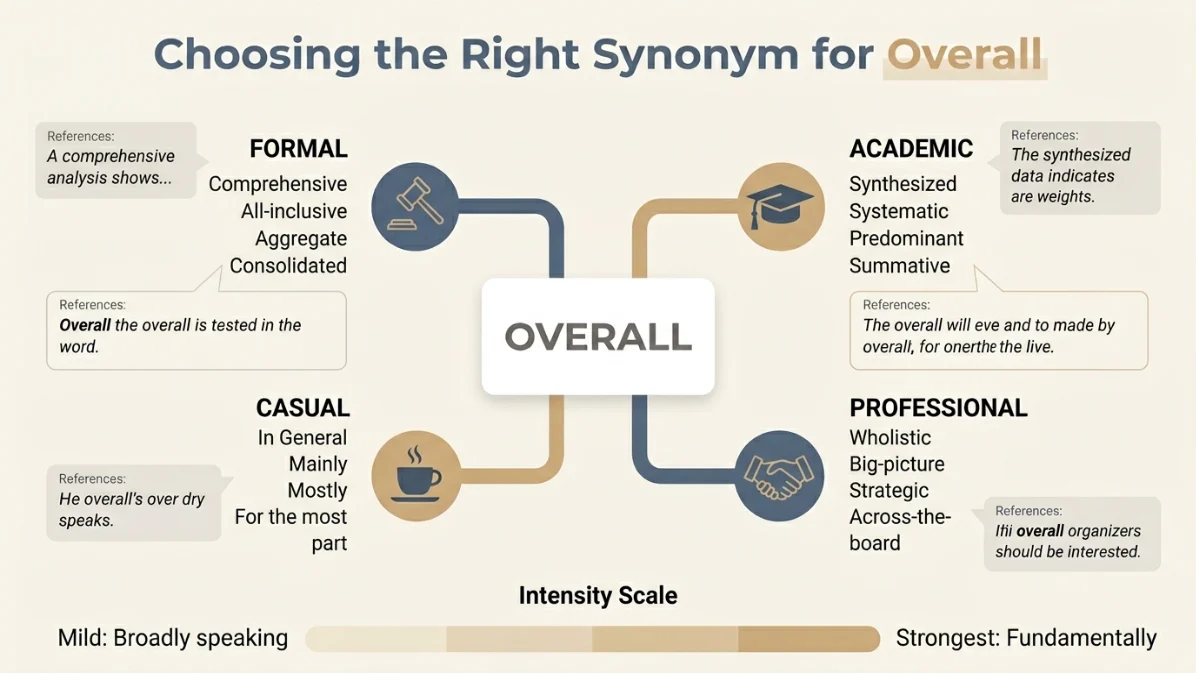
You are wrapping up a report and type “overall” one more time. Writing an essay conclusion and feel the word staring back at you. You are drafting a performance review and realize you have used “overall” in every paragraph.
It is a useful word. But relying on it too often makes your writing sound hesitant or repetitive. This guide gives you the right synonyms for overall, sorted by tone, context, and purpose, so your conclusions and summaries always land with impact.
What Does “Overall” Mean?
“Overall” means considering everything together or in general. It signals a summary, a final judgment, or a broad view that includes all parts. The best synonyms depend on context: generally for casual use, in summary for academic writing, on the whole for formal tone, and all things considered for balanced professional statements.
Meaning, Tone and Context
The word “overall” carries a balanced, evaluative tone. It suggests you have looked at the full picture and are now offering a conclusion or general statement.
Part of speech: Adverb, also used as an adjective
Tone: Neutral, reflective, or conclusive
Formality level: Neutral to slightly formal, suitable for most situations
Common use cases: Summarizing findings, giving final impressions, making general statements, evaluating performance
Related forms: None common as a direct derivative, though “all over” carries a different meaning
In professional settings, “overall” helps you deliver verdicts and recommendations. In casual speech, it introduces your general feeling about something. The word is safe and functional, but more precise synonyms make your summaries sound more authoritative and intentional.
When and How to Use “Overall”
Use “overall” when you need to step back and comment on the complete picture rather than individual details. It works in conclusions, summaries, evaluations, and general impressions.
Here are realistic examples using “overall” in everyday situations.
The team’s overall performance exceeded our quarterly targets. (professional)
Overall, the study suggests a strong correlation between sleep and memory retention. (academic)
Overall, it was a great trip despite the rainy weather. (casual)
She felt an overall sense of peace after making the decision. (emotional)
The overall tone of the novel remains hopeful even in dark chapters. (creative)
Overall, this product has been a game changer for my morning routine. (social media)
We need to assess the overall impact before finalizing the budget. (email)
Another Word for “Overall”
If you want a single dependable replacement, “generally” is often your best choice. It covers broad impressions and summary statements with a natural, unforced tone. However, the right synonym always depends on your specific situation.
For professional writing, try “on the whole” or “by and large.” For academic writing, use “in summary” or “collectively.” In casual conversation, “all in all” or “basically” fit naturally. For emotional writing, “all things considered” adds reflective warmth.
In creative writing, explore “in the grand scheme” or “taken together.” For resumes, “comprehensively” carries strong professional weight. On social media, “bottom line” or “long story short” connect with readers. Choose “fundamentally” for a stronger meaning and “broadly speaking” for a softer one.
When Not to Use “Overall”
Sometimes “overall” sounds vague, evasive, or too sweeping. When you need to be specific, a general word weakens your message.
The candidate has overall strong qualifications.
The candidate has strong qualifications in project management and team leadership.
If you are delivering specific data, direct praise, or precise criticism, drop “overall” and state exactly what you mean. Specifics build trust. Generalities create distance.
Words Commonly Confused With “Overall”
Several words overlap with “overall” but carry distinct meanings. Understanding the differences prevents miscommunication.
- Overall vs. Generally
Overall means considering all parts together. Generally means in most cases or usually. An overall improvement covers everything. A generally positive trend allows for exceptions. - Overall vs. In conclusion
In conclusion specifically signals the end of an argument or presentation. Overall can appear anywhere you need a summary view, not only at the end. - Overall vs. Altogether
Altogether means completely or entirely. Overall means considering everything. “Altogether different” means completely different. “Overall different” is not a standard phrase. - Overall vs. Entirely
Entirely means wholly or without exception. Overall allows for mixed details within a general picture. An entirely successful launch had zero problems. An overall successful launch had minor hiccups. - Overall vs. Total
Total refers to a complete sum or amount. Overall refers to a general impression or assessment. Total sales figures are exact numbers. Overall sales performance includes context and interpretation. - Overall vs. Comprehensive
Comprehensive means covering all elements in detail. Overall means viewing the broad picture, possibly skipping details. A comprehensive review examines every part. An overall review summarizes key points.
Best Synonym by Context for “Overall”
| Context | Best Synonym | Why It Works | Example |
|---|---|---|---|
| Formal writing | On the whole | Balanced and authoritative | On the whole, the findings support the proposed theory. |
| Academic writing | In summary | Precise and expected | In summary, the data indicates a significant shift. |
| Professional or business use | By and large | Confident yet measured | By and large, the merger benefited both companies. |
| Resume | Comprehensively | Shows thoroughness | Comprehensively managed a portfolio of 40 client accounts. |
| Casual conversation | All in all | Warm and natural | All in all, it was a pretty relaxing weekend. |
| Creative writing | In the grand scheme | Adds reflective depth | In the grand scheme, her worries seemed very small. |
| Emotional tone | All things considered | Empathetic and reflective | All things considered, she handled the news with grace. |
| Strong intensity | Fundamentally | Signals core truth | Fundamentally, the system needs a complete redesign. |
| Soft or moderate tone | Broadly speaking | Gentle and noncommittal | Broadly speaking, the event met our expectations. |
| Social media captions | Bottom line | Punchy and direct | Bottom line: this sunscreen is worth every penny. |
| Legal or formal analysis | In the aggregate | Technically precise | In the aggregate, the claims present a consistent pattern. |
Which Synonym Should You Choose?
Ask yourself three quick questions. First, what role does the word play in your sentence? If you are concluding, use “in summary” or “ultimately.” If you are generalizing, use “broadly speaking” or “by and large.” Second, how formal is your audience? Choose “on the whole” for reports and “all in all” for personal messages. Third, do you want to sound decisive or gentle? “Fundamentally” sounds firm. “Broadly speaking” sounds open. Let your intent guide your word selection naturally.
Real Life Examples of “Overall” in Sentences
Seeing synonyms in action shows how a single word swap changes the clarity and confidence of a sentence.
School: In summary, the experiment confirmed our original hypothesis.
Workplace: By and large, the new workflow improved cross team collaboration.
Writing: The novel’s tone is, on the whole, optimistic and forward looking.
Conversation: Basically, we just decided to postpone the trip until fall.
Social media: Long story short, this is the best coffee maker I have owned.
Resume: Comprehensively led digital transformation across five departments.
Email: All things considered, I recommend we proceed with the vendor.
Storytelling: In the grand scheme, that small failure saved him from a bigger one later.
25 Synonyms for “Overall”
| Synonym | Simple Meaning | Best Used For | Example Sentence |
|---|---|---|---|
| Generally | In most cases | Casual and neutral statements | Generally, the team responds well to constructive feedback. |
| On the whole | Considering everything | Formal and balanced evaluations | On the whole, the conference delivered valuable insights. |
| By and large | For the most part | Professional summaries | By and large, customer satisfaction has improved steadily. |
| All in all | When everything is considered | Casual and reflective speech | All in all, we had a wonderful anniversary celebration. |
| In summary | To summarize briefly | Academic and report conclusions | In summary, the results point to three main causes. |
| Ultimately | In the end, finally | Decisive conclusions | Ultimately, the decision rests with the board of directors. |
| Broadly speaking | In general terms | Cautious generalizations | Broadly speaking, the market favors sustainable products. |
| Largely | To a great extent | Emphasizing dominant trends | The success was largely due to the dedicated volunteer team. |
| Predominantly | Mainly, mostly | Data driven writing | The survey respondents were predominantly under 35 years old. |
| Essentially | At the core, basically | Simplifying complex ideas | Essentially, the plan reduces costs without cutting staff. |
| Fundamentally | At the most basic level | Strong declarations | Fundamentally, education shapes every other social outcome. |
| All things considered | After weighing everything | Empathetic and balanced views | All things considered, the project moved forward smoothly. |
| In the main | Mostly, on balance | Formal British influenced writing | In the main, the policy has achieved its stated goals. |
| Collectively | As a whole group | Academic and analytical writing | Collectively, these studies paint a clear picture. |
| Taken together | When viewed as a group | Research and analysis | Taken together, the interviews reveal common frustrations. |
| For the most part | Mostly, with minor exceptions | Conversational honesty | For the most part, the training was practical and useful. |
| In a nutshell | Very briefly, in short | Informal summaries | In a nutshell, the movie is about forgiveness and family. |
| At the end of the day | When everything is considered | Opinion and commentary | At the end of the day, kindness matters most. |
| As a rule | Usually, generally | Describing patterns | As a rule, early applicants receive priority consideration. |
| In the grand scheme | From a broader perspective | Reflective and philosophical writing | In the grand scheme, small setbacks rarely matter. |
| Comprehensively | In a thorough complete manner | Resumes and formal reviews | She comprehensively restructured the filing system. |
| Holistically | Considering the whole not parts | Wellness and systems thinking | We treat patient health holistically, not symptom by symptom. |
| Primarily | Mainly, chiefly | Prioritizing key factors | The decline was primarily caused by supply chain issues. |
| On balance | After weighing positives and negatives | Fair minded evaluations | On balance, the advantages outweigh the risks. |
| Net | Remaining after deductions | Business and financial writing | Net profit increased 12 percent year over year. |
Synonym Groups and Usage Differences
Professional vs. Personal Synonyms
In professional environments, words like “by and large,” “on balance,” and “collectively” communicate measured judgment. They show you have weighed evidence carefully.
In personal life, “all in all,” “basically,” and “all things considered” feel warmer and more approachable. Telling a friend “all in all, it was great” sounds natural. Telling your manager “on the whole, the project succeeded” sounds competent and reflective.
Formal vs. Conversational Synonyms
Formal writing rewards balanced precision. Use “on the whole,” “in the aggregate,” “in the main,” and “collectively” in reports, legal documents, and academic papers.
Conversational English thrives on brevity and ease. Words like “basically,” “all in all,” “in a nutshell,” and “at the end of the day” keep dialogue flowing naturally. A text to a friend might say “basically, we are all set,” while a client email uses “on the whole, the deliverables met our standards.”
Academic Synonyms
Academic writing values measured conclusions and precise summary. “In summary” and “collectively” are your strongest academic synonyms. “Taken together” works beautifully when synthesizing multiple sources or findings. “Predominantly” suits data descriptions. Avoid “at the end of the day” and “bottom line” entirely in scholarly work.
Professional and Business Synonyms
Business communication rewards clarity and confident judgment. “By and large” shows broad agreement without ignoring exceptions. “On balance” demonstrates fair evaluation weighing pros and cons. “Comprehensively” signals thoroughness and attention to detail. On resumes, “comprehensively,” “holistically,” and “across the organization” project leadership and strategic thinking.
Creative or Literary Synonyms
Creative writing benefits from synonyms that add rhythm, perspective, and emotional weight. “In the grand scheme” expands the lens beyond immediate events. “All things considered” adds a reflective, human quality to narration. “Ultimately” carries finality and emotional resolution. “Taken together” works well in memoir and personal essays.
Slang or Modern Synonyms
Terms like “bottom line,” “long story short,” “basically,” and “at the end of the day” energize social media captions, blog posts, and casual conversation. They are perfectly acceptable in personal branding and informal content. Avoid them in academic papers, formal reports, and legal documents where they undermine professional authority.
Strongest vs. Weaker Synonyms
Think of overall synonyms on an intensity scale from mild to strongest.
Mild: Broadly speaking, generally, largely
Moderate: On the whole, by and large, for the most part
Strong: Fundamentally, ultimately, on balance
Strongest: Decisively, comprehensively, unequivocally
Match the intensity to the certainty of your conclusion.
Emotional vs. Neutral Synonyms
“All things considered,” “in the grand scheme,” and “at the end of the day” add emotional reflection and human perspective. “By and large,” “in summary,” and “collectively” stay factual and measured. Choose emotional synonyms when connecting with readers personally. Choose neutral synonyms when presenting objective analysis.
Antonyms of “Overall”
| Antonym | Meaning | Example Sentence |
|---|---|---|
| Specifically | In a detailed exact manner | Specifically, the third quarter showed a sharp decline. |
| Partially | Only in part, not completely | The project was only partially completed by the deadline. |
| Individually | One by one, separately | Individually, each team member contributed unique skills. |
| Narrowly | In a limited or restricted way | The decision was narrowly focused on short term gains. |
| Exclusively | Only, solely | The grant was awarded exclusively to first generation students. |
| In particular | Specifically, especially | In particular, the introduction needs revision. |
| Precisely | Exactly, with accuracy | Precisely three errors occurred during the entire testing phase. |
| Piecemeal | Done bit by bit | The reforms were introduced piecemeal over a decade. |
| Locally | In a specific area only | The storm affected the region locally, not statewide. |
| Minutely | In great detail | The auditor minutely examined every transaction record. |
| Disproportionately | To an unequal degree | Small businesses were disproportionately affected by the policy. |
| Singularly | One at a time, individually | Singularly, none of the issues seemed critical. |
| Isolated | Alone, separate from others | An isolated incident does not reflect our company culture. |
| Sectionally | By sections, not as a whole | The report was reviewed sectionally by different teams. |
| Fragmentarily | In broken or incomplete pieces | The data arrived fragmentarily over several weeks. |
Comparison: Overall vs. Similar Words
Overall vs. Generally
Main difference: Overall considers a complete picture. Generally describes what happens in most cases.
Which one is stronger: Overall is stronger for conclusions. Generally is softer for tendencies.
Which one is more formal: Both are neutral. Overall feels slightly more evaluative.
Example: Overall, the event ran smoothly. Generally, these events attract around 200 attendees.
Overall vs. In conclusion
Main difference: In conclusion explicitly signals the end. Overall can appear mid discussion.
Which one is stronger: In conclusion carries more finality.
Which one is more formal: In conclusion is more formal and expected in academic writing.
Example: Overall, the evidence supports several interpretations. In conclusion, we recommend immediate action.
Overall vs. Ultimately
Main difference: Ultimately implies the final result after a process. Overall describes a broad view at any point.
Which one is stronger: Ultimately is stronger and more dramatic.
Which one is more formal: Ultimately works well in formal and persuasive writing.
Example: Overall, the training prepared her well. Ultimately, her persistence won the promotion.
Overall vs. Essentially
Main difference: Essentially reduces something to its core nature. Overall surveys the full scope.
Which one is stronger: Essentially is stronger for simplification and emphasis.
Which one is more formal: Both are neutral. Essentially appears often in explanations.
Example: Overall, the design meets our requirements. Essentially, the design solves two major problems.
Overall vs. All things considered
Main difference: All things considered emphasizes weighing multiple factors, including negatives. Overall can ignore specific tradeoffs.
Which one is stronger: All things considered is more empathetic and nuanced.
Which one is more formal: Both are acceptable in formal writing. All things considered sounds more reflective.
Example: Overall, the trip was enjoyable. All things considered, including the delays, the trip was still worthwhile.
Overall vs. Holistically
Main difference: Holistically emphasizes interconnected systems. Overall emphasizes broad summary.
Which one is stronger: Holistically is stronger in technical and wellness writing.
Which one is more formal: Holistically is more formal and specialized.
Example: Overall, patient outcomes improved. We treat each case holistically, considering mental and physical health together.
Common Phrases and Expressions with “Overall”
1. Overall picture
Meaning: The complete view including all important details.
Example sentence: Before deciding, let us look at the overall picture rather than one quarter.
2. Overall impression
Meaning: The general feeling or opinion formed after experiencing something.
Example sentence: My overall impression of the candidate was very positive.
3. Overall winner
Meaning: The person or thing that wins after all rounds or categories are considered.
Example sentence: Despite losing the first round, she emerged as the overall winner.
4. Overall health
Meaning: General physical and mental wellbeing considered together.
Example sentence: Regular walking improves your overall health more than sporadic intense workouts.
5. Overall effect
Meaning: The combined impact of all elements working together.
Example sentence: The overall effect of the redesign was a calmer, more inviting space.
6. Overall majority
Meaning: More votes than all other candidates or parties combined.
Example sentence: The party won an overall majority in parliament for the first time.
7. Overall goal
Meaning: The main or ultimate objective beyond smaller targets.
Example sentence: Our overall goal remains reducing carbon emissions by 40 percent this decade.
Common Mistakes to Avoid
Sticking with “overall” when a more precise word like “in summary” or “fundamentally” is available weakens your conclusion. A strong ending deserves a purposeful word.
Confusing “overall” with “altogether” leads to awkward phrasing. “Altogether different” is correct. “Overall different” is not standard English.
Using casual synonyms like “bottom line” or “long story short” in formal reports damages professional credibility. Reserve these for conversation and social content.
Using an overly dramatic synonym for a minor observation sounds forced. Describing a slightly improved process as “fundamentally transformed” erodes trust with your reader.
Repeating the same summary word across a document creates monotony. Vary your transitions between “on the whole,” “by and large,” and “in summary” to keep readers engaged.
Choosing a synonym with the wrong emotional tone can confuse your message. “At the end of the day” carries casual, opinionated weight. Using it in a scientific report undermines objectivity.
Using “comprehensively” on a resume without evidence of thorough work invites scrutiny during interviews. Be prepared to back up strong adverbs with specific examples.
FAQs
What is the best synonym for overall?
The best synonym depends on context. “All in all” works casually, “in summary” fits academic writing, and “by and large” suits professional and business communication.
What is a formal synonym for overall?
“On the whole,” “in the aggregate,” and “in the main” are strong formal synonyms. Choose “on the whole” for balanced evaluations in formal documents.
What is an informal synonym for overall?
“Basically,” “all in all,” “bottom line,” and “long story short” are effective informal synonyms. They fit naturally in conversations, texts, and social media captions.
What is another word for overall in professional writing?
“By and large,” “on balance,” and “collectively” work well in professional writing. They show measured judgment and careful consideration of evidence.
What is the difference between overall and generally?
“Overall” considers everything together to form a broad view. “Generally” describes what usually happens in most cases. Overall evaluates. Generally describes typical patterns.
What is the opposite of overall?
“Specifically” is the most direct opposite. Other common antonyms include “individually,” “narrowly,” “partially,” and “piecemeal,” each carrying slightly different meaning.
Conclusion
“Overall” is a reliable summary word that fits into many sentences. But your writing becomes more authoritative, precise, and engaging when you choose synonyms that match your specific context, tone, and intent.
Keep a mental shortlist of your favorite alternatives: “in summary” for academic depth, “on balance” for fair professional evaluations, “all in all” for personal warmth, and “fundamentally” for strong declarations. Ask yourself whether you are concluding, generalizing, or weighing tradeoffs, and pick the word that names that purpose directly. Small vocabulary choices create lasting impressions of clarity and confidence.