Have you ever found yourself typing the word “legacy” over and over again in an important email, a college essay, or a business proposal? It is a powerful word, but repeating it can make your writing feel flat and uninspired.
Maybe you are writing about a family inheritance, describing a company’s lasting impact, or updating your resume. You want to avoid sounding repetitive, but you are not sure which alternative fits best. This is where understanding the best synonyms of legacy becomes essential.
Choosing the right synonym not only improves your writing but also helps you communicate your exact meaning with clarity and confidence. In this guide, you will learn what legacy truly means, discover the most accurate synonyms for every situation, and never guess which word to use again.
What Are the Best Synonyms of “Legacy”?
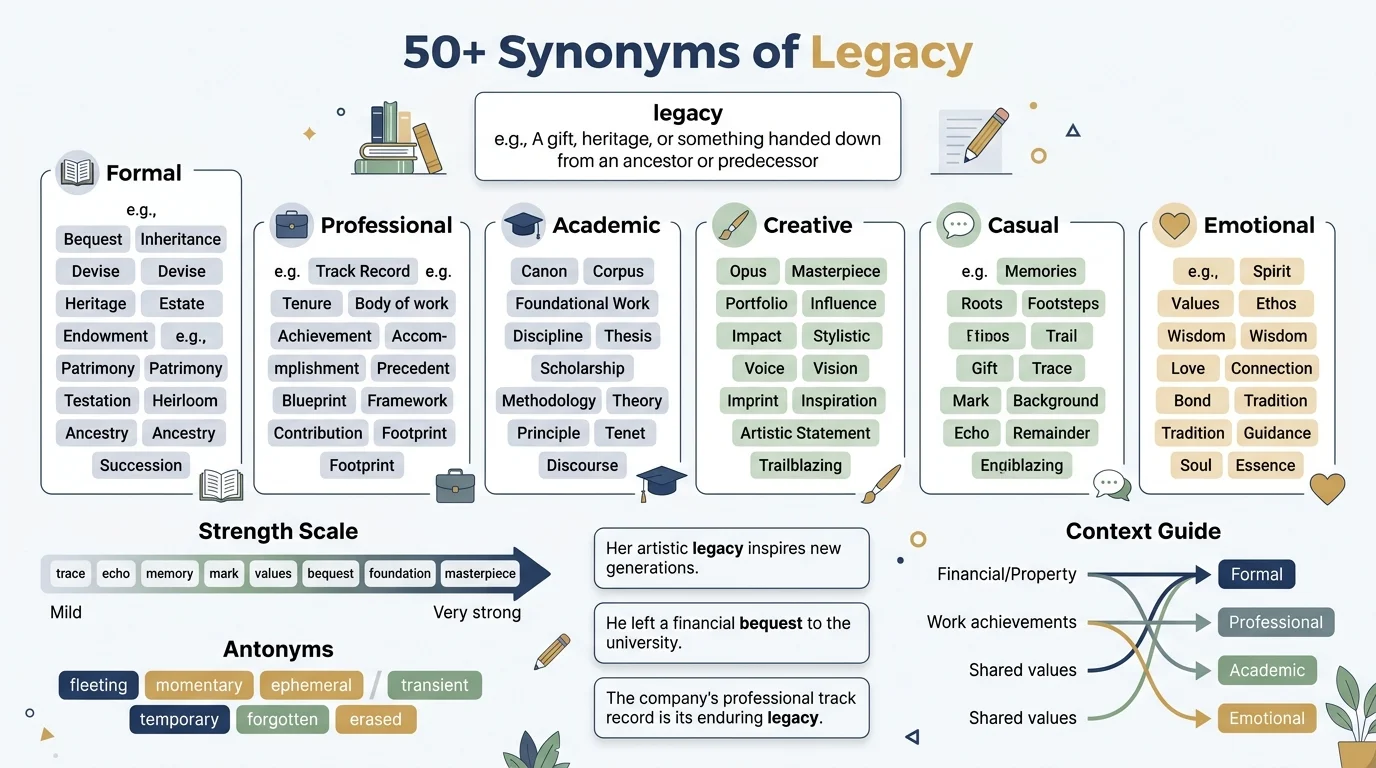
A legacy is something handed down from the past, whether it is money, property, traditions, or a lasting impact. The best formal synonym is “inheritance” for material assets and “heritage” for cultural or historical value. In professional writing, “endowment” or “contribution” works well. For emotional or creative contexts, “footprint” and “imprint” are strong choices. Choose based on whether you are discussing tangible assets, cultural traditions, or personal influence.
Meaning, Tone, and Context
Simple Definition
A legacy is anything that is passed down from one generation to the next. This can include money and property left in a will, cultural traditions, family values, or the lasting impact of a person’s work and achievements.
Part of Speech
Legacy is primarily used as a noun. Its plural form is legacies. It can also function as an adjective, such as in “legacy system” or “legacy applicant,” referring to outdated technology or someone admitted to a university because a relative attended there.
Overall Tone
Legacy has a neutral to positive tone. It often carries a sense of importance, permanence, and respect. However, the tone can shift depending on the context. For example, a “legacy of inequality” carries a more serious and negative weight, while a “legacy of kindness” is warm and inspiring.
Formality Level
The word legacy is semi-formal to formal. It is appropriate for professional, academic, and business settings. You will also hear it in everyday conversations about family history or personal goals, making it quite versatile.
Common Uses
Native English speakers use legacy in several common ways:
- To describe material inheritance: “She received a small legacy from her grandmother.”
- To discuss cultural or historical traditions: “The architecture is a legacy of the Roman Empire.”
- To talk about a person’s lasting impact: “He wants to leave a legacy of environmental protection.”
- In technology to describe outdated systems: “The company is updating its legacy software.”
Word Forms
When and How to Use “Legacy”
You should choose legacy when you want to emphasize the enduring nature of something that has been passed down. It works best when discussing topics that span generations or have historical significance.
Professional
The CEO’s legacy of innovation continues to guide our product development.”
Academic
“The researcher’s work left a profound legacy in the field of molecular biology.”
Workplace
“Our team is proud to carry on the legacy of excellence established by our founders.”
Personal
“My grandfather’s legacy of hard work and honesty has shaped who I am today.”
Email
“I am writing to discuss the future of the foundation and how we can build upon its remarkable legacy.”
Resume
“Spearheaded initiatives that will serve as a lasting legacy of operational efficiency.”
Social Media
“Honoring the legacy of those who fought for civil rights. Their work is not finished, and we continue the fight today.”
Best Synonyms of “Legacy”
No two synonyms are identical in every situation. While one word might work perfectly for a formal will, it could sound out of place in a creative story. Here are the best synonyms of legacy for specific contexts.
Professional Writing
Heritage is the best professional synonym. It emphasizes the cultural, historical, or traditional value of what is being passed down. It sounds authoritative and respectful.
Academic Writing
Inheritance is precise and formal. In academic contexts, it is often used to discuss both tangible assets and intangible traits like genetic or cultural inheritance.
Business Communication
Endowment works well when discussing financial gifts or resources given to an organization. It implies a sense of purpose and lasting support.
Casual Conversation
Gift is a simple, warm alternative. It is less formal and works well in personal discussions about what someone has left behind.
Emotional Writing
Footprint or imprint are excellent choices. They create a powerful image of a lasting mark left on the world or on other people’s lives.
Creative Writing
Birthright adds a dramatic and literary flair. It suggests that what is passed down is an inherent right or privilege.
Resume Writing
Contribution is a strong, active word. It focuses on what you have built and given, rather than simply what you have received.
Workplace Communication
Tradition is a good choice for team culture. It highlights the customs and practices that have been established over time.
Stronger Meaning
Patrimony carries a stronger sense of legal and historical weight, often referring to property or heritage passed down from male ancestors.
Softer Meaning
Aftermath can be a softer or more neutral way to describe the results of past events, though it often implies a negative consequence.
When Not to Use “Legacy”
There are many situations where legacy is not the best choice. Using it incorrectly can make your writing sound vague, overly dramatic, or simply out of place.
When It Sounds Too General
If you are simply referring to a result, legacy can sound too grand. For example, saying “The legacy of the meeting was a new plan” sounds exaggerated.
Better: “The outcome of the meeting was a new plan.”
When It Sounds Too Vague
Legacy can be unclear when you need to specify exactly what is being passed down.
Better: Specify whether you mean “inheritance” (money), “heritage” (culture), or “tradition” (customs).
When It Is Too Formal
In casual texts or conversations with friends, legacy might sound stiff.
Better: Use “gift” or “something left behind.”
When It Is Too Weak
If you are describing a massive historical impact, legacy can sometimes feel like an understatement.
Better: Use “monument” or “enduring contribution.”
When It Sounds Outdated
While not extremely outdated, legacy in the sense of a “bequest” is less common in everyday speech than “inheritance”.
When Referring to Negative Results
Legacy usually has a positive or neutral connotation. For negative results, words like “consequences” or “repercussions” are more appropriate.
Words Commonly Confused With “Legacy”
Legacy vs. Heritage
Difference: Heritage often refers to the culture, traditions, history, and language of a group of people. Legacy can be more personal and is often something you actively leave behind.
When to Use Each: Use “heritage” for cultural identity. Use “legacy” for an individual’s impact.
Example: “Exploring my Irish heritage has been a meaningful journey.” vs. “His scientific legacy will inspire future generations.
Legacy vs. Inheritance
Difference: Inheritance is typically money or property received after someone’s death. Legacy is the broader impact, values, and memories left behind.
When to Use Each: Use “inheritance” for legal and financial matters. Use “legacy” for the broader, often intangible, impact.
Example: “She used her inheritance to start a business.” vs. “Her legacy of compassion is her greatest achievement.”
Legacy vs. Bequest
Difference: A bequest is a specific legal term for a gift of personal property left in a will. Legacy is a broader term.
When to Use Each: Use “bequest” in legal or formal documents. Use “legacy” in almost every other context.
Example: “The museum received a generous bequest of art.” vs. “The artist’s legacy lives on through his work.”
Legacy vs. Tradition
Difference: Tradition refers to customs or beliefs passed down over time. Legacy can be a tradition, but it can also be a single impactful event or contribution.
When to Use Each: Use “tradition” for repeated practices. Use “legacy” for a lasting contribution or impact.
Example: “It’s a family tradition to gather for Thanksgiving.” vs. “His legacy is the scholarship fund he established.”
Legacy vs. Birthright
Difference: Birthright is something you are entitled to simply by being born. Legacy is something you receive or that is left for you.
When to Use Each: Use “birthright” for inherent rights. Use “legacy” for what is passed down or left behind.
Example: “Freedom is our birthright.” vs. “The library is a legacy from the town’s founder.”
Legacy vs. Footprint
Difference: Footprint is a more modern, metaphorical term for a lasting impact or mark. Legacy is more traditional.
When to Use Each: Use “footprint” in modern, creative, or environmental contexts. Use “legacy” in formal or traditional contexts.
Example: “The company is working to reduce its carbon footprint.” vs. “The company’s legacy of innovation is well known.”
Best Synonyms of “Legacy” by Context
How to Choose the Best Synonym of “Legacy”
Choosing the perfect synonym depends on understanding the nuances of your message.
- Identify What Is Being Passed Down: Is it money, property, traditions, values, or an impact? If it is money, “inheritance” or “bequest” are best. If it is cultural, choose “heritage”.
- Consider Your Audience: Are you writing for a legal professional, a friend, or a potential employer? For formal audiences, use “bequest” or “patrimony”. For casual audiences, “gift” or “hand-me-down” works better.
- Determine the Tone: Do you want to sound professional, emotional, or creative? “Heritage” is professional. “Footprint” is emotional and modern. “Birthright” is creative and dramatic.
- Evaluate the Emotional Strength: Are you describing a positive or negative result? For positive impacts, use “legacy” or “contribution”. For negative results, use “consequences” or “repercussions”.
- Think About Natural Sounding Usage: Does the synonym sound natural in your sentence? If it feels forced or overly formal, choose a different word.
Real Life Examples of “Legacy”
School
“For my history project, I researched the legacy of the Civil Rights Movement and how it continues to shape our laws today.”
College
“The university’s legacy of academic excellence attracted top students from around the globe.”
Workplace
“We are building a new office that will be a legacy of our company’s growth and commitment to our employees.”
Business
“The founder’s legacy of putting customers first is still the core of our business strategy.”
Email
“Dear Team, I am proud to announce a new initiative that will carry on our company’s legacy of community service.”
Resume
“Developed a training program that became a lasting legacy within the department.”
Conversation
“My father always said that a person’s real legacy is the kindness they show to others.”
Storytelling
“The old lighthouse stood as a silent legacy of the sailors who had once navigated these dangerous shores.”
Blogging
“Leaving a legacy isn’t about being famous; it’s about making a difference in the lives of the people around you.”
Social Media
“Today we remember the legacy of Dr. Martin Luther King Jr. and the ongoing fight for equality.”
18 Best Synonyms of “Legacy”
Synonyms of “Legacy” by Usage
Professional vs Personal Synonyms
In professional settings, you want to sound competent and authoritative. Use “heritage,” “endowment,” or “contribution”. In personal contexts, you can be warmer and more emotional. Use “gift,” “footprint,” or “hand-me-down”.
Formal vs Conversational Synonyms
For formal reports, essays, and legal documents, choose “bequest,” “patrimony,” or “inheritance”. For casual conversations, texts, and social media, “gift,” “mark,” or “hand-me-down” are better.
Academic Synonyms
In academic writing, precision is key. “Inheritance” is used in law and genetics. “Heritage” is used in sociology and history. “Bequest” is used in legal studies. These words sound more authoritative than “gift.”
Professional and Business Synonyms
For resumes and business communication, use active words that show impact. “Contribution” and “impact” are strong choices. “Endowment” is perfect for financial discussions.
Creative and Literary Synonyms
For storytelling and poetry, use words that evoke emotion and imagery. “Birthright”, “footprint”, and “imprint” add depth and drama to your writing.
Slang or Modern Synonyms
There is no direct slang for legacy. However, modern synonyms like “footprint” and “mark” are very popular in contemporary English. They are acceptable in professional and casual settings but should be avoided in extremely formal legal documents.
Strongest to Mildest Synonyms
Mild → Moderate → Strong → Very Strong
- Mild: Hand-me-down, remnant
- Moderate: Gift, contribution
- Strong: Heritage, inheritance, tradition
- Very Strong: Patrimony, birthright, bequest
Emotional vs Neutral Synonyms
Emotional Synonyms
- Footprint: Evokes a personal, lasting mark.
- Imprint: Suggests a deep, personal influence.
- Birthright: Carries a sense of justice and entitlement.
- Gift: Implies warmth and generosity.
These words are ideal for personal narratives, speeches, and creative writing.
Neutral Synonyms
- Inheritance: Simply states a fact.
- Bequest: A clinical, legal term.
- Result: A straightforward outcome.
- Estate: A factual description of property.
These words are best for legal documents, academic papers, and business reports where emotion is not appropriate.
Antonyms of “Legacy”
Comparison: “Legacy” vs Similar Words
Legacy vs. Heritage
Main Difference: Heritage is about collective identity and culture. Legacy is about what an individual or group leaves behind.
Which Is Stronger? Legacy can be stronger because it often refers to a specific, personal impact.
Which Is More Formal? Both are formal, but heritage is often used in academic and cultural discussions.
When to Use Each: Use “heritage” for culture and history. Use “legacy” for personal impact and contributions.
Examples:
- Legacy: “Her legacy of generosity inspired the community.”
- Heritage: “The festival is a celebration of our African heritage.”
Legacy vs. Inheritance
Main Difference: Inheritance is the physical or financial assets you receive. Legacy is the broader impact, values, and memories.
Which Is Stronger? Legacy is emotionally stronger because it encompasses more than just money.
Which Is More Formal? Inheritance is very formal, especially in legal contexts.
When to Use Each: Use “inheritance” for legal and financial matters. Use “legacy” for values and impact.
Examples:
- Legacy: “His legacy of integrity is what people remember.”
- Inheritance: “She invested her inheritance wisely.”
Legacy vs. Bequest
Main Difference: A bequest is a specific legal term for a gift in a will. Legacy is a more general term.
Which Is Stronger? Bequest is more precise and legally binding.
Which Is More Formal? Bequest is more formal and is used almost exclusively in legal documents.
When to Use Each: Use “bequest” in a will or estate plan. Use “legacy” in all other contexts.
Examples:
- Legacy: “The library is his lasting legacy.”
- Bequest: “The bequest was for a specific sum of money.”
Legacy vs. Tradition
Main Difference: Tradition is a custom or practice that is repeated over time. Legacy can be a tradition, but it can also be a single event or contribution.
Which Is Stronger? Legacy is often stronger because it can encompass an entire life’s work.
Which Is More Formal? Both are neutral to formal.
When to Use Each: Use “tradition” for customs. Use “legacy” for a more significant, lasting contribution.
Examples:
- Legacy: “The legacy of the Civil Rights Movement is still felt today.”
- Tradition: “It’s a family tradition to read bedtime stories.”
Legacy vs. Contribution
Main Difference: Contribution focuses on the act of giving or adding. Legacy focuses on what is left behind over time.
Which Is Stronger? Legacy is stronger because it implies permanence.
Which Is More Formal? Contribution is very professional and action-oriented.
When to Use Each: Use “contribution” for specific acts of giving. Use “legacy” for the overall, lasting result.
Examples:
- Legacy: “Her legacy is the thriving company she built.”
- Contribution: “His contribution to the fund was generous.”
Legacy vs. Footprint
Main Difference: Footprint is a modern metaphor for impact. Legacy is a traditional term.
Which Is Stronger? Legacy can be stronger in formal contexts.
Which Is More Formal? Legacy is more formal.
When to Use Each: Use “footprint” in modern, creative, or environmental contexts. Use “legacy” in formal contexts.
Examples:
- Legacy: “The legacy of the Roman Empire is visible in our laws.”
- Footprint: “The company is working to reduce its environmental footprint.”
Common Phrases and Expressions with “Legacy”
Phrase: Leave a legacy
Meaning: To do something that will be remembered or have an impact after you are gone.
Example: “She wants to leave a legacy of compassion and service.”
Phrase: Carry on the legacy
Meaning: To continue the work or traditions of someone who came before.
Example: “It is now our turn to carry on the legacy of our founders.”
Phrase: A lasting legacy
Meaning: An impact that will be remembered for a very long time.
Example: “The new park will be a lasting legacy for the community.”
Phrase: Cultural legacy
Meaning: The traditions, language, and history passed down through a culture.
Example: “The cultural legacy of ancient Greece is profound.”
Phrase: Legacy system
Meaning: An old computer system or software that is still in use.
Example: “The company is struggling to upgrade its legacy systems.”
Phrase: Legacy applicant
Meaning: A student applying to a university where a relative attended.
Example: “Many elite universities give preference to legacy applicants.”
Phrase: Legacy of inequality
Meaning: A historical pattern of unfair treatment that continues to affect the present.
Example: “The country is still grappling with its legacy of inequality.”
Common Mistakes to Avoid
Mistake 1: Using a Vague Synonym Instead of a Precise One
Saying “The legacy of the meeting was confusion” is vague.
Incorrect: “The legacy of the meeting was a lack of direction.”
Better: “The outcome of the meeting was a lack of direction.”
Why: “Outcome” is more precise and less dramatic.
Mistake 2: Confusing Legacy with Inheritance
Using legacy when you strictly mean money can be confusing.
Incorrect: “He received a large legacy from his uncle.”
Better: “He received a large inheritance from his uncle.”
Why: “Inheritance” is the standard term for receiving money or property.
Mistake 3: Using an Informal Synonym in Formal Writing
Using “hand-me-down” in a legal document is inappropriate.
Incorrect: “The hand-me-down from the estate was significant.”
Better: “The bequest from the estate was significant.”
Why: “Bequest” is the correct legal term.
Mistake 4: Selecting an Overly Dramatic Synonym
Using “birthright” for a small, everyday item is too dramatic.
Incorrect: “This old chair is my birthright.”
Better: “This old chair is a family heirloom.”
Why: “Heirloom” is more appropriate for a valued object.
Mistake 5: Repeating the Same Word Too Often
Overusing “legacy” in a short piece of writing is repetitive.
Incorrect: “His legacy is his art. His legacy is his family. His legacy is his kindness.”
Better: “His legacy is his art. His family is his heritage. His kindness is his imprint.”
Why: Varying your word choice keeps writing engaging and clear.
Mistake 6: Choosing the Wrong Emotional Tone
Using a neutral term like “estate” in a heartfelt eulogy can feel cold.
Incorrect: “We will remember his estate.”
Better: “We will remember his legacy of love.”
Why: “Legacy” carries the warmth and emotion appropriate for a eulogy.
Mistake 7: Using Slang in Academic Writing
Modern terms like “footprint” might be too informal for a research paper.
Incorrect: “The company’s environmental footprint is the focus of this paper.”
Better: “The company’s environmental impact is the focus of this paper.”
Why: “Impact” is more formal and appropriate for academic writing.
Frequently Asked Questions
1. What are the best synonyms of “legacy”?
The best synonyms depend on your context. Money or property, use “inheritance”. For cultural or historical value, use “heritage”. For a lasting impact, use “footprint”. A formal legal gift, use “bequest”.
2. What are the best formal synonyms of “legacy”?
The best formal synonyms are “bequest” for a gift in a will, “inheritance” for received property, and “patrimony” for inherited property or heritage. These words are appropriate for legal, academic, and professional documents.
3. What are common informal synonyms of “legacy”?
Common informal synonyms include “gift”, “hand-me-down,” and “mark.” “Gift” is warm and simple. “Hand-me-down” is used for physical items. “Mark” is a modern, short way to talk about an impact.
4. What is another word for “legacy” in professional writing?
In professional writing, “heritage” is an excellent choice for company culture. “Contribution” is strong for resumes. “Endowment” is perfect for financial contexts. These words sound authoritative and competent.
5. What is the difference between “legacy” and “inheritance”?
“Inheritance” is the money or property you receive after someone dies. “Legacy” is the broader impact, values, and memories that person leaves behind. You can have an inheritance of money, but a legacy of kindness.
6. What is the opposite of “legacy”?
The opposite of legacy is something like “forfeiture”, “disinheritance”, “oblivion”, or “loss”. These words describe the loss of what was passed down or the complete forgetting of someone’s contributions.
Conclusion
The word legacy is a powerful term for describing what is passed down from the past. Whether you are talking about a family inheritance, a cultural heritage, or a personal impact, choosing the right synonym can transform your writing. Remember that no synonym works perfectly in every situation. The best synonym depends on your audience, your tone, and your purpose. For formal documents, choose “bequest” or “inheritance”. For professional settings, use “heritage” or “contribution”. Fersonal and creative writing, “footprint” and “imprint” are excellent choices. The next time you need to use a word for something handed down, think carefully about the message you want to send. Your word choice will make all the difference. By mastering the synonyms of legacy, you can communicate with greater clarity, confidence, and impact.