Have you ever found yourself writing an email, an essay, or a social media caption and realized you have used the word “humility” three times in two paragraphs? You know the meaning, but you are stuck repeating the same word.
This happens to everyone, from students writing papers to professionals drafting performance reviews. Finding the right synonyms of humility can transform your writing from repetitive to refined.
Choosing the right synonym is not about showing off your vocabulary. It is about communicating with clarity, precision, and the right tone for your audience.
What Are the Best Synonyms of “Humility”?
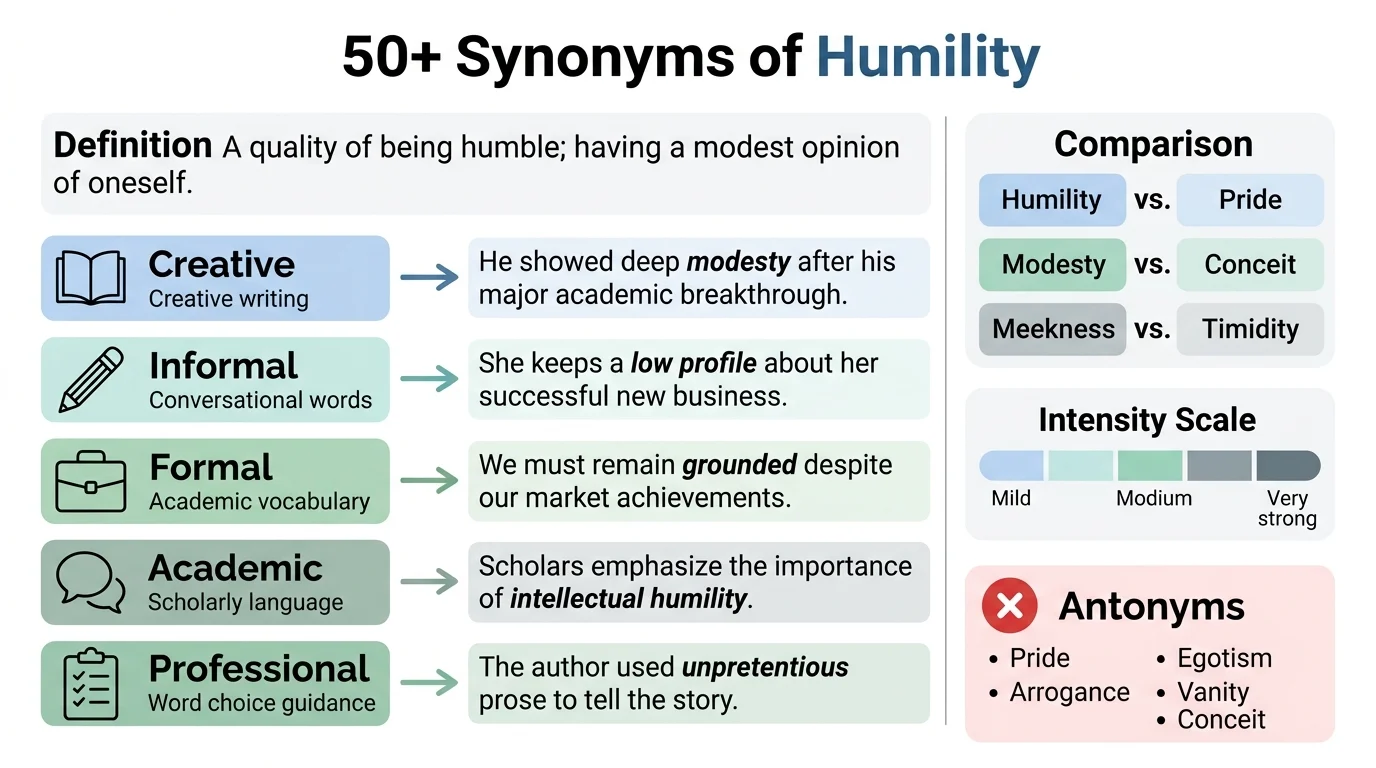
Humility is the quality of being humble and not thinking you are better than others. The best synonyms depend on context: use modesty for everyday situations, humbleness as a direct alternative, meekness for gentle patience, unpretentiousness for a lack of showiness, and self-effacement for downplaying your own achievements.
Meaning, Tone, and Context
Simple Definition
Humility is the quality of having a modest or low view of your own importance. It is a lack of false pride and a willingness to acknowledge your limitations without diminishing others.
Part of Speech
Noun
Overall Tone
Positive. Humility is widely regarded as a virtue. It is seen as a sign of strength, self-awareness, and emotional intelligence.
Formality Level
Neutral. Humility works well in formal writing, professional settings, and casual conversation. It is not overly academic or informal.
Common Uses
Native English speakers use “humility” when discussing leadership, personal growth, religious or spiritual contexts, and situations where someone handles success gracefully. You will hear it in performance reviews, biographies, commencement speeches, and everyday conversations about admirable people.
Word Forms
- Noun: humility
- Adjective: humble
- Adverb: humbly
- Related noun: humbleness
- Opposite noun: pride, arrogance
When and How to Use “Humility”
Choose “humility” when you want to describe someone who does not boast about their abilities, achievements, or status. It works best when you are praising someone or reflecting on personal growth.
Here are seven realistic examples labeled by context:
Professional: “Her humility made her a trusted leader who always credited her team for successes.”
Academic: “The researcher showed intellectual humility by acknowledging the limitations of her study.”
Workplace: “His humility during the project review impressed the executives more than his technical skills.”
Personal: “Traveling taught me humility by showing me how much I still had to learn about the world.”
Email: “I want to express my humility and gratitude for the opportunity to work with such talented colleagues.”
Resume: “Recognized for my humility and willingness to learn from every team member.”
Social Media: “Grateful for the reminder that humility is always more powerful than ego.”
Best Synonyms of “Humility”
No synonym is identical in every situation. The best choice depends on your audience, tone, and purpose.
- Professional writing: modesty – It is direct, widely understood, and carries a positive connotation in workplace settings.
- Academic writing: intellectual humility or humbleness – These convey a precise, self-aware tone suitable for research.
- Business communication: unpretentiousness – This emphasizes a lack of showiness without sounding weak.
- Casual conversation: humbleness – It feels natural and conversational while meaning the same thing.
- Emotional writing: self-effacement – This adds depth when describing someone who downplays their own role.
- Creative writing: lowliness – This carries a poetic, reflective quality.
- Resume writing: modesty – This is safe, professional, and suggests you do not oversell yourself.
- Workplace communication: lack of ego – This is a modern, direct phrase that resonates in team environments.
- Stronger meaning: self-abasement – This suggests extreme humility, almost to a fault.
- Softer meaning: modesty – This is the mildest, most neutral option.
When Not to Use “Humility”
When the Word Sounds Too General
If you are describing a specific behavior, “humility” can feel vague. Instead of saying “She showed humility,” say “She showed modesty by deflecting praise to her team.”
When the Word Sounds Too Vague
Humility is an abstract noun. In technical or legal writing, you may need more concrete language. Replace it with modesty or unpretentiousness for clarity.
When the Word Sounds Too Formal
In text messages or very casual conversation, “humility” can sound stiff. Use humbleness or simply say “not letting it go to your head.”
Informal rewrite: “He stayed humble after the promotion.”
When the Word Sounds Too Weak
Humility can sometimes imply passivity. If you need to convey strength and self-awareness, use groundedness or level-headedness.
Stronger rewrite: “Her groundedness kept her focused despite all the praise.”
When the Word Sounds Too Strong
Humility is generally positive, but in some contexts it can sound like you are performing virtue. If you want to avoid this, use modesty or unassuming nature.
Softer rewrite: “His unassuming nature made him easy to work with.”
When the Word Is Outdated
Humility itself is not outdated, but some synonyms like lowlihood are obsolete. Avoid these.
Words Commonly Confused With “Humility”
Humility vs. Modesty
Difference: Modesty often refers to behavior and outward presentation. Humility is deeper and more internal. Modesty is about not drawing attention to yourself. Humility is about genuinely not thinking you are better than others.
When to Use It: Use modesty when describing someone’s behavior, appearance, or how they talk about themselves. Use humility when describing their character.
Example (humility): “He accepted the award with genuine humility, knowing he stood on the shoulders of giants.”
Example (modesty): “She dressed with modesty and never spoke about her accomplishments.”
Humility vs. Meekness
Difference: Meekness implies patience and a gentle nature. Humility is about your view of yourself. Meekness is about how you respond to others. Meekness can suggest a lack of assertiveness, while humility does not.
When to Use It: Use meekness when describing someone who is patient and mild-tempered. Use humility when describing someone who does not have an inflated ego.
Example (humility): “His humility allowed him to learn from his critics.”
Example (meekness): “Her meekness made her a calming presence in heated debates.”
Humility vs. Diffidence
Difference: Diffidence is a lack of self-confidence or a distrust of your own abilities. Humility is an accurate, modest view of yourself, not a lack of confidence.
When to Use It: Use diffidence when describing shyness or hesitation. Use humility when describing a balanced, unpretentious self-assessment.
Example (humility): “She spoke with humility about her role in the project.”
Example (diffidence): “His diffidence prevented him from sharing his excellent ideas.”
Humility vs. Self-Effacement
Difference: Self-effacement is the act of making yourself seem less important. Humility is the quality of not overestimating your importance. Self-effacement is more active.
When to Use It: Use self-effacement when describing someone who intentionally downplays their role. Use humility when describing their underlying character.
Example (humility): “His humility was evident in how he treated everyone equally.”
Example (self-effacement): “Her self-effacement made her uncomfortable accepting compliments.”
Humility vs. Submissiveness
Difference: Submissiveness implies yielding to authority or control. Humility does not require submission. You can be humble and still be assertive.
When to Use It: Use submissiveness when describing obedience or yielding. Use humility when describing a modest self-view.
Example (humility): “He led with humility but made decisions confidently.”
Example (submissiveness): “Her submissiveness made her reluctant to disagree with her boss.”
Humility vs. Lowliness
Difference: Lowliness emphasizes a low social rank or humble condition. Humility is about mindset, not status.
When to Use It: Use lowliness in literary or religious contexts. Use humility in everyday writing.
Example (humility): “His humility made him approachable despite his fame.”
Example (lowliness): “The saint embraced lowliness and lived among .”
Best Synonyms of “Humility” by Context
| Context | Best Synonym | Why It Works | Example |
|---|---|---|---|
| Formal writing | Modesty | Clear, professional, and widely accepted | “The CEO’s modesty endeared her to the board.” |
| Academic writing | Intellectual humility | Precise and self-aware | “Intellectual humility is essential for sound research.” |
| Professional communication | Unpretentiousness | Emphasizes lack of showiness | “His unpretentiousness made him a favorite among clients.” |
| Business emails | Humbleness | Direct and slightly less formal | “I appreciate your humbleness in approaching this deal.” |
| Resume writing | Modesty | Safe and professional | “Recognized for modesty and teamwork.” |
| Workplace communication | Lack of ego | Modern and relatable | “Her lack of ego made collaboration easy.” |
| Casual conversation | Humbleness | Natural and conversational | “I really admire his humbleness.” |
| Everyday speaking | Being down to earth | Informal and warm | “She is so down to earth for someone so successful.” |
| Creative writing | Lowliness | Poetic and reflective | “He walked with the lowliness of a man who had seen it all.” |
| Storytelling | Self-effacement | Adds depth and character insight | “His self-effacement was both endearing and frustrating.” |
| Emotional writing | Meekness | Conveys gentleness and patience | “Her meekness hid a quiet strength.” |
| Strong emphasis | Self-abasement | Extreme humility, almost to a fault | “His self-abasement was painful to witness.” |
| Mild tone | Modesty | Gentle and neutral | “A little modesty goes a long way.” |
| Social media captions | Staying grounded | Relatable and modern | “Staying grounded no matter what.” |
| American English | Modesty | Most common choice | “Modesty is a virtue.” |
How to Choose the Best Synonym of “Humility”
Choosing the right synonym comes down to four questions:
- What is your audience? For professional and academic readers, choose modesty, humbleness, or unpretentiousness. For friends and casual readers, choose humbleness or being down to earth.
- What is your tone? For a neutral, informative tone, use modesty. For a warmer, more emotional tone, use meekness or self-effacement. For a modern, direct tone, use lack of ego.
- How strong do you want to be? If you want a mild suggestion, use modesty. If you want to emphasize extreme humility, use self-abasement or lowliness.
- What are you actually describing? Are you describing behavior (modesty), character (humility), patience (meekness), or lack of confidence (diffidence)? Match the word to the specific quality.
The goal is not to use the most sophisticated word. The goal is to communicate your intended message as clearly as possible.
Real Life Examples of “Humility”
School: “The valedictorian spoke with humility, thanking her teachers and family.” (Stronger: “The valedictorian spoke with modesty, deflecting praise to her teachers.”)
College: “Studying abroad taught me humility by showing me how little I knew about other cultures.”
Workplace: “His humility made him a better manager because he never stopped learning from his team.”
Business: “The founder’s humility was the secret to the company’s collaborative culture.” (Stronger: “The founder’s unpretentiousness created a culture where everyone felt valued.”)
Email: “I wanted to express my humility and appreciation for the trust you have placed in me.” (Stronger: “I want to express my gratitude and modesty regarding the trust you have placed in me.”)
Resume: “Demonstrated humility by actively seeking feedback and incorporating it into my work.”
Conversation: “I love how she has so much success but still has so much humility.”
Storytelling: “The knight knelt with humility before the queen, knowing his life was in her hands.”
Blogging: “Humility is the foundation of meaningful relationships.”
Social Media: “Reminder: humility > ego. Always.”
18 Best Synonyms of “Humility”
Synonyms of “Humility” by Usage
Professional vs. Personal Synonyms
In professional settings, choose modesty, unpretentiousness, or lack of ego. These sound polished and positive. In personal conversations, choose humbleness, being down to earth, or modesty. These sound warm and relatable.
Formal vs. Conversational Synonyms
For reports, essays, and business writing, use modesty, unpretentiousness, or reserve. These fit formal structures. For emails, texts, and casual conversations, use humbleness, bashfulness, or lack of pride. These feel natural and conversational.
Academic Synonyms
In academic writing, intellectual humility is the most precise choice. It conveys self-awareness about the limits of your knowledge. Modesty and humbleness also work well in research papers and essays.
Professional and Business Synonyms
For resumes, interviews, and performance reviews, choose modesty or unpretentiousness. These suggest you do not oversell yourself. For client communication, humbleness or lack of ego build trust.
Creative and Literary Synonyms
For storytelling and poetry, choose lowliness, self-effacement, or meekness. These add emotional depth and imagery. Lowliness has a biblical, reflective quality. Self-effacement adds psychological insight.
Slang or Modern Synonyms
There are no widely used slang synonyms for “humility.” However, modern phrases like staying grounded, keeping your feet on the ground, and not letting it go to your head capture the same meaning in casual speech.
Strongest to Mildest Synonyms
- Mild: Modesty, humbleness, unpretentiousness
- Moderate: Meekness, diffidence, reserve
- Strong: Self-effacement, lowliness, submissiveness
- Very Strong: Self-abasement, servility
Emotional vs. Neutral Synonyms
Emotional Synonyms: Meekness (gentle patience), self-effacement (intentional downplaying), lowliness (humility of spirit), bashfulness (shy affection).
Neutral Synonyms: Modesty, humbleness, unpretentiousness, lack of pride.
Use emotional synonyms when you want to evoke feeling. Use neutral synonyms when you simply want to inform.
Antonyms of “Humility”
Comparison: “Humility” vs Similar Words
Humility vs. Pride
Main Difference: Pride is the opposite of humility. Pride is excessive self-regard. Humility is a modest self-view.
Which Is Stronger? Pride is a stronger, more active emotion. Humility is quiet and passive.
Which Is More Formal? Both are neutral.
When to Use Each: Use pride when describing someone with an inflated ego. Use humility when describing someone with a balanced self-view.
Examples:
- Humility: “His humility made him open to feedback.”
- Pride: “His pride made him reject all criticism.”
Humility vs. Arrogance
Main Difference: Arrogance is aggressive self-importance. Humility is the absence of that quality.
Which Is Stronger? Arrogance is loud and forceful. Humility is quiet and understated.
Which Is More Formal? Both are neutral.
When to Use Each: Use arrogance when someone behaves superior. Use humility when someone behaves modestly.
Examples:
- Humility: “She accepted the compliment with humility.”
- Arrogance: “He responded with arrogance, dismissing the feedback.”
Humility vs. Modesty
Main Difference: Modesty is often external behavior. Humility is internal character.
Which Is Stronger? Humility is deeper and stronger.
Which Is More Formal? Both are formal.
When to Use Each: Use modesty for behavior and presentation. Use humility for character and mindset.
Examples:
- Humility: “His humility was evident in how he treated everyone equally.”
- Modesty: “Her modesty prevented her from boasting about her grades.”
Humility vs. Meekness
Main Difference: Meekness emphasizes gentleness and patience. Humility emphasizes modesty about yourself.
Which Is Stronger? Humility is stronger in terms of self-awareness. Meekness is stronger in terms of temperament.
Which Is More Formal? Both are formal.
When to Use Each: Use meekness for someone who is patient and gentle. Use humility for someone who is not arrogant.
Examples:
- Humility: “His humility allowed him to learn from his mistakes.”
- Meekness: “Her meekness made her a calming influence.”
Humility vs. Self-Effacement
Main Difference: Self-effacement is actively downplaying yourself. Humility is simply not overestimating yourself.
Which Is Stronger? Self-effacement is more active and intentional.
Which Is More Formal? Self-effacement is more literary.
When to Use Each: Use self-effacement when someone deliberately minimizes their role. Use humility when someone genuinely lacks ego.
Examples:
- Humility: “He had the humility to admit he was wrong.”
- Self-effacement: “Her self-effacement made her uncomfortable with praise.”
Humility vs. Submissiveness
Main Difference: Submissiveness is yielding to others. Humility is not about yielding. It is about self-perception.
Which Is Stronger? Submissiveness implies a power dynamic. Humility does not.
Which Is More Formal? Both are formal.
When to Use Each: Use submissiveness for obedience. Use humility for a modest self-view.
Examples:
- Humility: “He led with humility but made decisions firmly.”
- Submissiveness: “Her submissiveness made her agree with everything.”
Common Phrases and Expressions with “Humility”
| Phrase | Meaning | Example Sentence |
|---|---|---|
| A deep sense of humility | A strong, genuine feeling of modesty | “She had a deep sense of humility about her accomplishments.” |
| Intellectual humility | Awareness of the limits of your knowledge | “Intellectual humility is essential for good research.” |
| With great humility | In a very modest way | “He accepted the award with great humility.” |
| A lesson in humility | An experience that makes you less proud | “Failing that exam was a real lesson in humility.” |
| The virtue of humility | Humility seen as a moral quality | “He preached the virtue of humility to his students.” |
| Humility in victory | Modesty after winning | “His humility in victory earned him respect from his opponents.” |
| A touch of humility | A small amount of modesty | “A touch of humility would serve him well.” |
Common Mistakes to Avoid
Mistake 1: Using “Humility” When You Mean “Modesty”
Incorrect: “Her clothing showed great humility.”
Better: “Her clothing showed great modesty.”
Why: Humility is about character. Modesty is about behavior and appearance.
Mistake 2: Using “Meekness” When You Mean “Humility”
Incorrect: “His meekness allowed him to admit he was wrong.”
Better: “His humility allowed him to admit he was wrong.”
Why: Meekness is about patience, not self-awareness.
Mistake 3: Using “Humility” in a Negative Context
Incorrect: “His humility made him a pushover.”
Better: “His submissiveness made him a pushover.”
Why: Humility is positive. Use other words for negative qualities.
Mistake 4: Overusing “Humility” in Writing
Incorrect: “Her humility was inspiring. Her humility made her a great leader. Her humility was her best quality.”
Better: “Her humility was inspiring. Her modesty made her a great leader. Her lack of ego was her best quality.”
Why: Variation keeps writing fresh and engaging.
Mistake 5: Choosing an Overly Dramatic Synonym
Incorrect: “His self-abasement was admirable.”
Better: “His modesty was admirable.”
Why: Self-abasement suggests extreme, unhealthy humility. Most situations call for a milder word.
Mistake 6: Using “Humility” When You Mean “Shyness”
Incorrect: “Her humility prevented her from speaking in class.”
Better: “Her shyness prevented her from speaking in class.”
Why: Humility is about self-perception. Shyness is about social hesitation.
Frequently Asked Questions
1. What are the best synonyms of “humility”?
The best synonyms are modesty, humbleness, and unpretentiousness. Modesty works in most professional and everyday situations. Humbleness is a direct substitute. Unpretentiousness emphasizes a lack of showiness.
2. What are the best formal synonyms of “humility”?
The best formal synonyms are modesty, humbleness, and reserve. These words fit academic papers, business reports, and professional correspondence. They sound polished and neutral.
3. What are common informal synonyms of “humility”?
Common informal alternatives include humbleness, being down to earth, and phrases like not letting it go to your head. These sound natural in conversation and casual writing.
4. What is another word for “humility” in professional writing?
In professional writing, use modesty, unpretentiousness, or lack of ego. These convey humility without sounding weak or overly emotional. They are direct and workplace appropriate.
5. What is the difference between “humility” and “modesty”?
Humility is an internal quality. It is about how you view yourself. Modesty is often external. It is about how you behave and present yourself. You can be humble without being modest, and modest without being truly humble.
6. What is the opposite of “humility”?
The direct opposite is pride. Other opposites include arrogance, conceit, hubris, and vanity. These all involve excessive self-regard or a belief that you are better than others.
Conclusion
Humility is the quality of having a modest view of your own importance. It is a positive, admired trait that appears in everything from leadership to personal relationships. The best synonyms of humility depend on your context. Use modesty for most professional and everyday situations. Choose humbleness for a direct substitute. Select unpretentiousness for business writing. Pick meekness or self-effacement for emotional or creative writing. And remember, no synonym works perfectly in every situation. The right word depends on your audience, your tone, and your purpose. The next time you write, think about what you are actually describing. Are you talking about behavior, character, patience, or confidence? Choose the word that fits. Your readers will notice the difference.