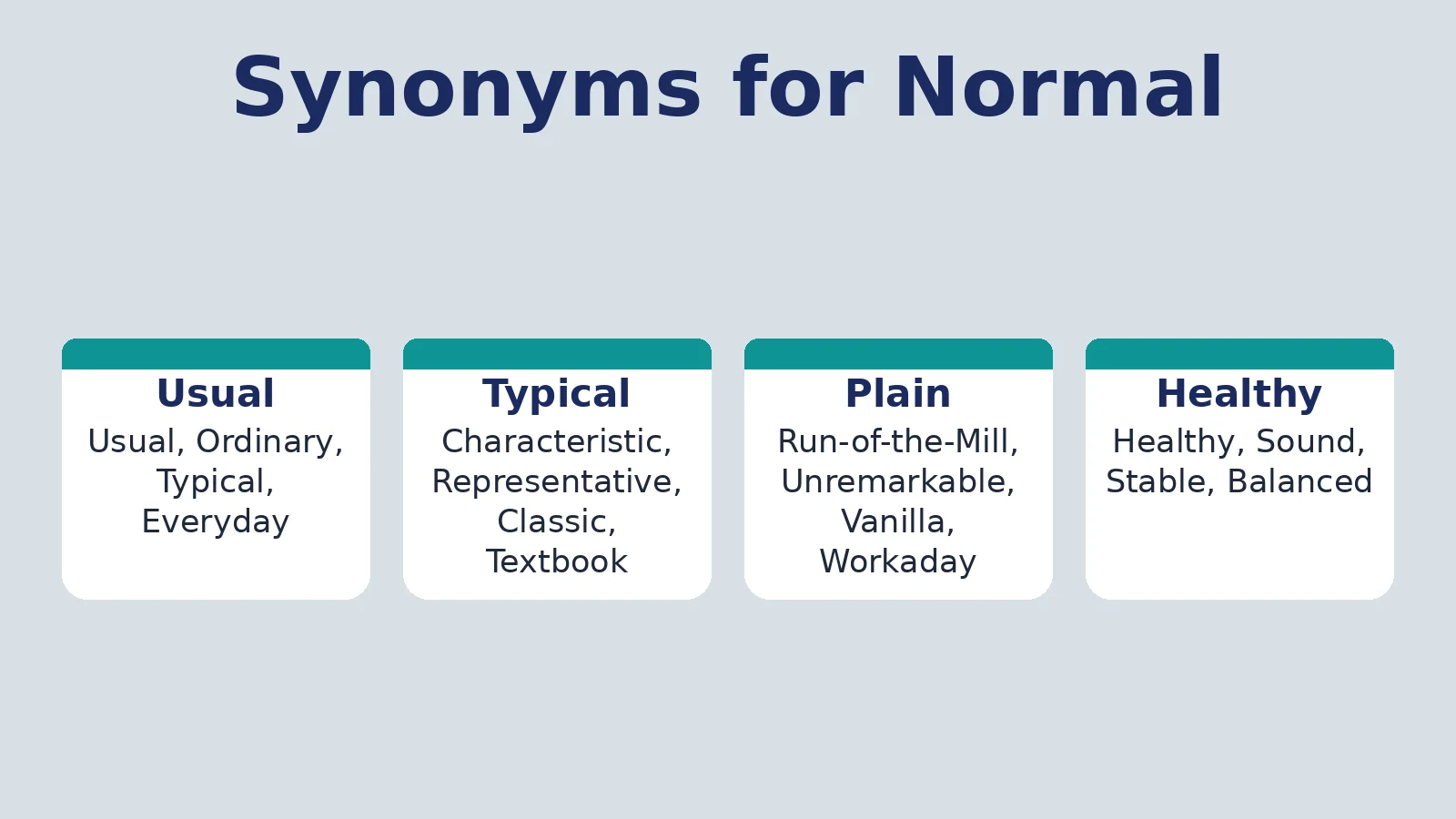
Normal might be the most reassuring word in English, and also one of the vaguest. It describes the usual workday, the standard shoe size, and the blood test result everyone hopes for, without ever saying which standard it means. The most useful synonyms for normal include usual, ordinary, typical, average, regular, standard, common, everyday, routine, conventional, healthy, sound, and natural. Each one measures your subject against a slightly different yardstick, which is why the wrong swap can quietly change a sentence.
This guide sorts more than 90 synonyms for normal into clear groups, from the everyday routine to the healthy recovery. Every group explains the small differences between its words and shows them in real sentences. As a result, you can describe a day, a result, or a return to health with the word that actually fits.
Top Synonyms for Normal: Quick Reference
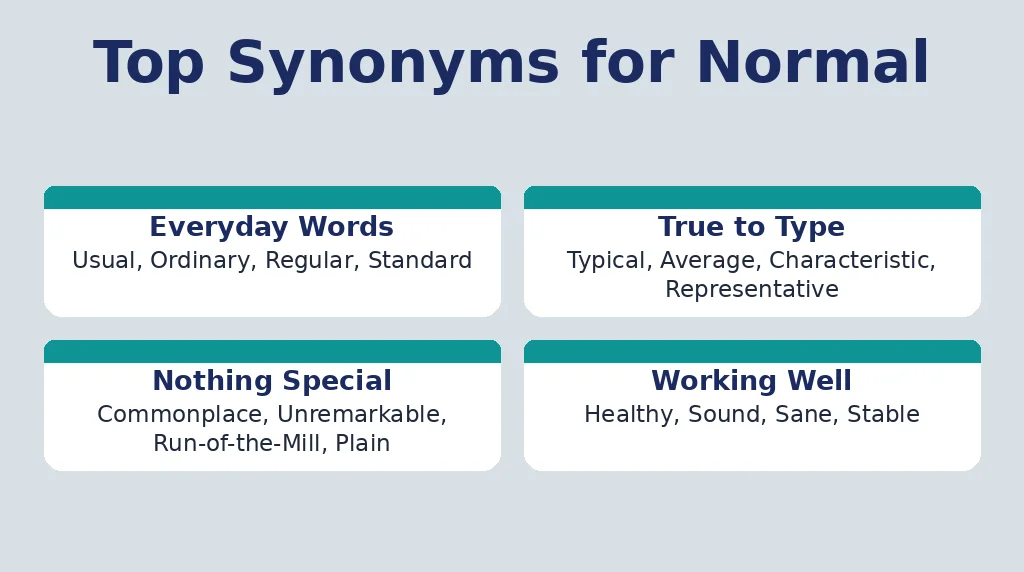
The table below covers the 28 synonyms readers reach for most often. Start here when you need one fast replacement. Later sections sort the full list into finer groups.
| Word | Meaning in one line | Best for |
|---|---|---|
| Usual | As happens most of the time | The safest all-purpose choice |
| Ordinary | Regular, with nothing special | Days, people, neutral tone |
| Typical | Showing the traits of its type | Examples, cases |
| Average | At the middle level or value | Numbers, sizes, results |
| Regular | Following a fixed pattern or rule | Schedules, routines |
| Standard | Meeting the accepted benchmark | Sizes, practice, formal tone |
| Common | Seen often; shared by many | Habits, events |
| Everyday | Part of ordinary daily life | Speech, objects, routines |
| Routine | Done as a regular, set procedure | Work, checks, formal tone |
| Customary | Done according to custom | Formal writing, social habits |
| Characteristic | Typical of a person or thing | Traits, formal tone |
| Representative | Standing for a whole group | Samples, examples |
| Classic | A perfect example of its kind | Cases, mistakes, praise |
| Textbook | Exactly as the books describe | Medicine, examples |
| Run-of-the-Mill | Ordinary, with nothing special | Slightly dismissive tone |
| Unremarkable | Not worth special notice | Results, days |
| Vanilla | Plain and basic, informal | Products, plans, chat |
| Healthy | Working and well, as expected | Bodies, results |
| Sound | Healthy and undamaged; sensible | Bodies, minds, decisions |
| Stable | Steady and not changing suddenly | Health, moods, conditions |
| Sane | Mentally healthy; sensible | Minds, decisions |
| Balanced | Steady and well proportioned | Minds, reports, views |
| Natural | As nature intends; to be expected | Reactions, processes |
| Expected | Anticipated; matching the forecast | Results, behavior |
| Familiar | Well known from everyday experience | Patterns, feelings |
| Conventional | Following accepted customs | Methods, formal tone |
| The norm | The usual level or pattern (noun) | Benchmarks, society |
| Par | The expected standard level (noun) | Performance, health |
What Does Normal Mean?
At its core, normal means conforming to a standard, and therefore usual, typical, or expected. Dictionaries phrase it in slightly different ways, but the heart of the word never changes. Merriam-Webster’s thesaurus puts it sharply: normal implies a lack of deviation from what has been established as the most usual or expected.
That means normal is always a comparison. Something is normal only against a background: yesterday’s routine, the rest of the group, or the figures on a chart. A normal temperature is normal for a body. A normal meeting is normal for that office. Change the background, and the word changes with it.
Context also sets the width of the word. In medicine, normal is a range, not a single point, so a result inside the range counts as normal even when it is not perfect. In daily speech, normal often just means “nothing unusual happened.” The groups below follow these different jobs one by one, so you can match the word to the standard you actually mean.
Standards also move over time, and normal moves with them. Working from home was unusual in one decade and a normal arrangement in the next. Screen time that once alarmed parents is now a normal part of childhood. Writers who use the word about society should quietly name their period and their group, because “normal” always means normal for someone, somewhere, at some time. That small care keeps the word honest.
Synonyms for Normal That Mean Usual and Expected
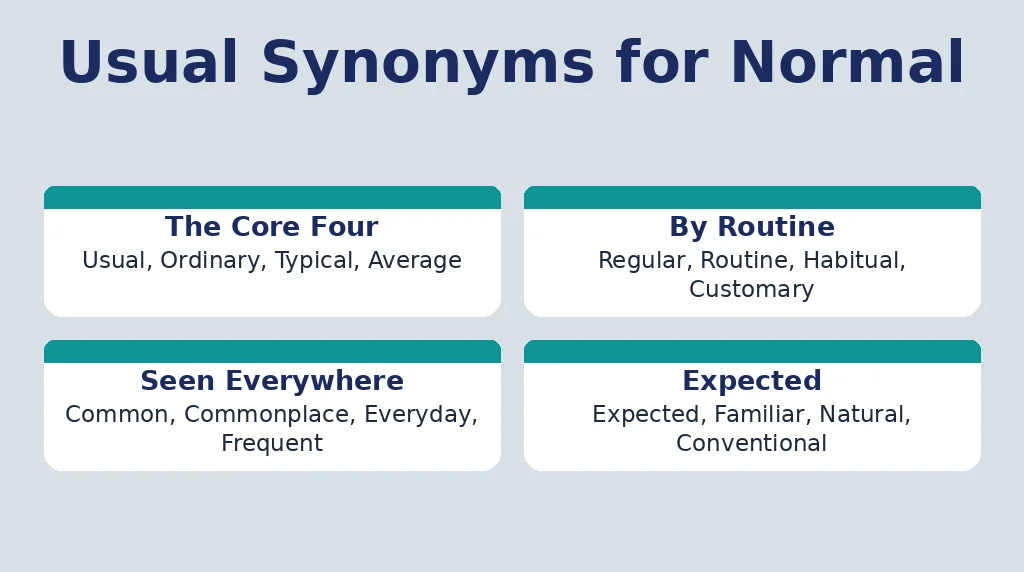
This is the home sense of normal, and it covers days, habits, weather, and events that follow the expected pattern. Nothing here promises quality. These words simply say that things went the way they usually go.
The Core Words
- Usual: as happens most of the time; the closest match of all. Example: She took her usual seat by the window.
- Ordinary: regular and unremarkable, with nothing special. Example: It was an ordinary Tuesday at the office.
- Typical: showing the expected traits of its kind. Example: A typical day starts with two meetings.
- Average: at the middle level of a group or scale. Example: The average temperature this month is mild.
- Regular: following a fixed pattern or schedule. Example: He makes regular visits to the clinic.
- Standard: meeting the accepted level or model. Example: The standard reply arrived within a day.
By Habit and Routine
These words stress repetition. The thing is normal because it keeps happening in the same way.
- Routine: done as a regular procedure. Example: The inspection was a routine check.
- Customary: in line with custom or habit. Example: It is customary to tip the driver.
- Habitual: done as a settled habit. Example: Her habitual walk takes her past the lake.
- Accustomed: familiar through habit; used to something. Example: He gave his accustomed nod.
- Expected: in line with what was predicted or awaited. Example: The delays were expected after the storm.
Seen All the Time
Frequency is the point of this group. The thing is normal because everyone encounters it constantly.
- Common: seen often; shared by many. Example: Colds are common in winter classrooms.
- Commonplace: found everywhere, and so unremarkable. Example: Rain is commonplace in April here.
- Everyday: part of ordinary daily life. Example: Everyday footwear suits the trail.
- Familiar: well known from constant experience. Example: The familiar routine calmed the class.
- Frequent: happening often. Example: Frequent showers keep the garden green.
- Prevalent: widespread in a place or period. Example: The view is prevalent among teachers.
- Prevailing: currently holding as the usual pattern. Example: The prevailing winds come from the west.
- Mainstream: belonging to the usual run of things. Example: The practice entered mainstream medicine.
- General: involving most cases or people. Example: The general rule allows one bag.
- Natural: in line with how things work; to be expected. Example: Tiredness is a natural response to travel.
- Conventional: following what is usually accepted. Example: He took the conventional route into law.
- Quotidian: daily and ordinary, formal or literary in tone. Example: The quotidian round of chores filled her morning.
Synonyms for Normal That Mean Typical and Representative
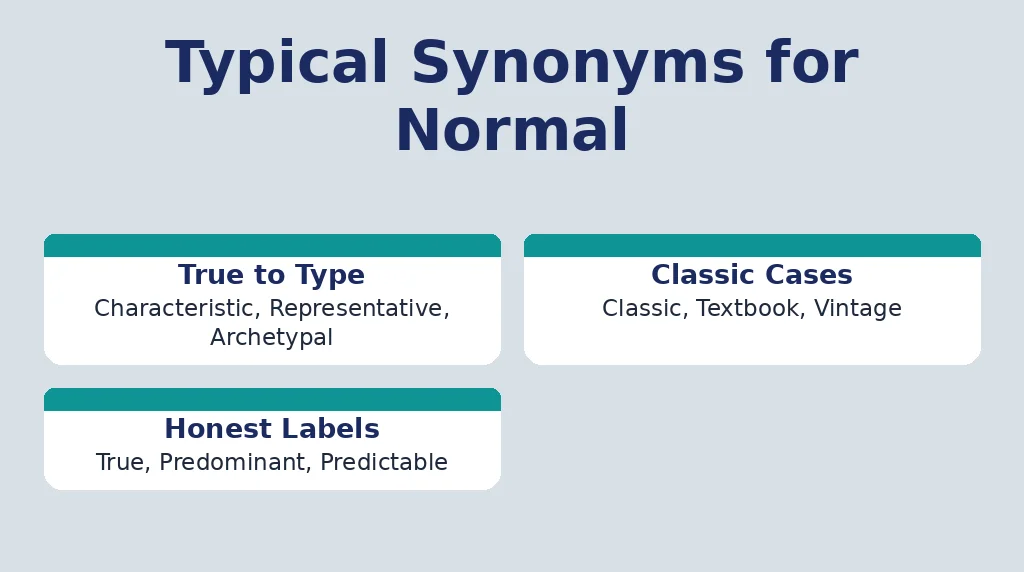
A typical example is normal in a different way. It stands for its whole class. When scientists, teachers, and writers pick one case to show a pattern, this is the family they reach for.
True to Type
- Characteristic: showing the traits that define a person or thing. Example: Impatience is characteristic of the breed.
- Representative: standing for a whole group fairly. Example: The sample is representative of the district.
- Archetypal: the original pattern that others copy. Example: She is the archetypal strict grandmother.
- True: matching the real nature of its kind. Example: He is a true craftsman in every detail.
- Predictable: following the type so closely that it can be foreseen. Example: The sequel gave a predictable ending.
The Perfect Example
These words praise the fit between the case and the category. The example is normal because it shows the pattern at its clearest.
- Classic: a perfect, well-known example of its kind. Example: It was a classic case of poor planning.
- Textbook: exactly as the reference books describe. Example: The patient showed textbook symptoms.
- Vintage: typical of a person, period, or style at their most characteristic. Example: That joke was vintage Dad.
- Predominant: the most common or strongest pattern present. Example: The predominant mood was relief.
One caution belongs here. Calling a person typical can sound like a judgment, as if the person had no individuality. Merriam-Webster notes the same risk. When you write about people, characteristic or representative usually lands more kindly.
Teachers and examiners lean on this family more than anyone. A typical answer shows the pattern of a whole class, and a textbook case gives students the pattern in its purest form. Report writers use representative for samples that must speak for thousands of people. In each job, the word promises that one case can safely stand for many, which is exactly the promise this group of synonyms makes.
Synonyms for Normal That Mean Plain and Unremarkable
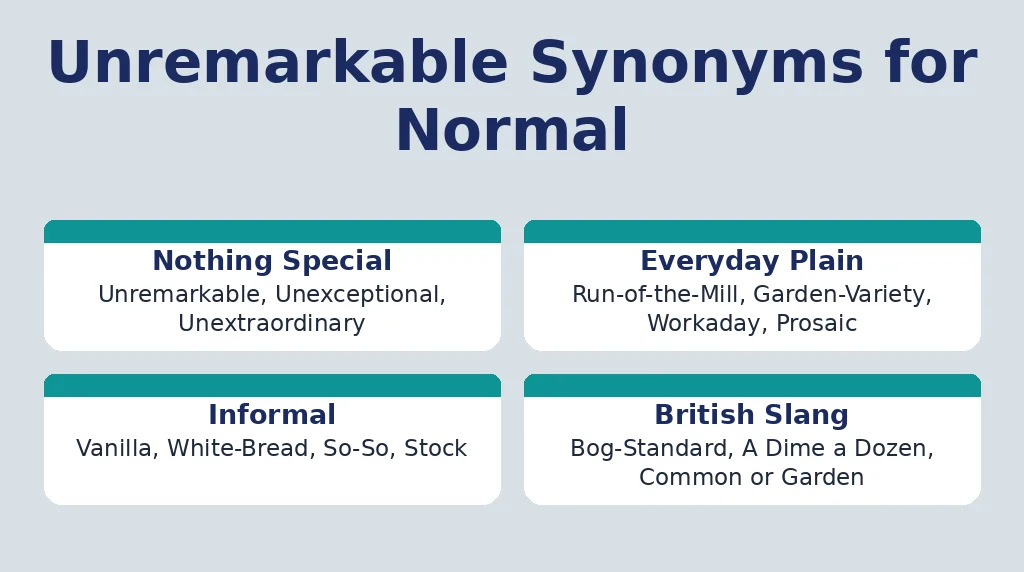
Some synonyms for normal go further and say there is nothing to notice at all. These words are useful, honest, and slightly dangerous, because several of them shade into dull or disappointing.
Nothing Special
- Unremarkable: not worth special notice. Example: The test results were unremarkable.
- Unexceptional: ordinary, giving no cause for comment. Example: It was an unexceptional week at work.
- Unextraordinary: completely ordinary, formal in tone. Example: He led an unextraordinary life by choice.
- Run-of-the-Mill: produced in the ordinary way; nothing special. Example: It is a run-of-the-mill hatchback.
- Garden-Variety: ordinary and common, informal. Example: This is a garden-variety cold, not flu.
- Standard-Issue: the ordinary model given to everyone. Example: Recruits received standard-issue boots.
Flat at the Edges
These words describe the texture of ordinary things, and most carry at least a small sigh.
- Workaday: ordinary and practical, tied to working days. Example: She wore her workaday shoes.
- Prosaic: plain and unromantic; matter-of-fact. Example: The report gives a prosaic account of events.
- Plain: simple, with no decoration or extras. Example: He ordered a plain black coffee.
- Homely: simple and unpretentious, chiefly American use. Example: The inn serves homely, filling food.
- Cut-and-Dried: settled and unchanging; already decided. Example: The rules are cut-and-dried on this point.
- Par for the Course: exactly what is usually expected, often said with resignation. Example: Delays are par for the course on this line.
- Matter-of-Course: expected as a natural part of things. Example: Checks happen as a matter of course.
- Stock: standard and ready-made, sometimes a little lazy. Example: He gave the stock reply to reporters.
- Trivial: of little importance. Example: The fault was trivial and fixed in minutes.
- Insignificant: too small to matter. Example: The difference proved insignificant.
- Unimportant: not worth attention or worry. Example: The missing page was unimportant.
- Unimpressive: failing to make an impression. Example: The sequel was unimpressive but harmless.
- Unexciting: offering nothing to stir interest. Example: The match was slow and unexciting.
Informal and Slang
Relaxed writing and conversation use shorter, cheekier words for the same idea. Vanilla calls a thing plain and basic, as in a vanilla software package. White-bread describes something bland and conventional, mainly in American slang. So-so gives a shrug in two syllables. Plain-Jane labels a person or thing ordinary in appearance, and it can sting. British slang offers bog-standard, meaning completely ordinary, and the phrases a dime a dozen and common or garden for things found everywhere. All of these add color, and all of them can sound dismissive, so place them carefully.
Tone is the whole skill with this family. The same hotel can be ordinary in a neutral report, unremarkable in a disappointed review, and run-of-the-mill in a weary one. None of these words lies, but each one leans. Before you publish, read the sentence aloud and check the lean. If you only mean “nothing unusual,” stay near the top of this section, with unremarkable and standard-issue, and leave the sighs out.
Synonyms for Normal for Health and How Things Function
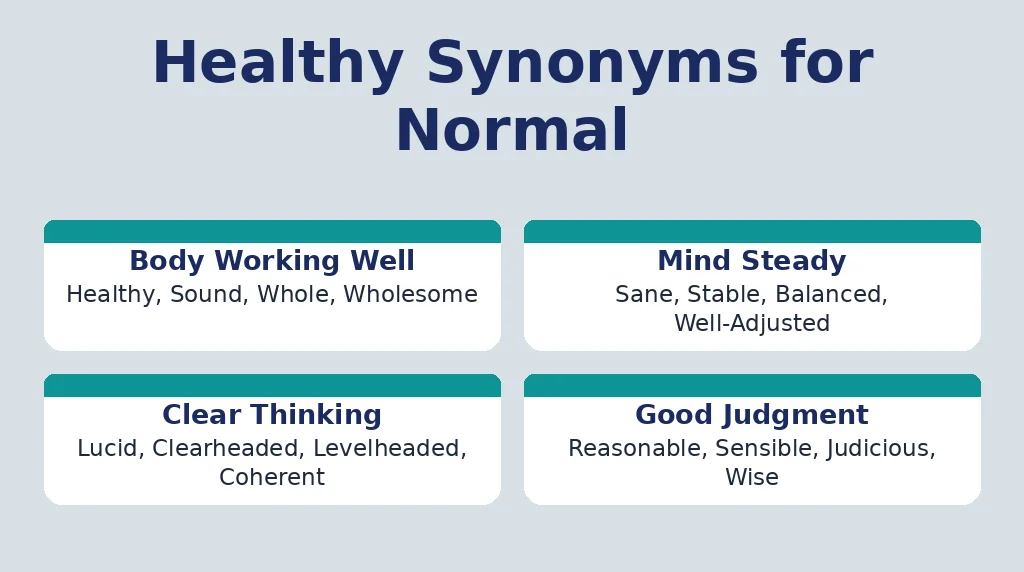
“Back to normal” is the phrase everyone waits to hear after an illness, an injury, or a fright. In this territory, normal means working as it should. Families often say a person is “not quite right” before they can name a single symptom, and the vocabulary of that feeling lives under synonyms for right.
Body and Mind Working Well
- Healthy: in good condition; working as it should. Example: Her lungs sounded healthy at the checkup.
- Sound: healthy, undamaged, and in good working order. Example: The vet declared the horse sound.
- Whole: complete and healed; fully well again. Example: Rest made him feel whole again.
- Wholesome: supporting good health; morally healthy too. Example: They keep a wholesome daily routine.
A sound body sits close to a strong one, and the guide to synonyms for strong covers the vocabulary of physical strength and resilience in full.
A Steady Mind
Mental normality has its own shelf of words, and they stress steadiness rather than brilliance.
- Sane: mentally healthy; also sensible. Example: No sane driver would attempt the crossing.
- Stable: steady and unlikely to change suddenly. Example: His mood has been stable for months.
- Rational: able to reason clearly. Example: She gave a calm, rational account.
- Lucid: clear in thought and expression. Example: He remained lucid throughout the interview.
- Clearheaded: thinking clearly, without confusion. Example: The clearheaded nurse took charge calmly.
- Levelheaded: calm and sensible under pressure. Example: A levelheaded friend talked him down.
- Balanced: steady and well proportioned in mind. Example: She holds a balanced view of the risks.
- Well-Balanced: emotionally steady. Example: The well-balanced report weighed both sides.
- Well-Adjusted: coping well with life and people. Example: Their children are happy and well-adjusted.
- Even-Keeled: calm and unshaken, informal. Example: The even-keeled pilot reassured everyone.
- Compos Mentis: fully in control of one’s mind, formal and legal in tone. Example: The court ruled her compos mentis.
- Right-Minded: thinking in a sound, sensible way. Example: Any right-minded reader would object.
Thinking Clearly
Closely related words describe judgment that works the way it should.
- Reasonable: fair and guided by good sense. Example: It was a reasonable request.
- Sensible: showing good judgment. Example: She made the sensible choice to wait.
- Coherent: clear and logically connected. Example: He gave a coherent explanation.
- Logical: following clear reasoning. Example: The plan follows a logical order.
- Judicious: showing careful judgment, formal. Example: She made judicious use of the budget.
- Wise: showing deep good judgment. Example: It was wise to ask before signing.
- Clear: easy to understand; free of confusion. Example: His thinking stayed clear all day.
One medical caution matters here. On a lab report, normal means inside the reference range for that test. It does not mean perfect, and it does not always mean healthy in every other respect. Writers covering health should keep that range meaning in view.
Machines and systems borrow the same language. Train companies announce that normal service has resumed, engineers report normal operations, and pilots call a normal landing the best kind there is. In each case the word promises a return to the trusted pattern. That is why this family of synonyms matters far beyond medicine: it is the vocabulary of things working again.
Synonyms for Normal as a Noun
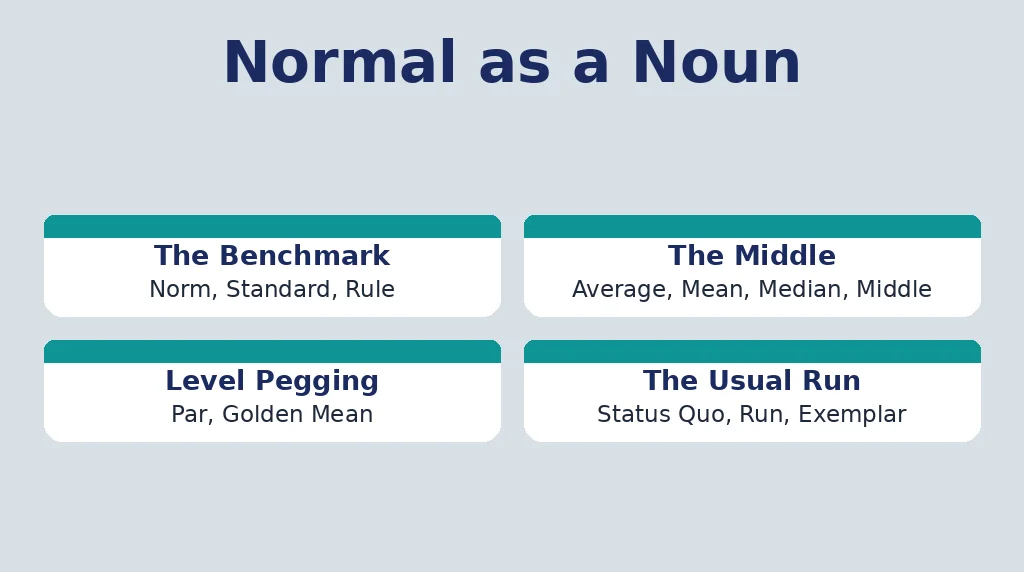
Normal also works as a noun, naming the level itself. Temperatures fall below normal, businesses hunt for a new normal, and performance returns to normal after a strange month.
- The Norm: the usual pattern or level. Example: Remote Fridays became the norm.
- Average: the middle value of a set. Example: Rainfall is above the average this year.
- Standard: the level used as a measure. Example: The hotel fell below its usual standard.
- Mean: the mathematical average, technical. Example: The mean score rose by two points.
- Median: the middle value in a ranked set, technical. Example: The median price climbed again.
- Par: the expected standard level. Example: His energy felt below par all week.
- Rule: the usual case, as in “as a rule.” Example: Quiet mornings are the rule here.
- Middle: the central point of a range. Example: Her results sit in the middle of the scale.
- Status Quo: the existing state of things. Example: The vote preserved the status quo.
- Golden Mean: the happy middle between extremes, literary. Example: He seeks the golden mean in spending.
- Run: the usual course of things, as in “the run of events.” Example: In the ordinary run of events, trains arrive on time.
- Exemplar: a model example that sets the level, formal. Example: Her thesis became an exemplar for the class.
One phrase deserves a note of its own. “The new normal” names a changed level that people now treat as standard, after a crisis, a technology shift, or a social change. The phrase works because the norm family is about levels rather than feelings. When you write it, name the old level and the new one, so readers can see the measure move.
Formal and Informal Synonyms for Normal
Register decides whether a sentence sounds like a report or a remark. The meaning stays the same, but the clothing changes completely.
Formal Choices
Official, academic, and careful writing favors customary, conventional, textbook, standard-issue, and the literary word wonted, meaning usual or habitual. A government report describes the customary procedure, not the bog-standard one. Wonted appears in older and elevated prose, as in “her wonted cheerfulness,” and it lends a bookish flavor that modern reports rarely want.
Neutral Everyday Choices
Usual, ordinary, typical, regular, average, and everyday fit nearly every context. They carry no judgment and no slang. When in doubt, these are the safe words, since every reader understands them at once and nobody takes offense at them.
Informal and Slang Choices
Vanilla, white-bread, so-so, run-of-the-mill, bog-standard, and a dime a dozen belong to conversation and lively writing. They are vivid because they judge a little. That same judgment makes them risky in formal work, in medical writing, and in anything written about real people.
How to Choose the Right Synonym for Normal
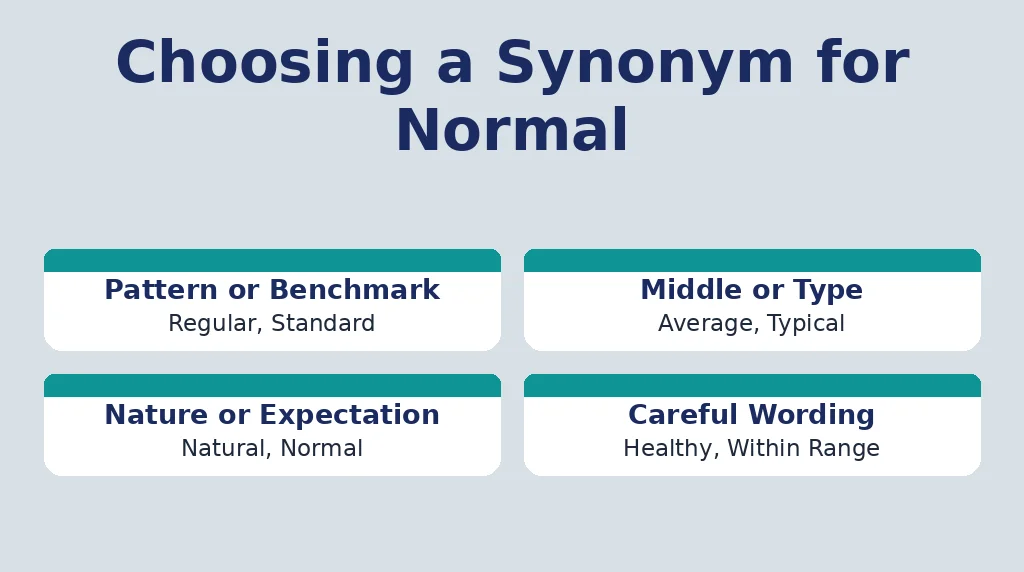
Five close neighbors cause most of the confusion around normal. One distinction at a time clears all of them.
Normal vs Regular: Expectation or Pattern?
Regular stresses conformity to a rule, standard, or pattern, as Merriam-Webster’s chooser explains. A regular meeting happens on a fixed schedule. Normal stresses matching what is expected. A normal meeting is simply the kind the office usually has. If the pattern is your point, choose regular. If the lack of surprises is your point, choose normal.
Normal vs Standard: The Thing or the Benchmark?
Standard names the measuring stick. Normal describes something that measures up to it. Standard practice is the benchmark itself. A normal working day meets that benchmark without fuss. Confusing the two reverses a sentence: the standard cannot be normal, because the standard is what normal is judged against.
Normal vs Average: A Description or a Grade?
Average is the middle value of a set, and statisticians use it without any judgment. About people, though, average has picked up a sting. “An average student” often sounds like a low grade. Normal carries no grade at all. When you describe a person, normal or typical is kinder and usually more accurate.
Normal vs Typical: Expected or Representative?
Typical says an example shows the traits of its whole type. Normal says a thing matches the expected level. A typical mistake represents a whole class of errors. A normal result sits inside the expected range. Teachers and scientists choose typical for examples and normal for measurements.
Normal vs Healthy: The Range or the Condition?
Healthy describes a condition; normal describes a position inside a range. A blood pressure reading can be normal for a patient who is not yet healthy overall. A healthy appetite, meanwhile, is judged by how it works, not by where it sits on a chart. Doctors use normal for measurements and healthy for the whole person or organ. Copy that habit, and medical writing stays both kind and precise.
Normal vs Natural: The Standard or the Nature?
Natural applies to what fits a thing’s essential nature or function. The natural love of a parent is natural because it grows from inside. Normal applies to what fits the usual course of events around it. Grief after a loss is both natural and normal, but the words reach that point from opposite directions.
A Careful Word About People
Calling a person “normal” quietly implies that someone else is not, and the remark can land as a judgment even when none is meant. Where you can, describe the specific thing instead: healthy, typical for her age, within the usual range, or back to his usual self. If mood or wellbeing is your subject, say what you actually see, such as calm, cheerful, or steady. The guide to synonyms for happy covers the positive end of that scale in depth.
Antonyms for Normal
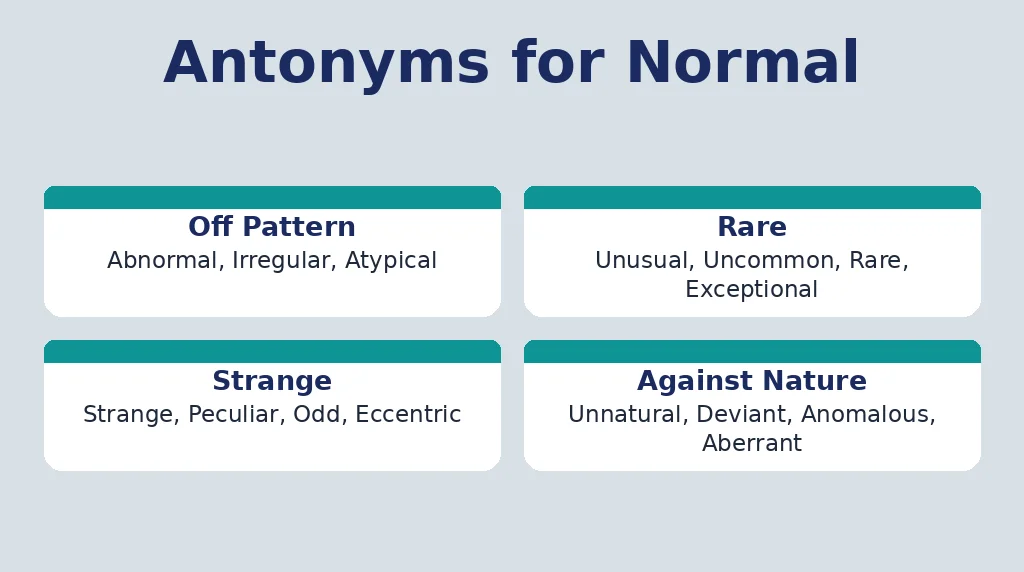
The opposites of normal split into three camps: things off the pattern, things too rare to be a pattern, and things that strike people as strange.
Off the Usual Pattern
- Abnormal: departing from what is normal; the direct opposite. Example: The scan showed an abnormal reading.
- Irregular: not following the usual pattern or rule. Example: His heartbeat was irregular.
- Atypical: not typical of its group. Example: The case was atypical in every respect.
- Anomalous: differing from the standard or expected. Example: One anomalous result spoiled the chart.
- Aberrant: departing from the accepted course, formal. Example: The aberrant weather ruined the harvest.
- Deviant: straying from accepted norms. Example: The deviant reading was traced to a fault.
Rare and Remarkable
- Unusual: not common or ordinary. Example: An unusual silence filled the hall.
- Uncommon: not often found. Example: Snow is uncommon in this valley.
- Rare: seldom seen or happening. Example: The bird is a rare visitor here.
- Exceptional: standing out from the usual run. Example: She showed exceptional patience.
- Extraordinary: far beyond the ordinary. Example: It took extraordinary effort.
- Unique: the only one of its kind. Example: Every fingerprint is unique.
Strange to the Eye
- Strange: unfamiliar and surprising. Example: A strange noise came from the attic.
- Different: not the same as usual. Example: The route felt different today.
- Eccentric: behaving in an odd, unconventional way. Example: The eccentric professor wore two watches.
- Peculiar: odd or unusual, often mildly critical. Example: A peculiar smell hung in the room.
- Odd: strange; also, not divisible evenly in numbers. Example: It was an odd day from the start.
- Disorderly: lacking the usual order. Example: The disorderly files took weeks to sort.
- Irrational: not guided by reason. Example: His fear of lifts was irrational.
- Unnatural: not in line with nature or expectation. Example: An unnatural quiet followed the blast.
Notice that several of these antonyms are compliments. Exceptional, extraordinary, and unique describe things that rise above the normal, and writers use them as praise. Others, like abnormal and deviant, carry alarm. The split mirrors the synonyms themselves: normal sits in the middle, and its opposites fall away on both sides, toward the wonderful and toward the worrying. Pick the side your sentence actually means, because readers will feel the difference at once.
Words That Are Not True Synonyms for Normal
Four words are often swapped in for normal, and all four change the meaning. Knowing them protects both praise and criticism.
Perfect
Normal includes variation and small flaws. A normal blood pressure reading sits inside a range, and a normal day includes a spilled coffee. Perfect allows no range and no spills. Calling a result perfect when the report says normal overstates the facts, sometimes dangerously in health writing.
Mediocre
Mediocre is a quality judgment meaning not very good. Normal and average describe position, not quality. An average-sized pumpkin is not a mediocre pumpkin. Writers who reach for mediocre when they mean average end up insulting things that are simply typical.
Boring
Boring describes the reaction of an audience, not the property of a thing. A normal day can be full, warm, and interesting, and an extraordinary day can bore a particular listener. Keep boring for reviews and reactions, and out of descriptions where normal belongs.
Normie
Normie is slang for a person who follows mainstream tastes, and it is usually mocking. It names a person, not a quality, so it cannot describe a day, a result, or a size. It also carries a sneer that neutral writing should avoid.
Frequently Asked Questions
What is the best synonym for normal?
Usual is the closest all-purpose match, because it keeps the core meaning of following the expected pattern. Ordinary and typical are nearly as safe. Choose standard for benchmarks, regular for schedules, and healthy for bodies and recovery. When none of them fits, the problem is usually the standard itself, so name the standard in the sentence and the right word tends to follow.
What is the difference between normal and regular?
Regular is about a pattern or rule, such as a regular monthly meeting. Normal is about matching what is expected, such as a normal meeting with the usual agenda. A thing can be regular without being normal, and normal without being regular.
Is average a synonym for normal?
Yes, with care. Average names the middle value of a set, and it works well for numbers, sizes, and scores. About people it can sound like a judgment on quality. In those cases, typical or normal is the kinder and clearer choice.
What is a formal word for normal?
Customary, conventional, and standard are safe formal choices. Textbook suits examples that match a model exactly. Wonted is the literary option, meaning usual or habitual, and it appears mostly in older or elevated prose.
What does “back to normal” mean, and what can replace it?
It means a return to the usual, healthy, or expected state after a disruption. Depending on the context, you can use back to usual, restored, settled, recovered, or running as normal again. For health, back to his old self is warmer and more human.
What is the opposite of normal?
Abnormal is the direct opposite. Unusual, irregular, and atypical are softer options for things off the usual pattern. Strange, eccentric, and peculiar suit things that merely look odd, while rare and exceptional suit things that stand out positively.
Is it okay to call a person normal?
It is usually better to name the specific quality instead. Healthy, typical for her age, and within the usual range all say more and judge less. “Normal” about a person can imply that others fall short of a standard, even when the writer means no harm.
What is an informal or slang word for normal?
Vanilla is the common informal choice for something plain and basic. British slang offers bog-standard, while run-of-the-mill and so-so work in relaxed writing everywhere. All of them judge a little, so save them for casual contexts.
Final Thoughts
Normal always points at a standard, and every synonym in this guide names a different one. Usual and ordinary point at the daily pattern, typical and representative point at the type, and healthy and sound point at proper working order. The noun family, led by the norm and par, names the level itself.
When you hesitate, ask which standard your sentence uses: the habit, the type, the range, or the rule? The answer picks the word. That is why normal survives every fashion in vocabulary: the standards keep changing, but the need to name them never does. For the complete reference lists behind this guide, the Merriam-Webster Thesaurus entry for normal is the natural next stop.