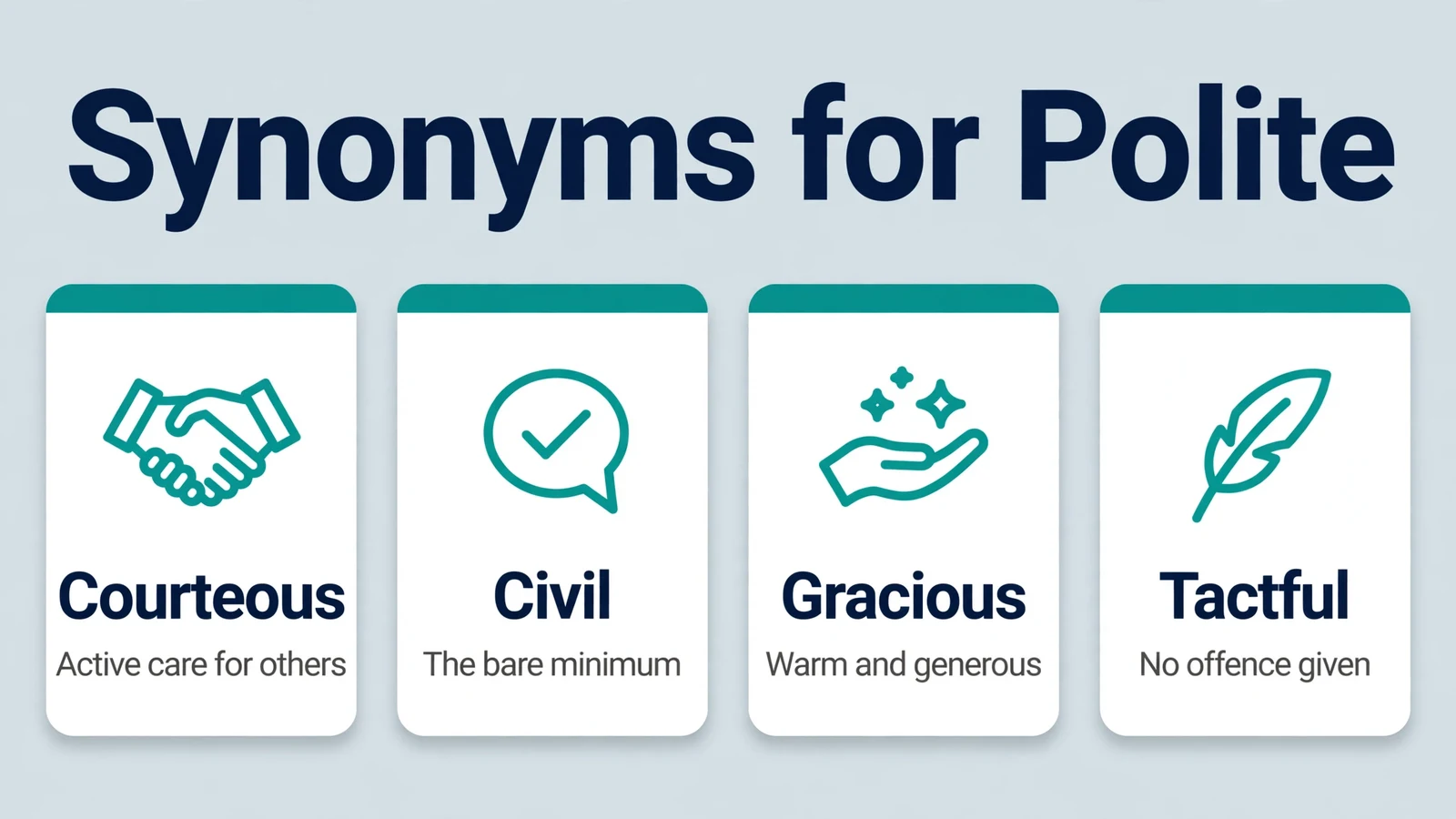
Polite is a safe word, but it is rarely the most precise one. The strongest synonyms for polite are courteous, civil, gracious, respectful, considerate and mannerly. Each one points at a slightly different kind of good behaviour. Courteous adds active care, civil sets the bare minimum, and gracious adds warmth on top.
The right choice depends on the setting. A shop assistant is courteous, a difficult email is diplomatic, and a well-raised child is well-behaved. This guide groups more than sixty verified alternatives by context, so you can pick the word that fits your sentence instead of reaching for polite every time.
You will also find the traps. Some familiar words, such as nice and kind, sit close to polite without meaning the same thing. Those get their own honest section below.
Quick Reference: Top Synonyms for Polite
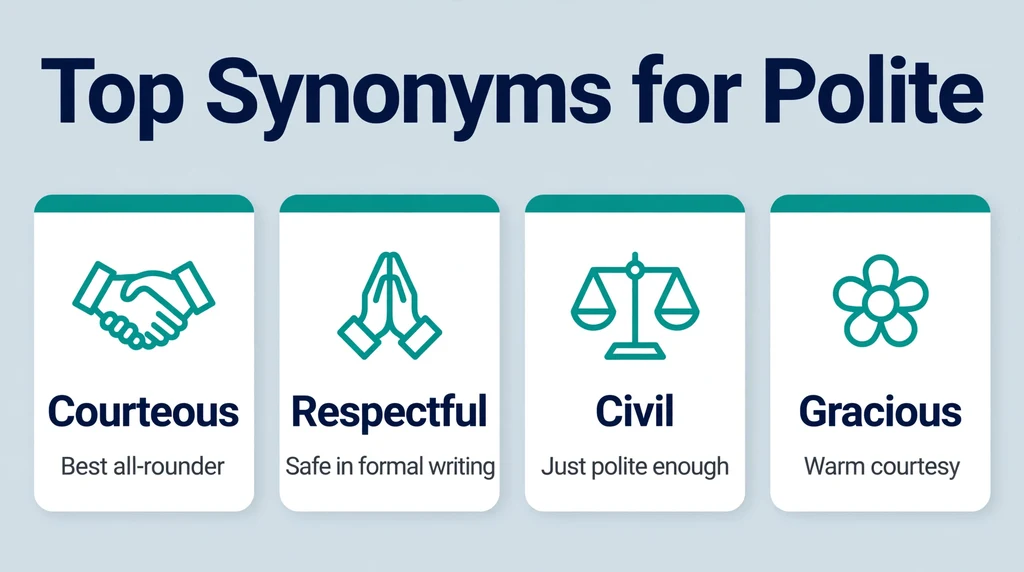
Start here when you need a fast answer. The table below covers the most useful options, with the setting where each one works best.
| Word | Meaning in one line | Best for / tone |
|---|---|---|
| Courteous | Polite with active care for others | Work, service, formal writing |
| Civil | Just polite enough to avoid rudeness | Tense situations, minimum standard |
| Gracious | Warm, generous courtesy | Hosts, thanks, formal events |
| Respectful | Shows regard for people and their standing | All settings, safe default |
| Considerate | Thinks about others before acting | Everyday manners |
| Mannerly | Has visibly good manners | Describing people, slightly formal |
| Well-behaved | Behaves properly and calmly | Children, formal British tone |
| Affable | Friendly and easy to talk to | Social settings, descriptions |
| Tactful | Says things without giving offence | Delicate speech, feedback |
| Diplomatic | Handles sensitive matters smoothly | Work, negotiation, refusal |
| Discreet | Careful not to embarrass or reveal | Private matters, service roles |
| Deferential | Yields politely to age or rank | Formal, hierarchical settings |
| Ceremonious | Follows full formal courtesy | Ceremonies, very formal writing |
| Formal | Correct and distant rather than warm | Official occasions |
| Proper | Right by the rules of society | Traditional, slightly old-fashioned |
| Decorous | Dignified and restrained | Formal descriptions |
| Refined | Cultivated, polished manners | Polite society, taste |
| Genteel | Quiet, old-style refinement | Older people, houses, voices |
| Elegant | Graceful and polished | Formal compliments |
| Urbane | Worldly, smooth and poised | Social, literary writing |
| Suave | Smooth and confident with people | Social charm, can feel slick |
| Civilized | Orderly and reasonable | Discussions, behaviour |
| Well-bred | Raised with good manners | People, slightly class-bound |
| Courtly | Old-world ceremonious courtesy | Literary, historical settings |
| Chivalrous | Protective, high-minded courtesy | Acts of help and respect |
| Gallant | Dashing, spirited courtesy | Literary, romantic tone |
| Cordial | Warmly friendly in manner | Greetings, meetings |
| Obliging | Happy to help and serve | Service, thanks |
The sections that follow sort these words by situation. That way, you can see why one fits your sentence and the next one does not.
What Does Polite Mean?
Polite has two related meanings, and good synonyms respect the split. Merriam-Webster’s thesaurus gives the main sense as showing consideration, courtesy, and good manners. Its example is disarmingly simple: it is only polite to hold the door for the person behind you.
Cambridge puts the same idea in social terms. A polite person behaves in a way that is socially correct. That behaviour also shows respect and care for other people.
Forms of address and daily rituals
Politeness shows up in set forms as much as in character. Merriam-Webster’s learners’ material points to polite forms of address, the titles and greetings a society expects. Sir, madam, Mr and Dr all belong to this system, and so do please, thank you and excuse me.
These rituals look small, yet they carry the definition in daily life. A request without please is a command. Thanks said a beat too late barely counts. The synonyms in this guide describe the people who handle these rituals well, and the ones who handle them with extra grace.
The second sense: polite society
The second sense is about refinement rather than kindness. It means following the established traditions of refined society and good taste. This is the polite of polite conversation and polite society. Certain subjects are never mentioned in polite conversation, as the dictionary example puts it.
Words from this second family sound different. Refined, genteel and civilized belong here. They describe polish, not warmth, and they can even carry a hint of exclusion.
Where the word comes from
The word’s history explains the polish. Polite comes from the Latin *politus*, the past participle of *polire*, which means to polish. The word entered English around 1500, according to Merriam-Webster’s word history. A polite person was, in the oldest sense, a polished one.
That origin still shows in modern use. Politeness is partly about the surface you present to others. The next sections separate that surface from the care underneath it, because the best synonym depends on which one you mean.
The two senses at a glance
| Sense | Core meaning | Typical words | Dictionary example |
|---|---|---|---|
| Manners | Consideration, courtesy, good manners | Courteous, civil, respectful | Holding the door for the person behind you |
| Refined society | Following the traditions of good taste | Refined, genteel, decorous | Subjects never mentioned in polite conversation |
Keep this split in mind as you read. A word from the wrong row can make a warm sentence sound cold, or a formal sentence sound gushing.
Synonyms for Polite in Everyday Manners
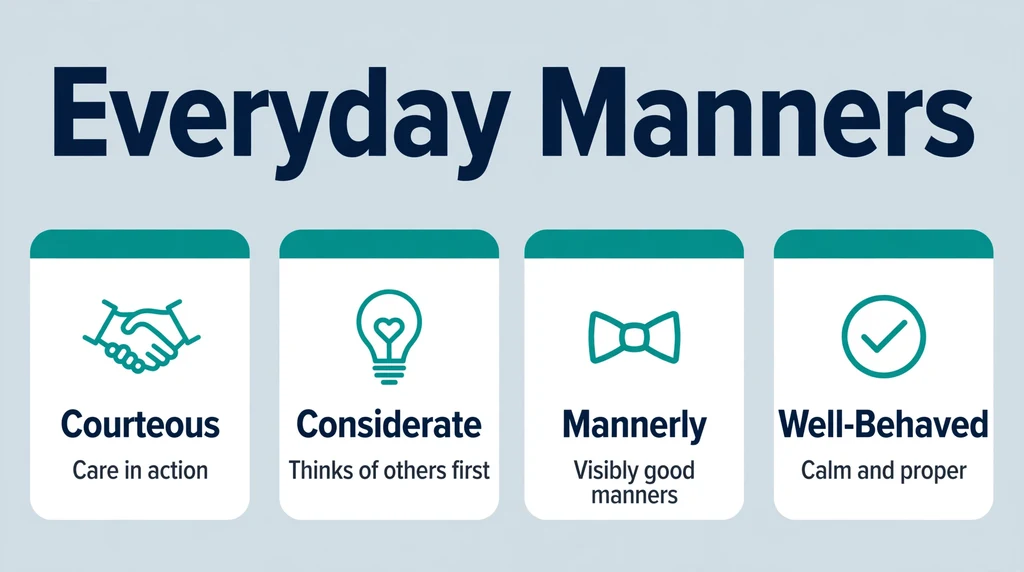
Everyday politeness is the small stuff. It is holding doors, saying thanks, listening without interrupting, and leaving people their space. These words cover that daily ground.
The core everyday words
Courteous is the strongest all-rounder. Merriam-Webster’s Synonym Chooser notes that courteous implies more actively considerate or dignified politeness than polite itself. A courteous driver lets you merge. A courteous colleague answers the awkward email with care.
Civil sits at the other end of the scale. The same Chooser warns that civil often suggests little more than the avoidance of overt rudeness. When people say “at least be civil,” they are asking for the floor, not the ceiling.
Respectful focuses on the other person’s standing. You are respectful to elders, to hosts, and to opponents in a debate. Considerate focuses on feelings instead. A considerate guest notices the early start tomorrow and keeps the music down.
Mannerly describes visible good manners in a person. Thoughtful describes the thinking behind them. The thoughtful neighbour brings in your parcels when it rains, without being asked.
Warm everyday words
Some polite words add friendliness to correctness. Affable people are easy to talk to, and their courtesy feels relaxed. Cordial greetings are warm rather than stiff, so the word suits meetings and welcomes. Gracious hosts make guests feel honoured, and gracious losers congratulate the winner without a wobble.
Obliging people show politeness through help. The obliging shopkeeper checks the back room for your size. Attentive politeness works through listening. An attentive host notices an empty glass before you do.
Two warmth words travel with this group. Pleasant and friendly are listed as synonyms by Merriam-Webster, yet they really describe likeability. The Chooser’s example makes the gap plain: if you cannot be pleasant, at least be polite. Warmth is a bonus. Manners are the requirement.
Easy company and careful manners
Sociable and genial describe people whose politeness comes out as company. A sociable host draws quiet guests into the talk. A genial landlord greets everyone by name. Both words sit in the dictionary lists for polite, and both praise ease rather than correctness.
Careful is the quiet worker in this family. Around tired, grieving or angry people, careful speakers watch every word. In someone else’s home, careful guests watch their hosts for cues. Merriam-Webster lists careful among the polite synonyms because so much everyday courtesy is simply attention paid in advance.
Words for children and behaviour
For children, the everyday word is well-behaved. Collins and Cambridge both place it in the polite family for behaviour. It praises calm, proper conduct rather than speech.
A well-behaved class listens, waits, and shares. Adults can be well-behaved too, but the word keeps a faint classroom flavour. For grown-ups, mannerly or courteous usually sounds better. Our full guide to synonyms for kind covers the warmer character words that sit next to this group.
Teachers often reach for good in this context, as in “be a good girl and sit quietly,” an example Cambridge gives for well-behaved behaviour. In adult writing, good is too broad to praise manners. Well-behaved, mannerly and courteous each say exactly what good leaves vague.
Everyday synonyms in sentences
- The courteous bus driver waited while the elderly man found his seat.
- Our neighbours stayed civil throughout the boundary dispute, and the street stayed calm.
- A gracious host never mentions how much the dinner cost to prepare.
- It was considerate of you to text before calling so late.
- The children were well-behaved for the whole museum trip, much to their teacher’s relief.
- An affable stranger on the train made the delay feel shorter for everyone.
Polite Words for Speech and Requests
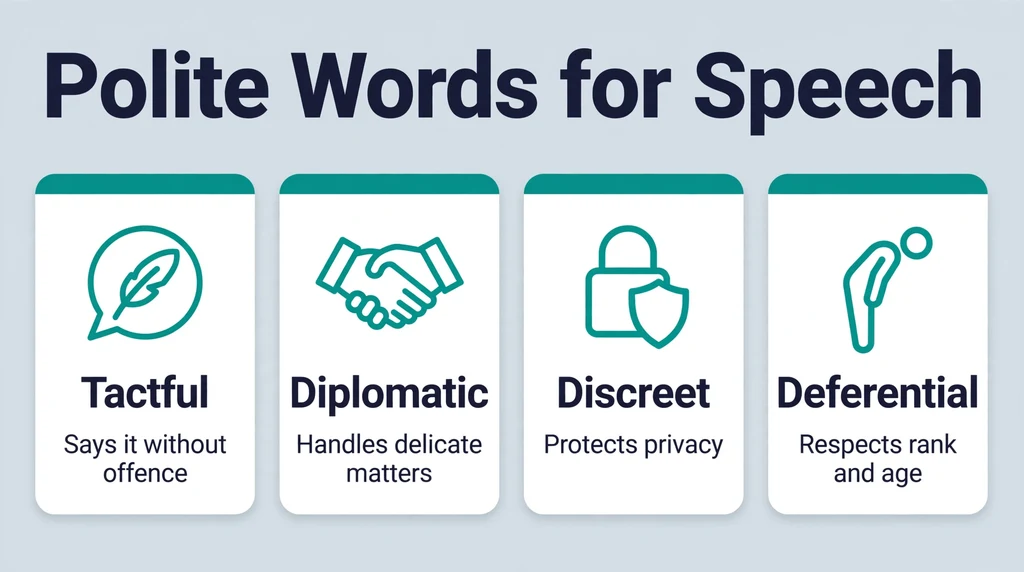
Politeness matters most when words can wound. Turning someone down, correcting a boss, or asking for a favour all need the softer end of the vocabulary.
Tactful and diplomatic words
Tactful is the key word for delicate speech. Collins groups it at the heart of the diplomatic family, for people who are tactful in dealing with others. A tactful reviewer criticises the report, never the writer.
Diplomatic goes one step further. Merriam-Webster says diplomatic stresses an ability to deal with ticklish situations tactfully. A diplomatic answer to a bad proposal buys time without causing a scene. That is why the word rules in offices and negotiations.
Discreet speech protects privacy. A discreet assistant never repeats what a meeting covered. Delicate handling suits the matter itself, as in a delicate subject or a delicate negotiation. Sensitive speakers read feelings early and adjust before anyone gets hurt.
Respectful ways to ask and refuse
Requests soften when the wording shows deference. Deferential speakers yield politely to age, rank or experience. Collins illustrates it with stars who expect deferential treatment in five-star hotels.
A courteous refusal stays firm without turning cold. Collins gives the model phrase: he gave me a courteous but firm refusal. That pairing, courteous with firm, is the whole skill of saying no politely.
Politic is the shrewd member of this family. Merriam-Webster notes that it implies shrewd as well as tactful handling of people. It suits situations where the polite move is also the smart move. Prudent words, finally, are careful words, chosen with an eye on consequences.
The humble register
Some polite speech works by lowering the speaker. A humble request presents itself as small, even when it matters. Modest proposals avoid grand claims for themselves. A dutiful letter to a senior colleague follows every convention of respect. All three words appear in the dictionary lists for polite, in the deferential corner of the family.
Use this register sparingly in modern writing. One humble touch softens a request. A whole page of it can sound old-fashioned, or even sarcastic, to contemporary readers.
Felicitous is the connoisseur’s word in this group. It describes words that are strikingly apt and well chosen. A felicitous phrase in a wedding speech lands exactly right. The word is formal and rare, but nothing else praises the choice of words themselves so precisely.
Polite requests, before and after
The synonyms above change real sentences. Watch how the wording of a request changes its temperature.
- Blunt: Send me the figures today. Warmer: I would be grateful if you could send me the figures today. The second version stays firm about the deadline and courteous about the person.
- Blunt: Your price is too high. Diplomatic: The quality is clear, and the price is more than our budget allows this quarter. The refusal lands, and the relationship survives.
- Blunt: That idea will not work. Tactful: That idea has promise, and the timeline is where it struggles most. The criticism is honest, and the writer keeps dignity.
- Blunt: I want a refund. Courteous: The jacket arrived damaged, so I would like to request a refund, please. Facts first, request second, courtesy throughout.
Formal and Business Synonyms for Polite
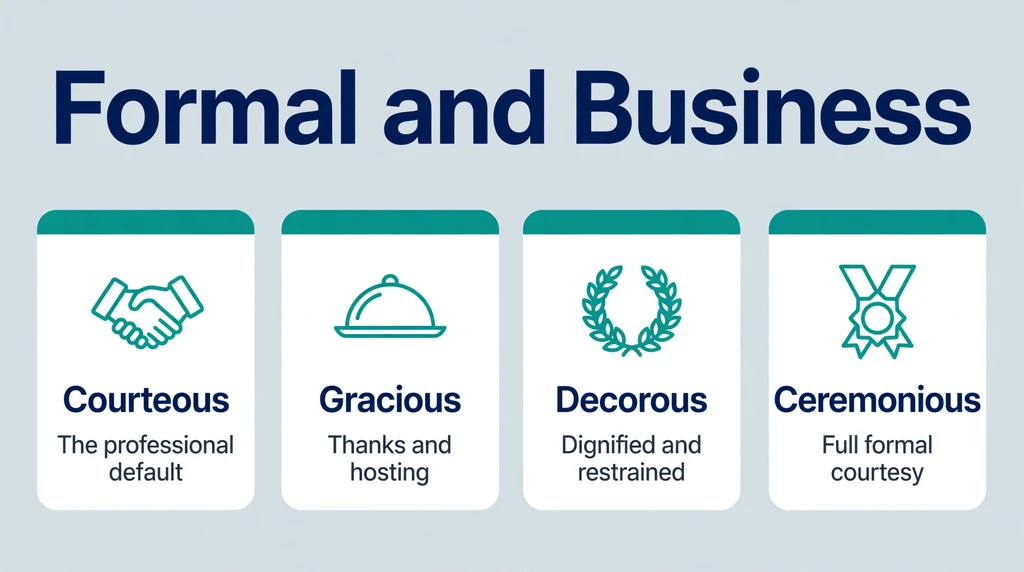
Professional life runs on controlled courtesy. The wrong word can sound cold, and the casual word can sound sloppy. These are the safe, formal options.
The professional core
Courteous is the default word of business English. Merriam-Webster’s own example praises clerks who were unfailingly courteous to customers. Job adverts, service charters and complaint replies all reach for it, because it promises active care rather than bare correctness.
Respectful is the second pillar. It suits emails between teams that disagree. A respectful reply acknowledges the other side before it argues back. Gracious covers thanks and hosting: a gracious welcome, a gracious acceptance, a gracious reply to an invitation.
For service and hospitality, hospitable describes the welcoming side of politeness. Solicitous is the most formal member here. It means showing attentive concern for someone’s comfort or welfare, and it appears in formal letters rather than chat.
Hotels promise guests the red-carpet treatment, and Merriam-Webster lists red-carpet among the polite family for exactly this sense. It means special, honoured handling. In business writing it works for launches, VIP visits and client welcomes, anywhere the welcome itself is part of the product.
In emails and letters
Written courtesy follows patterns readers recognise at once. A courteous email opens by acknowledging the last message. In a respectful reply, disagreement waits for the second paragraph, never the first line. Gracious notes accept thanks without waving it away.
Closings carry the same signals. “Thank you for your time and consideration” borrows considerate’s root for a reason. It tells the reader their effort was noticed, which is the core of politeness in every section of this guide.
Formal to the point of stiffness
Some formal words follow the rule book exactly. Proper behaviour is behaviour that society’s rules approve. Correct manners are precisely right, with no warmth promised either way. Formal manners keep a deliberate distance.
Ceremonious people observe every courtesy in full. That can honour a guest, or it can make a small meeting feel like a state visit. Decorous conduct is dignified and restrained, the standard for ceremonies, courts and solemn occasions.
Use these stiffer words with care. In modern business writing, courteous and respectful cover most needs. The ceremonial words are best saved for formal events, official letters and descriptions of traditional settings.
Applications and cover letters draw on this same shelf. Candidates thank the panel for its time in a courteous closing line. A respectful applicant asks about next steps without demanding them. After a rejection, a gracious reply keeps the door open for the next vacancy. Recruiters read these small signals as evidence of the very quality the words name.
Refined and Old-Fashioned Synonyms for Polite
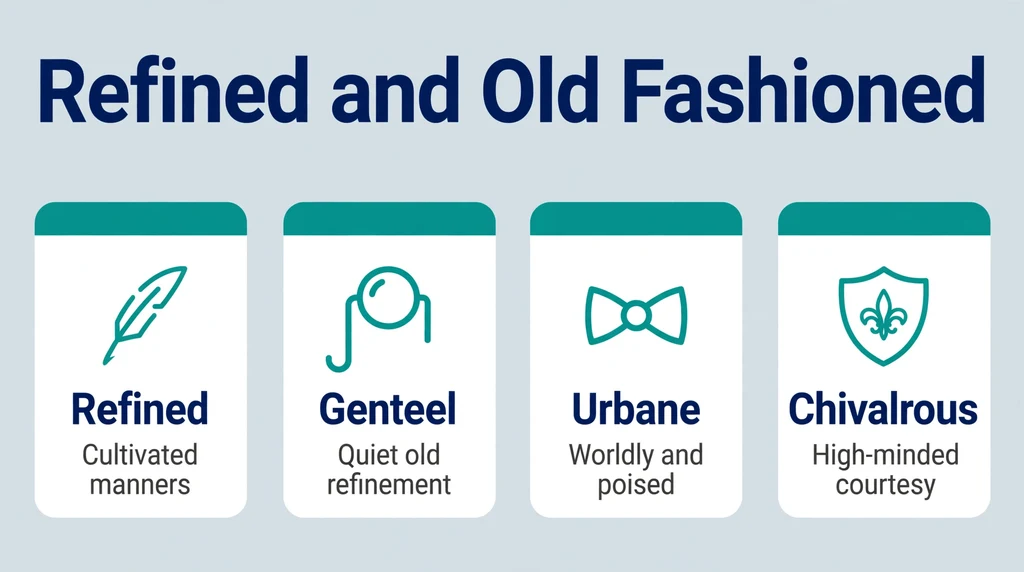
The second sense of polite, the refined one, owns a beautiful older vocabulary. These words describe polish, breeding and social ease more than kindness.
Polish and refinement
Refined is the leader of this group. Collins defines the sense as cultivated or refined, as in remarks that are not acceptable in polite society. Polished manners are smooth from practice, which echoes the word polite itself, born from the Latin for polished.
Cultured people show their refinement through taste and learning. Elegant manners add grace to the polish. Civilized behaviour is orderly and reasonable, the opposite of rough or wild. Cambridge uses it for discussion: let us discuss this in a civilized manner.
Well-bred points to upbringing. Collins notes she was too well-bred to make personal remarks. The word can sound class-bound today, so many writers prefer well-mannered phrasing in prose instead.
Charm, gallantry and the old school
Urbane people are poised from wide social experience, as Merriam-Webster puts it. Suave people handle others easily and without friction. Both words admire smoothness, although suave can slide towards slick.
Genteel is the quietest word here. Collins pictures two ladies with genteel manners and voices. It suits older people, quiet houses and fading traditions, and it can hint that the refinement is a little fragile.
For gallantry, two words stand out. Chivalrous behaviour is high-minded and self-sacrificing, in Merriam-Webster’s summary. Gallant behaviour is spirited and dashing, with ornate expressions of courtesy. Courtly manners complete the set, formal and gentle in the old court style.
Gentlemanly and ladylike are the dated, gendered members of this family. They still appear in older novels and formal obituaries. Modern writing usually picks a neutral word from the groups above.
Two curiosities close the refined shelf. Becoming behaviour, in the older sense, is behaviour that suits the person and the occasion beautifully. It survives in phrases like “modesty becoming to her rank.” Couth is the playful back-formation from uncouth, and writers use it with a smile: a couth, comfortable guest who knows which fork to use. Both words sit in the dictionary lists, and both now belong to light, literary use.
More Synonyms for Polite: Correctness and Social Fit
Between courtesy and refinement sits a quieter set of words. These synonyms judge behaviour against the occasion itself. They ask one question: did the conduct fit?
Appropriate behaviour matches the setting. Laughter is appropriate at a comedy club and inappropriate at a memorial. The word appears in the dictionary lists for polite because so much politeness is fit, judged case by case.
Suitable works the same way, with a slightly practical flavour. Suitable dress, suitable language and suitable gifts all pass the test of the occasion. Where appropriate judges the act, suitable often judges the thing chosen for the act.
Decent is the warmest word in this set. A decent reply arrives on time and answers the question. Decent behaviour treats people fairly as well as correctly. British speakers especially use decent as everyday praise for conduct that clears the bar with kindness to spare.
Seemly and befitting are the formal twins of this group. Seemly conduct is conduct that looks right by social standards. Befitting describes behaviour that matches a person’s role, as in courage befitting a captain. Both words belong to formal and literary registers today.
Together, these five words explain why polite has a second sense at all. A society keeps shared standards of fit, and its polite words measure people against them. When your sentence is really about fit rather than feelings, this is the correct shelf to choose from.
British Understatement: When Polite Says Less
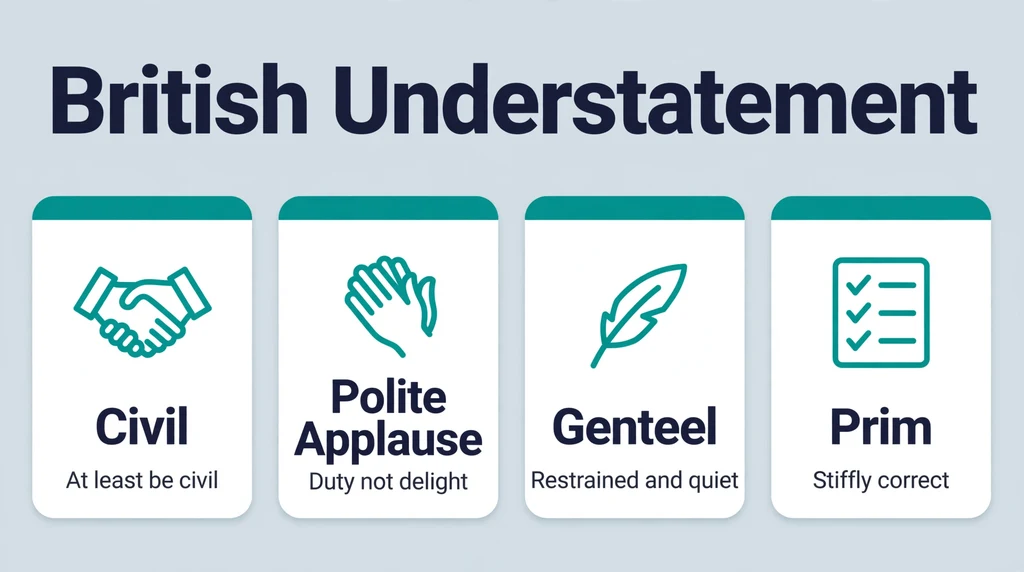
British politeness often works by saying less than it means. The words stay mild, while the message underneath can be firm, cool or quietly critical.
The bare minimum, politely demanded
Start with civil. Cambridge’s example catches the tone exactly: try to at least be civil towards him, even if you do not like him. Nothing warm is requested. The speaker only asks for the avoidance of open rudeness, which is precisely the minimum Merriam-Webster describes.
That makes civil a useful word for tense writing. Colleagues can stay civil through a dispute. Neighbours can manage a civil hello. The word reports correct behaviour and quietly admits that nobody enjoyed it.
Politeness without warmth
Merriam-Webster’s Chooser adds the key warning. Polite commonly implies polish of speech and manners, and it sometimes suggests an absence of cordiality. In other words, the manners can be perfect while the feelings stay cold.
The dictionary’s own example shows the faint-praise version. A performer received some polite applause despite the mistakes in her performance. The audience clapped because clapping was correct, not because they were thrilled. Writers use polite applause, polite interest and polite smiles the same way, to signal duty rather than delight.
When refined turns stiff
The refined family can understate disapproval too. Genteel restraint may praise quiet good taste, or it may suggest something faded and overly sheltered. Prim manners are stiffly correct. Someone described as prim is rarely being complimented on their warmth.
Even stuffy and stiff appear in the dictionary’s refined list for polite. They mark the point where good form tips into discomfort. Reading British prose well means hearing these small signals. The surface word stays polite in every sense, including the literal one.
How to Choose the Right Synonym for Polite
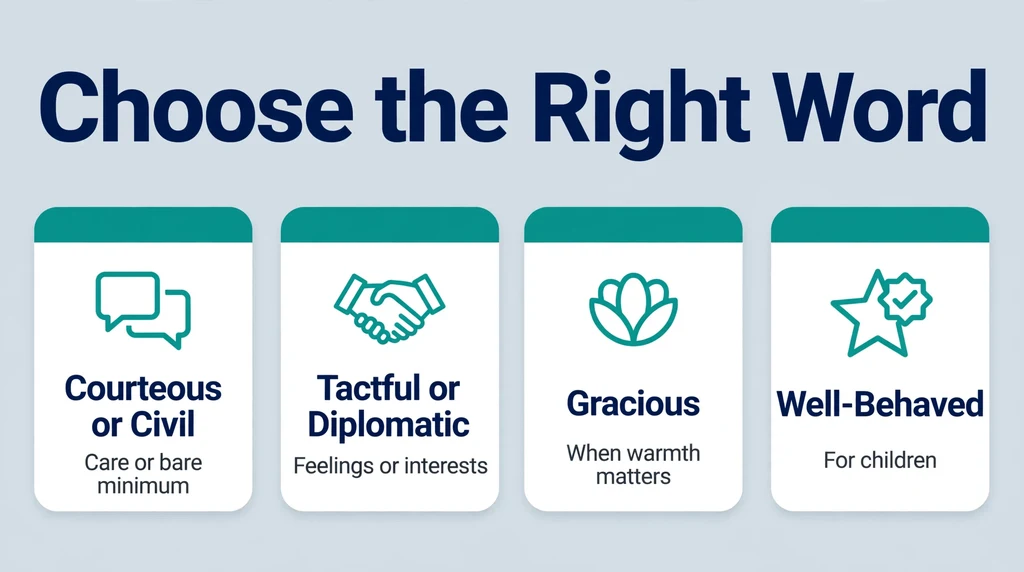
The groups above overlap, so the final choice comes down to three questions. Ask what the politeness is doing, who it is aimed at, and how warm it should feel.
Match the word to the job
If the sentence praises active care, choose courteous. The courteous nurse explains the delay and checks on you twice. If the sentence only clears the lowest bar, choose civil. The two rivals stayed civil throughout the hearing, and nothing more was true.
Choose tactful when feelings are at risk in speech. Choose diplomatic when interests are at risk as well. A tactful friend comments gently on the haircut. A diplomatic manager rejects the plan while keeping the planner onside.
For warmth with polish, gracious is the word. For upbringing and polish without warmth, reach for refined or well-bred. Children are the exception: well-behaved beats every adult word on the list.
Paired examples
Small swaps change the whole message. Compare these pairs before you settle on a word.
- The hotel staff were courteous at every hour of the day. (Active care, professional praise.)
- The hotel staff were civil at every hour of the day. (Correct, but the praise suddenly sounds thin.)
- She gave a diplomatic answer about the merger. (Skilful handling of a sensitive subject.)
- She gave a polite answer about the merger. (Correct manners, no skill implied.)
- He was a gallant host, full of stories and ceremony. (Old-school charm, slightly theatrical.)
- He was an obliging host, always refilling glasses. (Helpfulness, plain and warm.)
- The children were well-behaved on the train. (Calm, proper conduct.)
- The children were respectful on the train. (They treated others with regard, a slightly older quality.)
- She wrote a tactful note about the missed deadline. (Feelings protected, facts intact.)
- She wrote a diplomatic note about the missed deadline. (Feelings protected, and interests protected too.)
- The ambassador was an urbane dinner guest. (Worldly polish, at ease everywhere.)
- The ambassador was an obliging dinner guest. (Helpful and easy, with no polish implied.)
When in doubt, test the sentence with civil. If civil feels like an insult there, your word needs more warmth. If civil feels about right, your original word was probably flattering the subject.
A ten-second checklist
Run through these checks before you settle on any word from this page.
- Is the praise about behaviour, speech or breeding? Each has its own shelf above.
- Does the subject actively care, or merely avoid offence? Courteous answers the first, civil the second.
- Is warmth part of the truth? Add gracious or cordial, or leave the sentence cooler on purpose.
- Would a modern reader find the word dated? Genteel, courtly and ladylike carry period flavour.
- Is the word secretly a criticism? Smooth, prim and unctuous can turn on the subject.
Five checks, ten seconds. They catch nearly every wrong choice this family of words offers.
Antonyms of Polite
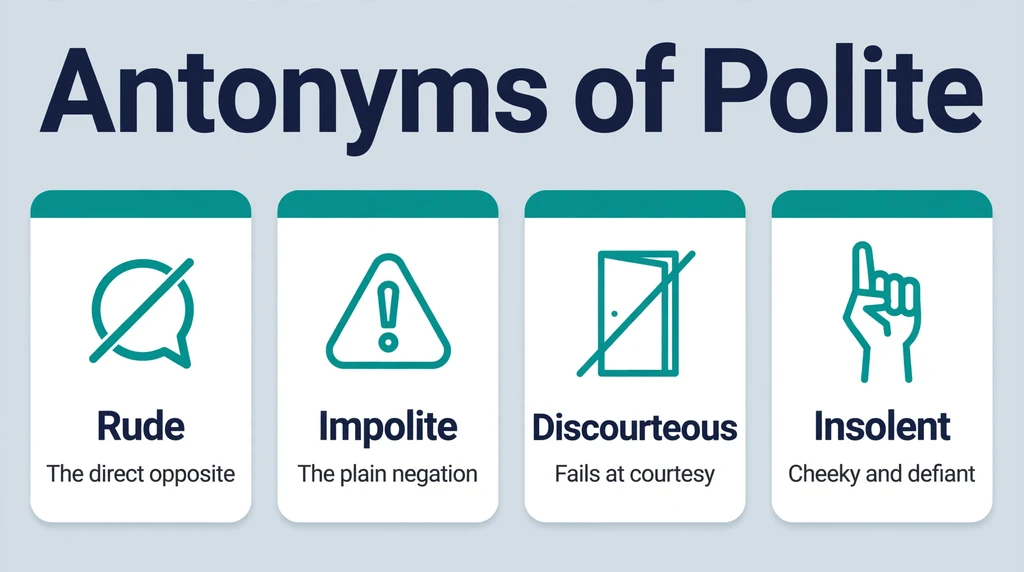
Every synonym above has a shadow. These opposites cover the full slide from cool to openly hostile, and each one pairs with a word you have already met.
- Rude is the direct opposite, the antonym Cambridge gives for polite. It covers bad manners of every size.
- Impolite is the plain negation, common in teaching and feedback.
- Discourteous undoes courteous; it suits formal complaints about service.
- Disrespectful undoes respectful, and it accuses the attitude, not just the act.
- Ill-mannered and bad-mannered undo mannerly, and both fit children and adults.
- Uncivil undoes civil; it sounds formal and slightly old-fashioned.
- Ungracious undoes gracious, for hosts and winners who fail at warmth.
- Insolent and impudent add cheek and defiance, especially towards authority.
- Abrupt, curt and brusque describe short, sharp speech that skips courtesy entirely.
Tone matters when you pick an opposite. Rude is the everyday word, while insolent belongs in formal or literary writing. For the full vocabulary of bad manners, see our guide to synonyms for rude.
Setting matters too. A complaint letter gains force from discourteous, a measured word that names the failure precisely. A story gains heat from insolent, which paints attitude and defiance. Match the opposite to the document, just as you matched the synonym to the sentence.
Words That Are Not True Synonyms for Polite
Some words sit near polite in everyday speech without sharing its meaning. Dictionaries list a few of them as relatives, which is exactly why they mislead writers.
Nice and kind: close, but different
Nice appears in the dictionary lists for polite, yet it is one of the vaguest words in English. A nice evening, a nice man and a nice cake share almost nothing. Nice reports general approval, not manners, so stronger writing replaces it with the precise word. Our breakdown of synonyms for nice shows how often it hides a better choice.
Kind is different in another way. Kindness is generosity of spirit: giving time, help or forgiveness. Politeness is correctness of behaviour. A strict official can be perfectly polite and not kind at all. A kind friend can be blunt, late and still deeply kind. Swap them only when the sentence is truly about both.
Warmth words and obedience words
Friendly and pleasant describe likeability, as the earlier section noted. A pleasant colleague may still interrupt, boast and forget every name. The manners and the warmth are separate scores, and good writing grades them separately.
Words for children’s obedience cause a similar mix-up. Obedient and good, in the classroom sense, describe following rules. A child can obey silently and rudely. Well-behaved is the bridge word, because it covers conduct that others actually experience.
When polite words turn into criticism
Three relatives of polite carry a sting. Unctuous people are excessively, oilily flattering, so the word attacks the politeness it describes. Smooth talkers may be performing; Merriam-Webster warns that the suavity can be deliberately assumed.
At the far end sit meek, submissive and yielding. These words appear at the edges of the dictionary lists, but they describe giving way to others. Politeness never requires submission. A polite person can refuse, argue and win, as long as the manners hold.
Frequently Asked Questions
What is the best synonym for polite?
Courteous is the best all-purpose replacement. Dictionaries note that it adds active consideration to basic politeness. Respectful is the safest choice for formal writing, and gracious works best when warmth matters. Civil is the right pick only when the sentence means the bare minimum.
What is a formal word for polite?
Courteous and decorous are the standard formal options. Ceremonious is more formal still, but it can suggest stiffness. For official letters, respectful and courteous cover nearly every situation.
Is courteous stronger than polite?
Yes, slightly. Merriam-Webster’s Synonym Chooser says courteous implies more actively considerate or dignified politeness. Polite can be mere correctness, while courteous shows real care for the other person.
What is the difference between civil and polite?
Civil is the minimum. It often means little more than avoiding open rudeness, as when people agree to at least be civil. Polite covers the full range of good manners above that floor.
What are polite words for making a request?
Tactful and diplomatic wording works best for requests. A deferential tone helps with senior people, and a courteous refusal keeps a no from sounding cold. The words please and thank you still carry most of the load.
What does polite applause mean?
It means applause given from duty rather than enthusiasm. Merriam-Webster illustrates polite with a performer who received polite applause despite mistakes in her performance. British writers use the phrase often.
What is the opposite of polite?
Rude is the direct opposite, and impolite is the plain negation. Stronger opposites include discourteous, disrespectful, insolent and brusque, each with its own tone and setting.
Is nice a synonym for polite?
Only loosely. Dictionaries list nice near polite, but the word is vague and covers food, weather and people alike. It says nothing specific about manners, so precise writing avoids it.
Final Thoughts
Polite does a lot of quiet work in English, but its family is richer than one word. Courteous adds care, civil sets the floor, and tactful and diplomatic words protect feelings in delicate speech. The refined branch, from genteel to gallant, adds polish and history. Even the traps teach something: nice hides better words, and kind names a deeper virtue than manners.
Before you publish your next essay, email or story, scan it for polite. Then ask which member of the family your sentence really needs. One precise word will do more for your reader than three safe ones. For the full dictionary lists behind this guide, see the Merriam-Webster Thesaurus entry for polite.