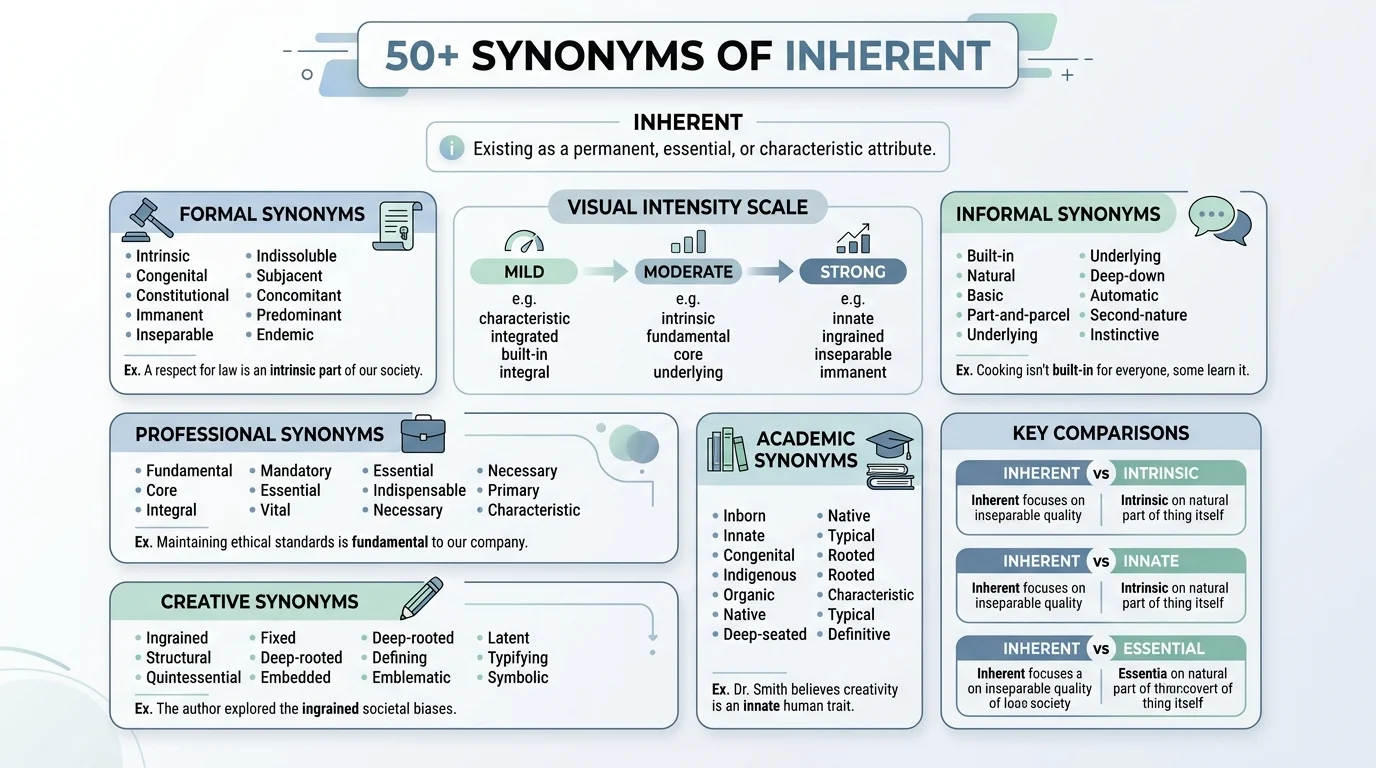
Have you ever found yourself writing an email, an essay, or a social media caption and realized you have used the word “inherent” three times in the same paragraph? You are not alone. Many writers reach for this useful adjective repeatedly because it perfectly describes qualities that naturally belong to something. But relying on the same word too often makes your writing feel repetitive and less engaging. That is exactly why you need to explore the synonyms of inherent. Choosing the right alternative can sharpen your message, match your tone, and make your communication more precise. Whether you are drafting a business report, crafting a college essay, or simply trying to sound more natural in everyday conversation, understanding the full range of synonyms of inherent will transform the way you write and speak.
What Are the Best Synonyms of “Inherent”?
“Inherent” means existing as a natural, permanent, and inseparable part of something. Formal writing, use “intrinsic” or “fundamental.” For casual conversation, choose “built-in” or “natural.” For academic work, “essential” and “constitutional” work well. Professional communication, “integral” and “ingrained” are strong choices.
Meaning, Tone, and Context
Simple Definition
Inherent describes a quality or characteristic that naturally belongs to someone or something and cannot be separated from it. If a feature is inherent, it is part of the very nature of that person, object, or system. You cannot remove it without changing what that thing fundamentally is.
Part of Speech
Inherent is an adjective. It is used to modify nouns and describe qualities that are permanent and essential.
Overall Tone
Inherent is a neutral word. It does not carry strong positive or negative emotion on its own. The tone depends entirely on what quality you are describing. An “inherent risk” sounds negative, while “inherent beauty” sounds positive.
Formality Level
Inherent leans formal. It appears frequently in academic writing, legal documents, business reports, and professional communication. In everyday conversation, native speakers more often use simpler alternatives like “built-in” or “natural.”
Common Uses
Native English speakers commonly use inherent in several contexts:
- Describing risks or dangers: “There is an inherent risk in any investment.”
- Discussing qualities or characteristics: “Kindness was an inherent part of her character.”
- Explaining system features: “The system has inherent limitations.”
- Talking about rights or values: “Access to justice is a basic right.”
Word Forms
- Adjective: inherent
- Adverb: inherently
- Noun: inherence or inherency
When and How to Use “Inherent”
Choose “inherent” when you need to emphasize that a quality is inseparable from the thing you are describing. The word works best when you want to make a strong, confident statement about something being fundamentally part of a person, system, or situation.
Here are seven realistic examples showing how to use inherent in different contexts:
Professional:
“The inherent challenges of this project require us to allocate additional resources.”
Academic:
“The researcher identified several inherent biases in the study’s methodology.”
Workplace:
“Collaboration is inherent to our team’s success.”
Personal:
“Patience is not an inherent trait of mine, but I am working on it.”
Email:
“Please be aware of the inherent delays in the shipping process during the holiday season.”
Resume:
“Developed solutions that addressed the inherent inefficiencies in the supply chain.”
Social Media:
“There is an inherent beauty in capturing candid moments rather than posed photographs.”
Best Synonyms of “Inherent”
No two synonyms are identical in every situation. Each alternative carries its own nuance, tone, and ideal use case. Here are the best synonyms of inherent for specific writing contexts.
Professional Writing
Recommendation: Integral
“Integral” emphasizes that something is essential and necessary for the whole to function properly. It sounds polished and confident in professional settings.
Academic Writing
Recommendation: Intrinsic
“Intrinsic” is more formal and philosophical. It is ideal for research papers and scholarly discussions where precision matters.
Business Communication
Recommendation: Fundamental
“Fundamental” conveys importance and foundational value. It works well in strategy documents and executive summaries.
Casual Conversation
Recommendation: Built-in or Natural
“Built-in” sounds practical and modern. “Natural” is the most basic, everyday term that everyone understands.
Emotional Writing
Recommendation: Deep-rooted
“Deep-rooted” adds emotional weight and suggests something that has grown strong over time. It works well in personal narratives and reflective writing.
Creative Writing
Recommendation: Immanent
“Immanent” has a literary, almost spiritual quality. It suggests something present throughout without being obvious, perfect for descriptive and poetic writing.
Resume Writing
Recommendation: Ingrained
“Ingrained” suggests habits, skills, or qualities that are deeply established through experience. It signals reliability and consistency.
Workplace Communication
Recommendation: Constitutional
“Constitutional” implies something is built into the very structure or makeup of a person or organization. It sounds authoritative and permanent.
Stronger Meaning
Recommendation: Indispensable
“Indispensable” takes inherent to a higher level by adding the idea that the quality is absolutely necessary and cannot be done without.
Softer Meaning
Recommendation: Natural
“Natural” is the mildest and most accessible alternative. It simply means something happens without effort or artificial intervention.
When Not to Use “Inherent”
Too General
Using “inherent” when you mean something more specific can make your writing feel vague and unfocused.
Weak: “There are inherent problems with the system.”
Better: “The system has a fundamental design flaw that causes data corruption.”
Too Vague
“Inherent” does not always provide enough detail about what you actually mean.
Weak: “Her inherent qualities make her a good leader.”
Better: “Her natural ability to listen and her deep-rooted empathy make her an exceptional leader.”
Too Formal
In casual conversation, “inherent” can sound stiff and unnatural.
Too Formal: “There is an inherent enjoyment in spending time with friends.”
More Natural: “There is something naturally enjoyable about hanging out with friends.”
Too Weak
Sometimes “inherent” does not convey the strength or urgency you need.
Too Weak: “Safety is inherent in our company culture.”
Stronger: “Safety is deeply ingrained in every aspect of our company culture.”
Too Strong
Using “inherent” for temporary or changeable qualities is inaccurate.
Incorrect: “His bad mood is inherent to his personality.”
Correct: “His bad mood is temporary and not characteristic of his usual self.”
Words Commonly Confused With “Inherent”
Inherent vs Intrinsic
Difference: Both mean naturally part of something, but “intrinsic” emphasizes essential nature and value, while “inherent” stresses being inseparably attached.
When to Use It: Use “intrinsic” when discussing value, worth, or internal qualities. Use “inherent” for risks, dangers, or characteristics that are inseparable.
Example (inherent): “There is an inherent danger in extreme sports.”
Example (intrinsic): “The diamond’s intrinsic value comes from its rarity.”
Inherent vs Innate
Difference: “Innate” specifically means qualities you are born with and almost always describes people or animals. “Inherent” is broader and can describe any person, thing, situation, or system.
When to Use It: Use “innate” for talents, abilities, or traits that exist from birth. Use “inherent” for any inseparable quality.
Example (inherent): “The inherent beauty of the landscape was breathtaking.”
Example (innate): “She has an innate ability to solve complex problems.”
Inherent vs Essential
Difference: “Essential” means absolutely necessary or indispensable. “Inherent” means naturally present and inseparable. Something can be inherent without being essential, and vice versa.
When to Use It: Use “essential” when you want to emphasize necessity. Use “inherent” when you want to emphasize natural presence.
Example (inherent): “Risk is inherent in entrepreneurship.”
Example (essential): “Good communication is essential for team success.”
Inherent vs Fundamental
Difference: “Fundamental” refers to the foundation or basis of something. “Inherent” refers to qualities that naturally belong. Something fundamental provides the base; something inherent is baked into the nature.
When to Use It: Use “fundamental” for core principles or building blocks. Use “inherent” for natural, inseparable characteristics.
Example (inherent): “The inherent flexibility of the material makes it ideal for this application.”
Example (fundamental): “Honesty is a fundamental principle of our organization.”
Inherent vs Ingrained
Difference: “Ingrained” suggests something that became deeply fixed over time through habit or repeated exposure. “Inherent” suggests something that exists from the beginning by nature.
When to Use It: Use “ingrained” for habits, beliefs, or behaviors that have been reinforced over time. Use “inherent” for natural, original qualities.
Example (inherent): “Curiosity is an inherent trait in young children.”
Example (ingrained): “Her work ethic is so ingrained that she never takes a day off.”
Best Synonyms of “Inherent” by Context
| Context | Best Synonym | Why It Works | Example |
|---|---|---|---|
| Formal writing | Intrinsic | Adds philosophical precision and academic weight | “The intrinsic value of education extends beyond career prospects.” |
| Academic writing | Constitutional | Suggests something built into the fundamental structure | “Doubt is constitutional to the scientific method.” |
| Professional communication | Integral | Emphasizes necessity and seamless connection | “Trust is integral to any successful partnership.” |
| Business emails | Built-in | Sounds practical, modern, and approachable | “Our platform has built-in security features.” |
| Resume writing | Ingrained | Signals deeply established, reliable qualities | “Developed ingrained problem-solving skills through years of complex project management.” |
| Workplace communication | Fundamental | Conveys importance and foundational value | “Respect is fundamental to our workplace culture.” |
| Casual conversation | Natural | Simple, warm, and universally understood | “She has a natural gift for making people feel comfortable.” |
| Everyday speaking | Built-in | Conversational and easy to use | “My phone has a built-in flashlight.” |
| Creative writing | Immanent | Literary and evocative, suggests hidden presence | “A sense of mystery was immanent in the old house.” |
| Storytelling | Deep-rooted | Adds emotional depth and suggests history | “His deep-rooted fear of failure drove every decision.” |
| Emotional writing | Inborn | Personal and intimate, suggests something from birth | “Her inborn compassion guided her life’s work.” |
| Strong emphasis | Indispensable | Adds urgency and absolute necessity | “Critical thinking is indispensable in today’s world.” |
| Mild tone | Natural | Gentle, non-assertive, widely accessible | “There is a natural rhythm to the changing seasons.” |
| Social media captions | Built-in | Short, modern, and relatable | “This place has built-in good vibes.” |
| American English | Built-in | Common in US casual and professional speech | “The software comes with built-in analytics.” |
How to Choose the Best Synonym of “Inherent”
Choosing the right synonym depends on several factors. Here is a practical decision guide to help you select the most effective word every time.
Consider your audience. Are you writing for academics, business professionals, or friends? Formal audiences respond better to “intrinsic” and “fundamental.” Casual audiences prefer “built-in” and “natural.”
Consider your purpose. Are you describing a risk, a value, a habit, or a talent? Use “intrinsic” for value, “ingrained” for habits, “innate” for talents, and “inherent” itself for risks.
Consider your emotional tone. Do you want to sound neutral, warm, or intense? “Natural” is neutral and warm. “Deep-rooted” adds emotional depth. “Indispensable” adds urgency and intensity.
Consider your medium. Is this a tweet, a report, or a novel? Social media calls for “built-in.” Reports benefit from “fundamental” and “integral.” Novels and creative writing welcome “immanent” and “inborn.”
Consider the strength you need. Mild situations call for “natural.” Moderate situations work with “essential.” Strong situations demand “indispensable” or “constitutional.”
The best synonym is the one that communicates your intended message most clearly to your specific audience. When in doubt, read your sentence aloud with each option and choose the one that sounds most natural.
Real Life Examples of “Inherent”
School
“The teacher explained that curiosity is inherent to the learning process, so she encouraged students to ask questions freely.”
College
“The professor challenged us to identify the inherent assumptions in each philosophical argument we studied.”
Workplace
“Adaptability is not inherent to everyone, but it is a skill that can be developed with practice.”
Business
“The inherent volatility of the market means we must maintain flexible investment strategies.”
“I wanted to flag the inherent risks associated with the new vendor before we finalize the contract.”
Resume
“Recognized inherent inefficiencies in the production line and implemented changes that reduced waste by 15 percent.”
Conversation
“I think there is an inherent trust between siblings that you do not find in other relationships.”
Storytelling
“The forest had an inherent wildness that made every visitor feel both alive and insignificant.”
Blogging
“There is an inherent satisfaction in creating something with your own hands, whether it is a meal or a piece of furniture.”
Social Media
“Travel has an inherent way of humbling you and expanding your perspective at the same time.”
18 Best Synonyms of “Inherent”
Synonyms of “Inherent” by Usage
Professional vs Personal Synonyms
In professional settings, choose words that convey confidence and precision. “Integral,” “fundamental,” and “constitutional” signal that you understand the core of a situation. In personal conversations, “natural,” “built-in,” and “inborn” feel warmer and more relatable. “She has a natural kindness” sounds personal and genuine, while “Kindness is integral to her professional approach” sounds polished and workplace-appropriate.
Formal vs Conversational Synonyms
For reports, essays, and business writing, use “intrinsic,” “essential,” and “fundamental.” These words carry authority and academic weight. For casual conversations, texting, and social media, “built-in” and “natural” are the clear winners. Native speakers rarely say “inherent” in casual speech; they say “It is built into the system” or “It comes naturally.”
Academic Synonyms
In research papers, essays, and academic discussions, precision is everything. “Intrinsic” adds philosophical depth. “Constitutional” suggests structural permanence. “Immanent” has a scholarly, theoretical quality. These words signal that you understand the subject at a deep level and can discuss it with authority.
Professional and Business Synonyms
For resumes, interviews, meetings, and client communication, choose words that project competence and reliability. “Integral” shows you understand what is essential. “Fundamental” demonstrates strategic thinking. “Ingrained” signals that your skills or values are deeply established. “Constitutional” suggests that quality is built into the very fabric of how you or your organization operates.
Creative and Literary Synonyms
Storytelling, fiction, poetry, and speeches benefit from expressive, evocative language. “Immanent” adds a mysterious, spiritual quality. “Deep-rooted” adds emotional depth and history. “Inborn” feels intimate and personal. These words create imagery and emotion in ways that more clinical alternatives cannot.
Slang or Modern Synonyms
There is no true slang equivalent for “inherent.” The closest modern alternatives are “built-in” and “hardwired.” “Hardwired” is informal and suggests something programmed into a person or system. It is acceptable in casual conversation and tech contexts but should be avoided in formal or academic writing.
Strongest to Mildest Synonyms
Mild: Natural, built-in
Moderate: Essential, fundamental, integral
Strong: Intrinsic, ingrained, constitutional
Very Strong: Indispensable, inalienable
As you move down this scale, the emotional intensity and sense of permanence increase. “Natural” simply means something happens without effort. “Indispensable” means the quality is absolutely necessary and cannot be removed.
Emotional vs Neutral Synonyms
Emotional Synonyms: Deep-rooted, inborn, instinctive. These words add warmth, personal connection, and emotional resonance. Use them in personal writing, narratives, and when you want to connect with readers on an emotional level.
Neutral Synonyms: Intrinsic, fundamental, constitutional, integral. These words simply communicate information without adding emotion. Use them in reports, academic papers, and professional documents where objectivity matters.
Antonyms of “Inherent”
Comparison: “Inherent” vs Similar Words
Inherent vs Intrinsic
Main Difference: “Intrinsic” emphasizes essential nature and value from within. “Inherent” emphasizes being inseparably attached to something.
Which Is Stronger? Both are strong, but “intrinsic” often carries more philosophical weight.
Which Is More Formal? “Intrinsic” is slightly more formal and academic.
When to Use Each: Use “intrinsic” for value, worth, and internal qualities. Use “inherent” for risks, dangers, and inseparable characteristics.
Examples:
Inherent: “There is an inherent risk in any surgical procedure.”
Intrinsic: “The intrinsic value of education goes beyond earning potential.”
Inherent vs Innate
Main Difference: “Innate” applies almost exclusively to living beings and qualities present from birth. “Inherent” applies to anything—people, things, systems, situations.
Which Is Stronger? “Innate” feels more personal and biologically rooted.
Which Is More Formal? Both are formal, but “innate” is more specialized.
When to Use Each: Use “innate” for natural-born talents and traits in people or animals. Use “inherent” for any inseparable quality in any context.
Examples:
Inherent: “The inherent flexibility of the material makes it useful.”
Innate: “Birds have an innate ability to navigate during migration.”
Inherent vs Essential
Main Difference: “Essential” means absolutely necessary. “Inherent” means naturally present. Something can be inherent but not essential.
Which Is Stronger? “Essential” is stronger because it implies necessity.
Which Is More Formal? Both are formal and widely used in professional writing.
When to Use Each: Use “essential” when you need to emphasize that something cannot be done without. Use “inherent” when you want to emphasize natural presence.
Examples:
Inherent: “There is an inherent tension between speed and quality.”
Essential: “Accuracy is essential in medical diagnosis.”
Inherent vs Fundamental
Main Difference: “Fundamental” refers to the foundation or basis. “Inherent” refers to natural, inseparable qualities.
Which Is Stronger? “Fundamental” suggests foundational importance.
Which Is More Formal? Both are formal and appropriate in academic and professional contexts.
When to Use Each: Use “fundamental” for core principles, building blocks, and foundational elements. Use “inherent” for natural characteristics.
Examples:
Inherent: “Risk is inherent to investing.”
Fundamental: “Trust is fundamental to any relationship.”
Inherent vs Ingrained
Main Difference: “Ingrained” suggests something fixed over time through habit or repetition. “Inherent” suggests something present from the beginning by nature.
Which Is Stronger? Both are strong, but “ingrained” implies a process of becoming fixed.
Which Is More Formal? Both are formal enough for professional writing.
When to Use Each: Use “ingrained” for habits, beliefs, and behaviors developed over time. Use “inherent” for natural, original qualities.
Examples:
Inherent: “Curiosity is inherent in children.”
Ingrained: “Her habit of arriving early is deeply ingrained.”
Inherent vs Implicit
Main Difference: “Implicit” means implied but not directly expressed. “Inherent” means naturally present and inseparable.
Which Is Stronger? “Inherent” is stronger because it asserts actual presence, not just implication.
Which Is More Formal? Both are formal and commonly used in academic writing.
When to Use Each: Use “implicit” when something is understood without being stated. Use “inherent” when something is naturally part of something else.
Examples:
Inherent: “The inherent dangers of the job are well documented.”
Implicit: “There is an implicit understanding that we will support each other.”
Common Phrases and Expressions with “Inherent”
inherent risk
Meaning: A danger that naturally exists as part of an activity or situation.
Example Sentence: “Every investment carries an inherent risk of loss.”
inherent in
Meaning: Naturally part of something; inseparable from it.
Example Sentence: “There are challenges inherent in any major life change.”
inherent to
Meaning: Belonging naturally to something (less common than “inherent in” but still used).
Example Sentence: “The ability to adapt is inherent to successful organizations.”
inherent quality
Meaning: A characteristic that naturally belongs to someone or something.
Example Sentence: “Patience is an inherent quality of good teachers.”
inherent value
Meaning: Worth that exists naturally without needing to be added.
Example Sentence: “The inherent value of kindness cannot be overstated.”
inherent weakness
Meaning: A natural flaw or limitation.
Example Sentence: “The design has an inherent weakness that makes it vulnerable to cracking.”
inherent bias
Meaning: A prejudice that naturally exists within a system or person.
Example Sentence: “We must acknowledge the inherent bias in any survey methodology.”
Common Mistakes to Avoid
1: Confusing “inherent” with “inherited”
Incorrect: “She has an inherent talent for music from her mother.”
Better: “She has an innate talent for music from her mother.”
Why: “Inherited” means received from parents through genes. “Inherent” means naturally part of something. For talents passed down, use “innate” or “inherited.”
2: Using the wrong preposition
Incorrect: “This problem is inherent with all large systems.”
Better: “This problem is inherent in all large systems.”
Why: “Inherent” takes the preposition “in,” not “with.”
3: Using “inherent” for temporary qualities
Incorrect: “His bad mood is inherent to his personality.”
Better: “His bad mood is temporary and uncharacteristic.”
Why: Inherent qualities are permanent and inseparable. Temporary states do not qualify.
4: Choosing a vague synonym
Incorrect: “There are inherent issues with the plan.” (vague)
Better: “There are fundamental flaws in the plan’s logic.” (specific)
Why: Vague language weakens your message. Choose precise alternatives that clarify what you mean.
5: Using informal synonyms in formal writing
Incorrect (academic paper): “The study has built-in problems.”
Better: “The study has intrinsic methodological limitations.”
Why: “Built-in” is too casual for academic or professional writing.
6: Using “inherent” when you mean “obvious”
Incorrect: “It is inherent that she is qualified.”
Better: “It is obvious that she is qualified.”
Why: “Inherent” describes natural qualities, not obviousness.
7: Overusing “inherent” in a single piece of writing
Incorrect: Using “inherent” five times in one paragraph.
Better: Vary your language with synonyms like “intrinsic,” “fundamental,” and “natural.”
Why: Repetition makes writing dull. Synonyms keep your reader engaged.
Frequently Asked Questions
1. What are the best synonyms of “inherent”?
The best synonyms depend on your context. Formal writing, use “intrinsic” or “fundamental.” For casual conversation, use “built-in” or “natural.” Academic work, choose “essential” or “constitutional.” For professional settings, “integral” and “ingrained” work well.
2. What are the best formal synonyms of “inherent”?
The best formal synonyms are “intrinsic,” “fundamental,” “essential,” and “constitutional.” These words carry academic and professional weight. They appear frequently in research papers, business reports, and legal documents where precision and authority matter.
3. What are common informal synonyms of “inherent”?
The most common informal synonyms are “built-in” and “natural.” Native speakers use these words in everyday conversation, social media, and casual writing. “Hardwired” is another informal option, especially in tech contexts.
4. What is another word for “inherent” in professional writing?
“Integral” is an excellent choice for professional writing. It emphasizes that something is essential and necessary for the whole to function. “Fundamental” and “constitutional” also work well in business and workplace communication.
5. What is the difference between “inherent” and “intrinsic”?
“Inherent” emphasizes that a quality is inseparably attached to something. “Intrinsic” emphasizes essential nature and value from within. Use “inherent” for risks and characteristics. Use “intrinsic” for value and worth.
6. What is the opposite of “inherent”?
The primary opposite of “inherent” is “extrinsic,” meaning coming from outside. Other antonyms include “acquired,” “incidental,” “external,” “added,” and “superficial.” These words describe qualities that are not naturally part of something.
Conclusion
“Inherent” is a powerful adjective that describes qualities naturally and permanently part of something. Whether you are writing a business report, an academic paper, or a personal email, understanding the full range of synonyms of inherent will make your communication clearer and more engaging. No single synonym works perfectly in every situation. The best choice depends on your audience, your purpose, and the tone you want to convey. Formal contexts, reach for “intrinsic” or “fundamental.” For casual conversations, “built-in” and “natural” are your friends. For professional settings, “integral” and “ingrained” project confidence and reliability. The next time you reach for “inherent,” pause and consider whether one of its many synonyms might serve you better. Your readers will notice the difference.