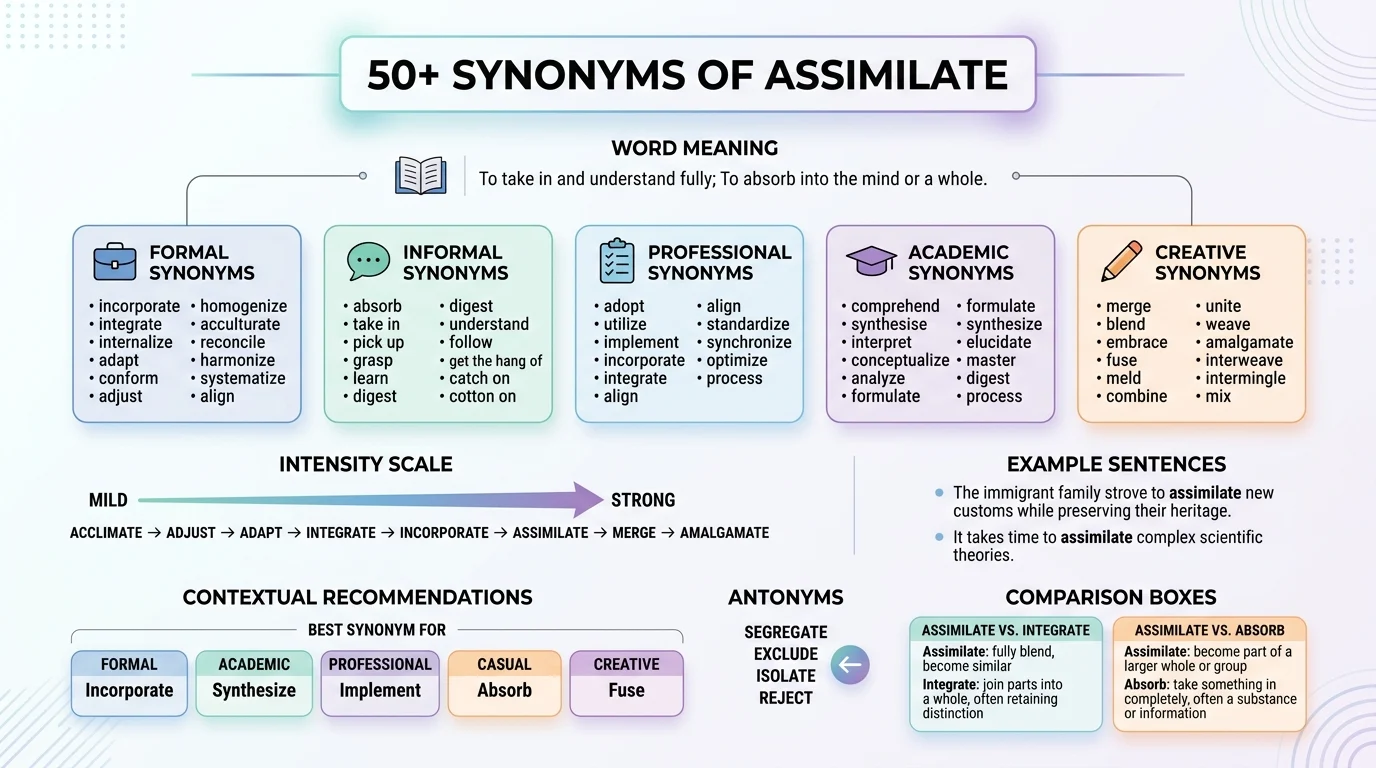
Have you ever caught yourself using the same word over and over in an email, an essay, or a social media caption? Maybe you wrote “assimilate” three times in one paragraph and realized it sounded repetitive and dull. Finding the right synonyms of assimilate can transform your writing from clunky to clear and professional.
The word “assimilate” appears frequently in academic papers, business reports, and everyday conversation. But using it in every situation often makes your language feel stiff or vague. This guide will help you understand what assimilate really means, when to use it, and which synonym fits each context perfectly. By the end, you will confidently choose the most precise word for your audience, whether you are writing a resume, an email, or a novel.
What Are the Best Synonyms of “Assimilate”?
Assimilate means to absorb, understand, or fully integrate something into a larger whole. The best synonyms depend on your context. Formal writing, choose “incorporate” or “integrate.” For casual conversation, use “absorb” or “take in.” For professional communication, “adopt” or “assimilate” itself often works best when used sparingly.
Meaning, Tone, and Context
Simple Definition
To assimilate means to take in information, ideas, or cultural practices and make them part of your own understanding or way of life. It can also refer to a group or individual becoming part of a larger society.
Part of Speech
Assimilate is primarily a verb. It can be transitive (taking an object) or intransitive (without an object). For example, “She assimilated the new information” versus “The immigrants assimilated quickly.”
Overall Tone
Assimilate is a neutral word. It does not carry strong positive or negative emotions by itself. However, the context can give it a positive tone, such as when someone successfully adapts to a new culture, or a more neutral tone, such as when the body absorbs nutrients.
Formality Level
Assimilate sits in the semi-formal to formal range. You will find it in academic writing, professional reports, and news articles. It is less common in casual conversation, where people prefer simpler words like “absorb” or “pick up.”
Common Uses
Native English speakers use assimilate in three main ways:
- Cultural or social contexts: Describing how people or groups blend into a new society.
- Intellectual or learning contexts: Describing how someone absorbs and understands new information or ideas.
- Biological or scientific contexts: Describing how the body takes in nutrients or other substances.
Word Forms
- Noun: assimilation
- Adjective: assimilative
- Adverb: assimilatively
- Related form: assimilable (capable of being assimilated)
- Opposite form: dissimilate (to make or become dissimilar)
When and How to Use “Assimilate”
Choose “assimilate” when you want to describe a process of absorption that leads to full integration. It works best when the subject becomes part of a larger whole, whether that is a society, a body of knowledge, or an organization.
Here are seven realistic examples showing how to use assimilate in different contexts.
Professional Context
“New hires need time to assimilate the company’s culture and workflow before they can work independently.”
Academic Context
“Students must assimilate complex theories before they can apply them to real-world problems.”
Workplace Context
“Our team has assimilated the new software update with minimal disruption to daily operations.”
Personal Context
“Moving to a new city was challenging, but I slowly assimilated the local customs and routines.”
Email Context
“Please take a moment to assimilate the attached report before our meeting on Thursday.”
Resume Context
“Quickly assimilated new market data to develop a targeted sales strategy that increased revenue by 15%.”
Social Media Context
“Traveling abroad helps you assimilate different perspectives and broaden your worldview.”
Best Synonyms of “Assimilate”
No synonym is identical in every situation. The right choice depends on your audience, tone, and purpose. Here are the best synonyms for specific contexts.
Professional Writing: “Integrate” works best because it emphasizes combining parts into a cohesive whole without losing individual identity. It sounds collaborative and strategic.
Academic Writing: “Incorporate” is ideal for research and essays because it suggests adding new material into an existing framework in a structured way.
Business Communication: “Adopt” conveys a deliberate choice to accept and use new methods or ideas, which fits decision-making contexts.
Casual Conversation: “Absorb” feels natural and easy to understand. It suggests taking something in without overthinking it.
Emotional Writing: “Embrace” adds warmth and willingness, making it perfect for personal narratives or persuasive pieces.
Creative Writing: “Merge” or “blend” create vivid imagery of things coming together, which works well in storytelling.
Resume Writing: “Adopt” or “integrate” show proactive learning and adaptability, which employers value.
Workplace Communication: “Incorporate” signals that you are adding new elements into existing processes in a practical way.
Stronger Meaning: “Internalize” suggests a deeper, more personal level of absorption, where something becomes part of your thinking or identity.
Softer Meaning: “Acclimate” focuses on gradual adjustment rather than full absorption, which feels gentler and less absolute.
When Not to Use “Assimilate”
Knowing when to avoid “assimilate” is just as important as knowing when to use it.
When the word sounds too general: If you are describing a specific action, “assimilate” might be too vague. For example, “He assimilated the instructions” does not tell the reader whether he understood them, memorized them, or applied them. A better choice: “He internalized the instructions and followed them precisely.”
When the word sounds too formal: In casual conversation or text messages, “assimilate” can feel stiff and out of place. For example, “I assimilated what you said” sounds unnatural. A better choice: “I got what you said” or “I took in what you said.”
When the word sounds too informal: In very formal academic or legal writing, “assimilate” may not carry enough weight. For example, “The court assimilated the evidence” sounds weak. A better choice: “The court incorporated the evidence into its ruling.”
When the word sounds too weak: If you want to emphasize complete understanding or integration, “assimilate” might not feel strong enough. For example, “She assimilated the new policy” does not convey mastery. A better choice: “She mastered the new policy” or “She fully integrated the new policy into her workflow.”
When the word sounds too strong: If you are describing a superficial or temporary adjustment, “assimilate” implies too much permanence. For example, “He assimilated the local customs during his two-week trip” sounds exaggerated. A better choice: “He adapted to the local customs during his two-week trip.”
When the word is outdated: Assimilate remains current, but in some contexts, especially around cultural integration, it can carry historical baggage. Some prefer “integrate” to avoid connotations of forced conformity.
Words Commonly Confused With “Assimilate”
Assimilate vs. Absorb
- Difference: Absorb suggests taking something in, but not necessarily making it part of yourself. Assimilate implies full integration.
- When to Use It: Use “absorb” when you want to emphasize the intake process rather than the integration.
- Example: “She absorbed the information quickly but needed time to assimilate it into her existing knowledge.”
Vs. Integrate
- Difference: Integrate focuses on combining parts into a whole while preserving some distinctiveness. Assimilate often implies that the absorbed part becomes indistinguishable from the whole.
- When to Use It: Use “integrate” when you want to emphasize harmony and inclusion without loss of identity.
- Example: “The new department was integrated into the company structure, but it retained its unique culture.”
Assimilate vs. Incorporate
- Difference: Incorporate emphasizes adding something as a new part of an existing whole. Assimilate emphasizes the process of becoming similar to or part of that whole.
- When to Use It: Use “incorporate” when you are adding a new element to an existing system.
- Example: “We will incorporate your feedback into the final report.”
Vs. Adapt
- Difference: Adapt focuses on changing to fit new conditions. Assimilate focuses on becoming part of a new whole.
- When to Use It: Use “adapt” when you are describing adjustments made in response to change.
- Example: “The team adapted quickly to the new software, but fully assimilating it into their workflow took longer.”
Vs. Digest
- Difference: Digest suggests breaking something down to understand it, often in a learning context. Assimilate suggests making it part of your knowledge or identity.
- When to Use It: Use “digest” when you are describing the mental process of understanding complex information.
- Example: “I need time to digest this chapter before I can assimilate its main arguments.”
Assimilate vs. Acculturate
- Difference: Acculturate specifically refers to adopting the cultural traits of another group. Assimilate is broader and can apply to ideas, nutrients, and social contexts.
- When to Use It: Use “acculturate” in anthropological or sociological contexts.
- Example: “The immigrants acculturated over several generations while maintaining some traditions.”
Best Synonyms of “Assimilate” by Context
| Context | Best Synonym | Why It Works | Example |
|---|---|---|---|
| Formal writing | Incorporate | Sounds structured and deliberate | “The committee will incorporate the new findings into the policy.” |
| Academic writing | Integrate | Emphasizes combining knowledge systematically | “Researchers integrated data from multiple sources.” |
| Professional communication | Adopt | Signals a strategic choice | “We adopted the new project management system.” |
| Business emails | Incorporate | Clear and action-oriented | “Please incorporate these changes into the final draft.” |
| Resume writing | Internalize | Shows deep learning and personal growth | “Internalized complex regulatory frameworks to ensure compliance.” |
| Workplace communication | Integrate | Highlights teamwork and collaboration | “The new hire integrated well with the sales team.” |
| Casual conversation | Absorb | Simple and natural | “I’m still absorbing everything from the meeting.” |
| Everyday speaking | Take in | Very common and easy to understand | “It took me a while to take in all the details.” |
| Creative writing | Merge | Creates vivid imagery of combination | “The two storylines merge in the final chapter.” |
| Storytelling | Blend | Evokes smooth, natural combination | “Her experiences blended into a rich worldview.” |
| Emotional writing | Embrace | Adds warmth and willingness | “She embraced the new culture with open arms.” |
| Strong emphasis | Internalize | Suggests complete personal adoption | “He internalized the company’s values completely.” |
| Mild tone | Acclimate | Focuses on gradual adjustment | “New students need time to acclimate to campus life.” |
| Social media captions | Absorb | Short, punchy, and relatable | “Still absorbing all the amazing views from my trip.” |
How to Choose the Best Synonym of “Assimilate”
Choosing the right synonym starts with understanding your purpose. Ask yourself these questions.
What is your meaning? Are you describing cultural integration, learning, or physical absorption? Each meaning has its own best synonyms.
What is your tone? Formal writing calls for “incorporate” or “integrate.” Casual conversation works better with “absorb” or “take in.”
Who is your audience? Professionals appreciate precise words like “adopt” and “internalize.” General readers prefer simpler words like “absorb.”
How much emotional strength do you need? “Embrace” adds warmth. “Internalize” adds depth. “Absorb” stays neutral.
What is your writing purpose? Resumes benefit from action-oriented synonyms like “integrated.” Academic papers need precise synonyms like “incorporated.” Creative writing thrives on vivid synonyms like “merged.”
What level of formality fits? Match your word to the formality of your document. A business report needs formal synonyms. A text message needs informal ones.
Does it sound natural? Read your sentence aloud. If the synonym feels forced or awkward, choose a different one.
The goal is not to impress with big words. The goal is to communicate your message as clearly as possible.
Real Life Examples of “Assimilate”
School
“The teacher paused to let the students assimilate the new concept before moving on.”
College
“Freshmen often struggle to assimilate the volume of reading required in their first semester.”
Workplace
“Our department has assimilated the new quality control procedures without any major issues.”
Business
“The merger required both companies to assimilate each other’s operational practices.”
“I need a few days to assimilate the proposal before I can give you my feedback.”
Resume
“Assimilated customer feedback to improve product design and increase satisfaction scores.”
Conversation
“It’s going to take me a while to assimilate everything that happened today.”
Storytelling
“The village slowly assimilated the travelers’ customs until they became part of local tradition.”
Blogging
“When you travel, you assimilate new perspectives that change how you see the world.”
“Still assimilating all the wisdom from this incredible conference.”
Now, see how replacing “assimilate” with a stronger synonym improves these sentences.
Weak: “She assimilated the new software.”
Strong: “She mastered the new software in two weeks.”
Weak: “The team assimilated the feedback.”
Strong: “The team incorporated the feedback into their revised plan.”
Weak: “He assimilated the local culture.”
Strong: “He embraced the local culture and made it his own.”
18 Best Synonyms of “Assimilate”
| Synonym | Simple Meaning | Best Used For | Example Sentence |
|---|---|---|---|
| Absorb | To take something in | Casual and general use | “The sponge absorbed the water quickly.” |
| Integrate | To combine into a whole | Professional and academic writing | “We need to integrate these two systems.” |
| Incorporate | To add as a new part | Business and formal documents | “Let’s incorporate these ideas into the proposal.” |
| Adopt | To choose and use as your own | Professional and personal decisions | “The company adopted a new remote work policy.” |
| Internalize | To make something part of your thinking | Deep learning and personal growth | “He internalized the lessons from his mentor.” |
| Digest | To mentally process and understand | Learning and information processing | “I need time to digest this complex report.” |
| Embrace | To accept willingly with enthusiasm | Emotional and persuasive writing | “She embraced the challenge with confidence.” |
| Merge | To combine into one | Creative and descriptive writing | “The two companies merged to form a giant corporation.” |
| Blend | To mix smoothly together | Creative and everyday language | “The new employee blended into the team effortlessly.” |
| Acclimate | To adjust to new conditions | Gradual adaptation contexts | “New students need time to acclimate to college life.” |
| Acculturate | To adopt the culture of another group | Anthropological and sociological contexts | “The immigrants acculturated over several generations.” |
| Naturalize | To become a citizen or make something native | Citizenship and legal contexts | “He was naturalized after five years of residency.” |
| Homogenize | To make uniform or similar | Technical and formal contexts | “Globalization tends to homogenize local cultures.” |
| Ingest | To take in food or information | Scientific and literal contexts | “The body ingests nutrients through digestion.” |
| Comprehend | To understand fully | Academic and intellectual contexts | “She comprehended the theory after extensive study.” |
| Grasp | To understand or seize mentally | Conversational and learning contexts | “I finally grasp the main concept.” |
| Take in | To absorb or understand | Casual and everyday conversation | “It was a lot to take in at once.” |
| Appropriate | To take something for your own use | Formal and sometimes legal contexts | “The committee appropriated the funds for the new project.” |
Synonyms of “Assimilate” by Usage
Professional vs Personal Synonyms
In professional settings, choose words that sound strategic and deliberate. “Integrate,” “incorporate,” and “adopt” work well in business reports, emails, and presentations. They signal that you are making thoughtful decisions.
In personal conversations, simpler words like “absorb,” “take in,” and “pick up” feel more natural. They do not sound stiff or overly formal.
Formal vs Conversational Synonyms
Formal synonyms for reports, essays, and business writing include:
- Incorporate
- Integrate
- Internalize
- Acculturate
- Naturalize
- Homogenize
Conversational synonyms for casual conversations and texting include:
- Absorb
- Take in
- Get
- Pick up
- Soak in
Academic Synonyms
Academic writing demands precision and authority. These synonyms work well in research papers, essays, and scholarly discussions.
- Integrate: Combines sources or ideas into a coherent argument.
- Incorporate: Adds new material into an existing framework.
- Internalize: Suggests deep, personal understanding.
- Comprehend: Emphasizes full intellectual grasp.
- Acculturate: Specific to cultural adoption in social sciences.
- Appropriate: Used in formal contexts to describe taking or adopting.
Professional and Business Synonyms
These synonyms strengthen resumes, interviews, meetings, and client communication.
- Integrate: Shows you can combine new information with existing knowledge.
- Adopt: Demonstrates proactive decision-making.
- Incorporate: Signals practical application.
- Internalize: Suggests deep commitment and understanding.
- Embrace: Adds a positive, can-do attitude.
Creative and Literary Synonyms
For storytelling, fiction, poetry, and descriptive writing, these synonyms add emotion and imagery.
- Merge: Creates a sense of unity and fusion.
- Blend: Evokes smooth, natural combination.
- Embrace: Adds warmth and emotional depth.
- Absorb: Can be used metaphorically to create vivid images.
- Take in: Works well in descriptive passages.
Slang or Modern Synonyms
Assimilate does not have widely used slang equivalents. In very casual contexts, people might say “get” or “pick up” instead. For example, “I’m still getting the hang of it” or “I picked up the basics quickly.” Avoid slang in formal or professional writing.
Strongest to Mildest Synonyms
Mild
- Acclimate (gradual adjustment)
- Adapt (changing to fit)
- Take in (simple absorption)
Moderate
- Absorb (taking in without full integration)
- Adopt (choosing to use)
- Incorporate (adding as a part)
Strong
- Integrate (combining into a whole)
- Internalize (making part of yourself)
- Digest (fully processing)
Very Strong
- Merge (becoming one)
- Homogenize (making uniform)
- Acculturate (complete cultural adoption)
Emotional vs Neutral Synonyms
Emotional Synonyms express stronger feelings or attitudes.
- Embrace (enthusiasm and willingness)
- Internalize (deep personal commitment)
- Merge (unity and connection)
Neutral Synonyms simply communicate information.
- Incorporate
- Integrate
- Absorb
- Adopt
- Digest
Use emotional synonyms when you want to persuade or connect with your reader on a personal level. Use neutral synonyms when you need to remain objective and professional.
Antonyms of “Assimilate”
| Antonym | Meaning | Example Sentence |
|---|---|---|
| Segregate | To separate from others | “The policy tended to segregate new immigrants from the community.” |
| Exclude | To leave out or keep out | “The new rules excluded many small businesses from the program.” |
| Separate | To divide or keep apart | “The two groups remained separate despite efforts to integrate them.” |
| Alienate | To make someone feel isolated | “The rigid rules alienated many employees.” |
| Dissimilate | To make or become dissimilar | “Over time, the two dialects dissimilated from each other.” |
| Isolate | To set apart from others | “The remote village remained isolated from modern influences.” |
| Distinguish | To recognize as different | “It is important to distinguish between facts and opinions.” |
| Differentiate | To show or recognize a difference | “The course helps students differentiate between similar concepts.” |
| Divide | To separate into parts | “The debate divided the community into two opposing camps.” |
| Detach | To separate or disconnect | “He detached himself from the group’s activities.” |
| Disconnect | To break a connection | “The new policy disconnected the department from central operations.” |
| Reject | To refuse to accept | “The committee rejected the proposed changes.” |
| Resist | To oppose or refuse to comply | “Some employees resisted the new procedures.” |
| Shun | To deliberately avoid | “The community shunned outsiders for generations.” |
| Discriminate | To recognize a distinction | “The law should not discriminate against any group.” |
Comparison: “Assimilate” vs Similar Words
Assimilate vs Integrate
Main Difference
Assimilate implies that the absorbed element becomes indistinguishable from the whole. Integrate implies that elements combine while retaining some distinct identity.
Which Is Stronger?
Assimilate is stronger because it suggests complete absorption.
Which Is More Formal?
Both are formal, but integrate is more common in professional and academic writing.
When to Use Each
Use assimilate when you want to emphasize full blending. Use integrate when you want to emphasize harmony and inclusion.
Examples
Assimilate: “The new employees assimilated into the company culture within months.”
Integrate: “The new department was integrated into the company structure.”
Assimilate vs Incorporate
Main Difference
Incorporate focuses on adding something as a new part. Assimilate focuses on the process of becoming part of a whole.
Which Is Stronger?
Assimilate is stronger because it implies deeper integration.
Which Is More Formal?
Both are formal. Incorporate is slightly more common in business writing.
When to Use Each
Use incorporate when you are adding an element to an existing system. Use assimilate when you are describing the process of becoming part of that system.
Examples
Assimilate: “The students assimilated the new material over several weeks.”
Incorporate: “The teacher incorporated the new material into the lesson plan.”
Assimilate vs Absorb
Main Difference
Absorb suggests taking something in without necessarily making it part of yourself. Assimilate implies full integration.
Which Is Stronger?
Assimilate is stronger because it implies a more complete process.
Which Is More Formal?
Assimilate is more formal. Absorb works in both formal and casual contexts.
When to Use Each
Use absorb when you want to describe the intake process. Use assimilate when you want to describe the outcome of that process.
Examples
Assimilate: “She assimilated the new information and changed her approach.”
Absorb: “She absorbed the new information but hasn’t applied it yet.”
Assimilate vs Adapt
Main Difference
Adapt focuses on changing to fit new conditions. Assimilate focuses on becoming part of a new whole.
Which Is Stronger?
Assimilate is stronger because it implies a more complete transformation.
Which Is More Formal?
Both are moderately formal. Adapt is slightly more common in everyday language.
When to Use Each
Use adapt when you are describing adjustments. Use assimilate when you are describing integration.
Examples
Assimilate: “The immigrants assimilated into American society.”
Adapt: “The immigrants adapted to the American climate.”
Assimilate vs Digest
Main Difference
Digest focuses on the mental process of breaking down and understanding information. Assimilate focuses on making that information part of your knowledge or identity.
Which Is Stronger?
Assimilate is stronger because it implies a more complete integration.
Which Is More Formal?
Both are moderately formal. Digest is common in both academic and casual contexts.
When to Use Each
Use digest when you are describing the initial understanding process. Use assimilate when you are describing the lasting integration.
Examples
Assimilate: “He assimilated the principles of economics into his thinking.”
Digest: “He needed time to digest the dense economics textbook.”
Assimilate vs Embrace
Main Difference
Embrace implies enthusiastic acceptance. Assimilate is neutral and does not imply emotion.
Which Is Stronger?
Embrace is emotionally stronger. Assimilate is stronger in terms of integration.
Which Is More Formal?
Assimilate is more formal. Embrace is common in both formal and informal writing.
When to Use Each
Use embrace when you want to add warmth or enthusiasm. Use assimilate when you want to remain neutral and objective.
Examples
Assimilate: “The company assimilated the new technology.”
Embrace: “The company embraced the new technology with enthusiasm.”
Common Phrases and Expressions with “Assimilate”
Assimilate into
Meaning: To become part of a group or society.
Example Sentence: “It took him several years to assimilate into his new community.”
Assimilate to
Meaning: To become similar to something else.
Example Sentence: “The immigrant community gradually assimilated to the local customs.”
Assimilate with
Meaning: To become similar to or compatible with something.
Example Sentence: “The new software assimilates with our existing systems seamlessly.”
Assimilate information
Meaning: To absorb and understand information.
Example Sentence: “Students need time to assimilate information before they can apply it.”
Assimilate knowledge
Meaning: To absorb and integrate knowledge into one’s understanding.
Example Sentence: “The course helps students assimilate knowledge from multiple disciplines.”
Assimilate culture
Meaning: To adopt the cultural practices of another group.
Example Sentence: “Traveling abroad helps you assimilate new cultures.”
Assimilate nutrients
Meaning: To absorb nutrients into the body.
Example Sentence: “The body assimilates nutrients more effectively from whole foods.”
Common Mistakes to Avoid
1: Choosing a vague synonym instead of a precise one
Incorrect: “The team assimilated the feedback.”
Better: “The team incorporated the feedback into their revised strategy.”
Why: “Incorporated” is more specific about how the feedback was used.
2: Confusing assimilate with absorb
Incorrect: “She assimilated the information but didn’t understand it.”
Better: “She absorbed the information but didn’t fully understand it.”
Why: Absorb describes taking in; assimilate implies full understanding and integration.
3: Using an informal synonym in formal writing
Incorrect: “The committee took in the new proposal.”
Better: “The committee incorporated the new proposal into its agenda.”
Why: “Took in” sounds too casual for formal contexts.
4: Selecting an overly dramatic synonym
Incorrect: “The team embraced the new software.”
Better: “The team adopted the new software.”
Why: “Embraced” implies enthusiasm that may not be accurate.
5: Repeating the same word too often
Incorrect: “The company assimilated the new policy. Employees assimilated the changes quickly.”
Better: “The company adopted the new policy. Employees integrated the changes quickly.”
Why: Varying synonyms improves readability and sounds more natural.
6: Choosing a synonym with the wrong emotional tone
Incorrect: “The committee embraced the new regulations.”
Better: “The committee accepted the new regulations.”
Why: “Embraced” suggests enthusiasm that may not be appropriate for regulations.
7: Using slang in academic or professional writing
Incorrect: “The students got the concepts quickly.”
Better: “The students assimilated the concepts quickly.”
Why: “Got” is too informal for academic writing.
Frequently Asked Questions
1. What are the best synonyms of “assimilate”?
The best synonyms depend on your context. Formal writing, use “incorporate” or “integrate.” For casual conversation, use “absorb” or “take in.” For professional communication, use “adopt” or “internalize.”
2. What are the best formal synonyms of “assimilate”?
The best formal synonyms include “incorporate,” “integrate,” “internalize,” “acculturate,” “naturalize,” and “homogenize.” These words sound authoritative and precise in academic and professional writing.
3. What are common informal synonyms of “assimilate”?
Common informal synonyms include “absorb,” “take in,” “pick up,” “get,” and “soak in.” These words work well in casual conversation, text messages, and social media posts.
4. What is another word for “assimilate” in professional writing?
In professional writing, “integrate” and “incorporate” are excellent alternatives. “Adopt” also works well when describing the acceptance of new policies or methods. These words sound strategic and deliberate.
5. What is the difference between “assimilate” and “integrate”?
Assimilate implies that the absorbed element becomes indistinguishable from the whole. Integrate implies that elements combine while retaining some distinct identity. Assimilate is stronger; integrate is more about harmony.
6. What is the opposite of “assimilate”?
The opposite of assimilate includes “segregate,” “exclude,” “separate,” “alienate,” “isolate,” and “dissimilate.” These words describe keeping things apart or making them different rather than bringing them together.
Conclusion
Assimilate means to absorb, understand, or fully integrate something into a larger whole. It is a versatile word that appears in academic, professional, and everyday contexts. But no single synonym works perfectly in every situation.
The best synonyms of assimilate depend on your audience, tone, and purpose. Formal writing, choose “incorporate” or “integrate.” For casual conversation, use “absorb” or “take in.” Professional communication, “adopt” or “internalize” work well. For creative writing, “merge” or “blend” add vivid imagery.
The key to strong writing is choosing the word that communicates your message most clearly. Do not force a synonym that sounds unnatural. Trust your ear and consider your reader.
One practical tip: before you write, ask yourself what you really mean. Are you describing absorption, integration, adoption, or understanding? Once you know your precise meaning, the right synonym will follow.
Definitions, meanings, and usage recommendations should be verified with trusted language references before publication. Recommended sources include Cambridge Dictionary, Oxford English Dictionary, Merriam Webster, Collins Dictionary, and Britannica.