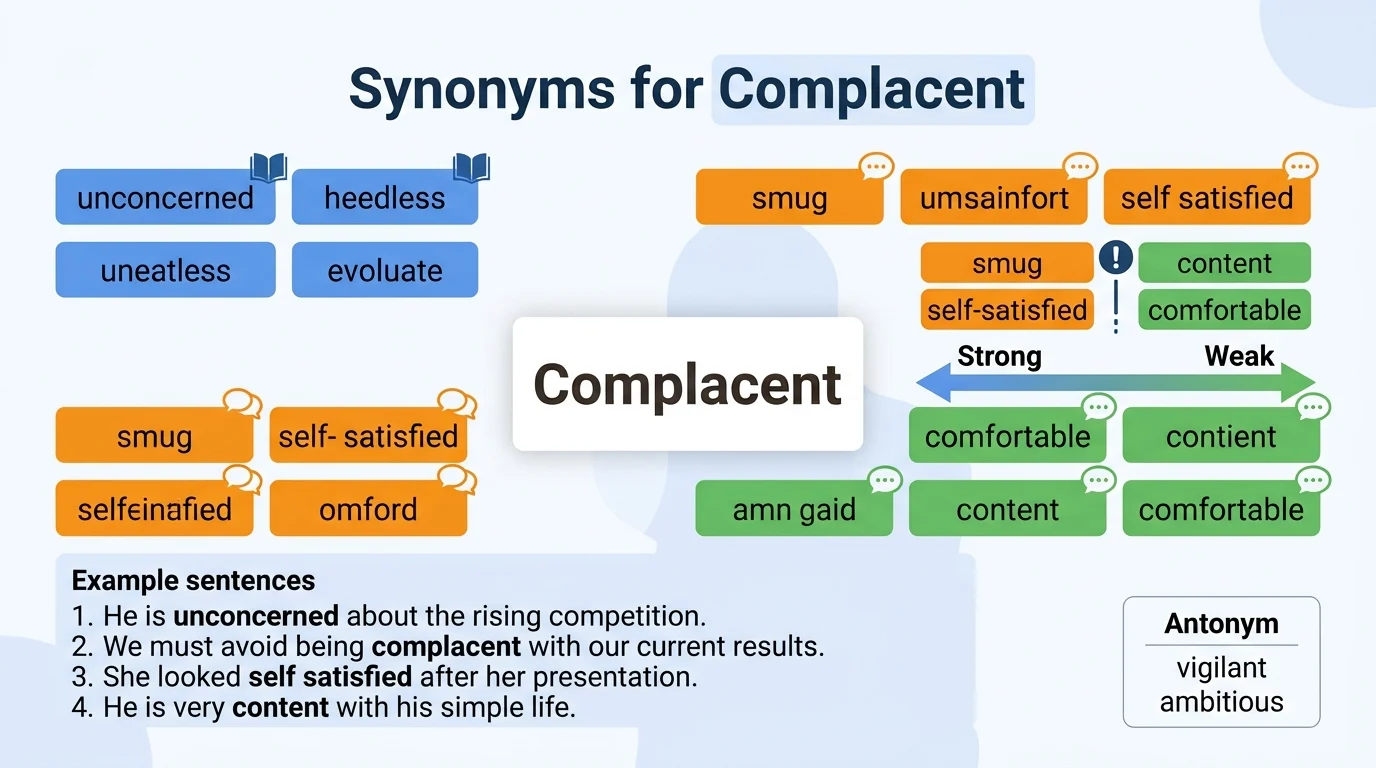
You are writing a performance review and describe an employee as complacent. But does that word truly capture what you mean? Perhaps you want to say they are satisfied, relaxed, or even unaware. English offers many alternatives, each with a distinct shade of meaning.
This guide helps you choose the right synonym for every situation. Whether you write an academic essay, a professional email, or a creative story, you will find the perfect word to replace complacent.
What Does “Complacent” Mean?
Complacent means feeling so satisfied with your current situation that you fail to notice potential problems or risks. The best synonyms include smug, self satisfied, and overconfident in emotional contexts. For professional writing, use unconcerned or heedless. For academic work, use apathetic or indifferent.
Meaning, Tone and Context
Simple Definition
Complacent describes a person who is overly pleased with themselves. They often ignore dangers or challenges because they believe everything is fine.
Part of Speech
Adjective. The noun form is complacency. The adverb form is complacently.
Tone
This word carries a negative tone. It suggests laziness, lack of awareness, or unwarranted pride.
Formality Level
Complacent is moderately formal. It works well in professional reports and academic writing. It also appears in everyday conversation, though less frequently.
Common Use Cases
People use complacent to describe employees, leaders, students, or even entire organizations. It often appears in performance feedback, political commentary, and personal growth discussions.
Important Word Forms
Adjective: complacent
Noun: complacency
Adverb: complacently
Opposite: vigilant, ambitious, concerned
When and How to Use “Complacent”
Use complacent when someone ignores obvious risks due to excessive comfort. The word works best in serious contexts where awareness matters.
Professional Context
The management team grew complacent about market changes and lost their competitive advantage.
Personal Context
He became complacent in his relationship and stopped making an effort to show affection.
Academic Context
The study found that students who feel complacent about their grades often perform worse on final examinations.
Emotional Context
She felt a strange complacent calm after winning the award, forgetting that others were still competing.
Creative Context
The kingdom rested in complacent silence while enemies gathered at the borders.
Social Media Context
Do not get complacent about your privacy settings online. Hackers are always looking for weak points.
Email Context
We cannot afford to be complacent about our project deadlines. The client expects exceptional results.
Another Word for “Complacent”
The best single replacement depends entirely on your context. Smug works for emotional descriptions. Unconcerned works for factual observations.
Professional Writing
Use unconcerned or heedless. These words sound neutral and objective.
Academic Writing
Use apathetic or indifferent. These terms describe a lack of interest or concern.
Casual Conversation
Use lazy or overly comfortable. These words feel natural in everyday speech.
Emotional Writing
Use smug or self satisfied. These words convey pride and arrogance.
Creative Writing
Use drowsy or lethargic. These words add imagery and atmosphere.
Resume or Workplace Use
Avoid complacent entirely. Instead, say motivated or driven. Never describe yourself as complacent.
Social Media Captions
Use too comfortable or resting on your laurels. These phrases sound conversational.
Stronger Meaning
Use arrogant or reckless. These words show more intensity.
Softer Meaning
Use comfortable or content. These words remove the negative judgment.
When Not to Use “Complacent”
Complacent sounds too vague in some situations. It also carries a harsh judgment that may offend readers.
Too Vague
Complacent does not explain what the person ignores. Instead of saying “the team was complacent,” say “the team ignored warning signs about declining sales.”
Too Casual
In academic writing, complacent may feel informal. Use indifferent or apathetic instead.
Too Formal
In casual conversation, complacent sounds stiff. Say “too comfortable” or “not paying attention.”
Too Weak
When someone acts with deliberate ignorance, complacent is too mild. Use reckless or negligent.
Too General
Complacent describes a feeling, not a specific action. Be more precise about what the person does or fails to do.
How a More Precise Synonym Improves the Sentence
Original: “She was complacent about her health.”
Improved: “She ignored her doctor’s warnings about her diet and exercise.”
Words Commonly Confused With “Complacent”
Complacent vs. Content
Content means satisfied and happy. Complacent means satisfied in a way that ignores problems. Content is positive. Complacent is negative.
Example: “She felt content with her life.” vs. “She grew complacent and stopped pursuing new opportunities.”
Complacent vs. Confident
Confident means believing in your abilities. Complacent means believing nothing can go wrong. Confidence is productive. Complacency is dangerous.
Example: “He was confident about the presentation.” vs. “He was complacent and forgot to prepare.”
Complacent vs. Apathetic
Apathetic means having no interest or emotion. Complacent means having interest but wrongly assuming everything is fine. Apathy is passive. Complacency is active self deception.
Example: “The apathetic student never cared about grades.” vs. “The complacent student assumed good grades would come easily.”
Complacent vs. Arrogant
Arrogant means having an exaggerated sense of your own importance. Complacent means being too relaxed about potential problems. Arrogance is about self perception. Complacency is about risk perception.
Example: “The arrogant CEO boasted about her success.” vs. “The complacent CEO ignored the new competitor.”
Complacent vs. Lazy
Lazy means unwilling to work. Complacent means willing to work but believing no extra effort is needed. Laziness is about action. Complacency is about judgment.
Example: “The lazy worker avoided all tasks.” vs. “The complacent worker did the minimum and assumed it was enough.”
Complacent vs. Satisfied
Satisfied means having enough. Complacent means having enough and forgetting that situations change. Satisfaction is a state. Complacency is a flawed mindset.
Example: “He was satisfied with his meal.” vs. “He was complacent about his job security.”
Best Synonym by Context for “Complacent”
| Context | Best Synonym | Why It Works | Example |
|---|---|---|---|
| Formal Writing | Unconcerned | Removes emotional judgment | The committee remained unconcerned about the budget shortfall. |
| Academic Writing | Apathetic | Describes a lack of interest precisely | The apathetic response from participants affected the study results. |
| Professional or Business Use | Heedless | Shows carelessness without personal attack | The heedless approach to cybersecurity exposed sensitive data. |
| Resume Use | Avoid this word | Never describe yourself this way | Not applicable. |
| Casual Conversation | Too comfortable | Sounds natural and nonjudgmental | She got too comfortable and stopped checking her work. |
| Creative Writing | Drowsy | Adds sensory imagery | The drowsy city ignored the approaching storm. |
| Emotional Tone | Smug | Conveys irritating pride | His smug attitude annoyed everyone in the meeting. |
| Strong Intensity | Reckless | Shows dangerous carelessness | The reckless driver ignored all traffic warnings. |
| Soft or Moderate Tone | Carefree | Removes negative judgment | He lived a carefree life without worrying about the future. |
| Social Media Captions | Resting on laurels | Sounds conversational and modern | Do not rest on your laurels. Keep pushing forward. |
| US Usage | Complacent | Standard American English | The company was complacent about customer feedback. |
| UK Usage | Complacent | Same meaning and usage | The government was complacent about economic indicators. |
Which Synonym Should You Choose?
Consider your audience first. Are you writing for a boss, a professor, a friend, or a social media follower? Each audience expects a different tone.
Think about the emotional intensity you need. Do you want to gently suggest someone is too relaxed? Use content or comfortable. Do you want to criticize someone harshly? Use smug or reckless.
Consider the context of your sentence. If you describe a system or organization, use unconcerned or heedless. If you describe a person’s attitude, use self satisfied or apathetic.
Ask yourself if the word matches the consequences. A complacent student gets a poor grade. A complacent pilot causes a crash. Stronger situations need stronger words.
Match your synonym to the action. Are they ignoring warnings? Use heedless. Are they refusing to grow? Use stagnant. Are they acting superior? Use smug.
Real Life Examples of “Complacent” in Sentences
School Context
The students grew complacent after the first few exams and stopped studying regularly.
Workplace Context
Her complacent attitude about safety protocols led to a serious accident in the factory.
Writing Context
The author’s complacent prose lacked the tension needed to keep readers engaged.
Conversation Context
“Do not get complacent just because you received one compliment,” my mentor warned.
Social Media Context
Celebrities often appear complacent about their fame until a scandal reminds them of public scrutiny.
Resume Context
Never use complacent on a resume. Instead, say you are driven, ambitious, or results oriented.
Email Context
I worry that our team has become complacent about client expectations. We need to work harder.
Storytelling Context
The dragon slept in complacent peace, unaware that the hero had finally found the hidden entrance.
15 Synonyms for “Complacent”
| Synonym | Simple Meaning | Best Used For | Example Sentence |
|---|---|---|---|
| Smug | Annoyingly pleased with yourself | Emotional and critical writing | His smug expression made everyone dislike him. |
| Self Satisfied | Proud of yourself in a foolish way | Creative and personal contexts | The self satisfied manager ignored all feedback. |
| Unconcerned | Not worried about potential problems | Professional and formal writing | The board remained unconcerned about falling profits. |
| Heedless | Not paying attention to risks | Business and safety contexts | The heedless driver caused a major collision. |
| Apathetic | Showing no interest or emotion | Academic and psychological contexts | The apathetic voters stayed home on election day. |
| Indifferent | Having no preference or concern | Neutral and factual writing | He was indifferent to the outcome of the debate. |
| Overconfident | Too sure of your abilities | Personal and performance contexts | The overconfident athlete lost the championship. |
| Arrogant | Behaving as if you are better than others | Critical and emotional descriptions | Her arrogant tone alienated her coworkers. |
| Reckless | Acting without thinking about dangers | Strong and intense situations | The reckless spending bankrupted the company. |
| Lethargic | Lacking energy and alertness | Creative and descriptive writing | The lethargic economy showed no signs of recovery. |
| Drowsy | Sleepy and unaware of surroundings | Poetic and sensory descriptions | The drowsy guard missed the intruder entirely. |
| Carefree | Without worries or responsibilities | Soft and positive descriptions | She enjoyed a carefree summer before college. |
| Lazy | Unwilling to work or make effort | Casual and direct criticism | The lazy student never completed homework on time. |
| Stagnant | Not changing or growing | Organizational and personal development | The stagnant company lost its innovative spirit. |
| Resting on Laurels | Stopping effort after success | Idiomatic and conversational use | The team rested on their laurels and lost the next match. |
Synonym Groups and Usage Differences
Professional vs. Personal Synonyms
In professional settings, choose words that sound objective and neutral. Unconcerned and heedless describe actions without emotional judgment. In personal settings, smug and lazy feel more honest and direct. A manager might say an employee is unconcerned about deadlines. A friend might say someone is lazy about housework.
Formal vs. Conversational Synonyms
Formal synonyms include apathetic, indifferent, and heedless. These words appear in reports, essays, and official documents. Conversational synonyms include too comfortable, resting on your laurels, and lazy. These words work well in texts, casual emails, and everyday speech. Never use slang in a formal cover letter.
Academic Synonyms
Academic writing requires precise and neutral language. Apathetic and indifferent describe states of mind without emotional coloring. Use these words in research papers, psychology essays, and sociological studies. Avoid smug and reckless in academic contexts because they carry too much personal judgment.
Professional and Business Synonyms
In business writing, avoid words that sound like personal attacks. Unconcerned describes a lack of attention without blaming the person. Heedless suggests carelessness that affects outcomes. Both words appear in performance reviews, project reports, and strategic planning documents. Never use smug or lazy in professional communication.
Creative or Literary Synonyms
Creative writing benefits from sensory and emotional words. Drowsy adds atmosphere and imagery. Lethargic describes a mood or setting. Smug adds personality to a character. These words help readers visualize the scene and understand the character’s mindset.
Slang or Modern Synonyms
Modern slang includes phrases like sleeping on it and not paying attention. These terms appear in social media, casual conversation, and informal writing. However, they are too casual for academic or professional work. Use them only when your audience expects a relaxed tone.
Strongest vs. Weaker Synonyms
Mild: comfortable, content, carefree
Moderate: unconcerned, indifferent, self satisfied
Strong: smug, arrogant, heedless
Strongest: reckless, negligent, dangerous
Emotional vs. Neutral Synonyms
Emotional Synonyms: smug, arrogant, lazy, reckless
These words carry strong judgment and feeling. Use them when you want to criticize or express frustration.
Neutral Synonyms: unconcerned, indifferent, apathetic
These words describe states without emotional weight. Use them in factual writing, reports, and academic papers.
Antonyms of “Complacent”
| Antonym | Meaning | Example Sentence |
|---|---|---|
| Vigilant | Carefully watching for dangers | The vigilant guard noticed the intruder immediately. |
| Ambitious | Wanting to achieve success | The ambitious employee worked overtime to impress the boss. |
| Concerned | Worried about potential problems | The concerned parents checked their child’s homework every night. |
| Aware | Knowing what is happening | The aware investor tracked market changes daily. |
| Alert | Quick to notice things | The alert driver avoided the sudden obstacle. |
| Driven | Highly motivated to succeed | The driven student studied three hours every evening. |
| Careful | Taking precautions to avoid harm | The careful surgeon double checked every instrument. |
| Attentive | Paying close attention | The attentive waiter remembered every order perfectly. |
| Diligent | Working carefully and persistently | The diligent researcher verified every data point. |
| Conscientious | Wanting to do things correctly | The conscientious worker never missed a deadline. |
| Mindful | Being aware of the present moment | The mindful leader listened to every team member’s concern. |
| Observant | Quick to notice small details | The observant detective spotted the hidden clue. |
| Proactive | Taking action before problems arise | The proactive manager fixed the issue before anyone noticed. |
| Wary | Cautious about possible dangers | The wary traveler avoided the unsafe neighborhood. |
| Nervous | Easily worried about things | The nervous student checked her answers three times. |
Comparison: Complacent vs. Similar Words
Complacent vs. Content
The main difference is judgment. Content describes a positive state of satisfaction. Complacent describes a negative state of ignoring risks. Content is peaceful. Complacent is dangerous.
Content is milder. Complacent is more critical.
Content is neutral and informal. Complacent is more formal and professional.
Content example: “She felt content with her simple life.”
Complacent example: “He felt complacent about his job and ignored the changing industry.”
Complacent vs. Confident
Confidence is productive. Complacency is destructive. Confidence comes from preparation. Complacency comes from illusion.
Confidence is positive. Complacency is negative.
Confidence works in professional and personal contexts. Complacency works better in cautionary contexts.
Confident example: “The confident speaker delivered a flawless presentation.”
Complacent example: “The complacent speaker assumed the audience would love him without practice.”
Complacent vs. Apathetic
Apathy is emotional emptiness. Complacency is emotional misjudgment. Apathetic people do not care. Complacent people care but wrongly think they are safe.
Apathy is more permanent. Complacency is more situational.
Apathy is more clinical. Complacency is more judgmental.
Apathetic example: “The apathetic citizen never voted in any election.”
Complacent example: “The complacent citizen assumed the election would go his way without his vote.”
Complacent vs. Arrogant
Arrogance is about self importance. Complacency is about risk blindness. Arrogant people think they are better than others. Complacent people think they are safer than they are.
Arrogance is more personal. Complacency is more situational.
Arrogance is more harsh. Complacency is more subtle.
Arrogant example: “The arrogant manager refused to listen to junior staff.”
Complacent example: “The complacent manager ignored the junior staff’s warnings about the new competitor.”
Complacent vs. Lazy
Laziness is refusing to act. Complacency is wrongly believing action is unnecessary. Lazy people avoid work. Complacent people do work but only the minimum.
Laziness is more visible. Complacency is more hidden.
Laziness is more casual. Complacency is more formal.
Lazy example: “The lazy employee took an extra long lunch break.”
Complacent example: “The complacent employee did the minimum required and left early.”
Complacent vs. Satisfied
Satisfaction is fulfillment. Complacency is delusion. Satisfied people appreciate what they have. Complacent people ignore what they might lose.
Satisfaction is a completed feeling. Complacency is a continuing state.
Satisfaction is positive and neutral. Complacency is negative.
Satisfied example: “She was satisfied with her progress and celebrated her achievement.”
Complacent example: “She was complacent about her progress and stopped trying to improve.”
Common Phrases and Expressions with “Complacent”
1. Complacent About
Meaning: Showing a lack of concern regarding a specific situation.
Example sentence: The government became complacent about environmental regulations until the crisis occurred.
2. Dangerously Complacent
Meaning: Showing a level of unconcern that could lead to serious harm.
Example sentence: The pilot was dangerously complacent about the storm approaching the airport.
3. Complacent Attitude
Meaning: A mindset that assumes everything is fine and ignores risks.
Example sentence: Her complacent attitude toward financial planning led to significant debt.
4. Complacent In
Meaning: Exhibiting a lack of concern while in a particular position or role.
Example sentence: The supervisor was complacent in his duties and failed to monitor the team effectively.
5. Complacent With
Meaning: Satisfied to the point of ignoring potential issues in a relationship or situation.
Example sentence: He grew complacent with his daily routine and forgot to pursue new challenges.
6. Become Complacent
Meaning: To gradually develop a lack of awareness about potential problems.
Example sentence: Many companies become complacent after years of steady profits.
7. Complacent Smile
Meaning: A smile that shows foolish pride or self satisfaction.
Example sentence: He wore a complacent smile while his competitors struggled.
8. Complacent Silence
Meaning: A quietness that suggests acceptance of a risky situation.
Example sentence: The board’s complacent silence allowed the crisis to grow.
Common Mistakes to Avoid
Mistake 1: Using Complacent When You Mean Content
Content means peaceful satisfaction. Complacent means dangerous self satisfaction. Never describe a happy moment as complacent. Use content for positive experiences.
Mistake 2: Confusing Complacent With Confident
Confidence is earned through preparation. Complacency is assumed without effort. If someone deserves to feel sure, call them confident. If someone is wrongly sure, call them complacent.
Mistake 3: Using Smug in Formal Writing
Smug carries strong emotional judgment. It sounds accusatory and personal. Use unconcerned or heedless in professional reports and academic papers.
Mistake 4: Using Overly Dramatic Synonyms for Simple Situations
Do not call someone reckless for forgetting a minor detail. Reserve strong words like reckless and negligent for serious consequences. Use comfortable or unconcerned for lighter situations.
Mistake 5: Repeating Complacent Too Often
If you mention complacent multiple times, your writing sounds repetitive. Use synonyms like heedless, apathetic, or indifferent to vary your language. A thesaurus helps you find alternatives.
Mistake 6: Choosing a Synonym With the Wrong Emotional Tone
Smug and arrogant sound harsh and critical. Apathetic and indifferent sound clinical and neutral. Match your synonym to the emotional weight you want to convey.
Mistake 7: Using Slang in Academic or Professional Writing
Avoid phrases like sleeping on it or too comfortable in formal contexts. Use precise academic or professional synonyms instead. Your audience expects standard vocabulary.
Mistake 8: Describing Yourself as Complacent
Never call yourself complacent in a resume, cover letter, or interview. Use ambitious, driven, or motivated instead. Complacent is always a negative word.
FAQs
What is the best synonym for complacent?
Smug is best for emotional contexts. Unconcerned is best for professional writing. Apathetic is best for academic work. Choose based on your situation.
What is a formal synonym for complacent?
Heedless and unconcerned are formal synonyms. They appear in reports, official documents, and professional correspondence. Both words avoid personal judgment.
What is an informal synonym for complacent?
Too comfortable and resting on your laurels are informal options. These phrases work well in conversation, social media, and casual writing. Avoid them in formal situations.
What is another word for complacent in professional writing?
Unconcerned is the best professional synonym. It describes a lack of attention without sounding accusatory. Heedless also works for business contexts.
What is the difference between complacent and arrogant?
Complacent means being too relaxed about risks. Arrogant means thinking you are better than others. Complacency is about safety. Arrogance is about status.
What is the opposite of complacent?
Vigilant is the most direct opposite. It means carefully watching for dangers. Other opposites include ambitious, concerned, and alert.
Conclusion
Complacent describes a dangerous state of excessive comfort. It is a negative word that suggests ignorance of potential problems. The best synonyms depend on your context, audience, and emotional intent.
For professional writing, choose unconcerned or heedless. academic work, choose apathetic or indifferent. For emotional descriptions, choose smug or self satisfied. creative writing, choose drowsy or lethargic.
Always match your word to the situation. A mild situation needs a mild word. A serious situation needs a strong word. Pay attention to tone, formality, and emotional weight.
The next time you want to describe someone who is too comfortable, think carefully about your context. Choose the precise synonym that delivers your message clearly and professionally. Your writing will become more accurate, engaging, and effective.