Have you ever caught yourself using the word “beneficial” repeatedly in an email, essay, or social media post? Many writers struggle to find fresh ways to express that something is helpful or good. You might find yourself writing “this is beneficial” and “that is beneficial” without realizing how repetitive you sound. The word “beneficial” is useful, but overusing it makes your writing feel flat and uninspired.
The good news is that English offers dozens of synonyms of beneficial that can add precision, energy, and variety to your communication. Understanding these alternatives helps you choose the exact word for every situation. Whether you are writing a formal business proposal, crafting a heartfelt email, or creating social media content, the right synonym can transform your message.
What Are the Best Synonyms of “Beneficial”?
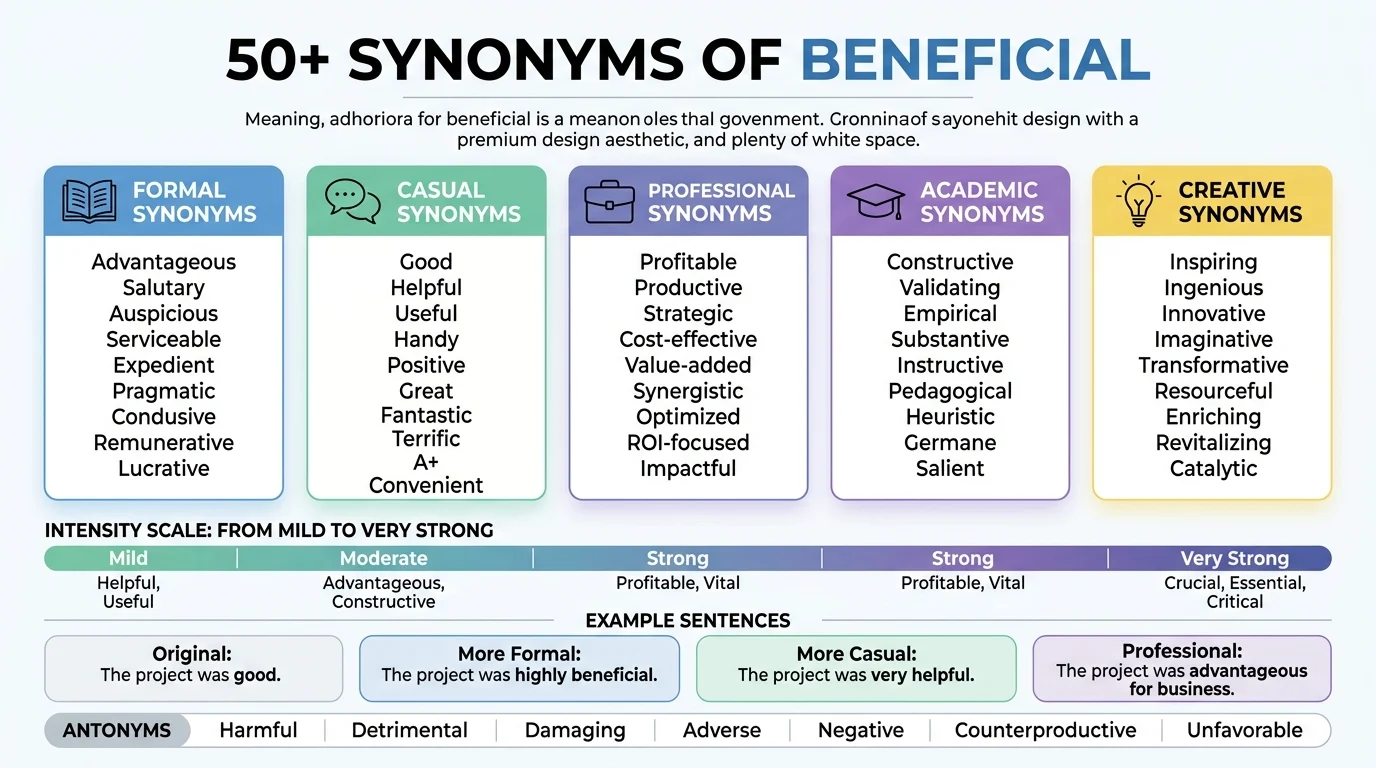
“Beneficial” means producing good results or helpful effects. It is a neutral, semi-formal word that works in most contexts. The best formal synonyms are “advantageous” and “favorable.” Casual conversation, use “helpful” or “good.” For professional writing, choose “valuable” or “productive.” For academic writing, “conducive” and “salutary” are excellent choices.
Meaning, Tone, and Context
Simple Definition
Something that is beneficial creates a positive outcome, improves a situation, or provides an advantage to someone or something.
Part of Speech
Adjective
Overall Tone
Positive and constructive. The word carries no negative connotations and suggests improvement or progress.
Formality Level
Semi-formal. You can use “beneficial” in most professional and academic settings. It also works in everyday conversation, though native speakers often choose simpler words like “helpful” in casual speech.
Common Uses
Native English speakers use “beneficial” to describe:
- Actions that produce positive results
- Advice or recommendations that improve a situation
- Products, services, or habits that provide value
- Decisions that lead to favorable outcomes
- Relationships or arrangements that benefit both parties
Word Forms
- Beneficial (adjective)
- Beneficially (adverb)
- Benefit (noun/verb)
- Beneficiary (noun)
When and How to Use “Beneficial”
Choose “beneficial” when you want to communicate that something produces a positive effect without being overly dramatic or emotional. It works well in professional and academic contexts where you need to sound objective and measured.
7 Realistic Examples
Professional Context
Regular performance reviews are beneficial for employee development and team productivity.
Academic Context
Reading academic journals before writing research papers is beneficial for understanding current scholarship.
Workplace Context
The new project management software proved beneficial for tracking deadlines and team progress.
Personal Context
Taking a twenty-minute walk each morning has been beneficial for my mental clarity.
Email Context
I believe this partnership would be mutually beneficial for both our organizations.
Resume Context
Led a team initiative that proved beneficial for reducing operational costs by fifteen percent.
Social Media Context
Starting your day with a protein-rich breakfast is beneficial for maintaining steady energy levels.
Best Synonyms of “Beneficial”
No synonym matches “beneficial” perfectly in every situation. Each alternative carries slightly different connotations and works best in specific contexts.
Professional Writing
“Advantageous” is the strongest choice because it explicitly communicates a strategic benefit or competitive edge.
Academic Writing
“Conducive” works best when describing conditions that make learning or research more effective.
Business Communication
“Valuable” emphasizes worth and importance in commercial contexts.
Casual Conversation
“Helpful” is the most natural and widely understood alternative in everyday speech.
Emotional Writing
“Meaningful” adds depth and personal significance to the concept of benefit.
Creative Writing
“Enriching” suggests that something adds value or improves quality of life in a holistic way.
Resume Writing
“Productive” focuses on outcomes and efficiency, which employers appreciate.
Workplace Communication
“Constructive” emphasizes positive contributions to projects or team dynamics.
Stronger Meaning
“Indispensable” suggests something is essential and irreplaceable.
Softer Meaning
“Useful” implies practical value without strong emotional weight.
When Not to Use “Beneficial”
When the Word Sounds Too General
Sometimes “beneficial” does not capture the specific nature of an advantage.
Original: The new policy was beneficial.
Better: The new policy increased efficiency by thirty percent.
Why: Specific data provides stronger evidence than a general adjective.
When the Word Sounds Too Vague
Writing that uses “beneficial” without explaining how or why feels incomplete.
Original: Reading is beneficial.
Better: Reading regularly improves vocabulary and cognitive function.
Why: Clear explanations of benefits are more persuasive than vague statements.
When the Word Sounds Too Formal
Casual writing calls for simpler, more approachable language.
Original: This recipe is beneficial for your health.
Better: This recipe is really good for you.
Why: Natural conversation uses simpler vocabulary and contractions.
When the Word Sounds Too Weak
Important achievements deserve stronger descriptive language.
Original: Her contribution was beneficial.
Better: Her contribution was instrumental to our success.
Why: Stronger words convey greater significance and impact.
When the Word Sounds Outdated
Salutary” and other formal synonyms may sound old-fashioned in modern writing.
Original: The experience was salutary.
Better: The experience was extremely helpful.
Why: Modern readers prefer contemporary vocabulary choices.
Words Commonly Confused With “Beneficial”
Beneficial vs Advantageous
Difference: “Advantageous” emphasizes strategic benefit or competitive edge. “Beneficial” has a broader meaning that includes any positive effect.
When to Use It: Use “advantageous” when discussing relative benefits that create a better position compared to alternatives.
Example: The location near the highway is advantageous for attracting customers.
Beneficial vs Helpful
Difference: “Helpful” is more casual and personal. “Beneficial” sounds more formal and objective.
When to Use It: Use “helpful” in everyday conversation and customer service interactions.
Example: The customer service representative was incredibly helpful.
Beneficial vs Valuable
Difference: “Valuable” emphasizes worth and importance. “Beneficial” focuses on producing good outcomes.
When to Use It: Use “valuable” when discussing financial worth or personal importance.
Example: Her feedback was valuable for improving the presentation.
Beneficial vs Productive
Difference: “Productive” emphasizes efficiency and output. “Beneficial” takes a broader view of positive effects.
When to Use It: Use “productive” in workplace and task-oriented contexts.
Example: The meeting was productive and resulted in clear action items.
Beneficial vs Constructive
Difference: “Constructive” suggests active contribution toward improvement. “Beneficial” describes the outcome itself.
When to Use It: Use “constructive” for feedback, criticism, or suggestions that build toward progress.
Example: The manager offered constructive feedback on the proposal.
Beneficial vs Useful
Difference: “Useful” focuses on practical application and function. “Beneficial” emphasizes positive outcomes.
When to Use It: Use “useful” for tools, information, or skills that serve a specific purpose.
Example: This digital tool is useful for managing multiple projects.
Best Synonyms of “Beneficial” by Context
| Context | Best Synonym | Why It Works | Example |
|---|---|---|---|
| Formal writing | Advantageous | Communicates strategic benefit effectively | The agreement proved advantageous for both nations. |
| Academic writing | Conducive | Describes conditions that enable learning | A quiet environment is conducive to deep concentration. |
| Professional communication | Valuable | Emphasizes importance and worth | His insights were valuable during the planning phase. |
| Business emails | Productive | Highlights efficiency and results | The conference was productive for building new partnerships. |
| Resume writing | Instrumental | Suggests essential contribution | Instrumental in developing the company’s social media strategy. |
| Workplace communication | Constructive | Emphasizes positive contributions | The team provided constructive feedback on the design. |
| Casual conversation | Helpful | Natural and approachable in everyday speech | It was helpful to have extra hands for the project. |
| Everyday speaking | Good | Simple and universally understood | A good night’s sleep makes a big difference. |
| Creative writing | Enriching | Adds depth and life improvement | The cultural exchange was enriching for everyone involved. |
| Storytelling | Rewarding | Emphasizes personal satisfaction | The volunteer work was rewarding in unexpected ways. |
| Emotional writing | Meaningful | Expresses personal significance | This gift is meaningful because of its sentimental value. |
| Strong emphasis | Essential | Communicates absolute necessity | Regular exercise is essential for maintaining health. |
| Mild tone | Helpful | Softens the claim without overstating | A checklist can be helpful for staying organized. |
| Social media captions | Game-changing | Engaging and modern expression | This new tool is game-changing for content creators. |
| American English | Helpful | Most common and widely accepted | The tutorial was helpful for beginners. |
How to Choose the Best Synonym of “Beneficial”
Selecting the right synonym starts with understanding your audience and purpose.
Consider your audience. Formal writing for executives or academics requires words like “advantageous” or “conducive.” Casual blog posts or social media work better with “helpful” or “good.”
Consider your tone. Emotional writing benefits from words like “rewarding” or “meaningful.” Professional contexts call for “valuable” or “productive.”
Consider emotional strength. Stronger claims need stronger words. Use “essential” for absolute necessity or “instrumental” for crucial contributions. Use “useful” for minor benefits.
Consider the specific benefit. Are you describing efficiency? Use “productive.” Are you describing personal growth? Use “enriching.” Be precise about what makes something beneficial.
Read the sentence aloud. Natural-sounding writing flows easily and feels right when spoken. If a synonym sounds awkward, choose a simpler alternative.
Avoid overcomplicating. The best synonym is the one that communicates your message most clearly. Native speakers often prefer simple words.
Real Life Examples of “Beneficial”
School
Original: Studying with friends is beneficial.
Improved: Studying with friends is productive because you can explain concepts to each other.
College
Original: The internship was beneficial for my career.
Improved: The internship was instrumental in building my professional network and skills.
Workplace
Original: Cross-training employees is beneficial.
Improved: Cross-training employees is valuable for creating a more flexible workforce.
Business
Original: The new software will be beneficial.
Improved: The new software will be advantageous because it automates repetitive tasks.
Original: This approach seems beneficial.
Improved: This approach appears favorable given our current timeline and resources.
Resume
Original: Helped implement beneficial changes.
Improved: Implemented changes that proved instrumental in reducing costs by twenty percent.
Conversation
Original: Exercise is beneficial.
Improved: Working out really helps me feel more energized during the day.
Storytelling
Original: Her advice was beneficial.
Improved: Her guidance was enriching and opened my eyes to new possibilities.
Blogging
Original: These tips are beneficial for beginners.
Improved: These tips are incredibly helpful for anyone just starting out.
Social Media
Original: This product is beneficial.
Improved: This product is a game-changer for busy professionals.
18 Best Synonyms of “Beneficial”
| Synonym | Simple Meaning | Best Used For | Example Sentence |
|---|---|---|---|
| Advantageous | Provides strategic or competitive benefit | Professional and strategic contexts | The partnership is advantageous for expanding into new markets. |
| Helpful | Offers assistance or support | Casual conversation and everyday use | The guide was helpful for navigating the city. |
| Valuable | Possesses great worth or importance | Business and professional communication | Her experience is valuable for mentoring junior team members. |
| Productive | Produces results or outputs | Workplace and task-oriented contexts | The brainstorming session was productive and generated new ideas. |
| Constructive | Builds toward improvement | Feedback and collaborative contexts | The review offered constructive suggestions for improvement. |
| Conducive | Creates favorable conditions | Academic and environmental contexts | The supportive atmosphere is conducive to open discussion. |
| Enriching | Adds value and improves quality | Personal development and creative writing | The travel experience was enriching and changed my perspective. |
| Instrumental | Played an essential role | Professional achievements and contributions | Her research was instrumental in developing the new treatment. |
| Rewarding | Provides personal satisfaction | Emotional writing and personal growth | Teaching has been rewarding in ways I never expected. |
| Meaningful | Carries significance and purpose | Emotional and personal contexts | The conversation was meaningful and deepened our friendship. |
| Favorable | Produces advantageous conditions | Formal writing and business proposals | The economic climate is favorable for new investments. |
| Essential | Absolutely necessary | Strong emphasis on importance | Good communication is essential for successful teams. |
| Useful | Serves a practical purpose | Everyday tasks and applications | The checklist was useful for tracking project milestones. |
| Salutary | Produces good effects | Formal and academic writing | The exercise program had a salutary effect on patient recovery. |
| Practical | Works effectively in real situations | Professional and everyday contexts | The training was practical and improved my daily workflow. |
| Helpful | Offers direct assistance | Customer service and personal support | The staff was helpful in resolving my issue quickly. |
| Benignant | Kind and favorable | Literary and descriptive writing | The benignant weather allowed the outdoor event to proceed. |
| Good | Positive and morally sound | General use and simple expression | Eating vegetables is good for your overall health. |
Synonyms of “Beneficial” by Usage
Professional vs Personal Synonyms
Professional synonyms: Advantageous, productive, instrumental, valuable, constructive
These words work well in business meetings, performance reviews, and client communications. They focus on outcomes, efficiency, and strategic value.
Personal synonyms: Helpful, rewarding, meaningful, enriching, useful
These words fit better in conversations with friends, personal emails, and social media posts. They emphasize personal experience and emotional value.
Formal vs Conversational Synonyms
Formal writing: Advantageous, conducive, salutary, favorable
Use these in research papers, legal documents, official reports, and formal presentations. They convey authority and precision.
Conversational synonyms: Helpful, good, useful, great
Use these in text messages, personal emails, casual conversations, and social media. They sound natural and approachable.
Academic Synonyms
Recommendations: Conducive, salutary, beneficial, advantageous, instrumental
Academic writing demands precise vocabulary. “Conducive” works well for environmental conditions. “Salutary” fits formal research papers. “Instrumental” describes essential contributions.
Professional and Business Synonyms
Best choices: Valuable, productive, instrumental, constructive, advantageous
Resumes and interviews: Use “instrumental” to describe important contributions. Use “productive” for project outcomes. Use “valuable” for skills and experience.
Business emails and meetings: Use “advantageous” for strategic decisions. Use “constructive” for feedback. Use “productive” for meetings and sessions.
Creative and Literary Synonyms
Recommendations: Enriching, rewarding, meaningful, benignant
Storytelling and descriptive writing: “Enriching” adds depth to experiences. “Rewarding” emphasizes emotional satisfaction. “Meaningful” suggests deeper significance. “Benignant” provides a literary tone.
Slang or Modern Synonyms
Modern synonyms: Game-changing, a game changer, clutch, solid
Meaning: These informal words communicate strong positive value in a contemporary style.
Where they are acceptable: Social media, blogs, creative writing, casual conversations, marketing copy
Where to avoid them: Academic papers, legal documents, formal business reports, professional emails
Strongest to Mildest Synonyms
Mild: Useful, helpful, good, practical
Moderate: Valuable, productive, constructive, rewarding
Strong: Advantageous, instrumental, valuable, enriching
Very Strong: Essential, indispensable, game-changing
Emotional vs Neutral Synonyms
Emotional synonyms: Rewarding, meaningful, enriching, helpful
These words express personal feelings and connect with readers emotionally. Use them in personal writing, social media, and creative content.
Neutral synonyms: Advantageous, productive, useful, conducive
These words communicate information without emotional weight. Use them in professional reports, academic papers, and business communications.
Antonyms of “Beneficial”
| Antonym | Meaning | Example Sentence |
|---|---|---|
| Detrimental | Causes harm or damage | Smoking is detrimental to lung health. |
| Harmful | Produces negative effects | Exposure to toxic chemicals is harmful. |
| Damaging | Causes injury or loss | The rumors were damaging to her reputation. |
| Injurious | Causes physical or emotional harm | Lack of sleep can be injurious to your health. |
| Unfavorable | Creates negative conditions | The weather was unfavorable for the outdoor event. |
| Disadvantageous | Creates a less favorable position | The new tax law is disadvantageous for small businesses. |
| Counterproductive | Achieves opposite of intended goal | Micromanaging is counterproductive for team morale. |
| Unhelpful | Does not provide assistance | His comments were unhelpful and confusing. |
| Useless | Serves no practical purpose | The broken equipment was useless for the project. |
| Wasteful | Uses resources without benefit | The inefficient process was wasteful of time and money. |
| Damaging | Causes negative consequences | The decision was damaging to employee trust. |
| Ineffective | Does not produce desired results | The marketing campaign was ineffective and costly. |
| Unhealthy | Damages health or well-being | Processed foods are unhealthy when consumed daily. |
| Pointless | Lacks purpose or benefit | The argument was pointless and wasted everyone’s time. |
| Adverse | Opposes or counteracts desired outcomes | The medication had adverse effects on the patient. |
Comparison: “Beneficial” vs Similar Words
Beneficial vs Advantageous
Main Difference: “Advantageous” emphasizes strategic benefit or competitive positioning. “Beneficial” covers any positive effect regardless of competition.
Which Is Stronger? “Advantageous” is stronger because it implies gaining an edge over alternatives.
Which Is More Formal? Both are formal, but “advantageous” sounds more deliberate and strategic.
When to Use Each:
- Use “advantageous” when comparing options or discussing strategic decisions.
- Use “beneficial” for general positive outcomes without comparison.
Examples:
- Beneficial: Exercise is beneficial for maintaining cardiovascular health.
- Advantageous: Our location is advantageous because we are near major transportation hubs.
Beneficial vs Helpful
Main Difference: “Helpful” is personal and immediate. “Beneficial” is broader and more abstract.
Which Is Stronger? “Beneficial” carries a slightly more formal weight than “helpful.”
Which Is More Formal? “Beneficial” is semi-formal. “Helpful” is casual.
When to Use Each:
- Use “helpful” when providing direct assistance or practical support.
- Use “beneficial” when discussing long-term or systemic advantages.
Examples:
- Beneficial: Regular reading is beneficial for cognitive development.
- Helpful: The user manual was helpful for setting up the device.
Beneficial vs Valuable
Main Difference: “Valuable” emphasizes worth and importance. “Beneficial” focuses on producing good results.
Which Is Stronger? “Valuable” often conveys greater significance in professional contexts.
Which Is More Formal? Both are professional, but “valuable” is more commonly used in business.
When to Use Each:
- Use “valuable” when discussing importance, worth, or precious resources.
- Use “beneficial” when describing outcomes and positive effects.
Examples:
- Beneficial: The training program was beneficial for employee morale.
- Valuable: Her multilingual skills are valuable for international negotiations.
Beneficial vs Constructive
Main Difference: “Constructive” suggests active contribution toward improvement. “Beneficial” is more passive and descriptive.
Which Is Stronger? “Constructive” is more active and implies participation.
Which Is More Formal? Both are semi-formal, with “constructive” common in feedback contexts.
When to Use Each:
- Use “constructive” for feedback, criticism, or suggestions aimed at improvement.
- Use “beneficial” for general positive outcomes.
Examples:
- Beneficial: Team lunches are beneficial for building workplace relationships.
- Constructive: The manager provided constructive feedback on my presentation.
Beneficial vs Productive
Main Difference: “Productive” focuses on output and efficiency. “Beneficial” takes a broader view of positive effects.
Which Is Stronger? “Productive” is stronger in task-oriented contexts.
Which Is More Formal? Both are semi-formal, with “productive” common in workplace settings.
When to Use Each:
- Use “productive” when discussing results, outcomes, and efficiency.
- Use “beneficial” for broader positive effects.
Examples:
- Beneficial: Regular breaks are beneficial for reducing work-related stress.
- Productive: The meeting was productive and resulted in clear deliverables.
Beneficial vs Enriching
Main Difference: “Enriching” suggests adding depth, quality, or value to someone’s life. “Beneficial” is more general.
Which Is Stronger? “Enriching” is stronger emotionally and suggests personal growth.
Which Is More Formal? “Beneficial” is more formal. “Enriching” is personal and descriptive.
When to Use Each:
- Use “enriching” for personal development, cultural experiences, and meaningful relationships.
- Use “beneficial” for professional, academic, or general advantages.
Examples:
- Beneficial: The mentorship program is beneficial for career development.
- Enriching: The volunteer experience was enriching and life-changing.
Common Phrases and Expressions with “Beneficial”
Mutually beneficial
Meaning: Describes an arrangement or relationship where both parties gain advantages.
Example: The partnership was mutually beneficial for both companies.
Beneficial to
Meaning: Indicates that something produces a positive effect for someone or something.
Example: Regular exercise is beneficial to overall health and wellness.
Beneficial for
Meaning: Similar to “beneficial to” but often used with outcomes or goals.
Example: This strategy is beneficial for achieving long-term growth.
Highly beneficial
Meaning: Describes something that produces exceptionally positive results.
Example: The mentorship program proved highly beneficial for young entrepreneurs.
Beneficial effect
Meaning: A positive result or outcome from a particular action or situation.
Example: The medication had a beneficial effect on her symptoms.
Beneficial impact
Meaning: A positive influence or effect on a situation or person.
Example: The new policies had a beneficial impact on employee retention.
Beneficial relationship
Meaning: A connection or association that produces positive outcomes for involved parties.
Example: The university developed a beneficial relationship with local businesses.
Common Mistakes to Avoid
Choosing a Vague Synonym Instead of a Precise One
Incorrect: The training was good for everyone.
Better: The training was advantageous for developing technical skills.
Why: “Good” is too general and does not specify the nature or outcome of the benefit.
Confusing “Beneficial” with “Beneficiary”
Incorrect: She was the beneficial of the estate.
Better: She was the beneficiary of the estate.
Why: “Beneficial” is an adjective meaning producing good effects. “Beneficiary” is a noun meaning someone who receives benefits.
Using an Informal Synonym in Formal Writing
Incorrect: The proposal seems great for our objectives.
Better: The proposal appears favorable for achieving our objectives.
Why: “Great” is too casual for formal business documents.
Selecting an Overly Dramatic Synonym
Incorrect: The memo was life-changing for the team.
Better: The memo was useful for clarifying expectations.
Why: “Life-changing” exaggerates the importance of routine communication.
Repeating the Same Word Too Often
Incorrect: The program was beneficial. The training was beneficial. The resources were beneficial.
Better: The program was valuable. The training was productive. The resources were useful.
Why: Using different synonyms adds variety and interest to your writing.
Choosing a Synonym with the Wrong Emotional Tone
Incorrect: The study results were rewarding for understanding cancer.
Better: The study results were beneficial for understanding cancer.
Why: “Rewarding” implies personal satisfaction, which is not appropriate for objective research results.
Using Slang in Academic Writing
Incorrect: The experiment was a game-changer in the field.
Better: The experiment proved instrumental in advancing the field.
Why: “Game-changer” is too casual for formal academic writing.
Frequently Asked Questions
What are the best synonyms of “beneficial”?
The best synonyms depend on your context. “Advantageous” works well for professional writing. “Helpful” fits casual conversation. “Valuable” is excellent for business communication. “Conducive” suits academic writing. “Rewarding” works for emotional and personal contexts.
What are the best formal synonyms of “beneficial”?
Formal synonyms include “advantageous,” “conducive,” “salutary,” and “favorable.” These words appear in research papers, official documents, legal writing, and professional reports. They communicate precision and authority while maintaining appropriate formality.
What are common informal synonyms of “beneficial”?
Common informal synonyms include “helpful,” “good,” “useful,” and “great.” Native speakers use these words in everyday conversation, text messages, personal emails, and social media posts. They sound natural, approachable, and easy to understand.
What is another word for “beneficial” in professional writing?
Professional writing often uses “advantageous,” “valuable,” “productive,” “instrumental,” and “constructive.” These words work in business emails, performance reviews, meeting notes, client communications, and professional presentations. They emphasize outcomes, value, and strategic advantage.
What is the difference between “beneficial” and “advantageous”?
“Beneficial” broadly describes anything that produces a positive effect. “Advantageous” specifically describes something that provides a strategic benefit or competitive edge. Use “advantageous” when comparing options or discussing positioning. Use “beneficial” for general positive outcomes.
What is the opposite of “beneficial”?
The most common antonyms include “detrimental,” “harmful,” “damaging,” “unfavorable,” and “disadvantageous.” Choose “detrimental” for formal contexts and “harmful” for general use. The best antonym depends on the specific negative outcome you want to describe.
Conclusion
“Beneficial” is a versatile word that describes anything producing positive results or good effects. It works in professional settings, academic writing, and everyday conversation. The best synonyms of beneficial include “advantageous” for formal contexts, “helpful” for casual use, and “valuable” for professional writing.
No synonym works perfectly in every situation. The most effective writers choose words based on their audience, purpose, and tone. Consider your message carefully and select the synonym that communicates your meaning most clearly.
Try replacing your next “beneficial” with a more specific synonym. Your writing will become more engaging and precise immediately.
3 thoughts on “50+ Synonyms of Beneficial | Meanings, Uses, Examples, and Best Alternatives”