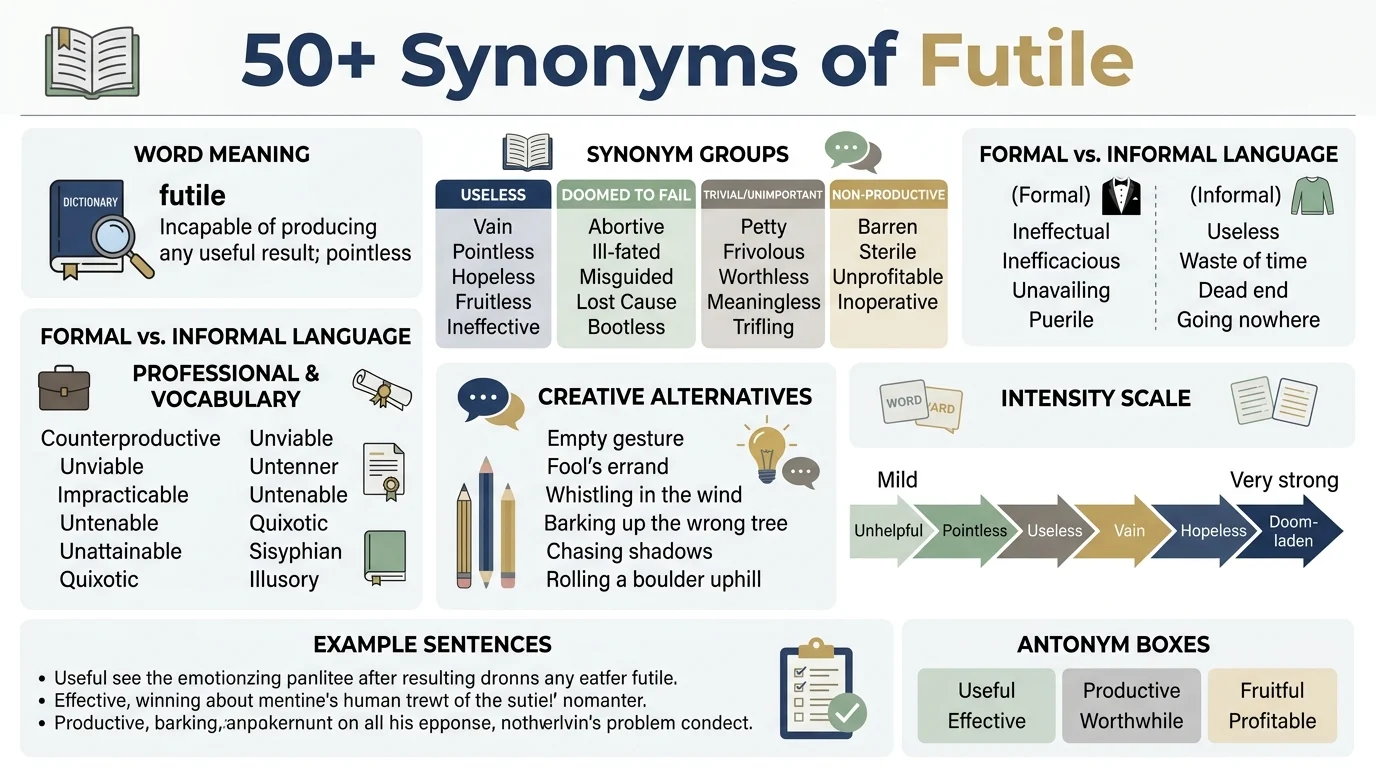
Have you ever written an email, essay, or social media post and found yourself using the same word over and over? Many writers reach for “futile” when describing hopeless efforts, but repeating it makes your writing feel dull and imprecise. Finding fresh synonyms of futile can transform your communication and help you express exactly what you mean. The right word adds clarity, precision, and emotional depth to your message. Whether you are writing a professional report, a college essay, or a casual text, choosing the perfect synonym elevates your language and keeps your audience engaged.
What Are the Best Synonyms of “Futile”?
Futile means producing no result or effect. It describes efforts that are pointless, useless, or doomed to fail. The best synonyms depend on your context. Professional writing, use ineffective or unproductive. For academic work, choose unavailing or unprofitable. For casual conversation, go with pointless or useless. Emotional impact, select fruitless or vain. Each synonym carries its own nuance and fits different situations perfectly.
Meaning, Tone, and Context
Simple Definition
Futile describes actions or efforts that cannot succeed or produce any meaningful result. When something is futile, it is completely ineffective and wastes time, energy, or resources.
Part of Speech
Adjective. It modifies nouns to describe actions, attempts, efforts, or situations that are hopelessly ineffective.
Overall Tone
Negative. Futile carries a distinctly negative tone. It suggests failure, disappointment, and wasted effort. The word often implies that someone should have known better than to try.
Formality Level
Formal to semi-formal. Futile appears more often in written English than in everyday conversation. It sounds natural in professional reports, academic writing, and formal speeches. In casual settings, native speakers usually choose simpler alternatives like “useless” or “pointless.”
Common Uses
Native English speakers use futile when describing:
- Attempts to change something unchangeable
- Efforts that lack any chance of success
- Wasted time, energy, or resources
- Hopeless situations where giving up is the only sensible option
- Arguments or discussions that lead nowhere
Word Forms
| Form | Word |
|---|---|
| Adjective | Futile |
| Noun | Futility |
| Adverb | Futilely |
When and How to Use “Futile”
Choose “futile” when you want to emphasize that an effort is completely hopeless and produces absolutely nothing worthwhile. The word works best when the failure is inevitable rather than just difficult.
Professional Context
“The team’s attempts to negotiate with the unresponsive vendor proved futile.”
Academic Context
“The researcher concluded that further investigation into the outdated theory would be futile.”
Workplace Context
“Continuing to use the broken software is futile when the new system is ready to launch.”
Personal Context
“She realized that trying to change his stubborn opinions was entirely futile.”
Email Context
“After three follow-up emails with no response, I decided further contact would be futile.”
Resume Context
“Avoid listing skills that are irrelevant to the position, as such additions are futile.”
Social Media Context
“Arguing in the comments section is usually futile, but sometimes I cannot help myself.”
Best Synonyms of “Futile”
No synonym works perfectly in every situation. Each alternative carries a slightly different meaning, tone, or level of formality. Here are the best synonyms for different contexts.
Professional Writing: Ineffective
Ineffective focuses on the lack of desired results. It sounds objective and analytical, making it perfect for business reports and professional communication. Unlike futile, it does not carry the same emotional weight of hopelessness. It simply states that something did not work.
Academic Writing: Unavailing
Unavailing is a precise, formal synonym that academic writers favor. It means that efforts produced no useful outcome despite sincere attempts. The word sounds scholarly and authoritative. It works well in research papers, essays, and formal academic discussions.
Business Communication: Unproductive
Unproductive emphasizes the waste of resources and time. It suggests that an effort consumed energy but created no value. Business professionals prefer this word because it focuses on efficiency and results rather than emotional failure.
Casual Conversation: Pointless
Pointless is the everyday alternative that native speakers use constantly. It is direct, simple, and conversational. It means exactly what it sounds like: no point, no purpose, no reason. This synonym fits perfectly in texts, casual chats, and informal writing.
Emotional Writing: Fruitless
Fruitless adds a layer of emotional disappointment. It suggests that someone worked hard but harvested nothing. The word paints a vivid picture of effort without reward. Writers use it when they want to evoke sympathy or frustration in their readers.
Creative Writing: Vain
Vain carries a slightly older, more literary feel. It suggests pride mixed with failure, as if someone tried too hard for no result. Creative writers use vain to add elegance and emotional complexity. It also appears frequently in poetry and literary fiction.
Resume Writing: Counterproductive
Counterproductive means an effort not only fails but actually harms progress. This strong synonym works well in resumes and professional profiles because it shows awareness of efficiency and smart decision-making.
Workplace Communication: Unsuccessful
Unsuccessful is neutral and professional. It simply states that an attempt did not achieve its goal. Unlike futile, it does not imply that success was impossible. This softer alternative works well in performance reviews and constructive feedback.
Stronger Meaning: Bootless
Bootless is an older, stronger synonym meaning completely without benefit or advantage. It sounds dramatic and emphatic. Writers use it when they want to emphasize absolute uselessness. The word appears more in literary works than in modern conversation.
Softer Meaning: Unproductive
Unproductive is milder than futile. It suggests that something did not produce results but does not imply hopelessness. This softer choice works better when you want to be constructive rather than critical.
When Not to Use “Futile”
When the Word Sounds Too General
Futile can feel vague when you need specific feedback. Instead of calling something futile, explain exactly why it failed.
Incorrect: “Your approach is futile.”
Better: “Your approach is inefficient because it duplicates existing efforts.”
Why: Specific feedback provides actionable information. The word “futile” simply criticizes without helping.
When the Word Sounds Too Vague
Some situations require precision rather than broad dismissal. Futile does not explain why something failed.
Incorrect: “The project was futile.”
Better: “The project yielded no measurable outcomes.”
Why: Measurable language makes the failure clear and professional. Futile sounds dismissive.
When the Word Sounds Too Formal
In casual conversations, formal words can feel awkward and unnatural.
Incorrect: “This conversation is futile.”
Better: “This conversation is going nowhere.”
Why: Everyday language sounds more natural and less confrontational.
When the Word Sounds Too Informal
Academic and professional writing often requires more sophisticated vocabulary.
Incorrect: “The experiment was pointless.”
Better: “The experiment was unavailing.”
Why: “Unavailing” sounds more academic and precise. “Pointless” is too casual for formal writing.
When the Word Sounds Too Weak
Sometimes you need a stronger word to emphasize complete hopelessness.
Incorrect: “Our efforts were ineffective.”
Better: “Our efforts were entirely bootless.”
Why: “Bootless” conveys absolute failure, while “ineffective” only suggests partial failure.
When the Word Sounds Too Strong
In sensitive situations, harsh words can damage relationships.
Incorrect: “Your help was futile.”
Better: “Your help was unfortunately unhelpful in this case.”
Why: The softer phrasing preserves the relationship while communicating the same basic idea.
When the Word Sounds Outdated
Futile is a word with a formal, slightly old-fashioned feel. In casual modern writing, simpler alternatives sound more natural.
Incorrect: “Attempting to fix the old car proved futile.”
Better: “Attempting to fix the old car was a waste of time.”
Why: Modern conversational English favors direct, simple language over formal vocabulary.
Words Commonly Confused With “Futile”
Futile vs. Fruitless
Difference: Both words mean producing no results, but fruitless emphasizes lack of reward or harvest. Futile emphasizes hopelessness and impossibility.
When to Use It: Choose fruitless when you want to evoke disappointment. Choose futile when you want to emphasize that success was never possible.
Example (Futile): “Trying to convince a flat-earther is futile.”
Example (Fruitless): “The search for the lost treasure was fruitless.”
Futile vs. Vain
Difference: Vain suggests excessive pride or ego combined with failure. Futile simply means ineffective without the element of pride.
When to Use It: Use vain in literary or emotional contexts. Use futile for straightforward descriptions of ineffective efforts.
Example (Futile): “Our attempts to save the building were futile.”
Example (Vain): “His vain attempts to impress her only made things worse.”
Futile vs. Useless
Difference: Useless is more general and informal. It describes anything without practical value. Futile specifically describes efforts that cannot succeed.
When to Use It: Choose useless for objects or general descriptions. Choose futile for actions and attempts.
Example (Futile): “Continuing the argument was futile.”
Example (Useless): “This broken tool is useless.”
Futile vs. Pointless
Difference: Pointless means having no purpose or reason. Futile means having no chance of success, even if a purpose exists.
When to Use It: Use pointless when something lacks meaning. Use futile when something has meaning but cannot succeed.
Example (Futile): “Trying to swim across the ocean is futile.”
Example (Pointless): “Arguing about taste is pointless.”
Futile vs. Ineffective
Difference: Ineffective is milder and more objective. It simply describes something that did not work. Futile implies that success was impossible from the start.
When to Use It: Use ineffective in professional and analytical contexts. Use futile when you want to emphasize hopelessness.
Example (Futile): “Rebuilding the failed startup was futile.”
Example (Ineffective): “The current marketing strategy is ineffective.”
Futile vs. Unproductive
Difference: Unproductive focuses on lack of output or results. Futile focuses on the impossibility of success.
When to Use It: Use unproductive in business and efficiency-focused contexts. Use futile when you want to emphasize that trying is a waste of time.
Example (Futile): “Negotiating with terrorists is futile.”
Example (Unproductive): “Our brainstorming session was unproductive.”
Best Synonyms of “Futile” by Context
| Context | Best Synonym | Why It Works | Example |
|---|---|---|---|
| Formal Writing | Ineffective | Sounds objective and professional | “The policy proved ineffective in reducing costs.” |
| Academic Writing | Unavailing | Precise and scholarly | “Further research on this topic appears unavailing.” |
| Professional Communication | Unproductive | Focuses on efficiency | “The meeting was entirely unproductive.” |
| Business Emails | Unsuccessful | Neutral and constructive | “Our marketing campaign was unsuccessful.” |
| Resume Writing | Counterproductive | Shows self-awareness | “Avoiding feedback is counterproductive.” |
| Workplace Communication | Unproductive | Constructive and clear | “This workflow is unproductive.” |
| Casual Conversation | Pointless | Simple and natural | “This argument is pointless.” |
| Everyday Speaking | Useless | Direct and clear | “Trying to fix this is useless.” |
| Creative Writing | Vain | Literary and emotional | “His vain efforts to reclaim the past failed.” |
| Storytelling | Fruitless | Creates vivid imagery | “The knight’s quest proved fruitless.” |
| Emotional Writing | Vain | Adds emotional depth | “Her vain hope broke her heart.” |
| Strong Emphasis | Bootless | Emphatic and dramatic | “All our planning was bootless.” |
| Mild Tone | Unproductive | Gentle and constructive | “This approach has been unproductive recently.” |
| Social Media Captions | Pointless | Casual and relatable | “Trying to adult today is pointless.” |
| American English | Pointless | Everyday usage | “This conversation is pointless.” |
How to Choose the Best Synonym of “Futile”
Choosing the right synonym starts with understanding your purpose. Ask yourself these questions before you write.
What is your audience? If you are writing for professionals, choose words like “ineffective” or “unproductive.” If you are talking to friends, pick “pointless” or “useless.”
What is your tone? For formal reports and academic papers, select “unavailing” or “ineffective.” For emotional writing, choose “fruitless” or “vain.” For casual conversations, go with “pointless.”
How strong should your language be? “Unproductive” is mild and constructive. “Bootless” is strong and emphatic. Match your intensity to the situation.
What is your purpose? Are you criticizing, describing, or informing? Constructive feedback calls for milder words like “unproductive.” Strong criticism calls for powerful words like “fruitless.”
Does formality matter? Academic writing demands formal vocabulary. Social media posts benefit from casual language. Match your formality level to your context.
Will your reader understand the word? Some synonyms, like “bootless” and “unavailing,” are less common. Use them in writing but avoid them in everyday conversation.
Does the word sound natural? Read your sentence aloud. If the synonym feels awkward or forced, choose a different one. Natural sound is more important than fancy vocabulary.
Real Life Examples of “Futile”
School Example
Original: “My attempt to finish the project on time was futile.”
Improved: “My attempt to finish the project on time was unproductive because I kept getting distracted.”
Why: “Unproductive” sounds more natural in a student’s reflection.
College Example
Original: “Futile efforts to change the professor’s grading policy frustrated everyone.”
Improved: “Fruitless efforts to change the professor’s grading policy frustrated everyone.”
Why: “Fruitless” adds emotional resonance to the frustration.
Workplace Example
Original: “Continuing the old process is futile.”
Improved: “Continuing the old process is unproductive and wastes valuable time.”
Why: Specificity makes the criticism more professional.
Business Example
Original: “Our attempts to enter the saturated market were futile.”
Improved: “Our attempts to enter the saturated market were unsuccessful.”
Why: “Unsuccessful” sounds more professional in business reports.
Email Example
Original: “Sending another reminder would be futile.”
Improved: “Sending another reminder would be pointless since they have not responded to the first three.”
Why: “Pointless” is more natural in email communication.
Resume Example
Original: “Listing outdated skills is futile.”
Improved: “Listing outdated skills is counterproductive because they waste valuable resume space.”
Why: “Counterproductive” emphasizes the negative impact on your application.
Conversation Example
Original: “Trying to change his mind is futile.”
Improved: “Trying to change his mind is pointless. He is too stubborn.”
Why: Casual language matches the conversational context.
Storytelling Example
Original: “The hero’s journey was futile.”
Improved: “The hero’s journey was vain, ending in disappointment and ruin.”
Why: “Vain” adds emotional and literary depth.
Blogging Example
Original: “Spending money on expensive ads is futile.”
Improved: “Spending money on expensive ads is fruitless when your target audience does not use that platform.”
Why: “Fruitless” creates a stronger image of wasted effort.
Social Media Example
Original: “This day has been futile.”
Improved: “This day has been completely pointless.”
Why: “Pointless” sounds more natural and relatable on social media.
18 Best Synonyms of “Futile”
| Synonym | Simple Meaning | Best Used For | Example Sentence |
|---|---|---|---|
| Useless | Without practical value | Everyday conversation | This broken printer is useless. |
| Pointless | Having no purpose or reason | Casual speaking and texting | Arguing with him is pointless. |
| Ineffective | Not producing intended results | Professional reports and feedback | The current system is ineffective. |
| Unproductive | Failing to produce desired output | Business and workplace settings | This meeting was unproductive. |
| Fruitless | Yielding no results despite effort | Emotional and narrative writing | The search for survivors was fruitless. |
| Vain | Producing no result; marked by pride | Creative and literary contexts | His vain attempts to win her heart failed. |
| Unavailing | Producing no useful outcome | Academic and formal writing | Further intervention proved unavailing. |
| Unsuccessful | Failing to achieve a goal | Neutral professional feedback | The campaign was unsuccessful. |
| Counterproductive | Harming rather than helping progress | Resumes and self-improvement | Procrastination is counterproductive. |
| Bootless | Without benefit or advantage | Strong emphatic writing | All our planning was bootless. |
| Ineffectual | Weak and without significant effect | Describing people or systems | The manager was ineffectual. |
| Profitless | Producing no profit or benefit | Financial and business contexts | The investment was profitless. |
| Abortive | Failing to be completed successfully | Formal and historical contexts | The rebellion was abortive. |
| Hollow | Without real substance or meaning | Emotional and descriptive writing | His hollow promises meant nothing. |
| Idle | Without purpose or result | Describing time or efforts | Idle speculation wasted our time. |
| Worthless | Having no value or merit | Strong negative descriptions | Their efforts were worthless. |
| Sterile | Producing nothing productive | Academic and clinical contexts | The research proved sterile. |
| Barren | Producing no useful result | Creative and descriptive writing | The barren discussion ended in silence. |
Synonyms of “Futile” by Usage
Professional vs Personal Synonyms
Professional Synonyms: Ineffective, unproductive, unsuccessful, counterproductive
These words sound objective and businesslike. They work well in reports, meetings, and client communication because they describe results without sounding emotional or personal.
Personal Synonyms: Pointless, useless, fruitless, worthless
These words carry more emotion and sound natural in everyday conversation. Use them with friends, family, and in social situations where emotional expression is acceptable.
Formal vs Conversational Synonyms
Formal Synonyms (for reports, essays, and business writing): Unavailing, ineffectual, abortive, profitless
These words sound scholarly and authoritative. They impress readers in academic and professional settings. However, they can feel awkward in casual conversation.
Conversational Synonyms (for emails, texts, and everyday speaking): Pointless, useless, no good, going nowhere
These phrases sound natural and friendly. They connect with readers immediately. However, they lack the precision of formal vocabulary.
Academic Synonyms
Unavailing suggests sincere effort that produced no results. Academic writers favor this word because it sounds precise and scholarly.
Ineffectual describes weak attempts that lacked power or impact. It works well in research papers and academic discussions.
Abortive refers to efforts that failed before completion. Historians and political scientists use this word frequently.
Profitless suggests that efforts produced no valuable outcome. Economists and business researchers use this term.
Why they sound authoritative: These words have Latin origins and appear frequently in academic literature. They signal expertise and precision to readers.
Professional and Business Synonyms
Unproductive focuses on efficiency and resource management. It is perfect for performance reviews and process improvement discussions.
Ineffective describes strategies, systems, and approaches that do not work. It sounds objective and analytical.
Unsuccessful is neutral and constructive. It works well in client communication and project post-mortems.
Counterproductive warns against harmful actions. It appears frequently in resumes, interviews, and leadership discussions.
Why they fit professional settings: These words emphasize measurable outcomes and practical results. They avoid emotional language and maintain a professional tone.
Creative and Literary Synonyms
Vain adds literary elegance and emotional complexity. Poets, novelists, and speechwriters choose this word to create sophisticated imagery.
Fruitless creates vivid pictures of effort without reward. It evokes sympathy and frustration in readers.
Bootless is dramatic and emphatic. It works best in speeches, poetry, and descriptive passages that require emotional intensity.
Barren suggests emptiness and desolation. Creative writers use this word to paint powerful emotional landscapes.
How they add emotion or imagery: These words use metaphorical language that engages the reader’s imagination. They connect abstract failure to concrete images like empty fields, fruitless trees, and wasted effort.
Slang or Modern Synonyms
Going nowhere is an informal phrase that means exactly what it sounds like. It describes efforts that lead to no progress.
A waste of time is perhaps the most common modern alternative. It directly communicates that something consumed time without producing value.
Dead end describes efforts that lead to no progress or resolution. It is visual and easy to understand.
When to avoid slang: Never use slang in academic papers, business reports, or professional emails. Slang undermines your credibility in formal situations.
Where slang works: Slang phrases sound natural in texts, social media posts, casual conversations, and informal emails.
Strongest to Mildest Synonyms
Intensity Scale from Mild to Very Strong
Mild Synonyms
- Unproductive
- Unsuccessful
- Ineffective
Moderate Synonyms
- Useless
- Pointless
- Fruitless
Strong Synonyms
- Vain
- Counterproductive
- Ineffectual
Very Strong Synonyms
- Bootless
- Abortive
- Worthless
How Intensity Changes Across the Scale
Mild synonyms describe failure objectively and constructively. Moderate synonyms add emotional weight. Strong synonyms emphasize hopelessness. Very strong synonyms convey absolute failure and complete waste. Choose your intensity based on how strongly you want to communicate.
Emotional vs Neutral Synonyms
Emotional Synonyms
These words express disappointment, frustration, or sorrow.
- Fruitless (disappointment)
- Vain (sadness mixed with pride)
- Bootless (complete frustration)
- Barren (emotional emptiness)
- Worthless (deep disappointment)
When to use emotional synonyms: Creative writing, personal reflection, storytelling, emotional speeches, and situations where you want to connect with readers on a feeling level.
Neutral Synonyms
These words simply communicate information without added emotion.
- Ineffective (factual)
- Unproductive (objective)
- Unsuccessful (neutral)
- Unavailing (formal)
- Profitless (analytical)
When to use neutral synonyms: Business communication, academic writing, professional reports, client correspondence, and situations where emotional language is inappropriate.
Antonyms of “Futile”
| Antonym | Meaning | Example Sentence |
|---|---|---|
| Effective | Producing the intended result | The new policy proved highly effective. |
| Productive | Yielding positive results | Our brainstorming session was very productive. |
| Successful | Achieving desired goals | The marketing campaign was wildly successful. |
| Useful | Having practical value | This software has been incredibly useful. |
| Fruitful | Producing good results | The negotiation was fruitful and productive. |
| Profitable | Producing financial gain | The investment turned out to be profitable. |
| Beneficial | Producing positive effects | Regular exercise is beneficial for health. |
| Valuable | Having worth or importance | Her contributions were valuable to the team. |
| Purposeful | Having meaning and direction | The training was purposeful and well-organized. |
| Meaningful | Having significance and purpose | Their conversation was meaningful and deep. |
| Advantageous | Providing a benefit | The new location proved advantageous. |
| Constructive | Building positive outcomes | The feedback was constructive and helpful. |
| Potent | Powerful and effective | The medication proved potent against the virus. |
| Viable | Capable of working successfully | The business plan is entirely viable. |
| Worthwhile | Deserving time and effort | The volunteer experience was worthwhile. |
Comparison: “Futile” vs Similar Words
Futile vs Ineffective
Main Difference: Ineffective describes something that does not work. Futile describes something that cannot work, no matter what.
Which Is Stronger? Futile is stronger because it implies impossibility. Ineffective is milder and suggests a chance of improvement.
Which Is More Formal? Both are formal, but ineffective appears more frequently in professional writing.
When to Use Each: Use ineffective for constructive feedback. Use futile for situations where hope is completely lost.
Examples:
Futile: “Trying to reason with a fanatic is futile.”
Ineffective: “The current marketing strategy is ineffective.”
Futile vs Fruitless
Main Difference: Fruitless emphasizes lack of reward or harvest. Futile emphasizes lack of hope or possibility.
Which Is Stronger? They are equally strong but focus on different aspects of failure.
Which Is More Formal? Both are formal, but fruitless has a more poetic feel.
When to Use Each: Use fruitless when you want to evoke disappointment. Use futile when you want to emphasize hopelessness.
Examples:
Futile: “The rescue mission was futile from the start.”
Fruitless: “Years of searching for a cure proved fruitless.”
Futile vs Vain
Main Difference: Vain includes an element of pride or ego. Futile simply describes failure without personal judgment.
Which Is Stronger? Vain is stronger emotionally because it combines failure with personal embarrassment.
Which Is More Formal? Vain is literary and formal. Futile is also formal but more neutral.
When to Use Each: Use vain in creative and emotional writing. Use futile in professional and descriptive contexts.
Examples:
Futile: “Continuing the project was futile.”
Vain: “His vain attempts to appear younger failed.”
Futile vs Pointless
Main Difference: Pointless means having no reason or purpose. Futile means having no chance of success.
Which Is Stronger? Futile is stronger because it suggests impossibility. Pointless is more about meaninglessness.
Which Is More Formal? Futile is formal. Pointless is casual.
When to Use Each: Use pointless in everyday conversation. Use futile in formal writing.
Examples:
Futile: “Trying to save the sinking ship was futile.”
Pointless: “This conversation is pointless.”
Futile vs Useless
Main Difference: Useless is broader and applies to objects and people. Futile applies specifically to actions and efforts.
Which Is Stronger? Both are strong, but useless can sound harsher when applied to people.
Which Is More Formal? Futile is formal. Useless is informal.
When to Use Each: Use useless for objects or general descriptions. Use futile for actions and efforts.
Examples:
Futile: “Efforts to reform the system were futile.”
Useless: “This useless tool belongs in the trash.”
Futile vs Unproductive
Main Difference: Unproductive focuses on efficiency and output. Futile focuses on hopelessness and failure.
Which Is Stronger? Futile is stronger because it implies complete failure. Unproductive is milder and suggests room for improvement.
Which Is More Formal? Both are formal, but unproductive is more commonly used in business contexts.
When to Use Each: Use unproductive in professional feedback. Use futile when describing hopeless situations.
Examples:
Futile: “The search for evidence was futile.”
Unproductive: “The team’s meeting was unproductive.”
Common Phrases and Expressions with “Futile”
Futile Attempt
Meaning: An effort that cannot succeed
Example Sentence: “The climber’s futile attempt to reach the summit ended in disappointment.”
Futile Effort
Meaning: Work that produces no results
Example Sentence: “Cleaning the carpet with water was a futile effort because the stain was permanent.”
Futile Gesture
Meaning: An action that accomplishes nothing
Example Sentence: “Apologizing after the damage was done felt like a futile gesture.”
Futile Hope
Meaning: Hope based on impossible expectations
Example Sentence: “She held onto the futile hope that he would change his mind.”
Futile Exercise
Meaning: An activity that wastes time and energy
Example Sentence: “Continuing this debate is a futile exercise.”
Prove Futile
Meaning: To show that something is useless
Example Sentence: “All attempts to negotiate proved futile.”
Futile Resistance
Meaning: Opposition that cannot succeed
Example Sentence: “The soldiers offered futile resistance against the advancing army.”
Common Mistakes to Avoid
1: Using Vague Synonyms
Incorrect: “The project was futile.”
Better: “The project failed because it lacked adequate resources.”
Why: Vague criticism does not help anyone improve. Specific explanations provide useful information.
2: Confusing “Futile” with “Fruitless”
Incorrect: “Trying to fly without wings is fruitless.”
Better: “Trying to fly without wings is futile.”
Why: Futile describes impossibility. Fruitless describes lack of reward. Flying without wings is impossible, not unrewarded.
3: Using Informal Synonyms in Formal Writing
Incorrect: “The research was pointless.”
Better: “The research was unavailing.”
Why: Academic writing requires formal vocabulary. “Pointless” sounds too casual for scholarly work.
4: Using Overly Dramatic Synonyms
Incorrect: “My failed recipe was bootless.”
Better: “My failed recipe was a waste of ingredients.”
Why: “Bootless” is too strong for minor everyday failures. Save it for serious situations.
5: Repeating the Same Word Too Often
Incorrect: “The attempt was futile. The effort was futile. The strategy was futile.”
Better: “The attempt was futile. The effort was unproductive. The strategy was ineffective.”
Why: Repeating the same word bores readers. Variety keeps your writing fresh and engaging.
6: Choosing the Wrong Emotional Tone
Incorrect: “The financial loss was vain.”
Better: “The financial loss was profitless.”
Why: “Vain” relates to pride and personal effort. Financial losses are profitless, not vain.
7: Using Slang in Professional Writing
Incorrect: “The marketing strategy was going nowhere.”
Better: “The marketing strategy was ineffective.”
Why: Slang undermines your professionalism in formal contexts. Choose appropriate vocabulary for your audience.
Frequently Asked Questions
What are the best synonyms of “futile”?
The best synonyms of futile depend on your context. Formal writing, use ineffective or unavailing. For casual conversation, choose pointless or useless. For emotional writing, select fruitless or vain. Each synonym fits different situations.
What are the best formal synonyms of “futile”?
The best formal synonyms of futile are unavailing, ineffectual, abortive, and profitless. These words appear frequently in academic papers, business reports, and professional correspondence. They sound precise, scholarly, and authoritative.
What are common informal synonyms of “futile”?
Common informal synonyms of futile include pointless, useless, going nowhere, and waste of time. Native English speakers use these words constantly in everyday conversation, texts, and social media posts. They are simple, direct, and easy to understand.
What is another word for “futile” in professional writing?
Another word for futile in professional writing is ineffective or unproductive. These words emphasize measurable outcomes and avoid emotional language. They work well in business reports, performance reviews, and professional feedback situations.
What is the difference between “futile” and “fruitless”?
The main difference is that futile emphasizes impossibility, while fruitless emphasizes lack of reward. Futile means something cannot succeed. Fruitless means something produced no useful result despite effort. Choose based on whether you want to emphasize hopelessness or disappointment.
What is the opposite of “futile”?
The opposite of futile is effective, productive, or successful. Effective describes actions that achieve their intended results. Productive describes efforts that create value. Successful describes achievements that meet goals. These words describe efforts that work rather than fail.
Conclusion
Futile describes efforts that cannot succeed or produce meaningful results. It is a formal, negative word that carries emotional weight. Understanding the exact meaning helps you choose the right synonym for every situation. For professional writing, select ineffective or unproductive. Academic contexts, choose unavailing. For casual conversations, pick pointless or useless. For emotional writing, use fruitless or vain. The best synonym depends on your audience, tone, and purpose. No single synonym fits every context. Always consider how your word choice will sound to your readers. Clear, precise vocabulary makes your writing stronger and more persuasive. The next time you reach for futile, pause and ask yourself which alternative communicates your message most effectively.
2 thoughts on “50+ Synonyms of Futile | Meanings, Uses, Examples, and Best Alternatives”