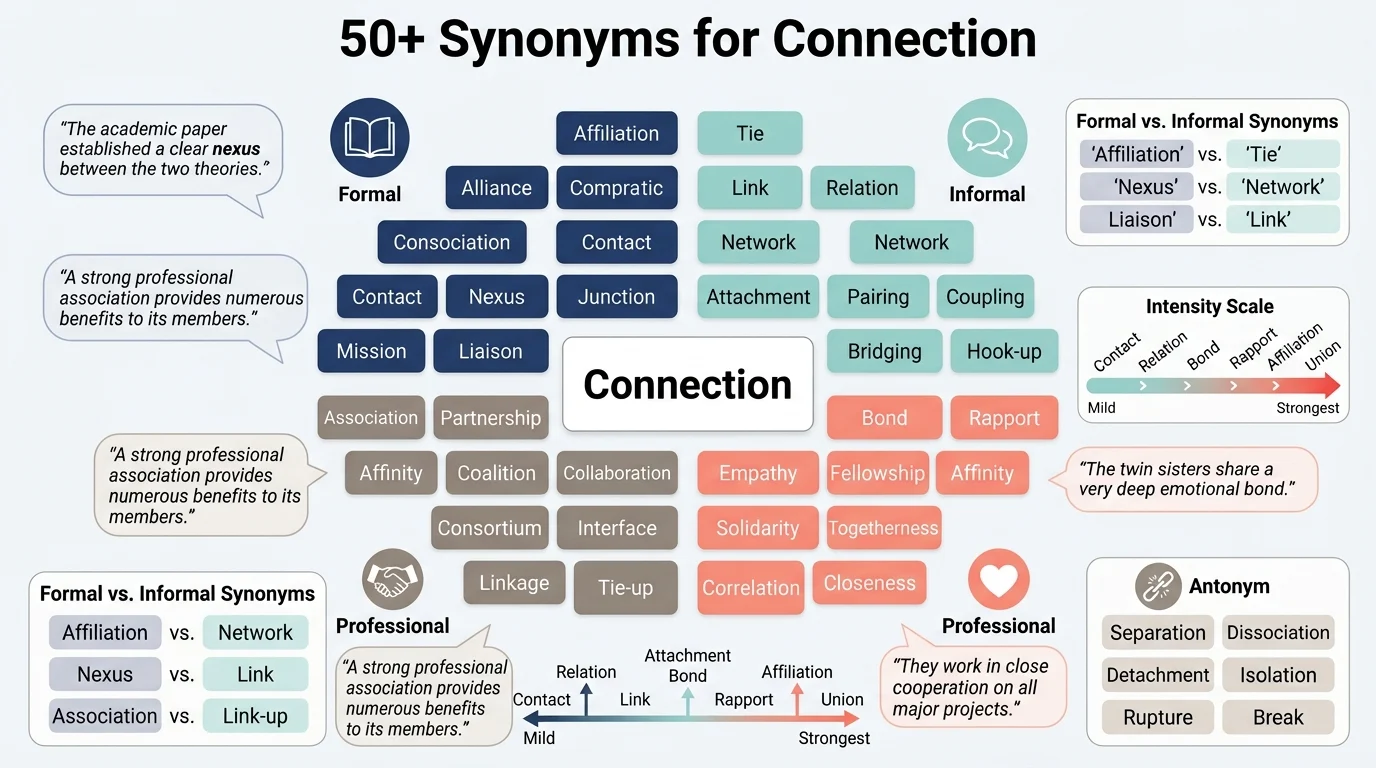
Have you ever caught yourself using the word “connection” over and over again in an email, a speech, or a social media post? You know the feeling. You are trying to describe a relationship, a link, or a bond, but the same word keeps appearing. This happens to everyone. Even professional writers fall into this habit.
The problem is not that “connection” is a bad word. It is an excellent and useful word. However, relying on it too much makes your writing sound repetitive and dull. Your readers may lose interest. Your message may lose its impact.
This guide will help you break that habit. will learn over 50 synonyms for connection. You will understand their meanings, tones, and best uses. you will also discover when to use each alternative for maximum effect. Whether you are writing a resume, an academic essay, a professional email, or a creative story, this guide has you covered.
What Does “Connection” Mean?
A connection is a relationship, link, or association between people, ideas, or things. For professional writing, use “association” or “affiliation.” For personal bonds, try “bond” or “attachment.” academic work, use “correlation” or “linkage.” emotional depth, choose “intimacy” or “rapport.”
Meaning, Tone and Context
Simple definition: A connection is a relationship or link between two or more things. It can be physical, emotional, intellectual, or professional.
Part of speech: Noun. The verb form is “connect.” The adjective form is “connected.”
Tone: Neutral. The word itself carries no strong emotional charge.
Formality level: Versatile. “Connection” works in almost any context. It is safe, standard, and widely understood.
Common use cases:
- Describing relationships between people
- Explaining how ideas relate to each other
- Talking about technological links
- Discussing emotional bonds
- Describing professional networks
- Explaining cause and effect
- Referring to physical attachments
Important word forms:
- Connect (verb)
- Connected (adjective)
- Connecting (adjective and verb form)
- Connectional (rare adjective)
- Disconnection (noun)
- Reconnection (noun)
When and How to Use “Connection”
Use “connection” when you need a general term for any kind of link, relationship, or association. It is your default word when no specific nuance is required. This makes it safe but unremarkable.
Here are realistic examples across different contexts:
Professional context:
“I have a strong connection with several industry leaders who can support this project.”
Personal context:
“We built a deep connection during our years of shared experiences.”
Academic context:
“The study explores the connection between sleep quality and cognitive performance.”
Emotional context:
“She felt an instant connection with the rescue dog she met at the shelter.”
Creative context:
“The artist created a visual connection between the past and the present through color.”
Social media context:
“Looking for meaningful connections with like minded creators in this space.”
Email context:
“I am writing to establish a connection with your organization regarding potential collaboration.”
Resume context:
“Built strong connections with clients resulting in a 30% increase in retention.”
Another Word for “Connection”
The best single replacement depends entirely on your context. Here are the top alternatives by situation:
Professional writing: “Association”
This word suggests a formal relationship between organizations or individuals.
Academic writing: “Correlation”
This is ideal when discussing statistical or research based relationships.
Casual conversation: “Link”
Simple, direct, and easy to understand in everyday speech.
Emotional writing: “Bond”
This conveys warmth, trust, and emotional depth.
Creative writing: “Bridge”
This adds imagery and suggests a connection between two separate worlds.
Resume or workplace use: “Network”
This suggests professional relationships that can benefit your career.
Social media captions: “Vibe” or “Rapport”
These feel modern and relatable for social audiences.
Stronger meaning: “Tie”
This implies a strong, binding connection that is difficult to break.
Softer meaning: “Relation”
This is gentler and less emotionally charged.
When Not to Use “Connection”
“Connection” can sound too vague in many situations. It often fails to capture the specific nature of a relationship. Here is when you should avoid it.
When you need emotional depth:
Instead of “connection,” use “bond” or “attachment.”
Weak sentence: “The mother felt a connection with her child.”
Better sentence: “The mother felt an unbreakable bond with her child.”
When you need professional formality:
Instead of “connection,” use “affiliation” or “association.”
Weak sentence: “Her connection to the university helped her career.”
Better sentence: “Her affiliation with the university opened many doors.”
When you need academic precision:
Instead of “connection,” use “correlation” or “relationship.”
Weak sentence: “There is a connection between the two variables.”
Better sentence: “There is a significant correlation between the two variables.”
When you are describing physical links:
Instead of “connection,” use “attachment” or “joint.”
Weak sentence: “The connection between the pipes broke.”
Better sentence: “The joint between the pipes broke.”
When you need to show intensity:
Instead of “connection,” use “union” or “fusion.”
Weak sentence: “Their connection was strong.”
Better sentence: “Their union was unbreakable.”
Words Commonly Confused With “Connection”
Connection vs. Relationship
A “relationship” is broader and often suggests ongoing interaction. A “connection” can be a single point of contact. You have a relationship with a partner. You have a connection with a LinkedIn contact.
Connection vs. Link
“Link” is more direct and often refers to technology or clearly defined relationships. “Connection” is more abstract. You click a link online. You feel a connection with someone.
Connection vs. Bond
A “bond” is always emotional and implies a strong, personal attachment. A “connection” can be intellectual, practical, or physical. A bond is a type of connection, but not all connections are bonds.
Connection vs. Association
“Association” suggests membership or shared interests. It is more formal than “connection.” You have an association with a professional body. You have a connection with a colleague.
Connection vs. Affiliation
“Affiliation” implies a formal link with an organization. It is the most professional synonym. You have an affiliation with a university. You have a connection with a friend.
Connection vs. Correlation
“Correlation” is strictly about statistical or scientific relationships. It has no emotional or personal meaning. “Connection” is far broader.
Best Synonym by Context for “Connection”
| Context | Best Synonym | Why It Works | Example |
|---|---|---|---|
| Formal writing | Association | Adds professionalism and precision | The association between the two departments is essential |
| Academic writing | Correlation | Conveys research based accuracy | The correlation between diet and health is clear |
| Professional or business | Affiliation | Shows formal organizational links | Her affiliation with the firm is long standing |
| Resume | Network | Demonstrates career relevant relationships | Built a network of industry contacts |
| Casual conversation | Link | Simple and universally understood | We have a link through our mutual friend |
| Creative writing | Bridge | Adds imagery and poetic quality | Time is a bridge between memory and hope |
| Emotional tone | Bond | Conveys depth and personal meaning | Their bond grew stronger through hardship |
| Strong intensity | Tie | Implies strength and durability | The tie between siblings is often unbreakable |
| Soft or moderate | Relation | Gentle and noncommittal | The relation between these ideas is interesting |
| Social media captions | Rapport | Feels modern and interpersonal | Loving the rapport with this community |
| Technological | Interface | Precise for tech contexts | The interface between the apps is seamless |
| Personal | Attachment | Suggests emotional investment | She developed a strong attachment to her mentor |
| Spiritual | Union | Conveys deep, transcendent meaning | They experienced a spiritual union |
Which Synonym Should You Choose?
Choosing the right synonym comes down to four key factors.
Consider the meaning: What kind of connection are you describing? Is it emotional, professional, intellectual, physical, or spiritual? Match your word to the type of relationship.
Consider the formality: Are you writing a research paper or a text to a friend? Formal contexts need formal words like “affiliation” or “correlation.” Casual contexts allow for words like “link” or “vibe.”
Consider the emotional intensity: Do you need to convey deep emotion or a simple fact? Strong emotions call for “bond” or “union.” Neutral facts call for “association” or “relationship.”
Consider the professional value: For resumes and cover letters, choose words like “network” or “affiliation.” These sound impressive and career focused.
Real Life Examples of “Connection” in Sentences
School context: “The teacher helped students see the connection between historical events and modern society.” Use “link” for more direct academic language.
Workplace context: “Her connection with the marketing team improved project outcomes significantly.” Use “alliance” for more formal business writing.
Writing context: “The essay needed a stronger connection between the introduction and the conclusion.” Use “bridge” for creative editing.
Conversation context: “We have a real connection. I have never felt this comfortable with anyone.” Use “chemistry” for romantic contexts.
Social media context: “This post about my journey is generating incredible connections with my audience.” Use “engagement” for social media metrics.
Resume context: “Created valuable connections with key stakeholders across multiple departments.” Use “partnerships” for professional growth.
Email context: “I hope to establish a connection with your team for future collaboration.” Use “liaison” for formal correspondence.
Storytelling context: “The magical connection between the siblings could not be explained by science.” Use “nexus” for fantasy or sci fi writing.
15 Synonyms for “Connection”
| Synonym | Simple Meaning | Best Used For | Example Sentence |
|---|---|---|---|
| Bond | A close emotional tie | Personal relationships and emotional writing | The bond between the twins was visible to everyone |
| Link | A direct relationship | Casual conversation and technology | The link between smoking and disease is well documented |
| Association | A formal relationship | Professional and academic writing | His association with the nonprofit lasted twenty years |
| Affiliation | An official connection | Resumes and business contexts | Her affiliation with the university boosted her credentials |
| Correlation | A statistical relationship | Academic and research writing | The correlation between income and education is clear |
| Rapport | A harmonious relationship | Personal and professional interaction | He built excellent rapport with his new team members |
| Tie | A strong binding connection | Emphasizing strength and durability | The ties between the two families go back generations |
| Attachment | An emotional bond | Psychology and personal writing | Her attachment to her hometown remained strong |
| Union | A close merging | Spiritual and deep emotional contexts | The union of their minds created something beautiful |
| Relationship | An ongoing interaction | General use in all contexts | Their relationship was built on mutual respect |
| Nexus | A central link | Creative and academic writing | The city was the nexus of trade in the region |
| Bridge | A linking element | Creative and inspirational writing | Kindness is a bridge between strangers |
| Interconnection | A mutual link | Complex or systemic relationships | The interconnection of ecosystems is fragile |
| Linkage | A connection between systems | Technical and academic writing | The linkage between the two databases was secure |
| Network | A system of connections | Professional and social contexts | She built an impressive network of mentors |
Synonym Groups and Usage Differences
Professional vs. Personal Synonyms
Professional synonyms focus on utility, benefit, and formal relationships. These include “network,” “affiliation,” “association,” and “liaison.” They sound competent and career oriented. Personal synonyms focus on emotion, trust, and intimacy. These include “bond,” “attachment,” “rapport,” and “chemistry.” They sound warm and human.
Formal vs. Conversational Synonyms
Formal synonyms work in reports, essays, speeches, and professional correspondence. Use “association,” “correlation,” “affiliation,” and “liaison.” Conversational synonyms work in texts, emails to friends, and casual writing. Use “link,” “tie,” “vibe,” and “rapport.” The wrong formality level makes you sound out of place.
Academic Synonyms
Academic words sound precise and suitable for essays or research based writing. “Correlation” implies statistical significance. “Relationship” is common in social sciences. “Linkage” works in technical fields. “Interconnection” describes complex systems. These words show scholarly precision.
Professional and Business Synonyms
Business words convey competence and value. “network” for professional contacts. Use “affiliation” for memberships. Use “association” for partnerships. “liaison” for coordination roles. Use “alliance” for strategic partnerships. These sound impressive on resumes and in meetings.
Creative or Literary Synonyms
Creative words add imagery, emotion, and descriptive depth. “bridge” to connect separate worlds. Use “nexus” for a central point. “tie” for binding relationships. Use “union” for deep merging. Use “fusion” for blended connections. These make stories and poetry more vivid.
Slang or Modern Synonyms
Some modern words work in casual settings but not formal ones. “Vibe” suggests emotional connection in social contexts. “Link” has been used in slang for relationships. “Connect” itself is often used as a verb in modern networking. Use these only in casual conversations or social media. Avoid them in professional and academic writing.
Strongest vs. Weaker Synonyms
Intensity scale from mild to strongest:
Mild: Association, relation, link, interface
Moderate: Connection, relationship, affiliation, correlation
Strong: Tie, bond, attachment, rapport
Strongest: Union, fusion, merger, nexus
Choose based on how much weight you want the word to carry.
Emotional vs. Neutral Synonyms
Emotional synonyms add feeling and personal meaning. “Bond,” “attachment,” “rapport,” and “union” all carry emotional weight. Neutral synonyms stay factual and objective. “Association,” “correlation,” “interface,” and “linkage” are emotion free. Match your choice to your content.
Antonyms of “Connection”
| Antonym | Meaning | Example Sentence |
|---|---|---|
| Disconnection | A lack of relationship | The disconnection between the teams caused project delays |
| Separation | A state of being apart | Separation from her family was difficult |
| Distance | A lack of closeness | The distance between their views was clear |
| Division | A split or partition | The division in the community grew worse |
| Isolation | Complete lack of connection | His isolation from society was self imposed |
| Detachment | A lack of emotional involvement | Her detachment from the situation surprised everyone |
| Breach | A break in relationship | The breach between the partners was irreparable |
| Gap | A space between things | The gap in their communication was problematic |
| Rift | A serious disagreement | The rift in the family lasted for years |
| Disunion | A lack of unity | The disunion of the group led to failure |
| Incompatibility | A lack of harmony | Their incompatibility ended the relationship |
| Alienation | Feeling separated | His alienation from his peers grew over time |
| Severance | A cutting off | The severance of ties was sudden and painful |
| Divergence | A moving apart | The divergence in their goals became apparent |
| Fragmentation | Breaking into pieces | The fragmentation of the network caused problems |
Comparison: Connection vs. Similar Words
Connection vs. Bond
Main difference: “Bond” always implies emotional depth. “Connection” can be entirely practical. A bond suggests trust and personal meaning.
Which is stronger: Bond is much stronger emotionally.
Which is more formal: Connection is more formal and neutral.
Example with connection: “I have a professional connection with her.”
Example with bond: “Our bond goes beyond professional courtesy.”
Connection vs. Association
Main difference: “Association” suggests membership or shared interests. “Connection” is broader and can mean anything.
Which is stronger: Association is more specific but not necessarily stronger.
Which is more formal: Association is more formal and businesslike.
Example with connection: “There is a connection between poverty and crime.”
Example with association: “His association with the club lasted thirty years.”
Connection vs. Link
Main difference: “Link” is more direct and concrete. “Connection” is more abstract.
Which is stronger: Neither is stronger, but “link” is more direct.
Which is more formal: Connection is slightly more formal.
Example with connection: “I felt a connection with the art.”
Example with link: “The link between cause and effect is clear.”
Connection vs. Relationship
Main difference: “Relationship” suggests ongoing interaction. “Connection” can be temporary or single point.
Which is stronger: Relationship implies more depth and continuity.
Which is more formal: Relationship is neutral but more personal.
Example with connection: “I have a connection in the marketing department.”
Example with relationship: “We have a long standing relationship with that client.”
Connection vs. Affiliation
Main difference: “Affiliation” always suggests a formal tie to an organization. “Connection” can be personal or professional.
Which is stronger: Affiliation is more official and binding.
Which is more formal: Affiliation is highly formal.
Example with connection: “I have a connection to the university.”
Example with affiliation: “My affiliation with the university is active.”
Connection vs. Rapport
Main difference: “Rapport” specifically means harmonious understanding. It is personal and positive. “Connection” can be any type.
Which is stronger: Rapport implies quality, not strength.
Which is more formal: Rapport is conversational but professional.
Example with connection: “We have a working connection.”
Example with rapport: “We have excellent rapport with our clients.”
Common Phrases and Expressions with “Connection”
1. Human connection
Meaning: A relationship between people based on shared humanity.
Example sentence: “Human connection is essential for mental health.”
2. Emotional connection
Meaning: A bond based on feelings rather than facts.
Example sentence: “They built an emotional connection through shared experiences.”
3. Professional connection
Meaning: A relationship based on work or career.
Example sentence: “Her professional connection with the executive opened new opportunities.”
4. Direct connection
Meaning: An immediate link without intermediaries.
Example sentence: “He has a direct connection to the decision maker.”
5. Connection to the past
Meaning: A link to history or heritage.
Example sentence: “The family heirloom provided a connection to the past.”
6. Network connection
Meaning: A technological or professional link.
Example sentence: “The network connection was unstable all morning.”
7. In connection with
Meaning: Regarding a particular subject.
Example sentence: “We are writing in connection with your recent inquiry.”
8. Make a connection
Meaning: To establish a link or relationship.
Example sentence: “She made an important connection at the conference.”
Common Mistakes to Avoid
1. Using “connection” when a more precise synonym is better
This is the most common problem. “Connection” is vague. Always ask if a more specific word would improve your message. “Bond” is better for emotions. “Correlation” is better for research. “Network” is better for professionals.
2. Confusing “connection” with “relationship”
These are not always interchangeable. “Relationship” implies ongoing interaction. “Connection” can be a single point of contact. Use “relationship” when you mean an ongoing tie. Use “connection” for single links.
3. Using a casual synonym in formal writing
Words like “vibe” and “link” are too casual for professional documents. Use “association” or “affiliation” instead. Your audience will take you more seriously.
4. Using an overly dramatic synonym for a simple situation
Do not use “union” to describe a simple professional contact. Do not use “bond” for a casual acquaintance. Match the intensity to the situation. Overdramatic language sounds insincere.
5. Repeating the same word too often
This is why you need this guide. Repetition bores readers. Vary your vocabulary. Use different synonyms throughout your writing. Keep your audience engaged.
6. Choosing a synonym with the wrong emotional tone
“Attachment” suggests some emotional investment. “Association” suggests none. Using “attachment” for a purely professional link sounds odd. Pay attention to the emotional weight of each word.
7. Using slang in academic or professional writing
Words like “vibe” and “connect” are fine for social media but not for essays or resumes. Maintain formality when required. Your credibility depends on it.
FAQs
What is the best synonym for connection?
The best synonym depends on your context. Use “bond” for emotional ties, “association” for formal relationships, and “correlation” for research.
What is a formal synonym for connection?
“Association” and “affiliation” are the most formal synonyms. Use them in business reports and academic papers.
What is an informal synonym for connection?
“Link” and “tie” are informal and conversational. Use them in casual writing and everyday speech.
What is another word for connection in professional writing?
“Network” is excellent for professional writing. “Affiliation” and “alliance” are also strong alternatives for workplace contexts.
What is the difference between connection and relationship?
A “relationship” implies ongoing interaction and depth. A “connection” can be a single point of contact or a brief link.
What is the opposite of connection?
“Disconnection” is the direct opposite. “Separation,” “distance,” and “division” are also strong antonyms.
Conclusion
“Connection” is a useful word, but it is far from your only option. The English language offers dozens of rich alternatives. Each one carries a unique meaning, tone, and emotional weight. Understanding these differences will transform your writing.
Remember to match your word to your situation. Use “bond” for emotional depth. Use “association” for professional formality. “correlation” for academic precision. “bridge” for creative imagery. Your choice of words shapes how readers understand your message.
Here is your practical vocabulary tip: Before writing any sentence with “connection,” pause. Ask yourself what kind of link you are describing. Then choose the word that matches that meaning exactly. This small habit will dramatically improve your clarity and impact.