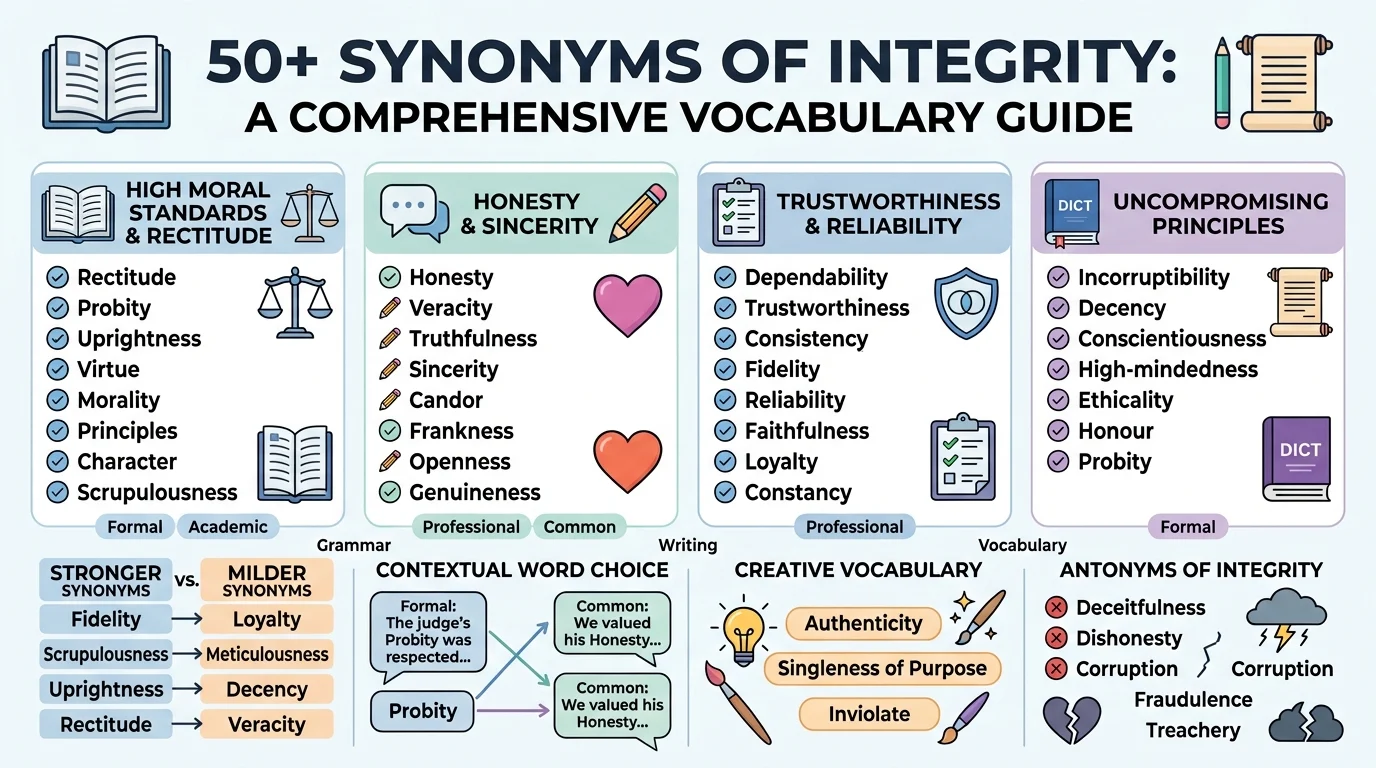
You are writing an important email to your boss, and you keep using the word “integrity” over and over. It feels repetitive, but you are not sure which other word fits. Maybe you are drafting a resume, an essay, or a social media post. You know what you want to say, but you cannot find the right alternative. This happens to everyone.
The good news is that there are many synonyms of integrity. The challenge is choosing the one that fits your exact situation. Some alternatives sound too formal. Others feel too casual. A few carry emotional weight, while others stay completely neutral.
This guide will help you understand the meaning of integrity, explore the best synonyms, and learn exactly which word to use in every context. By the end, you will never guess again. You will know.
What Are the Best Synonyms of “Integrity”?
Integrity means having strong moral principles and being honest and upright. The best synonyms depend on your context. Formal writing, use probity or rectitude. For casual conversation, use honesty or decency. For professional settings, use trustworthiness or ethical standards. Emotional writing, use virtue or honor. Each synonym carries a slightly different tone and level of formality.
Meaning, Tone, and Context
Simple Definition
Integrity is the quality of being honest and having strong moral principles. It also means the state of being whole, complete, or undivided.
Part of Speech
Noun
Overall Tone
Positive
Formality Level
Semi-formal to formal. Integrity works well in professional, academic, and everyday contexts. It is not overly casual, but it is not stiff either.
Common Uses
Native English speakers use integrity in two main ways.
First, they use it to describe moral character. A person with integrity tells the truth, keeps promises, and does the right thing even when no one is watching.
Second, they use it to describe physical or structural wholeness. Engineers talk about the integrity of a bridge. Data analysts talk about the integrity of a database.
Word Forms
| Form | Word |
|---|---|
| Noun | integrity |
| Adjective | integral (relating to wholeness) |
| Adverb | integrally |
| Related Noun | integritous (rare) |
The adjective “integral” means essential or necessary for completeness. It is related but not a direct synonym for “honest.”
When and How to Use “Integrity”
Choose integrity when you want to emphasize moral soundness, honesty, and consistency between words and actions. It works best when describing someone’s character, a system’s completeness, or an organization’s ethical standards.
Here are seven realistic examples.
Professional Context
“Our company values integrity above all other qualities in new hires.”
Academic Context
“The researcher’s integrity was never questioned throughout the entire study.”
Workplace Context
“She handled the confidential information with complete integrity.”
Personal Context
“I admire my father’s integrity more than any other trait.”
Email Context
“Thank you for your integrity in addressing this issue directly with the team.”
Resume Context
“Maintained integrity and confidentiality while managing sensitive client data.”
Social Media Context
“Integrity means doing the right thing even when it costs you something.”
Best Synonyms of “Integrity”
No synonym is identical in every situation. Each alternative emphasizes a different aspect of integrity. Some focus on honesty. Others emphasize moral strength, completeness, or reliability.
Here are the best synonyms for specific contexts.
Professional Writing
Trustworthiness – This word emphasizes reliability and the ability to be depended upon. It sounds natural in business reports and professional recommendations.
Academic Writing
Probity – This is a formal, precise word that means proven honesty and integrity. It is common in academic papers, especially in ethics, law, and philosophy.
Business Communication
Ethical standards – This phrase sounds modern and professional. It works well in mission statements, policy documents, and corporate communications.
Casual Conversation
Decency – This is warm, approachable, and easy to understand. It fits everyday conversations about character and behavior.
Emotional Writing
Virtue – This word carries emotional weight and moral warmth. It works well in personal letters, speeches, and reflective writing.
Creative Writing
Honor – This adds a sense of dignity and respect. It fits storytelling, fiction, and descriptive passages.
Resume Writing
Uprightness – This is a strong, professional word that signals moral strength. It stands out on resumes and cover letters.
Workplace Communication
Reliability – This focuses on consistency and dependability. It is practical and easy to understand in team settings.
Stronger Meaning
Incorruptibility – This is the strongest synonym. It means absolutely unable to be bribed or morally compromised.
Softer Meaning
Goodness – This is gentle and warm. It emphasizes basic moral decency without sounding heavy or formal.
When Not to Use “Integrity”
Integrity is a strong, positive word, but it does not fit every situation. Here are times when you should choose a different word.
When the context is too casual
Integrity can sound overly formal in casual text messages or quick chats with friends.
Incorrect: “Hey, I appreciate your integrity in telling me about the party.”
Better: “Hey, I appreciate you being honest with me about the party.”
When the meaning is too vague
Integrity can feel abstract if you do not specify what kind of integrity you mean.
Incorrect: “We need more integrity in this department.”
Better: “We need more honesty and accountability in this department.”
When the tone is too heavy
Integrity carries moral weight. It can feel too serious for lighthearted topics.
Incorrect: “I love your integrity in choosing that pizza topping.”
Better: “I love your honesty in admitting you hate pineapple on pizza.”
When you need to emphasize reliability instead of morality
Integrity focuses on moral character, not dependability.
Incorrect: “The software has great integrity.”
Better: “The software is highly reliable and stable.”
Words Commonly Confused With “Integrity”
Integrity vs Honesty
Difference: Honesty means telling the truth. Integrity means having strong moral principles that guide all your actions. A person can be honest but still lack integrity if they do not stand up for what is right.
When to Use It: Use honesty when you are specifically talking about truthfulness. Use integrity when you are talking about overall moral character.
Example: “She was honest about her mistake, but her integrity was shown when she took full responsibility.”
Integrity vs Morality
Difference: Morality is a broader system of beliefs about right and wrong. Integrity is the personal quality of consistently following those beliefs.
When to Use It: Use morality when discussing ethical systems or societal norms. Use integrity when discussing an individual’s character.
Example: “His morality was shaped by his upbringing, but his integrity was tested in the workplace.”
Integrity vs Ethics
Difference: Ethics are external rules or codes of conduct. Integrity is the internal quality of following those rules even when no one is enforcing them.
When to Use It: Use ethics when referring to professional codes or formal guidelines. Use integrity when referring to personal character.
Example: “The company’s ethics policy was clear, but the CEO’s integrity made it meaningful.”
Integrity vs Principle
Difference: A principle is a specific rule or belief. Integrity is the consistent application of those principles.
When to Use It: Use principle when referring to a specific belief. Use integrity when referring to the quality of consistently following beliefs.
Example: “He had strong principles, but his integrity ensured he never compromised them.”
Integrity vs Character
Difference: Character is the overall combination of traits that define a person. Integrity is one specific trait within that combination.
When to Use It: Use character when describing someone’s overall personality. Use integrity when specifically describing their honesty and moral strength.
Example: “Her character was admirable, and her integrity was the foundation of it.”
Integrity vs Sincerity
Difference: Sincerity means being genuine and free from pretense. Integrity means being morally upright and consistent.
When to Use It: Use sincerity when talking about authenticity or genuine feelings. Use integrity when talking about moral soundness.
Example: “His sincerity made people trust him, but his integrity made them respect him.”
Best Synonyms of “Integrity” by Context
| Context | Best Synonym | Why It Works | Example |
|---|---|---|---|
| Formal writing | Probity | Precise and authoritative | “The judge was known for her probity and fairness.” |
| Academic writing | Rectitude | Scholarly and exact | “The study examined the rectitude of the participants’ moral choices.” |
| Professional communication | Trustworthiness | Clear and practical | “His trustworthiness made him the ideal candidate for the role.” |
| Business emails | Ethical standards | Modern and professional | “We hold all employees to the highest ethical standards.” |
| Resume writing | Uprightness | Strong and distinctive | “Demonstrated uprightness in all client dealings.” |
| Workplace communication | Reliability | Focused and actionable | “Her reliability made her an essential team member.” |
| Casual conversation | Decency | Warm and approachable | “He is a man of basic decency.” |
| Everyday speaking | Honesty | Simple and direct | “I value honesty above everything else.” |
| Creative writing | Honor | Dignified and evocative | “He fought for his honor until the very end.” |
| Storytelling | Virtue | Rich and meaningful | “Her virtue guided her through every trial.” |
| Emotional writing | Goodness | Gentle and heartfelt | “I believe in the goodness of people.” |
| Strong emphasis | Incorruptibility | Powerful and absolute | “His incorruptibility was legendary.” |
| Mild tone | Fairness | Balanced and reasonable | “She always acted with fairness toward everyone.” |
| Social media captions | Authenticity | Trendy and relatable | “Authenticity over perfection, always.” |
How to Choose the Best Synonym of “Integrity”
Choosing the right synonym depends on four factors.
Consider your audience. Are you writing for a professor, a boss, a friend, or a social media follower? Formal audiences need words like probity and rectitude. Casual audiences respond better to honesty and decency.
Consider your tone. Do you want to sound emotional, neutral, or professional? Emotional writing benefits from words like virtue and honor. Neutral writing works well with trustworthiness and reliability. Professional writing calls for probity and ethical standards.
Consider your purpose. Are you describing a person, a system, or an action? Describing a person works with any synonym. Describing a system works better with wholeness or completeness. An action works best with honesty or fairness.
Consider the strength you need. Do you want a mild word or a very strong one? Mild options include goodness and decency. Strong options include incorruptibility and probity. Choose the strength that matches your message.
The best synonym is the one that communicates your intended meaning most clearly to your specific reader.
Real Life Examples of “Integrity”
School
“The student showed integrity by returning the lost wallet instead of keeping the money.”
College
“Academic integrity requires students to cite their sources properly.”
Workplace
“The manager’s integrity was evident when she admitted the team’s error to upper management.”
Business
“Our brand is built on integrity, transparency, and customer trust.”
“I am writing to commend you for the integrity you demonstrated during the negotiation.”
Resume
“Consistently upheld integrity and confidentiality in handling sensitive financial records.”
Conversation
“I respect her because she has real integrity. She never takes shortcuts.”
Storytelling
“The knight’s integrity was tested when he faced the choice between wealth and duty.”
Blogging
“Integrity in content creation means being honest with your audience, even when it hurts your metrics.”
“Integrity is not just about telling the truth. It is about living the truth.”
18 Best Synonyms of “Integrity”
Synonyms of “Integrity” by Usage
Professional vs Personal Synonyms
Professional synonyms work best in workplaces, business settings, and formal communications. These include probity, rectitude, trustworthiness, and uprightness. They sound authoritative and build confidence.
Personal synonyms sound better in everyday conversations with friends and family. These include honesty, decency, goodness, and sincerity. They feel warm and approachable.
Choose professional synonyms for emails to clients, performance reviews, and job applications. Choose personal synonyms for casual chats, social media, and personal letters.
Formal vs Conversational Synonyms
Formal synonyms fit reports, essays, business writing, and presentations. These include probity, rectitude, morality, and uprightness.
Conversational synonyms fit casual conversations, texting, and informal emails. These include honesty, decency, sincerity, and fairness.
Academic papers demand formal synonyms. Social media posts work better with conversational ones.
Academic Synonyms
For research, essays, reports, and academic discussions, choose precise, authoritative words.
Probity – Suggests proven, unquestionable honesty. It is common in law and ethics papers.
Rectitude – Emphasizes moral correctness and rightness of action.
Uprightness – Signals strong, consistent moral character.
Morality – Works well when discussing ethical frameworks and systems.
These words sound more scholarly and carry weight in academic contexts.
Professional and Business Synonyms
For resumes, interviews, meetings, presentations, performance reviews, client communication, and business emails, choose practical, confident words.
Trustworthiness – Signals reliability and dependability.
Uprightness – Stands out on resumes and in recommendations.
Ethical standards – Sounds modern and corporate.
Reliability – Focuses on consistent performance.
Fairness – Works well in management and leadership contexts.
These words fit professional settings because they are clear, actionable, and easy to understand.
Creative and Literary Synonyms
For storytelling, fiction, poetry, descriptive writing, and speeches, choose expressive alternatives that add emotion or imagery.
Virtue – Adds moral richness and depth.
Honor – Brings dignity and respect.
Goodness – Creates warmth and emotional connection.
Purity – Suggests innocence and moral cleanliness.
Righteousness – Adds intensity and moral conviction.
These words help writers paint vivid pictures of character and morality.
Slang or Modern Synonyms
Integrity does not have widely used slang equivalents. However, modern English speakers sometimes use these casual alternatives.
Realness – Used in casual conversation to mean genuine authenticity.
Authenticity – Popular in social media and personal branding.
Keeping it real – A phrase meaning staying true to oneself.
These are acceptable in casual settings but should be avoided in academic, professional, or formal writing.
Strongest to Mildest Synonyms
| Intensity | Synonym | Emotional Weight |
|---|---|---|
| Mild | Decency | Low |
| Mild | Fairness | Low |
| Moderate | Honesty | Medium |
| Moderate | Sincerity | Medium |
| Moderate | Goodness | Medium |
| Moderate | Trustworthiness | Medium |
| Strong | Uprightness | High |
| Strong | Rectitude | High |
| Strong | Virtue | High |
| Strong | Probity | High |
| Very Strong | Incorruptibility | Very High |
| Very Strong | Righteousness | Very High |
Emotional vs Neutral Synonyms
Emotional Synonyms
These words express stronger feelings and moral conviction.
Virtue, honor, righteousness, purity, and goodness carry emotional weight. They are ideal for speeches, personal letters, creative writing, and any context where you want to inspire or move your reader.
Neutral Synonyms
These words simply communicate information without adding strong emotion.
Trustworthiness, reliability, fairness, and honesty are straightforward and practical. They work well in business writing, technical documents, and everyday communication where clarity matters more than emotional impact.
Choose emotional synonyms when you want to persuade or inspire. Choose neutral synonyms when you want to inform or explain.
Antonyms of “Integrity”
| Antonym | Meaning | Example Sentence |
|---|---|---|
| Dishonesty | Lack of truthfulness | “His dishonesty cost him his job and his reputation.” |
| Corruption | Moral decay, especially involving bribery | “Corruption in the government eroded public trust.” |
| Deceit | Intentional misleading of others | “The deceit was uncovered during the investigation.” |
| Duplicity | Double-dealing or deceitfulness | “His duplicity made it impossible to trust him.” |
| Fraud | Wrongful deception for personal gain | “The fraud was discovered during the annual audit.” |
| Immorality | Lack of moral principles | “The immorality of the decision shocked the community.” |
| Untruthfulness | Tendency to lie or mislead | “Her untruthfulness made her an unreliable witness.” |
| Treachery | Betrayal of trust | “The treachery of his closest ally devastated him.” |
| Mendacity | Habitual lying | “His mendacity was well known among his colleagues.” |
| Chicanery | Deception through trickery | “The chicanery of the scheme was exposed in court.” |
| Crookedness | Dishonest or corrupt behavior | “The crookedness of the deal was obvious to everyone.” |
| Deceitfulness | Quality of being deceptive | “Her deceitfulness made her impossible to work with.” |
| Unscrupulousness | Lack of moral principles | “His unscrupulousness knew no bounds.” |
| Villainy | Wicked or criminal behavior | “The villainy of the antagonist drove the plot.” |
| Roguishness | Dishonest but often playful behavior | “His roguishness was charming but untrustworthy.” |
Comparison: “Integrity” vs Similar Words
Integrity vs Honesty
Main Difference: Honesty is about telling the truth. Integrity is about consistently doing the right thing, even when it is difficult. A person can be honest but still lack integrity if they do not stand up for what is right.
Which Is Stronger? Integrity is stronger because it encompasses more than just truthfulness. It includes moral consistency, courage, and principle.
Which Is More Formal? Both are neutral, but integrity is slightly more formal.
When to Use Each: Use honesty when discussing truthfulness in speech. Use integrity when discussing overall moral character and consistency.
Examples:
Integrity: “She showed integrity by refusing to take credit for her teammate’s work.”
Honesty: “She was honest about her role in the project.”
Integrity vs Morality
Main Difference: Morality is a system of beliefs about right and wrong. Integrity is the personal quality of living according to those beliefs.
Which Is Stronger? Integrity implies action and consistency. Morality can be passive.
Which Is More Formal? Morality is more academic. Integrity is more personal.
When to Use Each: Use morality when discussing ethical systems. Use integrity when discussing individual character.
Examples:
Integrity: “His integrity ensured he followed his moral code even when it cost him.”
Morality: “The morality of the decision was debated by the ethics committee.”
Integrity vs Ethics
Main Difference: Ethics are external rules or codes. Integrity is internal character.
Which Is Stronger? Integrity is stronger because it is personal and self-driven.
Which Is More Formal? Ethics is more formal and institutional.
When to Use Each: Use ethics when referring to professional codes. Use integrity when referring to personal character.
Examples:
Integrity: “Her integrity guided her actions, not just the company’s ethics policy.”
Ethics: “The company’s ethics policy prohibited accepting gifts from clients.”
Integrity vs Principle
Main Difference: A principle is a specific rule. Integrity is the consistent application of principles.
Which Is Stronger? Integrity is stronger because it implies action and consistency.
Which Is More Formal? Both are formal, but principle is slightly more common in everyday speech.
When to Use Each: Use principle when referring to a specific belief. Use integrity when referring to the quality of sticking to beliefs.
Examples:
Integrity: “His integrity meant he never compromised his principles.”
Principle: “Honesty was his guiding principle.”
Integrity vs Character
Main Difference: Character is the overall combination of traits. Integrity is one specific trait.
Which Is Stronger? Character is broader. Integrity is more specific and focused.
Which Is More Formal? Both are neutral.
When to Use Each: Use character when describing someone’s overall personality. Use integrity when specifically describing their honesty and moral strength.
Examples:
Integrity: “Her integrity was the foundation of her good character.”
Character: “He had strong character and was respected by everyone.”
Integrity vs Sincerity
Main Difference: Sincerity means being genuine. Integrity means being morally upright.
Which Is Stronger? Integrity is stronger because it encompasses moral action, not just genuine feelings.
Which Is More Formal? Both are neutral.
When to Use Each: Use sincerity when talking about authenticity. Use integrity when talking about moral soundness.
Examples:
Integrity: “His integrity was proven through his consistent actions.”
Sincerity: “Her sincerity made her apology believable.”
Common Phrases and Expressions with “Integrity”
Moral Integrity
Meaning: Strong moral character and adherence to ethical principles.
Example: “Her moral integrity was never questioned, even by her critics.”
Personal Integrity
Meaning: Honesty and moral strength in one’s personal life.
Example: “His personal integrity made him a role model for his children.”
Professional Integrity
Meaning: Adherence to ethical standards in a professional setting.
Example: “The lawyer’s professional integrity was respected by all her peers.”
Academic Integrity
Meaning: Honesty and ethical behavior in academic work.
Example: “The university enforces strict academic integrity policies.”
Structural Integrity
Meaning: The soundness and completeness of a physical structure.
Example: “Engineers inspected the bridge to confirm its structural integrity.”
Integrity of Character
Meaning: The quality of being honest and morally sound as a person.
Example: “His integrity of character was evident in every decision he made.”
Compromise One’s Integrity
Meaning: To act against one’s moral principles.
Example: “She refused to compromise her integrity for a promotion.”
Common Mistakes to Avoid
1: Choosing a Vague Synonym Instead of a Precise One
Using a weak synonym can make your writing feel unclear.
Incorrect: “He is a good person.”
Better: “He is a person of integrity.”
Why: “Good” is vague. “Integrity” is specific and meaningful.
2: Confusing Integrity with Honesty
These words are related but not identical. Honesty is about truthfulness. Integrity is about moral consistency.
Incorrect: “Her integrity was shown when she told the truth.”
Better: “Her honesty was shown when she told the truth. Her integrity was shown when she took responsibility for the consequences.”
Why: Integrity includes honesty but goes beyond it.
3: Using an Informal Synonym in Formal Writing
Some synonyms sound too casual for professional contexts.
Incorrect: “The candidate has real integrity.”
Better: “The candidate demonstrates exceptional probity and ethical judgment.”
Why: “Real” is informal. “Probity” is formal and authoritative.
4: Selecting an Overly Dramatic Synonym
Using very strong words in mild contexts can feel exaggerated.
Incorrect: “I appreciate your incorruptibility in choosing the restaurant.”
Better: “I appreciate your honesty in choosing the restaurant.”
Why: Incorruptibility is too strong for casual topics.
5: Repeating the Same Word Too Often
Overusing any word makes writing feel repetitive.
Incorrect: “Her integrity is admirable. Her integrity guides her decisions. Her integrity inspires others.”
Better: “Her integrity is admirable. Her principles guide her decisions. Her honesty inspires others.”
Why: Varying synonyms keeps writing fresh and engaging.
6: Choosing a Synonym with the Wrong Emotional Tone
Some synonyms carry emotional weight that may not fit your context.
Incorrect: “The report was completed with righteousness.”
Better: “The report was completed with thoroughness and accuracy.”
Why: Righteousness implies moral intensity. Thoroughness is neutral and professional.
7: Using Slang in Academic or Professional Writing
Slang synonyms like “realness” are inappropriate in formal contexts.
Incorrect: “The study confirms the realness of the data.”
Better: “The study confirms the integrity and completeness of the data.”
Why: “Realness” is casual. “Integrity” is professional.
Frequently Asked Questions
What are the best synonyms of integrity?
The best synonyms depend on your context. Formal writing, use probity or rectitude. For casual conversation, use honesty or decency. For professional settings, use trustworthiness or ethical standards.
What are the best formal synonyms of integrity?
The best formal synonyms are probity, rectitude, uprightness, and morality. These words sound authoritative and are commonly used in academic papers, legal documents, and professional reports.
What are common informal synonyms of integrity?
Common informal synonyms include honesty, decency, sincerity, and fairness. These words are simple, approachable, and work well in everyday conversations and casual writing.
What is another word for integrity in professional writing?
In professional writing, use trustworthiness, uprightness, or ethical standards. These words are clear, practical, and convey reliability and moral strength in business contexts.
What is the difference between integrity and honesty?
Honesty means telling the truth. Integrity means having strong moral principles and consistently doing the right thing. A person can be honest but still lack integrity if they do not stand up for what is right.
What is the opposite of integrity?
The opposites of integrity include dishonesty, corruption, deceit, duplicity, immorality, and fraud. These words describe a lack of moral principles or truthfulness.
Conclusion
Integrity is a powerful word that means having strong moral principles, honesty, and consistency between words and actions. It also refers to the state of being whole and complete.
The best synonyms of integrity depend on your audience, tone, and purpose. Formal writing, choose probity or rectitude. For casual conversation, choose honesty or decency. Professional settings, choose trustworthiness or ethical standards. For creative writing, choose virtue or honor.
No synonym works perfectly in every situation. The key is to choose the word that communicates your intended meaning most clearly to your specific reader. Consider your audience, your tone, and the strength you need.
A practical tip: Before you write, ask yourself what you really mean. Are you emphasizing honesty, reliability, moral strength, or completeness? Choose the synonym that matches your true meaning.
Definitions, meanings, and usage recommendations should be verified with trusted language references before publication. Recommended sources include Cambridge Dictionary, Oxford English Dictionary, Merriam Webster, Collins Dictionary, and Britannica.