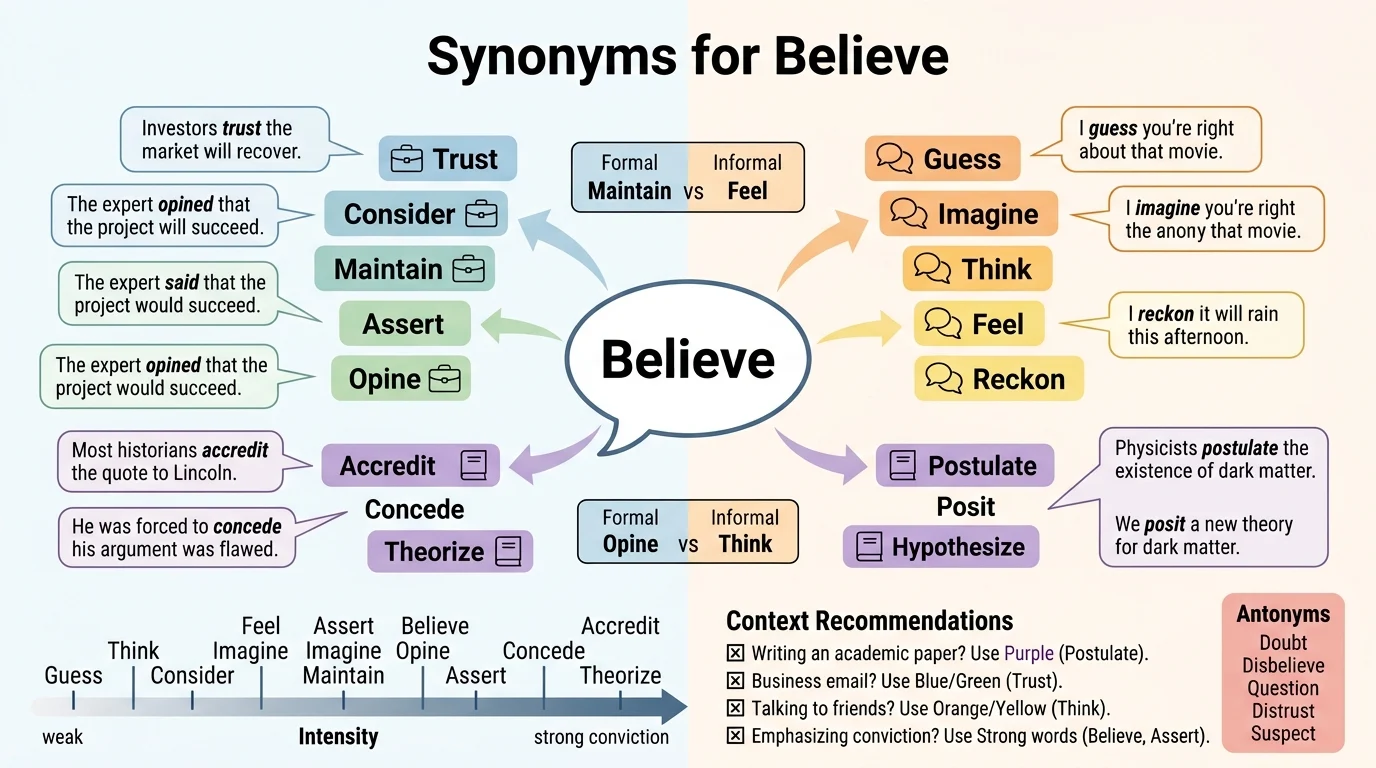
Do you keep repeating “believe” in your writing or conversations? You are not alone. Many English learners, students, and professionals struggle with this common word. Using the same word over and over makes your communication sound dull and repetitive. The good news is that English offers many powerful alternatives for “synonyms for believe” that can transform your speaking and writing.
Whether you are drafting an important email, writing an academic essay, or preparing for a job interview, varying your vocabulary shows confidence and precision. This guide will help you master the best “synonyms for believe” across different situations, tones, and contexts. By the end, you will know exactly which word to choose for professional, casual, academic, and creative settings.
What Does “Believe” Mean?
The word “believe” means to accept something as true, genuine, or real. It can express certainty, faith, opinion, or trust. The best “synonyms for believe” include “think” for casual use, “consider” for professional writing, “assume” for uncertainty, “trust” for emotional contexts, and “maintain” for formal or academic statements.
Meaning, Tone and Context
Simple Definition
To believe means to accept that something is true or exists without needing absolute proof.
Part of Speech
Believe functions as a verb. It can be transitive, taking a direct object, or intransitive.
Tone
The tone of “believe” is generally neutral. However, it can shift to positive when expressing trust or negative when expressing skepticism in certain contexts.
Formality Level
Believe sits in the middle of the formality scale. It works in casual conversations, professional emails, and formal writing. It is safe to use in almost any situation.
Common Use Cases
People use believe to state opinions, express trust in others, accept information, hold convictions, or speculate about uncertain situations.
Important Word Forms
The noun forms are “belief” and “believer.” The adjective form is “believable.” The opposite forms include “disbelieve,” “unbelievable,” and “unbelieving.”
When and How to Use “Believe”
You should use “believe” when you want to express acceptance of truth or trust in someone or something. It works best when you are stating a personal conviction, opinion, or general acceptance of facts.
Professional Example
“I believe our team can meet the quarterly targets with focused effort.”
Academic Example
“Many researchers believe this theory provides a solid foundation for further study.”
Personal Example
“I believe you have the strength to overcome this challenge.”
Emotional Example
“She believes in the power of kindness to heal deep wounds.”
Creative Example
“The old sailor believed the sea held secrets that no map could capture.”
Social Media Caption Example
“I believe in chasing dreams, not people.”
Email Example
“I believe we should schedule a follow up meeting to discuss the proposal.”
Another Word for “Believe”
The best single replacement for “believe” depends entirely on your situation. Here are the most effective options for different contexts.
Professional Writing
Consider is the top choice for workplace communication. It sounds thoughtful and measured.
Academic Writing
Maintain works well for presenting arguments. Assert is stronger for defending positions.
Casual Conversation
Think is the most natural and common substitute in everyday speech.
Emotional Writing
Trust conveys deep confidence. Have faith in expresses strong emotional conviction.
Creative Writing
Deem adds literary quality. Hold adds a more formal or old fashioned tone.
Resume or Workplace Use
Hold works for stating professional principles. Consider shows thoughtful decision making.
Social Media Captions
Feel suggests personal intuition. Reckon adds a casual, conversational tone.
Stronger Meaning
Insist shows firm confidence. Affirm confirms something with conviction.
Softer Meaning
Suspect suggests uncertainty. Suppose offers a tentative guess.
When Not to Use “Believe”
Using “believe” can make your writing sound vague or weak. Avoid it when you have evidence or proof to support your statement.
Too Vague
Instead of “I believe the project failed,” use “The project failed because of poor planning.” Facts are stronger than opinions.
Too Casual
In formal academic papers, avoid “We believe” when you should write “Research indicates” or “Data demonstrates.”
Weak
When you have authority or expertise, replace “I believe” with “I recommend” or “I conclude.”
Too General
Instead of “People believe climate change is real,” write “Climate scientists confirm climate change is real.”
Better Example
Weak: “I believe this strategy will work.”
Stronger: “This strategy has proven effective in similar cases.”
Words Commonly Confused With “Believe”
Believe vs. Think
Think is more casual and less certain. Believe implies stronger conviction. Use think for everyday opinions. Use believe for deeper held convictions.
Believe vs. Assume
Assume means accepting something without evidence. Believe often involves trust or evidence. Use assume when you lack information. Use believe when you have some reason.
Believe vs. Guess
Guess is purely speculative. Believe has some basis. Use guess for casual predictions. Use believe for informed opinions.
Believe vs. Trust
Trust focuses on reliability and confidence in people. Believe focuses on accepting statements or truths. Use trust for relationships. Use believe for facts.
Believe vs. Consider
Consider suggests careful thought. Believe suggests acceptance. Use consider for weighing options. Use believe for final conclusions.
Believe vs. Conclude
Conclude implies reaching a decision after reasoning. Believe can be more instinctive. Use conclude for logical outcomes. Use believe for personal acceptance.
Best Synonym by Context for “Believe”
| Context | Best Synonym | Why It Works | Example |
|---|---|---|---|
| Formal Writing | Maintain | Sound authoritative and professional | The committee maintains that policy changes are necessary. |
| Academic Writing | Assert | Shows confidence in arguments | Scholars assert this theory explains observed patterns. |
| Professional Business | Consider | Demonstrates thoughtful analysis | We consider this partnership strategically valuable. |
| Resume Context | Hold | Conveys strong professional principles | I hold that integrity drives sustainable business growth. |
| Casual Conversation | Think | Natural and conversational | I think we should try that new restaurant. |
| Creative Writing | Deem | Adds literary elegance | The council deemed the proposal worthy of consideration. |
| Emotional Tone | Trust | Expresses deep confidence | She trusts her instincts completely. |
| Strong Intensity | Insist | Shows unwavering conviction | I insist this is the right decision. |
| Soft Moderate Tone | Suppose | Expresses gentle speculation | I suppose that could work. |
| Social Media Captions | Feel | Personal and relatable | I feel this is the right path for me. |
| US Usage | Figure | Casual American English | I figure we should leave by noon. |
| UK Usage | Reckon | Common British informal usage | I reckon it will rain tomorrow. |
Which Synonym Should You Choose?
Selecting the perfect synonym requires considering four key factors: meaning, formality, intensity, and audience.
First, consider your exact meaning. Do you have evidence or is this a guess? Choose “conclude” for evidence and “suspect” for uncertainty.
Second, think about your audience. Professional emails need “consider” while texts need “think.” Never use casual synonyms in formal settings.
Third, evaluate emotional intensity. Use “trust” for deep confidence and “feel” for gentle personal opinions. Match intensity to your subject matter.
Fourth, consider your medium. Academic essays demand “assert” while blog posts can use “think.” Match your word to your platform.
Real Life Examples of “Believe” in Sentences
School Example
“The teacher believed every student could succeed with proper support.”
Workplace Example
“Our team believes in transparent communication at all levels.”
Writing Example
“The author believes that storytelling can change perspectives.”
Conversation Example
“I believe this restaurant serves the best pizza in town.”
Social Media Example
“Believe in yourself and your unique journey.”
Email Example
“I believe we should implement this solution immediately.”
Storytelling Example
“The villagers believed the ancient tree held magical powers.”
Professional Recommendation
“I believe we need to reconsider our marketing approach.”
25 Synonyms for “Believe”
| Synonym | Simple Meaning | Best Used For | Example Sentence |
|---|---|---|---|
| Think | Have an opinion | Casual conversation | I think we should leave now. |
| Consider | Give careful thought | Professional writing | Please consider my proposal. |
| Assume | Accept without proof | Tentative statements | I assume the meeting is still on. |
| Suppose | Guess uncertainly | Speculative thoughts | I suppose that makes sense. |
| Trust | Have confidence | Emotional relationships | I trust your judgment completely. |
| Maintain | Assert firmly | Formal statements | He maintains his innocence. |
| Assert | Declare confidently | Academic arguments | The author asserts this claim. |
| Hold | Believe strongly | Professional positions | I hold that honesty matters most. |
| Deem | Judge formally | Literary or legal writing | The court deemed the evidence sufficient. |
| Feel | Sense intuitively | Personal expression | I feel this is the right choice. |
| Figure | Think informally | American casual speech | I figure it will work out. |
| Reckon | Guess informally | British casual speech | I reckon we should go. |
| Conclude | Decide after reason | Logical conclusions | We conclude the data supports our theory. |
| Infer | Deduce from evidence | Analytical contexts | We infer this trend will continue. |
| Gather | Understand indirectly | Informal assumption | I gather you have questions. |
| Presume | Assume with some reason | Formal assumptions | We presume your schedule is flexible. |
| Speculate | Guess without evidence | Academic uncertainty | Scholars speculate about the cause. |
| Estimate | Judge roughly | Quantitative judgments | We estimate costs will rise. |
| Suspect | Think without proof | Uncertainty | I suspect he is telling the truth. |
| Fancy | Believe without reason | British informal | I fancy this plan will work. |
| Expect | Believe something will happen | Predictions | I expect positive results. |
| Understand | Accept as true | Comprehending facts | I understand your concern. |
| Acknowledge | Accept reluctantly | Formal acceptance | We acknowledge the challenge. |
| Recognize | Accept reality | Realizing truth | She recognizes her own potential. |
| Accept | Embrace as true | Strong conviction | I accept responsibility for my actions. |
Synonym Groups and Usage Differences
Professional vs. Personal Synonyms
Professional synonyms sound objective and measured. Consider, maintain, and conclude work best in workplace communication. Personal synonyms reflect individual feelings. Think, feel, and trust are more subjective. Use professional synonyms for serious business matters. Use personal synonyms for conversations with colleagues.
Formal vs. Conversational Synonyms
Formal synonyms include assert, maintain, deem, and conclude. These words belong in academic papers, legal documents, and official reports. Conversational synonyms include think, figure, reckon, and suppose. These work well in daily speech, texts, and informal emails. Never use conversational synonyms in formal writing.
Academic Synonyms
Academic writing requires precision. Assert, conclude, infer, and presume show careful reasoning. Academic synonyms should demonstrate analytical thinking. They often imply evidence or logical reasoning. Avoid vague words like suppose or guess in academic work.
Professional and Business Synonyms
Business communication needs professional but accessible words. Consider, hold, acknowledge, and recognize work well in workplace settings. These words show thoughtful decision making. They sound confident without being arrogant. Use them in emails, presentations, and professional documents.
Creative or Literary Synonyms
Creative writing benefits from vivid synonyms. Deem, fancy, and hold add literary flavor. These words can create atmosphere and character voice. Writers use them to show a character’s worldview or to add descriptive depth. Creative synonyms make your writing memorable.
Slang or Modern Synonyms
Slang synonyms are rarely appropriate for formal writing. Figure and reckon have an informal, regional quality. These synonyms work in casual conversations and social media. Use them only with familiar audiences. Avoid them in professional or academic settings.
Strongest vs. Weaker Synonyms
The intensity scale for belief ranges from mild to absolute. Suppose is the weakest, suggesting mere speculation. Think is moderate casual. Believe is solidly confident. Assert and maintain are firm. Insist is the strongest, showing absolute conviction. Choose intensity based on your confidence level.
Emotional vs. Neutral Synonyms
Emotional synonyms add human connection. Trust, feel, and have faith carry personal weight. These words work well in personal correspondence and motivational writing. Neutral synonyms like consider, conclude, and acknowledge stay factual. Use neutral synonyms when emotions should not influence communication.
Antonyms of “Believe”
| Antonym | Meaning | Example Sentence |
|---|---|---|
| Doubt | Question truth | I doubt his explanation. |
| Disbelieve | Refuse to accept | She disbelieves everything she reads online. |
| Question | Express uncertainty | Scientists question this theory. |
| Deny | Say something is false | He denied all accusations. |
| Reject | Refuse to accept | The committee rejected the proposal. |
| Mistrust | Lack confidence | I mistrust that politician. |
| Suspect | Have negative doubts | I suspect foul play. |
| Distrust | Have no faith in | She distrusts strangers. |
| Oppose | Actively disagree | They oppose this policy. |
| Contradict | Say the opposite | His actions contradict his words. |
| Dispute | Challenge truth | The lawyer disputes the evidence. |
| Refute | Prove false | Research refutes this claim. |
| Scorn | Show contempt | He scorns their beliefs. |
| Repudiate | Reject completely | She repudiated his ideas. |
| Discard | Abandon completely | He discarded the old theory. |
Comparison: Believe vs. Similar Words
Believe vs. Think
Main Difference
Believe implies stronger conviction. Think refers to general opinion or mental activity.
Which One Is Stronger
Believe is considerably stronger. It suggests deeper personal commitment.
Which One Is More Formal
Believe is more formal. Think is casual and everyday.
Example with Think
“I think we should postpone the meeting until next week.”
Example with Believe
“I believe honesty is the foundation of any relationship.”
Believe vs. Assume
Main Difference
Believe often involves trust or evidence. Assume means accepting without proof.
Which One Is Stronger
Believe is stronger because it implies some basis for acceptance.
Which One Is More Formal
Believe is moderately formal. Assume works in both formal and casual contexts.
Example with Assume
“I assume you have completed the assignment.”
Example with Believe
“I believe you completed the assignment based on your past performance.”
Believe vs. Trust
Main Difference
Believe applies to facts, statements, and concepts. Trust applies to people, systems, and reliability.
Which One Is Stronger
Trust is emotionally stronger. Believe is intellectually stronger.
Which One Is More Formal
Trust is less formal. Believe works better in professional contexts.
Example with Trust
“I trust my financial advisor completely.”
Example with Believe
“I believe financial planning is essential for security.”
Believe vs. Consider
Main Difference
Consider suggests evaluating options. Believe suggests reaching a final acceptance.
Which One Is Stronger
Believe is stronger. Consider is more tentative.
Which One Is More Formal
Consider is very formal. Believe is moderately formal.
Example with Consider
“Please consider all available options before deciding.”
Example with Believe
“I believe this is the best option available.”
Believe vs. Conclude
Main Difference
Conclude requires evidence and reasoning. Believe can be based on instinct or trust.
Which One Is Stronger
Conclude is stronger because it claims logical certainty.
Which One Is More Formal
Conclude is highly formal. Believe is moderately formal.
Example with Conclude
“We conclude from the data that our hypothesis is correct.”
Example with Believe
“I believe our approach will solve the problem.”
Believe vs. Suppose
Main Difference
Suppose is highly tentative. Believe has actual conviction.
Which One Is Stronger
Believe is significantly stronger.
Which One Is More Formal
Suppose can be used formally. Believe works across all levels.
Example with Suppose
“I suppose we could try a different strategy.”
Example with Believe
“I believe a different strategy would succeed.”
Common Phrases and Expressions with “Believe”
1. Believe It Or Not
Meaning
Used to introduce surprising information.
Example Sentence
Believe it or not, we completed the project ahead of schedule.
2. Make Believe
Meaning
Imagination or pretending, especially for children.
Example Sentence
The children loved to make believe they were pirates.
3. I Believe So
Meaning
A polite way to answer in the affirmative.
Example Sentence
Will the meeting finish on time? I believe so.
4. Would You Believe?
Meaning
Used to express shock or surprise.
Example Sentence
Would you believe I finished the marathon in three hours?
5. Believe Your Eyes
Meaning
Trust what you can see.
Example Sentence
I could not believe my eyes when I saw the beautiful sunset.
6. I Believe In You
Meaning
Expressing support and confidence in someone.
Example Sentence
You can achieve anything. I truly believe in you.
7. To The Best Of My Belief
Meaning
Based on what I know or think.
Example Sentence
To the best of my belief, the documents were submitted last week.
8. Lead Me To Believe
Meaning
To cause someone to think something.
Example Sentence
His explanation led me to believe he had no involvement.
Common Mistakes to Avoid
Using Believe When You Have Proof
Believe is for acceptance without absolute proof. When you have evidence, choose conclude, prove, or demonstrate.
Confusing Believe With Trust
Use trust for people and reliability. Use believe for facts and concepts. These are not interchangeable.
Using Casual Synonyms In Formal Writing
Avoid think, figure, and reckon in professional or academic documents. These words can undermine your credibility.
Using Overly Dramatic Synonyms For Simple Situations
Do not use assert or insist for everyday opinions. These words suggest strong conflict or formal disagreement.
Repeating The Same Word
Vary your vocabulary. Use a range of synonyms to keep your writing fresh and engaging.
Wrong Emotional Tone
Choose words that match your emotional message. Do not use cold, neutral words for emotional topics. Do not use emotional words for routine communication.
Using Slang In Professional Writing
Slang synonyms like reckon and figure belong only in casual contexts. Using them professionally can hurt your reputation.
FAQs
What is the best synonym for believe?
The best synonym depends on your context. Think is best for casual use. Consider is best for professional writing. Assert works for academic arguments.
What is a formal synonym for believe?
Maintain, assert, and conclude are excellent formal synonyms for believe. They appear in academic papers, legal documents, and official correspondence.
What is an informal synonym for believe?
Think, figure, and reckon are informal synonyms. Use them in conversation, texts, and casual writing. Never use them in formal documents.
What is another word for believe in professional writing?
Consider and hold work best in professional settings. They sound thoughtful and measured. Maintain is also appropriate for formal business communication.
What is the difference between believe and assume?
Believe implies some level of trust or evidence. Assume means accepting without proof. Believe is stronger than assume in most contexts.
What is the opposite of believe?
Doubt is the most direct opposite. Other antonyms include question, disbelieve, reject, and deny.
Conclusion
Mastering “synonyms for believe” will elevate your communication skills significantly. This simple word has many powerful alternatives that can transform your writing and speaking. Professional contexts demand words like consider, maintain, and assert. Casual conversations allow think, figure, and reckon. Academic writing requires conclude, presume, and infer.
The key is matching your word to your situation. Consider your audience, your emotional message, and your level of certainty. Always avoid repetition by varying your vocabulary. One practical tip is to keep a list of synonyms by context. Reference it when writing emails, essays, or social media posts.
Strong vocabulary skills set you apart in every professional and personal setting. Start using these synonyms today and watch your communication become more precise, confident, and effective.