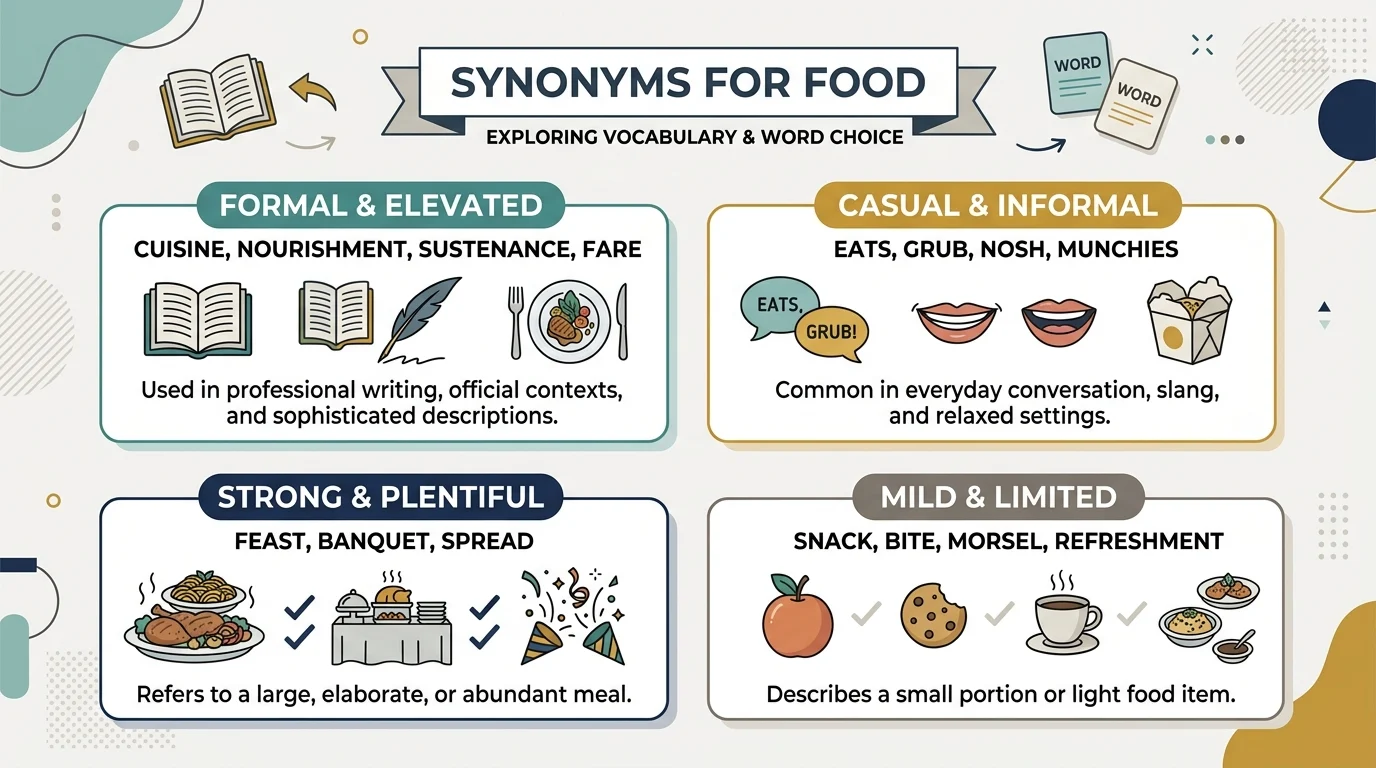
Does your writing depend too heavily on the word “food”? You are not alone. Many writers, students, and professionals repeat this common term without realizing how many precise alternatives exist.
Whether you are crafting a restaurant review, writing a nutrition report, or describing a memorable meal, the right synonym can transform your message from basic to brilliant. This guide will help you choose the perfect word for every situation.
Quick Answer: What Does “Food” Mean?
Food is any substance consumed to provide nutritional support and energy for the body. The best synonyms depend on your context. For formal writing, try “nourishment” or “sustenance.”casual conversation, use “grub” or “eats.” For professional contexts, consider “cuisine” or “fare.” Creative writing benefits from words like “delicacy” or “feast.”
Meaning, Tone and Context
- Simple definition: Food refers to any edible material that living organisms consume to maintain life, growth, and energy.
- Part of speech: Food functions as a noun. Related forms include “foods” as the plural noun and “foodie” as an informal noun for a person passionate about food.
- Tone: The word “food” is generally neutral. It carries no strong positive or negative emotional weight.
- Formality level: “Food” works across all formality levels. It fits casual conversation, academic writing, and everything in between.
- Common use cases: You will find “food” in grocery shopping, cooking, nutrition, restaurant discussions, health articles, and everyday conversation.
- Important word forms: The adjective form is “food-related” or “food-based.” The verb form is rarely used, but “to food” appears only in informal expressions.
When and How to Use “Food”
Understanding when to use the word “food” helps you communicate clearly and naturally. Here are realistic examples across different contexts.
Professional context:
“The conference organizers provided food for all attendees during the networking session.”
Academic context:
“The study examined how food choices affect cognitive performance in adolescents.”
Casual context:
I picked up some food for dinner on my way home from work.
Emotional context:
“The food at my grandmother’s house always made me feel safe and loved.”
Creative writing context:
“The food on the table told stories of distant lands and ancient traditions.”
Social media context:
“Just had the most amazing food at this hidden gem downtown.”
Email context:
“Please let me know if you have any dietary restrictions so I can arrange suitable food for the meeting.”
Another Word for “Food”
Finding the perfect replacement for “food” depends heavily on your situation. Here are the best alternatives by context.
Professional writing: “Sustenance” works well in business reports and professional documents. It suggests essential nutrition without being overly casual.
Academic writing: “Nutrition” fits research papers and scholarly articles. It focuses on the scientific and health aspects of what we consume.
Casual conversation: “Eats” serves as a friendly, relaxed option for everyday chat with friends and family.
Emotional writing: “Comfort food” captures the nostalgic and soothing qualities of meals that connect to memory and emotion.
Creative writing: “Cuisine” adds sophistication and cultural depth to descriptions of food traditions.
Resume writing: “Culinary” appears in resumes for chefs, restaurant managers, and food service professionals.
Social media captions: “Bites” works perfectly for Instagram food photos and casual food posts.
Stronger meaning: “Feast” suggests abundance, celebration, and indulgence in large quantities.
Softer meaning: “Nibbles” implies small, light portions perfect for appetizers or casual snacking.
When Not to Use “Food”
The word “food” sometimes sounds too vague or general for effective communication. Replacing it with a more precise synonym can dramatically improve your message.
Avoid “food” when describing a specific culinary tradition. Instead of “I love Italian food,” try “I love Italian cuisine.” This adds cultural specificity and sophistication.
Skip “food” when emphasizing nutritional quality. “Healthy food” sounds weak compared to “nutritious fare” or “wholesome sustenance.”
Avoid “food” in emotional or sentimental contexts. “The food reminded me of home” becomes more powerful as “The comfort food reminded me of home.”
Do not use “food” when discussing professional culinary arts. “He studied food” lacks the precision of “He studied culinary arts” or “He trained in gastronomy.”
Avoid “food” for special occasion meals. “Wedding food” sounds less special than “wedding feast” or “wedding banquet.”
Skip “food” when describing high end dining. “The restaurant served amazing food” pales next to “The restaurant served exquisite cuisine.”
Words Commonly Confused With “Food”
Several words relate to food but carry distinct meanings. Understanding these differences helps you choose the right term.
Food vs. Cuisine
“Food” refers to any edible substance. “Cuisine” specifically describes a style or method of cooking associated with a particular culture or region. “Cuisine” is more formal and culturally specific.
Food vs. Fare
“Food” is the general term for edible items. “Fare” specifically refers to food provided in a particular setting, such as on a journey or at an event. “Fare” often suggests a selection or offering.
Food vs. Nourishment
“Food” focuses on the substance itself. “Nourishment” emphasizes the nutritional benefit and sustenance derived from eating. “Nourishment” carries a more purposeful and health focused tone.
Food vs. Provisions
“Food” is everyday language. “Provisions” describes supplies of food and other essentials, often for a journey or specific purpose. “Provisions” suggests planning and preparation.
Food vs. Diet
“Food” is general. “Diet” refers to the types of food regularly consumed by a person or group, or a specific eating plan. “Diet” is more patterned and intentional.
Food vs. Meal
“Food” is any edible substance. “Meal” is an organized eating occasion at a specific time. “Meal” implies a structured event rather than random eating.
Best Synonym by Context for “Food”
| Context | Best Synonym | Why It Works | Example |
|---|---|---|---|
| Formal writing | Nourishment | Emphasizes nutritional value and sustenance | The organization provides nourishment to underprivileged communities. |
| Academic writing | Nutrition | Focuses on scientific and health aspects | The research examines how nutrition influences cognitive development. |
| Professional or business use | Fare | Suggests a curated selection for an event | The conference fare included vegetarian and gluten free options. |
| Resume writing | Culinary | Demonstrates professional food experience | Managed culinary operations for a restaurant serving 200 guests daily. |
| Casual conversation | Eats | Friendly and relaxed everyday language | Let’s grab some eats after the movie. |
| Creative writing | Cuisine | Adds cultural depth and sophistication | The cuisine of Provence celebrates fresh herbs and olive oil. |
| Emotional tone | Comfort food | Evokes nostalgia and emotional connection | Her chicken soup was the ultimate comfort food on cold days. |
| Strong intensity | Feast | Suggests abundance and celebration | The holiday feast included roasted turkey and all the trimmings. |
| Soft or moderate tone | Nibbles | Implies light, small portions | We served nibbles before the main course arrived. |
| Social media captions | Bites | Short, engaging, and visually descriptive | These summer bites are perfect for your next barbecue. |
| US usage | Grub | Casual American slang for food | The diner serves classic American grub. |
| UK usage | Nosh | British informal term for food | We had a lovely nosh at the local pub. |
Which Synonym Should You Choose?
Selecting the right synonym for “food” depends on several key factors. Start by identifying your audience. Are you writing for friends or formal clients? This determines the level of formality.
Consider your emotional intent. Are you describing a simple meal or an unforgettable feast? The intensity of the word should match the intensity of your experience.
Think about your context. Is this a scientific paper, a restaurant review, or a casual text message? Each situation demands a different vocabulary.
Evaluate the cultural dimension. Are you discussing a specific regional cuisine or general sustenance? Cultural specificity requires words like “cuisine” rather than generic “food.”
Consider the physical scale. Are you describing a small snack or a large banquet? Word choice should reflect portion size and occasion.
Match the tone to your purpose. Professional documents benefit from “nourishment” and “fare.” Creative writing thrives with “cuisine” and “delicacy.” Casual contexts welcome “eats” and “grub.”
Real Life Examples of “Food” in Sentences
School context:
“The biology textbook explained how food provides energy for cellular functions.”
Workplace context:
“The company cafeteria serves nutritious food to keep employees healthy and productive.”
Academic writing:
“The anthropologist studied how food practices reflect cultural identity and social structure.”
Conversational context:
“I cannot believe you have never tried Thai food. It is absolutely incredible.”
Social media context:
“Sunday brunch food goals. This avocado toast is everything.”
Resume context:
“Developed innovative food products that increased sales by 30 percent.”
Email context:
“The team lunch has been scheduled for noon. Please bring any food items you would like to share.”
Storytelling context:
“The food on the table was more than sustenance. It was a testament to generations of family recipes and love.”
25 Synonyms for “Food”
| Synonym | Simple Meaning | Best Used For | Example Sentence |
|---|---|---|---|
| Cuisine | A style of cooking associated with a culture | Restaurant reviews, cultural writing | French cuisine emphasizes butter and cream in traditional dishes. |
| Fare | Food offered in a specific setting | Events, travel, establishments | The airline’s vegetarian fare included quinoa and roasted vegetables. |
| Nourishment | Food that provides essential nutrients | Health writing, formal contexts | Proper nourishment supports immune function and overall wellness. |
| Sustenance | Food that maintains life and health | Formal, academic, survival contexts | The refugees desperately needed sustenance after their long journey. |
| Eats | Casual term for food | Everyday conversation, social media | We found some amazing eats at the food truck festival. |
| Grub | American slang for food | Casual, informal situations | The camping trip required easy grub that could be cooked over a fire. |
| Nosh | British informal term for food | Casual conversation, informal settings | We stopped for a nosh at the corner deli. |
| Bites | Small portions of food | Social media, appetizers, casual dining | These tasty bites disappeared within minutes of hitting the table. |
| Feast | Large, elaborate meal | Celebrations, special occasions | The wedding feast included courses of seafood, meat, and decadent desserts. |
| Banquet | Formal, large meal for many people | Official events, formal dining | The annual award banquet featured a five course gourmet meal. |
| Delicacy | Rare or expensive food item | Gourmet writing, cultural descriptions | Caviar is considered a delicacy in many parts of the world. |
| Provisions | Supplies of food and essentials | Travel, outdoor activities, planning | The hikers packed enough provisions for their weeklong trek. |
| Rations | Fixed portion of food | Military, survival, controlled contexts | Soldiers received daily rations during the deployment. |
| Refreshments | Light food and drinks | Events, meetings, casual gatherings | The conference provided refreshments during the afternoon break. |
| Spread | Varied selection of food for sharing | Buffets, gatherings, parties | The holiday spread included cheese, fruit, and cured meats. |
| Meal | Organized eating occasion | Daily life, scheduling, nutrition | The school provides one hot meal for students each day. |
| Breakfast | First meal of the day | Morning routines, nutrition contexts | A balanced breakfast gives you energy for the morning. |
| Lunch | Midday meal | Work, school, daily routines | The team discussed the project over lunch. |
| Dinner | Main evening meal | Daily life, family, social gatherings | We have dinner together every Sunday evening. |
| Snack | Small amount of food between meals | Casual contexts, nutrition, daily life | She grabbed a healthy snack of almonds and fruit. |
| Appetizer | Small dish before main meal | Dining, restaurants, events | The appetizer sampler included spring rolls and dumplings. |
| Entree | Main dish of a meal | Restaurants, cooking, formal dining | The entree featured grilled salmon with asparagus. |
| Dessert | Sweet course at meal end | Dining, celebrations, comfort contexts | The chocolate dessert was the perfect ending to the meal. |
| Cuisine | Style of food associated with a culture | Cultural writing, restaurant reviews | Mexican cuisine features vibrant colors and bold flavors. |
| Gastronomy | Art of good eating and cooking | Sophisticated writing, food science | Modern gastronomy combines science with culinary creativity. |
Synonym Groups and Usage Differences
Professional vs. Personal Synonyms
Professional contexts demand more formal language. “Nourishment” and “sustenance” appear in health reports and business documents. These words emphasize function and necessity. Personal writing welcomes warmer words like “comfort food” and “favorites.” These terms connect to memory and emotion. “Cuisine” works well in both professional restaurant reviews and personal travel writing.
Formal vs. Conversational Synonyms
Formal writing favors “sustenance,” “nourishment,” and “provisions.” These words appear in legal documents, academic papers, and official reports. Conversational situations prefer “eats,” “grub,” and “nosh.” These casual terms fit texts, social media, and friendly chats. “Fare” sits comfortably in the middle, appropriate for business emails and professional events.
Academic Synonyms
Academic writing requires precision and a scientific tone. “Nutrition” appears in health and biology research. “Sustenance” works in anthropology and sociology papers. “Dietary intake” serves clinical and nutritional studies. “Food consumption” fits economic and behavioral research. These terms avoid emotional language and focus on measurable, observable phenomena.
Professional and Business Synonyms
Business writing benefits from “fare” for event planning and catering. “Cuisine” appears in restaurant management and hospitality. “Provisions” works in logistics and supply chain contexts. “Nourishment” fits workplace wellness programs. These terms sound competent and appropriate for professional environments. Avoid casual alternatives like “grub” in official business communications.
Creative or Literary Synonyms
Creative writing thrives on vivid, evocative language. “Feast” suggests celebration and abundance. “Banquet” evokes formal elegance. “Delicacy” adds sophistication and rarity. “Gastronomy” appeals to food connoisseurs. “Cuisine” provides cultural richness. These words create imagery and emotion that simple “food” cannot achieve. Use them in novels, poetry, food writing, and descriptive passages.
Slang or Modern Synonyms
Slang terms have their place in casual contexts. “Grub” appears in American informal speech. “Nosh” serves British casual conversation. “Eats” works across English speaking regions. “Bites” dominates food photography and social media. These terms are acceptable in texts, casual blogs, and conversational writing. Never use them in academic papers, formal reports, or professional documents.
Strongest vs. Weaker Synonyms
The intensity of food words ranges from mild to powerful. “Feast” sits at the strongest end of the scale, suggesting abundance and celebration. “Banquet” implies formal elegance and quantity. “Spread” suggests a generous selection. “Fare” remains moderate. “Eats” and “grub” are much weaker in intensity. “Nibbles” suggests light, small portions. Choose intensity based on your context and emotional intent.
Emotional vs. Neutral Synonyms
Emotional words add feeling and connection to your writing. “Comfort food” evokes nostalgia and warmth. “Feast” suggests joy and celebration. “Delicacy” implies desire and luxury. Neutral words stay factual and objective. “Nutrition” focuses on health and science. “Sustenance” emphasizes survival and function. “Provisions” suggests practicality. Choose emotional words for personal and creative writing. Use neutral terms for reports and professional documents.
Antonyms of “Food”
| Antonym | Meaning | Example Sentence |
|---|---|---|
| Fasting | Abstaining from food | The patient was fasting before the medical procedure. |
| Starvation | Severe lack of food | The documentary exposed the reality of starvation in the region. |
| Hunger | The feeling of needing food | Hunger motivated the family to find sustainable food sources. |
| Malnutrition | Poor nutrition from lack of food | Malnutrition affects millions of children worldwide. |
| Thirst | Need for water, not food | Thirst is a more immediate survival need than hunger. |
| Emptiness | Lack of food in the stomach | The emptiness in her stomach prevented her from sleeping. |
| Deprivation | Lack of basic necessities including food | Sleep deprivation is as harmful as food deprivation. |
| Inedia | Ability to live without food | The claim of inedia has been scientifically disproven. |
| Famine | Widespread lack of food | The famine devastated the agricultural region. |
| Anorexia | Medical condition of food avoidance | Anorexia requires professional medical intervention. |
| Bulemia | Eating disorder involving food elimination | Treatment for bulimia includes nutritional counseling. |
| Underfeeding | Providing insufficient food | Underfeeding livestock affects their health and productivity. |
| Water | Basic need different from food | Water is essential for survival alongside food. |
| Exercise | Physical activity that requires food energy | Exercise increases the need for proper food intake. |
| Calorie deficit | State of consuming less food than needed | The athlete maintained a calorie deficit for weight loss. |
Comparison: Food vs. Similar Words
Food vs. Cuisine
“Food” is the general term for edible substances. “Cuisine” refers to a specific culinary tradition. “Cuisine” is more formal and culturally specific. Use “cuisine” when discussing Italian, French, or Thai cooking styles. Use “food” for everyday references.
Example with food: “I need to buy food for the party.”
Example with cuisine: “Italian cuisine emphasizes fresh, simple ingredients.”
Food vs. Fare
“Food” covers all edible items. “Fare” describes food offered in a particular setting. “Fare” often implies a selection or menu. Use “fare” for event catering, airline meals, or restaurant offerings.
Example with food: “The restaurant serves delicious food.”
Example with fare: “The conference fare included dietary accommodations.”
Food vs. Nourishment
“Food” describes any edible substance. “Nourishment” emphasizes nutritional benefit. “Nourishment” is more purposeful and health focused. Use “nourishment” for health writing and professional contexts.
Example with food: “We need food to survive.”
Example with nourishment: “Fresh vegetables provide essential nourishment.”
Food vs. Provisions
“Food” is everyday language for edible items. “Provisions” describes supplies of food for a journey or purpose. “Provisions” suggests planning and preparation. Use “provisions” for camping, travel, or emergency contexts.
Example with food: “I bought food at the grocery store.”
Example with provisions: “The explorers packed provisions for their Arctic expedition.”
Food vs. Diet
“Food” is general and immediate. “Diet” refers to habitual food consumption patterns. “Diet” implies consistency or intentional eating. Use “diet” for nutrition counseling and health discussions.
Example with food: “She enjoys eating food from different cultures.”
Example with diet: “His diet includes plenty of plant based proteins.”
Food vs. Meal
“Food” is any edible substance. “Meal” is a structured eating occasion. “Meal” implies time, place, and organization. Use “meal” for breakfast, lunch, or dinner contexts.
Example with food: “The food was carefully prepared.”
Example with meal: “We sat down together for the evening meal.”
Common Phrases and Expressions with “Food”
1. Food for thought
Meaning: Something worth thinking about seriously
Example sentence: “The professor’s lecture gave us plenty of food for thought about climate change.”
2. Fast food
Meaning: Quick, easily prepared food often from restaurants
Example sentence: “Fast food is convenient but often lacks nutritional value.”
3. Soul food
Meaning: Food associated with African American Southern culture
Example sentence: “Her grandmother prepared traditional soul food on Sundays.”
4. Food chain
Meaning: The hierarchical system of organisms eating each other
Example sentence: “Plastic pollution affects the entire marine food chain.”
5. Food for the soul
Meaning: Something emotionally or spiritually nourishing
Example sentence: “Listening to live music is food for the soul.”
6. Food miles
Meaning: The distance food travels from production to consumption
Example sentence: “People concerned about food miles choose locally grown produce.”
7. Junk food
Meaning: Food with low nutritional value and high fat or sugar
Example sentence: “The children ate too much junk food at the party.”
8. Dog eat dog world
Meaning: A competitive environment where people harm each other
Example sentence: “The corporate world is a dog eat dog world of intense competition.”
Common Mistakes to Avoid
- Using “food” when a more precise synonym would improve your message. Replace “food” with “cuisine” when discussing cultural traditions.
- Confusing “food” with “meal.” “Food” is the substance itself. “Meal” is a planned eating occasion.
- Using casual synonyms in formal writing. Do not use “grub” or “eats” in academic papers or professional reports.
- Using an overly dramatic synonym for simple situations. “Feast” does not describe a quick sandwich. Save powerful words for appropriate moments.
- Repeating the same word too often. Vary your vocabulary with “sustenance,” “fare,” and “nutrition” to keep writing interesting.
- Choosing a synonym with the wrong emotional tone. “Comfort food” adds warmth. “Sustenance” stays neutral. Match emotion to purpose.
- Using slang in academic or professional writing. “Grub,” “nosh,” and “eats” belong in casual contexts only.
FAQs
What is the best synonym for food?
The best synonym depends on context. “Cuisine” works for cultural discussions. “Nourishment” fits health writing. “Fare” suits event descriptions. “Eats” works for casual conversation.
What is a formal synonym for food?
“Nourishment” and “sustenance” are excellent formal synonyms. “Provisions” works in professional contexts. “Cuisine” appears in formal restaurant writing. “Gastronomy” serves academic food studies.
What is an informal synonym for food?
Eats,” “grub,” and “nosh” are common informal synonyms. “Bites” works for social media. “Snacks” suits casual references. “Munchies” appears in very relaxed conversation.
What is another word for food in professional writing?
“Fare,” “provisions,” and “nourishment” work well professionally. “Cuisine” appears in hospitality contexts. “Nutrition” fits health and wellness writing.
What is the difference between food and cuisine?
“Food” is any edible substance. “Cuisine” is a specific style of cooking associated with a culture or region. “Cuisine” is more formal and culturally specific.
What is the opposite of food?
“Fasting” is the act of avoiding food. “Starvation” is severe food deprivation. “Malnutrition” is lack of proper nutrition. “Thirst” is the need for water, not food.
Conclusion
The word “food” serves as a useful foundation for countless conversations. Yet the English language offers over fifty precise alternatives for every situation. Understanding when to use “cuisine,” “fare,” “nourishment,” or “eats” elevates your writing and speaking. Consider your audience, context, emotional tone, and formality level before choosing. A thoughtful word choice shows linguistic sophistication and cultural awareness. Start by replacing “food” with one new synonym this week. Your vocabulary will thank you.