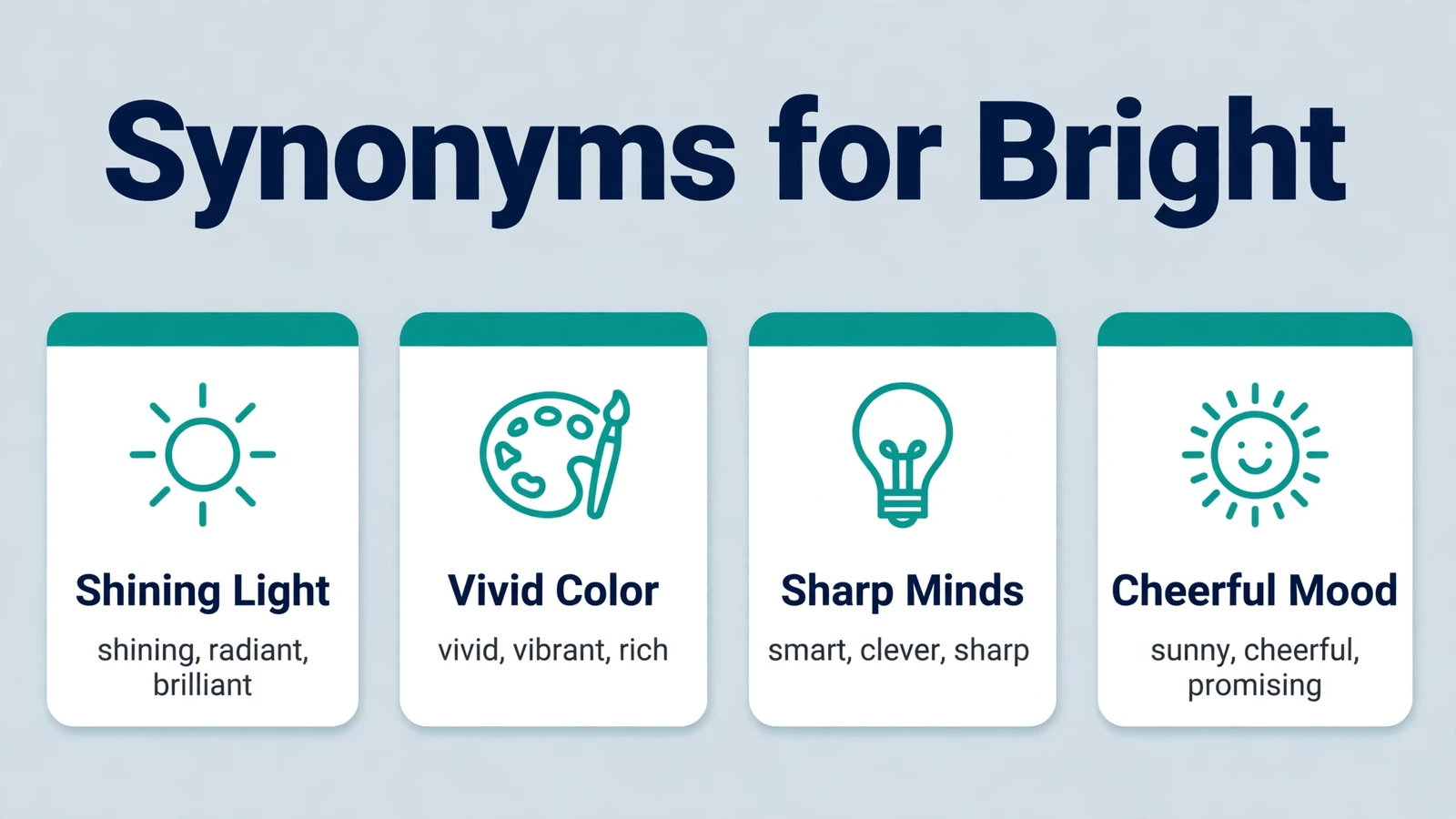
Few adjectives work as hard as bright. It describes the sun at noon, a red dress, a top student and a hopeful future, all in a single syllable. The most useful synonyms for bright include shining, radiant, brilliant, vivid, vibrant, smart, sharp, cheerful, sunny and promising. Each one, though, belongs to a different sense of the word, and swapping them carelessly produces odd sentences. A radiant student sounds like she glows, while a luminous future is not quite English at all.
This guide sorts 55+ verified synonyms for bright by meaning, so you always pick the word that fits. Every entry comes from real dictionary and thesaurus sources, with register notes where a word is formal, informal or literary. Short examples show the key words in action, and a later section explains the difference between bright and brilliant.
Top Synonyms for Bright: Quick Reference
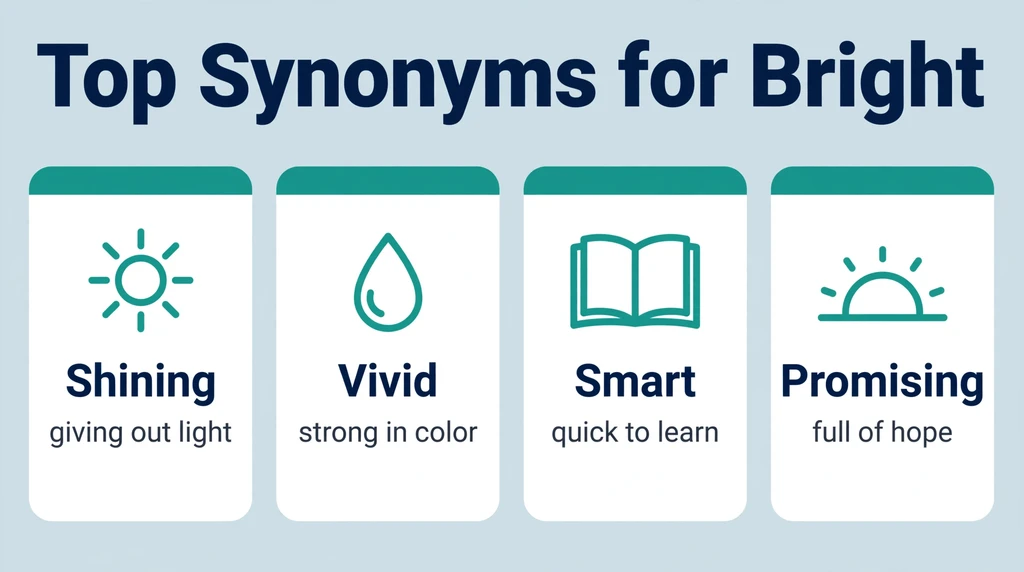
The table below gathers the 28 synonyms readers reach for most often, across every sense of the word. The sections after it sort the full list into finer groups, with glosses and examples.
| Word | Meaning in one line | Best for |
|---|---|---|
| Shining | Giving out or reflecting light | Stars, eyes, metal |
| Brilliant | Extremely bright, often sparkling | Sunlight, diamonds, ideas |
| Radiant | Sending out rays of light or joy | Sun, faces, smiles |
| Gleaming | Shining with a soft, steady light | Polished surfaces, teeth |
| Glowing | Giving out a warm, soft light | Embers, lamps, skin |
| Luminous | Glowing steadily, even in darkness | Watch dials, paint, prose |
| Dazzling | So bright it hurts or amazes | Headlights, sunlight, displays |
| Sparkling | Shining with flashes of light | Water, snow, gems |
| Vivid | Strong and clear in color | Paint, flowers, fabric |
| Vibrant | Full of strong color and energy | City scenes, palettes |
| Rich | Deep and full in color | Reds, fabrics, paints |
| Colorful | Full of bright, varied colors | Clothes, markets, festivals |
| Smart | Quick to learn and understand | Students, colleagues |
| Clever | Skilled at thinking and solving | Ideas, remarks, children |
| Sharp | Fast and accurate in the mind | Analysts, debaters, wits |
| Astute | Quick to judge a situation well | Business, politics, deals |
| Brainy | Very intelligent, informal praise | Schoolkids, quiz teams |
| Cheerful | Full of good mood | People, rooms, voices |
| Sunny | Cheerful by nature | Dispositions, smiles |
| Lively | Full of energy and spirit | Children, parties, debate |
| Upbeat | Positive and cheerful, informal | Moods, reports, music |
| Promising | Showing signs of future success | Futures, careers, starts |
| Encouraging | Giving hope or confidence | Signs, results, news |
| Hopeful | Full of hope | Outlooks, forecasts |
| Rosy | Pleasantly hopeful, perhaps too much | Futures, pictures, outlooks |
| Clear | Without cloud | Skies, days, forecasts |
| Fair | Pleasant and dry, in weather | Days, weekends, sailing |
| Cloudless | With no clouds at all | Skies, nights, mornings |
What Does Bright Mean?
Bright is an adjective with several related senses, and each sense owns a different family of synonyms. Merriam-Webster starts with light: bright means radiating or reflecting light, as in bright lights and bright eyes. From there, the word stretches in five directions. A bright color has high saturation, so it looks strong and pure. A bright student is quick and intelligent. A bright smile is cheerful and lively. A bright future promises good things, and a bright day is sunny and clear.
This spread explains why no single synonym replaces bright everywhere. Shining belongs to lamps and stars, while sharp belongs to minds. The sections below keep the senses apart, so the word you choose always matches the thing you describe.
The word itself is old. Merriam-Webster traces it from Middle English back to Old English *beorht*, and its first known use dates to before the 12th century. Few everyday adjectives have served so many jobs for so long, which is exactly why its synonym list runs so deep.
The Six Senses at a Glance
This table maps each sense to the phrase where you meet it most, and to the synonyms that serve it best. It works as a shortcut for the whole guide.
| Sense | You say it in | Go-to synonyms |
|---|---|---|
| Strong light | a bright light | shining, radiant, dazzling |
| Full of light | a bright room | light, sunny, illuminated |
| Strong color | a bright dress | vivid, vibrant, rich |
| Intelligent | a bright student | smart, clever, sharp |
| Cheerful | a bright smile | cheerful, sunny, lively |
| Promising | a bright future | promising, encouraging, hopeful |
| Sunny weather | a bright day | sunny, clear, fair |
Forms and Phrases of Bright
Bright also works beyond the adjective slot. Merriam-Webster lists an adverb use, as in the storm passed and the sun shone bright. As a noun, the plural brights names a car’s high beams in American English, and it also labels brightly colored clothing in the laundry basket: wash the whites and brights separately. The comparative forms run brighter and brightest, and they appear everywhere from weather reports to school rankings: brighter spells, the brightest star, the brightest students.
One more pattern matters for writers. Bright loves partners: bright eyes, bright colors, bright ideas, bright prospects. In each pair, the noun tells you which sense is active, and therefore which synonym family to open. That is why this guide is organized by the company bright keeps, rather than by the word alone.
Synonyms for Bright: Light and Shining Things
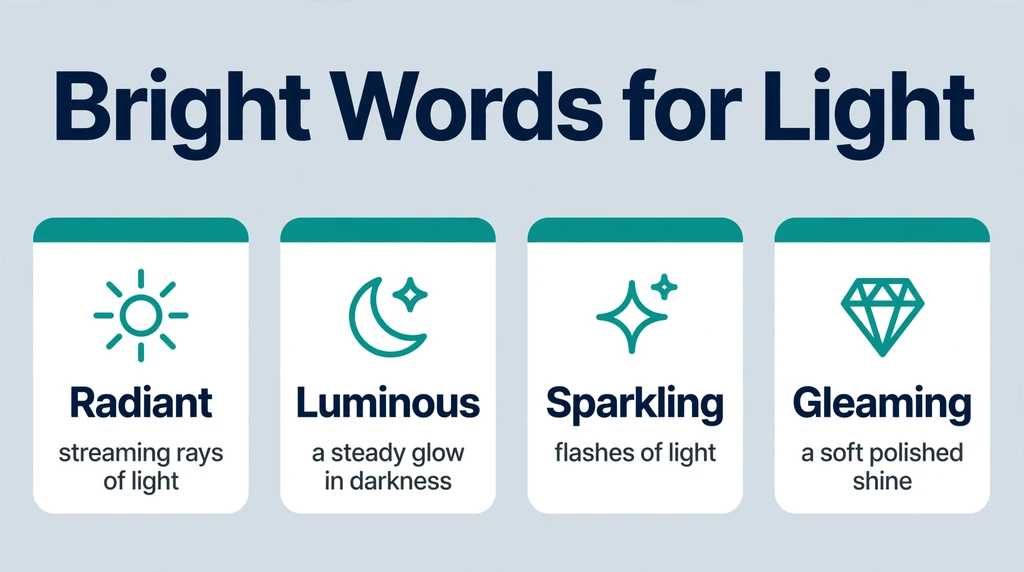
The oldest and most literal sense of bright is about light itself. English sorts these words by how the light behaves: whether it pours out, flashes, glows softly or bounces off a surface. The three groups below follow that logic.
Words for Things That Give Out Light
Shining is the closest everyday match: it means giving out or reflecting light, as in a shining star. Brilliant goes further and suggests intense, often sparkling brightness, so writers save it for the midday sun or a cut diamond. Radiant stresses rays streaming outward, which is why it suits the sun and anything that seems to beam. Blazing adds heat and force, perfect for a blazing sun or blazing headlights at noon.
For steadier light, luminous describes a calm, even glow that holds up in darkness, like luminous paint on a watch dial. Glowing is warmer and softer: embers, lamps and faces glow rather than blaze. Beaming pictures light streaming in one direction, as in Collins’s example of a beaming sun rising out of the sea. Sparkling, meanwhile, breaks the light into flashes, so it fits water, snow and cut gems.
Two stronger words sit at the top of the scale. Dazzling is so bright that it briefly overwhelms the eyes. Intense measures pure strength, as in the intense light that reflects off snow at high altitude. At the literary end, effulgent and lambent appear in poetry and elevated prose: effulgent means shining out in full splendor, while lambent describes light playing softly over a surface. Incandescent names light produced by heat, familiar from the incandescent bulb. Finally, resplendent adds grandeur, suiting ceremonial scenes and formal description.
Words for Surfaces That Catch the Light
Some things do not make light but return it beautifully. Gleaming is the key word here: a soft, steady shine from something clean or polished, like a gleaming dome or gleaming teeth. Glistening adds wetness, so roads glisten after rain. Glittering breaks the shine into many hard points, right for frost, sequins and city windows. Shimmering lets the light tremble, as heat or water makes it waver.
For smooth finishes, lustrous stresses an even, rich light from a surface that reflects without glittering, a classic word for hair and pearls. Glossy covers coated and printed surfaces, from glossy magazines to glossy paint. Burnished and polished describe shine earned by rubbing: burnished copper, polished brass, a polished floor. Each of these words tells the reader not just that a surface is bright, but how it got that way.
Words for Rooms and Spaces Full of Light
Bright also describes places filled with light, not just sources of it. Light itself works here, since a light room is simply one you can see in easily. Sunny points to direct sunshine entering the space, as in a sunny kitchen. Cambridge marks illuminated as the formal option, common in reports and specifications: the hall was illuminated by a single bulb.
Cambridge also lists a neat family of compounds for this sense. Sunlit and sun-drenched scale the sunshine up, while moonlit and starlit move the same idea into the night. Candlelit suits dinners and old libraries, and floodlit belongs to stadiums and monuments after dark. These compounds are precise, so one of them often beats bright itself.
Bright Eyes and Bright Stars: Where the Light Sense Works Hardest
Two partnerships show this sense at its most useful. Merriam-Webster’s own examples pair bright with lights and with eyes, and both pairings reward a precise swap. Bright eyes become shining eyes when they reflect health and energy, sparkling eyes when amusement flashes in them, and gleaming eyes when the feeling turns keen or hungry. Each swap changes the emotion, not just the light level, so choose by the scene.
Stars take the scale words. A shining star is simply visible and lovely. A radiant star seems to pour light outward. A brilliant star tops the sky, which is why astronomers and poets both save that word for the best of the night. Travel writing uses the same ladder for cities: a glittering skyline at a distance, a dazzling display up close, and a glowing old town when the light turns warm. The ladder, soft to strong, runs glowing, gleaming, shining, radiant, brilliant, dazzling.
Synonyms for Bright Colors
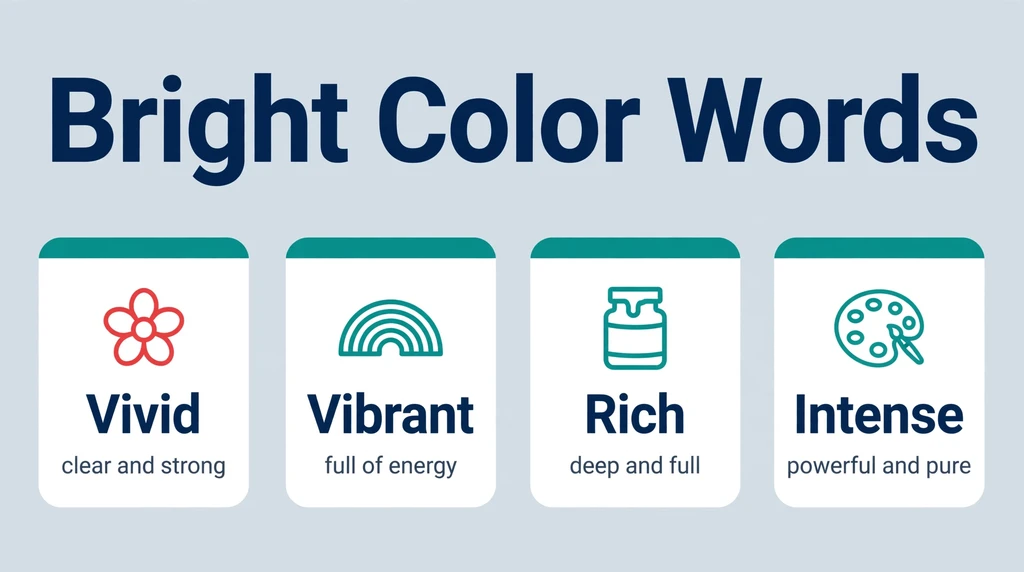
When bright describes a color, it means the color is strong, pure and hard to ignore. Merriam-Webster defines the sense technically: a bright color is one of high saturation or lightness. The everyday champion of this group is vivid, which Collins uses to define the sense itself. A vivid red is clear, strong and fully itself, with no grey mixed in.
Vibrant adds energy to the strength. Designers reach for it when a palette feels alive: vibrant greens, a vibrant street market, vibrant packaging. Rich moves in the opposite direction, toward depth. A rich red or rich brown is deep and full rather than loud, which makes rich the tasteful choice for fabrics, wood and paint. Colorful simply says that many bright colors are present together, as in colorful clothes or a colorful festival.
Several light words cross over into this sense. Intense measures a color’s force, glowing suggests warmth in the tone, and deep (a Thesaurus.com listing for this sense) stresses darkness plus strength, as in deep jewel tones. In practice, choose vivid for clarity, vibrant for energy, rich for depth, and colorful when the variety itself is the point. Our quick test: if you could turn the color up with a dial, it is bright, and one of these four words will name the result more precisely.
Bright Colors in Design, Fashion and the Home
Different trades lean on different members of this family. Fashion writers favor vivid and vibrant, because both promise energy on the page: a vivid silk scarf, vibrant summer dresses. Interiors writers prefer rich, since rooms need depth more than noise: rich velvet cushions, a rich walnut stain with a warm finish. Graphic designers, meanwhile, use bright as a technical neighbor of saturation, and they often write saturated when they mean a pure, strong color in a file or on a screen.
Home and garden writing mixes the family freely. A colorful border praises variety in the flower beds. Glowing describes warm tones at golden hour, when brick and terracotta seem lit from inside. Paint names borrow the same words, so a tin labeled vivid or rich tells you the strength of the color before you open it. When you write about color, one of these precise words will always serve the reader better than bright alone.
Synonyms for Bright Minds: Intelligence
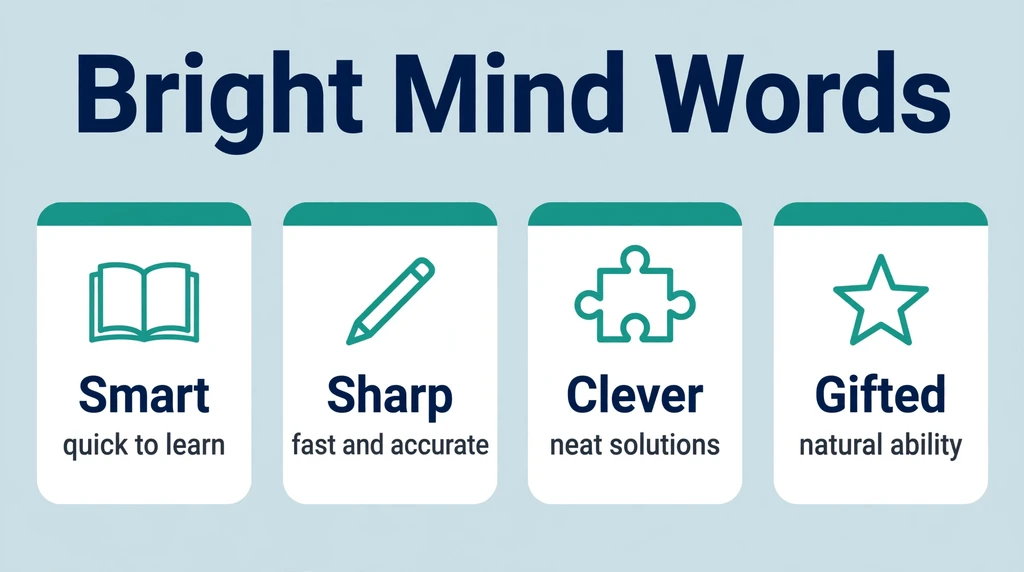
Calling a person bright praises the speed and quality of their thinking. This is the sense behind bright students, bright ideas and bright young things, and it owns a rich synonym set of its own.
Quick, Clever and Ready to Learn
Smart is the everyday default, especially in American English, where Cambridge notes it is the main word for this sense. Clever sits close beside it, with a slight stress on skill and inventiveness: a clever student finds neat solutions, not just fast ones. Sharp praises speed plus accuracy, which is why it suits analysts, debaters and anyone who spots the flaw in an argument first. Teachers also call strong pupils gifted or talented, words that stress natural ability in a subject: a gifted mathematician, a talented young pianist.
Three more words refine the praise. Astute describes quick judgment about situations and people, so it dominates business and political writing: an astute investor, an astute move. Acute stresses depth of perception, as in Collins’s example of an extremely acute mind hidden behind a relaxed manner. Apt is quieter and older in flavor; an apt student learns readily. At the informal end, brainy works as friendly praise for schoolkids and quiz champions, but it can sound teasing between adults, so tone decides.
If you want the full map of this territory, our guide to synonyms for smart sorts these words by context in much more detail.
Bright Ideas and Bright Remarks
Bright also describes thoughts, not just thinkers. A bright idea is a clever, promising one, and Collins groups this sense with clever and smart: a bright idea for saving money, a smart solution to the rota problem. Inventive praises originality, since an inventive answer is one nobody else thought of. Quick-witted covers speed in conversation: the quick-witted reply that saves an awkward meeting. Keen appears in set phrases like a keen mind or a keen intellect, where it stresses eagerness plus sharpness.
Writers should note one trap in this corner. Praise for ideas can shade into praise for judgment, and English keeps those apart. A clever plan is inventive; a wise plan is well judged. The mistakes section below explains where writers most often blur that line.
Bright in School and Work Reports
Report writing is where this sense earns its keep, because bright alone quickly sounds vague. A teacher who writes “a bright pupil” says little; the synonyms do the real work. Sharp fits the child who answers first and accurately. Clever fits the one who builds, codes or argues inventively. Gifted fits the child whose ability in one subject sits far ahead of the class, and apt suits steady, ready learners.
Workplace writing follows the same ladder. Appraisals praise astute judgment in managers, keen analysis in researchers, and quick-witted handling in anyone who faces the public. Job references use bright for general promise and reserve brilliant for the rare candidate who defines a year of hiring. Choosing the precise word keeps praise believable, which is the whole point of a reference.
Synonyms for a Bright Mood: Cheerful and Lively
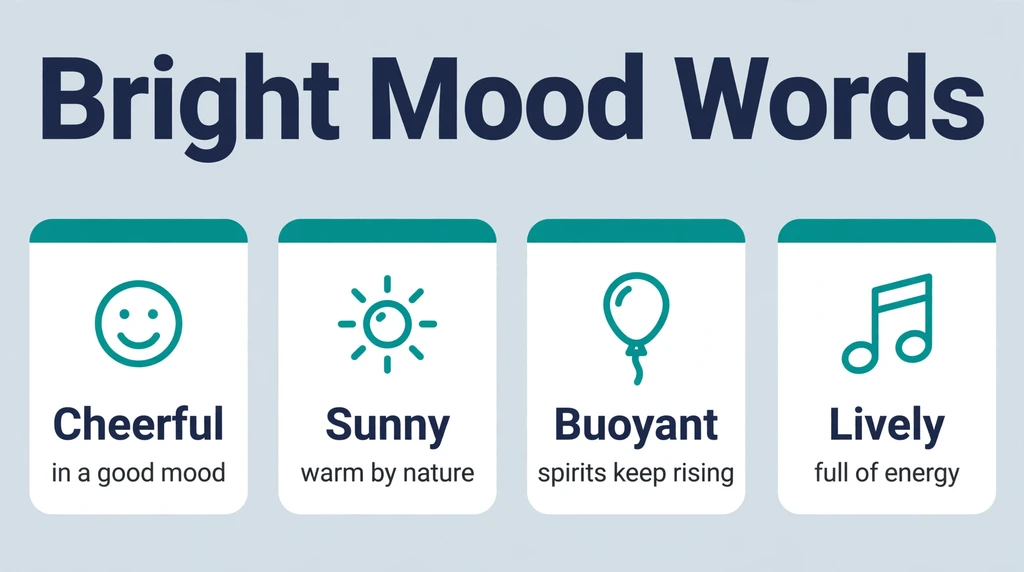
A bright smile, a bright greeting and a bright personality all use the mood sense of the word. Merriam-Webster defines it plainly: bright here means having or showing a good mood. Cheerful is the natural leader of this group, and it covers people, voices and rooms alike. Lively adds energy, so it suits children, conversations and parties. Happy is simpler and broader, a safe choice whenever precision matters less than warmth.
Faces get two special words. Sunny describes a disposition that seems to carry its own weather: a sunny nature, a sunny smile. Radiant describes visible joy, since Merriam-Webster notes that bright faces are radiant with happiness. A radiant bride or a radiant grin shows feeling on the surface, which is exactly what writers of scenes need.
The informal shelf is well stocked. Upbeat is the modern everyday pick for moods, meetings and market reports. Buoyant suggests spirits that keep rising back, useful after setbacks. Chirpy is informal and light, perfect for morning greetings. For a warmer, older flavor, jolly and merry describe open, sociable cheer, joyful and joyous raise the emotion for celebrations, and light-hearted stresses freedom from worry. Vivacious singles out lively charm, usually for people who animate a room. Glad still appears, but modern readers may find it old-fashioned in this sense.
For the wider family of mood words, see our collection of synonyms for happy.
Synonyms for a Bright Future: Promising Signs
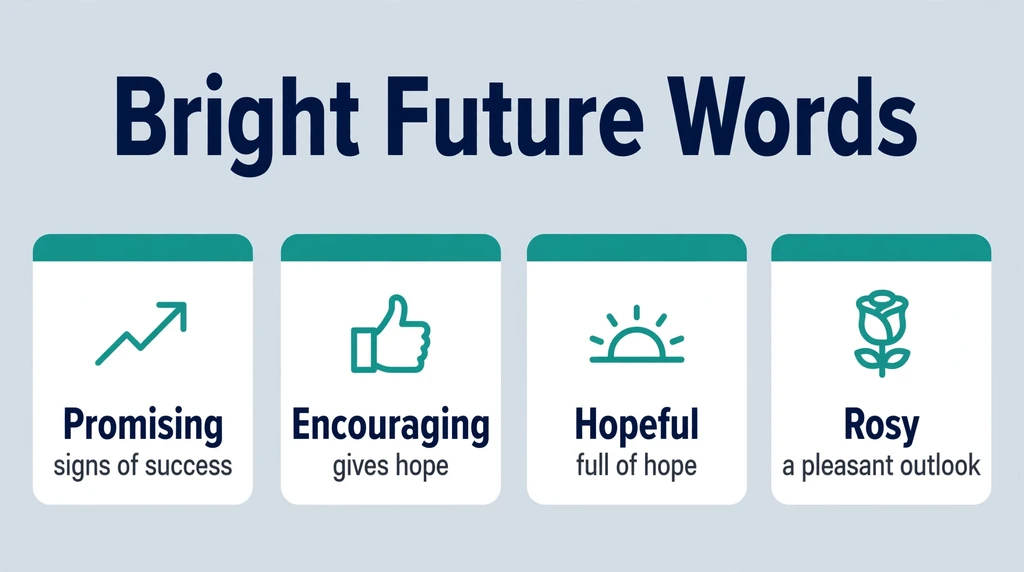
When forecasters and proud parents call a future bright, they mean it shows signs of success. Promising is the exact synonym here: Merriam-Webster even defines this sense of bright through it, and its own example is a bright future predicted for a young math whiz. A promising start, a promising career and a promising treatment all point the same way.
The supporting words grade the hope. Encouraging fits evidence: encouraging signs, encouraging results, an encouraging first quarter. Hopeful describes the outlook or the people holding it, as in hopeful forecasts. Optimistic goes one step more formal and analytical, common in economics and reporting. Rosy pictures the future in pleasant colors, although writers often use it with gentle doubt: is the future really so rosy? Favorable, Merriam-Webster’s word for signs pointing toward a happy outcome, suits conditions and winds rather than people. Auspicious and golden add a formal shine: an auspicious start, a golden opportunity.
This sense also owns a famous idiom. To look on the bright side is to find the good part of something mostly bad, and Merriam-Webster lists the phrase under this very entry. It is the one place where bright side needs no synonym at all.
Three partnerships carry most of this sense in print. Bright prospects belongs to careers and negotiations, and it swaps cleanly with promising prospects. Bright outlook belongs to forecasters, who grade it with hopeful or optimistic. A bright start belongs to projects, seasons and school terms, and it pairs with encouraging when the evidence is early. Notice how each partner noun pulls a different synonym behind it. Learn the partnerships, and the right replacement usually suggests itself.
Synonyms for Bright Weather
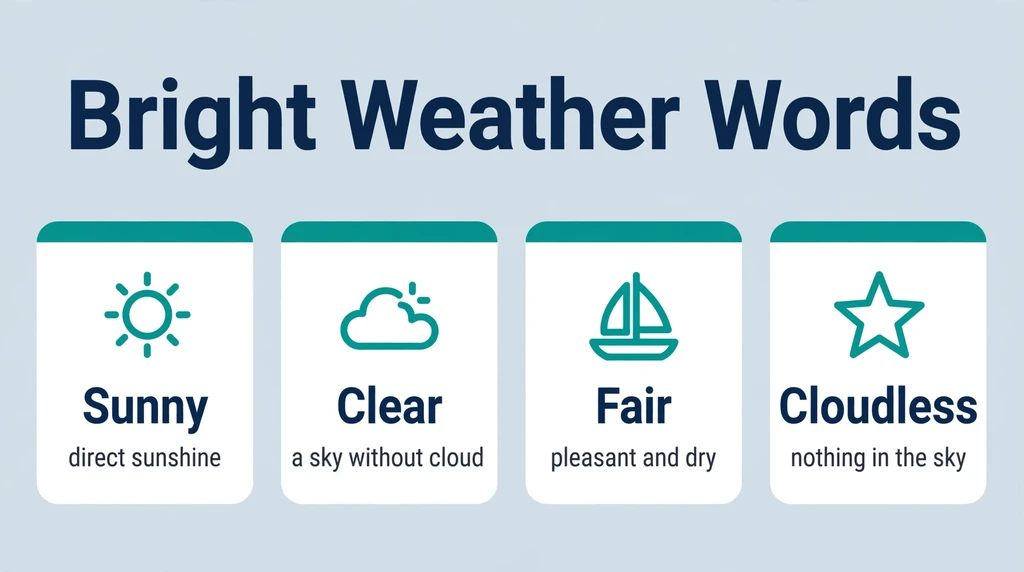
Weather reports use bright for days that are, in Merriam-Webster’s words, not stormy or cloudy. Sunny is the strongest and simplest replacement, promising direct sunshine. Clear focuses on the sky itself: clear skies, a clear morning, a clear run of days. Fair is the forecaster’s measured word for pleasant, dry conditions, as in a fair weekend for sailing. Cloudless is absolute, so save it for skies with nothing in them at all: a cloudless night is the stargazer’s hope.
British forecasts add a handy phrase: bright spells, meaning intervals of sunshine between clouds. The BBC line quoted by Thesaurus.com runs, once the fog lifts, brighter spells should develop. That phrase shows the everyday job of the weather sense: it grades the day between grey and glorious. Choose sunny for full sun, clear for an empty sky, fair for a generally pleasant day, and bright itself when the sun comes and goes.
Synonyms for Bright in Sentences
Seeing the key words at work fixes their shades faster than any gloss. These original examples pair each major sense with its best synonyms.
- The lighthouse threw a shining beam across the harbor, steady and white.
- By noon the snowfields turned dazzling, and every skier reached for sunglasses.
- A luminous dial glowed on his watch, calm against the dark cabin.
- Her gleaming bicycle looked freshly polished, right down to the spokes.
- She chose a vivid blue for the nursery walls, cheerful without being loud.
- The market stalls wore vibrant piles of peppers, oranges and dyed wool.
- A rich green velvet covered the old armchair by the fire.
- Our sharpest trainee spotted the error in the spreadsheet within a minute.
- It was a clever fix: one line of code, and the whole form worked again.
- The fund manager made an astute call and sold before the market turned.
- He arrived with a sunny grin and set the whole room at ease.
- Despite the setbacks, the team stayed buoyant and finished the season strongly.
- The trial results were encouraging, so the hospital widened the study.
- Saturday stayed clear and fair, perfect for the village fair.
Read the set again and notice the pattern. Every synonym succeeds because its sense matches the noun beside it, not because it sounds fancier than bright. That single habit, matching sense before style, prevents almost every error this word causes.
How to Choose the Right Synonym for Bright
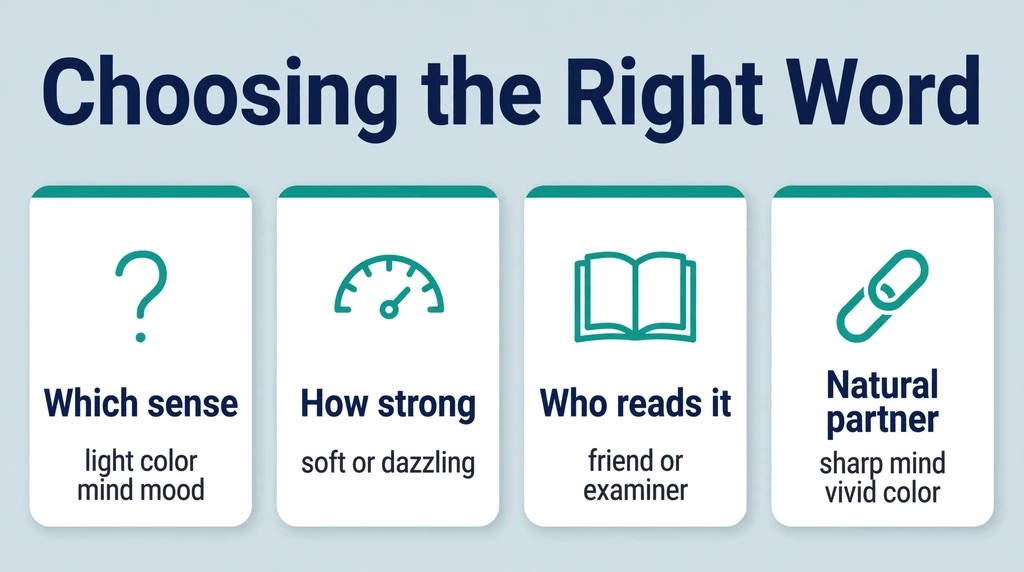
Start with the sense, then adjust for strength and register. These paired examples show the method in action.
For light, picture a scale. A candle glows, a lamp shines, the noon sun blazes, and a welder’s arc dazzles. So write “the glowing embers” for soft warmth, but “the dazzling headlights” when the light should almost hurt. If the light feels calm and steady in darkness, luminous beats both.
For people, match the word to the compliment. A smart student learns fast in general. A clever student solves problems neatly. A sharp student notices everything, while an astute student reads people and situations. “Our brightest graduate joined the lab” praises overall ability; “our most astute graduate joined the legal team” praises judgment.
For the future, grade your confidence. Encouraging reports early evidence, hopeful reports an attitude, and promising reports likely success. Rosy adds color but invites doubt, so journalists use it when the pleasant picture might be too simple.
Finally, watch the register. Brainy, chirpy and upbeat are informal. Illuminated and auspicious are formal. Effulgent, lambent and resplendent are literary, and they will look overdressed in a business report. The right synonym is the one a reader passes without stumbling.
A Quick Decision Checklist
Four questions settle almost every case. First, which sense is it: light, color, mind, mood, future or weather? Second, how strong should the word feel: gentle like glowing, standard like shining, or extreme like dazzling? Third, who is reading: a friend, a manager or an examiner? Formal readers expect illuminated and auspicious; casual readers prefer sunny and smart. Fourth, does the word collocate, that is, does it naturally partner the noun? English says sharp mind, vivid color and rosy future far more often than the reverse pairings.
Run through those four questions and the choice usually makes itself. Keep this checklist beside the quick reference table, and bright stops being a default and becomes a decision.
Bright vs Brilliant: What Is the Difference?
These two words cause the most confusion, so it helps that Merriam-Webster’s Synonym Chooser treats them directly. In the light sense, bright implies emitting or reflecting a high degree of light. Brilliant implies intense, often sparkling brightness. In other words, brilliant is bright turned up and given an edge of sparkle: bright sunlight fills a room, but brilliant sunlight flashes off water and makes you squint.
The same scale carries into their other senses. A bright student is quick and full of promise. A brilliant student is exceptional, the standout of a cohort. A bright idea is clever and useful, while a brilliant idea feels like a small work of genius. Writers therefore use bright for strong everyday praise and save brilliant for the top of the scale.
One caution follows from that scale. Because brilliant sits higher, it can sound inflated when the thing described is ordinary. A brilliant cup of tea amuses British readers precisely because the praise overshoots. When in doubt, choose bright for warmth and brilliant for wonder. Our dedicated guide to synonyms for brilliant explores that top end of the scale in full.
Antonyms for Bright
Each sense of bright owns its own opposites, so pick the antonym that matches the sense you are reversing.
For light, Cambridge gives dim and dark as the direct opposites: a dim corridor, a dark room. Dull covers weak light and flat surfaces, and it doubles as the opposite for mood, since a dull afternoon feels as flat as a dull shine. For color, the natural opposites are pale, muted and faded, which describe saturation turned down rather than light switched off.
For minds, the opposites are slow and dull, both of which should be used with care about real people. For weather, Merriam-Webster’s own definition points the way: bright means not stormy or cloudy, so cloudy, overcast and stormy are its weather opposites. For mood and outlook, gloomy reverses both at once, which is why gloomy forecasts and gloomy faces share a word.
Words That Are Not True Synonyms for Bright
Some near neighbors of bright fail as synonyms, and naming them protects your writing from quiet errors.
Cunning appears in thesaurus lists for bright ideas, but it means clever in a sly, self-serving way. A cunning plan benefits its maker first, so the word accuses while bright praises. Sensible fails from the other side: it praises practical judgment, not quickness. A sensible idea is safe and workable; a bright idea is smart and original.
Wise describes judgment deepened by experience. An eighty-year-old mentor is wise; a ten-year-old chess champion is bright. Swapping them muddles the compliment in both directions. Gaudy looks like a color synonym, yet it adds a verdict of bad taste: gaudy colors are bright in a loud, cheap way, so the word judges rather than describes. Scintillating belongs to conversation and wit. Collins’s own example for the word is scintillating conversation, so using it for steady light borrows the wrong sparkle. Save it for dialogue, repartee and performances.
Frequently Asked Questions
What is the best synonym for bright?
It depends on the sense. For light, shining and radiant cover most cases, while brilliant marks the strongest light. For a person, smart and clever are the safest everyday choices. For a future, promising is the closest match of all.
What is a good synonym for bright for a student?
Smart and clever are the most natural. Gifted and talented stress natural ability in a subject, sharp stresses speed of understanding, and brainy works as informal praise. Teachers writing reports usually rotate smart, clever and gifted to avoid repetition.
Is brilliant stronger than bright?
Yes. Merriam-Webster’s Synonym Chooser says bright implies a high degree of light, while brilliant implies intense, often sparkling brightness. The same gap appears with people and ideas: bright praises quick promise, and brilliant praises exceptional quality.
What is another way to say bright future?
Promising future is the closest swap. Hopeful outlook, rosy future and encouraging prospects also work, with small shifts in tone. Rosy can hint that the picture is too pleasant, so careful writers use it when a little doubt is intended.
What is a formal synonym for bright?
For places and light, illuminated is the formal option in Cambridge’s lists. Auspicious is the formal choice for beginnings and signs. At the literary end, effulgent and resplendent appear in elevated prose and poetry, though they look overdressed in everyday writing.
What is the opposite of bright?
The opposite changes with the sense. Dim and dark reverse light, pale and muted reverse color, dull and gloomy reverse mood, and cloudy and overcast reverse weather. For intelligence, slow is the direct opposite, though it is unkind about real people.
Can bright describe a color?
Yes, and dictionaries define that sense precisely. Merriam-Webster says a bright color is one of high saturation or lightness. Vivid is the closest synonym, with vibrant adding energy and rich adding depth: a vivid scarf, vibrant packaging, a rich red curtain.
What do you call a bright personality?
A cheerful, sunny or upbeat personality are the commonest descriptions. Buoyant fits someone whose spirits recover quickly, and vivacious fits someone whose energy fills a room. Each word keeps the good mood of bright while adding its own detail.
Final Thoughts
Bright survives because it is generous: one small word covering light, color, brains, mood, hope and weather. Its synonyms repay the same generosity with precision. Shining names the lamp, vivid names the dress, sharp names the mind, sunny names the temperament, and promising names the future. Choose by sense first, then by strength and register, and your prose gains the exact shade you meant.
For the complete dictionary treatment behind several of these groups, the Merriam-Webster Thesaurus entry for bright lists every sense with examples. Keep it beside this guide, and the word bright will never have to work alone again.