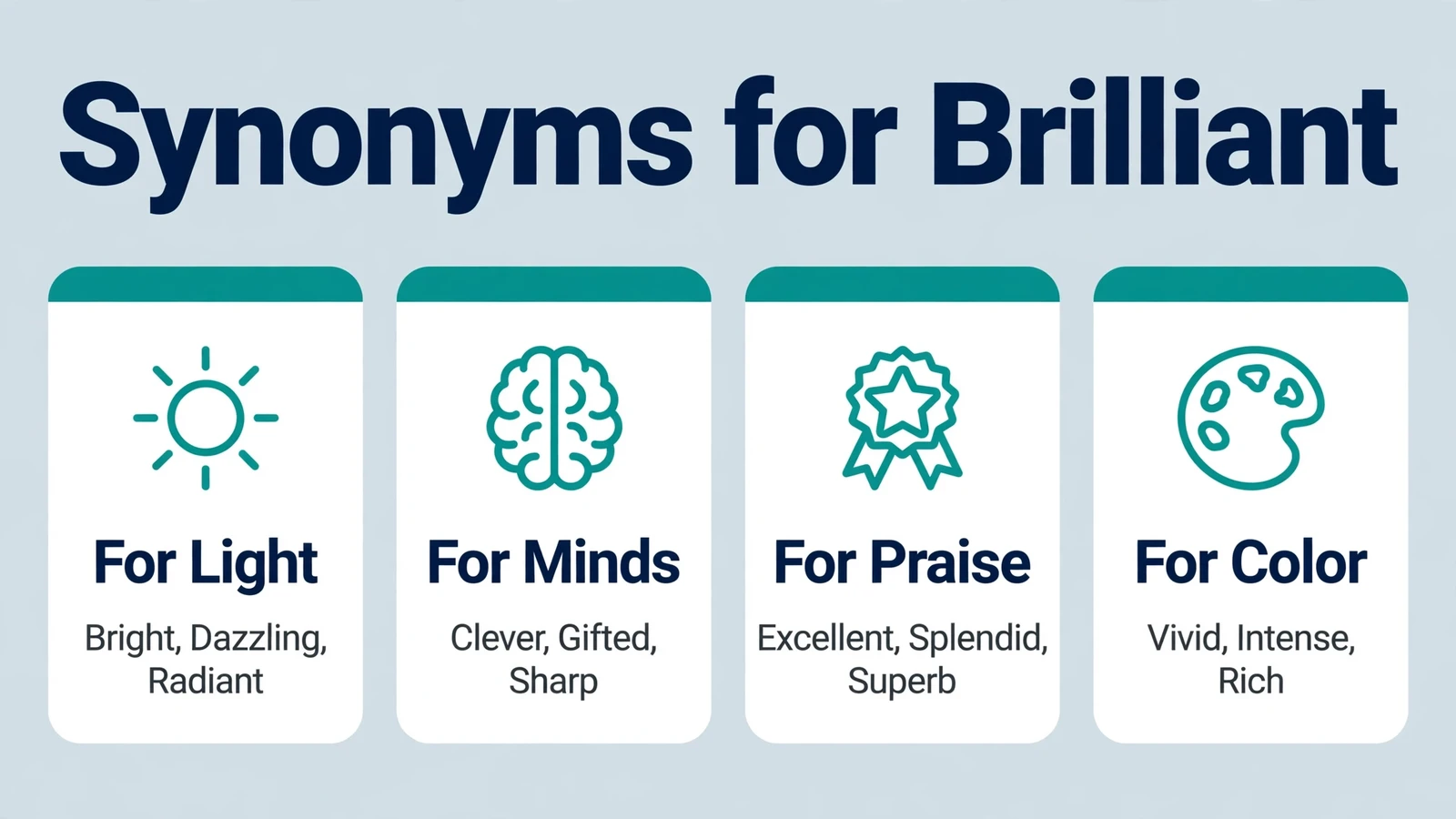
Brilliant is one of the hardest-working words in English. It praises a diamond, a scientist, a sunny morning, and a perfect holiday, all with the same seven letters. The most useful synonyms for brilliant are bright, dazzling, and radiant for light, clever, gifted, and sharp for a quick mind, excellent, splendid, and superb for quality, and vivid and intense for strong color.
Because the word covers four different senses, one replacement never fits everywhere. A luminous mind sounds odd, and a brainy sunset sounds worse. This guide therefore keeps the senses apart. Each group below lists verified synonyms with short meanings and examples, all checked against the major thesauruses. As a result, you can match the word to the job instead of guessing, instead of hoping a pretty word happens to fit.
Top Synonyms for Brilliant: Quick Reference
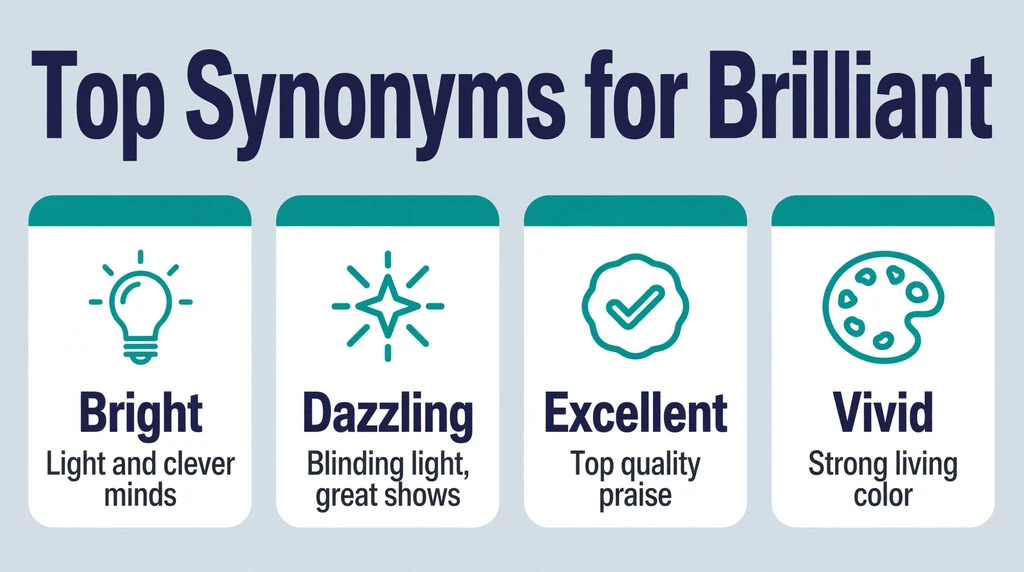
The table below gathers the 28 synonyms readers reach for most often. It mixes all four senses, so check the “Best for” column before you borrow a word. Later sections sort the same words into their proper homes.
| Word | Meaning in one line | Best for |
|---|---|---|
| Bright | Giving out or reflecting much light | Light, color, clever children |
| Dazzling | So bright it almost blinds you | Lights, displays, performances |
| Radiant | Shining as if sending out rays | Sunlight, faces, smiles |
| Luminous | Glowing steadily in the dark | Night skies, dials, paint |
| Lustrous | Shining evenly off a surface | Hair, silk, pearls |
| Sparkling | Flashing with tiny points of light | Gems, water, wit |
| Gleaming | Shining with a clean, soft light | Metal, teeth, polished wood |
| Clever | Quick and inventive in thinking | Ideas, solutions, people |
| Gifted | Naturally talented beyond others | Students, musicians, athletes |
| Sharp | Fast and accurate in mind | Thinkers, analysts, replies |
| Brainy | Very intelligent, informal | Students, bookish characters |
| Astute | Shrewd and quick to judge well | Business, politics, deals |
| Quick-witted | Fast with replies and reactions | Debates, comedy, interviews |
| Ingenious | Clever at inventing solutions | Designs, devices, plans |
| Intelligent | Able to learn and reason well | Formal writing, reports |
More Quick Synonyms for Praise and Color
| Word | Meaning in one line | Best for |
|---|---|---|
| Excellent | Extremely good, top quality | Work, results, service |
| Splendid | Excellent and impressive, formal | Events, buildings, news |
| Superb | Excellent in every detail | Performances, food, skill |
| Magnificent | Grand, beautiful, and impressive | Views, buildings, gestures |
| Wonderful | Delightfully good | Experiences, people, news |
| Fantastic | Extremely good, informal praise | Plans, offers, results |
| Outstanding | Clearly better than the rest | Achievements, students, debts aside |
| First-class | Of the highest standard | Travel, service, work |
| Top-notch | Very good, informal | Teams, products, quality |
| Terrific | Very good, enthusiastic praise | News, performances, people |
| Vivid | Strong, clear, and lifelike | Colors, memories, descriptions |
| Intense | Very strong in degree | Light, color, experiences |
| Rich | Deep and full in color | Fabrics, paints, autumn leaves |
What Does Brilliant Mean?
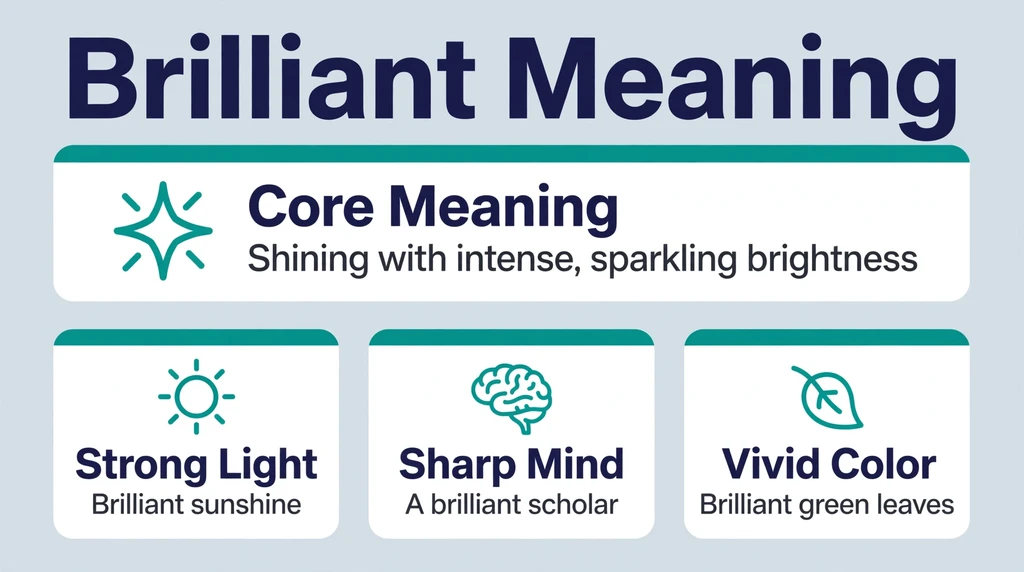
At its core, brilliant means shining with intense, often sparkling brightness. Merriam-Webster puts the light sense first, and every other sense grows out of it. A brilliant mind, for example, seems to shine with ideas. A brilliant performance stands out the way a jewel catches light.
The Four Senses at a Glance
The word works as an adjective in four main senses. First, it describes strong light, as in brilliant sunshine. Second, it praises intelligence, as in a brilliant scholar. Third, it means excellent or impressive, as in a brilliant success. Fourth, it describes vivid color, as in the brilliant green of a parrot’s wing.
Merriam-Webster also records two close cousins of these senses. One means likely to attract attention, as in a brilliant example of waste. The other is a noun: a brilliant is a diamond or gem cut and polished for ornament. This guide focuses on the four adjective senses, since those drive almost every search.
Writers love the word because it carries warmth as well as praise. Clever sounds cool and neat, while excellent sounds formal and measured. Brilliant, by contrast, glows a little. That glow is exactly why the wrong synonym can feel flat, so the groups below keep each sense in its own section.
The word family helps explain the spread of meanings. The noun brilliance names both the shine and the genius, as in the brilliance of the sun on water or the brilliance of her essay. The adverb brilliantly then follows the adjective into every sense: a plan can work brilliantly, a stage can be brilliantly lit, and a color can glow brilliantly. When you swap the adjective, the whole family usually swaps with it, which gives your writing a consistent register from sentence to sentence.
Synonyms for Brilliant That Describe Light
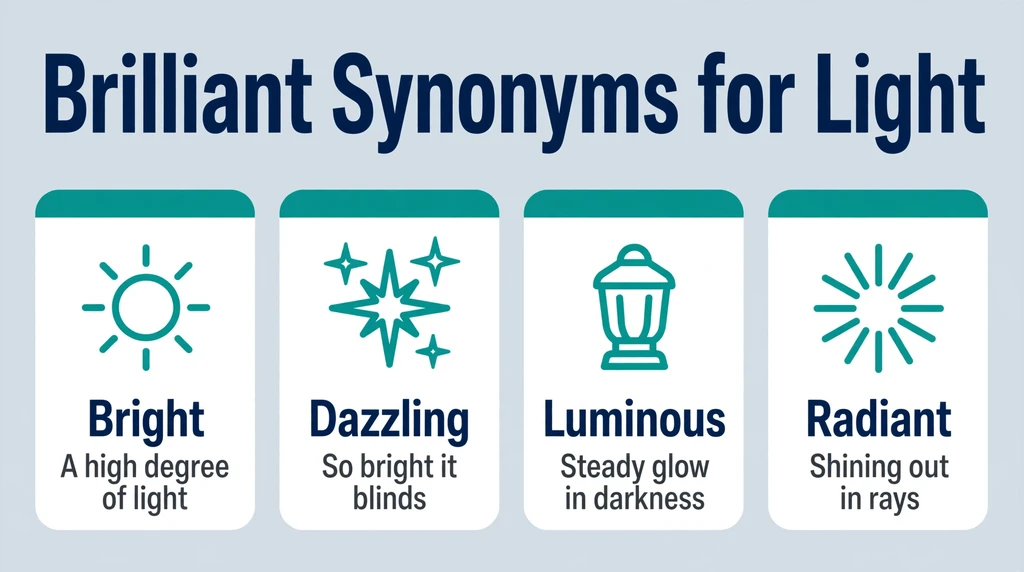
Light is the home sense of brilliant, so this group is the oldest and richest. Merriam-Webster’s Synonym Chooser groups bright, luminous, lustrous, and radiant together here. All four mean shining or glowing with light. Brilliant itself adds intensity, plus a hint of sparkle.
Strong and Dazzling Light
Bright is the safe, general replacement. It means emitting or reflecting a high degree of light. For example: “A bright lamp hung over the desk.”
Dazzling goes further. It describes light so strong that it hurts or confuses the eyes. For example: “Dazzling headlights swept around the corner.”
Blazing adds heat and fury. It suits fierce sunshine and firelight. For example: “They landed in blazing sunshine and reached for their sunglasses.”
Intense stresses concentrated strength. Photographers and skiers use it for light that almost burns. For example: “The intense glare off the snow made her squint.”
Glaring is a near neighbor with a negative twist. It often describes harsh, unpleasant light rather than beauty. Use it when the brightness bothers someone in the scene.
Glowing and Sparkling Light
Radiant suggests rays streaming outward. It fits the sun, a fire, or a happy face lit by joy. For example: “The bride looked radiant in the morning light.”
Luminous means glowing steadily, often in surrounding darkness. Merriam-Webster stresses that suffused, even glow. For example: “Luminous paint marked the path through the cave.”
Lustrous describes light reflected evenly off a surface. It never glitters. Hair, silk, and pearls are its classic partners. For example: “Her hair had a lustrous shine in the window light.”
Sparkling breaks light into tiny flashing points. Gems, frost, and sea water sparkle. For example: “Sparkling dew covered the lawn at dawn.”
Gleaming is a clean, soft shine, often on metal or polished wood. It suggests order and care, which is why it suits kitchens, cars, and armor. For example: “The gleaming counters told her the cafe had just opened.”
Glistening is the wet cousin of gleaming. It fits rain on leaves, sweat on skin, or tears held back. For example: “His forehead was glistening after the climb.”
Shimmering light trembles gently and keeps moving. Heat above a road shimmers, and so do reflections on a lake at noon. Glittering, meanwhile, breaks the light into hard little flashes, which suits frost, sequins, and city skylines.
Shining is the plain, honest member of this family. It makes no promise about strength or sparkle. A shining star and a shining example both simply stand out by glowing.
Literary Words for Brilliant Light
Poets keep two grand old words for this sense. Effulgent means shining forth brilliantly, and Cambridge marks it literary. Coruscating means flashing and sparkling, and Collins lists it under the dazzling sense. Both words impress, yet both can overwhelm a plain sentence. Save them for descriptive writing, speeches, and poetry, where a richer texture already fills the page.
Synonyms for Brilliant That Describe a Sharp Mind
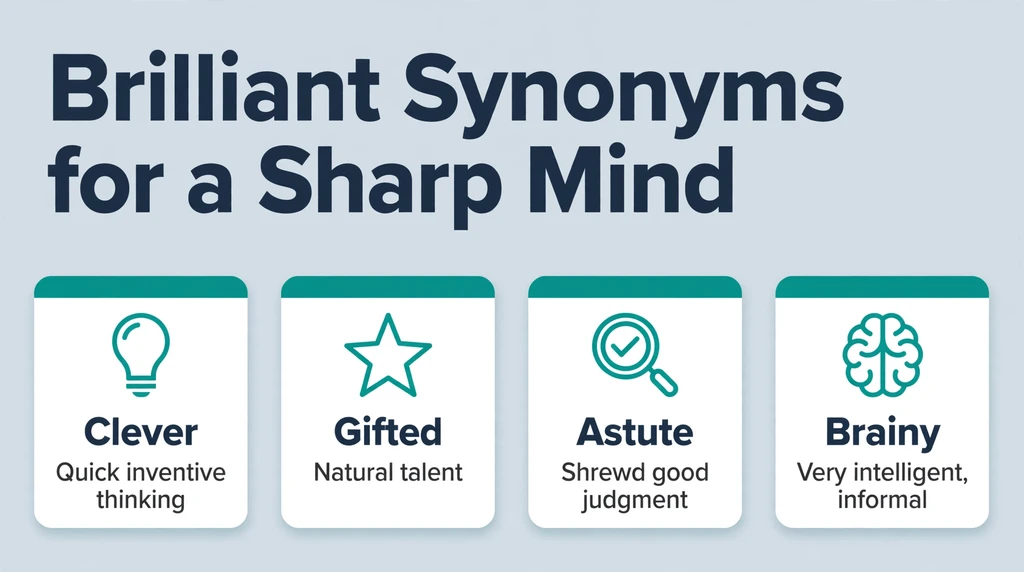
The second sense praises people, ideas, and work that show unusual intelligence. Cambridge groups clever, smart, bright, sharp, gifted, talented, intellectual, cerebral, brainy, and astute here. Collins adds alert, quick, and quick-witted for the same sense. Each word, however, praises a different kind of cleverness.
Quick and Clever Thinking
Clever is the everyday favorite. It praises quick, inventive thinking rather than deep learning. For example: “She found a clever way to fix the leak with one clip.”
Smart is the main American choice for the same ground. It sounds casual and warm. If you want the full landscape of this word family, our guide to synonyms for smart sorts it by sense as well.
Bright belongs here too, especially for children and students. Teachers call a quick pupil bright, never luminous. For example: “He is a bright boy who reads years above his age.”
Sharp praises speed and accuracy together. A sharp mind cuts straight to the point. Quick-witted narrows that speed to replies and reactions, which is why it suits debaters and comedians. Alert, by contrast, stresses noticing things fast, before anyone else in the room.
Talent and Deep Intelligence
Gifted describes natural talent that goes beyond training. Schools use it for exceptional children, and critics use it for musicians. For example: “The gifted pianist played her first concert at nine.”
Talented is the slightly milder cousin. It praises real ability without claiming genius. Expert shifts the praise from raw talent to mastery, which suits craftspeople, surgeons, and senior engineers.
Intellectual and cerebral praise the life of ideas. Cerebral is the more formal of the two, and Cambridge labels it formal. Both fit scholars and thinkers better than athletes. Brainy, meanwhile, keeps things light and informal, so it suits fiction and friendly speech.
Astute praises judgment rather than brainpower. An astute investor reads people and markets shrewdly. Ingenious and inventive praise the products of a mind: devices, plans, and solutions that nobody else imagined. Keen and acute describe piercing perception, as in an acute sense of smell or a keen eye for detail. Finally, precocious belongs to children who develop far ahead of their age, in speech, music, or learning.
Gifted, Talented, or Brilliant?
These three praise words overlap, yet they point at different things. Gifted points at the person and her natural endowment. Talented points at a developed skill in one field. Brilliant points at the shining quality of the work or the mind itself.
Consider a young violinist. Calling her gifted says the ability arrived early and naturally. Calling her talented says the ability is real and proven. Calling her performance brilliant says the playing itself sparkled on the night. Good writers pick the angle they actually mean, rather than stacking all three into one heavy compliment.
Synonyms for Brilliant That Mean Excellent
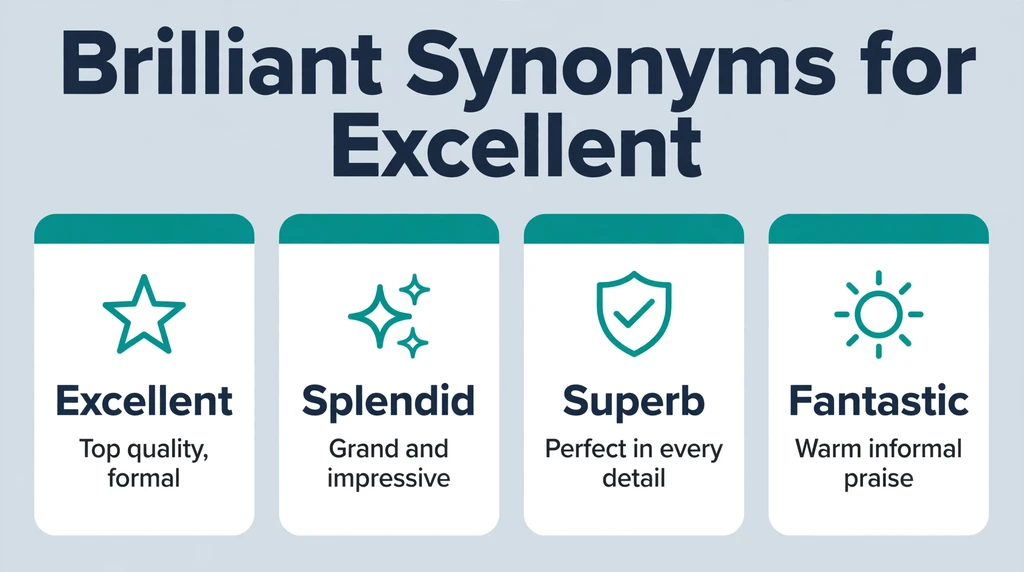
The third sense is pure praise: excellent, impressive, or first-rate. A brilliant performance, a brilliant book, and a brilliant idea all shine in this way. The words below run from formal to friendly, so match the register to your reader.
Formal and Impressive Praise
Excellent is the standard formal replacement. It fits reports, reviews, and references without fuss. For example: “The team delivered excellent results under real pressure.”
Splendid raises the ceremony a little. It sounds formal and slightly old-world, and Cambridge marks it formal. It suits grand events, fine buildings, and generous gestures.
Superb praises quality in every detail. Critics reach for it when nothing feels out of place. Magnificent adds size and grandeur, so it fits views, palaces, and heroic efforts. Glorious carries a note of triumph or beauty, as in a glorious victory or a glorious sunset. Sublime aims higher still, at beauty so fine it lifts the spirit, which is why it suits sacred music, mountain dawns, and perfect desserts.
Outstanding says one thing stands above the rest of its class. Exceptional stresses rarity: the case breaks the usual rule. Impressive, meanwhile, names the effect on the audience, so it works when you want praise without superlatives.
Warm and Everyday Praise
Wonderful adds delight and gratitude. It fits experiences and people more than objects. Terrific brings energy and enthusiasm, especially in speech. Tremendous can praise quality, yet it can also mean very large, so context must guide the reader.
Fabulous and fantastic both sound warm, modern, and informal. Fantastic shades toward delighted surprise, as in a fantastic offer. If praise is your whole topic, our roundup of synonyms for fantastic goes deeper into this cheerful family.
Amazing and awesome are the casual all-rounders of speech. Amazing stresses surprise at quality, while awesome now mostly means very good in everyday American talk. Both lose force in formal writing, so save them for dialogue and social posts.
First-class and top-notch praise tested quality. First-class sounds measured and British, and it suits service, travel, and workmanship. Top-notch is its informal partner, handy for teams, tools, and products. Great, finally, is the plain all-purpose praise word. It never fails, although it rarely excites either.
Brilliant Praise in Sentences
Examples show the register ladder at work. A formal report says: “The surgeon performed an outstanding operation under difficult conditions.” A newspaper review says: “It was a superb evening, with a magnificent final act.” A friend texting the same news says: “The gig was fantastic, honestly top-notch from start to finish.”
Notice how the meaning stays steady while the temperature changes. Reports cool the praise down so facts can carry it. Speech warms the praise up so feeling can carry it. Choosing your synonym is mostly choosing that temperature.
Synonyms for Brilliant in British Informal Speech
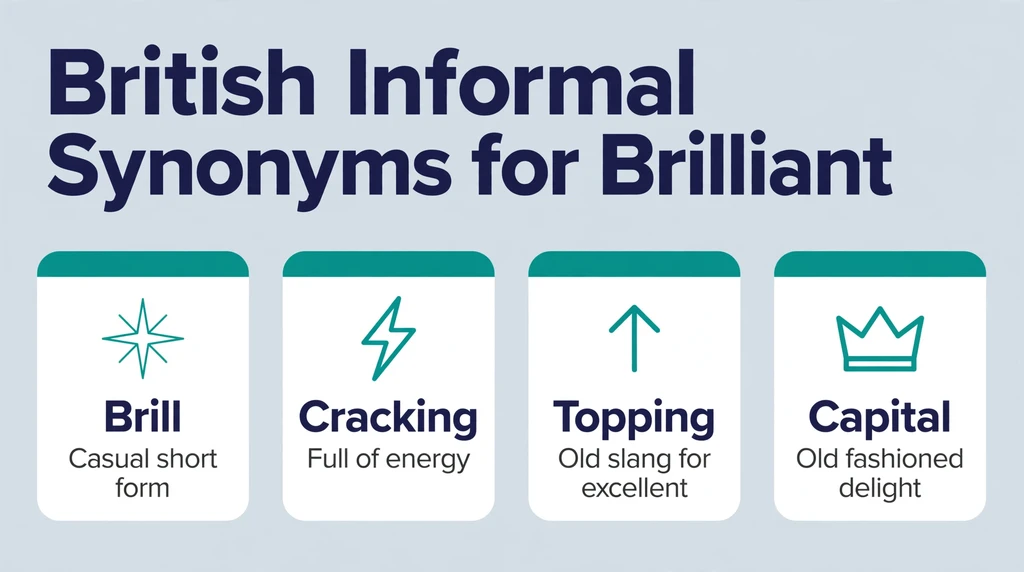
In Britain, brilliant is also a cheer of approval. Someone shares good news, and the reply comes back: “Brilliant!” The word works alone, like a small round of applause. American English rarely uses it this way, which is why British dialogue can confuse learners at first.
The shortening brill keeps the same cheer in a casual form. Friends text it, nod it, and drop it into plans. For example: “You booked the train? Brill, see you at six.”
Cracking is another British favorite, informal and full of energy. A cracking night, a cracking goal, and a cracking read all earn the same grin. Collins labels it British and informal, which matches how it feels in the wild.
British speakers also stretch brilliant across ordinary good news. A free parking space, a cleared diary, or a sunny forecast can all earn the word. The praise sounds bigger than the event, and that playful gap is exactly the point. Learners who copy the habit sound natural fast, as long as their smile does half the work.
Older British Praise Words
Older British praise words still appear in books and period dramas. Topping was slang for excellent, and capital served as a delighted exclamation. Grand did warm, general duty for anything lovely, from a grand time to a grand old house. A1 rates things at the top grade, like a ship or a hotel in perfect order. These words charm in historical fiction, yet they can puzzle modern readers, so gloss them lightly when you use them.
One warning matters here. The slang praise words wicked and sick flip a negative word into a compliment among younger speakers. Cambridge lists both as informal or slang praise. They work in dialogue, never in a report, a review, or a reference letter.
Synonyms for Brilliant That Describe Vivid Color
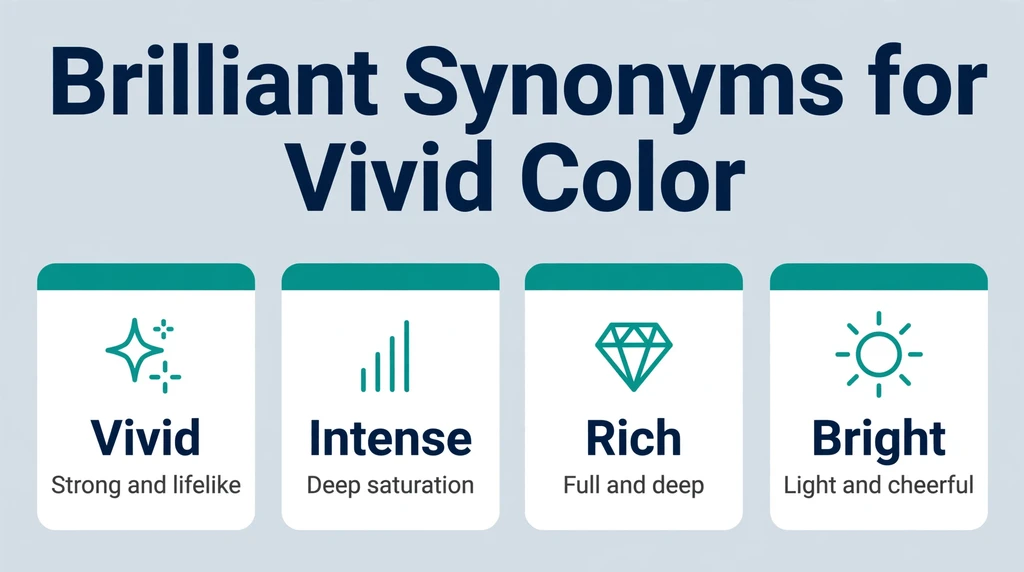
The fourth sense lives in art, nature writing, and fashion. Here brilliant means color at full strength: clear, deep, and impossible to ignore. WordNet defines this sense as having strong or striking color, and Oxford’s color group for brilliant lists vivid, intense, bright, blazing, and dazzling.
Vivid is the key word of this group. It means color so strong it seems alive. For example: “The parrot’s vivid feathers flashed green and gold.”
Intense stresses saturation and depth. An intense blue fills the eye completely. Rich describes color that feels deep and full, like velvet or autumn leaves. Painters and fabric sellers lean on it heavily.
Bright returns here in its color sense, lighter than vivid but still cheerful. A bright red dress glows without burning the eye. Blazing and dazzling push color toward glare, so they suit noon deserts, neon signs, and festival banners at full sun.
Choose inside this group by depth. Bright suggests lightness, vivid suggests life, intense suggests saturation, and rich suggests depth. A garden description can happily use all four across one paragraph, as long as each flower earns its own shade.
Watch the word order in this sense too. Brilliant usually sits directly before the color name: brilliant blue, brilliant green, brilliant orange. That tight pairing signals the color sense at once. By contrast, “a brilliant painter of blue skies” swings the word back toward talent, which shows how firmly position steers meaning in English.
Brilliant vs Bright: What Is the Difference?
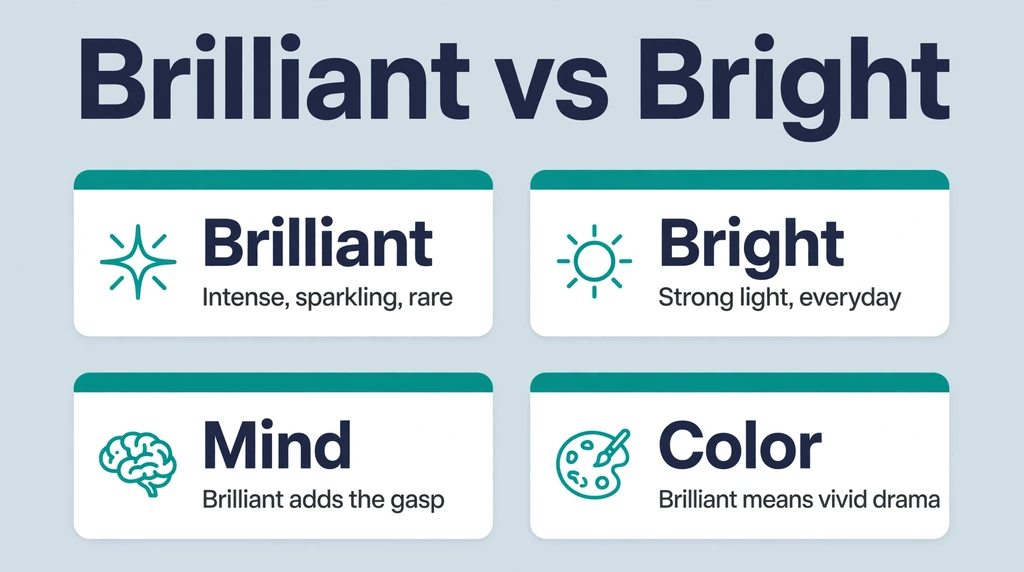
These two words overlap so much that learners often swap them freely. Merriam-Webster’s Synonym Chooser draws the line with care. Both words mean shining or glowing with light. Brilliant, though, implies intense, often sparkling brightness. Bright simply implies emitting or reflecting a high degree of light.
In practice, brilliant is bright turned up and dressed up. Sunlight on snow at noon feels brilliant. A well-lit office feels bright. Diamonds, chandeliers, and stage lights earn brilliant, while lamps, mornings, and computer screens usually settle for bright.
The same pattern holds for minds. A bright student learns fast and does well. A brilliant student does something rarer: she asks the question nobody else saw. Bright is praise, while brilliant is praise with a gasp inside it.
Color follows the same ladder. Bright colors are clear and cheerful. Brilliant colors are vivid to the point of drama. Compare “a bright scarf” with “a brilliant scarf” and feel the second one glow a little harder.
So when should you pick bright? Choose it for everyday clarity, screens, weather, and hopeful futures. Choose brilliant when the sentence needs intensity, sparkle, or wonder. Our companion guide to synonyms for bright maps that word’s own senses in full, including its cheerful and intelligent sides.
Three quick pairs make the gap concrete. “A bright idea” is a good, useful idea. “A brilliant idea” is the idea that solves the whole problem at once. “A bright room” is pleasantly light. “A brilliant room” sounds like a showroom or a palace hall, flooded and sparkling. “A bright student” pleases her teacher. “A brilliant student” may be heading for a scholarship and a headline.
How to Choose the Right Synonym for Brilliant
Start with the sense, not the sound. Ask what shines in your sentence: a light, a mind, a result, or a color. That single answer cuts the full list of sixty down to one small shelf. Then ask two smaller questions about strength and register.
For light, climb the ladder slowly. Ordinary glow takes bright or shining. Steady glow in darkness takes luminous. Reflected surface shine takes lustrous or gleaming. Blinding strength takes dazzling or blazing, and flashing points take sparkling. Each step up should be earned by the scene itself.
For minds, name the kind of cleverness. Fast replies take quick-witted. Invented solutions take ingenious. Shrewd judgment takes astute. Born talent takes gifted, while trained mastery takes expert. A sentence like “her brilliant negotiation” usually wants astute, because deals run on judgment, not raw brainpower.
For praise, match the occasion. A reference letter takes excellent or outstanding. A concert review takes superb or magnificent. A text to a friend takes fantastic, terrific, or brill. When the praise word feels too big for the moment, step down one rung rather than deleting it entirely.
For color, think in depth. Light and cheerful takes bright. Alive and clear takes vivid. Saturated takes intense. Deep and luxurious takes rich. Nature writing often mixes two of them in one scene, one for the sky and one for the field below.
A Worked Example
One example ties the method together. Take the plain sentence “It was a brilliant match.” If the match dazzled as entertainment, praise is the real sense, and superb keeps the tone measured. If one player’s mind decided the game, astute or inspired thinking is the real subject, so name the player and use astute. If floodlights lit the scene, dazzling belongs to the light, not the play. Sense first, every time.
Formal and Informal Synonyms for Brilliant
Register decides whether praise sounds polished or playful. The same concert can be superb in a newspaper and sick in a group chat. Neither word is wrong, yet each belongs to its own room.
In formal writing, reach for excellent, splendid, outstanding, exceptional, luminous, and cerebral. Academic and professional readers trust these words because they praise without shouting. They also age well, which matters in essays, reports, and published reviews.
Neutral ground belongs to bright, clever, intelligent, gifted, vivid, and impressive. These words travel safely between a school essay and a casual blog post. When you are unsure of your audience, this middle shelf is the wise choice.
Informal praise is warmer and louder. Fantastic, terrific, amazing, awesome, top-notch, and brainy fill everyday speech. British speakers add brill and cracking. Slang goes further still with wicked, cool, and sick, although those three date fast and divide readers by age.
Writers of fiction can use the whole ladder at once. Narration may call a mind ingenious, while the character herself says, “Brilliant, just brilliant.” The contrast between the two registers quietly shows class, age, and mood without a single line of explanation.
A final register test is simple. Read the sentence aloud and imagine it in a job interview. If it sounds like something a careful manager could say, it is formal or neutral. If it sounds like something a fan shouts after a goal, it is informal. Brilliant itself passes the interview test in Britain, yet its slang cousins very rarely do.
Antonyms for Brilliant
Opposites split along the same four senses, so choose by sense again.
For light, the natural opposites are dim, dull, dark, and gloomy. Cambridge names dim as the direct antonym for the light sense. A dim room, a dull morning, and a gloomy corridor all refuse to shine.
For minds, English prefers dull, slow, and untalented. These words describe a lack of spark rather than a lack of worth. Handle them with care in real life, since they sting far more than the light words do.
For praise, the opposites are terrible, awful, and plain bad. Cambridge pairs terrible against the pleasant sense of brilliant. For color, dull, faded, and pale do the work, draining the strength out of the shade.
Antonyms also make handy editing tools. If a paragraph calls everything brilliant, swap one claim for its opposite and see whether the sentence still feels true. Writers who test praise against dim, dull, and terrible usually discover which compliments their work has actually earned.
Words That Are Not True Synonyms for Brilliant
Some tempting words sit close to brilliant without earning a place in its groups. Knowing them protects your sentences from quiet mistakes.
Genius is a noun, not an adjective. You can call someone a genius, but “a genius student” breaks the pattern that “a brilliant student” follows. Genius also names the person, while brilliant can describe the person’s single idea, answer, or performance.
Wise appears in some thesaurus lists for the intelligent sense, including Cambridge’s. Still, it praises judgment earned through experience. A wise elder may move slowly and speak little, while a brilliant thinker sparkles with speed. The two virtues often travel together, yet they are not the same one.
Shiny describes surfaces that reflect light, like shoes and cars. It lacks the intensity and the figurative reach of brilliant. Nobody praises a shiny mathematician, however polished his shoes may be.
Famous and prominent belong to a neighboring idea. Merriam-Webster lists prominent for a separate sense of brilliant, meaning likely to attract attention. Attention, though, is not excellence, intelligence, or light, so this guide keeps those words outside the main groups.
Resplendent sounds perfect for shining glory, yet the major thesaurus entries for brilliant do not list it directly for this word. Careful writers treat it as a splendid word in its own right, not as a verified swap for brilliant.
Finally, watch the spelling. Brilliant takes two l’s and one r in the middle: bri-lli-ant. The common slip “brillant” drops a letter and, sadly, a little of the shine.
Synonyms for Brilliant in Example Sentences
Short examples fix each sense in the memory better than any definition. Read them in groups of four, one group per sense.
For light: “A brilliant shaft of sunlight cut across the harbor.” “The chandelier threw brilliant light over the ballroom.” In both, radiant or dazzling could step in without breaking the scene.
For minds: “Her brilliant thesis changed how the department taught history.” “He gave a brilliant answer to a question nobody else understood.” Here clever, astute, or ingenious fits the second sentence best, since the brilliance lives in one reply.
For praise: “They had a brilliant time in Lisbon.” “The chef produced a brilliant tasting menu.” Splendid suits the holiday in formal prose, while superb suits the menu in a review.
For color: “Brilliant autumn leaves covered the path.” “The bird’s brilliant plumage flashed as it turned.” Vivid and rich both fit the leaves, while intense fits a single saturated feather.
Try the swap test on your own drafts. Replace brilliant with the group word you chose, then read the sentence cold the next day. If the sentence still shines without strain, the swap worked. If it sounds like a costume, step one rung down the ladder and try again.
Frequently Asked Questions
What is the best synonym for brilliant?
It depends on the sense. Bright is the best all-round swap for light, clever works best for a quick mind, and excellent is the safest choice for praise. For color, vivid usually fits best.
What is a formal synonym for brilliant?
Excellent, splendid, and outstanding lead the formal shelf for praise. For light, luminous is formal and precise. For intelligence, intellectual and cerebral carry the most formal tone.
Is bright the same as brilliant?
Not quite. Merriam-Webster explains that bright means giving off a high degree of light, while brilliant adds intensity and sparkle. Brilliant is the stronger, rarer word in almost every sense.
What is the British meaning of brilliant?
In British informal speech, brilliant often works as a cheer of approval. It means excellent or wonderful, and it can stand alone as a reply: “Brilliant!” Brill is its casual short form.
What is a synonym for brilliant that means intelligent?
Gifted praises natural talent, sharp praises speed and accuracy, and ingenious praises inventive solutions. Brainy is the informal everyday option, while astute praises shrewd judgment in business or politics.
What is the opposite of brilliant?
For light, the opposite is dim or dull. For praise, it is terrible or bad. For intelligence, English uses dull, slow, or untalented, depending on how direct you want to be.
Can brilliant describe a color?
Yes. Brilliant often describes vivid, saturated color, as in brilliant green or brilliant blue. Vivid, intense, and rich are its closest color synonyms, while bright is the lighter option.
Is brilliant a positive word?
Yes, in all four main senses it praises something strongly. The only playful exception is sarcasm, where a drawn-out “Brilliant!” after a mistake means the exact opposite.
Final Thoughts
Brilliant earns its popularity honestly. Few words can praise a sunrise, a scientist, a holiday, and a paint color with equal warmth. The trick is remembering that each sense owns its own family of synonyms. Light takes dazzling, radiant, and luminous. Minds take clever, gifted, and astute. Praise takes excellent, splendid, and superb. Color takes vivid, intense, and rich.
Choose by sense first, then tune the strength and the register. Do that, and your replacement will shine as brightly as the original. For the full dictionary treatment of the word and its relatives, the Merriam-Webster Thesaurus entry for brilliant is the natural next stop.